Social Structure
 Social structure is a framework consisting of
social institutions (political, educational &
religion), social practices (roles & statuses) and
social groups(primary and secondary).
 It establishes a society and applies limits on
behavior.
 It refers as the way in which a society is
organized.
 It is a collection of people and relations in a
specific geographical area.
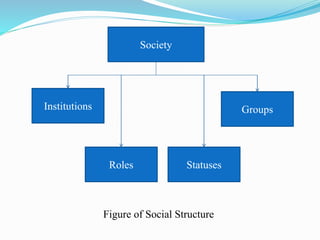
Society
Institutions
Statuses
Groups
Roles
Figure of Social Structure
Status
A status is a socially defined position in society characterized
by certain expectations, rights and duties.
Types of status
Ascribed Status given to individual generlly at birth and
from which they cannot escape; these statuses are fixed
Achieved Status
Positions that are achieved by individuals for themselves ;
these status can change
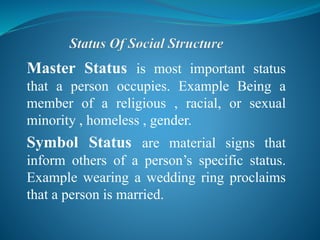
Master Status is most important status
that a person occupies. Example Being a
member of a religious , racial, or sexual
minority , homeless , gender.
Symbol Status are material signs that
inform others of a person’s specific status.
Example wearing a wedding ring proclaims
that a person is married.
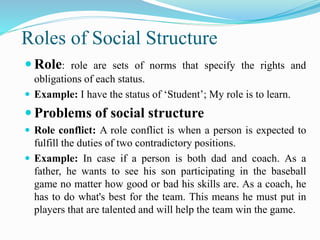
Roles of Social Structure
 Role: role are sets of norms that specify the rights and
obligations of each status.
 Example: I have the status of ‘Student’; My role is to learn.
 Problems of social structure
 Role conflict: A role conflict is when a person is expected to
fulfill the duties of two contradictory positions.
 Example: In case if a person is both dad and coach. As a
father, he wants to see his son participating in the baseball
game no matter how good or bad his skills are. As a coach, he
has to do what's best for the team. This means he must put in
players that are talented and will help the team win the game.
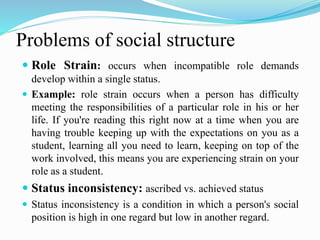
Problems of social structure
 Role Strain: occurs when incompatible role demands
develop within a single status.
 Example: role strain occurs when a person has difficulty
meeting the responsibilities of a particular role in his or her
life. If you're reading this right now at a time when you are
having trouble keeping up with the expectations on you as a
student, learning all you need to learn, keeping on top of the
work involved, this means you are experiencing strain on your
role as a student.
 Status inconsistency: ascribed vs. achieved status
 Status inconsistency is a condition in which a person's social
position is high in one regard but low in another regard.
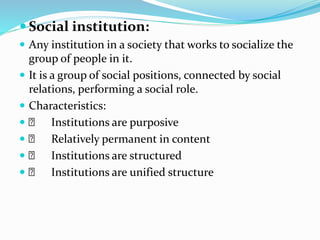
 Social institution:
 Any institution in a society that works to socialize the
group of people in it.
 It is a group of social positions, connected by social
relations, performing a social role.
 Characteristics:
 Institutions are purposive
 Relatively permanent in content
 Institutions are structured
 Institutions are unified structure
 Major social institutions:
 The family:
 It is the basic unit of society and the educational
system where the child begins to learn his ABC.
 It is the basic unit of socialization where the individual
develop their values, behavior, and way of life through
interaction with the members of the family.
 Government as a social institution:
 Is the institution which solves the conflicts that are
public in nature and involve more than one people.
 Educations:
 The form of learning in which the
knowledge, skills, and habits of a group of people are
transfer from one generation to the next through
teaching, training or research.
 Religions:
 Religion is a system of belief and rituals
that serves to bind people together through shared
worship, thereby creating a social group.

Social structure

  • 2.
    Social Structure  Socialstructure is a framework consisting of social institutions (political, educational & religion), social practices (roles & statuses) and social groups(primary and secondary).  It establishes a society and applies limits on behavior.  It refers as the way in which a society is organized.  It is a collection of people and relations in a specific geographical area.
  • 3.
  • 4.
    Status A status isa socially defined position in society characterized by certain expectations, rights and duties. Types of status Ascribed Status given to individual generlly at birth and from which they cannot escape; these statuses are fixed Achieved Status Positions that are achieved by individuals for themselves ; these status can change
  • 5.
    Master Status ismost important status that a person occupies. Example Being a member of a religious , racial, or sexual minority , homeless , gender. Symbol Status are material signs that inform others of a person’s specific status. Example wearing a wedding ring proclaims that a person is married.
  • 6.
    Roles of SocialStructure  Role: role are sets of norms that specify the rights and obligations of each status.  Example: I have the status of ‘Student’; My role is to learn.  Problems of social structure  Role conflict: A role conflict is when a person is expected to fulfill the duties of two contradictory positions.  Example: In case if a person is both dad and coach. As a father, he wants to see his son participating in the baseball game no matter how good or bad his skills are. As a coach, he has to do what's best for the team. This means he must put in players that are talented and will help the team win the game.
  • 7.
    Problems of socialstructure  Role Strain: occurs when incompatible role demands develop within a single status.  Example: role strain occurs when a person has difficulty meeting the responsibilities of a particular role in his or her life. If you're reading this right now at a time when you are having trouble keeping up with the expectations on you as a student, learning all you need to learn, keeping on top of the work involved, this means you are experiencing strain on your role as a student.  Status inconsistency: ascribed vs. achieved status  Status inconsistency is a condition in which a person's social position is high in one regard but low in another regard.
  • 8.
     Social institution: Any institution in a society that works to socialize the group of people in it.  It is a group of social positions, connected by social relations, performing a social role.  Characteristics:  Institutions are purposive  Relatively permanent in content  Institutions are structured  Institutions are unified structure
  • 9.
     Major socialinstitutions:  The family:  It is the basic unit of society and the educational system where the child begins to learn his ABC.  It is the basic unit of socialization where the individual develop their values, behavior, and way of life through interaction with the members of the family.  Government as a social institution:  Is the institution which solves the conflicts that are public in nature and involve more than one people.
  • 10.
     Educations:  Theform of learning in which the knowledge, skills, and habits of a group of people are transfer from one generation to the next through teaching, training or research.  Religions:  Religion is a system of belief and rituals that serves to bind people together through shared worship, thereby creating a social group.