Social Structure


                   1
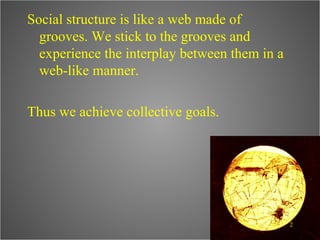
Social structure is like a web made of
  grooves. We stick to the grooves and
  experience the interplay between them in a
  web-like manner.

Thus we achieve collective goals.


                                               2
Statuses:

• Ascribed
• Achieved
• Master


                   3
Status refers to a person’s social ranking in
a society as determined by wealth,
influence, and prestige.


                        Hughes and Kroehler, 2005


                                                4
Master Status
This is the status that “carries primary weight
 in a person’s interactions and relationships
 with others.” (Hughes and Kroehler)

Master Status can be positive or negative as in
 the status of Doctor or felon.


                                                  5
Woes of the Master Status
The Master Status may be ascribed instead of
 achieved. I should recount the Master Status
 of a sociology professor in Canada named
 Brian Maclean.

It turns out that his master status is that of
   convict. Or is it?

A negative master status has the added weight
 of stigma as in the case of the Canadian
                                             6
 professor.
Roles
We all have roles.

Roles are culturally defined rights and duties.

I am performing a role right now. So are you.
   (At least I hope you are.)

                                                  7
Role Performance:


The actual behavior of the person
      who occupies a status.


                                    8
Role-Set
Robert K. Merton states it thusly:

“…each role status involves not a single
 associated role, but an array of roles. This
 basic feature of social structure can be
 registered by the distinctive but not
 formidable term, role-set.”
                      In: British Journal of Sociology,
                                       8: 106-20. 1957

                                                      9
Role Set:

                           Parent
Colleague


               Professor


Teacher                    Committee
                            Member
                                    10
Your Role Set

Let’s make one


                 11
Role Conflict
Results when individuals are confronted with
 conflicting expectations stemming from
 their simultaneous occupancy of two or
 more statuses.

Example: the coach with the son on the team


                                               12
13
Role Strain
Occurs when individuals find the expectations
 of a single role incompatible.

Example: Doctors as caring and as aggressive
 bill collectors.


                                            14
15
Groups
Aggregates
Categories
Institutions
  Society
               16
Groups and Their Processes


                             17
Groups are two or more people who share a
feeling of unity and who are bound together
in a relatively stable pattern of social
interaction.

                       Hughes and Kroehler, 2005


                                              18
Groups are based upon relationships.
 There are two fundamental types of
 relationships:

            Expressive ties
           Instrumental ties


                                       19
Types of Groups:
•   Primary Group
•   Secondary Group
•   In-group
•   Out-group
•   Reference Group


                              20
Primary groups (expressive) are
  important because they are
  instrumental to the socialization
  process (children).

They also serve as processes of social
 control. Think of an intimate group
 you have belonged to.


                                         21
In-Groups
In-groups are value oriented: They are those
  in which we belong and identify with. They
  can be morally at odds with society or
  merely be of a different nature (subculture).


                                                  22
Out-groups
Out-groups are essentially relative to the
 perceptions of its members. An example
 would be gangs versus the police. Which is
 in and which is out?


                                              23
In-group, out-group
In-groups may have feelings of indifference,
  disgust or even hostility towards outgroups.
(Consider the study by Muzafer Sherif of the
  boy’s camp.)


                                             24
Reference Groups
“Social units we use for appraising and
shaping attitudes, feelings, and actions.”
(Singer in Hughes and Kroehler)

Reference groups can be any number of
things including family, friends, and the
media.


                                             25
Reference groups are essential even if
 rarely thought about. They are a source
 of psychological identification.

What are your reference groups?


                                       26
“When our membership group does not
match our reference group, we may
experience feelings of relative deprivation
—discontent associated with the gap
between what we have… and what we
believe we should have.”

                        Hughes and Kroehler, 2005

                                               27
Groupthink:
Could it be that the “groupthink”
 phenomenon that affected the Bay
 of Pigs invasion has had some
 effect on the invasion of Iraq?


                                    28
Consider the architects of the
       Iraq Invasion


                                 29
Conformity
 Like groupthink, conformity can occur from
 peer pressure. Consider the studies done by
 Solomon Asch with the three lines.
 This shows how much pressure the group
 can have on the individual.

See Link:
  http://www.youtube.com/watch?v=iRh5qy09nNw

                                           30
Conformity


             31
Conformity


             32
Aggregates
A collection of anonymous individuals who
are in the same place at the same time.

They have no connection other than space
and time.


                                           33
Situational Behavior
How certain are we of our ability to maintain
 our own moral structure when challenged
 by authority?


                                                34
Situational Behavior


                       35
Category
“A collection of people who share a
characteristic that is deemed to be of social
significance.”


                    (Hughes and Kroehler 2007)

                                                36
Institutions
Institutions make up the principal structure
that organizes, directs and executes the
essential tasks of living.

We are in an institution right now.


                                               37
Society
Society is the most complex and
comprehensive type of social structure in
today’s world.

Most of today’s societies are in the form of
“nation states.” These are ‘political entities
centering on a government.’
                         Hughes and Kroehler, 2005
                                                 38
Leadership

Authoritarian style
Democratic style
Laissez-faire style


                         39
Authoritarian


                40
Democratic


             41
Laissez-faire


                42
Formal Organizations


                       43
• A group with specific goals
• Large “secondary” groups
• Varied in size, goal orientation, and
  efficiency but are structured to facilitate the
  management of large scale operations
• Ubiquitous


                                                44
Types of Formal Organizations:
• Voluntary
• Coercive
• Total institutions
     (resocialization; mortification)
• Utilitarian organizations (labor;
  government; schools)

                                        45
Voluntary


            46
Coercive


           47
Total Institution


                    48
Total Institution
     Involves

• Resocialization
• Mortification

                    (Think Erving Goffman)

                                         49
Utilitarian


              50
Informal Organizations
• Consist of interpersonal networks and ties
  that [may] arise in a formal organization but
  are not defined or prescribed by it.
                         (Hughes and Kroehler)
• Think of how we work and organize
  ourselves while management is organized
  for one purpose, we may have a different
  set of purposes. What De Certeau calls
  perruque.
                                             51
Bureaucracy


              52
Max Weber 1864-1920


                      53
“Ideal” Type
• A perfect definition and example of
  something that is not perfect in reality.
• It is the “ideal” of what something is – it is
  something that is perfect in structure yet
  does not (cannot) exist in reality.


                                                   54
Weber’s “Ideal Type” of
            Bureaucracy
•   Division of labor
•   Hierarchy
•   Written rules and regulations
•   Impersonal (offices not for personal ends)
•   Offices are based upon actual competence
•   Promotion based upon seniority or merit

                                                 55
What does old Max mean by an
“Ideal Type” in this instance?


                             56
In this case bureaucracy is an
 idealized model. It is not meant
to necessarily exist in reality, but
   is an aggregate of the ideal
 functions of what a bureaucracy
            should be.

                                   57
What’s wrong with
 bureaucracies?


                    58
Dysfunctions of bureaucracy:
•   Routinization
•   Trained Incapacity
•   Depersonalization
•   Vested Interests (Oligarchy)
•   Excessive Growth (Parkinson’s Law)


                                         59
Robert Michels
The iron law of oligarchy


                            60
He stated that all power tends to concentrate
into the hands of a few.

He listed three reasons for oligarchical
tendencies found in formal organizations:


                                            61
1 Hierarchical leadership structures – most
  voting by members becomes a ritualistic
  conformation.
2 Officials have special advantages: access
  to information unavailable to others,
  control of administrative resources …
3 Ordinary members tend to be uninterested
  in assuming leadership responsibilities and
  may be apathetic to the problems of the
  organization.

                    (Hughes and Kroehler, 2007)   62
Organizations (bureaucracies)
can be viewed from either the
   functionalist, conflict or
 interactionist perspectives.

                                63
Functionalism:
• Bureaucracies and organizations are benign.
• They are essential for the functioning of
  society.
• They are the most practical method of
  distributing resources and providing
  employment.


                                            64
65
Conflict Perspective
• Such organizations are instruments of
  capitalism
• As such they promote a hierarchical class
  system in which some are favored while
  others (most) are taken advantage of.
• They are based upon a top-down structure
  of rigid domination that prevents
  democracy in the workplace.
                                              66
67
Interactionist Perspective
• While some the elements of Conflict may
  be true, people have agency. They can
  negotiate their destinies.
• This provides for a “negotiated order” of
  “fluid, ongoing understandings and
  agreements people reach as the go about
  their daily activities”
                     (Hughes and Kroehler 2007)
                                              68
69

Social structure

  • 1.
  • 2.
    Social structure islike a web made of grooves. We stick to the grooves and experience the interplay between them in a web-like manner. Thus we achieve collective goals. 2
  • 3.
  • 4.
    Status refers toa person’s social ranking in a society as determined by wealth, influence, and prestige. Hughes and Kroehler, 2005 4
  • 5.
    Master Status This isthe status that “carries primary weight in a person’s interactions and relationships with others.” (Hughes and Kroehler) Master Status can be positive or negative as in the status of Doctor or felon. 5
  • 6.
    Woes of theMaster Status The Master Status may be ascribed instead of achieved. I should recount the Master Status of a sociology professor in Canada named Brian Maclean. It turns out that his master status is that of convict. Or is it? A negative master status has the added weight of stigma as in the case of the Canadian 6 professor.
  • 7.
    Roles We all haveroles. Roles are culturally defined rights and duties. I am performing a role right now. So are you. (At least I hope you are.) 7
  • 8.
    Role Performance: The actualbehavior of the person who occupies a status. 8
  • 9.
    Role-Set Robert K. Mertonstates it thusly: “…each role status involves not a single associated role, but an array of roles. This basic feature of social structure can be registered by the distinctive but not formidable term, role-set.” In: British Journal of Sociology, 8: 106-20. 1957 9
  • 10.
    Role Set: Parent Colleague Professor Teacher Committee Member 10
  • 11.
  • 12.
    Role Conflict Results whenindividuals are confronted with conflicting expectations stemming from their simultaneous occupancy of two or more statuses. Example: the coach with the son on the team 12
  • 13.
  • 14.
    Role Strain Occurs whenindividuals find the expectations of a single role incompatible. Example: Doctors as caring and as aggressive bill collectors. 14
  • 15.
  • 16.
  • 17.
    Groups and TheirProcesses 17
  • 18.
    Groups are twoor more people who share a feeling of unity and who are bound together in a relatively stable pattern of social interaction. Hughes and Kroehler, 2005 18
  • 19.
    Groups are basedupon relationships. There are two fundamental types of relationships: Expressive ties Instrumental ties 19
  • 20.
    Types of Groups: • Primary Group • Secondary Group • In-group • Out-group • Reference Group 20
  • 21.
    Primary groups (expressive)are important because they are instrumental to the socialization process (children). They also serve as processes of social control. Think of an intimate group you have belonged to. 21
  • 22.
    In-Groups In-groups are valueoriented: They are those in which we belong and identify with. They can be morally at odds with society or merely be of a different nature (subculture). 22
  • 23.
    Out-groups Out-groups are essentiallyrelative to the perceptions of its members. An example would be gangs versus the police. Which is in and which is out? 23
  • 24.
    In-group, out-group In-groups mayhave feelings of indifference, disgust or even hostility towards outgroups. (Consider the study by Muzafer Sherif of the boy’s camp.) 24
  • 25.
    Reference Groups “Social unitswe use for appraising and shaping attitudes, feelings, and actions.” (Singer in Hughes and Kroehler) Reference groups can be any number of things including family, friends, and the media. 25
  • 26.
    Reference groups areessential even if rarely thought about. They are a source of psychological identification. What are your reference groups? 26
  • 27.
    “When our membershipgroup does not match our reference group, we may experience feelings of relative deprivation —discontent associated with the gap between what we have… and what we believe we should have.” Hughes and Kroehler, 2005 27
  • 28.
    Groupthink: Could it bethat the “groupthink” phenomenon that affected the Bay of Pigs invasion has had some effect on the invasion of Iraq? 28
  • 29.
    Consider the architectsof the Iraq Invasion 29
  • 30.
    Conformity Like groupthink,conformity can occur from peer pressure. Consider the studies done by Solomon Asch with the three lines. This shows how much pressure the group can have on the individual. See Link: http://www.youtube.com/watch?v=iRh5qy09nNw 30
  • 31.
  • 32.
  • 33.
    Aggregates A collection ofanonymous individuals who are in the same place at the same time. They have no connection other than space and time. 33
  • 34.
    Situational Behavior How certainare we of our ability to maintain our own moral structure when challenged by authority? 34
  • 35.
  • 36.
    Category “A collection ofpeople who share a characteristic that is deemed to be of social significance.” (Hughes and Kroehler 2007) 36
  • 37.
    Institutions Institutions make upthe principal structure that organizes, directs and executes the essential tasks of living. We are in an institution right now. 37
  • 38.
    Society Society is themost complex and comprehensive type of social structure in today’s world. Most of today’s societies are in the form of “nation states.” These are ‘political entities centering on a government.’ Hughes and Kroehler, 2005 38
  • 39.
  • 40.
  • 41.
  • 42.
  • 43.
  • 44.
    • A groupwith specific goals • Large “secondary” groups • Varied in size, goal orientation, and efficiency but are structured to facilitate the management of large scale operations • Ubiquitous 44
  • 45.
    Types of FormalOrganizations: • Voluntary • Coercive • Total institutions (resocialization; mortification) • Utilitarian organizations (labor; government; schools) 45
  • 46.
  • 47.
  • 48.
  • 49.
    Total Institution Involves • Resocialization • Mortification (Think Erving Goffman) 49
  • 50.
  • 51.
    Informal Organizations • Consistof interpersonal networks and ties that [may] arise in a formal organization but are not defined or prescribed by it. (Hughes and Kroehler) • Think of how we work and organize ourselves while management is organized for one purpose, we may have a different set of purposes. What De Certeau calls perruque. 51
  • 52.
  • 53.
  • 54.
    “Ideal” Type • Aperfect definition and example of something that is not perfect in reality. • It is the “ideal” of what something is – it is something that is perfect in structure yet does not (cannot) exist in reality. 54
  • 55.
    Weber’s “Ideal Type”of Bureaucracy • Division of labor • Hierarchy • Written rules and regulations • Impersonal (offices not for personal ends) • Offices are based upon actual competence • Promotion based upon seniority or merit 55
  • 56.
    What does oldMax mean by an “Ideal Type” in this instance? 56
  • 57.
    In this casebureaucracy is an idealized model. It is not meant to necessarily exist in reality, but is an aggregate of the ideal functions of what a bureaucracy should be. 57
  • 58.
    What’s wrong with bureaucracies? 58
  • 59.
    Dysfunctions of bureaucracy: • Routinization • Trained Incapacity • Depersonalization • Vested Interests (Oligarchy) • Excessive Growth (Parkinson’s Law) 59
  • 60.
    Robert Michels The ironlaw of oligarchy 60
  • 61.
    He stated thatall power tends to concentrate into the hands of a few. He listed three reasons for oligarchical tendencies found in formal organizations: 61
  • 62.
    1 Hierarchical leadershipstructures – most voting by members becomes a ritualistic conformation. 2 Officials have special advantages: access to information unavailable to others, control of administrative resources … 3 Ordinary members tend to be uninterested in assuming leadership responsibilities and may be apathetic to the problems of the organization. (Hughes and Kroehler, 2007) 62
  • 63.
    Organizations (bureaucracies) can beviewed from either the functionalist, conflict or interactionist perspectives. 63
  • 64.
    Functionalism: • Bureaucracies andorganizations are benign. • They are essential for the functioning of society. • They are the most practical method of distributing resources and providing employment. 64
  • 65.
  • 66.
    Conflict Perspective • Suchorganizations are instruments of capitalism • As such they promote a hierarchical class system in which some are favored while others (most) are taken advantage of. • They are based upon a top-down structure of rigid domination that prevents democracy in the workplace. 66
  • 67.
  • 68.
    Interactionist Perspective • Whilesome the elements of Conflict may be true, people have agency. They can negotiate their destinies. • This provides for a “negotiated order” of “fluid, ongoing understandings and agreements people reach as the go about their daily activities” (Hughes and Kroehler 2007) 68
  • 69.