MODULE

SCORING SLEEP
SCORING SLEEP

Scoring a sleep study is divided into 4 parts:

3)   Scoring sleep stages
4)   Scoring respiratory events
5)   Scoring arousals
6)   Scoring periodic limb movements
LESSON 1: SLEEP STAGE SCORING

OBJECTIVES:
At the end of this lesson the student must be able
to:
• Measure frequency and amplitude of waveforms
• Differentiate sleep/ wake stages according to patient-
    specific factor
• Apply standard criteria for scoring sleep stages
LESSON 1: SLEEP STAGE SCORING

Before you assign a stage on each epoch you need to
classify the waveforms

Alpha waves are EEG waveform activity in the 8 – 13
cycle per second (cps) or 8 – 13 Hz range.
Theta waves are EEG waveform activity in the 4 - 7 cps
(4 -7 Hz) range.
Sleep Spindles are EEG waveform activity in the 13 – 16
cps (13 – 16 Hz) range.
Delta waves are EEG waveform activity 0.5 – 3 cps
(0.5 – 3 Hz) range.
LESSON 1: SLEEP STAGE SCORING
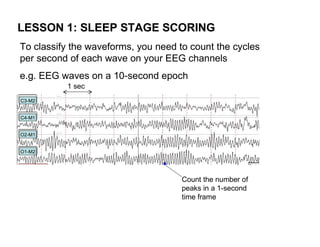
To classify the waveforms, you need to count the cycles
per second of each wave on your EEG channels
e.g. EEG waves on a 10-second epoch
          1 sec
C3-M2


C4-M1


O2-M1


O1-M2


                                     Count the number of
                                     peaks in a 1-second
                                     time frame
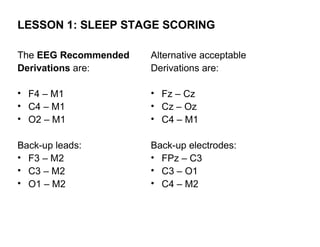
LESSON 1: SLEEP STAGE SCORING

The EEG Recommended   Alternative acceptable
Derivations are:      Derivations are:

• F4 – M1             • Fz – Cz
• C4 – M1             • Cz – Oz
• O2 – M1             • C4 – M1

Back-up leads:        Back-up electrodes:
• F3 – M2             • FPz – C3
• C3 – M2             • C3 – O1
• O1 – M2             • C4 – M2
LESSON 1: SLEEP STAGE SCORING

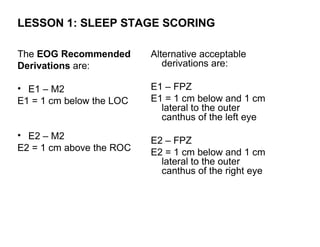
The EOG Recommended       Alternative acceptable
Derivations are:             derivations are:

• E1 – M2                 E1 – FPZ
E1 = 1 cm below the LOC   E1 = 1 cm below and 1 cm
                            lateral to the outer
                            canthus of the left eye
• E2 – M2
                          E2 – FPZ
E2 = 1 cm above the ROC   E2 = 1 cm below and 1 cm
                            lateral to the outer
                            canthus of the right eye
LESSON 1: SLEEP STAGE SCORING

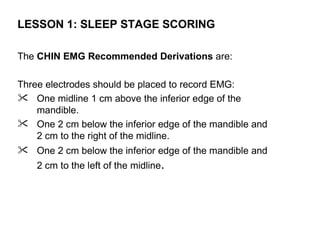
The CHIN EMG Recommended Derivations are:

Three electrodes should be placed to record EMG:
 One midline 1 cm above the inferior edge of the
    mandible.
 One 2 cm below the inferior edge of the mandible and
    2 cm to the right of the midline.
 One 2 cm below the inferior edge of the mandible and
    2 cm to the left of the midline.
LESSON 1: SLEEP STAGE SCORING

Important Things to Know

• Read between the lines
• EEG takes precedence over EOG & EMG
• Pattern Recognition
• Sleep architecture
• Score sleep stages in 30 second sequential epochs
  (from Lights Out to Lights On)
• Assign a stage to each epoch
• If 2 or more stages coexist during a single epoch, assign
  the stage comprising the greatest portion of the epoch
  (majority rules).
LESSON 1: SLEEP STAGE SCORING

Scoring of Sleep Stages

•   Stage W (Wakefulness)
•   Stage N1 (NREM 1)
•   Stage N2 (NREM 2)
•   Stage N3 (NREM 3)
•   Stage R (REM)
LESSON 1: SLEEP STAGE SCORING

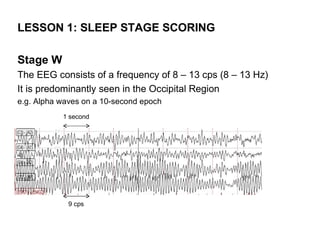
Stage W
The EEG consists of a frequency of 8 – 13 cps (8 – 13 Hz)
It is predominantly seen in the Occipital Region
e.g. Alpha waves on a 10-second epoch
           1 second


             9 cps
LESSON 1: SLEEP STAGE SCORING

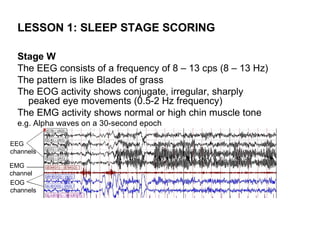
  Stage W
  The EEG consists of a frequency of 8 – 13 cps (8 – 13 Hz)
  The pattern is like Blades of grass
  The EOG activity shows conjugate, irregular, sharply
    peaked eye movements (0.5-2 Hz frequency)
  The EMG activity shows normal or high chin muscle tone
  e.g. Alpha waves on a 30-second epoch

EEG
channels

EMG
channel
EOG
channels
LESSON 1: SLEEP STAGE SCORING

Definition of Sleep Onset

It is the start of the first epoch scored as any stage other
than Stage W.
(In most subjects, this will usually be the first epoch of
Stage N1).
It is the first epoch of sleep (no matter what stage) from
Lights out.
LESSON 1: SLEEP STAGE SCORING

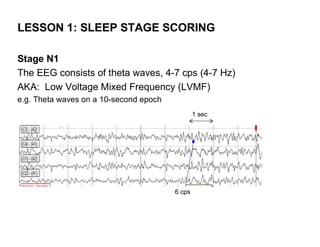
Stage N1
The EEG consists of theta waves, 4-7 cps (4-7 Hz)
AKA: Low Voltage Mixed Frequency (LVMF)
e.g. Theta waves on a 10-second epoch
                                                1 sec


                                        6 cps
LESSON 1: SLEEP STAGE SCORING

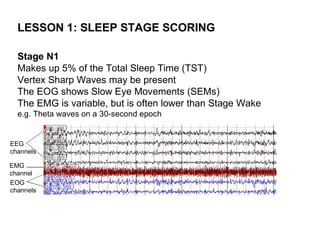
  Stage N1
  Makes up 5% of the Total Sleep Time (TST)
  Vertex Sharp Waves may be present
  The EOG shows Slow Eye Movements (SEMs)
  The EMG is variable, but is often lower than Stage Wake
  e.g. Theta waves on a 30-second epoch


EEG
channels

EMG
channel
EOG
channels
LESSON 1: SLEEP STAGE SCORING

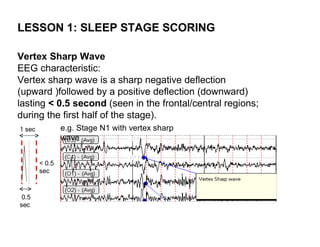
Vertex Sharp Wave
EEG characteristic:
Vertex sharp wave is a sharp negative deflection
(upward )followed by a positive deflection (downward)
lasting < 0.5 second (seen in the frontal/central regions;
during the first half of the stage).
1 sec           e.g. Stage N1 with vertex sharp
                wave


        < 0.5
        sec


 0.5
sec
LESSON 1: SLEEP STAGE SCORING

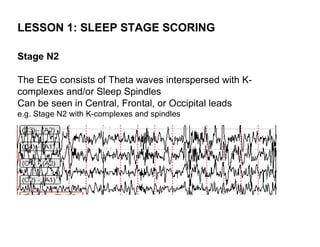
Stage N2

The EEG consists of Theta waves interspersed with K-
complexes and/or Sleep Spindles
Can be seen in Central, Frontal, or Occipital leads
e.g. Stage N2 with K-complexes and spindles
LESSON 1: SLEEP STAGE SCORING

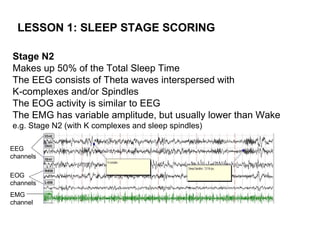
Stage N2
Makes up 50% of the Total Sleep Time
The EEG consists of Theta waves interspersed with
K-complexes and/or Spindles
The EOG activity is similar to EEG
The EMG has variable amplitude, but usually lower than Wake
e.g. Stage N2 (with K complexes and sleep spindles)

EEG
channels

EOG
channels
EMG
channel
LESSON 1: SLEEP STAGE SCORING


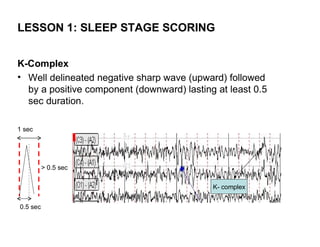
K-Complex
• Well delineated negative sharp wave (upward) followed
  by a positive component (downward) lasting at least 0.5
  sec duration.

1 sec


          > 0.5 sec

                                            K- complex


0.5 sec
LESSON 1: SLEEP STAGE SCORING

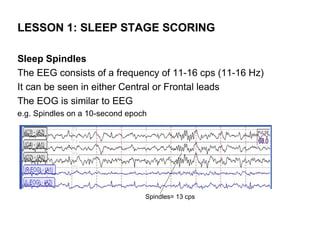
Sleep Spindles
The EEG consists of a frequency of 11-16 cps (11-16 Hz)
It can be seen in either Central or Frontal leads
The EOG is similar to EEG
e.g. Spindles on a 10-second epoch


                                 Spindles= 13 cps
LESSON 1: SLEEP STAGE SCORING

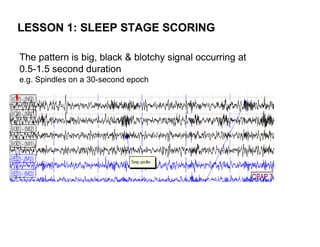
The pattern is big, black & blotchy signal occurring at
0.5-1.5 second duration
e.g. Spindles on a 30-second epoch
LESSON 1: SLEEP STAGE SCORING

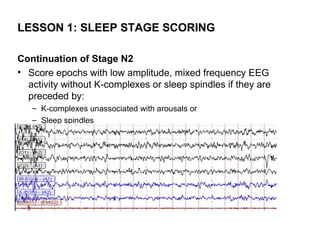
Continuation of Stage N2
• Score epochs with low amplitude, mixed frequency EEG
  activity without K-complexes or sleep spindles if they are
  preceded by:
   – K-complexes unassociated with arousals or
   – Sleep spindles
LESSON 1: SLEEP STAGE SCORING

Termination of Stage N2

a) Transition to Stage W
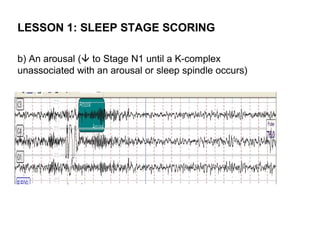
b) An arousal ( to Stage N1 until a K-complex
   unassociated with an arousal or sleep spindle occurs)
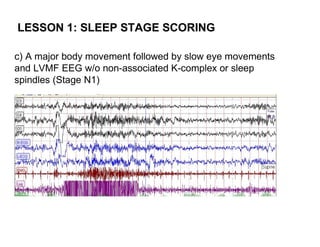
c) A major body movement followed by slow eye
   movements and LVMF EEG w/o non-associated K-
   complex or sleep spindles (Stage N1)
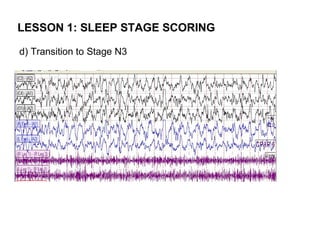
d) Transition to Stage N3
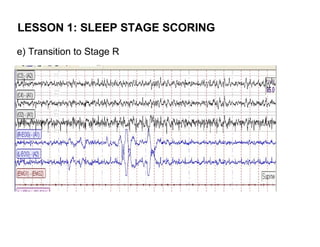
e) Transition to Stage R
LESSON 1: SLEEP STAGE SCORING

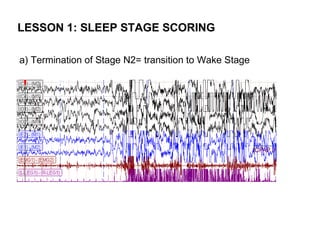
a) Termination of Stage N2= transition to Wake Stage
LESSON 1: SLEEP STAGE SCORING

b) An arousal ( to Stage N1 until a K-complex
unassociated with an arousal or sleep spindle occurs)
LESSON 1: SLEEP STAGE SCORING

c) A major body movement followed by slow eye movements
and LVMF EEG w/o non-associated K-complex or sleep
spindles (Stage N1)
LESSON 1: SLEEP STAGE SCORING

d) Transition to Stage N3
LESSON 1: SLEEP STAGE SCORING

e) Transition to Stage R
LESSON 1: SLEEP STAGE SCORING

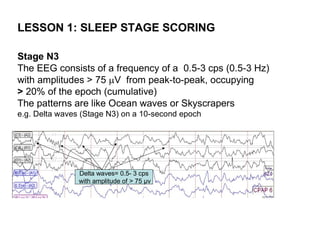
Stage N3
The EEG consists of a frequency of a 0.5-3 cps (0.5-3 Hz)
with amplitudes > 75 V from peak-to-peak, occupying
> 20% of the epoch (cumulative)
The patterns are like Ocean waves or Skyscrapers
e.g. Delta waves (Stage N3) on a 10-second epoch


                Delta waves= 0.5- 3 cps
                with amplitude of > 75 µv
LESSON 1: SLEEP STAGE SCORING

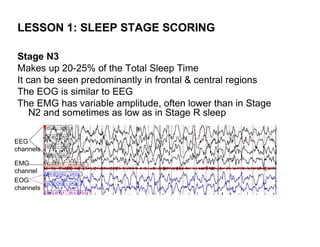
Stage N3
Makes up 20-25% of the Total Sleep Time
It can be seen predominantly in frontal & central regions
The EOG is similar to EEG
The EMG has variable amplitude, often lower than in Stage
    N2 and sometimes as low as in Stage R sleep

EEG
channels

EMG
channel
EOG
channels
LESSON 1: SLEEP STAGE SCORING

Stage R

Makes up 20 – 25% Total Sleep Time
The EEG consists of LVMF Theta waves, 4-7 cps (4-7 Hz).
Alpha waves may be present but will be 1-2 cps slower
than Wake Alpha.
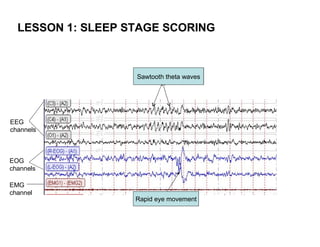
Distinct feature is the presence of Sawtooth Waves which
are sharply contoured or triangular waves , often serrated,
2-6 Hz, preceding a burst of rapid eye movements (REMs).
The EOG shows presence of Rapid Eye Movements
The EMG is significantly reduced compared to NREM
   sleep.
LESSON 1: SLEEP STAGE SCORING


                   Sawtooth theta waves


EEG
channels


EOG
channels

EMG
channel
                   Rapid eye movement
LESSON 1: SLEEP STAGE SCORING

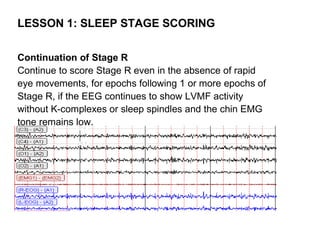
Continuation of Stage R
Continue to score Stage R even in the absence of rapid
eye movements, for epochs following 1 or more epochs of
Stage R, if the EEG continues to show LVMF activity
without K-complexes or sleep spindles and the chin EMG
tone remains low.
LESSON 1: SLEEP STAGE SCORING

End of Stage R

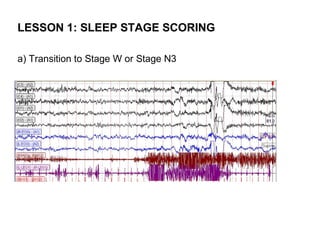
Stage R is ceased when 1 or more of the following occur:
a) Transition to Stage W or Stage N3
b) An arousal occurs followed by LVMF EEG and SEMs (if
   chin is up [Stage N1]; if chin is low w/no SEMs then
   score as Stage R)
c) A major body movement followed by SEM and LVMF
   EEG w/o non-arousal associated K-complexes or sleep
   spindles [Stage N1]
LESSON 1: SLEEP STAGE SCORING
End of Stage R (continued)

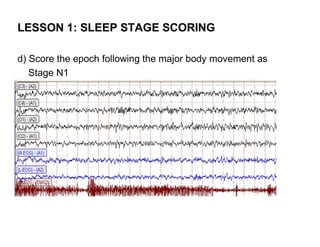
d) Score the epoch following the major body movement as
   Stage N1
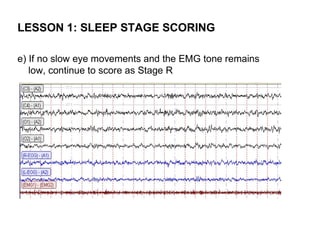
e) If no slow eye movements and the EMG tone remains
   low, continue to score as Stage R
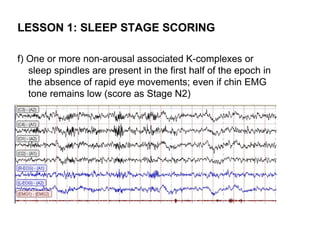
f) One or more non-arousal associated K-complexes or
   sleep spindles are present in the first half of the epoch in
   the absence of rapid eye movements; even if chin EMG
   tone remains low (score as Stage N2)
LESSON 1: SLEEP STAGE SCORING

a) Transition to Stage W or Stage N3
LESSON 1: SLEEP STAGE SCORING

b) An arousal occurs followed by LVMF EEG and SEMs (if
   chin is up [Stage N1]; if chin is low w/no SEMs then
   score as Stage R)
LESSON 1: SLEEP STAGE SCORING

c) A major body movement followed by SEM and LVMF
   EEG w/o non-arousal associated K-complexes or sleep
   spindles [Stage N1]


         Body movement
LESSON 1: SLEEP STAGE SCORING

d) Score the epoch following the major body movement as
   Stage N1
LESSON 1: SLEEP STAGE SCORING

e) If no slow eye movements and the EMG tone remains
   low, continue to score as Stage R
LESSON 1: SLEEP STAGE SCORING

f) One or more non-arousal associated K-complexes or
   sleep spindles are present in the first half of the epoch in
   the absence of rapid eye movements; even if chin EMG
   tone remains low (score as Stage N2)
LESSON 1: SLEEP STAGE SCORING
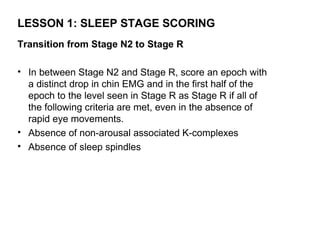
Transition from Stage N2 to Stage R

• In between Stage N2 and Stage R, score an epoch with
  a distinct drop in chin EMG and in the first half of the
  epoch to the level seen in Stage R as Stage R if all of
  the following criteria are met, even in the absence of
  rapid eye movements.
• Absence of non-arousal associated K-complexes
• Absence of sleep spindles
LESSON 1: SLEEP STAGE SCORING

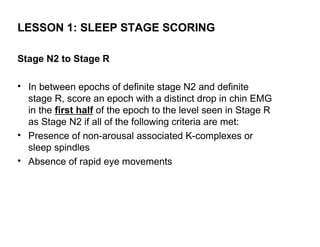
Stage N2 to Stage R

• In between epochs of definite stage N2 and definite
  stage R, score an epoch with a distinct drop in chin EMG
  in the first half of the epoch to the level seen in Stage R
  as Stage N2 if all of the following criteria are met:
• Presence of non-arousal associated K-complexes or
  sleep spindles
• Absence of rapid eye movements
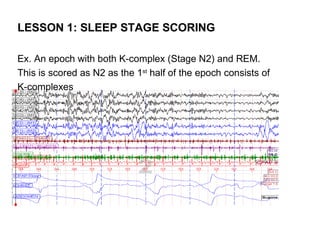
LESSON 1: SLEEP STAGE SCORING

Ex. An epoch with both K-complex (Stage N2) and REM.
This is scored as N2 as the 1st half of the epoch consists of
K-complexes
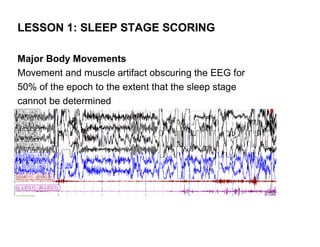
LESSON 1: SLEEP STAGE SCORING

Major Body Movements
Movement and muscle artifact obscuring the EEG for
50% of the epoch to the extent that the sleep stage
cannot be determined
LESSON 1: SLEEP STAGE SCORING

Score an epoch with a major body movement as
  follows:

a) If alpha rhythm is present for part of the epoch (even <15
   seconds duration), score as Stage W.
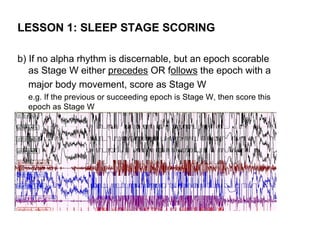
b) If no alpha rhythm is discernable, but an epoch scorable
   as Stage W either precedes OR follows the epoch with a
   major body movement, score as Stage W.
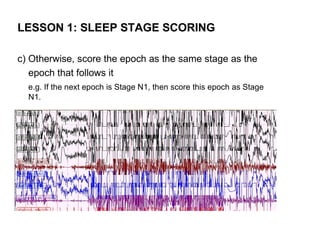
c) Otherwise, score the epoch as the same stage as the
   epoch that follows it.
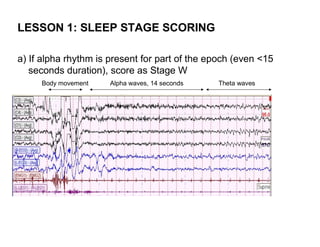
LESSON 1: SLEEP STAGE SCORING

a) If alpha rhythm is present for part of the epoch (even <15
   seconds duration), score as Stage W
     Body movement    Alpha waves, 14 seconds   Theta waves
LESSON 1: SLEEP STAGE SCORING

b) If no alpha rhythm is discernable, but an epoch scorable
   as Stage W either precedes OR follows the epoch with a
   major body movement, score as Stage W
  e.g. If the previous or succeeding epoch is Stage W, then score this
  epoch as Stage W
LESSON 1: SLEEP STAGE SCORING

c) Otherwise, score the epoch as the same stage as the
   epoch that follows it
  e.g. If the next epoch is Stage N1, then score this epoch as Stage
  N1.
LESSON 1: SLEEP STAGE SCORING


                  Reference
• AASM Manual for Scoring Sleep, 2007
LESSON 2: RESPIRATORY EVENTS SCORING

    OBJECTIVES:
    At the end of this lesson the student must be able to:
•   Categorize abnormal respiratory events according to the
    definitions and sub-classifications of apnea, hypopnea,
    hypoventilation, periodic breathing, Cheyne – Stokes
    respiration and UARS
•   Subdivide respiratory events into correct category
•   Discriminate clinically significant events
•   Measure respiratory events
•   Measure oxygen desaturations
LESSON 2: RESPIRATORY EVENTS SCORING

Event Duration Rules

• The event duration is measured from the nadir preceding
  the first breath that is clearly reduced to the beginning of
  the first breath that approximates the baseline breathing
  amplitude.
LESSON 2: RESPIRATORY EVENTS SCORING

Score an apnea when ALL of the following criteria are
   met:

 Drop in the peak thermal sensor or airflow sensor
  excursion by >90% of baseline
 Duration of the event lasts at least 10 seconds.
 At least 90% of the event’s duration meets the
  amplitude reduction criteria for apnea.
LESSON 2: RESPIRATORY EVENTS SCORING

Classify an apnea in an adult based upon inspiratory
    effort:

Score a respiratory event as an obstructive apnea if it
meets apnea criteria and is associated with continued or
increased effort throughout the entire period of absent
airflow.
LESSON 2: RESPIRATORY EVENTS SCORING

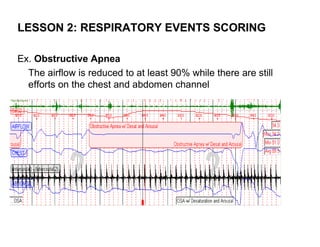
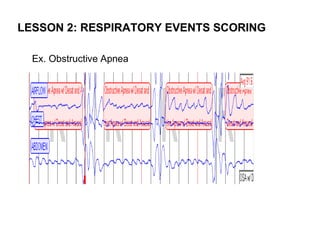
Ex. Obstructive Apnea
  The airflow is reduced to at least 90% while there are still
  efforts on the chest and abdomen channel
LESSON 2: RESPIRATORY EVENTS SCORING

  Ex. Obstructive Apnea
LESSON 2: RESPIRATORY EVENTS SCORING

Classify an apnea in an adult based upon inspiratory
    effort:

Score a respiratory event as a central apnea if it meets
apnea criteria and is associated with absent inspiratory
effort throughout the entire period of absent airflow.
LESSON 2: RESPIRATORY EVENTS SCORING
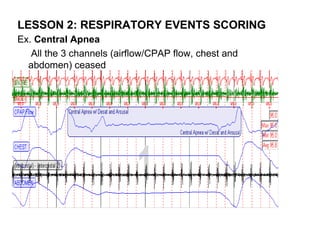
Ex. Central Apnea
   All the 3 channels (airflow/CPAP flow, chest and
  abdomen) ceased
LESSON 2: RESPIRATORY EVENTS SCORING

Classify an apnea in an adult based upon inspiratory
  effort:

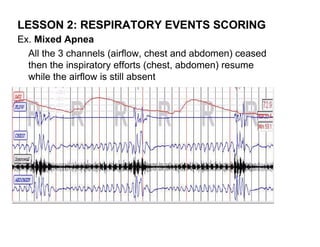
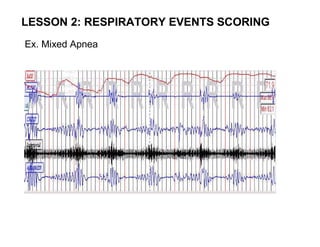
Score a respiratory event as a mixed apnea if it meets
apnea criteria and is associated with absent inspiratory
effort in the initial portion of the event, followed by
resumption of inspiratory effort in the second portion of the
event.
LESSON 2: RESPIRATORY EVENTS SCORING
Ex. Mixed Apnea
  All the 3 channels (airflow, chest and abdomen) ceased
  then the inspiratory efforts (chest, abdomen) resume
  while the airflow is still absent
LESSON 2: RESPIRATORY EVENTS SCORING
Ex. Mixed Apnea
LESSON 2: RESPIRATORY EVENTS SCORING

NOTE

• Identification of an apnea does not require a minimum
  desaturation criterion.
LESSON 2: RESPIRATORY EVENTS SCORING

Hypopnea Rules

Score a hypopnea if ALL of the following criteria are met:

 The nasal pressure signal excursions (or alternative
  hypopnea sensor) drop by >30% of baseline.
 The duration lasts at least 10 seconds
 > 4% desaturation from pre-event baseline.
 At least 90% of the event’s duration must meet the
  amplitude reduction of criteria for hypopnea.
LESSON 2: RESPIRATORY EVENTS SCORING

Score a Hypopnea if ALL of the following are met:

•   The nasal pressure signal excursions (or alternative
    hypopnea sensor) drop by >50% of baseline.
•   The duration of this drop lasts at least 10 seconds.
•   There is a >3% desaturation from pre-event baseline
    or the event is associated with arousal.
•   At least 90% of the event’s duration must meet the
    amplitude reduction of criteria for hypopnea.
LESSON 2: RESPIRATORY EVENTS SCORING
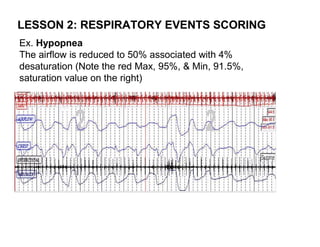
Ex. Hypopnea
The airflow is reduced to 50% associated with 4%
desaturation (Note the red Max, 95%, & Min, 91.5%,
saturation value on the right)
LESSON 2: RESPIRATORY EVENTS SCORING
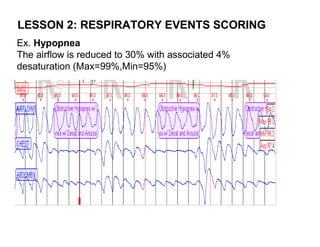
Ex. Hypopnea
The airflow is reduced to 30% with associated 4%
desaturation (Max=99%,Min=95%)
LESSON 2: RESPIRATORY EVENTS SCORING
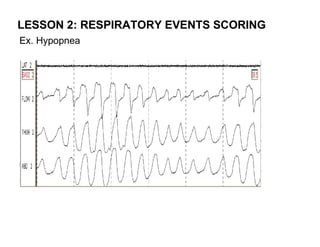
Ex. Hypopnea
LESSON 2: RESPIRATORY EVENTS SCORING

Respiratory Effort-Related Arousal Rule

Score a respiratory effort-related arousal (RERA) if there is
a sequence of breaths lasting at least 10 seconds
characterized by increasing respiratory effort or flattening of
the nasal pressure waveform leading to an arousal from
sleep when the sequence of breaths does not meet criteria
for an apnea or hypopnea.
LESSON 2: RESPIRATORY EVENTS SCORING

NOTE

When scoring RERAs, the use of esophageal pressure is
the preferred method of assessing change in respiratory
effort, although nasal pressure and inductance
plethysmography can be used.
LESSON 2: RESPIRATORY EVENTS SCORING

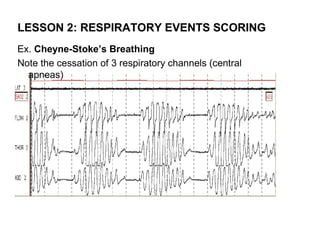
Cheyne-Stokes Breathing Rule

At least THREE consecutive cycles of cyclical crescendo
and decrescendo change in breathing amplitude AND at
least ONE of the following:
    • 5 or more central apneas OR [central] hypopneas per
      hour of sleep
    • Cyclic crescendo and decrescendo change in
      breathing amplitude has duration of at least 10
      consecutive minutes.
LESSON 2: RESPIRATORY EVENTS SCORING

Cheyne-Stokes Respiration

• Most common cause:
  – CHF
  – Renal failure
  – Meningitis
  – Drug overdose
   intracranial pressure
LESSON 2: RESPIRATORY EVENTS SCORING
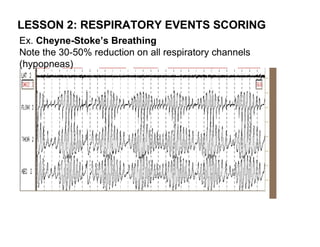
Ex. Cheyne-Stoke’s Breathing
Note the 30-50% reduction on all respiratory channels
(hypopneas)
LESSON 2: RESPIRATORY EVENTS SCORING
Ex. Cheyne-Stoke’s Breathing
Note the cessation of 3 respiratory channels (central
  apneas)
LESSON 2: RESPIRATORY EVENTS SCORING


             Reference
• AASM Manual for Scoring Sleep, 2007
LESSON 3: EEG AROUSALS SCORING

OBJECTIVE:

  At the end of this lesson the student must be able to:
• Apply standard criteria for determining arousals
LESSON 3: EEG AROUSALS SCORING

Scoring Arousals

Scoring during any stage of sleep if there is an abrupt shift
of EEG frequency including alpha, theta, and/or
frequencies > 16 Hz (but not spindles) that lasts at least 3
seconds, with at least 10 seconds of stable sleep preceding
the change.
LESSON 3: EEG AROUSALS SCORING

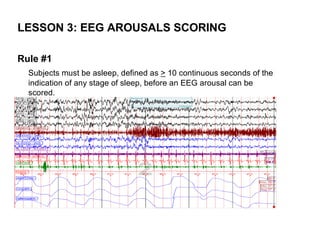
Rule #1
  Subjects must be asleep, defined as > 10 continuous seconds of the
  indication of any stage of sleep, before an EEG arousal can be
  scored.
LESSON 3: EEG AROUSALS SCORING
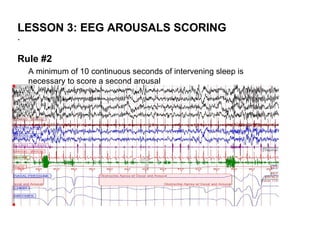
.

Rule #2
    A minimum of 10 continuous seconds of intervening sleep is
    necessary to score a second arousal
LESSON 3: EEG AROUSALS SCORING

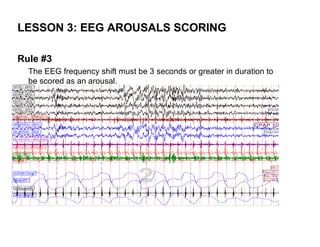
Rule #3
  The EEG frequency shift must be 3 seconds or greater in duration to
  be scored as an arousal.
LESSON 3: EEG AROUSALS SCORING

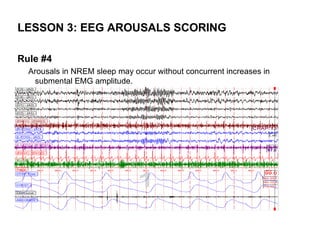
Rule #4
  Arousals in NREM sleep may occur without concurrent increases in
   submental EMG amplitude.
LESSON 3: EEG AROUSALS SCORING

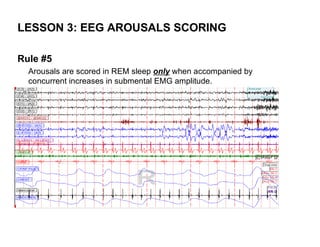
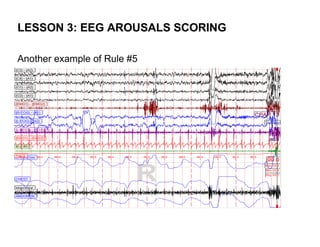
Rule #5
  Arousals are scored in REM sleep only when accompanied by
  concurrent increases in submental EMG amplitude.
LESSON 3: EEG AROUSALS SCORING

Another example of Rule #5
LESSON 3: EEG AROUSALS SCORING

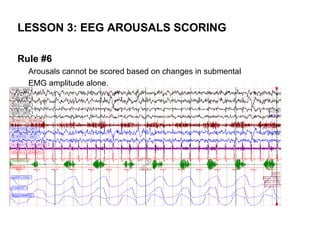
Rule #6
  Arousals cannot be scored based on changes in submental
  EMG amplitude alone.
LESSON 3: EEG AROUSALS SCORING

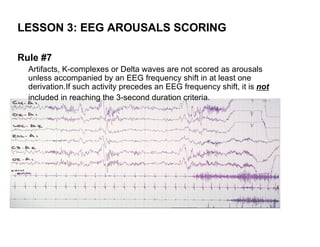
Rule #7
  Artifacts, K-complexes or Delta waves are not scored as arousals
  unless accompanied by an EEG frequency shift in at least one
  derivation.If such activity precedes an EEG frequency shift, it is not
  included in reaching the 3-second duration criteria.
LESSON 3: EEG AROUSALS SCORING

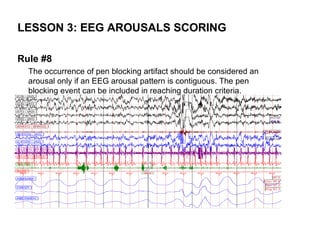
Rule #8
  The occurrence of pen blocking artifact should be considered an
  arousal only if an EEG arousal pattern is contiguous. The pen
  blocking event can be included in reaching duration criteria.
LESSON 3: EEG AROUSALS SCORING

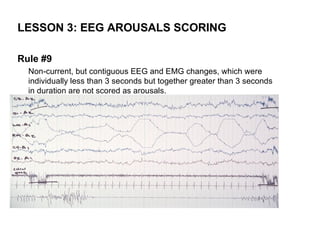
Rule #9
  Non-current, but contiguous EEG and EMG changes, which were
  individually less than 3 seconds but together greater than 3 seconds
  in duration are not scored as arousals.
LESSON 3: EEG AROUSALS SCORING

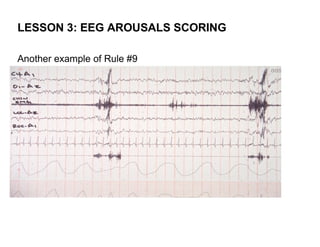
Another example of Rule #9
LESSON 3: EEG AROUSALS SCORING

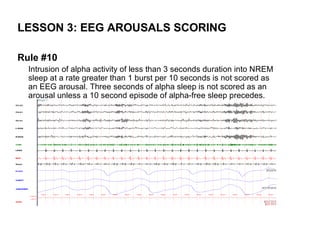
Rule #10
  Intrusion of alpha activity of less than 3 seconds duration into NREM
  sleep at a rate greater than 1 burst per 10 seconds is not scored as
  an EEG arousal. Three seconds of alpha sleep is not scored as an
  arousal unless a 10 second episode of alpha-free sleep precedes.
LESSON 3: EEG AROUSALS SCORING

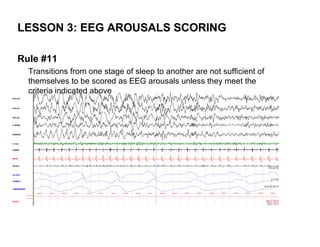
Rule #11
  Transitions from one stage of sleep to another are not sufficient of
  themselves to be scored as EEG arousals unless they meet the
  criteria indicated above
LESSON 3: EEG AROUSALS SCORING

Reference

• AASM Guidelines Taskforce, Sleep, 15:173-184, 1992
• AASM Manual for Scoring Sleep, 2007
LESSON 4: PERIODIC LIMB MOVEMENT IN
SLEEP (PLMS) SCORING

OBJECTIVES:
At the end of this lesson the student must be able to:

• Measure frequency, duration, and amplitude of limb
  movements
• Apply scoring rules for limb movements
LESSON 4: PLMS SCORING

The following rules define a significant leg movement
    event:
•   Minimum duration is 0.5 seconds
•   Maximum duration is 10 seconds
4. Minimum amplitude is an 8 µV increase in EMG
    voltage above resting EMG
5. Timing of the onset is defined as the point at which
    there is an 8 µV increase in EMG voltage above
    resting EMG.
6. Timing of the ending of a LM event is defined as the
    start of a period lasting at least 0.5 sec during which
    the EMG does not exceed 2 µV above resting EMG.
LESSON 4: PLMS SCORING


Scoring Limb Movements

• Should not be scored if it occurs during a period from 0.5
  seconds PRECEDING an apnea or hypopnea to 0.5
  seconds FOLLOWING an apnea or hypopnea.
LESSON 4: PLMS SCORING

Scoring PLMS
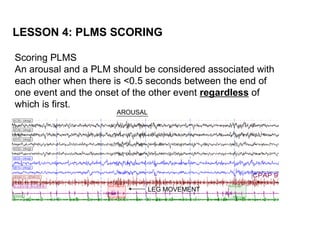
An arousal and a PLM should be considered associated with
each other when there is <0.5 seconds between the end of
one event and the onset of the other event regardless of
which is first.
                      AROUSAL


                                LEG MOVEMENT
LESSON 4: PLMS SCORING

Application

• Surface electrodes should be placed longitudinally and
  symmetrically around the middle of the muscle so that
  they are 2-3 cm apart OR 1/3 of the length of the
  anterior tibialis muscle; whichever is shorter.
LESSON 4: PLMS SCORING

Impedances

•   Use of 60 Hz (notch) filters should be avoided.
•   Acceptable impedances < 10,000 Ω
•   Preferred impedances < 5,000 Ω
•   Sensitivity limits of -100 and 100 µV are preferred.
LESSON 4: PLMS SCORING

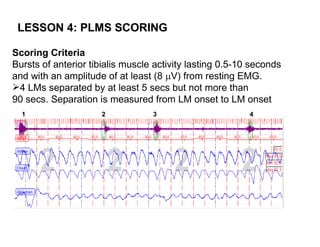
Scoring Criteria
Bursts of anterior tibialis muscle activity lasting 0.5-10 seconds
and with an amplitude of at least (8 V) from resting EMG.
4 LMs separated by at least 5 secs but not more than
90 secs. Separation is measured from LM onset to LM onset
  1                  2            3                       4
LESSON 4: PLMS SCORING

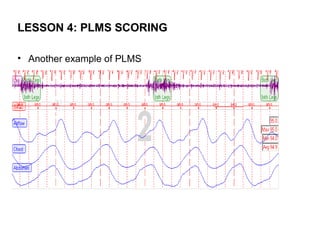
• Another example of PLMS
LESSON 4: PLMS SCORING

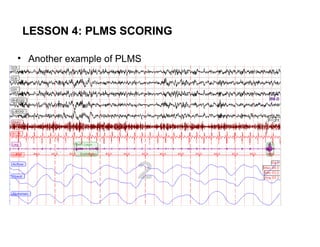
• Another example of PLMS
LESSON 4: PLMS SCORING

• PLMS Reference
• Sleep, Vol. 16, No. 8. 1993
• AASM Manual for Scoring Sleep, 2007

Scoring sleep 2013 webinar n2sleep

  • 1.
  • 2.
    SCORING SLEEP Scoring asleep study is divided into 4 parts: 3) Scoring sleep stages 4) Scoring respiratory events 5) Scoring arousals 6) Scoring periodic limb movements
  • 3.
    LESSON 1: SLEEPSTAGE SCORING OBJECTIVES: At the end of this lesson the student must be able to: • Measure frequency and amplitude of waveforms • Differentiate sleep/ wake stages according to patient- specific factor • Apply standard criteria for scoring sleep stages
  • 4.
    LESSON 1: SLEEPSTAGE SCORING Before you assign a stage on each epoch you need to classify the waveforms Alpha waves are EEG waveform activity in the 8 – 13 cycle per second (cps) or 8 – 13 Hz range. Theta waves are EEG waveform activity in the 4 - 7 cps (4 -7 Hz) range. Sleep Spindles are EEG waveform activity in the 13 – 16 cps (13 – 16 Hz) range. Delta waves are EEG waveform activity 0.5 – 3 cps (0.5 – 3 Hz) range.
  • 5.
    LESSON 1: SLEEPSTAGE SCORING To classify the waveforms, you need to count the cycles per second of each wave on your EEG channels e.g. EEG waves on a 10-second epoch 1 sec C3-M2 C4-M1 O2-M1 O1-M2 Count the number of peaks in a 1-second time frame
  • 6.
    LESSON 1: SLEEPSTAGE SCORING The EEG Recommended Alternative acceptable Derivations are: Derivations are: • F4 – M1 • Fz – Cz • C4 – M1 • Cz – Oz • O2 – M1 • C4 – M1 Back-up leads: Back-up electrodes: • F3 – M2 • FPz – C3 • C3 – M2 • C3 – O1 • O1 – M2 • C4 – M2
  • 7.
    LESSON 1: SLEEPSTAGE SCORING The EOG Recommended Alternative acceptable Derivations are: derivations are: • E1 – M2 E1 – FPZ E1 = 1 cm below the LOC E1 = 1 cm below and 1 cm lateral to the outer canthus of the left eye • E2 – M2 E2 – FPZ E2 = 1 cm above the ROC E2 = 1 cm below and 1 cm lateral to the outer canthus of the right eye
  • 8.
    LESSON 1: SLEEPSTAGE SCORING The CHIN EMG Recommended Derivations are: Three electrodes should be placed to record EMG:  One midline 1 cm above the inferior edge of the mandible.  One 2 cm below the inferior edge of the mandible and 2 cm to the right of the midline.  One 2 cm below the inferior edge of the mandible and 2 cm to the left of the midline.
  • 9.
    LESSON 1: SLEEPSTAGE SCORING Important Things to Know • Read between the lines • EEG takes precedence over EOG & EMG • Pattern Recognition • Sleep architecture • Score sleep stages in 30 second sequential epochs (from Lights Out to Lights On) • Assign a stage to each epoch • If 2 or more stages coexist during a single epoch, assign the stage comprising the greatest portion of the epoch (majority rules).
  • 10.
    LESSON 1: SLEEPSTAGE SCORING Scoring of Sleep Stages • Stage W (Wakefulness) • Stage N1 (NREM 1) • Stage N2 (NREM 2) • Stage N3 (NREM 3) • Stage R (REM)
  • 11.
    LESSON 1: SLEEPSTAGE SCORING Stage W The EEG consists of a frequency of 8 – 13 cps (8 – 13 Hz) It is predominantly seen in the Occipital Region e.g. Alpha waves on a 10-second epoch 1 second 9 cps
  • 12.
    LESSON 1: SLEEPSTAGE SCORING Stage W The EEG consists of a frequency of 8 – 13 cps (8 – 13 Hz) The pattern is like Blades of grass The EOG activity shows conjugate, irregular, sharply peaked eye movements (0.5-2 Hz frequency) The EMG activity shows normal or high chin muscle tone e.g. Alpha waves on a 30-second epoch EEG channels EMG channel EOG channels
  • 13.
    LESSON 1: SLEEPSTAGE SCORING Definition of Sleep Onset It is the start of the first epoch scored as any stage other than Stage W. (In most subjects, this will usually be the first epoch of Stage N1). It is the first epoch of sleep (no matter what stage) from Lights out.
  • 14.
    LESSON 1: SLEEPSTAGE SCORING Stage N1 The EEG consists of theta waves, 4-7 cps (4-7 Hz) AKA: Low Voltage Mixed Frequency (LVMF) e.g. Theta waves on a 10-second epoch 1 sec 6 cps
  • 15.
    LESSON 1: SLEEPSTAGE SCORING Stage N1 Makes up 5% of the Total Sleep Time (TST) Vertex Sharp Waves may be present The EOG shows Slow Eye Movements (SEMs) The EMG is variable, but is often lower than Stage Wake e.g. Theta waves on a 30-second epoch EEG channels EMG channel EOG channels
  • 16.
    LESSON 1: SLEEPSTAGE SCORING Vertex Sharp Wave EEG characteristic: Vertex sharp wave is a sharp negative deflection (upward )followed by a positive deflection (downward) lasting < 0.5 second (seen in the frontal/central regions; during the first half of the stage). 1 sec e.g. Stage N1 with vertex sharp wave < 0.5 sec 0.5 sec
  • 17.
    LESSON 1: SLEEPSTAGE SCORING Stage N2 The EEG consists of Theta waves interspersed with K- complexes and/or Sleep Spindles Can be seen in Central, Frontal, or Occipital leads e.g. Stage N2 with K-complexes and spindles
  • 18.
    LESSON 1: SLEEPSTAGE SCORING Stage N2 Makes up 50% of the Total Sleep Time The EEG consists of Theta waves interspersed with K-complexes and/or Spindles The EOG activity is similar to EEG The EMG has variable amplitude, but usually lower than Wake e.g. Stage N2 (with K complexes and sleep spindles) EEG channels EOG channels EMG channel
  • 19.
    LESSON 1: SLEEPSTAGE SCORING K-Complex • Well delineated negative sharp wave (upward) followed by a positive component (downward) lasting at least 0.5 sec duration. 1 sec > 0.5 sec K- complex 0.5 sec
  • 20.
    LESSON 1: SLEEPSTAGE SCORING Sleep Spindles The EEG consists of a frequency of 11-16 cps (11-16 Hz) It can be seen in either Central or Frontal leads The EOG is similar to EEG e.g. Spindles on a 10-second epoch Spindles= 13 cps
  • 21.
    LESSON 1: SLEEPSTAGE SCORING The pattern is big, black & blotchy signal occurring at 0.5-1.5 second duration e.g. Spindles on a 30-second epoch
  • 22.
    LESSON 1: SLEEPSTAGE SCORING Continuation of Stage N2 • Score epochs with low amplitude, mixed frequency EEG activity without K-complexes or sleep spindles if they are preceded by: – K-complexes unassociated with arousals or – Sleep spindles
  • 23.
    LESSON 1: SLEEPSTAGE SCORING Termination of Stage N2 a) Transition to Stage W b) An arousal ( to Stage N1 until a K-complex unassociated with an arousal or sleep spindle occurs) c) A major body movement followed by slow eye movements and LVMF EEG w/o non-associated K- complex or sleep spindles (Stage N1) d) Transition to Stage N3 e) Transition to Stage R
  • 24.
    LESSON 1: SLEEPSTAGE SCORING a) Termination of Stage N2= transition to Wake Stage
  • 25.
    LESSON 1: SLEEPSTAGE SCORING b) An arousal ( to Stage N1 until a K-complex unassociated with an arousal or sleep spindle occurs)
  • 26.
    LESSON 1: SLEEPSTAGE SCORING c) A major body movement followed by slow eye movements and LVMF EEG w/o non-associated K-complex or sleep spindles (Stage N1)
  • 27.
    LESSON 1: SLEEPSTAGE SCORING d) Transition to Stage N3
  • 28.
    LESSON 1: SLEEPSTAGE SCORING e) Transition to Stage R
  • 29.
    LESSON 1: SLEEPSTAGE SCORING Stage N3 The EEG consists of a frequency of a 0.5-3 cps (0.5-3 Hz) with amplitudes > 75 V from peak-to-peak, occupying > 20% of the epoch (cumulative) The patterns are like Ocean waves or Skyscrapers e.g. Delta waves (Stage N3) on a 10-second epoch Delta waves= 0.5- 3 cps with amplitude of > 75 µv
  • 30.
    LESSON 1: SLEEPSTAGE SCORING Stage N3 Makes up 20-25% of the Total Sleep Time It can be seen predominantly in frontal & central regions The EOG is similar to EEG The EMG has variable amplitude, often lower than in Stage N2 and sometimes as low as in Stage R sleep EEG channels EMG channel EOG channels
  • 31.
    LESSON 1: SLEEPSTAGE SCORING Stage R Makes up 20 – 25% Total Sleep Time The EEG consists of LVMF Theta waves, 4-7 cps (4-7 Hz). Alpha waves may be present but will be 1-2 cps slower than Wake Alpha. Distinct feature is the presence of Sawtooth Waves which are sharply contoured or triangular waves , often serrated, 2-6 Hz, preceding a burst of rapid eye movements (REMs). The EOG shows presence of Rapid Eye Movements The EMG is significantly reduced compared to NREM sleep.
  • 32.
    LESSON 1: SLEEPSTAGE SCORING Sawtooth theta waves EEG channels EOG channels EMG channel Rapid eye movement
  • 33.
    LESSON 1: SLEEPSTAGE SCORING Continuation of Stage R Continue to score Stage R even in the absence of rapid eye movements, for epochs following 1 or more epochs of Stage R, if the EEG continues to show LVMF activity without K-complexes or sleep spindles and the chin EMG tone remains low.
  • 34.
    LESSON 1: SLEEPSTAGE SCORING End of Stage R Stage R is ceased when 1 or more of the following occur: a) Transition to Stage W or Stage N3 b) An arousal occurs followed by LVMF EEG and SEMs (if chin is up [Stage N1]; if chin is low w/no SEMs then score as Stage R) c) A major body movement followed by SEM and LVMF EEG w/o non-arousal associated K-complexes or sleep spindles [Stage N1]
  • 35.
    LESSON 1: SLEEPSTAGE SCORING End of Stage R (continued) d) Score the epoch following the major body movement as Stage N1 e) If no slow eye movements and the EMG tone remains low, continue to score as Stage R f) One or more non-arousal associated K-complexes or sleep spindles are present in the first half of the epoch in the absence of rapid eye movements; even if chin EMG tone remains low (score as Stage N2)
  • 36.
    LESSON 1: SLEEPSTAGE SCORING a) Transition to Stage W or Stage N3
  • 37.
    LESSON 1: SLEEPSTAGE SCORING b) An arousal occurs followed by LVMF EEG and SEMs (if chin is up [Stage N1]; if chin is low w/no SEMs then score as Stage R)
  • 38.
    LESSON 1: SLEEPSTAGE SCORING c) A major body movement followed by SEM and LVMF EEG w/o non-arousal associated K-complexes or sleep spindles [Stage N1] Body movement
  • 39.
    LESSON 1: SLEEPSTAGE SCORING d) Score the epoch following the major body movement as Stage N1
  • 40.
    LESSON 1: SLEEPSTAGE SCORING e) If no slow eye movements and the EMG tone remains low, continue to score as Stage R
  • 41.
    LESSON 1: SLEEPSTAGE SCORING f) One or more non-arousal associated K-complexes or sleep spindles are present in the first half of the epoch in the absence of rapid eye movements; even if chin EMG tone remains low (score as Stage N2)
  • 42.
    LESSON 1: SLEEPSTAGE SCORING Transition from Stage N2 to Stage R • In between Stage N2 and Stage R, score an epoch with a distinct drop in chin EMG and in the first half of the epoch to the level seen in Stage R as Stage R if all of the following criteria are met, even in the absence of rapid eye movements. • Absence of non-arousal associated K-complexes • Absence of sleep spindles
  • 43.
    LESSON 1: SLEEPSTAGE SCORING Stage N2 to Stage R • In between epochs of definite stage N2 and definite stage R, score an epoch with a distinct drop in chin EMG in the first half of the epoch to the level seen in Stage R as Stage N2 if all of the following criteria are met: • Presence of non-arousal associated K-complexes or sleep spindles • Absence of rapid eye movements
  • 44.
    LESSON 1: SLEEPSTAGE SCORING Ex. An epoch with both K-complex (Stage N2) and REM. This is scored as N2 as the 1st half of the epoch consists of K-complexes
  • 45.
    LESSON 1: SLEEPSTAGE SCORING Major Body Movements Movement and muscle artifact obscuring the EEG for 50% of the epoch to the extent that the sleep stage cannot be determined
  • 46.
    LESSON 1: SLEEPSTAGE SCORING Score an epoch with a major body movement as follows: a) If alpha rhythm is present for part of the epoch (even <15 seconds duration), score as Stage W. b) If no alpha rhythm is discernable, but an epoch scorable as Stage W either precedes OR follows the epoch with a major body movement, score as Stage W. c) Otherwise, score the epoch as the same stage as the epoch that follows it.
  • 47.
    LESSON 1: SLEEPSTAGE SCORING a) If alpha rhythm is present for part of the epoch (even <15 seconds duration), score as Stage W Body movement Alpha waves, 14 seconds Theta waves
  • 48.
    LESSON 1: SLEEPSTAGE SCORING b) If no alpha rhythm is discernable, but an epoch scorable as Stage W either precedes OR follows the epoch with a major body movement, score as Stage W e.g. If the previous or succeeding epoch is Stage W, then score this epoch as Stage W
  • 49.
    LESSON 1: SLEEPSTAGE SCORING c) Otherwise, score the epoch as the same stage as the epoch that follows it e.g. If the next epoch is Stage N1, then score this epoch as Stage N1.
  • 50.
    LESSON 1: SLEEPSTAGE SCORING Reference • AASM Manual for Scoring Sleep, 2007
  • 51.
    LESSON 2: RESPIRATORYEVENTS SCORING OBJECTIVES: At the end of this lesson the student must be able to: • Categorize abnormal respiratory events according to the definitions and sub-classifications of apnea, hypopnea, hypoventilation, periodic breathing, Cheyne – Stokes respiration and UARS • Subdivide respiratory events into correct category • Discriminate clinically significant events • Measure respiratory events • Measure oxygen desaturations
  • 52.
    LESSON 2: RESPIRATORYEVENTS SCORING Event Duration Rules • The event duration is measured from the nadir preceding the first breath that is clearly reduced to the beginning of the first breath that approximates the baseline breathing amplitude.
  • 53.
    LESSON 2: RESPIRATORYEVENTS SCORING Score an apnea when ALL of the following criteria are met:  Drop in the peak thermal sensor or airflow sensor excursion by >90% of baseline  Duration of the event lasts at least 10 seconds.  At least 90% of the event’s duration meets the amplitude reduction criteria for apnea.
  • 54.
    LESSON 2: RESPIRATORYEVENTS SCORING Classify an apnea in an adult based upon inspiratory effort: Score a respiratory event as an obstructive apnea if it meets apnea criteria and is associated with continued or increased effort throughout the entire period of absent airflow.
  • 55.
    LESSON 2: RESPIRATORYEVENTS SCORING Ex. Obstructive Apnea The airflow is reduced to at least 90% while there are still efforts on the chest and abdomen channel
  • 56.
    LESSON 2: RESPIRATORYEVENTS SCORING Ex. Obstructive Apnea
  • 57.
    LESSON 2: RESPIRATORYEVENTS SCORING Classify an apnea in an adult based upon inspiratory effort: Score a respiratory event as a central apnea if it meets apnea criteria and is associated with absent inspiratory effort throughout the entire period of absent airflow.
  • 58.
    LESSON 2: RESPIRATORYEVENTS SCORING Ex. Central Apnea All the 3 channels (airflow/CPAP flow, chest and abdomen) ceased
  • 59.
    LESSON 2: RESPIRATORYEVENTS SCORING Classify an apnea in an adult based upon inspiratory effort: Score a respiratory event as a mixed apnea if it meets apnea criteria and is associated with absent inspiratory effort in the initial portion of the event, followed by resumption of inspiratory effort in the second portion of the event.
  • 60.
    LESSON 2: RESPIRATORYEVENTS SCORING Ex. Mixed Apnea All the 3 channels (airflow, chest and abdomen) ceased then the inspiratory efforts (chest, abdomen) resume while the airflow is still absent
  • 61.
    LESSON 2: RESPIRATORYEVENTS SCORING Ex. Mixed Apnea
  • 62.
    LESSON 2: RESPIRATORYEVENTS SCORING NOTE • Identification of an apnea does not require a minimum desaturation criterion.
  • 63.
    LESSON 2: RESPIRATORYEVENTS SCORING Hypopnea Rules Score a hypopnea if ALL of the following criteria are met:  The nasal pressure signal excursions (or alternative hypopnea sensor) drop by >30% of baseline.  The duration lasts at least 10 seconds  > 4% desaturation from pre-event baseline.  At least 90% of the event’s duration must meet the amplitude reduction of criteria for hypopnea.
  • 64.
    LESSON 2: RESPIRATORYEVENTS SCORING Score a Hypopnea if ALL of the following are met: • The nasal pressure signal excursions (or alternative hypopnea sensor) drop by >50% of baseline. • The duration of this drop lasts at least 10 seconds. • There is a >3% desaturation from pre-event baseline or the event is associated with arousal. • At least 90% of the event’s duration must meet the amplitude reduction of criteria for hypopnea.
  • 65.
    LESSON 2: RESPIRATORYEVENTS SCORING Ex. Hypopnea The airflow is reduced to 50% associated with 4% desaturation (Note the red Max, 95%, & Min, 91.5%, saturation value on the right)
  • 66.
    LESSON 2: RESPIRATORYEVENTS SCORING Ex. Hypopnea The airflow is reduced to 30% with associated 4% desaturation (Max=99%,Min=95%)
  • 67.
    LESSON 2: RESPIRATORYEVENTS SCORING Ex. Hypopnea
  • 68.
    LESSON 2: RESPIRATORYEVENTS SCORING Respiratory Effort-Related Arousal Rule Score a respiratory effort-related arousal (RERA) if there is a sequence of breaths lasting at least 10 seconds characterized by increasing respiratory effort or flattening of the nasal pressure waveform leading to an arousal from sleep when the sequence of breaths does not meet criteria for an apnea or hypopnea.
  • 69.
    LESSON 2: RESPIRATORYEVENTS SCORING NOTE When scoring RERAs, the use of esophageal pressure is the preferred method of assessing change in respiratory effort, although nasal pressure and inductance plethysmography can be used.
  • 70.
    LESSON 2: RESPIRATORYEVENTS SCORING Cheyne-Stokes Breathing Rule At least THREE consecutive cycles of cyclical crescendo and decrescendo change in breathing amplitude AND at least ONE of the following: • 5 or more central apneas OR [central] hypopneas per hour of sleep • Cyclic crescendo and decrescendo change in breathing amplitude has duration of at least 10 consecutive minutes.
  • 71.
    LESSON 2: RESPIRATORYEVENTS SCORING Cheyne-Stokes Respiration • Most common cause: – CHF – Renal failure – Meningitis – Drug overdose  intracranial pressure
  • 72.
    LESSON 2: RESPIRATORYEVENTS SCORING Ex. Cheyne-Stoke’s Breathing Note the 30-50% reduction on all respiratory channels (hypopneas)
  • 73.
    LESSON 2: RESPIRATORYEVENTS SCORING Ex. Cheyne-Stoke’s Breathing Note the cessation of 3 respiratory channels (central apneas)
  • 74.
    LESSON 2: RESPIRATORYEVENTS SCORING Reference • AASM Manual for Scoring Sleep, 2007
  • 75.
    LESSON 3: EEGAROUSALS SCORING OBJECTIVE: At the end of this lesson the student must be able to: • Apply standard criteria for determining arousals
  • 76.
    LESSON 3: EEGAROUSALS SCORING Scoring Arousals Scoring during any stage of sleep if there is an abrupt shift of EEG frequency including alpha, theta, and/or frequencies > 16 Hz (but not spindles) that lasts at least 3 seconds, with at least 10 seconds of stable sleep preceding the change.
  • 77.
    LESSON 3: EEGAROUSALS SCORING Rule #1 Subjects must be asleep, defined as > 10 continuous seconds of the indication of any stage of sleep, before an EEG arousal can be scored.
  • 78.
    LESSON 3: EEGAROUSALS SCORING . Rule #2 A minimum of 10 continuous seconds of intervening sleep is necessary to score a second arousal
  • 79.
    LESSON 3: EEGAROUSALS SCORING Rule #3 The EEG frequency shift must be 3 seconds or greater in duration to be scored as an arousal.
  • 80.
    LESSON 3: EEGAROUSALS SCORING Rule #4 Arousals in NREM sleep may occur without concurrent increases in submental EMG amplitude.
  • 81.
    LESSON 3: EEGAROUSALS SCORING Rule #5 Arousals are scored in REM sleep only when accompanied by concurrent increases in submental EMG amplitude.
  • 82.
    LESSON 3: EEGAROUSALS SCORING Another example of Rule #5
  • 83.
    LESSON 3: EEGAROUSALS SCORING Rule #6 Arousals cannot be scored based on changes in submental EMG amplitude alone.
  • 84.
    LESSON 3: EEGAROUSALS SCORING Rule #7 Artifacts, K-complexes or Delta waves are not scored as arousals unless accompanied by an EEG frequency shift in at least one derivation.If such activity precedes an EEG frequency shift, it is not included in reaching the 3-second duration criteria.
  • 85.
    LESSON 3: EEGAROUSALS SCORING Rule #8 The occurrence of pen blocking artifact should be considered an arousal only if an EEG arousal pattern is contiguous. The pen blocking event can be included in reaching duration criteria.
  • 86.
    LESSON 3: EEGAROUSALS SCORING Rule #9 Non-current, but contiguous EEG and EMG changes, which were individually less than 3 seconds but together greater than 3 seconds in duration are not scored as arousals.
  • 87.
    LESSON 3: EEGAROUSALS SCORING Another example of Rule #9
  • 88.
    LESSON 3: EEGAROUSALS SCORING Rule #10 Intrusion of alpha activity of less than 3 seconds duration into NREM sleep at a rate greater than 1 burst per 10 seconds is not scored as an EEG arousal. Three seconds of alpha sleep is not scored as an arousal unless a 10 second episode of alpha-free sleep precedes.
  • 89.
    LESSON 3: EEGAROUSALS SCORING Rule #11 Transitions from one stage of sleep to another are not sufficient of themselves to be scored as EEG arousals unless they meet the criteria indicated above
  • 90.
    LESSON 3: EEGAROUSALS SCORING Reference • AASM Guidelines Taskforce, Sleep, 15:173-184, 1992 • AASM Manual for Scoring Sleep, 2007
  • 91.
    LESSON 4: PERIODICLIMB MOVEMENT IN SLEEP (PLMS) SCORING OBJECTIVES: At the end of this lesson the student must be able to: • Measure frequency, duration, and amplitude of limb movements • Apply scoring rules for limb movements
  • 92.
    LESSON 4: PLMSSCORING The following rules define a significant leg movement event: • Minimum duration is 0.5 seconds • Maximum duration is 10 seconds 4. Minimum amplitude is an 8 µV increase in EMG voltage above resting EMG 5. Timing of the onset is defined as the point at which there is an 8 µV increase in EMG voltage above resting EMG. 6. Timing of the ending of a LM event is defined as the start of a period lasting at least 0.5 sec during which the EMG does not exceed 2 µV above resting EMG.
  • 93.
    LESSON 4: PLMSSCORING Scoring Limb Movements • Should not be scored if it occurs during a period from 0.5 seconds PRECEDING an apnea or hypopnea to 0.5 seconds FOLLOWING an apnea or hypopnea.
  • 94.
    LESSON 4: PLMSSCORING Scoring PLMS An arousal and a PLM should be considered associated with each other when there is <0.5 seconds between the end of one event and the onset of the other event regardless of which is first. AROUSAL LEG MOVEMENT
  • 95.
    LESSON 4: PLMSSCORING Application • Surface electrodes should be placed longitudinally and symmetrically around the middle of the muscle so that they are 2-3 cm apart OR 1/3 of the length of the anterior tibialis muscle; whichever is shorter.
  • 96.
    LESSON 4: PLMSSCORING Impedances • Use of 60 Hz (notch) filters should be avoided. • Acceptable impedances < 10,000 Ω • Preferred impedances < 5,000 Ω • Sensitivity limits of -100 and 100 µV are preferred.
  • 97.
    LESSON 4: PLMSSCORING Scoring Criteria Bursts of anterior tibialis muscle activity lasting 0.5-10 seconds and with an amplitude of at least (8 V) from resting EMG. 4 LMs separated by at least 5 secs but not more than 90 secs. Separation is measured from LM onset to LM onset 1 2 3 4
  • 98.
    LESSON 4: PLMSSCORING • Another example of PLMS
  • 99.
    LESSON 4: PLMSSCORING • Another example of PLMS
  • 100.
    LESSON 4: PLMSSCORING • PLMS Reference • Sleep, Vol. 16, No. 8. 1993 • AASM Manual for Scoring Sleep, 2007