Eva A.M. van Poppel
Sleep scoring using AASM
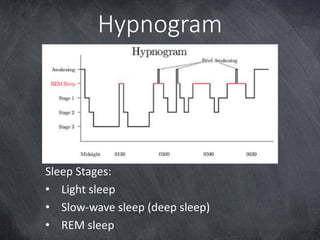
Hypnogram
Sleep Stages:
• Light sleep
• Slow-wave sleep (deep sleep)
• REM sleep
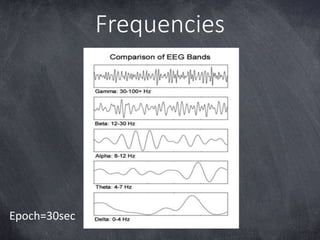
Frequencies
Epoch=30sec
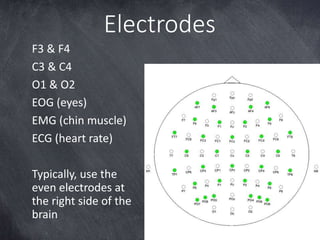
Electrodes
F3 & F4
C3 & C4
O1 & O2
EOG (eyes)
EMG (chin muscle)
ECG (heart rate)
Typically, use the
even electrodes at
the right side of the
brain
Sleep scoring
There are 2 methods of sleep scoring
• Rechtschaffen & Kales (R&K, 1968)
• American Academy of Sleep Medicine
(AASM) (2007)
• We use AASM.
Sleep stage: 0
Wake (W).
Alpha in O1 & O2 (min 50% of epoch)
EEG: Low voltage, mixed frequency pattern.
Fast eye movements (usually lasting <500ms
and eye blinks (0.5 – 2Hz).
Sleep stage: 1
Alpha deminshes or disappears at sleep
onset.
Replaced by low voltage, mixed frequency
EEG pattern.
Slow rolling eye movements (sinus,
>500ms).
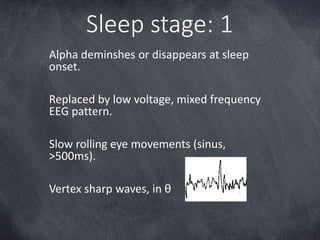
Vertex sharp waves, in θ
Sleep stage: 2
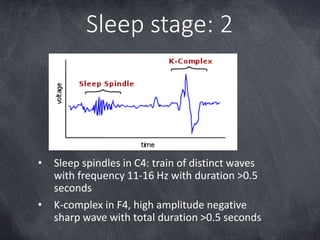
• Sleep spindles in C4: train of distinct waves
with frequency 11-16 Hz with duration >0.5
seconds
• K-complex in F4, high amplitude negative
sharp wave with total duration >0.5 seconds
Sleep stage: 3
Slow Wave Sleep
Also called delta sleep since there are high
amplitude waves in the delta range (0-4 Hz).
Stage 3 when >20% (6 seconds) of the
epoch contains Slow Oscillations with
frequency 0,5 – 2 Hz and amplitude >75 µV.
Use Frontal (F4) electrodes.
Sleep stage: 4
Slow Wave Sleep
Stage 4 when >50% of the epoch contains
Slow Oscillations with frequency 0,5 – 2 Hz
and amplitude >75 µV.
Not used anymore in AASM!
Sleep stage: 5
REM Sleep (R)
1. Low voltage, mixed frequency pattern,
no sleep spindles and K-complexes
2. Chin EMG no or lowest amplitude
3. Rapid Eye Movements
Sometimes sawtooth waves
90-120 min after sleep
onset
Sometimes no first cyclus
When people sleep in a new environment.
Sleep stage: 6 (MA)
Movement Arousal rule.
Score an arousal (6) together with the sleep
stage
when there is an abrupt shift of EEG frequency
including alpha, theta and or frequencies >16
Hz (no spindles) that last at least 3 seconds.
In REM an increase in EMG is required lasting
at least 1 second.
Major Body Movement
When there are movement artefacts for more than half
of a 30 seconds page epoch and the sleep stage cannot
be determined.
In AASM, apply the following rules:
• If alpha rhytm is present (even <15sec), score as
wake
• When there is no alpha, but there is an epoch before
or after the movement which is wake, score also as
wake
• Otherwise, score as the epoch that follows it.

Sleep scoring using AASM

  • 1.
    Eva A.M. vanPoppel Sleep scoring using AASM
  • 2.
    Hypnogram Sleep Stages: • Lightsleep • Slow-wave sleep (deep sleep) • REM sleep
  • 3.
  • 4.
    Electrodes F3 & F4 C3& C4 O1 & O2 EOG (eyes) EMG (chin muscle) ECG (heart rate) Typically, use the even electrodes at the right side of the brain
  • 5.
    Sleep scoring There are2 methods of sleep scoring • Rechtschaffen & Kales (R&K, 1968) • American Academy of Sleep Medicine (AASM) (2007) • We use AASM.
  • 6.
    Sleep stage: 0 Wake(W). Alpha in O1 & O2 (min 50% of epoch) EEG: Low voltage, mixed frequency pattern. Fast eye movements (usually lasting <500ms and eye blinks (0.5 – 2Hz).
  • 7.
    Sleep stage: 1 Alphademinshes or disappears at sleep onset. Replaced by low voltage, mixed frequency EEG pattern. Slow rolling eye movements (sinus, >500ms). Vertex sharp waves, in θ
  • 8.
    Sleep stage: 2 •Sleep spindles in C4: train of distinct waves with frequency 11-16 Hz with duration >0.5 seconds • K-complex in F4, high amplitude negative sharp wave with total duration >0.5 seconds
  • 9.
    Sleep stage: 3 SlowWave Sleep Also called delta sleep since there are high amplitude waves in the delta range (0-4 Hz). Stage 3 when >20% (6 seconds) of the epoch contains Slow Oscillations with frequency 0,5 – 2 Hz and amplitude >75 µV. Use Frontal (F4) electrodes.
  • 10.
    Sleep stage: 4 SlowWave Sleep Stage 4 when >50% of the epoch contains Slow Oscillations with frequency 0,5 – 2 Hz and amplitude >75 µV. Not used anymore in AASM!
  • 11.
    Sleep stage: 5 REMSleep (R) 1. Low voltage, mixed frequency pattern, no sleep spindles and K-complexes 2. Chin EMG no or lowest amplitude 3. Rapid Eye Movements Sometimes sawtooth waves 90-120 min after sleep onset Sometimes no first cyclus When people sleep in a new environment.
  • 12.
    Sleep stage: 6(MA) Movement Arousal rule. Score an arousal (6) together with the sleep stage when there is an abrupt shift of EEG frequency including alpha, theta and or frequencies >16 Hz (no spindles) that last at least 3 seconds. In REM an increase in EMG is required lasting at least 1 second.
  • 13.
    Major Body Movement Whenthere are movement artefacts for more than half of a 30 seconds page epoch and the sleep stage cannot be determined. In AASM, apply the following rules: • If alpha rhytm is present (even <15sec), score as wake • When there is no alpha, but there is an epoch before or after the movement which is wake, score also as wake • Otherwise, score as the epoch that follows it.

Editor's Notes

  • #3 is a graph that represents the stages of sleep as a function of time.