
Design Flash ADC
3bit
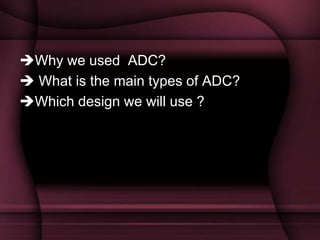
Why we used ADC?
 What is the main types of ADC?
Which design we will use ?
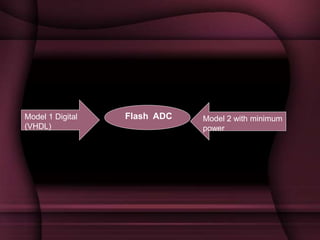
Model 1 Digital
(VHDL)
Model 2 with minimum
power
Flash ADC
Model1 Design Flash ADC
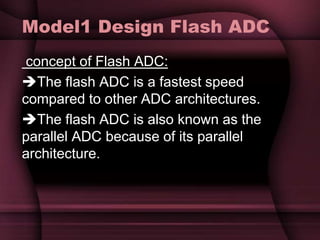
concept of Flash ADC:
The flash ADC is a fastest speed
compared to other ADC architectures.
The flash ADC is also known as the
parallel ADC because of its parallel
architecture.
• it is used for high-speed and very large
bandwidth applications such as radar
processing, digital oscilloscopes
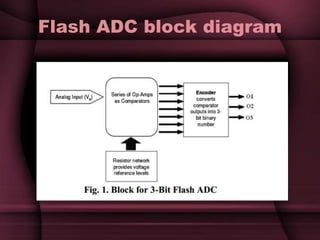
Flash ADC block diagram
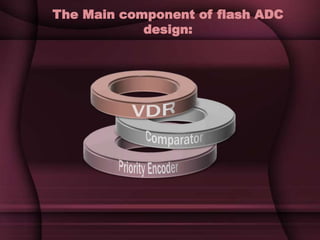
The Main component of flash ADC
design:
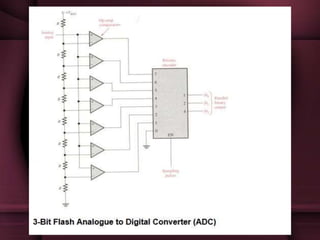
• these architecture needs 2n -1
comparators for a n-bit ADC; for example,
a set of 7 comparators is used for 3-bit
flash ADC. Each comparator has a
reference voltage that is provided by an
external reference source.
• For instance, a 6-bit flash ADC needs 63
comparators, but 1023 comparators are
needed for a 10-bit flash ADC
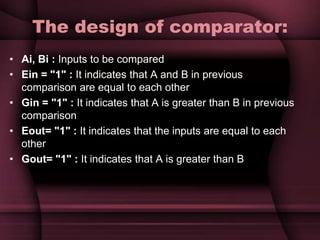
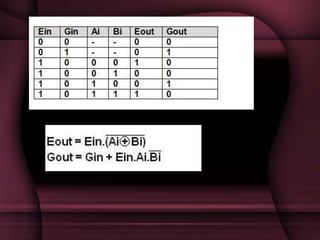
The design of comparator:
• Ai, Bi : Inputs to be compared
• Ein = "1" : It indicates that A and B in previous
comparison are equal to each other
• Gin = "1" : It indicates that A is greater than B in previous
comparison
• Eout= "1" : It indicates that the inputs are equal to each
other
• Gout= "1" : It indicates that A is greater than B
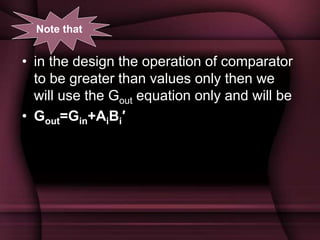
• in the design the operation of comparator
to be greater than values only then we
will use the Gout equation only and will be
• Gout=Gin+AiBi′
Note that
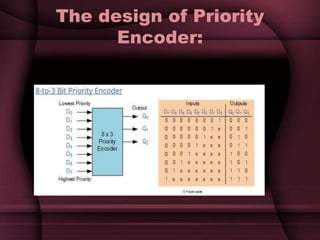
The design of Priority
Encoder:
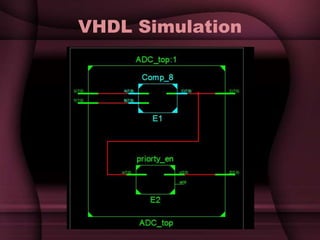
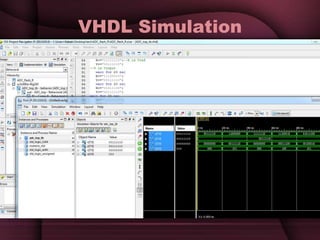
VHDL Simulation
VHDL Simulation
 That compare between normal design of
flash and another analogue design to get
lowest power consumption
Resolution and circuit complexity causing
high power consumption are the major
problems with Flash ADC, and these have
limited its application despite its speed of
conversion, which is the fastest among all
types of Analog to Digital Converters”.
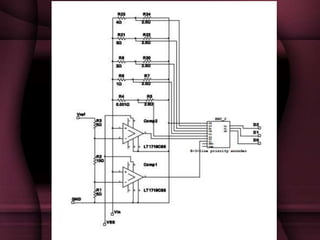
Model2 “Design Flash ADC
with Low power ”
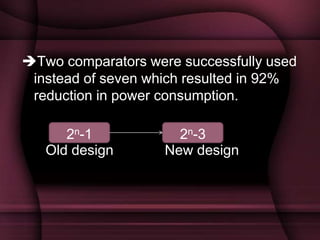
Two comparators were successfully used
instead of seven which resulted in 92%
reduction in power consumption.
Old design New design
2n-1 2n-3
Reference
• [1] Design & Implementation of Low Power 3-bit Flash ADC in
0.18µm CMOS, Pradeep Kumar, Amit Kolhe, international Journal
of Soft Computing and Engineering (IJSCE)ISSN: 2231-2307,
Volume-1, Issue-5, November 2011.
• [2] https://en.wikipedia.org/wiki/Comparator
• [3] http://www.electronics-tutorials.ws/combination/comb_4.html
• [4] Design of a new 3-bit Flash Analog to Digital Converter
(ADC)E. O. Ogunti and F. J. OmotayoDepartment of
Electrical/Electronic Engineering Federal University of Technology,
Akure, Nigeria
Design flash adc 3bit (VHDL design)

Design flash adc 3bit (VHDL design)

  • 1.
  • 2.
    Why we usedADC?  What is the main types of ADC? Which design we will use ?
  • 3.
    Model 1 Digital (VHDL) Model2 with minimum power Flash ADC
  • 4.
    Model1 Design FlashADC concept of Flash ADC: The flash ADC is a fastest speed compared to other ADC architectures. The flash ADC is also known as the parallel ADC because of its parallel architecture.
  • 5.
    • it isused for high-speed and very large bandwidth applications such as radar processing, digital oscilloscopes
  • 6.
  • 7.
    The Main componentof flash ADC design:
  • 8.
    • these architectureneeds 2n -1 comparators for a n-bit ADC; for example, a set of 7 comparators is used for 3-bit flash ADC. Each comparator has a reference voltage that is provided by an external reference source. • For instance, a 6-bit flash ADC needs 63 comparators, but 1023 comparators are needed for a 10-bit flash ADC
  • 10.
    The design ofcomparator: • Ai, Bi : Inputs to be compared • Ein = "1" : It indicates that A and B in previous comparison are equal to each other • Gin = "1" : It indicates that A is greater than B in previous comparison • Eout= "1" : It indicates that the inputs are equal to each other • Gout= "1" : It indicates that A is greater than B
  • 12.
    • in thedesign the operation of comparator to be greater than values only then we will use the Gout equation only and will be • Gout=Gin+AiBi′ Note that
  • 13.
    The design ofPriority Encoder:
  • 14.
  • 15.
  • 16.
     That comparebetween normal design of flash and another analogue design to get lowest power consumption Resolution and circuit complexity causing high power consumption are the major problems with Flash ADC, and these have limited its application despite its speed of conversion, which is the fastest among all types of Analog to Digital Converters”. Model2 “Design Flash ADC with Low power ”
  • 17.
    Two comparators weresuccessfully used instead of seven which resulted in 92% reduction in power consumption. Old design New design 2n-1 2n-3
  • 19.
    Reference • [1] Design& Implementation of Low Power 3-bit Flash ADC in 0.18µm CMOS, Pradeep Kumar, Amit Kolhe, international Journal of Soft Computing and Engineering (IJSCE)ISSN: 2231-2307, Volume-1, Issue-5, November 2011. • [2] https://en.wikipedia.org/wiki/Comparator • [3] http://www.electronics-tutorials.ws/combination/comb_4.html • [4] Design of a new 3-bit Flash Analog to Digital Converter (ADC)E. O. Ogunti and F. J. OmotayoDepartment of Electrical/Electronic Engineering Federal University of Technology, Akure, Nigeria