MGM 4139
STRATEGIC MANAGEMENT
CASE STUDY
by : Anaseri Zulkifli EX2833
Hafizullah Mohd Amin EX2906
Michelle Lim Li Yoke EX2885
Mohd Osman Mohd Hassan EX2894
Mohd Johan Khair Azmi EX2889
Rashidi Jaffri Jaafar EX2815
Contents
• Introduction
• Vision & Mission Statement
• Analysis & Matrix
• Internal Analysis
• External Analysis
• SWOT Matrix
• BCG Matrix
• Recommendation
• Financial Analysis
• EPS – EBIT Analysis
• Ratio Analysis
• Conclusion
• Reference
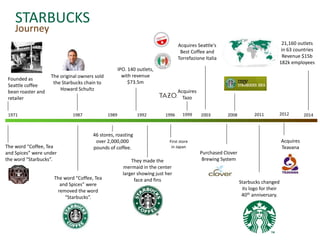
STARBUCKS
Journey
Founded as
Seattle coffee
bean roaster and
retailer
1971 1992
The word “Coffee, Tea
and Spices” were under
the word “Starbucks”.
1987
The original owners sold
the Starbucks chain to
Howard Schultz
The word “Coffee, Tea
and Spices” were
removed the word
“Starbucks”.
They made the
mermaid in the center
larger showing just her
face and fins Starbucks changed
its logo for their
40th anniversary.
2011
IPO. 140 outlets,
with revenue
$73.5m
19991996
First store
in Japan
20081989
46 stores, roasting
over 2,000,000
pounds of coffee.
Acquires
Tazo
2003
Acquires Seattle's
Best Coffee and
Torrefazione Italia
Purchased Clover
Brewing System
2012
Acquires
Teavana
2014
21,160 outlets
in 63 countries
Revenue $15b
182k employees
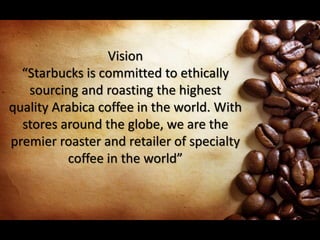
Vision
“Starbucks is committed to ethically
sourcing and roasting the highest
quality Arabica coffee in the world. With
stores around the globe, we are the
premier roaster and retailer of specialty
coffee in the world”
STARBUCKS
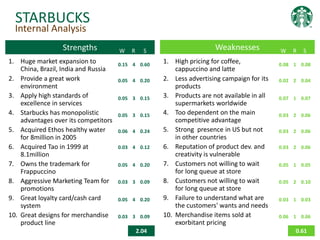
Internal Analysis
1. Huge market expansion to
China, Brazil, India and Russia
Weaknesses
0.15 4 0.60
0.05 4 0.20
0.05 3 0.15
0.05 3 0.15
0.06 4 0.24
0.03 4 0.12
0.05 4 0.20
0.03 3 0.09
0.05 4 0.20
0.03 3 0.09
0.08 1 0.08
0.02 2 0.04
0.07 1 0.07
0.03 2 0.06
0.03 2 0.06
0.03 2 0.06
0.05 1 0.05
0.05 2 0.10
0.03 1 0.03
0.06 1 0.06
2.04 0.61
4. Too dependent on the main
competitive advantage
5. Strong presence in US but not
in other countries
6. Reputation of product dev. and
creativity is vulnerable
7. Customers not willing to wait
for long queue at store
8. Customers not willing to wait
for long queue at store
9. Failure to understand what are
the customers' wants and needs
10. Merchandise items sold at
exorbitant pricing
Strengths W R S W R S
4. Starbucks has monopolistic
advantages over its competitors
5. Acquired Ethos healthy water
for 8million in 2005
6. Acquired Tao in 1999 at
8.1million
7. Owns the trademark for
Frappuccino
8. Aggressive Marketing Team for
promotions
9. Great loyalty card/cash card
system
10. Great designs for merchandise
product line
2. Provide a great work
environment
3. Apply high standards of
excellence in services
1. High pricing for coffee,
cappuccino and latte
2. Less advertising campaign for its
products
3. Products are not available in all
supermarkets worldwide
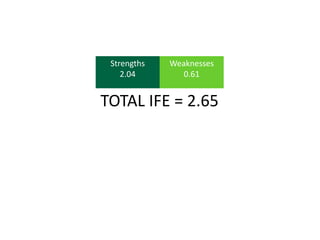
Strengths
2.04
Weaknesses
0.61
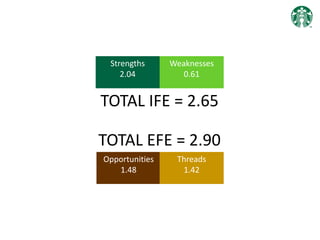
TOTAL IFE = 2.65
STARBUCKS
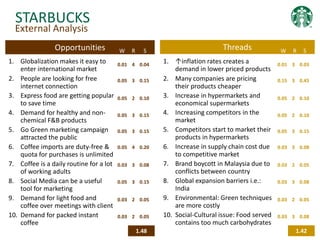
External Analysis
1. Globalization makes it easy to
enter international market
Threads
0.01 4 0.04
0.05 3 0.15
0.05 2 0.10
0.05 3 0.15
0.05 3 0.15
0.05 4 0.20
0.03 3 0.08
0.05 3 0.15
0.03 2 0.05
0.03 2 0.05
0.01 3 0.03
0.15 3 0.45
0.05 2 0.10
0.05 2 0.10
0.05 3 0.15
0.03 3 0.08
0.03 2 0.05
0.03 3 0.08
0.03 2 0.05
0.03 3 0.08
1.48 1.42
4. Increasing competitors in the
market
5. Competitors start to market their
products in hypermarkets
6. Increase in supply chain cost due
to competitive market
7. Brand boycott in Malaysia due to
conflicts between country
8. Global expansion barriers i.e.:
India
9. Environmental: Green techniques
are more costly
10. Social-Cultural issue: Food served
contains too much carbohydrates
Opportunities W R S W R S
4. Demand for healthy and non-
chemical F&B products
5. Go Green marketing campaign
attracted the public
6. Coffee imports are duty-free &
quota for purchases is unlimited
7. Coffee is a daily routine for a lot
of working adults
8. Social Media can be a useful
tool for marketing
9. Demand for light food and
coffee over meetings with client
10. Demand for packed instant
coffee
2. People are looking for free
internet connection
3. Express food are getting popular
to save time
1. ↑inflation rates creates a
demand in lower priced products
2. Many companies are pricing
their products cheaper
3. Increase in hypermarkets and
economical supermarkets
Strengths
2.04
Weaknesses
0.61
TOTAL IFE = 2.65
Opportunities
1.48
Threads
1.42
TOTAL EFE = 2.90
TOTAL IFE = 2.65
TOTAL EFE = 2.90
Threads
1.42
Opportunities
1.48
Strengths
2.04
Weaknesses
0.61
STARBUCKS
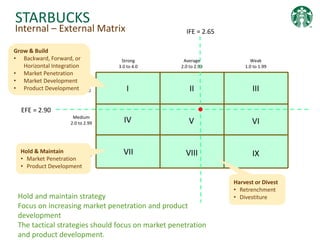
Internal – External Matrix
Strong
3.0 to 4.0
Average
2.0 to 2.99
Weak
1.0 to 1.99
High
3.0 to 4.0
Medium
2.0 to 2.99
Low
1.0 to 1.99
I II III
IV V VI
VII VIII IX
IFE = 2.65
EFE = 2.90
Grow & Build
• Backward, Forward, or
Horizontal Integration
• Market Penetration
• Market Development
• Product Development
Hold & Maintain
• Market Penetration
• Product Development
Harvest or Divest
• Retrenchment
• DivestitureHold and maintain strategy
Focus on increasing market penetration and product
development
The tactical strategies should focus on market penetration
and product development.
STARBUCKS
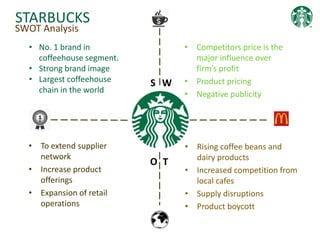
SWOT Analysis
Strength Weakness
Opportunity Thread
• No. 1 brand in
coffeehouse segment.
• Strong brand image
• Largest coffeehouse
chain in the world
• Competitors price is the
major influence over
firm’s profit
• Product pricing
• Negative publicity
• To extend supplier
network
• Increase product
offerings
• Expansion of retail
operations
• Rising coffee beans and
dairy products
• Increased competition from
local cafes
• Supply disruptions
• Product boycott
S W
O T
STARBUCKS
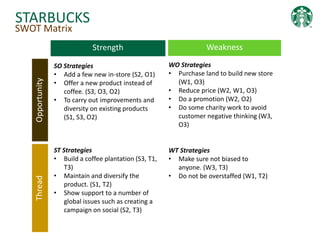
SWOT Matrix
SO Strategies
• Add a few new in-store (S2, O1)
• Offer a new product instead of
coffee. (S3, O3, O2)
• To carry out improvements and
diversity on existing products
(S1, S3, O2)
WO Strategies
• Purchase land to build new store
(W1, O3)
• Reduce price (W2, W1, O3)
• Do a promotion (W2, O2)
• Do some charity work to avoid
customer negative thinking (W3,
O3)
ST Strategies
• Build a coffee plantation (S3, T1,
T3)
• Maintain and diversify the
product. (S1, T2)
• Show support to a number of
global issues such as creating a
campaign on social (S2, T3)
WT Strategies
• Make sure not biased to
anyone. (W3, T3)
• Do not be overstaffed (W1, T2)
Strength Weakness
OpportunityThread
STARBUCKS
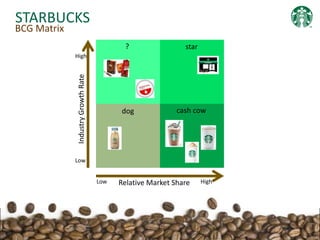
BCG Matrix
High
High
Low
Low
IndustryGrowthRate
Relative Market Share
star
dog cash cow
?
Recommendation
• Starbucks should reduce their price by producing a
new product of coffee using cheaper beans.
• Special discounts promotions to increase the sales.
This is also to face competition from nationwide
coffee manufactures.
• Starbucks can effectively pursue Focus-Based
Strategy
• Advertisement can be developed through internet,
give brochures, do road shows
EPS Analysis
Earnings Per Share (EPS)
Earnings Per Share : Net Income – Dividend on Preferred Stock
(EPS) Weighted Average Common Shares Outstanding
• Also called net income per
share
• Market prospect ratio that
measures the amount of net
income earned per share of
stock outstanding
• A good measure of
profitability
• Gives a view of the
comparative earnings or
earnings power of the firm.
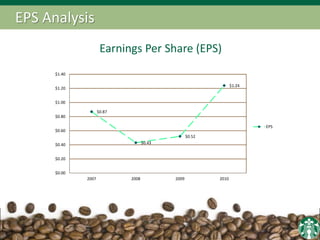
EPS Analysis
Earnings Per Share (EPS)
$0.87
$0.43
$0.52
$1.24
$0.00
$0.20
$0.40
$0.60
$0.80
$1.00
$1.20
$1.40
2007 2008 2009 2010
EPS
EBIT Analysis
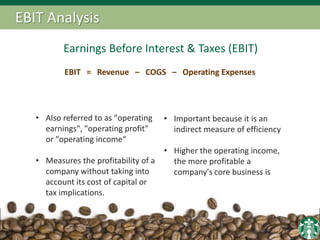
Earnings Before Interest & Taxes (EBIT)
• Also referred to as "operating
earnings", "operating profit"
or "operating income“
• Measures the profitability of a
company without taking into
account its cost of capital or
tax implications.
• Important because it is an
indirect measure of efficiency
• Higher the operating income,
the more profitable a
company's core business is
EBIT = Revenue – COGS – Operating Expenses
EBIT Analysis
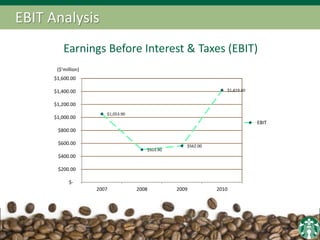
Earnings Before Interest & Taxes (EBIT)
$1,053.90
$503.90
$562.00
$1,419.40
$-
$200.00
$400.00
$600.00
$800.00
$1,000.00
$1,200.00
$1,400.00
$1,600.00
2007 2008 2009 2010
($'million)
EBIT
Ratio Analysis
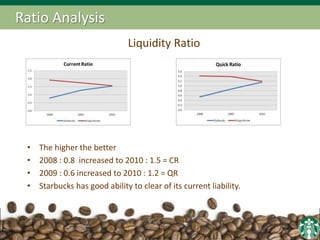
Liquidity Ratio
• The higher the better
• 2008 : 0.8 increased to 2010 : 1.5 = CR
• 2009 : 0.6 increased to 2010 : 1.2 = QR
• Starbucks has good ability to clear of its current liability.
Ratio Analysis
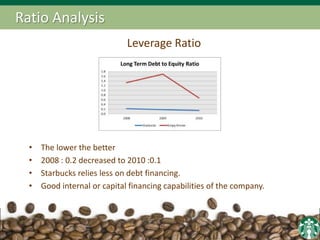
Leverage Ratio
• The lower the better
• 2008 : 0.2 decreased to 2010 :0.1
• Starbucks relies less on debt financing.
• Good internal or capital financing capabilities of the company.
Ratio Analysis
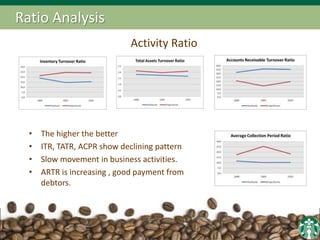
Activity Ratio
• The higher the better
• ITR, TATR, ACPR show declining pattern
• Slow movement in business activities.
• ARTR is increasing , good payment from
debtors.
Ratio Analysis
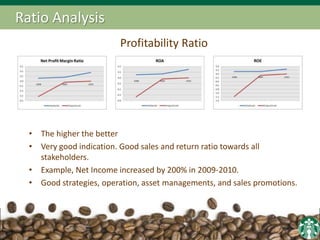
Profitability Ratio
• The higher the better
• Very good indication. Good sales and return ratio towards all
stakeholders.
• Example, Net Income increased by 200% in 2009-2010.
• Good strategies, operation, asset managements, and sales promotions.
Conclusion
• Overall Starbucks has maintained a competitive
advantage since creating its original blue ocean of
bringing quality, bistro-style coffee choices to the
masses.
• In order to stay current it will need to focus on its core
competencies.
• To remain competitive, they need to create new value
innovation.
• Rather than creating more new products, we think
their strength lies in their brand and by enhancing the
connection to their loyal customers
Conclusion
• Overall Starbucks has maintained a competitive
advantage since creating its original blue ocean of
bringing quality, bistro-style coffee choices to the
masses.
• In order to stay current it will need to focus on its core
competencies.
• To remain competitive, they need to create new value
innovation.
• Rather than creating more new products, we think
their strength lies in their brand and by enhancing the
connection to their loyal customers Thank You

Starbucks Case Study, SWOT, Internal and External Analysis

  • 2.
    MGM 4139 STRATEGIC MANAGEMENT CASESTUDY by : Anaseri Zulkifli EX2833 Hafizullah Mohd Amin EX2906 Michelle Lim Li Yoke EX2885 Mohd Osman Mohd Hassan EX2894 Mohd Johan Khair Azmi EX2889 Rashidi Jaffri Jaafar EX2815
  • 3.
    Contents • Introduction • Vision& Mission Statement • Analysis & Matrix • Internal Analysis • External Analysis • SWOT Matrix • BCG Matrix • Recommendation • Financial Analysis • EPS – EBIT Analysis • Ratio Analysis • Conclusion • Reference
  • 4.
    STARBUCKS Journey Founded as Seattle coffee beanroaster and retailer 1971 1992 The word “Coffee, Tea and Spices” were under the word “Starbucks”. 1987 The original owners sold the Starbucks chain to Howard Schultz The word “Coffee, Tea and Spices” were removed the word “Starbucks”. They made the mermaid in the center larger showing just her face and fins Starbucks changed its logo for their 40th anniversary. 2011 IPO. 140 outlets, with revenue $73.5m 19991996 First store in Japan 20081989 46 stores, roasting over 2,000,000 pounds of coffee. Acquires Tazo 2003 Acquires Seattle's Best Coffee and Torrefazione Italia Purchased Clover Brewing System 2012 Acquires Teavana 2014 21,160 outlets in 63 countries Revenue $15b 182k employees
  • 5.
    Vision “Starbucks is committedto ethically sourcing and roasting the highest quality Arabica coffee in the world. With stores around the globe, we are the premier roaster and retailer of specialty coffee in the world”
  • 7.
    STARBUCKS Internal Analysis 1. Hugemarket expansion to China, Brazil, India and Russia Weaknesses 0.15 4 0.60 0.05 4 0.20 0.05 3 0.15 0.05 3 0.15 0.06 4 0.24 0.03 4 0.12 0.05 4 0.20 0.03 3 0.09 0.05 4 0.20 0.03 3 0.09 0.08 1 0.08 0.02 2 0.04 0.07 1 0.07 0.03 2 0.06 0.03 2 0.06 0.03 2 0.06 0.05 1 0.05 0.05 2 0.10 0.03 1 0.03 0.06 1 0.06 2.04 0.61 4. Too dependent on the main competitive advantage 5. Strong presence in US but not in other countries 6. Reputation of product dev. and creativity is vulnerable 7. Customers not willing to wait for long queue at store 8. Customers not willing to wait for long queue at store 9. Failure to understand what are the customers' wants and needs 10. Merchandise items sold at exorbitant pricing Strengths W R S W R S 4. Starbucks has monopolistic advantages over its competitors 5. Acquired Ethos healthy water for 8million in 2005 6. Acquired Tao in 1999 at 8.1million 7. Owns the trademark for Frappuccino 8. Aggressive Marketing Team for promotions 9. Great loyalty card/cash card system 10. Great designs for merchandise product line 2. Provide a great work environment 3. Apply high standards of excellence in services 1. High pricing for coffee, cappuccino and latte 2. Less advertising campaign for its products 3. Products are not available in all supermarkets worldwide
  • 8.
  • 9.
    STARBUCKS External Analysis 1. Globalizationmakes it easy to enter international market Threads 0.01 4 0.04 0.05 3 0.15 0.05 2 0.10 0.05 3 0.15 0.05 3 0.15 0.05 4 0.20 0.03 3 0.08 0.05 3 0.15 0.03 2 0.05 0.03 2 0.05 0.01 3 0.03 0.15 3 0.45 0.05 2 0.10 0.05 2 0.10 0.05 3 0.15 0.03 3 0.08 0.03 2 0.05 0.03 3 0.08 0.03 2 0.05 0.03 3 0.08 1.48 1.42 4. Increasing competitors in the market 5. Competitors start to market their products in hypermarkets 6. Increase in supply chain cost due to competitive market 7. Brand boycott in Malaysia due to conflicts between country 8. Global expansion barriers i.e.: India 9. Environmental: Green techniques are more costly 10. Social-Cultural issue: Food served contains too much carbohydrates Opportunities W R S W R S 4. Demand for healthy and non- chemical F&B products 5. Go Green marketing campaign attracted the public 6. Coffee imports are duty-free & quota for purchases is unlimited 7. Coffee is a daily routine for a lot of working adults 8. Social Media can be a useful tool for marketing 9. Demand for light food and coffee over meetings with client 10. Demand for packed instant coffee 2. People are looking for free internet connection 3. Express food are getting popular to save time 1. ↑inflation rates creates a demand in lower priced products 2. Many companies are pricing their products cheaper 3. Increase in hypermarkets and economical supermarkets
  • 10.
    Strengths 2.04 Weaknesses 0.61 TOTAL IFE =2.65 Opportunities 1.48 Threads 1.42 TOTAL EFE = 2.90
  • 11.
    TOTAL IFE =2.65 TOTAL EFE = 2.90 Threads 1.42 Opportunities 1.48 Strengths 2.04 Weaknesses 0.61 STARBUCKS Internal – External Matrix Strong 3.0 to 4.0 Average 2.0 to 2.99 Weak 1.0 to 1.99 High 3.0 to 4.0 Medium 2.0 to 2.99 Low 1.0 to 1.99 I II III IV V VI VII VIII IX IFE = 2.65 EFE = 2.90 Grow & Build • Backward, Forward, or Horizontal Integration • Market Penetration • Market Development • Product Development Hold & Maintain • Market Penetration • Product Development Harvest or Divest • Retrenchment • DivestitureHold and maintain strategy Focus on increasing market penetration and product development The tactical strategies should focus on market penetration and product development.
  • 12.
    STARBUCKS SWOT Analysis Strength Weakness OpportunityThread • No. 1 brand in coffeehouse segment. • Strong brand image • Largest coffeehouse chain in the world • Competitors price is the major influence over firm’s profit • Product pricing • Negative publicity • To extend supplier network • Increase product offerings • Expansion of retail operations • Rising coffee beans and dairy products • Increased competition from local cafes • Supply disruptions • Product boycott S W O T
  • 13.
    STARBUCKS SWOT Matrix SO Strategies •Add a few new in-store (S2, O1) • Offer a new product instead of coffee. (S3, O3, O2) • To carry out improvements and diversity on existing products (S1, S3, O2) WO Strategies • Purchase land to build new store (W1, O3) • Reduce price (W2, W1, O3) • Do a promotion (W2, O2) • Do some charity work to avoid customer negative thinking (W3, O3) ST Strategies • Build a coffee plantation (S3, T1, T3) • Maintain and diversify the product. (S1, T2) • Show support to a number of global issues such as creating a campaign on social (S2, T3) WT Strategies • Make sure not biased to anyone. (W3, T3) • Do not be overstaffed (W1, T2) Strength Weakness OpportunityThread
  • 14.
  • 15.
    Recommendation • Starbucks shouldreduce their price by producing a new product of coffee using cheaper beans. • Special discounts promotions to increase the sales. This is also to face competition from nationwide coffee manufactures. • Starbucks can effectively pursue Focus-Based Strategy • Advertisement can be developed through internet, give brochures, do road shows
  • 16.
    EPS Analysis Earnings PerShare (EPS) Earnings Per Share : Net Income – Dividend on Preferred Stock (EPS) Weighted Average Common Shares Outstanding • Also called net income per share • Market prospect ratio that measures the amount of net income earned per share of stock outstanding • A good measure of profitability • Gives a view of the comparative earnings or earnings power of the firm.
  • 17.
    EPS Analysis Earnings PerShare (EPS) $0.87 $0.43 $0.52 $1.24 $0.00 $0.20 $0.40 $0.60 $0.80 $1.00 $1.20 $1.40 2007 2008 2009 2010 EPS
  • 18.
    EBIT Analysis Earnings BeforeInterest & Taxes (EBIT) • Also referred to as "operating earnings", "operating profit" or "operating income“ • Measures the profitability of a company without taking into account its cost of capital or tax implications. • Important because it is an indirect measure of efficiency • Higher the operating income, the more profitable a company's core business is EBIT = Revenue – COGS – Operating Expenses
  • 19.
    EBIT Analysis Earnings BeforeInterest & Taxes (EBIT) $1,053.90 $503.90 $562.00 $1,419.40 $- $200.00 $400.00 $600.00 $800.00 $1,000.00 $1,200.00 $1,400.00 $1,600.00 2007 2008 2009 2010 ($'million) EBIT
  • 20.
    Ratio Analysis Liquidity Ratio •The higher the better • 2008 : 0.8 increased to 2010 : 1.5 = CR • 2009 : 0.6 increased to 2010 : 1.2 = QR • Starbucks has good ability to clear of its current liability.
  • 21.
    Ratio Analysis Leverage Ratio •The lower the better • 2008 : 0.2 decreased to 2010 :0.1 • Starbucks relies less on debt financing. • Good internal or capital financing capabilities of the company.
  • 22.
    Ratio Analysis Activity Ratio •The higher the better • ITR, TATR, ACPR show declining pattern • Slow movement in business activities. • ARTR is increasing , good payment from debtors.
  • 23.
    Ratio Analysis Profitability Ratio •The higher the better • Very good indication. Good sales and return ratio towards all stakeholders. • Example, Net Income increased by 200% in 2009-2010. • Good strategies, operation, asset managements, and sales promotions.
  • 24.
    Conclusion • Overall Starbuckshas maintained a competitive advantage since creating its original blue ocean of bringing quality, bistro-style coffee choices to the masses. • In order to stay current it will need to focus on its core competencies. • To remain competitive, they need to create new value innovation. • Rather than creating more new products, we think their strength lies in their brand and by enhancing the connection to their loyal customers
  • 25.
    Conclusion • Overall Starbuckshas maintained a competitive advantage since creating its original blue ocean of bringing quality, bistro-style coffee choices to the masses. • In order to stay current it will need to focus on its core competencies. • To remain competitive, they need to create new value innovation. • Rather than creating more new products, we think their strength lies in their brand and by enhancing the connection to their loyal customers Thank You