 Starbucks Corporation, an American company founded in
1971 in Seattle.
 Starbucks has about 182,000 employees across 19,767
company operated & licensed stores in 62 countries.
 Their product mix includes roasted and handcrafted high
quality/premium priced coffees, tea, a variety of fresh food
items and other beverages.
INTRODUCTION
MISSION STATEMENT
1990-2008
Establish Starbucks as
the premier purveyor
of the finest coffee in
the world while
maintaining our
uncompromising
principles as we
grow.
2008 ONWARDS
To inspire and nurture
the human spirit –
one person, one cup
and one
neighbourhood at a
time.
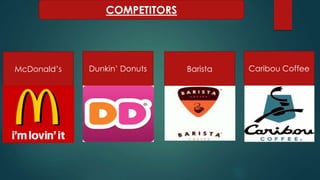
COMPETITORS
McDonald’s Dunkin’ Donuts Barista Caribou Coffee
INDUSTRY DEMAND AND DETERMINANTS
 This Industry is highly sensitive to macro-economic factors such as
household disposable income.
 Another factor is the per capita coffee consumption in different areas.
 Consumer taste and preference.
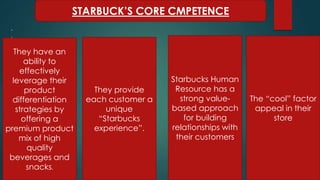
STARBUCK’S CORE CMPETENCE
.
.
They have an
ability to
effectively
leverage their
product
differentiation
strategies by
offering a
premium product
mix of high
quality
beverages and
snacks.
They provide
each customer a
unique
“Starbucks
experience”.
Starbucks Human
Resource has a
strong value-
based approach
for building
relationships with
their customers
The “cool” factor
appeal in their
store
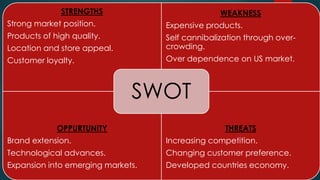
STRENGTHS
Strong market position.
Products of high quality.
Location and store appeal.
Customer loyalty.
WEAKNESS
Expensive products.
Self cannibalization through over-
crowding.
Over dependence on US market.
OPPURTUNITY
Brand extension.
Technological advances.
Expansion into emerging markets.
THREATS
Increasing competition.
Changing customer preference.
Developed countries economy.
SWOT
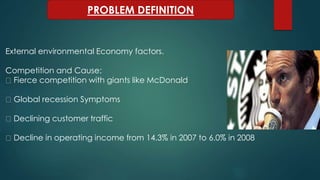
PROBLEM DEFINITION
External environmental Economy factors.
Competition and Cause:
Fierce competition with giants like McDonald
Global recession Symptoms
Declining customer traffic
Decline in operating income from 14.3% in 2007 to 6.0% in 2008
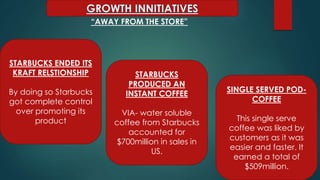
“AWAY FROM THE STORE”
STARBUCKS ENDED ITS
KRAFT RELSTIONSHIP
By doing so Starbucks
got complete control
over promoting its
product
STARBUCKS
PRODUCED AN
INSTANT COFFEE
VIA- water soluble
coffee from Starbucks
accounted for
$700million in sales in
US.
SINGLE SERVED POD-
COFFEE
This single serve
coffee was liked by
customers as it was
easier and faster. It
earned a total of
$509million.
RECOMMENDATIONS
 Products based on regional preferences.
 More innovative products.
 They can opt for business re-engineering to reduce waste.
 They can also come up with more healthy product offering in its mix.
 They must focus on the developing countries and emerging markets.

Starbucks

  • 1.
     Starbucks Corporation,an American company founded in 1971 in Seattle.  Starbucks has about 182,000 employees across 19,767 company operated & licensed stores in 62 countries.  Their product mix includes roasted and handcrafted high quality/premium priced coffees, tea, a variety of fresh food items and other beverages. INTRODUCTION
  • 2.
    MISSION STATEMENT 1990-2008 Establish Starbucksas the premier purveyor of the finest coffee in the world while maintaining our uncompromising principles as we grow. 2008 ONWARDS To inspire and nurture the human spirit – one person, one cup and one neighbourhood at a time.
  • 3.
  • 4.
    INDUSTRY DEMAND ANDDETERMINANTS  This Industry is highly sensitive to macro-economic factors such as household disposable income.  Another factor is the per capita coffee consumption in different areas.  Consumer taste and preference.
  • 5.
    STARBUCK’S CORE CMPETENCE . . Theyhave an ability to effectively leverage their product differentiation strategies by offering a premium product mix of high quality beverages and snacks. They provide each customer a unique “Starbucks experience”. Starbucks Human Resource has a strong value- based approach for building relationships with their customers The “cool” factor appeal in their store
  • 6.
    STRENGTHS Strong market position. Productsof high quality. Location and store appeal. Customer loyalty. WEAKNESS Expensive products. Self cannibalization through over- crowding. Over dependence on US market. OPPURTUNITY Brand extension. Technological advances. Expansion into emerging markets. THREATS Increasing competition. Changing customer preference. Developed countries economy. SWOT
  • 7.
    PROBLEM DEFINITION External environmentalEconomy factors. Competition and Cause: Fierce competition with giants like McDonald Global recession Symptoms Declining customer traffic Decline in operating income from 14.3% in 2007 to 6.0% in 2008
  • 8.
    “AWAY FROM THESTORE” STARBUCKS ENDED ITS KRAFT RELSTIONSHIP By doing so Starbucks got complete control over promoting its product STARBUCKS PRODUCED AN INSTANT COFFEE VIA- water soluble coffee from Starbucks accounted for $700million in sales in US. SINGLE SERVED POD- COFFEE This single serve coffee was liked by customers as it was easier and faster. It earned a total of $509million.
  • 9.
    RECOMMENDATIONS  Products basedon regional preferences.  More innovative products.  They can opt for business re-engineering to reduce waste.  They can also come up with more healthy product offering in its mix.  They must focus on the developing countries and emerging markets.