
FLEXIBLE BENEFITS
M G M 4 1 2 5 C O M P E N S AT I O N
M A N A G E M E N T
P R E P A R E D F O R : D R . S A M S U D I N Y A A C O B
P R E P A R E D B Y : H A F I Z U L L A H M O H D A M I N
( E X 0 2 9 0 6 )
AGENDA
• About Flexible Benefits
• Premium Conversion Accounts
• Individual Premium FSA
• Limited-Purpose Medical FSA - HSA Compatible
• General-Purpose Medical FSA
• Reference
WHAT IS FLEXIBLE BENEFIT PLAN?
• A great way to help you increase your spendable income while reducing your
payroll taxes.
• A Flexible Benefit Plan is a pre-tax payroll deduction plan that allows an
employer to sponsor a plan where employees can set aside some amount for
eligible insurance, medical, dental, optical and daycare expenses before
payroll taxes is applied.
• The effect is a reduction of taxes paid which results in an increase in
employees’ spendable income.
HOW MUCH MONEY WILL COME OUT OF MY PAY
CHECK IF I DECIDE TO PARTICIPATE?
• Estimate your total expenses separately for each of the flexible benefit plan
accounts you elect.
• The total is then divided by the number of times you will be paid during the
plan year. (For example, RM3,600 plan year election divided by 12 pay
periods = RM300 per pay period.)
• Keep in mind that amounts withheld pre-tax will have an immediate tax
savings because your payroll taxes will be lower.
WHEN DO I NEED TO DECIDE WHETHER OR NOT
I WANT TO PARTICIPATE?
• You must complete an enrollment form prior to the beginning of the plan year,
at which time you select benefit options and specify the annual elections for
each option separately.
• The Plan Administrator will set the due date for enrollment forms. Please refer
to your Summary Plan Description (SPD) to determine if mid-year plan entry is
permitted for employees hired after the beginning of the plan year.
• Elections are irrevocable for the entire plan year except for a qualifying
change in status.
• Caution: Changes you make mid-year must be consistent with the change in
status event and you are not guaranteed permission to change all accounts.
DOES THE PLAN COVER MY FAMILY?
• The plan covers you, your spouse, and your dependent children (as defined in
the plan).
• Even if you are covered by an insurance plan other than your employer’s, you
may still set aside money in Flexible Spending Accounts (FSA) for out-of-
pocket medical, dental, optical, and dependent care expenses under your
employer's plan.
DO I HAVE TO USE ALL OF THE AVAILABLE
ACCOUNTS?
• You may use any combination of the available accounts in the flexible benefit
plan sponsored by your employer or none at all.
• Participation in the plan is voluntary and can be reevaluated during open
enrollment prior to the start of each plan year.
IF I PUT PRE-TAX AMOUNT IN A FSA, WON’T I
HAVE LESS MONEY?
• No, you will actually save money because you will not be paying payroll taxes
on the money you elect to set aside in the Flexible Spending Accounts (FSA).
• You will also receive up to 100% reimbursement of the amounts elected by
filing claims for eligible expenses.
• The savings in payroll taxes almost offsets the additional amounts the
employee was able to set aside for the FSA’s each pay period.
CAN I CHANGE MY ELECTIONS AT ANY TIME?
• Once the plan year begins, you cannot adjust your elections until the following
plan year unless you experience a qualified change in status.
• Change in status events may include, but are not limited to: marriage, legal
separation, divorce, birth or adoption of a child, death of a spouse or child,
change of employment status of employee, spouse, or dependent, or a third
party-initiated change, such as a change in the cost of insurance or daycare.
• Depending on your employer’s plan, you will typically have 30 to 90 days to
adjust your elections consistent with the qualifying event. A complete list of
qualifying events and the time limit to change elections is available by
referring to your Summary Plan Description (SPD).
CAN I TRANSFER THE LEFTOVER MONEY TO
ANOTHER FSA?
• Each FSA is separate and balances are not interchangeable.
• Qualified dependent care expenses may only be reimbursed under the
Dependent Care FSA and qualified medical expenses may only be reimbursed
through the General-Purpose or Limited-Purpose Medical FSA.
WHAT HAPPENS IF I DON’T USE ALL OF THE
MONEY IN MY FSA?
• Any funds remaining at the end of the plan year (or applicable grace period)
are subject to the “Use-or-Lose”
• Remaining account balances may not be refunded or “rolled over” to a future
plan year.
IF I PARTICIPATE IN THIS PLAN, CAN I STILL
RECEIVE TAX CREDITS AND ITEMIZE MEDICAL
DEDUCTIONS OF MY TAX RETURN?
• By participating in the General-Purpose Medical FSA, the Limited-Purpose
Medical FSA and/or the Premium Conversion portion of the plan, you are
already receiving the tax savings on the expenses on your paycheck and
cannot claim them again as an itemized deduction on your tax return.
• In order to itemize your medical expenses have to be a minimum of 7.5% of
your gross earnings.
• Most people are unable to itemize unless they experience a catastrophic
expense. For certain expenses, such as child care, we recommend you
consult with your tax advisor to determine whether the Dependent Care FSA
or the Federal Child Care Tax Credit best fits your personal situation.
HOW SOON CAN I EXPECT TO RECEIVE MY
REIMBURSEMENT CLAIM?
• Claim forms are processed on a daily basis.
• Reimbursement checks are generated according to the schedule as
contracted with your employer.
• The checks are always issued to you, and cannot be issued to your providers
directly. The reimbursement check stub provides a breakdown of your current
account activity, including the amounts paid, the service date, claims pending,
and the remaining account balance.
• A replacement FSA Claim Form can be obtained on our website under Forms
& Instructions at: www.bdgflex.com. FSA participants also receive periodic
account statements, which summarize year-to-date activity.
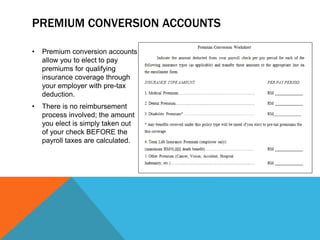
PREMIUM CONVERSION ACCOUNTS
• Premium conversion accounts
allow you to elect to pay
premiums for qualifying
insurance coverage through
your employer with pre-tax
deduction.
• There is no reimbursement
process involved; the amount
you elect is simply taken out
of your check BEFORE the
payroll taxes are calculated.
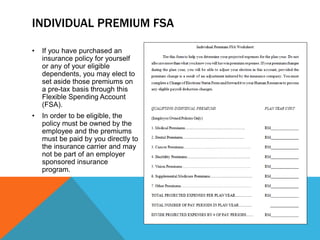
INDIVIDUAL PREMIUM FSA
• If you have purchased an
insurance policy for yourself
or any of your eligible
dependents, you may elect to
set aside those premiums on
a pre-tax basis through this
Flexible Spending Account
(FSA).
• In order to be eligible, the
policy must be owned by the
employee and the premiums
must be paid by you directly to
the insurance carrier and may
not be part of an employer
sponsored insurance
program.
LIMITED-PURPOSE MEDICAL FSA - HSA
COMPATIBLE
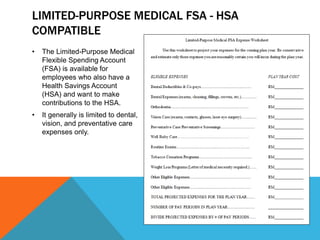
• The Limited-Purpose Medical
Flexible Spending Account
(FSA) is available for
employees who also have a
Health Savings Account
(HSA) and want to make
contributions to the HSA.
• It generally is limited to dental,
vision, and preventative care
expenses only.
GENERAL-PURPOSE MEDICAL FSA
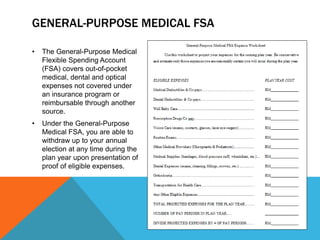
• The General-Purpose Medical
Flexible Spending Account
(FSA) covers out-of-pocket
medical, dental and optical
expenses not covered under
an insurance program or
reimbursable through another
source.
• Under the General-Purpose
Medical FSA, you are able to
withdraw up to your annual
election at any time during the
plan year upon presentation of
proof of eligible expenses.
REFERENCE
1. https://www.discoverybenefits.com
2. http://www.mercersignatureevents.com
3. http://www.csdk12.net
4. http://www.flexiben.com/

HR : Flexible Benefits

  • 1.
    FLEXIBLE BENEFITS M GM 4 1 2 5 C O M P E N S AT I O N M A N A G E M E N T P R E P A R E D F O R : D R . S A M S U D I N Y A A C O B P R E P A R E D B Y : H A F I Z U L L A H M O H D A M I N ( E X 0 2 9 0 6 )
  • 2.
    AGENDA • About FlexibleBenefits • Premium Conversion Accounts • Individual Premium FSA • Limited-Purpose Medical FSA - HSA Compatible • General-Purpose Medical FSA • Reference
  • 3.
    WHAT IS FLEXIBLEBENEFIT PLAN? • A great way to help you increase your spendable income while reducing your payroll taxes. • A Flexible Benefit Plan is a pre-tax payroll deduction plan that allows an employer to sponsor a plan where employees can set aside some amount for eligible insurance, medical, dental, optical and daycare expenses before payroll taxes is applied. • The effect is a reduction of taxes paid which results in an increase in employees’ spendable income.
  • 4.
    HOW MUCH MONEYWILL COME OUT OF MY PAY CHECK IF I DECIDE TO PARTICIPATE? • Estimate your total expenses separately for each of the flexible benefit plan accounts you elect. • The total is then divided by the number of times you will be paid during the plan year. (For example, RM3,600 plan year election divided by 12 pay periods = RM300 per pay period.) • Keep in mind that amounts withheld pre-tax will have an immediate tax savings because your payroll taxes will be lower.
  • 5.
    WHEN DO INEED TO DECIDE WHETHER OR NOT I WANT TO PARTICIPATE? • You must complete an enrollment form prior to the beginning of the plan year, at which time you select benefit options and specify the annual elections for each option separately. • The Plan Administrator will set the due date for enrollment forms. Please refer to your Summary Plan Description (SPD) to determine if mid-year plan entry is permitted for employees hired after the beginning of the plan year. • Elections are irrevocable for the entire plan year except for a qualifying change in status. • Caution: Changes you make mid-year must be consistent with the change in status event and you are not guaranteed permission to change all accounts.
  • 6.
    DOES THE PLANCOVER MY FAMILY? • The plan covers you, your spouse, and your dependent children (as defined in the plan). • Even if you are covered by an insurance plan other than your employer’s, you may still set aside money in Flexible Spending Accounts (FSA) for out-of- pocket medical, dental, optical, and dependent care expenses under your employer's plan. DO I HAVE TO USE ALL OF THE AVAILABLE ACCOUNTS? • You may use any combination of the available accounts in the flexible benefit plan sponsored by your employer or none at all. • Participation in the plan is voluntary and can be reevaluated during open enrollment prior to the start of each plan year.
  • 7.
    IF I PUTPRE-TAX AMOUNT IN A FSA, WON’T I HAVE LESS MONEY? • No, you will actually save money because you will not be paying payroll taxes on the money you elect to set aside in the Flexible Spending Accounts (FSA). • You will also receive up to 100% reimbursement of the amounts elected by filing claims for eligible expenses. • The savings in payroll taxes almost offsets the additional amounts the employee was able to set aside for the FSA’s each pay period.
  • 8.
    CAN I CHANGEMY ELECTIONS AT ANY TIME? • Once the plan year begins, you cannot adjust your elections until the following plan year unless you experience a qualified change in status. • Change in status events may include, but are not limited to: marriage, legal separation, divorce, birth or adoption of a child, death of a spouse or child, change of employment status of employee, spouse, or dependent, or a third party-initiated change, such as a change in the cost of insurance or daycare. • Depending on your employer’s plan, you will typically have 30 to 90 days to adjust your elections consistent with the qualifying event. A complete list of qualifying events and the time limit to change elections is available by referring to your Summary Plan Description (SPD).
  • 9.
    CAN I TRANSFERTHE LEFTOVER MONEY TO ANOTHER FSA? • Each FSA is separate and balances are not interchangeable. • Qualified dependent care expenses may only be reimbursed under the Dependent Care FSA and qualified medical expenses may only be reimbursed through the General-Purpose or Limited-Purpose Medical FSA. WHAT HAPPENS IF I DON’T USE ALL OF THE MONEY IN MY FSA? • Any funds remaining at the end of the plan year (or applicable grace period) are subject to the “Use-or-Lose” • Remaining account balances may not be refunded or “rolled over” to a future plan year.
  • 10.
    IF I PARTICIPATEIN THIS PLAN, CAN I STILL RECEIVE TAX CREDITS AND ITEMIZE MEDICAL DEDUCTIONS OF MY TAX RETURN? • By participating in the General-Purpose Medical FSA, the Limited-Purpose Medical FSA and/or the Premium Conversion portion of the plan, you are already receiving the tax savings on the expenses on your paycheck and cannot claim them again as an itemized deduction on your tax return. • In order to itemize your medical expenses have to be a minimum of 7.5% of your gross earnings. • Most people are unable to itemize unless they experience a catastrophic expense. For certain expenses, such as child care, we recommend you consult with your tax advisor to determine whether the Dependent Care FSA or the Federal Child Care Tax Credit best fits your personal situation.
  • 11.
    HOW SOON CANI EXPECT TO RECEIVE MY REIMBURSEMENT CLAIM? • Claim forms are processed on a daily basis. • Reimbursement checks are generated according to the schedule as contracted with your employer. • The checks are always issued to you, and cannot be issued to your providers directly. The reimbursement check stub provides a breakdown of your current account activity, including the amounts paid, the service date, claims pending, and the remaining account balance. • A replacement FSA Claim Form can be obtained on our website under Forms & Instructions at: www.bdgflex.com. FSA participants also receive periodic account statements, which summarize year-to-date activity.
  • 12.
    PREMIUM CONVERSION ACCOUNTS •Premium conversion accounts allow you to elect to pay premiums for qualifying insurance coverage through your employer with pre-tax deduction. • There is no reimbursement process involved; the amount you elect is simply taken out of your check BEFORE the payroll taxes are calculated.
  • 13.
    INDIVIDUAL PREMIUM FSA •If you have purchased an insurance policy for yourself or any of your eligible dependents, you may elect to set aside those premiums on a pre-tax basis through this Flexible Spending Account (FSA). • In order to be eligible, the policy must be owned by the employee and the premiums must be paid by you directly to the insurance carrier and may not be part of an employer sponsored insurance program.
  • 14.
    LIMITED-PURPOSE MEDICAL FSA- HSA COMPATIBLE • The Limited-Purpose Medical Flexible Spending Account (FSA) is available for employees who also have a Health Savings Account (HSA) and want to make contributions to the HSA. • It generally is limited to dental, vision, and preventative care expenses only.
  • 15.
    GENERAL-PURPOSE MEDICAL FSA •The General-Purpose Medical Flexible Spending Account (FSA) covers out-of-pocket medical, dental and optical expenses not covered under an insurance program or reimbursable through another source. • Under the General-Purpose Medical FSA, you are able to withdraw up to your annual election at any time during the plan year upon presentation of proof of eligible expenses.
  • 16.