A CASE STUDY ON TATA STARBUCKS
STRATEGIC PLAN TO OPEN KIOSKS
IN INDIA
Presented by
Mandeep Singh
Roll no 54
Section- D
SIMS 2013-2015
Coffee Kiosk Market
• After surging during the past decade, the Coffee and Snack Shops industry
experienced a major slowdown in 2009 due to a struggling economy and,
to a lesser extent, changing consumer tastes in US and UK
• After revenue declined 6.6% to $25.9 billion in 2009, it resumed its
upward climb between 2010 and 2012 in the US
• Outlook for the Indian coffee kiosk sector is much more attractive as a
result of lower levels of market saturation and continued industry
dynamism
• BMI is forecasting a CAGR of 9.1% to 2017, in volume terms, as the
country's rapidly expanding middle class embraces café culture
• Given the expansion capacity of Starbucks and Dunkin' Donuts and their
Indian ambitions, there will be considerable dynamism in the coffee sector
over the coming years
• The biggest players in this industry in the world are Starbucks and Costa
• While in India the major players are Café day express, Nescafe , Gloria
Jean’s Coffee, Costa, Dunkin donuts and other local players
7/24/2013 2Symbiosis Institute of Management Studies
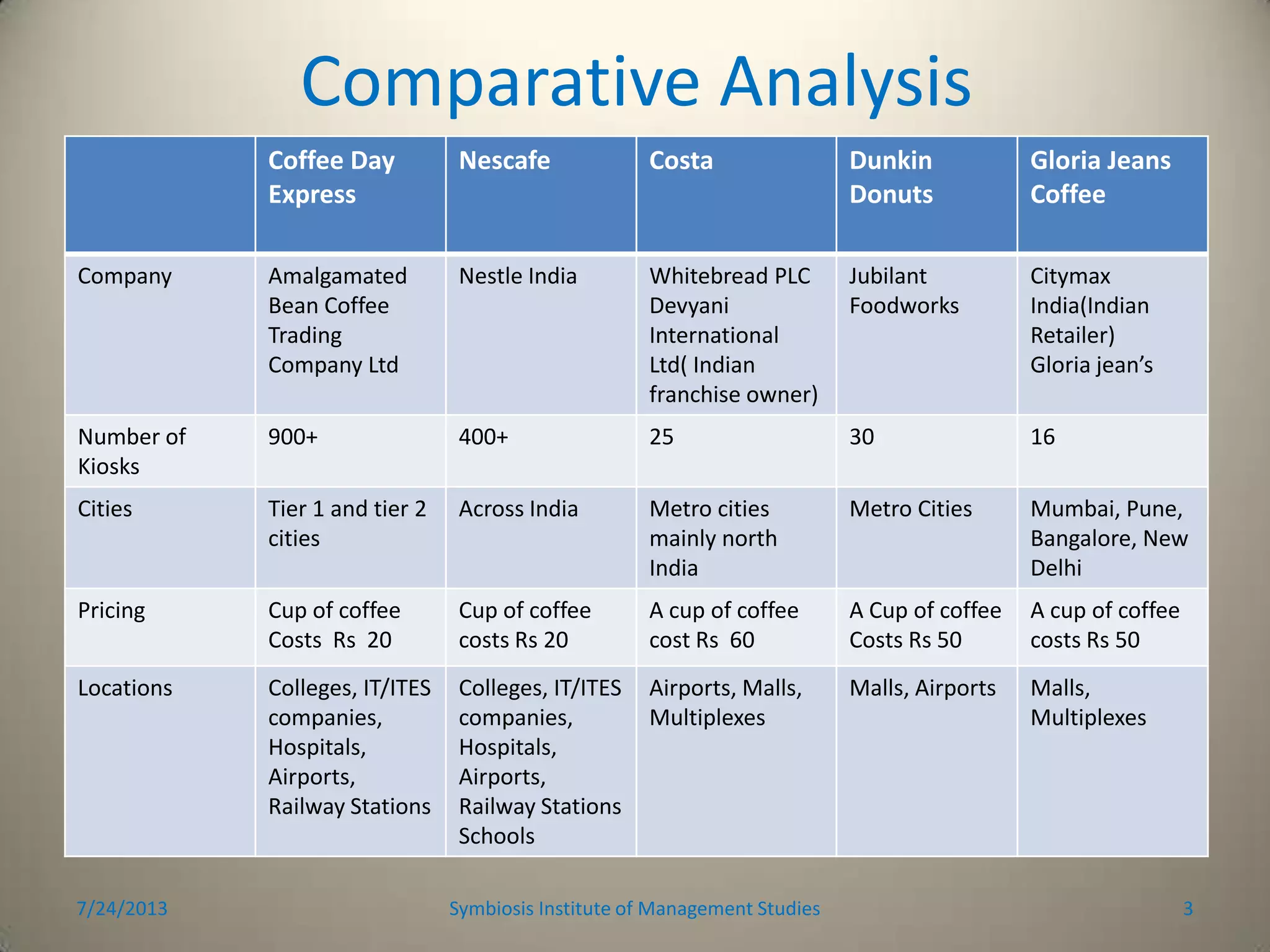
Comparative Analysis
Coffee Day
Express
Nescafe Costa Dunkin
Donuts
Gloria Jeans
Coffee
Company Amalgamated
Bean Coffee
Trading
Company Ltd
Nestle India Whitebread PLC
Devyani
International
Ltd( Indian
franchise owner)
Jubilant
Foodworks
Citymax
India(Indian
Retailer)
Gloria jean’s
Number of
Kiosks
900+ 400+ 25 30 16
Cities Tier 1 and tier 2
cities
Across India Metro cities
mainly north
India
Metro Cities Mumbai, Pune,
Bangalore, New
Delhi
Pricing Cup of coffee
Costs Rs 20
Cup of coffee
costs Rs 20
A cup of coffee
cost Rs 60
A Cup of coffee
Costs Rs 50
A cup of coffee
costs Rs 50
Locations Colleges, IT/ITES
companies,
Hospitals,
Airports,
Railway Stations
Colleges, IT/ITES
companies,
Hospitals,
Airports,
Railway Stations
Schools
Airports, Malls,
Multiplexes
Malls, Airports Malls,
Multiplexes
7/24/2013 3Symbiosis Institute of Management Studies
7/24/2013 Symbiosis Institute of Management Studies 4
0
2
4
6
8
10
12
Rs 51-75 Rs 0-30 Rs 76-100 Rs 31-50 Rs 100 and
above
R
E
S
P
O
N
D
E
N
T
S
PRICE OF A CUP OF COFFEE
How much do you spend on a cup
of coffee?
Total
8 8
9
5 5
0
1
2
3
4
5
6
7
8
9
10
1 2 3 4 5
R
E
S
P
O
N
D
E
N
T
S
Ratings- 1-Delighted 5- don't care
Rate your level of excitement if a
starbucks outlet opens up near you?
Total
Barista
17%
brewberrys
3%
Cafe Day
Express
43%
Costa Coffee
17%
Nescafe
11%
Starbucks
9%
Which coffee outlet do you prefer the
most?
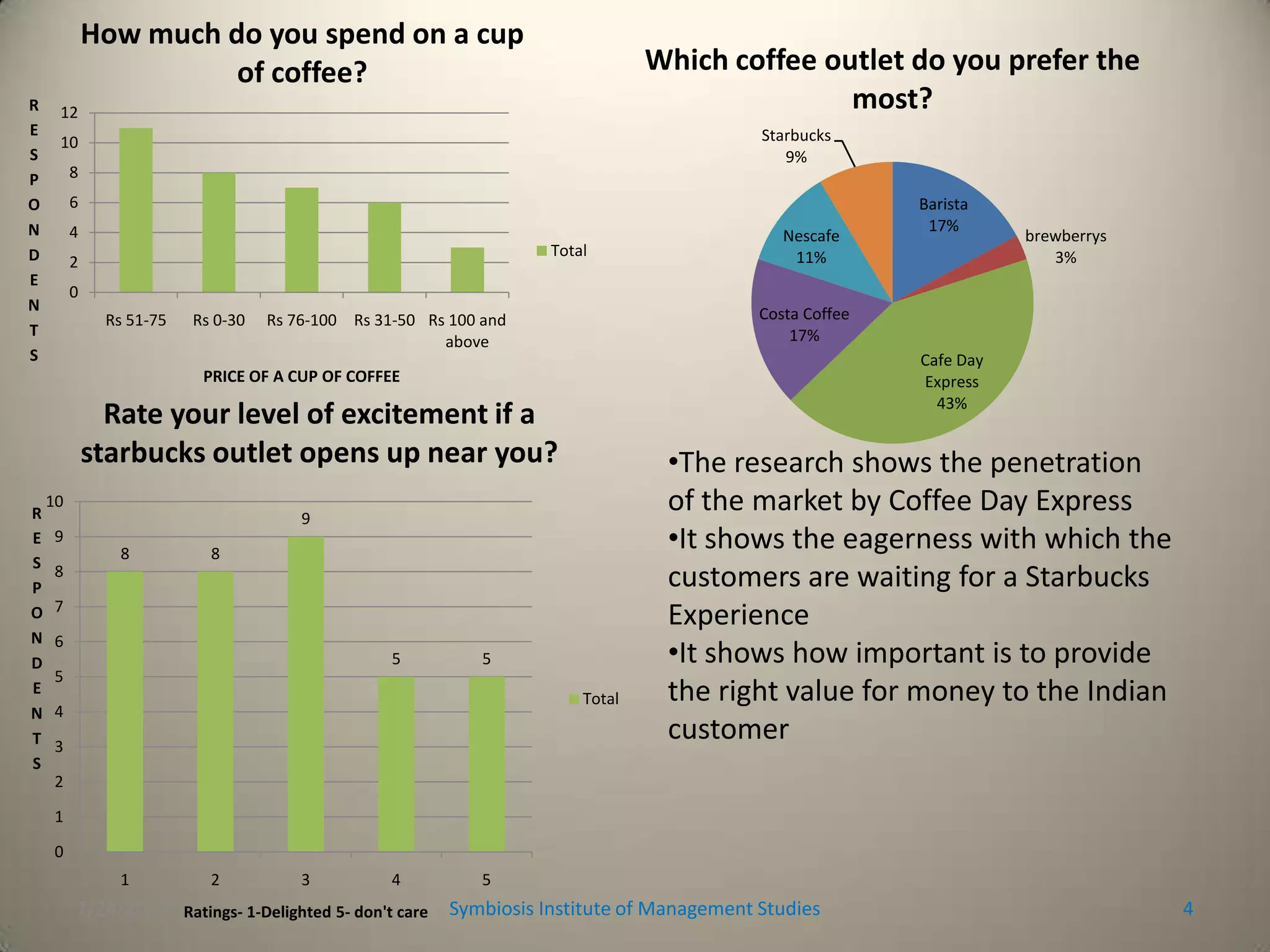
•The research shows the penetration
of the market by Coffee Day Express
•It shows the eagerness with which the
customers are waiting for a Starbucks
Experience
•It shows how important is to provide
the right value for money to the Indian
customer
7/24/2013 Symbiosis Institute of Management Studies 5
BUSINESS STRATEGY
Customer Retention is the key to a better
brand equity
Though expanding fast in new geographies, must
realize importance of customer retention
Customer retention 5 times cheaper than new
customer:
Greater retention  greater brand equity 
greater sales  profits
How to gain Sustainable Competitive Advantage in Newer
Economies
Sustainable competitive advantage lies not in one, but a combination of
multiple resources, each of which individually need not necessarily be the
best, but in overall weighted average terms, presents the best solution.
• Product Quality
• Prices
• Service
PRODUCT STARBUCKS KIOSKS
TARGET
MARKET
•Between the ages of 20-35 yrs, college students, IT/ITES Professionals
•Brand conscious and people looking for higher quality
COMPETITIVE
ADVANTAGE
Need to focus on the quality and the experience provided by the kiosk.
Competitive pricing in the range of Rs 50-75 Per cup of coffee
Providing Indian products in their product package
Providing a complete STARBUCKS experience
PLAN FOR
EXECUTION
Initial Capital required/Kiosk = Rs 5,00,000- Rs 10,00,000
Daily Sales expected = Rs 3,000 – Rs 10,000
Area covered/Kiosk = 100-150 sq. ft
lOCATION Ideal location for the flagship kiosks will be a mall with an average footfall
of 25000 – 40000 ( Phoenix mall or Amanora Park Town)
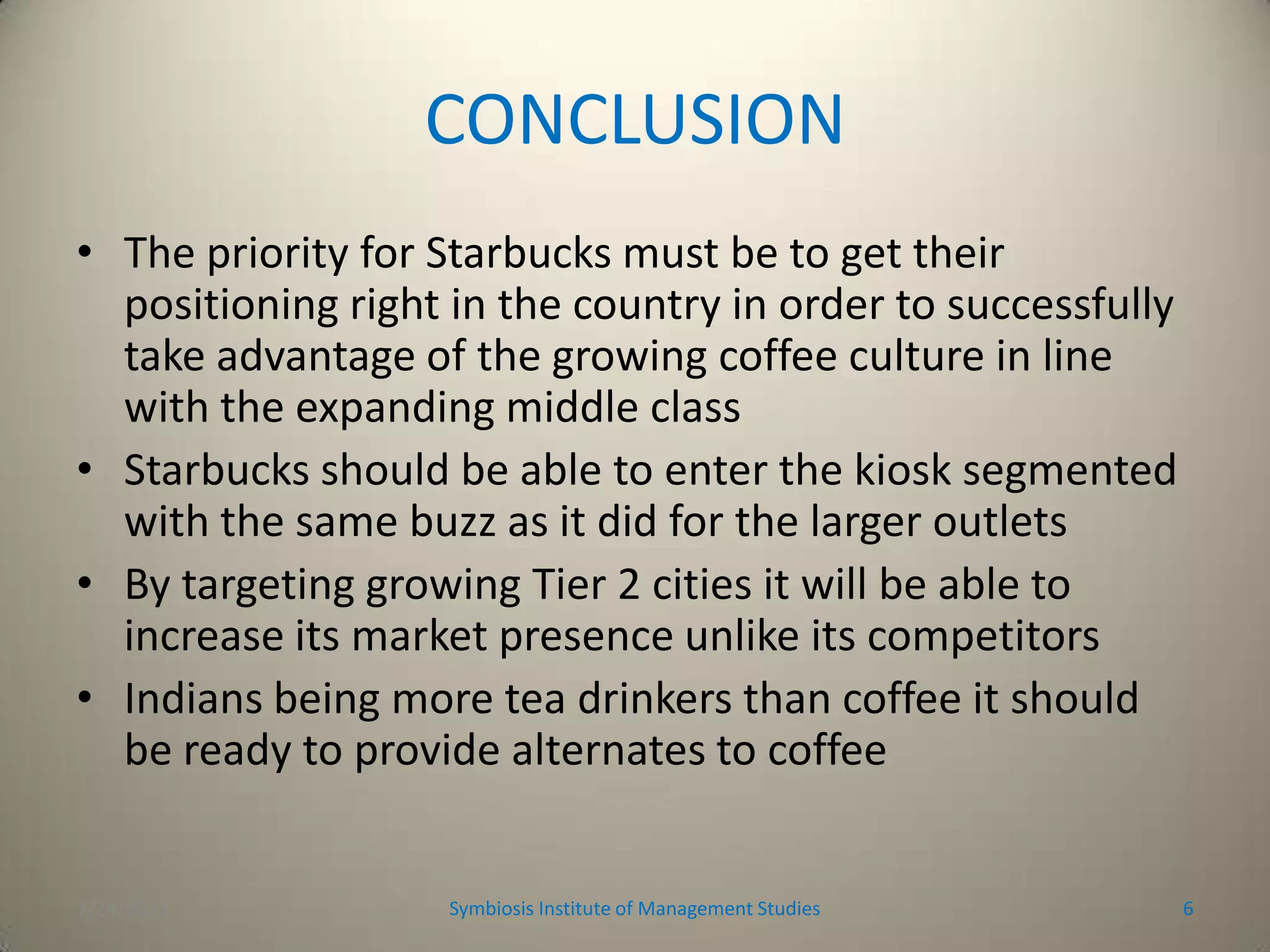
CONCLUSION
• The priority for Starbucks must be to get their
positioning right in the country in order to successfully
take advantage of the growing coffee culture in line
with the expanding middle class
• Starbucks should be able to enter the kiosk segmented
with the same buzz as it did for the larger outlets
• By targeting growing Tier 2 cities it will be able to
increase its market presence unlike its competitors
• Indians being more tea drinkers than coffee it should
be ready to provide alternates to coffee
7/24/2013 Symbiosis Institute of Management Studies 6

A case study on tata starbucks strategic plan

  • 1.
    A CASE STUDYON TATA STARBUCKS STRATEGIC PLAN TO OPEN KIOSKS IN INDIA Presented by Mandeep Singh Roll no 54 Section- D SIMS 2013-2015
  • 2.
    Coffee Kiosk Market •After surging during the past decade, the Coffee and Snack Shops industry experienced a major slowdown in 2009 due to a struggling economy and, to a lesser extent, changing consumer tastes in US and UK • After revenue declined 6.6% to $25.9 billion in 2009, it resumed its upward climb between 2010 and 2012 in the US • Outlook for the Indian coffee kiosk sector is much more attractive as a result of lower levels of market saturation and continued industry dynamism • BMI is forecasting a CAGR of 9.1% to 2017, in volume terms, as the country's rapidly expanding middle class embraces café culture • Given the expansion capacity of Starbucks and Dunkin' Donuts and their Indian ambitions, there will be considerable dynamism in the coffee sector over the coming years • The biggest players in this industry in the world are Starbucks and Costa • While in India the major players are Café day express, Nescafe , Gloria Jean’s Coffee, Costa, Dunkin donuts and other local players 7/24/2013 2Symbiosis Institute of Management Studies
  • 3.
    Comparative Analysis Coffee Day Express NescafeCosta Dunkin Donuts Gloria Jeans Coffee Company Amalgamated Bean Coffee Trading Company Ltd Nestle India Whitebread PLC Devyani International Ltd( Indian franchise owner) Jubilant Foodworks Citymax India(Indian Retailer) Gloria jean’s Number of Kiosks 900+ 400+ 25 30 16 Cities Tier 1 and tier 2 cities Across India Metro cities mainly north India Metro Cities Mumbai, Pune, Bangalore, New Delhi Pricing Cup of coffee Costs Rs 20 Cup of coffee costs Rs 20 A cup of coffee cost Rs 60 A Cup of coffee Costs Rs 50 A cup of coffee costs Rs 50 Locations Colleges, IT/ITES companies, Hospitals, Airports, Railway Stations Colleges, IT/ITES companies, Hospitals, Airports, Railway Stations Schools Airports, Malls, Multiplexes Malls, Airports Malls, Multiplexes 7/24/2013 3Symbiosis Institute of Management Studies
  • 4.
    7/24/2013 Symbiosis Instituteof Management Studies 4 0 2 4 6 8 10 12 Rs 51-75 Rs 0-30 Rs 76-100 Rs 31-50 Rs 100 and above R E S P O N D E N T S PRICE OF A CUP OF COFFEE How much do you spend on a cup of coffee? Total 8 8 9 5 5 0 1 2 3 4 5 6 7 8 9 10 1 2 3 4 5 R E S P O N D E N T S Ratings- 1-Delighted 5- don't care Rate your level of excitement if a starbucks outlet opens up near you? Total Barista 17% brewberrys 3% Cafe Day Express 43% Costa Coffee 17% Nescafe 11% Starbucks 9% Which coffee outlet do you prefer the most? •The research shows the penetration of the market by Coffee Day Express •It shows the eagerness with which the customers are waiting for a Starbucks Experience •It shows how important is to provide the right value for money to the Indian customer
  • 5.
    7/24/2013 Symbiosis Instituteof Management Studies 5 BUSINESS STRATEGY Customer Retention is the key to a better brand equity Though expanding fast in new geographies, must realize importance of customer retention Customer retention 5 times cheaper than new customer: Greater retention  greater brand equity  greater sales  profits How to gain Sustainable Competitive Advantage in Newer Economies Sustainable competitive advantage lies not in one, but a combination of multiple resources, each of which individually need not necessarily be the best, but in overall weighted average terms, presents the best solution. • Product Quality • Prices • Service PRODUCT STARBUCKS KIOSKS TARGET MARKET •Between the ages of 20-35 yrs, college students, IT/ITES Professionals •Brand conscious and people looking for higher quality COMPETITIVE ADVANTAGE Need to focus on the quality and the experience provided by the kiosk. Competitive pricing in the range of Rs 50-75 Per cup of coffee Providing Indian products in their product package Providing a complete STARBUCKS experience PLAN FOR EXECUTION Initial Capital required/Kiosk = Rs 5,00,000- Rs 10,00,000 Daily Sales expected = Rs 3,000 – Rs 10,000 Area covered/Kiosk = 100-150 sq. ft lOCATION Ideal location for the flagship kiosks will be a mall with an average footfall of 25000 – 40000 ( Phoenix mall or Amanora Park Town)
  • 6.
    CONCLUSION • The priorityfor Starbucks must be to get their positioning right in the country in order to successfully take advantage of the growing coffee culture in line with the expanding middle class • Starbucks should be able to enter the kiosk segmented with the same buzz as it did for the larger outlets • By targeting growing Tier 2 cities it will be able to increase its market presence unlike its competitors • Indians being more tea drinkers than coffee it should be ready to provide alternates to coffee 7/24/2013 Symbiosis Institute of Management Studies 6