BJMP 6023
SUPPLY CHAIN MANAGEMENT
1. Hafizullah Amin 822481
2. Siti Nur Ayunnie Bt Mirin 822418
3. Mohd Tarmin Ismail 821830
4. Zuhadi Shamsuddin 822416 1
1. Introduction
-Big Data Definition
-History of Big Data
2. How Big Data is Shaping the Supply Chains of Tomorrow
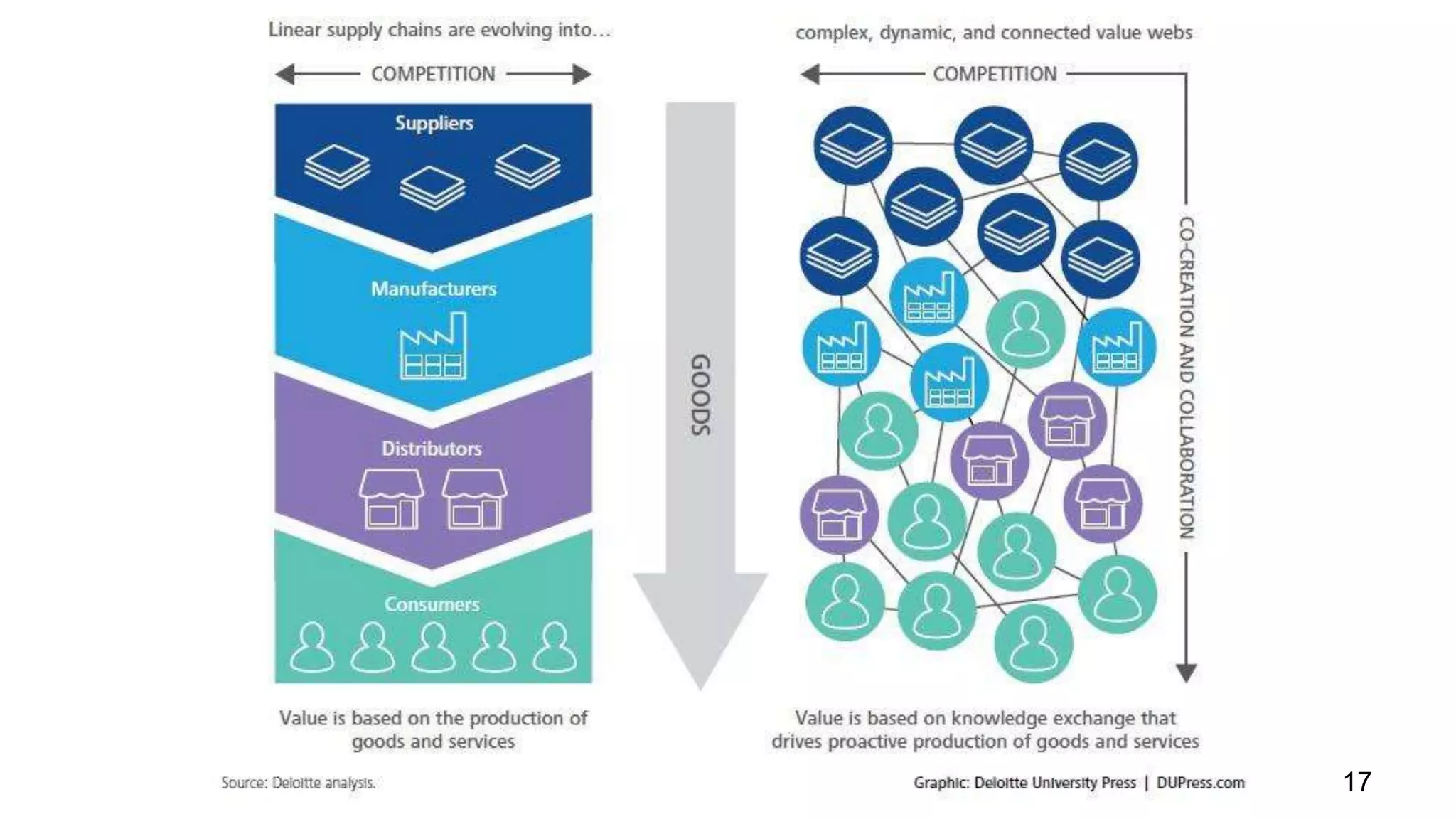
3. Big vs. Small Data in Supply Chain
4. Big Data Application in Supply Chain Operations
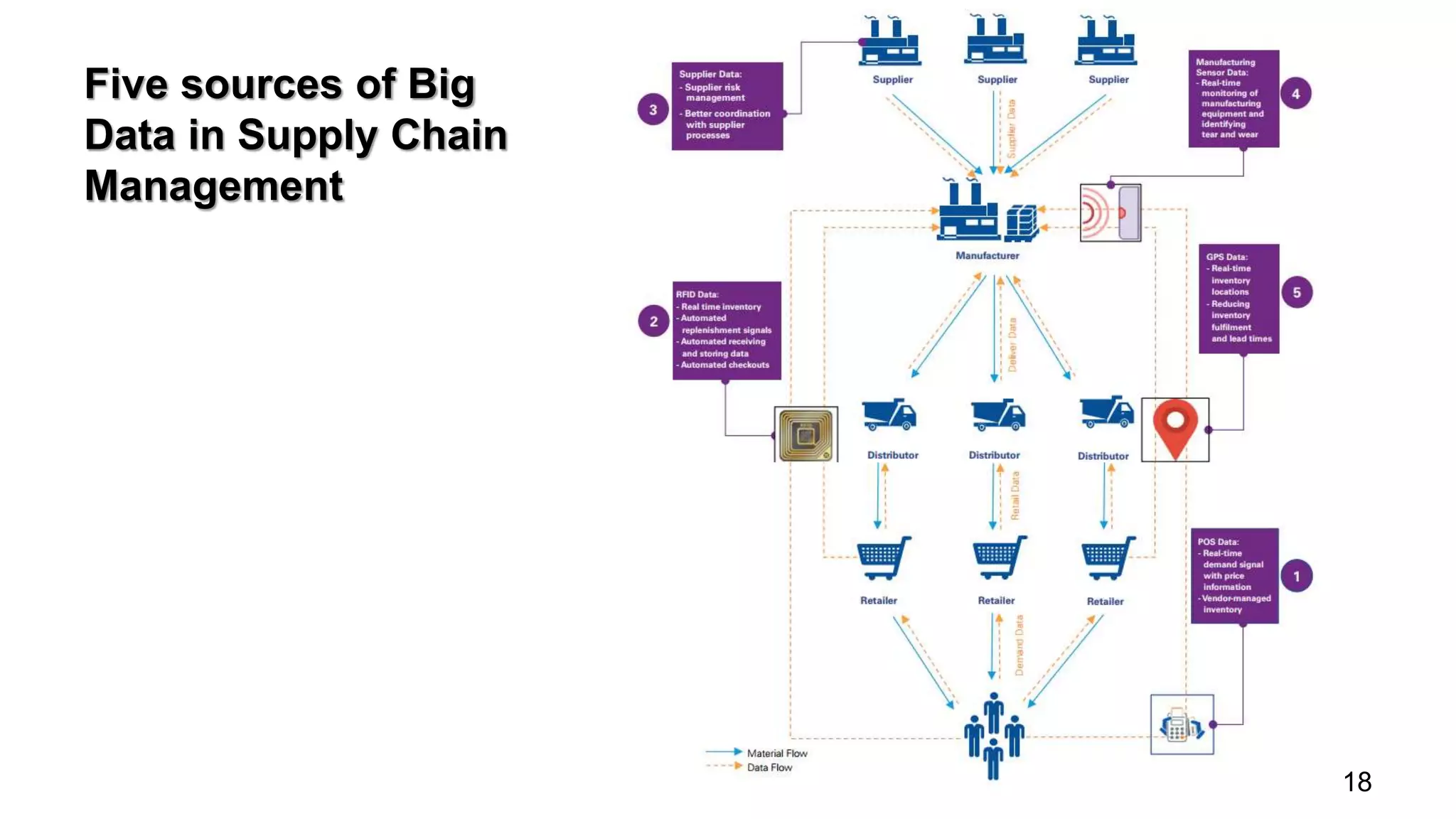
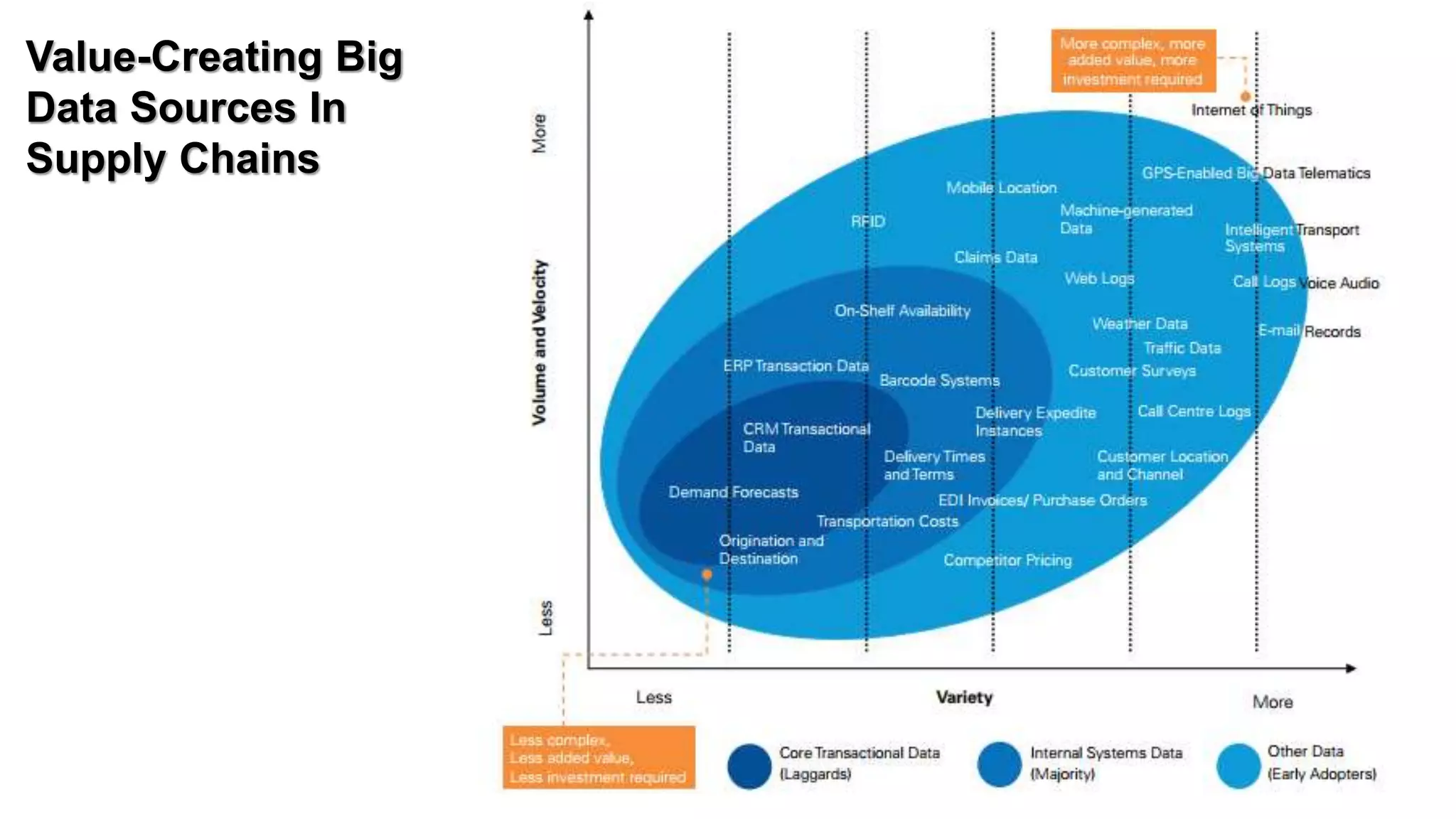
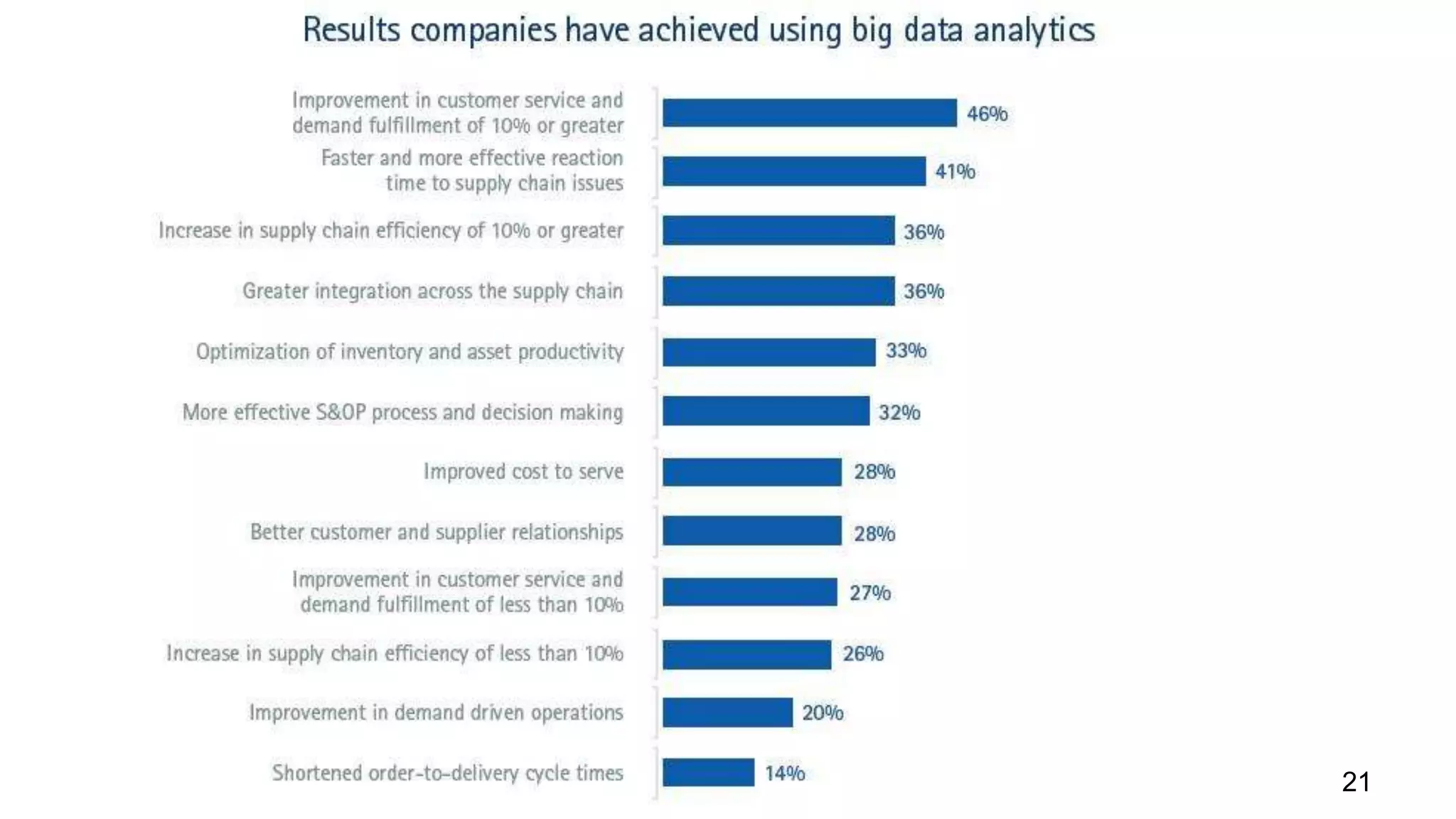
5. Value-Creating Big Data Sources in Supply Chains
6. How Can an Organization Become Big-Data Enabled in Supply Chai
n Management
7. The Future of Big Data
8. Conclusion
Content
2
Introduction
3
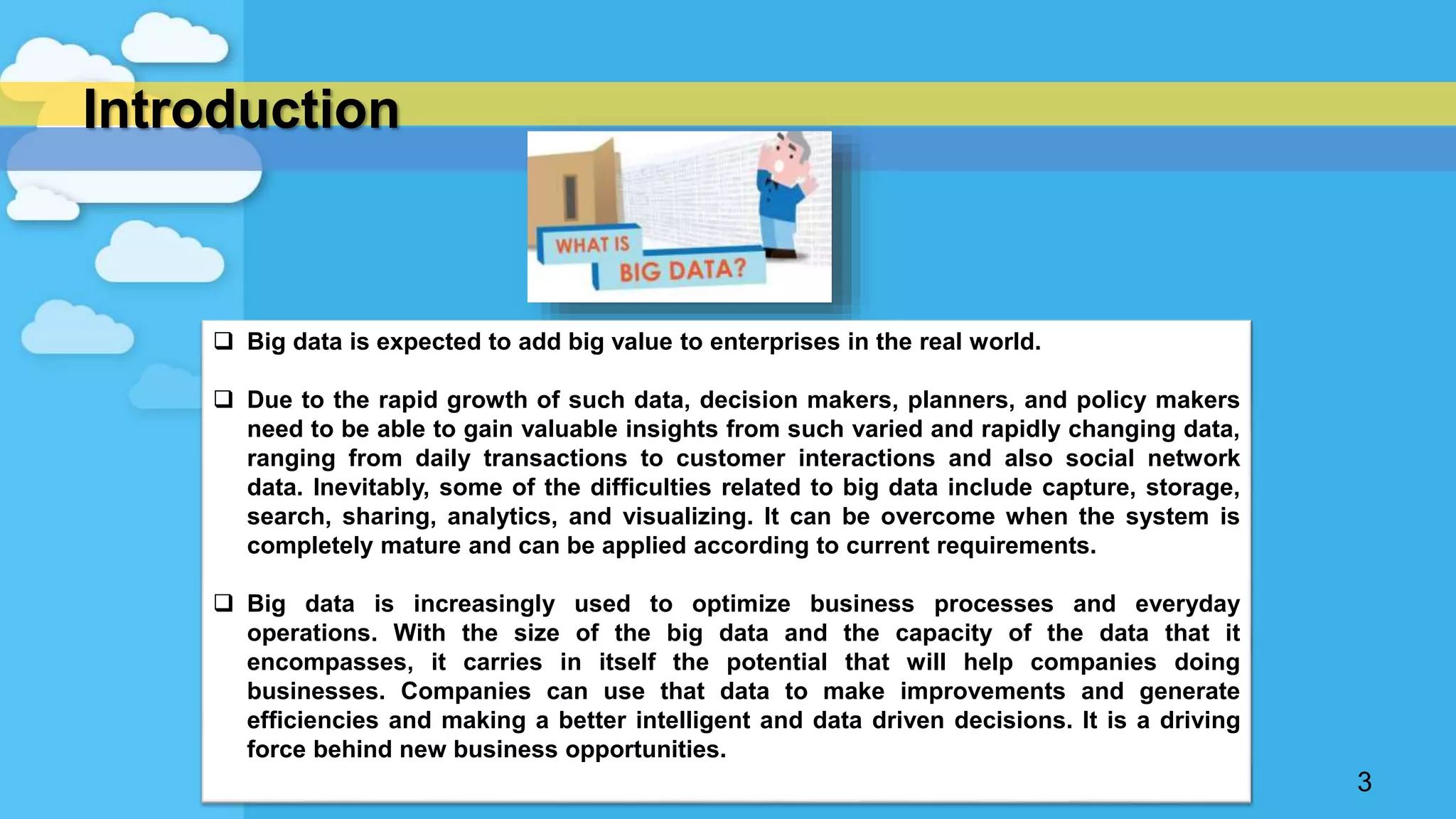
 Big data is expected to add big value to enterprises in the real world.
 Due to the rapid growth of such data, decision makers, planners, and policy makers
need to be able to gain valuable insights from such varied and rapidly changing data,
ranging from daily transactions to customer interactions and also social network
data. Inevitably, some of the difficulties related to big data include capture, storage,
search, sharing, analytics, and visualizing. It can be overcome when the system is
completely mature and can be applied according to current requirements.
 Big data is increasingly used to optimize business processes and everyday
operations. With the size of the big data and the capacity of the data that it
encompasses, it carries in itself the potential that will help companies doing
businesses. Companies can use that data to make improvements and generate
efficiencies and making a better intelligent and data driven decisions. It is a driving
force behind new business opportunities.
Definition
4
BIGDATA A term that
describes the large
volume of data –
both structured and
unstructured – that
inundates a
business on a day-
to-day basis. But it's
not the amount
of data that's
important. It's what
organizations do
with the data that
matters.
BIGDATA
“A high-volume,
high-velocity
and/or high-variety
information assets
that demand cost-
effective, innovative
forms of information
processing that
enable enhanced
insight, decision
making, and
process
automation.“(Gartne
r,2012 )
BIGDATA
It refers to a process
that is used when
traditional data
mining and handling
techniques cannot
uncover the insights
and meaning of the
underlying data. Data
that is unstructured or
time sensitive or
simply very large
cannot be processed
by relational database
engines. This type of
data requires a
different processing
approach called big
data, which uses
massive parallelism on
readily-available
hardware.
History of Big Data
5
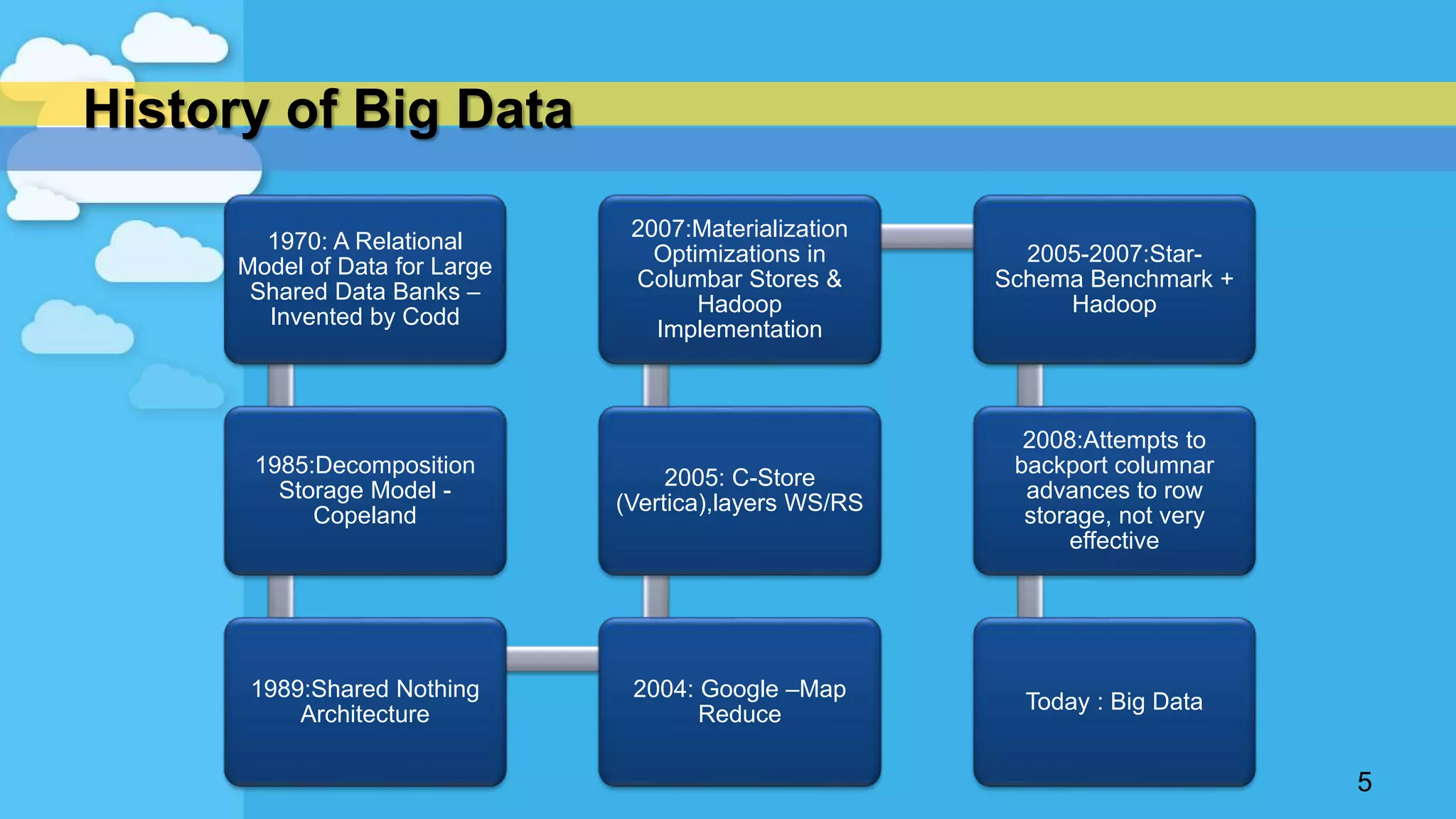
1970: A Relational
Model of Data for Large
Shared Data Banks –
Invented by Codd
1985:Decomposition
Storage Model -
Copeland
1989:Shared Nothing
Architecture
2004: Google –Map
Reduce
2005: C-Store
(Vertica),layers WS/RS
2007:Materialization
Optimizations in
Columbar Stores &
Hadoop
Implementation
2005-2007:Star-
Schema Benchmark +
Hadoop
2008:Attempts to
backport columnar
advances to row
storage, not very
effective
Today : Big Data
.
Concepts
6
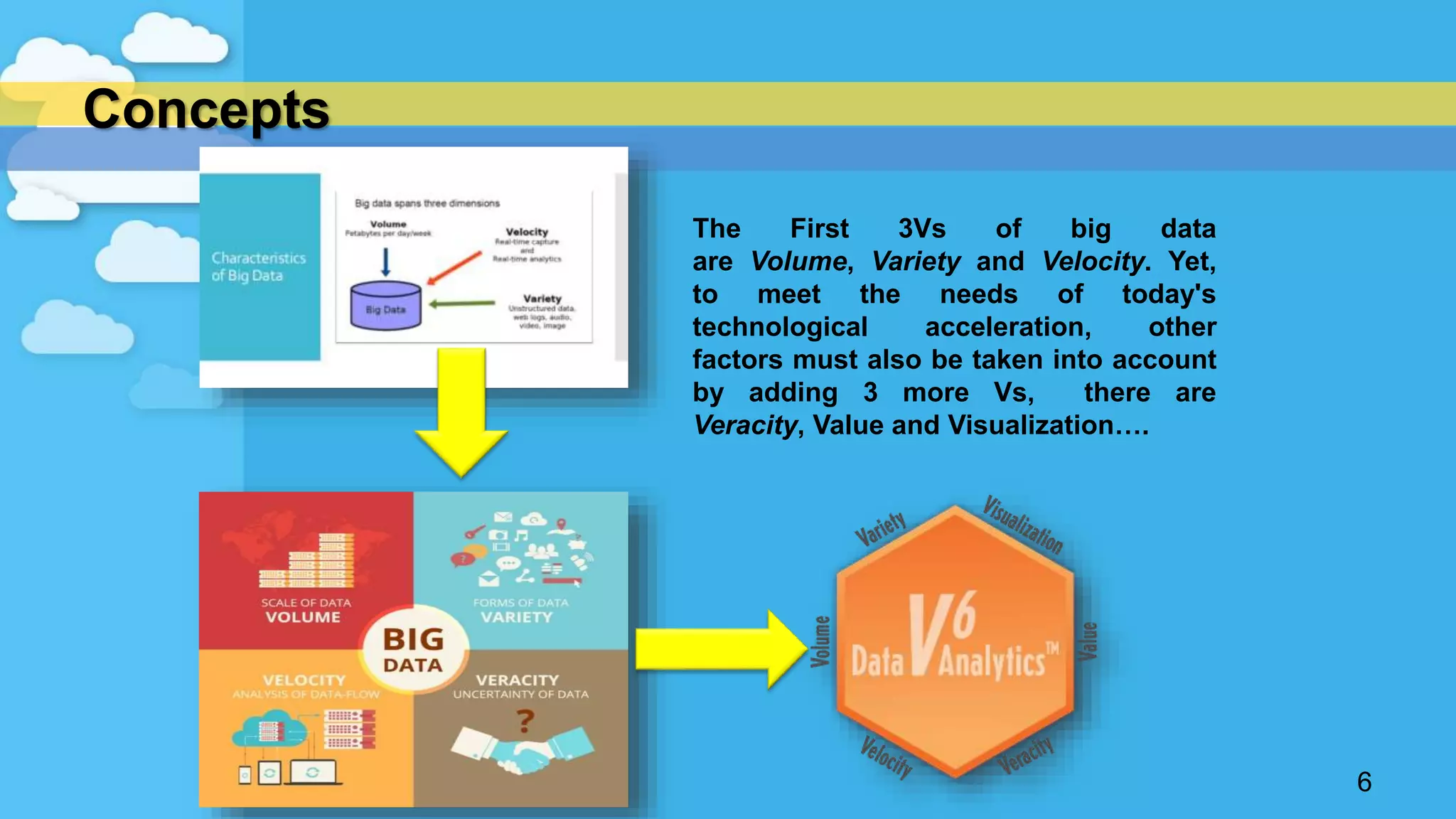
The First 3Vs of big data
are Volume, Variety and Velocity. Yet,
to meet the needs of today's
technological acceleration, other
factors must also be taken into account
by adding 3 more Vs, there are
Veracity, Value and Visualization….
Concepts
7
Big Data upgrade
Those who use Big Data often use the Three Vs model to describe it. The three Vs represent:
 Volume
 Variety
 Velocity
To meet the latest needs, at least three more Vs must be added, which is
Veracity - It is about making sure that the Big Data is accurate
Value - It refers to the relative value of the Big Data process
outcomes
Visualization - It is an important way for architects, planners, and
policy experts to communicate with the public
*Visualization example: Access to government data, an interactive data visualizations that invite public participation
Big Data Shaping The Supply Chains
8
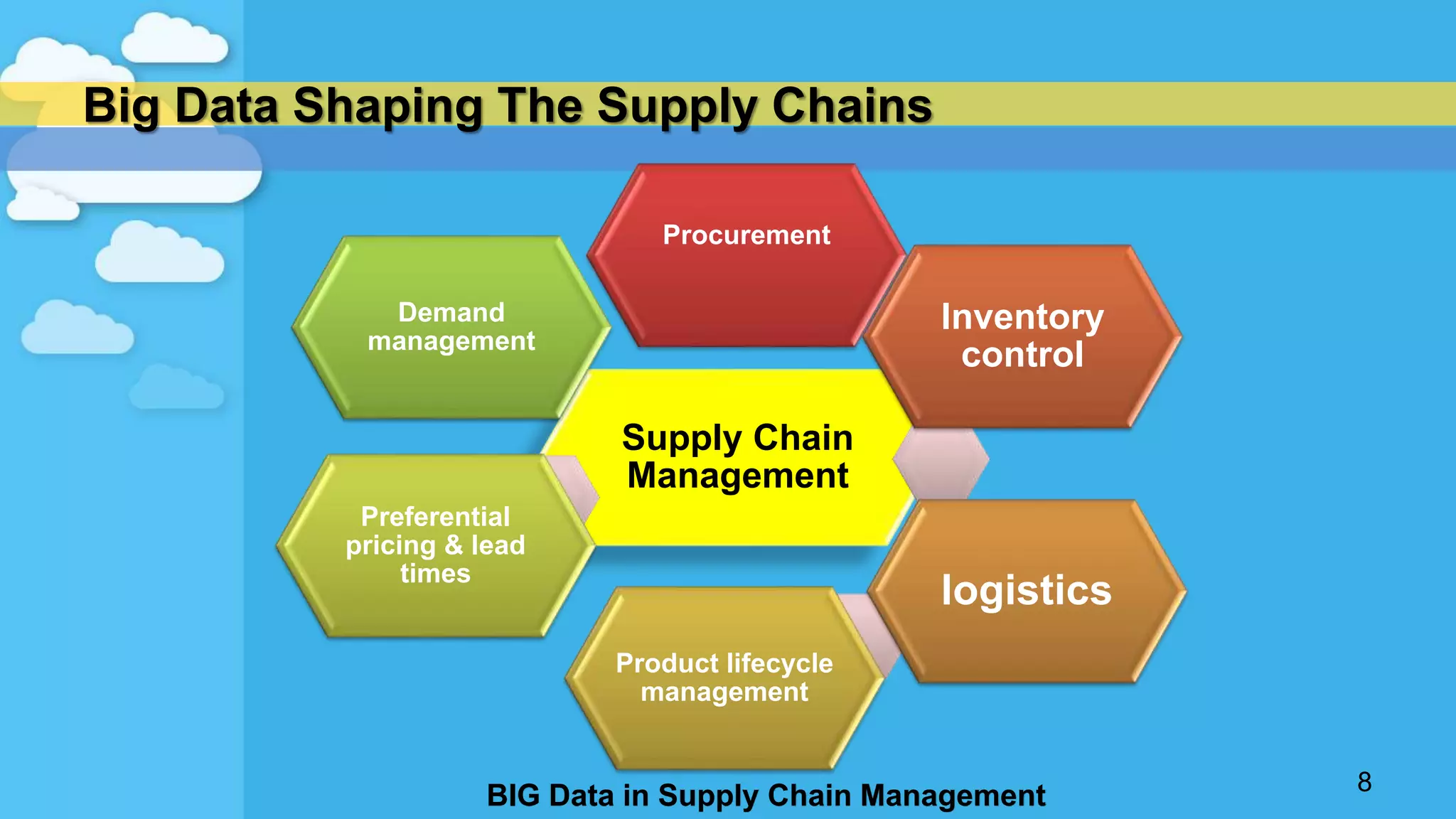
Supply Chain
Management
Procurement
Inventory
control
logistics
Product lifecycle
management
Preferential
pricing & lead
times
Demand
management
BIG Data in Supply Chain Management
Big Data Shaping The Supply Chains
9
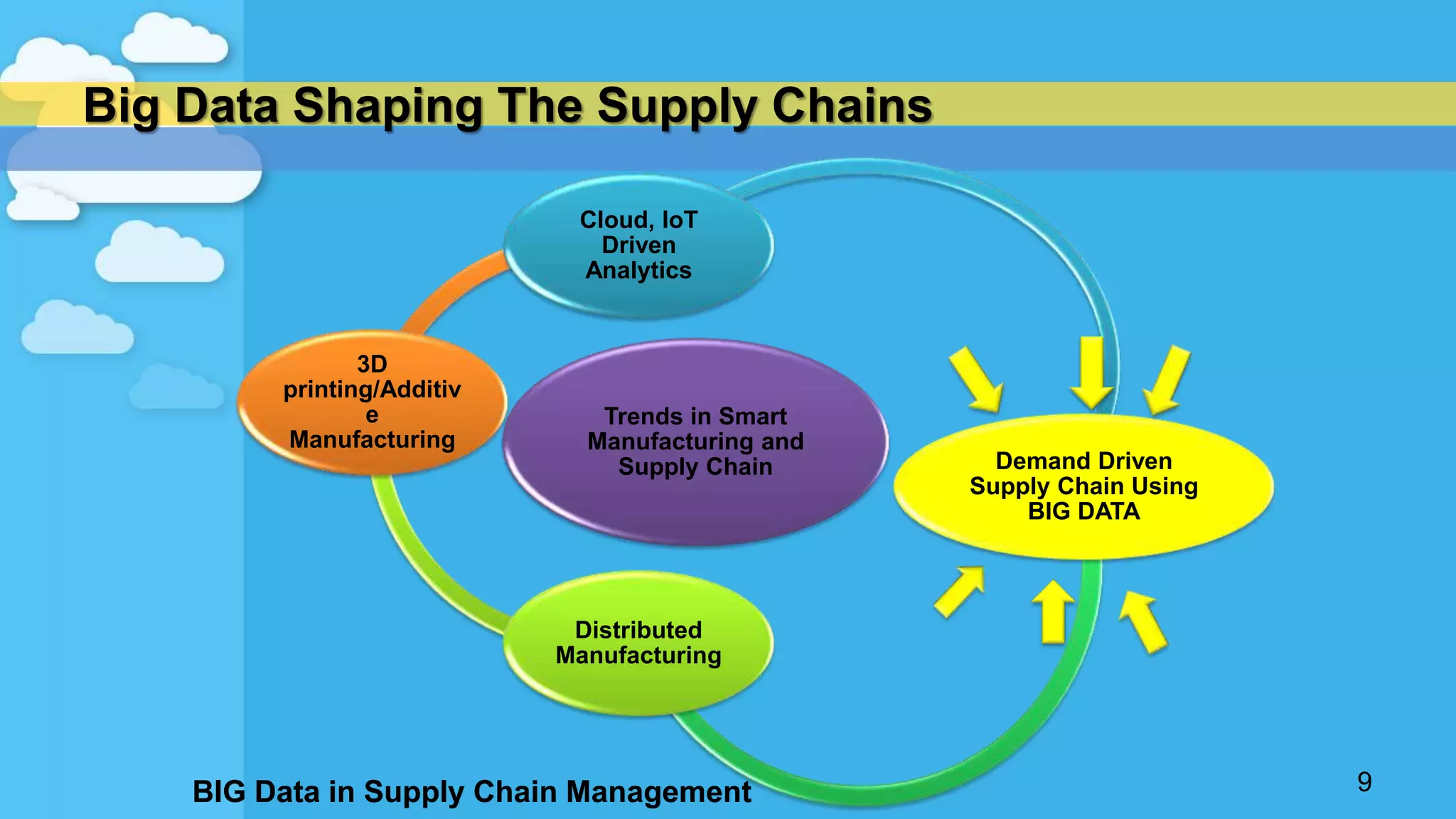
Trends in Smart
Manufacturing and
Supply Chain
Cloud, IoT
Driven
Analytics
Demand Driven
Supply Chain Using
BIG DATA
Distributed
Manufacturing
3D
printing/Additiv
e
Manufacturing
BIG Data in Supply Chain Management
Big Data Shaping The Supply Chains
10
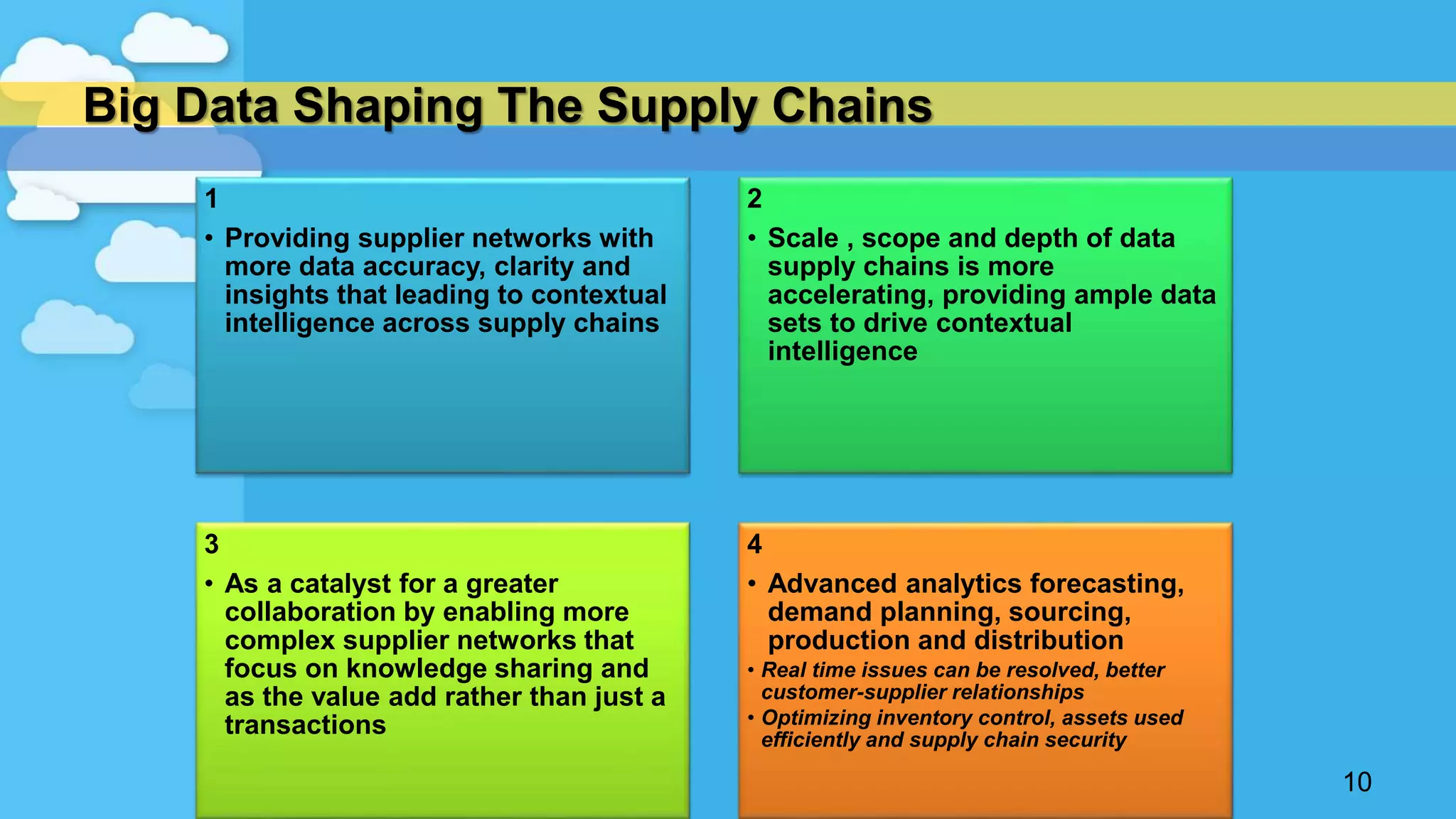
1
• Providing supplier networks with
more data accuracy, clarity and
insights that leading to contextual
intelligence across supply chains
2
• Scale , scope and depth of data
supply chains is more
accelerating, providing ample data
sets to drive contextual
intelligence
3
• As a catalyst for a greater
collaboration by enabling more
complex supplier networks that
focus on knowledge sharing and
as the value add rather than just a
transactions
4
• Advanced analytics forecasting,
demand planning, sourcing,
production and distribution
• Real time issues can be resolved, better
customer-supplier relationships
• Optimizing inventory control, assets used
efficiently and supply chain security
Big Data Shaping The Supply Chains
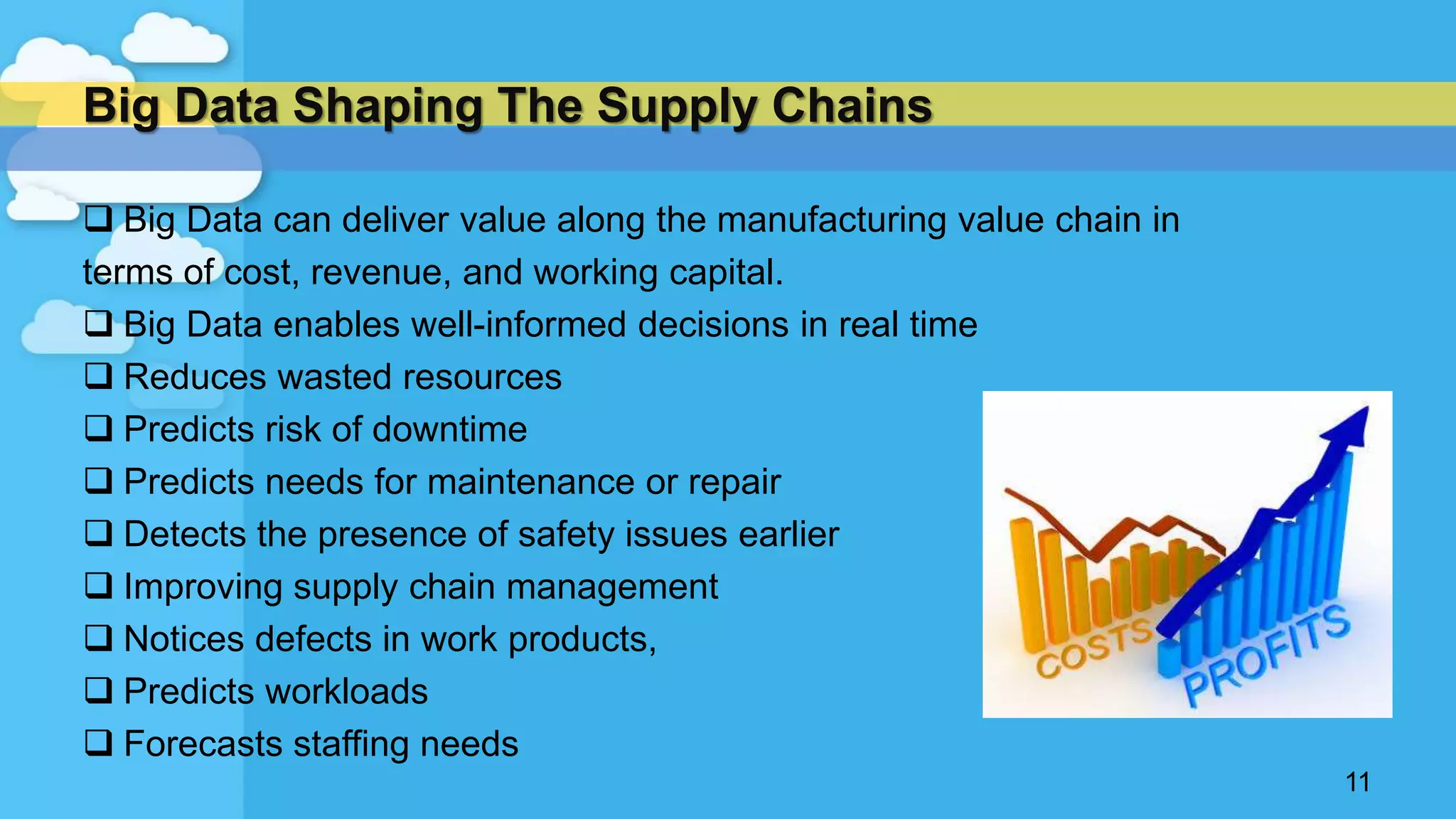
 Big Data can deliver value along the manufacturing value chain in
terms of cost, revenue, and working capital.
 Big Data enables well-informed decisions in real time
 Reduces wasted resources
 Predicts risk of downtime
 Predicts needs for maintenance or repair
 Detects the presence of safety issues earlier
 Improving supply chain management
 Notices defects in work products,
 Predicts workloads
 Forecasts staffing needs
11
Big Data vs. Small Data in Supply Chain
12
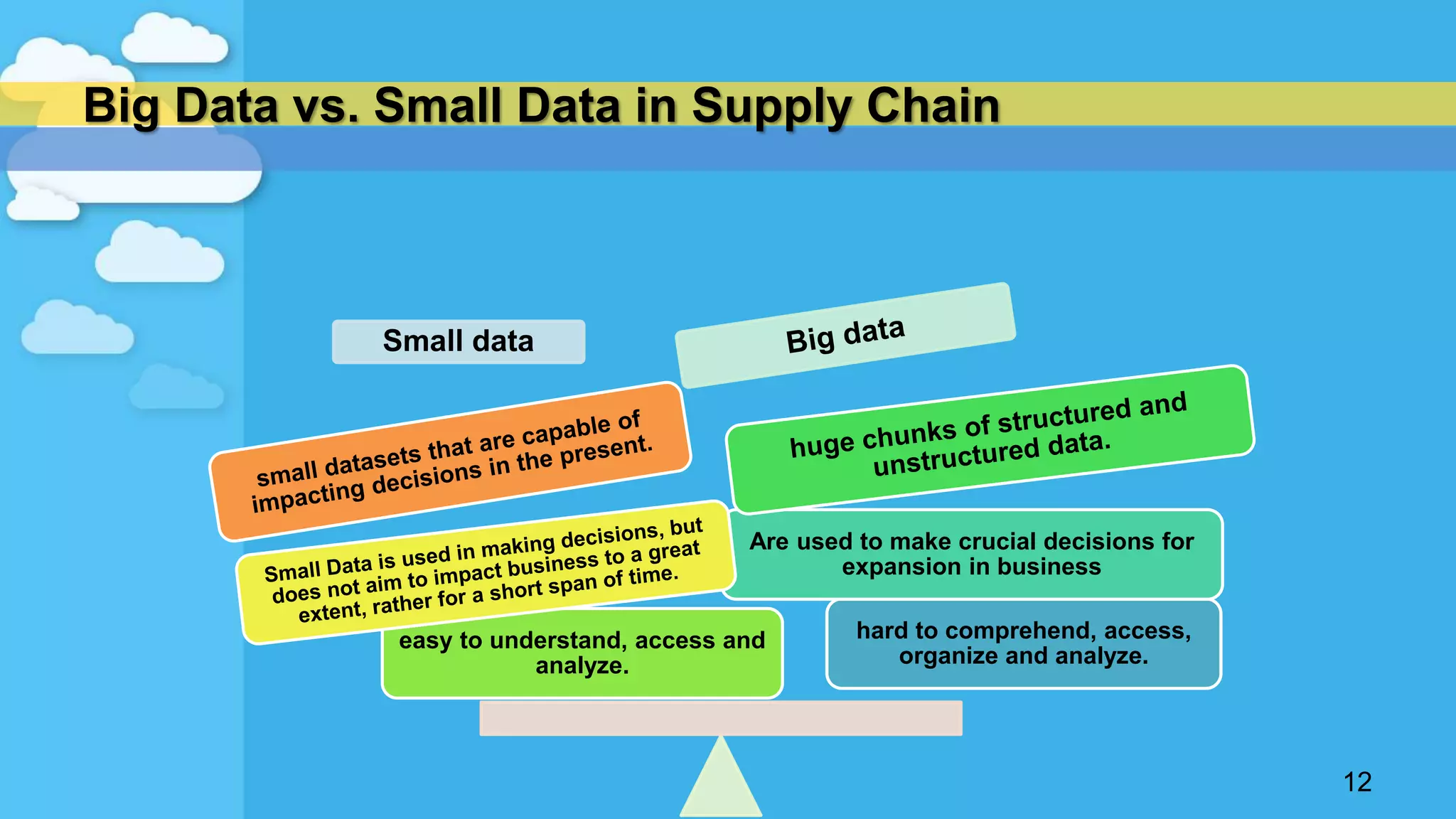
Small data
hard to comprehend, access,
organize and analyze.
Are used to make crucial decisions for
expansion in business
easy to understand, access and
analyze.
Big Data vs. Small Data in Supply Chain
13
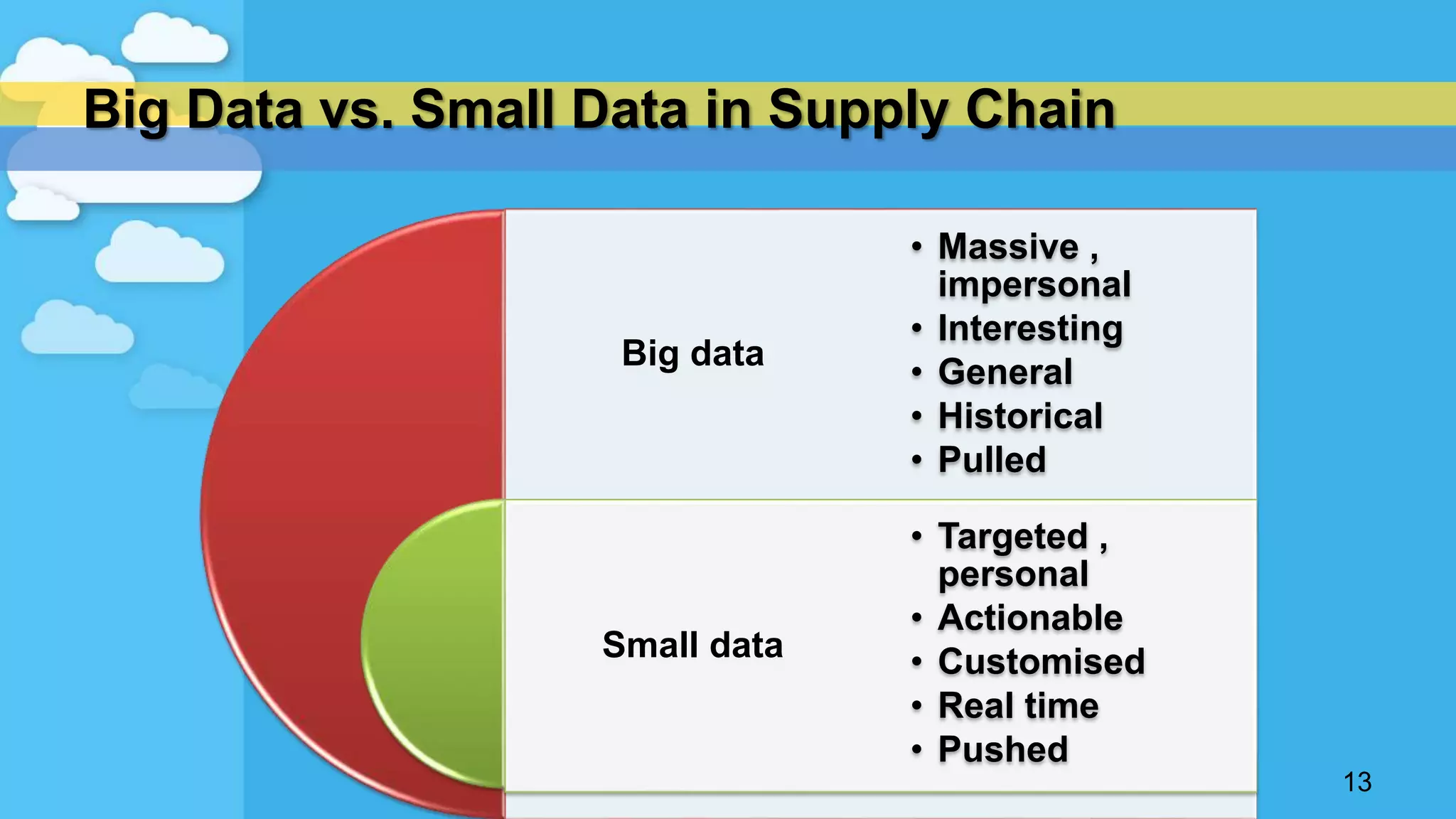
Big data
Small data
• Massive ,
impersonal
• Interesting
• General
• Historical
• Pulled
• Targeted ,
personal
• Actionable
• Customised
• Real time
• Pushed
Big Data Application in Supply Chain Operations
14
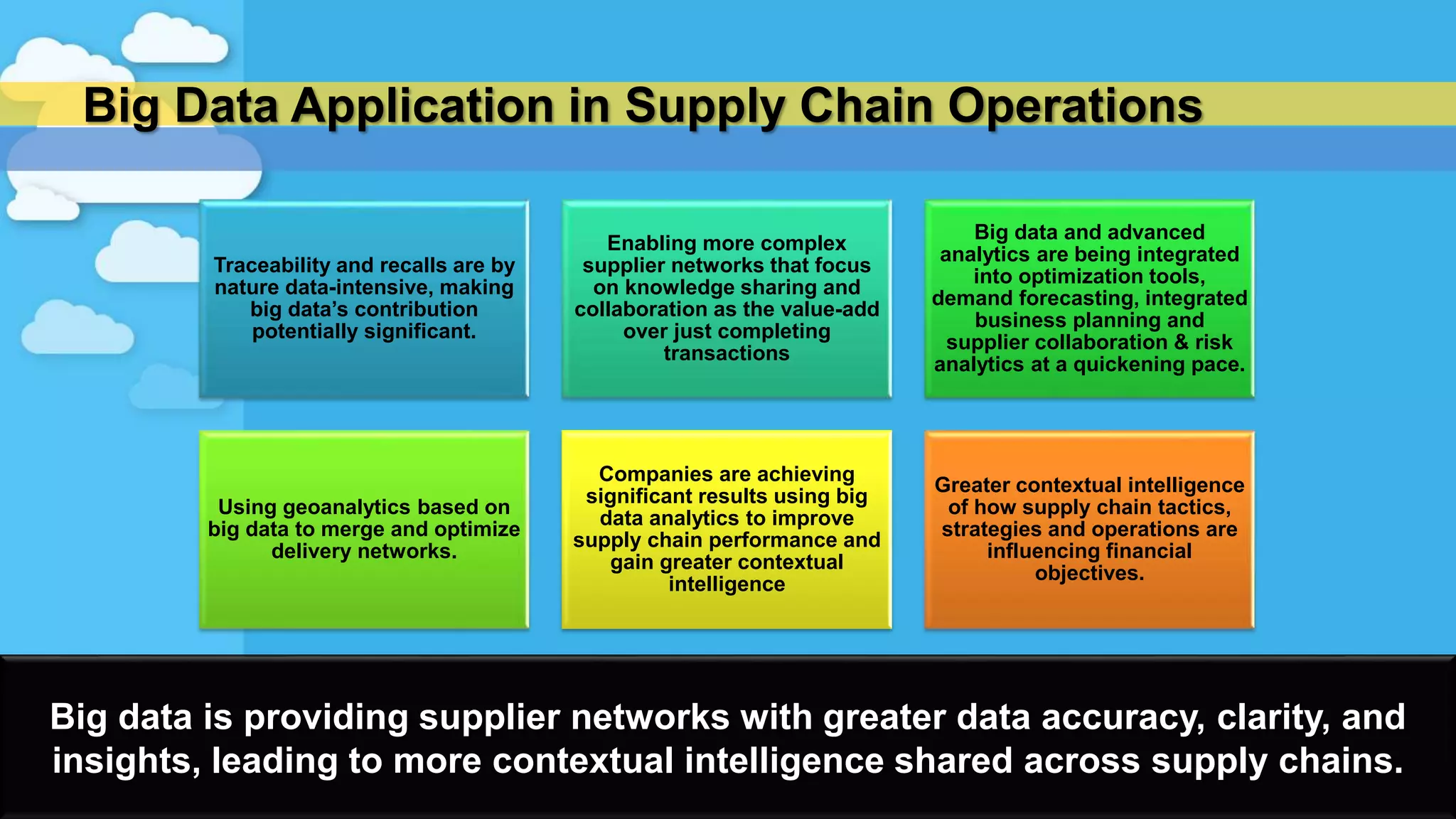
Traceability and recalls are by
nature data-intensive, making
big data’s contribution
potentially significant.
Enabling more complex
supplier networks that focus
on knowledge sharing and
collaboration as the value-add
over just completing
transactions
Big data and advanced
analytics are being integrated
into optimization tools,
demand forecasting, integrated
business planning and
supplier collaboration & risk
analytics at a quickening pace.
Using geoanalytics based on
big data to merge and optimize
delivery networks.
Companies are achieving
significant results using big
data analytics to improve
supply chain performance and
gain greater contextual
intelligence
Greater contextual intelligence
of how supply chain tactics,
strategies and operations are
influencing financial
objectives.
Big data is providing supplier networks with greater data accuracy, clarity, and
insights, leading to more contextual intelligence shared across supply chains.
15
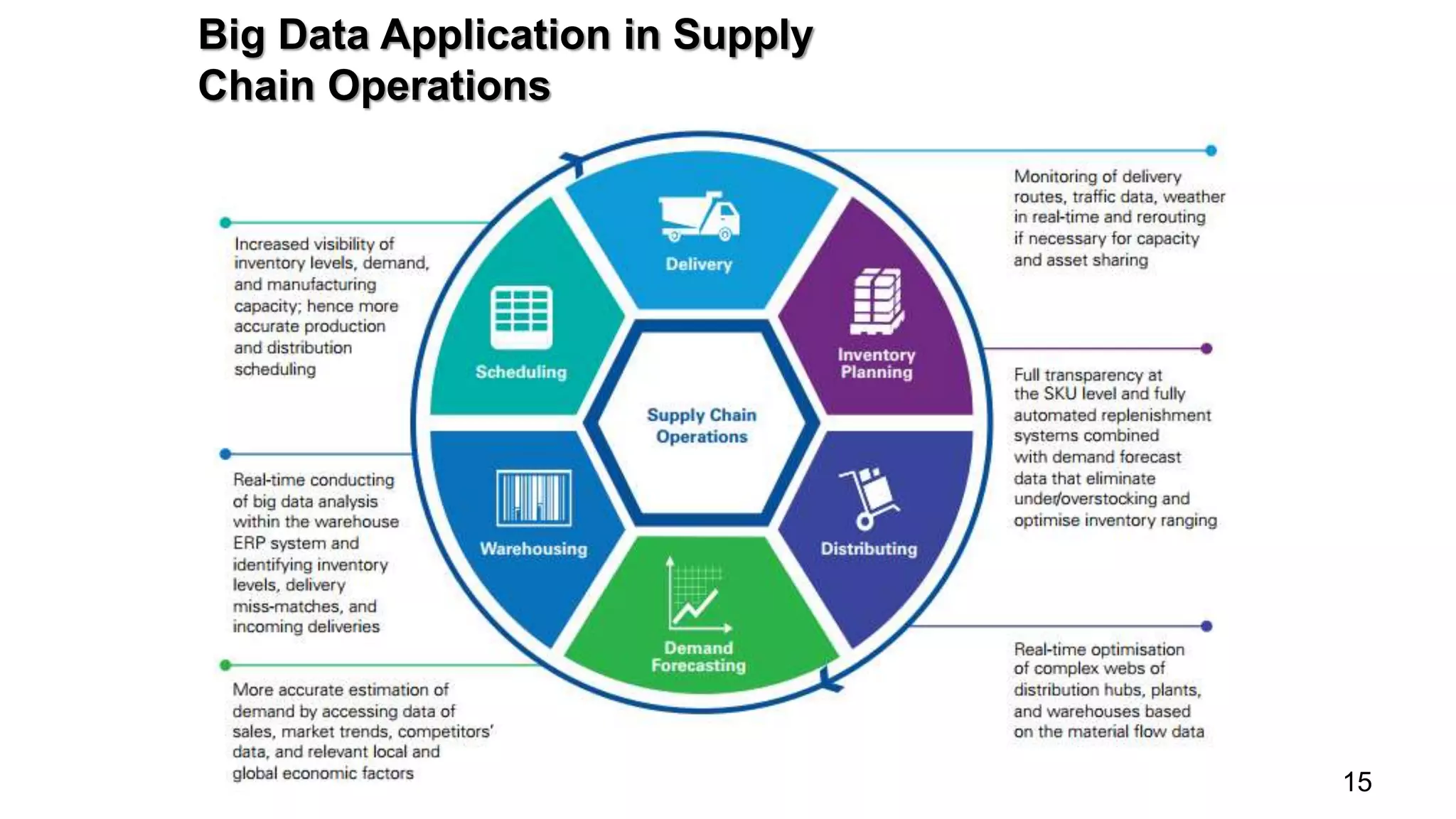
Big Data Application in Supply
Chain Operations
Value-Creating Big Data Sources In Supply Chains
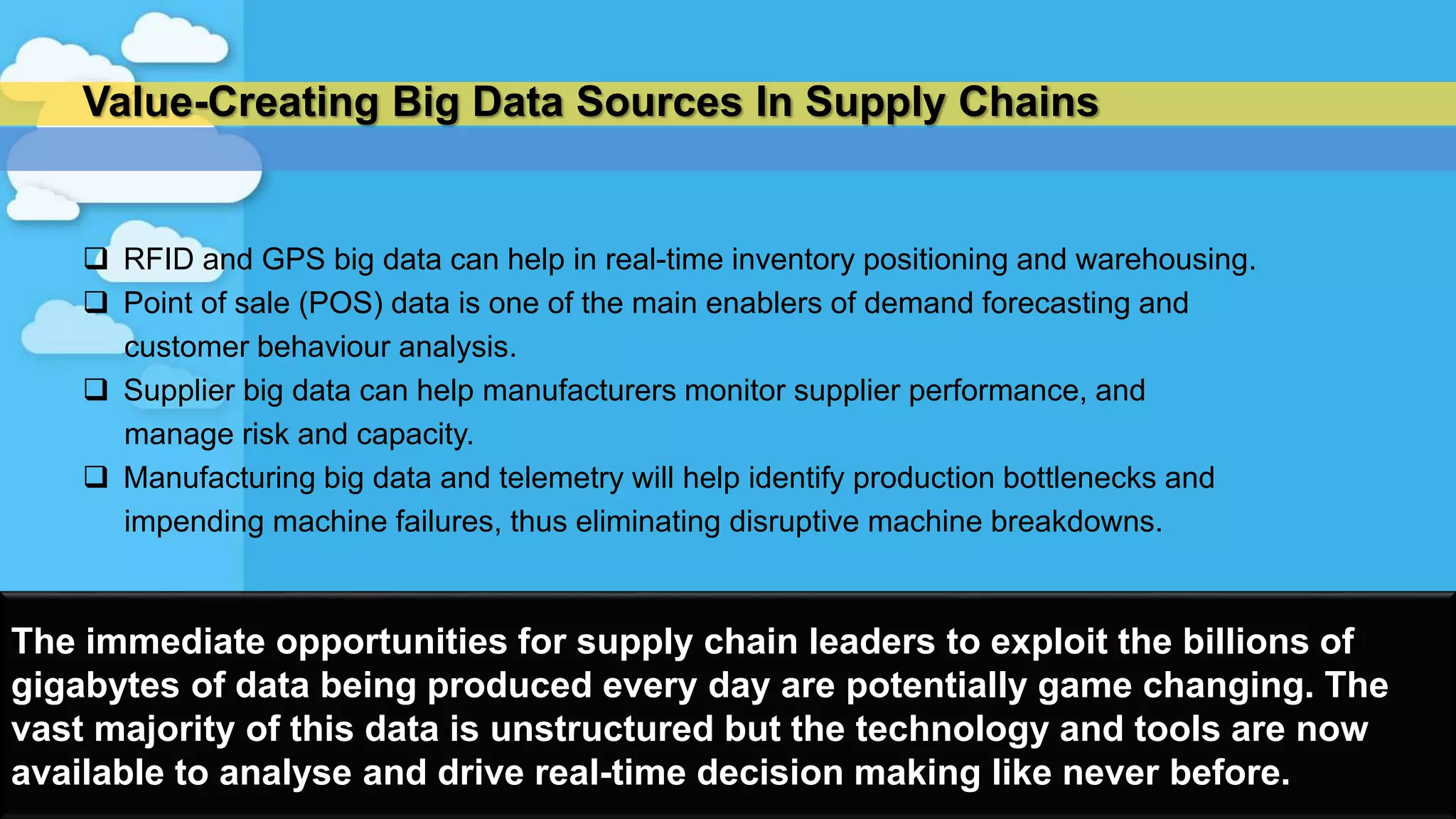
 RFID and GPS big data can help in real-time inventory positioning and warehousing.
 Point of sale (POS) data is one of the main enablers of demand forecasting and
customer behaviour analysis.
 Supplier big data can help manufacturers monitor supplier performance, and
manage risk and capacity.
 Manufacturing big data and telemetry will help identify production bottlenecks and
impending machine failures, thus eliminating disruptive machine breakdowns.
16
The immediate opportunities for supply chain leaders to exploit the billions of
gigabytes of data being produced every day are potentially game changing. The
vast majority of this data is unstructured but the technology and tools are now
available to analyse and drive real-time decision making like never before.
17
18
Five sources of Big
Data in Supply Chain
Management
19
Value-Creating Big
Data Sources In
Supply Chains
20
The Advantages of Big Data in Supply Chain Management
Get better
diagnostic
information
Get a clearer
“crystal ball” for
the future
Manage
external factors
that are beyond
your control
Reduce demand
variability and
cycle times
Make more
profitable supply
chain demand
forecasts
Prepare for the
‘SNEW’ wave
21
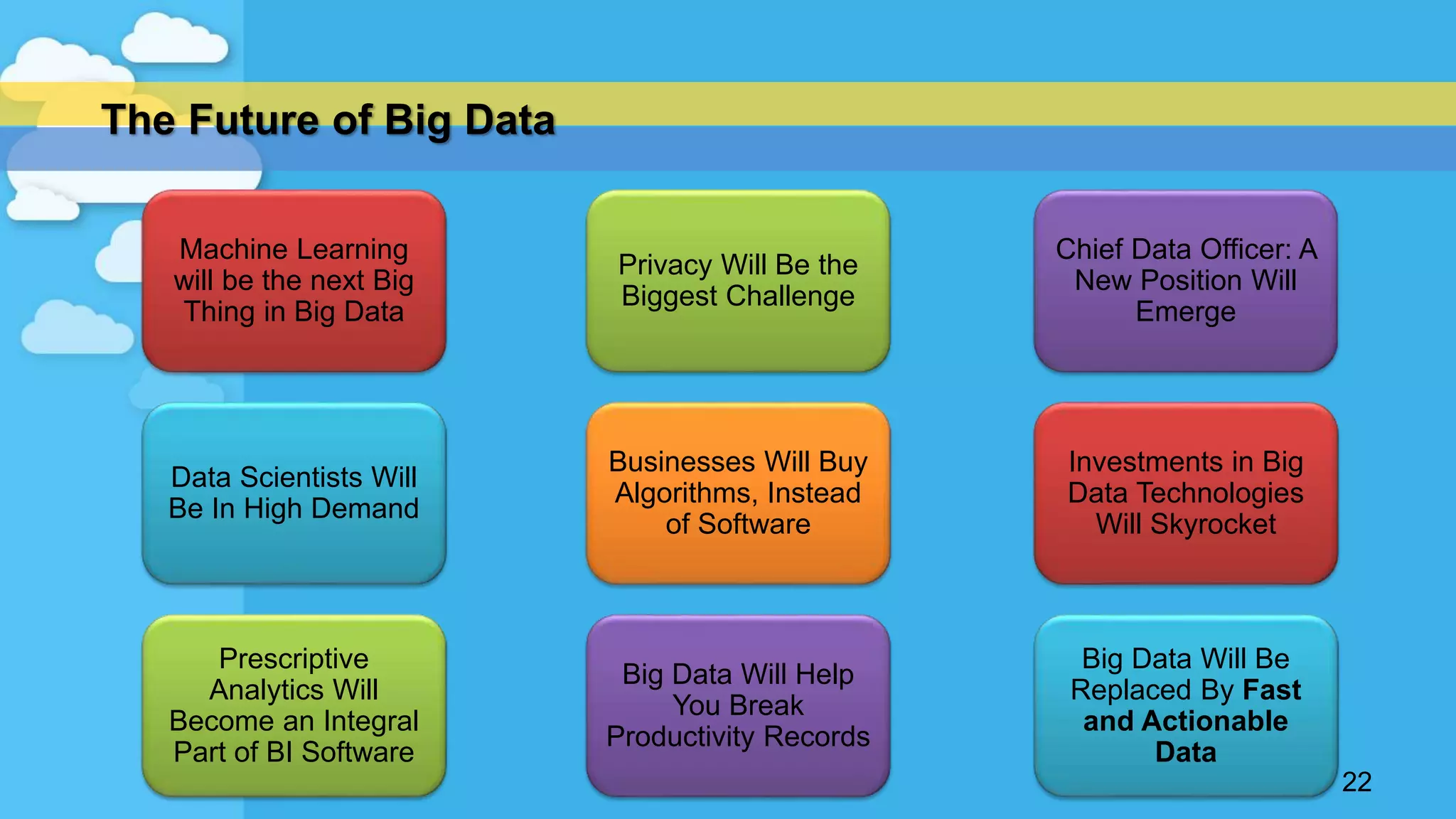
22
Machine Learning
will be the next Big
Thing in Big Data
Privacy Will Be the
Biggest Challenge
Chief Data Officer: A
New Position Will
Emerge
Data Scientists Will
Be In High Demand
Businesses Will Buy
Algorithms, Instead
of Software
Investments in Big
Data Technologies
Will Skyrocket
Prescriptive
Analytics Will
Become an Integral
Part of BI Software
Big Data Will Help
You Break
Productivity Records
Big Data Will Be
Replaced By Fast
and Actionable
Data
The Future of Big Data
 Observing what is happening in the world, given the developments in information
and mobile technology, there is no doubt that we find ourselves in the era of Big Data.
 Anticipating sales volumes, customer preferences for products and optimizing work
schedules are a few examples where proper analysis of big data has the power to help business
succeed.
 It is critical that supply chain management and logistics decision makers take note of
the fact that as data and analytics transform organizations, and the landscape within which they
operate .
 For a successful organization, it is necessary to take a whole range of steps and
actions.
23
Conclusion
 Boyd, D. & Crawford, K. (2012). Critical questions for big data: Provocations for a cultural, technol
ogical, and scholarly phenomenon. Information, Communication and Society. 15 (5) pp.662-679.
 Chen, H., Chiang, R & Storey, V. (2012) Business intelligence and analytics: From big data to big
impact. MIS Quarterly 36 (4) pp.1165-1188.
 LaValle, S., Lesser, E., Shockley, R., Hopkins, M. & Kruschwitz, N. (2010). Big data, analytics and
the path from insights to value. MIT Sloan Management Review.
 Tan, K., Zhan, Y., Ji, G., Ye, F. & Chang, C. (2015) Harvesting big data to enhance supply chain in
novation capabilities: An analytic infrastructure based on deduction graph. International Journal of
Economics. 165 (2015) pp.223-233.
 Waller, M. & Fawcett, S. (2013). Data science, predictive analytics, and big data: A revolution that
will transform supply chain design and management. Journal of Business Logistics. 34 (2) pp.77-
84.
 Wang, G., Gunasekaran, A., Ngai E. & Papadopoulos T. (2016). Big data analytics in logistics and
supply chain management. Certain investigations for research and applications. International Jour
nal of Production Economics. 176 pp.98-110.
 KPMG, Supply Chain Big Data Series Part 1,2,3 & 4 (2017)
24
References

How Big Data Shaping The Supply Chain

  • 1.
    BJMP 6023 SUPPLY CHAINMANAGEMENT 1. Hafizullah Amin 822481 2. Siti Nur Ayunnie Bt Mirin 822418 3. Mohd Tarmin Ismail 821830 4. Zuhadi Shamsuddin 822416 1
  • 2.
    1. Introduction -Big DataDefinition -History of Big Data 2. How Big Data is Shaping the Supply Chains of Tomorrow 3. Big vs. Small Data in Supply Chain 4. Big Data Application in Supply Chain Operations 5. Value-Creating Big Data Sources in Supply Chains 6. How Can an Organization Become Big-Data Enabled in Supply Chai n Management 7. The Future of Big Data 8. Conclusion Content 2
  • 3.
    Introduction 3  Big datais expected to add big value to enterprises in the real world.  Due to the rapid growth of such data, decision makers, planners, and policy makers need to be able to gain valuable insights from such varied and rapidly changing data, ranging from daily transactions to customer interactions and also social network data. Inevitably, some of the difficulties related to big data include capture, storage, search, sharing, analytics, and visualizing. It can be overcome when the system is completely mature and can be applied according to current requirements.  Big data is increasingly used to optimize business processes and everyday operations. With the size of the big data and the capacity of the data that it encompasses, it carries in itself the potential that will help companies doing businesses. Companies can use that data to make improvements and generate efficiencies and making a better intelligent and data driven decisions. It is a driving force behind new business opportunities.
  • 4.
    Definition 4 BIGDATA A termthat describes the large volume of data – both structured and unstructured – that inundates a business on a day- to-day basis. But it's not the amount of data that's important. It's what organizations do with the data that matters. BIGDATA “A high-volume, high-velocity and/or high-variety information assets that demand cost- effective, innovative forms of information processing that enable enhanced insight, decision making, and process automation.“(Gartne r,2012 ) BIGDATA It refers to a process that is used when traditional data mining and handling techniques cannot uncover the insights and meaning of the underlying data. Data that is unstructured or time sensitive or simply very large cannot be processed by relational database engines. This type of data requires a different processing approach called big data, which uses massive parallelism on readily-available hardware.
  • 5.
    History of BigData 5 1970: A Relational Model of Data for Large Shared Data Banks – Invented by Codd 1985:Decomposition Storage Model - Copeland 1989:Shared Nothing Architecture 2004: Google –Map Reduce 2005: C-Store (Vertica),layers WS/RS 2007:Materialization Optimizations in Columbar Stores & Hadoop Implementation 2005-2007:Star- Schema Benchmark + Hadoop 2008:Attempts to backport columnar advances to row storage, not very effective Today : Big Data
  • 6.
    . Concepts 6 The First 3Vsof big data are Volume, Variety and Velocity. Yet, to meet the needs of today's technological acceleration, other factors must also be taken into account by adding 3 more Vs, there are Veracity, Value and Visualization….
  • 7.
    Concepts 7 Big Data upgrade Thosewho use Big Data often use the Three Vs model to describe it. The three Vs represent:  Volume  Variety  Velocity To meet the latest needs, at least three more Vs must be added, which is Veracity - It is about making sure that the Big Data is accurate Value - It refers to the relative value of the Big Data process outcomes Visualization - It is an important way for architects, planners, and policy experts to communicate with the public *Visualization example: Access to government data, an interactive data visualizations that invite public participation
  • 8.
    Big Data ShapingThe Supply Chains 8 Supply Chain Management Procurement Inventory control logistics Product lifecycle management Preferential pricing & lead times Demand management BIG Data in Supply Chain Management
  • 9.
    Big Data ShapingThe Supply Chains 9 Trends in Smart Manufacturing and Supply Chain Cloud, IoT Driven Analytics Demand Driven Supply Chain Using BIG DATA Distributed Manufacturing 3D printing/Additiv e Manufacturing BIG Data in Supply Chain Management
  • 10.
    Big Data ShapingThe Supply Chains 10 1 • Providing supplier networks with more data accuracy, clarity and insights that leading to contextual intelligence across supply chains 2 • Scale , scope and depth of data supply chains is more accelerating, providing ample data sets to drive contextual intelligence 3 • As a catalyst for a greater collaboration by enabling more complex supplier networks that focus on knowledge sharing and as the value add rather than just a transactions 4 • Advanced analytics forecasting, demand planning, sourcing, production and distribution • Real time issues can be resolved, better customer-supplier relationships • Optimizing inventory control, assets used efficiently and supply chain security
  • 11.
    Big Data ShapingThe Supply Chains  Big Data can deliver value along the manufacturing value chain in terms of cost, revenue, and working capital.  Big Data enables well-informed decisions in real time  Reduces wasted resources  Predicts risk of downtime  Predicts needs for maintenance or repair  Detects the presence of safety issues earlier  Improving supply chain management  Notices defects in work products,  Predicts workloads  Forecasts staffing needs 11
  • 12.
    Big Data vs.Small Data in Supply Chain 12 Small data hard to comprehend, access, organize and analyze. Are used to make crucial decisions for expansion in business easy to understand, access and analyze.
  • 13.
    Big Data vs.Small Data in Supply Chain 13 Big data Small data • Massive , impersonal • Interesting • General • Historical • Pulled • Targeted , personal • Actionable • Customised • Real time • Pushed
  • 14.
    Big Data Applicationin Supply Chain Operations 14 Traceability and recalls are by nature data-intensive, making big data’s contribution potentially significant. Enabling more complex supplier networks that focus on knowledge sharing and collaboration as the value-add over just completing transactions Big data and advanced analytics are being integrated into optimization tools, demand forecasting, integrated business planning and supplier collaboration & risk analytics at a quickening pace. Using geoanalytics based on big data to merge and optimize delivery networks. Companies are achieving significant results using big data analytics to improve supply chain performance and gain greater contextual intelligence Greater contextual intelligence of how supply chain tactics, strategies and operations are influencing financial objectives. Big data is providing supplier networks with greater data accuracy, clarity, and insights, leading to more contextual intelligence shared across supply chains.
  • 15.
    15 Big Data Applicationin Supply Chain Operations
  • 16.
    Value-Creating Big DataSources In Supply Chains  RFID and GPS big data can help in real-time inventory positioning and warehousing.  Point of sale (POS) data is one of the main enablers of demand forecasting and customer behaviour analysis.  Supplier big data can help manufacturers monitor supplier performance, and manage risk and capacity.  Manufacturing big data and telemetry will help identify production bottlenecks and impending machine failures, thus eliminating disruptive machine breakdowns. 16 The immediate opportunities for supply chain leaders to exploit the billions of gigabytes of data being produced every day are potentially game changing. The vast majority of this data is unstructured but the technology and tools are now available to analyse and drive real-time decision making like never before.
  • 17.
  • 18.
    18 Five sources ofBig Data in Supply Chain Management
  • 19.
  • 20.
    20 The Advantages ofBig Data in Supply Chain Management Get better diagnostic information Get a clearer “crystal ball” for the future Manage external factors that are beyond your control Reduce demand variability and cycle times Make more profitable supply chain demand forecasts Prepare for the ‘SNEW’ wave
  • 21.
  • 22.
    22 Machine Learning will bethe next Big Thing in Big Data Privacy Will Be the Biggest Challenge Chief Data Officer: A New Position Will Emerge Data Scientists Will Be In High Demand Businesses Will Buy Algorithms, Instead of Software Investments in Big Data Technologies Will Skyrocket Prescriptive Analytics Will Become an Integral Part of BI Software Big Data Will Help You Break Productivity Records Big Data Will Be Replaced By Fast and Actionable Data The Future of Big Data
  • 23.
     Observing whatis happening in the world, given the developments in information and mobile technology, there is no doubt that we find ourselves in the era of Big Data.  Anticipating sales volumes, customer preferences for products and optimizing work schedules are a few examples where proper analysis of big data has the power to help business succeed.  It is critical that supply chain management and logistics decision makers take note of the fact that as data and analytics transform organizations, and the landscape within which they operate .  For a successful organization, it is necessary to take a whole range of steps and actions. 23 Conclusion
  • 24.
     Boyd, D.& Crawford, K. (2012). Critical questions for big data: Provocations for a cultural, technol ogical, and scholarly phenomenon. Information, Communication and Society. 15 (5) pp.662-679.  Chen, H., Chiang, R & Storey, V. (2012) Business intelligence and analytics: From big data to big impact. MIS Quarterly 36 (4) pp.1165-1188.  LaValle, S., Lesser, E., Shockley, R., Hopkins, M. & Kruschwitz, N. (2010). Big data, analytics and the path from insights to value. MIT Sloan Management Review.  Tan, K., Zhan, Y., Ji, G., Ye, F. & Chang, C. (2015) Harvesting big data to enhance supply chain in novation capabilities: An analytic infrastructure based on deduction graph. International Journal of Economics. 165 (2015) pp.223-233.  Waller, M. & Fawcett, S. (2013). Data science, predictive analytics, and big data: A revolution that will transform supply chain design and management. Journal of Business Logistics. 34 (2) pp.77- 84.  Wang, G., Gunasekaran, A., Ngai E. & Papadopoulos T. (2016). Big data analytics in logistics and supply chain management. Certain investigations for research and applications. International Jour nal of Production Economics. 176 pp.98-110.  KPMG, Supply Chain Big Data Series Part 1,2,3 & 4 (2017) 24 References