Table of Contents 
• Introduction: Then and Now 
• Mission Statement (1990-2008) 
• Ethics 
• SWOT Analysis 
– Strengths, Weaknesses, Opportunities, Threat 
• Strategies, Competition, Charts 
• Mission Statement (2008-Present) 
• Action Plan & Recommendations 
• Conclusion 
Starbucks
Then… 
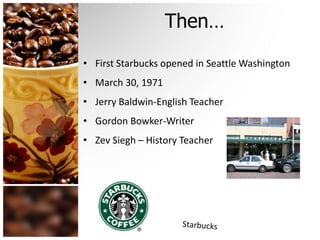
• First Starbucks opened in Seattle Washington 
• March 30, 1971 
• Jerry Baldwin-English Teacher 
• Gordon Bowker-Writer 
• Zev Siegh – History Teacher
Then… 
• Entrepreneur Howard Schultz joined the company 
in 1982 
• Director of Retail Operations and Marketing 
• Idea of selling beverages 
Starbucks
Then… 
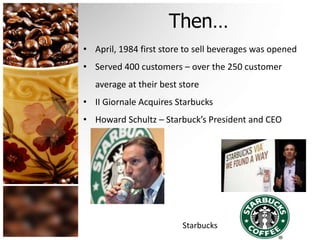
• April, 1984 first store to sell beverages was opened 
• Served 400 customers – over the 250 customer 
average at their best store 
• II Giornale Acquires Starbucks 
• Howard Schultz – Starbuck’s President and CEO 
Starbucks
Now… 
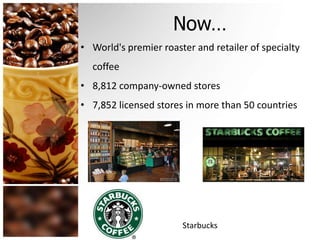
• World's premier roaster and retailer of specialty 
coffee 
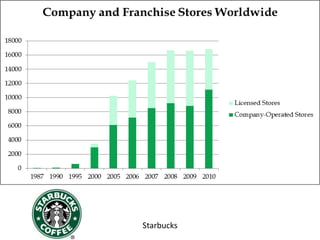
• 8,812 company-owned stores 
• 7,852 licensed stores in more than 50 countries 
Starbucks
Now… 
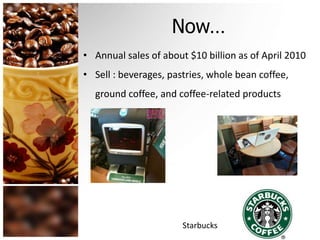
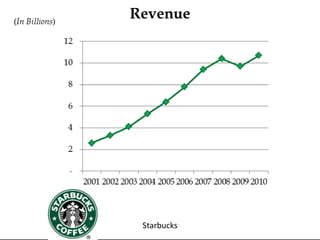
• Annual sales of about $10 billion as of April 2010 
• Sell : beverages, pastries, whole bean coffee, 
ground coffee, and coffee-related products 
Starbucks
Mission Statement 
1990 – October 2008 
• Establish Starbucks as the premier purveyor of the 
finest coffee in the world while maintaining our 
uncompromising principles as we grow. 
Starbucks
Ethics 
Starbucks™ Shared Planet™ is committed to doing business 
responsibly. A better way to help each other and the planet. 
Starbucks
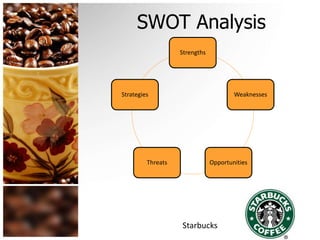
SWOT Analysis 
Strengths 
Weaknesses 
Strategies 
Threats Opportunities 
Starbucks
Strengths 
• Leading retailer and roaster for brand specialty 
coffee in the world 
• Known for providing superior products and services 
• Number 7 on Fortune Magazine's "100 Best 
Companies to Work For" for 2008 
• Consistent high quality of service 
• Limited number of strong competitors 
• High market share and market growth 
Starbucks
Weaknesses 
• High pricing because of the quality ingredients used 
• Starbucks refuses to guarantee that milk, beverages, 
chocolate, ice cream, and baked goods sold in the 
company’s stores are free of genetically-modified 
ingredients 
• Strong presence in the U.S. - more than three quarters 
of its cafes located in the domestic market 
• In order to reduce business risk, expansion is needed 
Starbucks
Opportunities 
• High growth of economy and market in Indonesia, 
especially in urban areas 
• Could diverse their product not only in coffee 
• The potential employees are educated people which 
make it easier to train them 
• Strong financial support 
Starbucks
Threats 
• Competitors and copycat brands could pose potential 
threats 
• Sentimental issue to the bad effect of coffee from society 
• Global financial crisis - makes people tend not to spend 
• Threats of substitute products and services such as colas, 
teas or juices that are sold in retails 
• Exposed to rises in the cost of coffee and dairy products 
Starbuck
Strategies 
• Maximize market penetration 
• Provide a relaxing social atmosphere 
• Offer high-quality products 
• Encourages a great working environment 
• Achieve profitability 
Starbucks
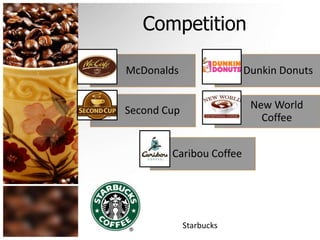
Competition 
McDonalds Dunkin Donuts 
Second Cup New World 
Coffee 
Caribou Coffee 
Starbucks
Starbucks
Starbucks
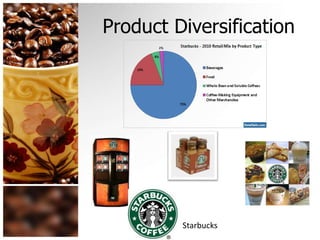
Product Diversification 
Starbucks
Starbucks
Starbucks
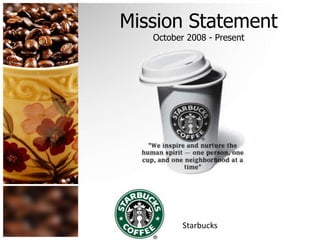
Mission Statement 
October 2008 - Present 
Starbucks
Action Plan & 
Recommendations 
• Enhance atmosphere 
– Entertainment to attract more customers 
• Increase marketing 
• Advertise 
• Sales promotions 
• Promote healthy products 
Starbucks

Starbuckspowerpoint 111031081828-phpapp01

  • 2.
    Table of Contents • Introduction: Then and Now • Mission Statement (1990-2008) • Ethics • SWOT Analysis – Strengths, Weaknesses, Opportunities, Threat • Strategies, Competition, Charts • Mission Statement (2008-Present) • Action Plan & Recommendations • Conclusion Starbucks
  • 3.
    Then… • FirstStarbucks opened in Seattle Washington • March 30, 1971 • Jerry Baldwin-English Teacher • Gordon Bowker-Writer • Zev Siegh – History Teacher
  • 4.
    Then… • EntrepreneurHoward Schultz joined the company in 1982 • Director of Retail Operations and Marketing • Idea of selling beverages Starbucks
  • 5.
    Then… • April,1984 first store to sell beverages was opened • Served 400 customers – over the 250 customer average at their best store • II Giornale Acquires Starbucks • Howard Schultz – Starbuck’s President and CEO Starbucks
  • 6.
    Now… • World'spremier roaster and retailer of specialty coffee • 8,812 company-owned stores • 7,852 licensed stores in more than 50 countries Starbucks
  • 7.
    Now… • Annualsales of about $10 billion as of April 2010 • Sell : beverages, pastries, whole bean coffee, ground coffee, and coffee-related products Starbucks
  • 8.
    Mission Statement 1990– October 2008 • Establish Starbucks as the premier purveyor of the finest coffee in the world while maintaining our uncompromising principles as we grow. Starbucks
  • 9.
    Ethics Starbucks™ SharedPlanet™ is committed to doing business responsibly. A better way to help each other and the planet. Starbucks
  • 10.
    SWOT Analysis Strengths Weaknesses Strategies Threats Opportunities Starbucks
  • 11.
    Strengths • Leadingretailer and roaster for brand specialty coffee in the world • Known for providing superior products and services • Number 7 on Fortune Magazine's "100 Best Companies to Work For" for 2008 • Consistent high quality of service • Limited number of strong competitors • High market share and market growth Starbucks
  • 12.
    Weaknesses • Highpricing because of the quality ingredients used • Starbucks refuses to guarantee that milk, beverages, chocolate, ice cream, and baked goods sold in the company’s stores are free of genetically-modified ingredients • Strong presence in the U.S. - more than three quarters of its cafes located in the domestic market • In order to reduce business risk, expansion is needed Starbucks
  • 13.
    Opportunities • Highgrowth of economy and market in Indonesia, especially in urban areas • Could diverse their product not only in coffee • The potential employees are educated people which make it easier to train them • Strong financial support Starbucks
  • 14.
    Threats • Competitorsand copycat brands could pose potential threats • Sentimental issue to the bad effect of coffee from society • Global financial crisis - makes people tend not to spend • Threats of substitute products and services such as colas, teas or juices that are sold in retails • Exposed to rises in the cost of coffee and dairy products Starbuck
  • 15.
    Strategies • Maximizemarket penetration • Provide a relaxing social atmosphere • Offer high-quality products • Encourages a great working environment • Achieve profitability Starbucks
  • 16.
    Competition McDonalds DunkinDonuts Second Cup New World Coffee Caribou Coffee Starbucks
  • 17.
  • 18.
  • 19.
  • 20.
  • 21.
  • 22.
    Mission Statement October2008 - Present Starbucks
  • 23.
    Action Plan & Recommendations • Enhance atmosphere – Entertainment to attract more customers • Increase marketing • Advertise • Sales promotions • Promote healthy products Starbucks