STARBUCKS STRATRGIC
MANAGEMENT
PRESENTATION
TIM BASTIAN, LANCE HEAPS, TYLER
STONE
• Founded in 1971 in Seattle, Washington
• In 1982 current CEO and chairman of the Board Howard Schultz
joins Starbucks as Director of Retail Operations and Marketing
• In 1985 Howard Schultz founds Il Giornale
• In 1987 Howard Schultz acquires Starbucks, and changes the
newly merged company’s name to Starbuck Corporation
Company History
• In 1992 Starbucks Corporation has it’s IPO
• In 2000 Howard Schultz leaves the firm as a manager, but
remains on the Board of Directors
• In 2001 ethical sourcing guidelines are introduced
• In 2008 Howard Schultz returns as CEO to a troubled company
• In 2014 Starbucks loses a $2.8 billion lawsuit to Kraft
• In 2015 Starbucks introduces the Race Together campaign
Company History (Cont)
• “To inspire and nurture the human spirit – one person, one cup
and one neighborhood at a time.”
• “Starbucks is committed to a role of environmental leadership in
all facets of the business.”
Mission Statement
• Starbucks is classified as part of the Specialty Eateries Industry
• Other firms in this industry include Aramark and Panera Bread
Industry
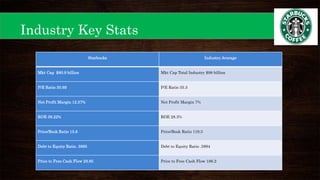
Starbucks Industry Average
Mkt Cap $80.9 billion Mkt Cap Total Industry $98 billion
P/E Ratio 30.69 P/E Ratio 35.3
Net Profit Margin 12.57% Net Profit Margin 7%
ROE 39.22% ROE 28.3%
Price/Book Ratio 15.6 Price/Book Ratio 119.3
Debt to Equity Ratio .3885 Debt to Equity Ratio .5994
Price to Free Cash Flow 28.85 Price to Free Cash Flow 186.2
Industry Key Stats
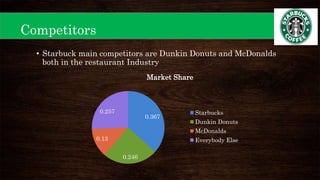
• Starbuck main competitors are Dunkin Donuts and McDonalds
both in the restaurant Industry
Competitors
0.367
0.246
0.13
0.257
Market Share
Starbucks
Dunkin Donuts
McDonalds
Everybody Else
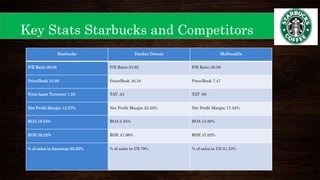
Starbucks Dunkin Donuts McDonald’s
P/E Ratio 30.08 P/E Ratio 33.62 P/E Ratio 20.08
Price/Book 15.29 Price/Book 16.10 Price/Book 7.47
Total Asset Turnover 1.53 TAT .24 TAT .80
Net Profit Margin 12.57% Net Profit Margin 23.55% Net Profit Margin 17.34%
ROA 19.23% ROA 5.55% ROA 13.88%
ROE 39.22% ROE 47.98% ROE 37.02%
% of sales in Americas 82.95% % of sales in US 79% % of sales in US 31.53%
Key Stats Starbucks and Competitors
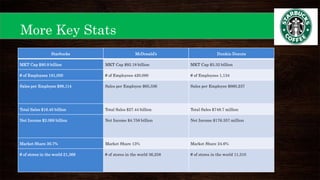
Starbucks McDonald’s Dunkin Donuts
MKT Cap $80.9 billion MKT Cap $92.18 billion MKT Cap $5.32 billion
# of Employees 191,000 # of Employees 420,000 # of Employees 1,134
Sales per Employee $86,114 Sales per Employee $65,336 Sales per Employee $660,237
Total Sales $16.45 billion Total Sales $27.44 billion Total Sales $748.7 million
Net Income $2.068 billion Net Income $4.758 billion Net Income $176.357 million
Market Share 36.7% Market Share 13% Market Share 24.6%
# of stores in the world 21,366 # of stores in the world 36,258 # of stores in the world 11,310
More Key Stats
FOREX Hedging Strategy
• In 2014 Starbucks hedged 10% of it’s foreign currency risk
measured as a % of total foreign sales
• Going forward we expect more and more of Starbucks revenue
streams to come from countries not using the USD
• More FOREX hedging activities or risk wider fluctuation in
earnings
Commodity Hedging Strategy
• In 2014 Starbucks hedged 1.25% of it’s exposure to commodity
prices measured as a % of cost of sales
• Starbucks currently hedges the following commodities diesel
fuel, dairy products, and coffee.
• As food offerings become more of Starbucks marketing mix they
must consider hedging wheat, poultry, and other food related
commodities.
Cash Conversion Cycle
• Starbucks had a Cash Conversion Cycle of 9.68 days
• McDonalds and Dunkin Donuts had CCC’s of -.85 days, and .69
days respectively
• Starbucks CCC was cut by just over 5 days from 2013 to 2014
Cash Conversion Cycle (cont)
• We believe Starbucks employing a neutral strategy should focus
on improving it’s CCC
• If the CCC had been 3 days instead of 9.68 days, 2014 FCF
would have been 28.15% or $787 million higher than it was
• We believe Starbucks should set an objective to lower CCC from
9.68 days to 3 days within 5 years
Capital Structure
• Starbucks current capital structure is 96.5% equity financed,
and 3.5% debt financed
• Starbucks weighted average after tax cost of debt is 1.51%
• Starbucks cost of equity is 7.07% (CAPM)
• Starbucks WACC with it’s current capital structure is 6.88%
Capital Structure Recommendations
• If Starbucks changed it’s capital structure to 80% equity 20%
debt Ceteris Paribas it would lower the WACC to 5.96%.
• This is nearly a 100 basis points reduction
• Lower of cost of capital means more new projects would become
profitable and be accepted meaning higher FCF.
• Higher FCF generation on current projects, and higher EVA.
• Very little additional risk with this proposed new capital
structure, and a very large potential return
Free Cash Flow
• In 2014 Starbucks generated $2.796 billion in FCF
• That was up 315% from 2012
• 2013 was not used because of lawsuit
• In 2014 Starbucks spent $643.3 million (net) buying back stock
• In 2014 Starbucks paid out $783.1 million in dividends
• In 2014 McDonalds generated $6.825 billion in FCF, and Dunkin
Donuts generated $275 million in FCF
Liquidity Ratios
• In 2014 Starbucks had a quick ratio of 1.01, which increased
from .811 in 2013
• In 2014 MCD and DNKN had quick ratios of 1.48 and 1.21
respectively
• In 2014 SBUX earned more in interest than they paid out
• MCD and DNKN had TIE ratios 13.77 and 5 respectively
Q3 15 Financial Breakdown
• Americas accounted for 70% of operating income
• China-Asia-Pacific accounted for 12% of operating income
• Europe-Middle East-Africa accounted for 11% of operating
income
• All other Segments 7% of operating income
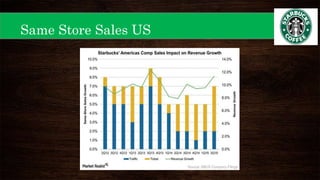
Same Store Sales US
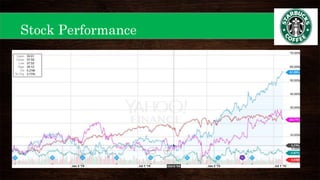
Stock Performance
Stock Performance
• SBUX is up 57.29% over 2 years light blue line
• S&P 500 is up 22.58% over 2 years red line
• MCD is down 1.87% over 2 years green line
• DNKN is up 22.71% over 2 years pink line
Marketing
• In 2014 SBUX spent $315.5 million on marketing, which equated
to 1.92% of sales
• DNKN 5% of sales 2014
• MCD 2.92% of sales 2014
R&D
• SBUX, DNKN, and MCD do not even list R&D Expense as
separate line item
• Starbucks main R&D activities focus on creating new blends of
coffee and teas, new brewing processes, and new
packaging/storage systems
Personnel
• Starbucks had an annual employee turnover rate of 50% versus
a 400% annual employee turnover rate for the coffee industry in
2009
• Starbucks calls their employees partners not workers, associates,
or employees
• Starbucks has also embraced promoting diversity in its
workforce. In 2009 31% of Starbucks managers were ethnic
minorities, and 66% were women
Ops
• Ultimately the success of Starbucks depends on the ability of the
retail stores to satisfy customers in terms of product delivery,
maintaining the proper store ambiance, and catering to customer
needs
• Economic recession of 2008
• Rising labor costs
• Rising operational costs
• Other issues
Economic Forces
• Political factors where Starbucks sources raw materials
• Monitoring political stability
– Operating countries
• Tax Policy
• Employment Laws
Government and Political Forces
• Population wants lower prices
• Older generation are retiring
• Family patterns are changing
• Level of education
• Consumer preference changing
Social Forces
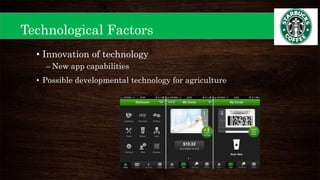
• Innovation of technology
– New app capabilities
• Possible developmental technology for agriculture
Technological Factors
• Climate Change
• Environmental Disasters
– Coffee bean producing countries
Environmental Factors
• Laws and Policies for health authorities
• Customs
• Trade regulations
Legal Factors
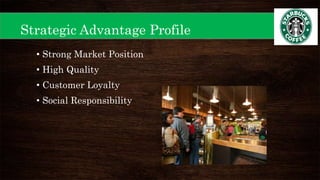
• Strong Market Position
• High Quality
• Customer Loyalty
• Social Responsibility
Strategic Advantage Profile
• Coffee chain market is saturated
• Significant Capital Requirements
• Safe
– Against new entrants
Threat of New Entrants
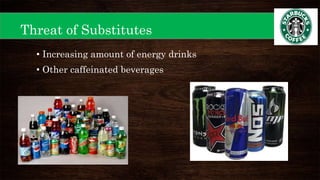
• Increasing amount of energy drinks
• Other caffeinated beverages
Threat of Substitutes
• It is not costly to switch brands
– Either cheaper or same cost
• Many other options
• Variety
Bargaining Power of Buyers
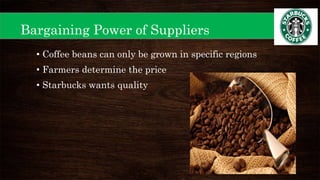
• Coffee beans can only be grown in specific regions
• Farmers determine the price
• Starbucks wants quality
Bargaining Power of Suppliers
• Rivalry is very high
• Brand identity is used
– Want to portray a better image than competitors
Intensity of Competitive Rivalry
• Strong Customer Connect
• Technology Leverage
• Strong Financial Position
• Free Advertising
Strengths
• Product Recalls
• Tax Evasion
• Lawsuits
Weaknesses
• Entry into health and wellness market
• Growing presence in Asia
• M-Commerce
• Recycling
Opportunities
• Intense Competition
• Compliance Costs
Threats
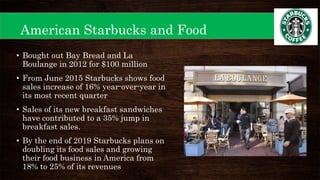
American Starbucks and Food
• Bought out Bay Bread and La
Boulange in 2012 for $100 million
• From June 2015 Starbucks shows food
sales increase of 16% year-over-year in
its most recent quarter
• Sales of its new breakfast sandwiches
have contributed to a 35% jump in
breakfast sales.
• By the end of 2019 Starbucks plans on
doubling its food sales and growing
their food business in America from
18% to 25% of its revenues
EMEA Brand Immersion
• By end of 2014 Starbucks had 2,100 stores in 37
countries and plans to double their stores by 2019
• More drive thru locations and licensing with various
grocery stores
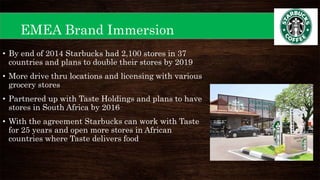
• Partnered up with Taste Holdings and plans to have
stores in South Africa by 2016
• With the agreement Starbucks can work with Taste
for 25 years and open more stores in African
countries where Taste delivers food
CAP Brand Immersion
• According to their last annual total from
2014 Starbucks has 80,000 partners in 4,600
stores in 15 countries with 12 million
transactions every week in this region
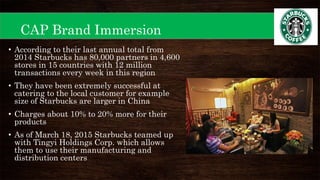
• They have been extremely successful at
catering to the local customer for example
size of Starbucks are larger in China
• Charges about 10% to 20% more for their
products
• As of March 18, 2015 Starbucks teamed up
with Tingyi Holdings Corp. which allows
them to use their manufacturing and
distribution centers
CAP (Cont)
• Starbucks plans on jumping from 1,600 stores in China to 3,400 by end
of 2019
• Outside of China the biggest markets in the CAP region are Japan,
India, Thailand, and Korea
• Japan Starbucks has over 4 million customers a week and 1.3 million
active My Starbucks rewards users
• In Korea there are 700 Starbucks stores and Starbucks plans to have
half of their next stores built over the 2015 year to be drive thrus
• In India there are over 60 stores in six major cities and that number is
expected to grow exponentially through the next 5 years
• Thailand has opened 200 stores and is home to the first Starbucks
store outside of the United States
• Starbucks expects there to be 10,000 stores in the CAP region by 2019.
Mobile App
• In the Americas, particularly the US, Starbucks wants more
customers ordering and paying through the Starbucks app
• This app allows you to browse through menus, check your
existing balance on your card and add funds to your Starbucks
card through debit or credit card, PayPal or Apple Pay
• You can also connect it directly with your bank and have
reoccurring payments come out and go to your Starbucks account
• This app also provides the ability to send gift cards as well as
download free songs, apps and more with Starbucks “Pick of the
Week”
• https://www.youtube.com/watch?v=BlQDttTWM6o
• https://www.youtube.com/watch?v=o7HrfxrebL8
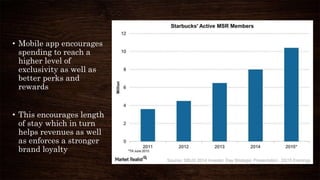
• Mobile app encourages
spending to reach a
higher level of
exclusivity as well as
better perks and
rewards
• This encourages length
of stay which in turn
helps revenues as well
as enforces a stronger
brand loyalty
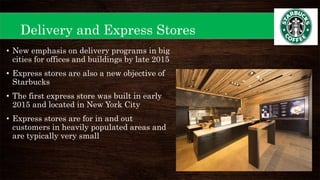
Delivery and Express Stores
• New emphasis on delivery programs in big
cities for offices and buildings by late 2015
• Express stores are also a new objective of
Starbucks
• The first express store was built in early
2015 and located in New York City
• Express stores are for in and out
customers in heavily populated areas and
are typically very small
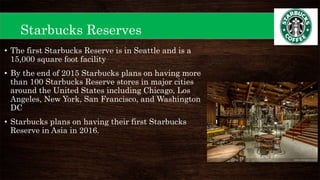
Starbucks Reserves
• The first Starbucks Reserve is in Seattle and is a
15,000 square foot facility
• By the end of 2015 Starbucks plans on having more
than 100 Starbucks Reserve stores in major cities
around the United States including Chicago, Los
Angeles, New York, San Francisco, and Washington
DC
• Starbucks plans on having their first Starbucks
Reserve in Asia in 2016.
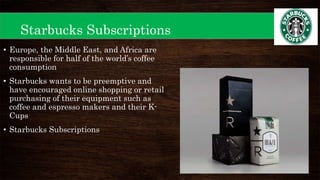
Starbucks Subscriptions
• Europe, the Middle East, and Africa are
responsible for half of the world’s coffee
consumption
• Starbucks wants to be preemptive and
have encouraged online shopping or retail
purchasing of their equipment such as
coffee and espresso makers and their K-
Cups
• Starbucks Subscriptions
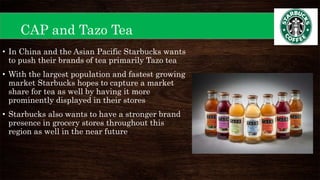
CAP and Tazo Tea
• In China and the Asian Pacific Starbucks wants
to push their brands of tea primarily Tazo tea
• With the largest population and fastest growing
market Starbucks hopes to capture a market
share for tea as well by having it more
prominently displayed in their stores
• Starbucks also wants to have a stronger brand
presence in grocery stores throughout this
region as well in the near future
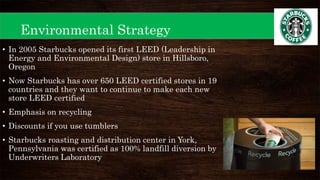
Environmental Strategy
• In 2005 Starbucks opened its first LEED (Leadership in
Energy and Environmental Design) store in Hillsboro,
Oregon
• Now Starbucks has over 650 LEED certified stores in 19
countries and they want to continue to make each new
store LEED certified
• Emphasis on recycling
• Discounts if you use tumblers
• Starbucks roasting and distribution center in York,
Pennsylvania was certified as 100% landfill diversion by
Underwriters Laboratory
Energy and Water
• In 2008 Starbucks set out to decrease their water usage by
25% by the end of 2015
• They have already decreased their usage by over 23% by
upgrading water filtration systems, installing efficient
fixtures, and monitoring consumption to identify spikes
and target leaks
• Starbucks has also installed energy management systems
in over 4,000 stores in order to see opportunities for
savings in the future
• Starbucks purchases and supports clean energy sources
like wind powered farms and offer them additional revenue
over electricity powered by fossil fuels
Worldwide and Community Strategy
• In the United States Starbucks and Youth Build USA provide customer service
excellence training, which allows young people from disadvantaged backgrounds
to train in retail and customer service
• Starbucks also pledges to hire 10,000 veterans and military spouses by 2018 to
help successfully transition veterans and their families to a civilian life
• Starbucks also provides .05 to .15 cents of every purchase to go to local partnering
nonprofits in order to give back to the community
Worldwide and Community Strategy
• The Starbucks Foundation gave 13.1 million in 2014 to causes like opportunity for
youth, community service, grants, access to clean water, and of course supporting
coffee, tea, and cocoa communities
• The Starbucks Foundation also provides money to RED an African program that
helps fund HIV/AIDS prevention
• Tuition for eligible ASU students
• Lyft rides
Strategic Alternatives
• Starbucks has implemented a strong aggressive growth strategy
by using diversification with its products varying from tea to
breakfast sandwiches as well as its stores with Reserves and
express stores
• Starbucks continues to use a mixed strategy however for its
global operations keeping a more neutral strategy for the United
States
• Starbucks will continue an aggressive strategy using intensive
growth overseas in order for a stronger brand recognition and
growth in revenues
Choice
• Continue expanding overseas while profit is high to build brand
recognition and buzz through these large countries and
communities
• Continue their environmental efforts and good practices so that
word of mouth can only be positive
• Alleviate some of the pressure of having the United States being
83% of your revenue by having more sales either in stores or
through online shopping or subscriptions in different countries
• Use a neutral harvesting strategy to avoid over saturation and
possibly self cannibalization of stores in the American market
Guidelines and Recommendations
• We recommend putting a stronger emphasis on advertising
overseas to further market their products and brand
• Starbucks should continue helping their employees because that
in turn retains valuable employees and establishes themselves
as a great place to work
• They should market their online store and encourage customers
to review their products maybe with a star or coupon

Starbucks Presentation

  • 1.
  • 2.
    • Founded in1971 in Seattle, Washington • In 1982 current CEO and chairman of the Board Howard Schultz joins Starbucks as Director of Retail Operations and Marketing • In 1985 Howard Schultz founds Il Giornale • In 1987 Howard Schultz acquires Starbucks, and changes the newly merged company’s name to Starbuck Corporation Company History
  • 3.
    • In 1992Starbucks Corporation has it’s IPO • In 2000 Howard Schultz leaves the firm as a manager, but remains on the Board of Directors • In 2001 ethical sourcing guidelines are introduced • In 2008 Howard Schultz returns as CEO to a troubled company • In 2014 Starbucks loses a $2.8 billion lawsuit to Kraft • In 2015 Starbucks introduces the Race Together campaign Company History (Cont)
  • 4.
    • “To inspireand nurture the human spirit – one person, one cup and one neighborhood at a time.” • “Starbucks is committed to a role of environmental leadership in all facets of the business.” Mission Statement
  • 5.
    • Starbucks isclassified as part of the Specialty Eateries Industry • Other firms in this industry include Aramark and Panera Bread Industry
  • 6.
    Starbucks Industry Average MktCap $80.9 billion Mkt Cap Total Industry $98 billion P/E Ratio 30.69 P/E Ratio 35.3 Net Profit Margin 12.57% Net Profit Margin 7% ROE 39.22% ROE 28.3% Price/Book Ratio 15.6 Price/Book Ratio 119.3 Debt to Equity Ratio .3885 Debt to Equity Ratio .5994 Price to Free Cash Flow 28.85 Price to Free Cash Flow 186.2 Industry Key Stats
  • 7.
    • Starbuck maincompetitors are Dunkin Donuts and McDonalds both in the restaurant Industry Competitors 0.367 0.246 0.13 0.257 Market Share Starbucks Dunkin Donuts McDonalds Everybody Else
  • 8.
    Starbucks Dunkin DonutsMcDonald’s P/E Ratio 30.08 P/E Ratio 33.62 P/E Ratio 20.08 Price/Book 15.29 Price/Book 16.10 Price/Book 7.47 Total Asset Turnover 1.53 TAT .24 TAT .80 Net Profit Margin 12.57% Net Profit Margin 23.55% Net Profit Margin 17.34% ROA 19.23% ROA 5.55% ROA 13.88% ROE 39.22% ROE 47.98% ROE 37.02% % of sales in Americas 82.95% % of sales in US 79% % of sales in US 31.53% Key Stats Starbucks and Competitors
  • 9.
    Starbucks McDonald’s DunkinDonuts MKT Cap $80.9 billion MKT Cap $92.18 billion MKT Cap $5.32 billion # of Employees 191,000 # of Employees 420,000 # of Employees 1,134 Sales per Employee $86,114 Sales per Employee $65,336 Sales per Employee $660,237 Total Sales $16.45 billion Total Sales $27.44 billion Total Sales $748.7 million Net Income $2.068 billion Net Income $4.758 billion Net Income $176.357 million Market Share 36.7% Market Share 13% Market Share 24.6% # of stores in the world 21,366 # of stores in the world 36,258 # of stores in the world 11,310 More Key Stats
  • 10.
    FOREX Hedging Strategy •In 2014 Starbucks hedged 10% of it’s foreign currency risk measured as a % of total foreign sales • Going forward we expect more and more of Starbucks revenue streams to come from countries not using the USD • More FOREX hedging activities or risk wider fluctuation in earnings
  • 11.
    Commodity Hedging Strategy •In 2014 Starbucks hedged 1.25% of it’s exposure to commodity prices measured as a % of cost of sales • Starbucks currently hedges the following commodities diesel fuel, dairy products, and coffee. • As food offerings become more of Starbucks marketing mix they must consider hedging wheat, poultry, and other food related commodities.
  • 12.
    Cash Conversion Cycle •Starbucks had a Cash Conversion Cycle of 9.68 days • McDonalds and Dunkin Donuts had CCC’s of -.85 days, and .69 days respectively • Starbucks CCC was cut by just over 5 days from 2013 to 2014
  • 13.
    Cash Conversion Cycle(cont) • We believe Starbucks employing a neutral strategy should focus on improving it’s CCC • If the CCC had been 3 days instead of 9.68 days, 2014 FCF would have been 28.15% or $787 million higher than it was • We believe Starbucks should set an objective to lower CCC from 9.68 days to 3 days within 5 years
  • 14.
    Capital Structure • Starbuckscurrent capital structure is 96.5% equity financed, and 3.5% debt financed • Starbucks weighted average after tax cost of debt is 1.51% • Starbucks cost of equity is 7.07% (CAPM) • Starbucks WACC with it’s current capital structure is 6.88%
  • 15.
    Capital Structure Recommendations •If Starbucks changed it’s capital structure to 80% equity 20% debt Ceteris Paribas it would lower the WACC to 5.96%. • This is nearly a 100 basis points reduction • Lower of cost of capital means more new projects would become profitable and be accepted meaning higher FCF. • Higher FCF generation on current projects, and higher EVA. • Very little additional risk with this proposed new capital structure, and a very large potential return
  • 16.
    Free Cash Flow •In 2014 Starbucks generated $2.796 billion in FCF • That was up 315% from 2012 • 2013 was not used because of lawsuit • In 2014 Starbucks spent $643.3 million (net) buying back stock • In 2014 Starbucks paid out $783.1 million in dividends • In 2014 McDonalds generated $6.825 billion in FCF, and Dunkin Donuts generated $275 million in FCF
  • 17.
    Liquidity Ratios • In2014 Starbucks had a quick ratio of 1.01, which increased from .811 in 2013 • In 2014 MCD and DNKN had quick ratios of 1.48 and 1.21 respectively • In 2014 SBUX earned more in interest than they paid out • MCD and DNKN had TIE ratios 13.77 and 5 respectively
  • 18.
    Q3 15 FinancialBreakdown • Americas accounted for 70% of operating income • China-Asia-Pacific accounted for 12% of operating income • Europe-Middle East-Africa accounted for 11% of operating income • All other Segments 7% of operating income
  • 19.
  • 20.
  • 21.
    Stock Performance • SBUXis up 57.29% over 2 years light blue line • S&P 500 is up 22.58% over 2 years red line • MCD is down 1.87% over 2 years green line • DNKN is up 22.71% over 2 years pink line
  • 22.
    Marketing • In 2014SBUX spent $315.5 million on marketing, which equated to 1.92% of sales • DNKN 5% of sales 2014 • MCD 2.92% of sales 2014
  • 23.
    R&D • SBUX, DNKN,and MCD do not even list R&D Expense as separate line item • Starbucks main R&D activities focus on creating new blends of coffee and teas, new brewing processes, and new packaging/storage systems
  • 24.
    Personnel • Starbucks hadan annual employee turnover rate of 50% versus a 400% annual employee turnover rate for the coffee industry in 2009 • Starbucks calls their employees partners not workers, associates, or employees • Starbucks has also embraced promoting diversity in its workforce. In 2009 31% of Starbucks managers were ethnic minorities, and 66% were women
  • 25.
    Ops • Ultimately thesuccess of Starbucks depends on the ability of the retail stores to satisfy customers in terms of product delivery, maintaining the proper store ambiance, and catering to customer needs
  • 26.
    • Economic recessionof 2008 • Rising labor costs • Rising operational costs • Other issues Economic Forces
  • 27.
    • Political factorswhere Starbucks sources raw materials • Monitoring political stability – Operating countries • Tax Policy • Employment Laws Government and Political Forces
  • 28.
    • Population wantslower prices • Older generation are retiring • Family patterns are changing • Level of education • Consumer preference changing Social Forces
  • 29.
    • Innovation oftechnology – New app capabilities • Possible developmental technology for agriculture Technological Factors
  • 30.
    • Climate Change •Environmental Disasters – Coffee bean producing countries Environmental Factors
  • 31.
    • Laws andPolicies for health authorities • Customs • Trade regulations Legal Factors
  • 32.
    • Strong MarketPosition • High Quality • Customer Loyalty • Social Responsibility Strategic Advantage Profile
  • 33.
    • Coffee chainmarket is saturated • Significant Capital Requirements • Safe – Against new entrants Threat of New Entrants
  • 34.
    • Increasing amountof energy drinks • Other caffeinated beverages Threat of Substitutes
  • 35.
    • It isnot costly to switch brands – Either cheaper or same cost • Many other options • Variety Bargaining Power of Buyers
  • 36.
    • Coffee beanscan only be grown in specific regions • Farmers determine the price • Starbucks wants quality Bargaining Power of Suppliers
  • 37.
    • Rivalry isvery high • Brand identity is used – Want to portray a better image than competitors Intensity of Competitive Rivalry
  • 38.
    • Strong CustomerConnect • Technology Leverage • Strong Financial Position • Free Advertising Strengths
  • 39.
    • Product Recalls •Tax Evasion • Lawsuits Weaknesses
  • 40.
    • Entry intohealth and wellness market • Growing presence in Asia • M-Commerce • Recycling Opportunities
  • 41.
    • Intense Competition •Compliance Costs Threats
  • 42.
    American Starbucks andFood • Bought out Bay Bread and La Boulange in 2012 for $100 million • From June 2015 Starbucks shows food sales increase of 16% year-over-year in its most recent quarter • Sales of its new breakfast sandwiches have contributed to a 35% jump in breakfast sales. • By the end of 2019 Starbucks plans on doubling its food sales and growing their food business in America from 18% to 25% of its revenues
  • 43.
    EMEA Brand Immersion •By end of 2014 Starbucks had 2,100 stores in 37 countries and plans to double their stores by 2019 • More drive thru locations and licensing with various grocery stores • Partnered up with Taste Holdings and plans to have stores in South Africa by 2016 • With the agreement Starbucks can work with Taste for 25 years and open more stores in African countries where Taste delivers food
  • 44.
    CAP Brand Immersion •According to their last annual total from 2014 Starbucks has 80,000 partners in 4,600 stores in 15 countries with 12 million transactions every week in this region • They have been extremely successful at catering to the local customer for example size of Starbucks are larger in China • Charges about 10% to 20% more for their products • As of March 18, 2015 Starbucks teamed up with Tingyi Holdings Corp. which allows them to use their manufacturing and distribution centers
  • 45.
    CAP (Cont) • Starbucksplans on jumping from 1,600 stores in China to 3,400 by end of 2019 • Outside of China the biggest markets in the CAP region are Japan, India, Thailand, and Korea • Japan Starbucks has over 4 million customers a week and 1.3 million active My Starbucks rewards users • In Korea there are 700 Starbucks stores and Starbucks plans to have half of their next stores built over the 2015 year to be drive thrus • In India there are over 60 stores in six major cities and that number is expected to grow exponentially through the next 5 years • Thailand has opened 200 stores and is home to the first Starbucks store outside of the United States • Starbucks expects there to be 10,000 stores in the CAP region by 2019.
  • 46.
    Mobile App • Inthe Americas, particularly the US, Starbucks wants more customers ordering and paying through the Starbucks app • This app allows you to browse through menus, check your existing balance on your card and add funds to your Starbucks card through debit or credit card, PayPal or Apple Pay • You can also connect it directly with your bank and have reoccurring payments come out and go to your Starbucks account • This app also provides the ability to send gift cards as well as download free songs, apps and more with Starbucks “Pick of the Week” • https://www.youtube.com/watch?v=BlQDttTWM6o • https://www.youtube.com/watch?v=o7HrfxrebL8
  • 47.
    • Mobile appencourages spending to reach a higher level of exclusivity as well as better perks and rewards • This encourages length of stay which in turn helps revenues as well as enforces a stronger brand loyalty
  • 48.
    Delivery and ExpressStores • New emphasis on delivery programs in big cities for offices and buildings by late 2015 • Express stores are also a new objective of Starbucks • The first express store was built in early 2015 and located in New York City • Express stores are for in and out customers in heavily populated areas and are typically very small
  • 49.
    Starbucks Reserves • Thefirst Starbucks Reserve is in Seattle and is a 15,000 square foot facility • By the end of 2015 Starbucks plans on having more than 100 Starbucks Reserve stores in major cities around the United States including Chicago, Los Angeles, New York, San Francisco, and Washington DC • Starbucks plans on having their first Starbucks Reserve in Asia in 2016.
  • 50.
    Starbucks Subscriptions • Europe,the Middle East, and Africa are responsible for half of the world’s coffee consumption • Starbucks wants to be preemptive and have encouraged online shopping or retail purchasing of their equipment such as coffee and espresso makers and their K- Cups • Starbucks Subscriptions
  • 51.
    CAP and TazoTea • In China and the Asian Pacific Starbucks wants to push their brands of tea primarily Tazo tea • With the largest population and fastest growing market Starbucks hopes to capture a market share for tea as well by having it more prominently displayed in their stores • Starbucks also wants to have a stronger brand presence in grocery stores throughout this region as well in the near future
  • 52.
    Environmental Strategy • In2005 Starbucks opened its first LEED (Leadership in Energy and Environmental Design) store in Hillsboro, Oregon • Now Starbucks has over 650 LEED certified stores in 19 countries and they want to continue to make each new store LEED certified • Emphasis on recycling • Discounts if you use tumblers • Starbucks roasting and distribution center in York, Pennsylvania was certified as 100% landfill diversion by Underwriters Laboratory
  • 53.
    Energy and Water •In 2008 Starbucks set out to decrease their water usage by 25% by the end of 2015 • They have already decreased their usage by over 23% by upgrading water filtration systems, installing efficient fixtures, and monitoring consumption to identify spikes and target leaks • Starbucks has also installed energy management systems in over 4,000 stores in order to see opportunities for savings in the future • Starbucks purchases and supports clean energy sources like wind powered farms and offer them additional revenue over electricity powered by fossil fuels
  • 54.
    Worldwide and CommunityStrategy • In the United States Starbucks and Youth Build USA provide customer service excellence training, which allows young people from disadvantaged backgrounds to train in retail and customer service • Starbucks also pledges to hire 10,000 veterans and military spouses by 2018 to help successfully transition veterans and their families to a civilian life • Starbucks also provides .05 to .15 cents of every purchase to go to local partnering nonprofits in order to give back to the community
  • 55.
    Worldwide and CommunityStrategy • The Starbucks Foundation gave 13.1 million in 2014 to causes like opportunity for youth, community service, grants, access to clean water, and of course supporting coffee, tea, and cocoa communities • The Starbucks Foundation also provides money to RED an African program that helps fund HIV/AIDS prevention • Tuition for eligible ASU students • Lyft rides
  • 56.
    Strategic Alternatives • Starbuckshas implemented a strong aggressive growth strategy by using diversification with its products varying from tea to breakfast sandwiches as well as its stores with Reserves and express stores • Starbucks continues to use a mixed strategy however for its global operations keeping a more neutral strategy for the United States • Starbucks will continue an aggressive strategy using intensive growth overseas in order for a stronger brand recognition and growth in revenues
  • 57.
    Choice • Continue expandingoverseas while profit is high to build brand recognition and buzz through these large countries and communities • Continue their environmental efforts and good practices so that word of mouth can only be positive • Alleviate some of the pressure of having the United States being 83% of your revenue by having more sales either in stores or through online shopping or subscriptions in different countries • Use a neutral harvesting strategy to avoid over saturation and possibly self cannibalization of stores in the American market
  • 58.
    Guidelines and Recommendations •We recommend putting a stronger emphasis on advertising overseas to further market their products and brand • Starbucks should continue helping their employees because that in turn retains valuable employees and establishes themselves as a great place to work • They should market their online store and encourage customers to review their products maybe with a star or coupon

Editor's Notes

  • #44 With this exclusive agreement Taste Holdings has the right to operate Starbucks for as long as 25 years and plans to have stores in South Africa in 2016. Also with this agreement Starbucks can work with Taste Holdings to open more stores in African countries where Taste delivers food. As of now Starbucks gets coffee and/or tea from several African countries including Ethiopia, Rwanda, Tanzania, Uganda, Zambia, Cameroon, Burundi, Democratic Republic of Congo, and Kenya.