
© 2015 Global Technology Resources, Inc. All Rights Reserved. Contents herein contain confidential information not to be copied.
Successfully	
  Deploying	
  IPv6	
  
Presented	
  by	
  Sco8	
  Hogg,	
  CTO	
  GTRI	
  
NANOG	
  On	
  The	
  Road	
  5	
  –	
  Orlando,	
  FL	
  
February	
  24,	
  2015	
  
© 2015 Global Technology Resources, Inc. All Rights Reserved.
•  Dual Stack Migration Planning Pitfalls
•  Training for IPv6 Deployment Success
•  Addressing Challenges
•  IPv6 Routing
•  Dual-Protocol Applications
•  Troubleshooting Dual-Protocol Networks
Agenda	
  
© 2015 Global Technology Resources, Inc. All Rights Reserved.
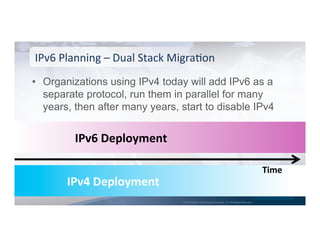
•  Organizations using IPv4 today will add IPv6 as a
separate protocol, run them in parallel for many
years, then after many years, start to disable IPv4
IPv6	
  Planning	
  –	
  Dual	
  Stack	
  MigraNon	
  
IPv4	
  Deployment	
  
IPv6	
  Deployment	
  
Time	
  
© 2015 Global Technology Resources, Inc. All Rights Reserved.
•  Failing to build a cross-function IPv6 deployment team
–  Multidisciplinary, Collaborative, Cooperative
•  Organizations need to treat IPv6 as a “Program” not just
like a typical IT “Project”
–  IPv6 transition is made up of many smaller projects that
will span multiple years and cross the entire enterprise
•  Regular/Frequent meetings are key to maintaining pace
•  Just like anything, executive buy-in and support is
essential
IPv6	
  Planning	
  PiOalls	
  
© 2015 Global Technology Resources, Inc. All Rights Reserved.
•  Don’t try to look at everything, identify devices requireing IPv6
•  Focus your efforts on the Internet perimeter
–  Look at every device in the transmission path (IPS, WAF, web
proxy, DLP, …)
•  The good news is you have waited to deploy IPv6
–  Now most IT products come standard with IPv6 capabilities
•  Don’t be concerned about an IPv4-only management plane –
that will come later
•  Some devices may remain IPv4-only until they die
Performing	
  an	
  IPv6	
  Readiness	
  Assessment	
  
© 2015 Global Technology Resources, Inc. All Rights Reserved.
•  Assume your IT organization has not taken the initiative
to immerse themselves in IPv6
•  People need to be trained early in the process, but not
too early that they forget what they learned
–  Train “just in time”, not years before an IPv6 address is
actually configured on a production device
•  Train for different skillsets (appdev, sysadmin, net admin,
sec admin, helpdesk, PMs, …)
•  Much of your IPv4 experience is applicable to IPv6
•  Don’t fear the larger addresses – Learn to “Think in Hex”
Training	
  for	
  Success	
  
© 2015 Global Technology Resources, Inc. All Rights Reserved.
•  IPv4-Think is dangerous when planning IPv6 addressing
–  Crazy Talk: Using decimal #s, embedding VLAN #, IPv4
address converted to hex
•  There is no scarcity of IPv6 addresses
–  If there is no scarcity, there can be no waste
–  Don’t try to assign only the minimum-needed prefix length
–  Plan for the number of subnets, not the number of hosts
•  Perform addressing for simplicity and ease of
management
–  Don’t be concerned about lots of reserved space
IPv6	
  Addressing	
  
© 2015 Global Technology Resources, Inc. All Rights Reserved.
•  Don’t force levels of hierarchy that are not needed
•  Use standard prefix lengths: /48, /56, /64
•  Use nibble-boundary – don’t use /50, /57, /65, …
•  Consistency between sites can increase operational
efficiency, however, not every site needs the same
addressing plan
–  Branches need a different plan than a data center “site”
•  Stick with Global Unicast Addresses (GUA) 2000::/3
•  Avoid Unique Local Addresses (ULA) FC00::/7
IPv6	
  Addressing	
  
© 2015 Global Technology Resources, Inc. All Rights Reserved.
•  IP addressing and routing go hand-in-hand
•  All IP routing protocols have IPv6 capabilities
•  Separating control plane for two data planes can be desirable
–  Establish BGP peer over IPv4 TCP 179 for sharing IPv4 routes
–  Establish BGP peer over IPv6 TCP 179 for sharing IPv6 routes
•  Don’t forget to use a 32-bit RID to the IPv6 routing process
•  Peering using global (preferred) or link-local addresses
•  Consider using locally-administered link-local addresses
–  fe80::cccc:0001, fe80::dddd:0002, …
•  Type carefully – don’t fat-finger the address
IPv6	
  RouNng	
  
© 2015 Global Technology Resources, Inc. All Rights Reserved.
•  Assessing current code for IPv6-capability
–  Most applications are not creating socket-level connections
–  Most applications use higher-level APIs or rely on lower-level web
services for connectivity
•  Create code that is Address-Family (AF) independent
•  Presentation-to-Numeric (p2n) & Numeric-to-Presentation (n2p)
–  Robustness principle: Be conservative in what you send, be liberal
in what you accept
•  Be careful of data structures for storing 128-bit addresses
•  Create code that performs dual-protocol DNS resolution and
incorporates Happy Eyeballs (RFC 6555)
•  Write code that properly handles Path MTU Discovery (PMTUD)
Dual-­‐Protocol	
  ApplicaNons	
  
© 2015 Global Technology Resources, Inc. All Rights Reserved.
•  Understand how IPv4 and IPv6 are different in terms of
networking (NDP, extension headers, dynamic tunnels,
…)
•  Don’t deploy IPv6 if you lack the products to secure the
protocol
•  Don’t be overly worried about IPv6 NDP security
weaknesses
–  You haven’t secured your IPv4 LANs either
–  https://community.infoblox.com/blogs/2015/02/10/holding-
ipv6-neighbor-discovery-higher-standard-security
IPv6	
  Security	
  ConsideraNons	
  
© 2015 Global Technology Resources, Inc. All Rights Reserved.
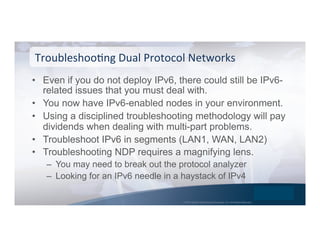
•  Even if you do not deploy IPv6, there could still be IPv6-
related issues that you must deal with.
•  You now have IPv6-enabled nodes in your environment.
•  Using a disciplined troubleshooting methodology will pay
dividends when dealing with multi-part problems.
•  Troubleshoot IPv6 in segments (LAN1, WAN, LAN2)
•  Troubleshooting NDP requires a magnifying lens.
–  You may need to break out the protocol analyzer
–  Looking for an IPv6 needle in a haystack of IPv4
TroubleshooNng	
  Dual	
  Protocol	
  Networks	
  
© 2015 Global Technology Resources, Inc. All Rights Reserved.
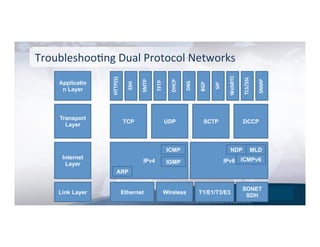
TroubleshooNng	
  Dual	
  Protocol	
  Networks	
  
Applicatio
n Layer
Transport
Layer
Internet
Layer
Link Layer
IPv4 IPv6
ARP
ICMP
IGMP
TCP UDP SCTP
HTTP(S)	
  
SSH	
  
SMTP	
  
TFTP	
  
DHCP	
  
DNS	
  
SIP	
  
WebRTC	
  
TLS/SSL	
  
SNMP	
  
BGP	
  
DCCP
T1/E1/T3/E3
SONET
SDH
ICMPv6
NDP MLD
Ethernet Wireless
© 2015 Global Technology Resources, Inc. All Rights Reserved.
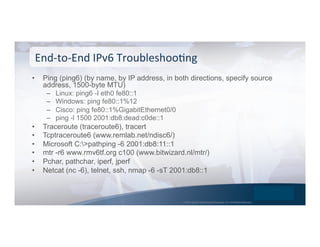
•  Ping (ping6) (by name, by IP address, in both directions, specify source
address, 1500-byte MTU)
–  Linux: ping6 -I eth0 fe80::1
–  Windows: ping fe80::1%12
–  Cisco: ping fe80::1%GigabitEthernet0/0
–  ping -l 1500 2001:db8:dead:c0de::1
•  Traceroute (traceroute6), tracert
•  Tcptraceroute6 (www.remlab.net/ndisc6/)
•  Microsoft C:>pathping -6 2001:db8:11::1
•  mtr -r6 www.rmv6tf.org c100 (www.bitwizard.nl/mtr/)
•  Pchar, pathchar, iperf, jperf
•  Netcat (nc -6), telnet, ssh, nmap -6 -sT 2001:db8::1
End-­‐to-­‐End	
  IPv6	
  TroubleshooNng	
  
© 2015 Global Technology Resources, Inc. All Rights Reserved.
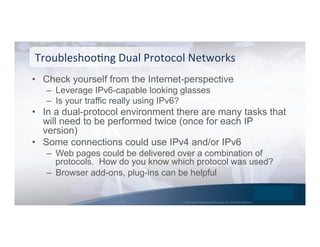
•  Check yourself from the Internet-perspective
–  Leverage IPv6-capable looking glasses
–  Is your traffic really using IPv6?
•  In a dual-protocol environment there are many tasks that
will need to be performed twice (once for each IP
version)
•  Some connections could use IPv4 and/or IPv6
–  Web pages could be delivered over a combination of
protocols. How do you know which protocol was used?
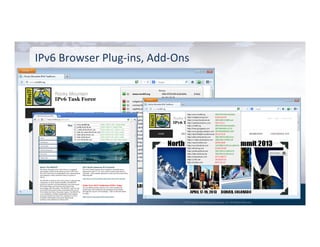
–  Browser add-ons, plug-ins can be helpful
TroubleshooNng	
  Dual	
  Protocol	
  Networks	
  
© 2015 Global Technology Resources, Inc. All Rights Reserved.
IPv6	
  Browser	
  Plug-­‐ins,	
  Add-­‐Ons	
  
© 2015 Global Technology Resources, Inc. All Rights Reserved. Contents herein contain confidential information not to be copied.
Thank	
  You!	
  
Sco8	
  Hogg,	
  CTO	
  GTRI	
  
303-­‐949-­‐4865	
  	
  |	
  	
  shogg	
  at	
  gtri.com	
  

Successfully Deploying IPv6

  • 1.
    © 2015 GlobalTechnology Resources, Inc. All Rights Reserved. Contents herein contain confidential information not to be copied. Successfully  Deploying  IPv6   Presented  by  Sco8  Hogg,  CTO  GTRI   NANOG  On  The  Road  5  –  Orlando,  FL   February  24,  2015  
  • 2.
    © 2015 GlobalTechnology Resources, Inc. All Rights Reserved. •  Dual Stack Migration Planning Pitfalls •  Training for IPv6 Deployment Success •  Addressing Challenges •  IPv6 Routing •  Dual-Protocol Applications •  Troubleshooting Dual-Protocol Networks Agenda  
  • 3.
    © 2015 GlobalTechnology Resources, Inc. All Rights Reserved. •  Organizations using IPv4 today will add IPv6 as a separate protocol, run them in parallel for many years, then after many years, start to disable IPv4 IPv6  Planning  –  Dual  Stack  MigraNon   IPv4  Deployment   IPv6  Deployment   Time  
  • 4.
    © 2015 GlobalTechnology Resources, Inc. All Rights Reserved. •  Failing to build a cross-function IPv6 deployment team –  Multidisciplinary, Collaborative, Cooperative •  Organizations need to treat IPv6 as a “Program” not just like a typical IT “Project” –  IPv6 transition is made up of many smaller projects that will span multiple years and cross the entire enterprise •  Regular/Frequent meetings are key to maintaining pace •  Just like anything, executive buy-in and support is essential IPv6  Planning  PiOalls  
  • 5.
    © 2015 GlobalTechnology Resources, Inc. All Rights Reserved. •  Don’t try to look at everything, identify devices requireing IPv6 •  Focus your efforts on the Internet perimeter –  Look at every device in the transmission path (IPS, WAF, web proxy, DLP, …) •  The good news is you have waited to deploy IPv6 –  Now most IT products come standard with IPv6 capabilities •  Don’t be concerned about an IPv4-only management plane – that will come later •  Some devices may remain IPv4-only until they die Performing  an  IPv6  Readiness  Assessment  
  • 6.
    © 2015 GlobalTechnology Resources, Inc. All Rights Reserved. •  Assume your IT organization has not taken the initiative to immerse themselves in IPv6 •  People need to be trained early in the process, but not too early that they forget what they learned –  Train “just in time”, not years before an IPv6 address is actually configured on a production device •  Train for different skillsets (appdev, sysadmin, net admin, sec admin, helpdesk, PMs, …) •  Much of your IPv4 experience is applicable to IPv6 •  Don’t fear the larger addresses – Learn to “Think in Hex” Training  for  Success  
  • 7.
    © 2015 GlobalTechnology Resources, Inc. All Rights Reserved. •  IPv4-Think is dangerous when planning IPv6 addressing –  Crazy Talk: Using decimal #s, embedding VLAN #, IPv4 address converted to hex •  There is no scarcity of IPv6 addresses –  If there is no scarcity, there can be no waste –  Don’t try to assign only the minimum-needed prefix length –  Plan for the number of subnets, not the number of hosts •  Perform addressing for simplicity and ease of management –  Don’t be concerned about lots of reserved space IPv6  Addressing  
  • 8.
    © 2015 GlobalTechnology Resources, Inc. All Rights Reserved. •  Don’t force levels of hierarchy that are not needed •  Use standard prefix lengths: /48, /56, /64 •  Use nibble-boundary – don’t use /50, /57, /65, … •  Consistency between sites can increase operational efficiency, however, not every site needs the same addressing plan –  Branches need a different plan than a data center “site” •  Stick with Global Unicast Addresses (GUA) 2000::/3 •  Avoid Unique Local Addresses (ULA) FC00::/7 IPv6  Addressing  
  • 9.
    © 2015 GlobalTechnology Resources, Inc. All Rights Reserved. •  IP addressing and routing go hand-in-hand •  All IP routing protocols have IPv6 capabilities •  Separating control plane for two data planes can be desirable –  Establish BGP peer over IPv4 TCP 179 for sharing IPv4 routes –  Establish BGP peer over IPv6 TCP 179 for sharing IPv6 routes •  Don’t forget to use a 32-bit RID to the IPv6 routing process •  Peering using global (preferred) or link-local addresses •  Consider using locally-administered link-local addresses –  fe80::cccc:0001, fe80::dddd:0002, … •  Type carefully – don’t fat-finger the address IPv6  RouNng  
  • 10.
    © 2015 GlobalTechnology Resources, Inc. All Rights Reserved. •  Assessing current code for IPv6-capability –  Most applications are not creating socket-level connections –  Most applications use higher-level APIs or rely on lower-level web services for connectivity •  Create code that is Address-Family (AF) independent •  Presentation-to-Numeric (p2n) & Numeric-to-Presentation (n2p) –  Robustness principle: Be conservative in what you send, be liberal in what you accept •  Be careful of data structures for storing 128-bit addresses •  Create code that performs dual-protocol DNS resolution and incorporates Happy Eyeballs (RFC 6555) •  Write code that properly handles Path MTU Discovery (PMTUD) Dual-­‐Protocol  ApplicaNons  
  • 11.
    © 2015 GlobalTechnology Resources, Inc. All Rights Reserved. •  Understand how IPv4 and IPv6 are different in terms of networking (NDP, extension headers, dynamic tunnels, …) •  Don’t deploy IPv6 if you lack the products to secure the protocol •  Don’t be overly worried about IPv6 NDP security weaknesses –  You haven’t secured your IPv4 LANs either –  https://community.infoblox.com/blogs/2015/02/10/holding- ipv6-neighbor-discovery-higher-standard-security IPv6  Security  ConsideraNons  
  • 12.
    © 2015 GlobalTechnology Resources, Inc. All Rights Reserved. •  Even if you do not deploy IPv6, there could still be IPv6- related issues that you must deal with. •  You now have IPv6-enabled nodes in your environment. •  Using a disciplined troubleshooting methodology will pay dividends when dealing with multi-part problems. •  Troubleshoot IPv6 in segments (LAN1, WAN, LAN2) •  Troubleshooting NDP requires a magnifying lens. –  You may need to break out the protocol analyzer –  Looking for an IPv6 needle in a haystack of IPv4 TroubleshooNng  Dual  Protocol  Networks  
  • 13.
    © 2015 GlobalTechnology Resources, Inc. All Rights Reserved. TroubleshooNng  Dual  Protocol  Networks   Applicatio n Layer Transport Layer Internet Layer Link Layer IPv4 IPv6 ARP ICMP IGMP TCP UDP SCTP HTTP(S)   SSH   SMTP   TFTP   DHCP   DNS   SIP   WebRTC   TLS/SSL   SNMP   BGP   DCCP T1/E1/T3/E3 SONET SDH ICMPv6 NDP MLD Ethernet Wireless
  • 14.
    © 2015 GlobalTechnology Resources, Inc. All Rights Reserved. •  Ping (ping6) (by name, by IP address, in both directions, specify source address, 1500-byte MTU) –  Linux: ping6 -I eth0 fe80::1 –  Windows: ping fe80::1%12 –  Cisco: ping fe80::1%GigabitEthernet0/0 –  ping -l 1500 2001:db8:dead:c0de::1 •  Traceroute (traceroute6), tracert •  Tcptraceroute6 (www.remlab.net/ndisc6/) •  Microsoft C:>pathping -6 2001:db8:11::1 •  mtr -r6 www.rmv6tf.org c100 (www.bitwizard.nl/mtr/) •  Pchar, pathchar, iperf, jperf •  Netcat (nc -6), telnet, ssh, nmap -6 -sT 2001:db8::1 End-­‐to-­‐End  IPv6  TroubleshooNng  
  • 15.
    © 2015 GlobalTechnology Resources, Inc. All Rights Reserved. •  Check yourself from the Internet-perspective –  Leverage IPv6-capable looking glasses –  Is your traffic really using IPv6? •  In a dual-protocol environment there are many tasks that will need to be performed twice (once for each IP version) •  Some connections could use IPv4 and/or IPv6 –  Web pages could be delivered over a combination of protocols. How do you know which protocol was used? –  Browser add-ons, plug-ins can be helpful TroubleshooNng  Dual  Protocol  Networks  
  • 16.
    © 2015 GlobalTechnology Resources, Inc. All Rights Reserved. IPv6  Browser  Plug-­‐ins,  Add-­‐Ons  
  • 17.
    © 2015 GlobalTechnology Resources, Inc. All Rights Reserved. Contents herein contain confidential information not to be copied. Thank  You!   Sco8  Hogg,  CTO  GTRI   303-­‐949-­‐4865    |    shogg  at  gtri.com