IPV6
an introduction to transition planning


                          Eduardo Coelho
                         http://coelho.pro.br
TOPICS (1)

• why    you have to plan before the deployment

• the   framework

• whats    wrong with ipv4?

• dual   stack deployment strategy

• router   advertisements and the plug-and-play philosophy

• choosing   the equipments
TOPICS (2)

• IPv6   addressing

• DNS    settings delivery issues

• legacy   devices

• transition   protocols

• security   concerns

• final   suggestions
WHY YOU HAVE TO PLAN
    BEFORE THE DEPLOYMENT
• acceptplanning as part of IT culture as it should always have
 been (ps: if you`re already there, great!)

• your   planning can act as a decision-making tool

• including   be ready to defend investment choices

• documenting     helps delegate and check compliance

• feel   you are on top of the changing environment
THE FRAMEWORK

•a   simple framework for the changes

 • get    to know (conheça)

 • plan   (planeje)

 • test   (teste)

 • implement        (implemente)
WHAT’S WRONG WITH IPV4


• lack   of enough host addresses

• NAT     issues and lack of end-to-end connectivity

• note: you
          should pay attention to the opportunities that
 comes with ipv6 deploy
DUAL STACK DEPLOYMENT
         PHILOSOPHY

• ipv4   is not compatible with ipv6

• thedeployment of ipv6 is meant to be made world-wide in
 parallel to already functioning ipv4 networks

• while
      the traffic on internet and intranets shift to v6, transition
 protocols will help most equipment to remain connected
THE PLUG-AND-PLAY
               PHILOSOPHY
• plug-and-play   as a principle

• that   makes ipv6 more plug-and-play

• reduced     router processing

• better   connectivity auto-healing

• mobility   is supported

• multicast   gains momentum
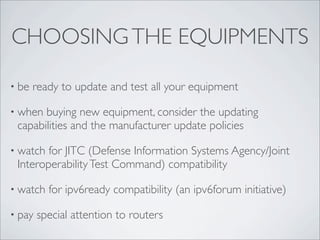
CHOOSING THE EQUIPMENTS

• be   ready to update and test all your equipment

• when buying new equipment, consider the updating
 capabilities and the manufacturer update policies

• watch for JITC (Defense Information Systems Agency/Joint
 Interoperability Test Command) compatibility

• watch   for ipv6ready compatibility (an ipv6forum initiative)

• pay   special attention to routers
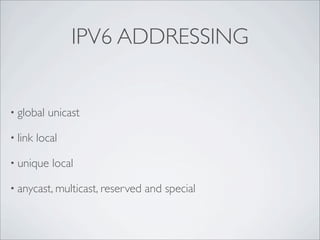
IPV6 ADDRESSING


• global   unicast

• link   local

• unique    local

• anycast, multicast, reserved   and special
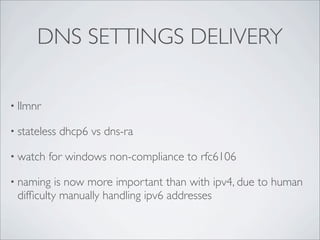
DNS SETTINGS DELIVERY

• llmnr

• stateless   dhcp6 vs dns-ra

• watch   for windows non-compliance to rfc6106

• naming  is now more important than with ipv4, due to human
 difficulty manually handling ipv6 addresses
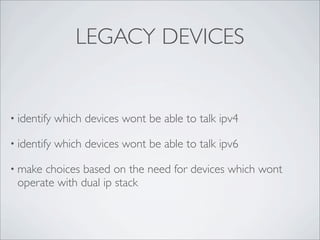
LEGACY DEVICES


• identify   which devices wont be able to talk ipv4

• identify   which devices wont be able to talk ipv6

• makechoices based on the need for devices which wont
 operate with dual ip stack
TRANSITION PROTOCOLS (1)

• there   a lot of transitional protocols, including some drafts

• be   careful about equipment support

• avoid
      transitional protocols when possible, due to security
 concerns (possible firewall traversal and datagram data
 obfuscation)

• isps   may offer dual stack connectivity or transparent tunneling
TRANSITION PROTOCOLS (2)

• recommended       transitional protocols:

 • initial   transition: 6to4 (auto), teredo (auto, ipv4 nat support)

 • intrasite, initial   transition: isatap

 • final   transition: 4in6 (manual, rfc2473)

• othertunnels: 6in4 (manual, broker based), 6over4 (requires
 ipv4 multicast, hard to comply), nat64 (translation protocol)
SECURITY CONCERNS

• rogue   routers

• rogue   dhcp servers

• sniffing

• spoofing

• tunneling   obfuscation
FINAL SUGGESTIONS

• carefully   choose isp offering

• define network-level addressing plan and enforce
 requirements

• have   a clear plan for naming and dhcp

• consider    deprecating ipv4-only devices

• prefer   dual-stack devices
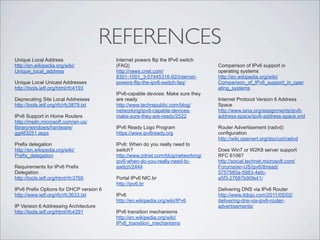
REFERENCES
Unique Local Address                     Internet powers flip the IPv6 switch
http://en.wikipedia.org/wiki/            (FAQ)                                   Comparison of IPv6 support in
Unique_local_address                     http://news.cnet.com/                   operating systems
                                         8301-1001_3-57445316-92/internet-       http://en.wikipedia.org/wiki/
Unique Local Unicast Addresses           powers-flip-the-ipv6-switch-faq/        Comparison_of_IPv6_support_in_oper
http://tools.ietf.org/html/rfc4193                                               ating_systems
                                         IPv6-capable devices: Make sure they
Deprecating Site Local Addresses         are ready                               Internet Protocol Version 6 Address
http://tools.ietf.org/rfc/rfc3879.txt    http://www.techrepublic.com/blog/       Space
                                         networking/ipv6-capable-devices-        http://www.iana.org/assignments/ipv6-
IPv6 Support in Home Routers             make-sure-they-are-ready/2522           address-space/ipv6-address-space.xml
http://msdn.microsoft.com/en-us/
library/windows/hardware/                IPv6 Ready Logo Program                 Router Advertisement (radvd)
gg463251.aspx                            https://www.ipv6ready.org               configuration
                                                                                 http://wiki.openwrt.org/doc/uci/radvd
Prefix delegation                        IPv6: When do you really need to
http://en.wikipedia.org/wiki/            switch?                                 Does Win7 or W2K8 server support
Prefix_delegation                        http://www.zdnet.com/blog/networking/   RFC 6106?
                                         ipv6-when-do-you-really-need-to-        http://social.technet.microsoft.com/
Requirements for IPv6 Prefix             switch/2444                             Forums/en-US/ipv6/thread/
Delegation                                                                       5757980a-5983-4efc-
http://tools.ietf.org/html/rfc3769       Portal IPv6 NIC.br                      a5f3-27687b90fe41/
                                         http://ipv6.br
IPv6 Prefix Options for DHCP version 6                                           Delivering DNS via IPv6 Router
http://www.ietf.org/rfc/rfc3633.txt      IPv6                                    http://www.itdojo.com/2011/05/02/
                                         http://en.wikipedia.org/wiki/IPv6       delivering-dns-via-ipv6-router-
IP Version 6 Addressing Architecture                                             advertisements/
http://tools.ietf.org/html/rfc4291       IPv6 transition mechanisms
                                         http://en.wikipedia.org/wiki/
                                         IPv6_transition_mechanisms

2012 11-09 facex - i pv6 transition planning-

  • 1.
    IPV6 an introduction totransition planning Eduardo Coelho http://coelho.pro.br
  • 2.
    TOPICS (1) • why you have to plan before the deployment • the framework • whats wrong with ipv4? • dual stack deployment strategy • router advertisements and the plug-and-play philosophy • choosing the equipments
  • 3.
    TOPICS (2) • IPv6 addressing • DNS settings delivery issues • legacy devices • transition protocols • security concerns • final suggestions
  • 4.
    WHY YOU HAVETO PLAN BEFORE THE DEPLOYMENT • acceptplanning as part of IT culture as it should always have been (ps: if you`re already there, great!) • your planning can act as a decision-making tool • including be ready to defend investment choices • documenting helps delegate and check compliance • feel you are on top of the changing environment
  • 5.
    THE FRAMEWORK •a simple framework for the changes • get to know (conheça) • plan (planeje) • test (teste) • implement (implemente)
  • 6.
    WHAT’S WRONG WITHIPV4 • lack of enough host addresses • NAT issues and lack of end-to-end connectivity • note: you should pay attention to the opportunities that comes with ipv6 deploy
  • 7.
    DUAL STACK DEPLOYMENT PHILOSOPHY • ipv4 is not compatible with ipv6 • thedeployment of ipv6 is meant to be made world-wide in parallel to already functioning ipv4 networks • while the traffic on internet and intranets shift to v6, transition protocols will help most equipment to remain connected
  • 8.
    THE PLUG-AND-PLAY PHILOSOPHY • plug-and-play as a principle • that makes ipv6 more plug-and-play • reduced router processing • better connectivity auto-healing • mobility is supported • multicast gains momentum
  • 9.
    CHOOSING THE EQUIPMENTS •be ready to update and test all your equipment • when buying new equipment, consider the updating capabilities and the manufacturer update policies • watch for JITC (Defense Information Systems Agency/Joint Interoperability Test Command) compatibility • watch for ipv6ready compatibility (an ipv6forum initiative) • pay special attention to routers
  • 10.
    IPV6 ADDRESSING • global unicast • link local • unique local • anycast, multicast, reserved and special
  • 11.
    DNS SETTINGS DELIVERY •llmnr • stateless dhcp6 vs dns-ra • watch for windows non-compliance to rfc6106 • naming is now more important than with ipv4, due to human difficulty manually handling ipv6 addresses
  • 12.
    LEGACY DEVICES • identify which devices wont be able to talk ipv4 • identify which devices wont be able to talk ipv6 • makechoices based on the need for devices which wont operate with dual ip stack
  • 13.
    TRANSITION PROTOCOLS (1) •there a lot of transitional protocols, including some drafts • be careful about equipment support • avoid transitional protocols when possible, due to security concerns (possible firewall traversal and datagram data obfuscation) • isps may offer dual stack connectivity or transparent tunneling
  • 14.
    TRANSITION PROTOCOLS (2) •recommended transitional protocols: • initial transition: 6to4 (auto), teredo (auto, ipv4 nat support) • intrasite, initial transition: isatap • final transition: 4in6 (manual, rfc2473) • othertunnels: 6in4 (manual, broker based), 6over4 (requires ipv4 multicast, hard to comply), nat64 (translation protocol)
  • 15.
    SECURITY CONCERNS • rogue routers • rogue dhcp servers • sniffing • spoofing • tunneling obfuscation
  • 16.
    FINAL SUGGESTIONS • carefully choose isp offering • define network-level addressing plan and enforce requirements • have a clear plan for naming and dhcp • consider deprecating ipv4-only devices • prefer dual-stack devices
  • 17.
    REFERENCES Unique Local Address Internet powers flip the IPv6 switch http://en.wikipedia.org/wiki/ (FAQ) Comparison of IPv6 support in Unique_local_address http://news.cnet.com/ operating systems 8301-1001_3-57445316-92/internet- http://en.wikipedia.org/wiki/ Unique Local Unicast Addresses powers-flip-the-ipv6-switch-faq/ Comparison_of_IPv6_support_in_oper http://tools.ietf.org/html/rfc4193 ating_systems IPv6-capable devices: Make sure they Deprecating Site Local Addresses are ready Internet Protocol Version 6 Address http://tools.ietf.org/rfc/rfc3879.txt http://www.techrepublic.com/blog/ Space networking/ipv6-capable-devices- http://www.iana.org/assignments/ipv6- IPv6 Support in Home Routers make-sure-they-are-ready/2522 address-space/ipv6-address-space.xml http://msdn.microsoft.com/en-us/ library/windows/hardware/ IPv6 Ready Logo Program Router Advertisement (radvd) gg463251.aspx https://www.ipv6ready.org configuration http://wiki.openwrt.org/doc/uci/radvd Prefix delegation IPv6: When do you really need to http://en.wikipedia.org/wiki/ switch? Does Win7 or W2K8 server support Prefix_delegation http://www.zdnet.com/blog/networking/ RFC 6106? ipv6-when-do-you-really-need-to- http://social.technet.microsoft.com/ Requirements for IPv6 Prefix switch/2444 Forums/en-US/ipv6/thread/ Delegation 5757980a-5983-4efc- http://tools.ietf.org/html/rfc3769 Portal IPv6 NIC.br a5f3-27687b90fe41/ http://ipv6.br IPv6 Prefix Options for DHCP version 6 Delivering DNS via IPv6 Router http://www.ietf.org/rfc/rfc3633.txt IPv6 http://www.itdojo.com/2011/05/02/ http://en.wikipedia.org/wiki/IPv6 delivering-dns-via-ipv6-router- IP Version 6 Addressing Architecture advertisements/ http://tools.ietf.org/html/rfc4291 IPv6 transition mechanisms http://en.wikipedia.org/wiki/ IPv6_transition_mechanisms