Communicating Effectively in
Organizations – Communication Process,
Barriers to Communication, Overcoming
Barriers to Communication
Dr. G C Mohanta, BE, MSc(Engg), MBA, PhD(Mgt)
Professor
16-2
Communication
 Communication is the sharing of information
between two or more individuals or groups to reach
a common understanding.
 Communication is defined as "the transmission of
information and understanding through the use of
common symbols."
Interpersonal Communication
Verbal Communication
 The encoding of messages into words,
either written or spoken
Nonverbal Communication
 The encoding of messages by means of
facial expressions, body language, and
styles of dress.
Interpersonal Communication (Contd.)
 Oral Communication
 Advantages: Speed and feedback.
 Disadvantage: Distortion of the message.
 Written Communication
 Advantages: Tangible and verifiable.
 Disadvantages: Time consuming and lacks feedback.
 Nonverbal Communication
 Advantages: Supports other communications and provides
observable expression of emotions and feelings.
 Disadvantage: Misperception of body language or gestures
can influence receiver’s interpretation of message.
Importance of Good
Communication
 Increased efficiency in new technologies
and skills
 Improved quality of products and services
 Increased responsiveness to customers
 More innovation through communication
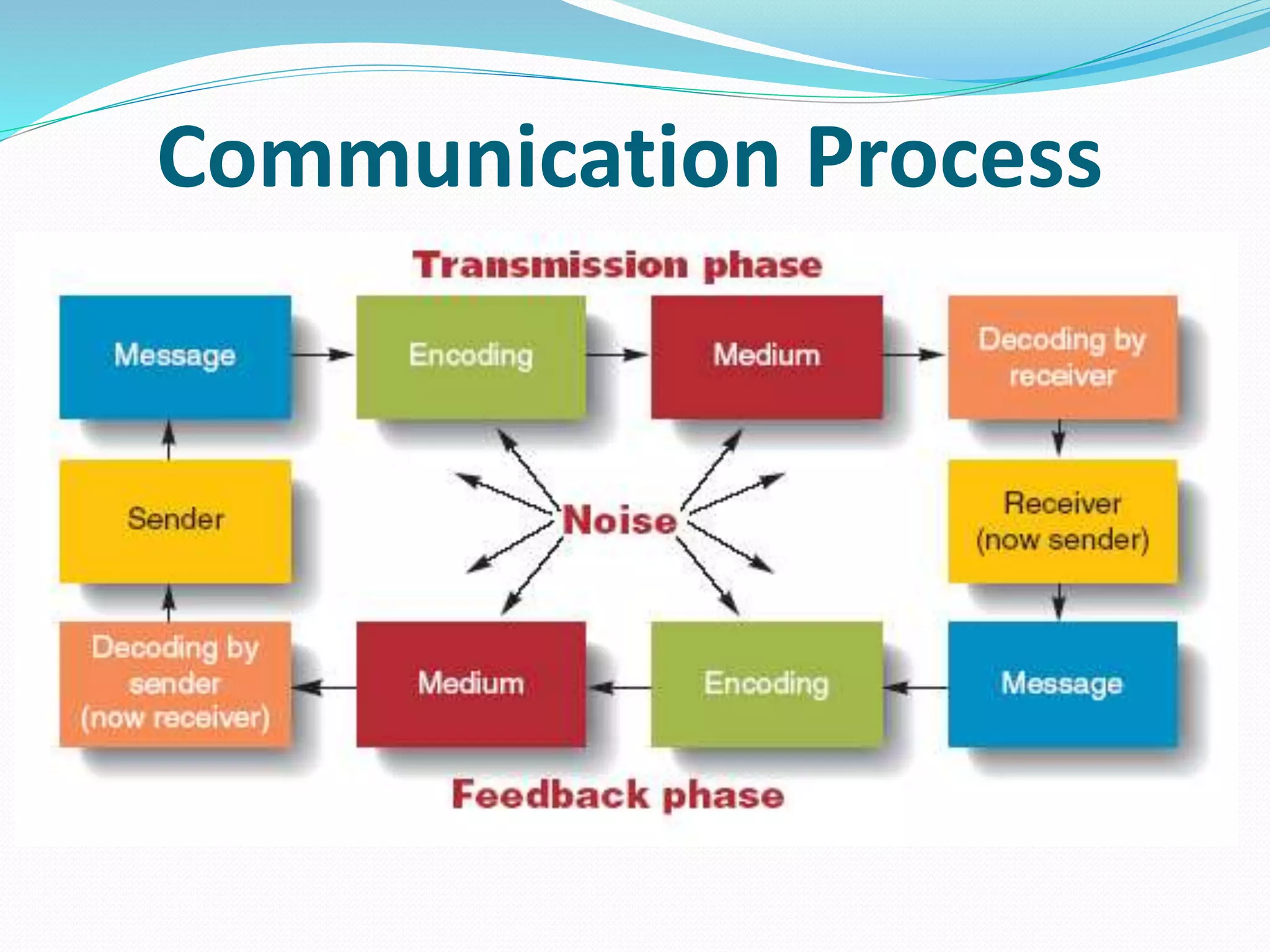
Communication Process
 Phases of the Communication Process:
 Transmission phase in which information is
shared by two or more people.
 Feedback phase in which a common
understanding is assured.
Communication Process
Communication Process (Contd.)
Sender – person wishing to share
information with some other person
Message – what information to communicate
Encoding – sender translates the message
into symbols or language
Noise – refers to anything that hampers any
stage of the communication process
Communication Process (Contd.)
Receiver – person or group for which the
message is intended
Medium – pathway through which an
encoded message is transmitted to a receiver
Decoding - critical point where the
receiver interprets and tries to make sense of
the message
Communication Process (Contd.)
 Feedback phase is initiated by the receiver
 Receiver decides what message to be sent to
the original sender
 Feedback eliminates misunderstandings,
ensures that messages are correctly interpreted
Dangers of Ineffective Communication
 When managers and other members of an
organization are ineffective communicators,
organizational performance suffers and
 Any competitive advantage the organization might
have, is likely to be lost
Information Richness and
Communication Media
 Managers and their subordinates can
become effective communicators by:
 Selecting an appropriate medium for each
message—there is no one “best” medium.
 Considering information richness
 A medium with high richness can carry much more
information to aid understanding.
Information Richness
The amount of information that a
communication medium can carry
The extent to which the medium
enables the sender and receiver to
reach a common understanding
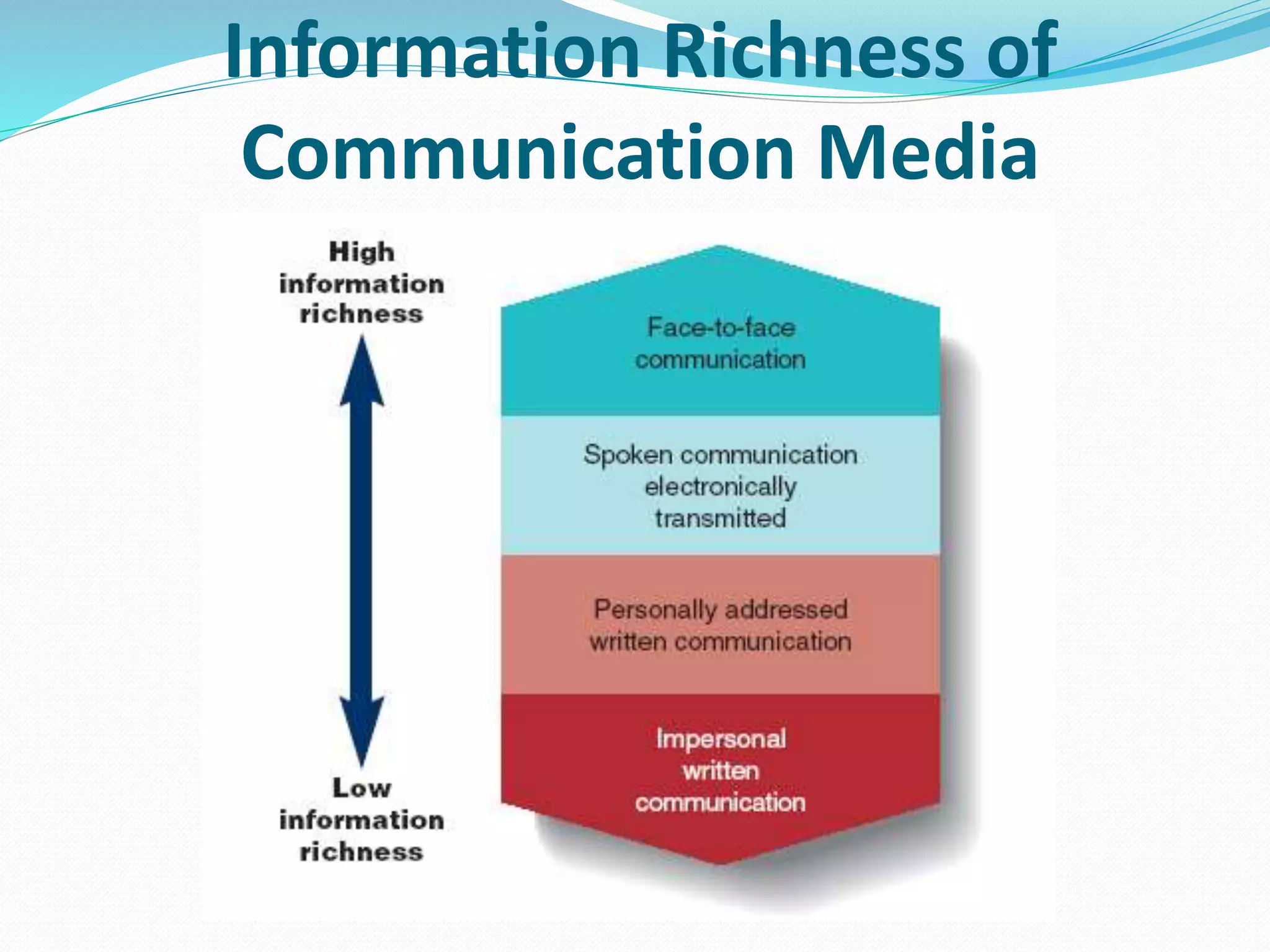
Information Richness of
Communication Media
Communication Media
Face-to-Face
 Has highest information richness.
 Can take advantage of verbal and
nonverbal signals.
Communication Media
 Face-to-Face
 Provides for instant feedback.
 Management by wandering around takes
advantage of this with informal talks to workers.
 Video conferences provide much of this richness
and reduce travel costs and meeting times.
Communication Media
 Spoken Communication Electronically
Transmitted
 Has the second highest information richness.
 Telephone conversations are information rich
with tone of voice, sender’s emphasis, and quick
feedback, but provide no visual nonverbal cues.
Communication Media
 Personally Addressed Written
Communication
 Has a lower richness than the verbal forms of
communication, but still is directed at a given
person.
 Personal addressing helps to ensure that
receiver actually reads the message; personal
letters and e-mail are common forms.
Communication Media
 Personally Addressed Written
Communication
 Does not provide instant feedback to the sender
although sender may get feedback later.
 Excellent media for complex messages requesting
follow-up actions by receiver.
Communication Media
 Impersonal Written Communication
 Has the lowest information richness.
 Good for messages to many receivers where
little or no feedback is expected (e.g.,
newsletters, reports)
Grapevine Communication
 Grapevine Communication is informal communication and
there is no definite route of communication for sharing
information.
 In this form of communication, information converges a long
way by passing from one person to another person, leaving no
indication from which point it started.
 Grapevine Communication Characteristics:
 Informal, not controlled by management.
 Perceived by most employees as being more believable and reliable
than formal communications.
 Largely used to serve the self-interests of those who use it.
 Results from:
 Desire for information about important situations
 Ambiguous conditions
 Conditions that cause anxiety
Barriers to Effective Communication
Barriers to effective communications are as
follows:
1. Frame of reference: People can encode/decode messages
differently because of different frames of reference.
 It results from different individual backgrounds and
experiences.
 It produces distorted communication and occurs even at
different organizational levels.
2. Selective listening: A form of selective perception where
individuals perceive only information that affirms their beliefs
and blocks out new and disconfirming information.
 3. Value judgments: The receiver assigns an overall worth to
the message based on his/her evaluation of the message's
anticipated meaning.
Barriers to Effective
Communication (Contd.)
4. Source credibility: Trust, confidence, and faith that the
receiver has in the communicator's words/actions.
 Directly impacts message reception and reaction by the
receiver.
5. Filtering: The communicator manipulates the information
so the receiver hears it as positive.
 It frequently occurs in upward communication.
 It occurs because the direction carries control of information
to management that may affect merit evaluations.
6. In-group language: Language (jargon) developed by a
particular group that is meaningful/understandable only to
the members;
 Produces communication breakdowns when outsiders are
involved.
Barriers to Effective
Communication (Contd.)
7. Status differences: Can be perceived as threats by those
lower in the organizational hierarchy and channel of
communication who normally would be included.
8. Time pressures: Can produce short-circuiting wherein
someone has been left out of the formal channel of
communication who normally would be included.
9. Communication overload: People feel buried by
information and data that they cannot adequately absorb.
 It occurs because of the deluge of information with which
managers must contend.
 Overloaded manager cannot absorb/adequately respond
to all messages which results in "screening out“ many
messages.
Barriers to Effective
Communication (Contd.)
10. Emotions: How a receiver feels at the time of
receipt of a message, will influence how the
message is interpreted.
11. Communication Apprehension: Undue
tension and anxiety about oral communication,
written communication, or both.
Barriers to Effective
Communication (Contd.)
Communication Barriers Between Men & Women
Men talk to:
 Emphasize status, power, and independence
 Complain that women talk on and on
 Offer solutions
 To boast about their accomplishments
Women talk to:
 Establish connection and intimacy
 Criticize men for not listening
 Speak of problems to promote closeness
 Express regret and restore balance to a conversation
Barriers to Effective Cross-Cultural
Communication & Cultural Context
Barriers to Effective Cross-Cultural
Communication
 Semantics, Word Connotations, Tone Differences,
Perception Differences
Communication Barriers and Cultural
Context
 High-Context Cultures - Cultures that rely heavily on
nonverbal and subtle situational cues to communication
 Low-Context Cultures - Cultures that rely heavily on
words to convey meaning in communication
Overcoming Barriers to Effective
Communications
 Developing a deep understanding of the various
barriers to communication must lead the
management to devising ways and means of
overcoming these barriers.
 Besides, every communicator must take specific
steps to improve conditions and eliminate
roadblocks to effective communication.
Overcoming Barriers to Effective
Communications (Contd.)
 American Management Association has formulated the
following commandments for effective communication:
1. Clarifying ideas before communication
2. Knowing purpose of communication
3. Understanding physical and human environments of communication
4. Consulting others in planning communication
5. Understanding contents and overtones of communication
6. Understanding value of communication to the receiver
7. Taking follow up action
8. Understanding importance of communication
9. Taking actions congruent with communication
10. Good listening
Strategies for Communicating
Effectively in Organizations
Strategies for communicating effectively are as
follows:
 1. Following up - attempting to determine whether your
intended message was actually received.
 2. Regulating information flow - attempting to eliminate
communication overload;
 Regulating information quantity and quality by bringing only
significant deviations from policies and procedures to the
superior.
 3. Utilizing feedback - sent by receivers of the messages.
 4. Developing empathy - placing oneself in the shoes of the
receiver to anticipate how the message will be decoded.
Strategies for Communicating
Effectively in Organizations (Contd.)
 5. Repetition - Introducing repetition/redundancy into
communications to be sure that the message is understood.
 6. Encouraging mutual trust - developing trust between
senders and receivers;
 It facilitates communication and makes follow up on each
communication less critical.
 7. Effective timing - Timing a communication, so that it does
not compete with other messages being sent to the receiver.
 8. Simplifying language - Encoding messages into words and
symbols that the receiver understands.
Strategies for Communicating
Effectively in Organizations (Contd.)
 9. Effective listening: Entails listening with
understanding - removing distractions, putting the
speaker at ease, showing that you want to listen, and
asking questions.
 10. Using the grapevine: Managers should know how
to use it and increase its accuracy, as distortions
travelling through the grapevine can be devastating.
 11. Promoting Ethical Communications: Send
communications which adhere to ethics.
Strategies for Communicating
Effectively in Organizations (Contd.)
Krep's principles guiding effective internal
communications suggest that organization
members:
 i. Should not intentionally deceive one another.
 ii. Should not purposely harm any other member.
 iii. Should be treated justly.
 Management in many instances says it has the right to gather
intelligence on its employees, even spying if it is not illegal.
 There are many numbers of tools available for such monitoring
of behaviour.
 Competitive intelligence, a system for gathering information
that affects a firm, analyzing the data, and taking action is
becoming an accepted practice.

Communicating Effectively in Organizations - Communication Process, Barriers to Communication, Overcoming Barriers to Communication

  • 1.
    Communicating Effectively in Organizations– Communication Process, Barriers to Communication, Overcoming Barriers to Communication Dr. G C Mohanta, BE, MSc(Engg), MBA, PhD(Mgt) Professor
  • 2.
    16-2 Communication  Communication isthe sharing of information between two or more individuals or groups to reach a common understanding.  Communication is defined as "the transmission of information and understanding through the use of common symbols."
  • 3.
    Interpersonal Communication Verbal Communication The encoding of messages into words, either written or spoken Nonverbal Communication  The encoding of messages by means of facial expressions, body language, and styles of dress.
  • 4.
    Interpersonal Communication (Contd.) Oral Communication  Advantages: Speed and feedback.  Disadvantage: Distortion of the message.  Written Communication  Advantages: Tangible and verifiable.  Disadvantages: Time consuming and lacks feedback.  Nonverbal Communication  Advantages: Supports other communications and provides observable expression of emotions and feelings.  Disadvantage: Misperception of body language or gestures can influence receiver’s interpretation of message.
  • 5.
    Importance of Good Communication Increased efficiency in new technologies and skills  Improved quality of products and services  Increased responsiveness to customers  More innovation through communication
  • 6.
    Communication Process  Phasesof the Communication Process:  Transmission phase in which information is shared by two or more people.  Feedback phase in which a common understanding is assured.
  • 7.
  • 8.
    Communication Process (Contd.) Sender– person wishing to share information with some other person Message – what information to communicate Encoding – sender translates the message into symbols or language Noise – refers to anything that hampers any stage of the communication process
  • 9.
    Communication Process (Contd.) Receiver– person or group for which the message is intended Medium – pathway through which an encoded message is transmitted to a receiver Decoding - critical point where the receiver interprets and tries to make sense of the message
  • 10.
    Communication Process (Contd.) Feedback phase is initiated by the receiver  Receiver decides what message to be sent to the original sender  Feedback eliminates misunderstandings, ensures that messages are correctly interpreted
  • 11.
    Dangers of IneffectiveCommunication  When managers and other members of an organization are ineffective communicators, organizational performance suffers and  Any competitive advantage the organization might have, is likely to be lost
  • 12.
    Information Richness and CommunicationMedia  Managers and their subordinates can become effective communicators by:  Selecting an appropriate medium for each message—there is no one “best” medium.  Considering information richness  A medium with high richness can carry much more information to aid understanding.
  • 13.
    Information Richness The amountof information that a communication medium can carry The extent to which the medium enables the sender and receiver to reach a common understanding
  • 14.
  • 15.
    Communication Media Face-to-Face  Hashighest information richness.  Can take advantage of verbal and nonverbal signals.
  • 16.
    Communication Media  Face-to-Face Provides for instant feedback.  Management by wandering around takes advantage of this with informal talks to workers.  Video conferences provide much of this richness and reduce travel costs and meeting times.
  • 17.
    Communication Media  SpokenCommunication Electronically Transmitted  Has the second highest information richness.  Telephone conversations are information rich with tone of voice, sender’s emphasis, and quick feedback, but provide no visual nonverbal cues.
  • 18.
    Communication Media  PersonallyAddressed Written Communication  Has a lower richness than the verbal forms of communication, but still is directed at a given person.  Personal addressing helps to ensure that receiver actually reads the message; personal letters and e-mail are common forms.
  • 19.
    Communication Media  PersonallyAddressed Written Communication  Does not provide instant feedback to the sender although sender may get feedback later.  Excellent media for complex messages requesting follow-up actions by receiver.
  • 20.
    Communication Media  ImpersonalWritten Communication  Has the lowest information richness.  Good for messages to many receivers where little or no feedback is expected (e.g., newsletters, reports)
  • 21.
    Grapevine Communication  GrapevineCommunication is informal communication and there is no definite route of communication for sharing information.  In this form of communication, information converges a long way by passing from one person to another person, leaving no indication from which point it started.  Grapevine Communication Characteristics:  Informal, not controlled by management.  Perceived by most employees as being more believable and reliable than formal communications.  Largely used to serve the self-interests of those who use it.  Results from:  Desire for information about important situations  Ambiguous conditions  Conditions that cause anxiety
  • 22.
    Barriers to EffectiveCommunication Barriers to effective communications are as follows: 1. Frame of reference: People can encode/decode messages differently because of different frames of reference.  It results from different individual backgrounds and experiences.  It produces distorted communication and occurs even at different organizational levels. 2. Selective listening: A form of selective perception where individuals perceive only information that affirms their beliefs and blocks out new and disconfirming information.  3. Value judgments: The receiver assigns an overall worth to the message based on his/her evaluation of the message's anticipated meaning.
  • 23.
    Barriers to Effective Communication(Contd.) 4. Source credibility: Trust, confidence, and faith that the receiver has in the communicator's words/actions.  Directly impacts message reception and reaction by the receiver. 5. Filtering: The communicator manipulates the information so the receiver hears it as positive.  It frequently occurs in upward communication.  It occurs because the direction carries control of information to management that may affect merit evaluations. 6. In-group language: Language (jargon) developed by a particular group that is meaningful/understandable only to the members;  Produces communication breakdowns when outsiders are involved.
  • 24.
    Barriers to Effective Communication(Contd.) 7. Status differences: Can be perceived as threats by those lower in the organizational hierarchy and channel of communication who normally would be included. 8. Time pressures: Can produce short-circuiting wherein someone has been left out of the formal channel of communication who normally would be included. 9. Communication overload: People feel buried by information and data that they cannot adequately absorb.  It occurs because of the deluge of information with which managers must contend.  Overloaded manager cannot absorb/adequately respond to all messages which results in "screening out“ many messages.
  • 25.
    Barriers to Effective Communication(Contd.) 10. Emotions: How a receiver feels at the time of receipt of a message, will influence how the message is interpreted. 11. Communication Apprehension: Undue tension and anxiety about oral communication, written communication, or both.
  • 26.
    Barriers to Effective Communication(Contd.) Communication Barriers Between Men & Women Men talk to:  Emphasize status, power, and independence  Complain that women talk on and on  Offer solutions  To boast about their accomplishments Women talk to:  Establish connection and intimacy  Criticize men for not listening  Speak of problems to promote closeness  Express regret and restore balance to a conversation
  • 27.
    Barriers to EffectiveCross-Cultural Communication & Cultural Context Barriers to Effective Cross-Cultural Communication  Semantics, Word Connotations, Tone Differences, Perception Differences Communication Barriers and Cultural Context  High-Context Cultures - Cultures that rely heavily on nonverbal and subtle situational cues to communication  Low-Context Cultures - Cultures that rely heavily on words to convey meaning in communication
  • 28.
    Overcoming Barriers toEffective Communications  Developing a deep understanding of the various barriers to communication must lead the management to devising ways and means of overcoming these barriers.  Besides, every communicator must take specific steps to improve conditions and eliminate roadblocks to effective communication.
  • 29.
    Overcoming Barriers toEffective Communications (Contd.)  American Management Association has formulated the following commandments for effective communication: 1. Clarifying ideas before communication 2. Knowing purpose of communication 3. Understanding physical and human environments of communication 4. Consulting others in planning communication 5. Understanding contents and overtones of communication 6. Understanding value of communication to the receiver 7. Taking follow up action 8. Understanding importance of communication 9. Taking actions congruent with communication 10. Good listening
  • 30.
    Strategies for Communicating Effectivelyin Organizations Strategies for communicating effectively are as follows:  1. Following up - attempting to determine whether your intended message was actually received.  2. Regulating information flow - attempting to eliminate communication overload;  Regulating information quantity and quality by bringing only significant deviations from policies and procedures to the superior.  3. Utilizing feedback - sent by receivers of the messages.  4. Developing empathy - placing oneself in the shoes of the receiver to anticipate how the message will be decoded.
  • 31.
    Strategies for Communicating Effectivelyin Organizations (Contd.)  5. Repetition - Introducing repetition/redundancy into communications to be sure that the message is understood.  6. Encouraging mutual trust - developing trust between senders and receivers;  It facilitates communication and makes follow up on each communication less critical.  7. Effective timing - Timing a communication, so that it does not compete with other messages being sent to the receiver.  8. Simplifying language - Encoding messages into words and symbols that the receiver understands.
  • 32.
    Strategies for Communicating Effectivelyin Organizations (Contd.)  9. Effective listening: Entails listening with understanding - removing distractions, putting the speaker at ease, showing that you want to listen, and asking questions.  10. Using the grapevine: Managers should know how to use it and increase its accuracy, as distortions travelling through the grapevine can be devastating.  11. Promoting Ethical Communications: Send communications which adhere to ethics.
  • 33.
    Strategies for Communicating Effectivelyin Organizations (Contd.) Krep's principles guiding effective internal communications suggest that organization members:  i. Should not intentionally deceive one another.  ii. Should not purposely harm any other member.  iii. Should be treated justly.  Management in many instances says it has the right to gather intelligence on its employees, even spying if it is not illegal.  There are many numbers of tools available for such monitoring of behaviour.  Competitive intelligence, a system for gathering information that affects a firm, analyzing the data, and taking action is becoming an accepted practice.