

By: Fayssal Al-Kilani
MSc Engineering Management
Lean Thinking in the food
Supply Chains
“THERE ARE SO MANY PEOPLE WHO CAN FIGURE COSTS, AND SO
FEW WHO CAN MEASURE VALUES”
Outline
Lean Thinking Definition
Introduction
Food Sector Brief
Review of Literature
Lean Tools and Techniques
Lean Action Plan for Perfection
Case Study UK Tea Industry
Conclusion
References
1
What is lean thinking?
A fundamental business logic, based on the approach developed by Toyota (in the 1990s)
It is focused on eliminating waste from business processes and thereby enhancing value to the
customer
It aims to optimize the whole value stream for a product or service; not optimizing the
activities of individual organizations, departments or assets
2
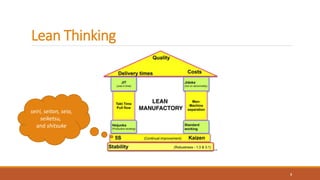
Lean Thinking
3
seiri, seiton, seio,
seiketsu,
and shitsuke
Introduction
In the time of recession, most of the big companies in all sectors and sub-sectors of the market, were
facing troubles with overrun costs and losses in their projects despite high quality products. Thus, the
new generations’ management started to think of adopting new ways to deliver their product
considering the following lean technique:
Cost reduction
High quality products
Waste elimination
Improving customer’s satisfaction (Quality)
4
Food Sector Brief
Waste is not new for the food sector. 1.3 Billion Metric Tons are wasted per year
approximately 179 KGs/Person
Aim
Eliminating the waste by systematic way of thinking
Combat Hunger
Raise Income
Improve food security
Raise economic development
Protect the environment
Majority of the companies are small and medium enterprises (SME)
5
Review of Literature
There is consensus that lean techniques can eliminate waste and reduce risk to manufacturing
and services sectors including construction, aerospace, services, tourism, hospitals and public
administration.
Impact on the way company do business:
Strategic Level: Define Values.
Operational Level: Tools to eliminate waste.
The remainder will be the action plan of the implementation of lean thinking to food industry.
6
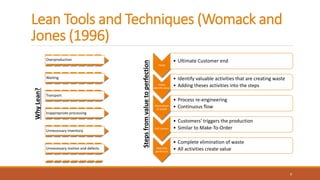
Lean Tools and Techniques (Womack and
Jones (1996)
Overproduction
Waiting
Transport
Inappropriate processing
Unnecessary inventory
Unnecessary motion and defects
7
Value
• Ultimate Customer end
Value
Identification
• Identify valuable activities that are creating waste
• Adding theses activities into the steps
Elimination
of waste
• Process re-engineering
• Continuous flow
Pull System
• Customers' triggers the production
• Similar to Make-To-Order
Step into
perfection
• Complete elimination of waste
• All activities create valueStepsfromvaluetoperfection
WhyLean?
Lean Tools and Techniques contd…
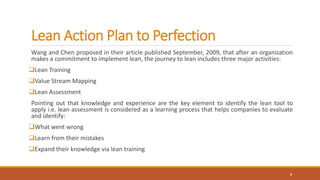
The are numerous lean tools available for companies includes the single minute exchange of
dies (SMED) and value steam mapping.
Piecemeal
Unsystematic application of a single lean tool  Reduce waste without obstruction
Lean Thinking
Set of principals
Business philosophy (Tsasis and Bruce-Barret, 2008)
Lean action plan
Systematic application
Sustainable results
Reduce waste
High value for customers
8
Lean Action Plan to Perfection
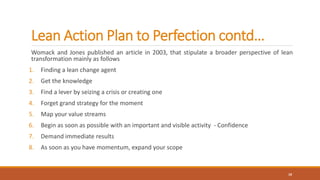
Wang and Chen proposed in their article published September, 2009, that after an organization
makes a commitment to implement lean, the journey to lean includes three major activities:
Lean Training
Value Stream Mapping
Lean Assessment
Pointing out that knowledge and experience are the key element to identify the lean tool to
apply i.e. lean assessment is considered as a learning process that helps companies to evaluate
and identify:
What went wrong
Learn from their mistakes
Expand their knowledge via lean training
9
Lean Action Plan to Perfection contd…
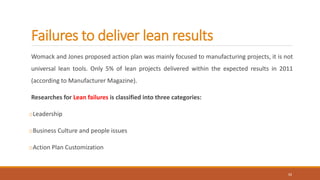
Womack and Jones published an article in 2003, that stipulate a broader perspective of lean
transformation mainly as follows
1. Finding a lean change agent
2. Get the knowledge
3. Find a lever by seizing a crisis or creating one
4. Forget grand strategy for the moment
5. Map your value streams
6. Begin as soon as possible with an important and visible activity - Confidence
7. Demand immediate results
8. As soon as you have momentum, expand your scope
10
Failures to deliver lean results
Womack and Jones proposed action plan was mainly focused to manufacturing projects, it is not
universal lean tools. Only 5% of lean projects delivered within the expected results in 2011
(according to Manufacturer Magazine).
Researches for Lean failures is classified into three categories:
oLeadership
oBusiness Culture and people issues
oAction Plan Customization
11
Leadership
Cudney and Elrod highlighted in their article published in 2011, that there are 6 factors are the
core lead to contribute to lean failures:
Short Term Commitment
Lack of focus on a specific issue
Poor Planning
Poor Employee involvement
Ineffective training method
Poor understanding from top managers
12
Leadership contd…
On the other hand, Kubiak (2011) was reviewing the lean Six Sigma initiative and supporting processes of a large
multinational organizations, the outcome was that this failure is due to Organization’s leadership desired fast
results.
Sarkar (2011), reported that failure of Lean Six Sigma for production is due to the following:
Not having a mindshare of leadership
Not working of the right business priorities
Not having a larger roadmap in place
Not being a methodology agnostic
Not having the right number of change agents
Not being able to coach the TOP MANAGEMENT (Agrees with Kubiak)
Not focusing on values necessary for creating continuous improvement culture
Not having the right organizational culture
13
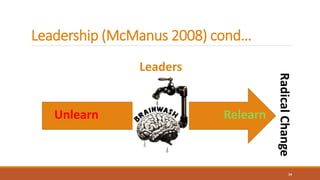
Leadership (McManus 2008) cond…
14
Leaders
Unlearn Relearn
RadicalChange
Business culture and people issues
Companies trying the implementation of the lean management for the past two decades; despite
that, failure was reoccurring. The studies was focused in large scale companies in China; Chen and
Meng listed the following reasons in 2010:
Companies failed to recognize the strategic importance of lean thinking and focused too much on
lean tools
Companies were eager for quick results and abandoned the lean process with the first failure
Companies attempted to imitate and copy success practices without adopting them to their own
business culture
Knowledge of lean tools was superficial without analytical skills to pinpoint problems
15
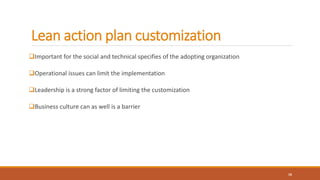
Lean action plan customization
Important for the social and technical specifies of the adopting organization
Operational issues can limit the implementation
Leadership is a strong factor of limiting the customization
Business culture can as well is a barrier
16
Application of Lean Thinking to the
Tea Industry in the UK
17
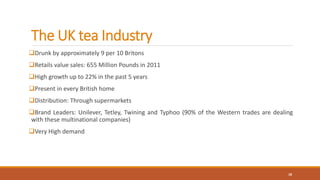
The UK tea Industry
Drunk by approximately 9 per 10 Britons
Retails value sales: 655 Million Pounds in 2011
High growth up to 22% in the past 5 years
Present in every British home
Distribution: Through supermarkets
Brand Leaders: Unilever, Tetley, Twining and Typhoo (90% of the Western trades are dealing
with these multinational companies)
Very High demand
18
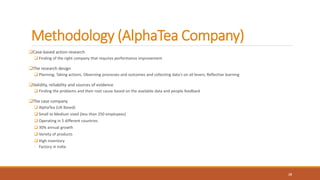
Methodology (AlphaTea Company)
Case-based action research
 Finding of the right company that requires performance improvement
The research design
 Planning; Taking actions; Observing processes and outcomes and collecting data's on all levers; Reflective learning
Validity, reliability and sources of evidence
 Finding the problems and their root cause based on the available data and people feedback
The case company
 AlphaTea (UK Based)
 Small to Medium sized (less than 250 employees)
 Operating in 5 different countries
 30% annual growth
 Variety of products
 High inventory
◦ Factory in India
19
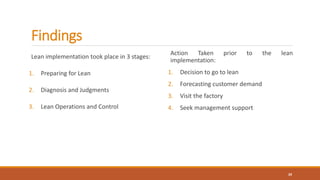
Findings
Lean implementation took place in 3 stages:
1. Preparing for Lean
2. Diagnosis and Judgments
3. Lean Operations and Control
20
Action Taken prior to the lean
implementation:
1. Decision to go to lean
2. Forecasting customer demand
3. Visit the factory
4. Seek management support
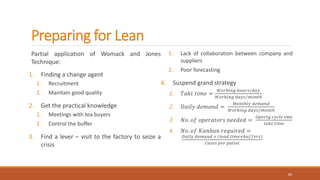
Preparing for Lean
Partial application of Womack and Jones
Technique:
1. Finding a change agent
1. Recruitment
2. Maintain good quality
2. Get the practical knowledge
1. Meetings with tea buyers
2. Control the buffer
3. Find a lever – visit to the factory to seize a
crisis
1. Lack of collaboration between company and
suppliers
2. Poor forecasting
4. Suspend grand strategy
1. 𝑇𝑎𝑘𝑡 𝑡𝑖𝑚𝑒 =
𝑊𝑜𝑟𝑘𝑖𝑛𝑔 ℎ𝑜𝑢𝑟𝑠/𝑑𝑎𝑦
𝑊𝑜𝑟𝑘𝑖𝑛𝑔 𝑑𝑎𝑦𝑠/𝑚𝑜𝑛𝑡ℎ
2. 𝐷𝑎𝑖𝑙𝑦 𝑑𝑒𝑚𝑎𝑛𝑑 =
𝑀𝑜𝑛𝑡ℎ𝑙𝑦 𝑑𝑒𝑚𝑎𝑛𝑑
𝑊𝑜𝑟𝑘𝑖𝑛𝑔 𝑑𝑎𝑦𝑠/𝑚𝑜𝑛𝑡ℎ
3. 𝑁𝑜. 𝑜𝑓 𝑜𝑝𝑒𝑟𝑎𝑡𝑜𝑟𝑠 𝑛𝑒𝑒𝑑𝑒𝑑 =
𝑂𝑝𝑒𝑟𝑡𝑔 𝑐𝑦𝑐𝑙𝑒 𝑡𝑚𝑒
𝑡𝑎𝑘𝑡 𝑡𝑖𝑚𝑒
4. 𝑁𝑜. 𝑜𝑓 𝐾𝑎𝑛𝑏𝑎𝑛 𝑟𝑒𝑞𝑢𝑖𝑟𝑒𝑑 =
𝐷𝑎𝑖𝑙𝑦 𝑑𝑒𝑚𝑎𝑛𝑑 × (𝑙𝑒𝑎𝑑 𝑡𝑖𝑚𝑒+𝑏𝑢𝑓𝑓𝑒𝑟𝑠)
𝐶𝑎𝑠𝑒𝑠 𝑝𝑒𝑟 𝑝𝑎𝑙𝑙𝑒𝑡
21
22
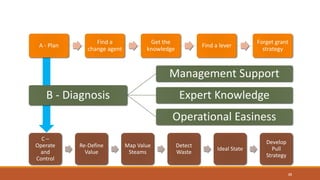
A - Plan
Find a
change agent
Get the
knowledge
Find a lever
Forget grant
strategy
B - Diagnosis
Management Support
Expert Knowledge
Operational Easiness
C –
Operate
and
Control
Re-Define
Value
Map Value
Steams
Detect
Waste
Ideal State
Develop
Pull
Strategy
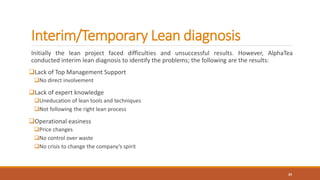
Interim/Temporary Lean diagnosis
Initially the lean project faced difficulties and unsuccessful results. However, AlphaTea
conducted interim lean diagnosis to identify the problems; the following are the results:
Lack of Top Management Support
No direct involvement
Lack of expert knowledge
Uneducation of lean tools and techniques
Not following the right lean process
Operational easiness
Price changes
No control over waste
No crisis to change the company’s spirit
23
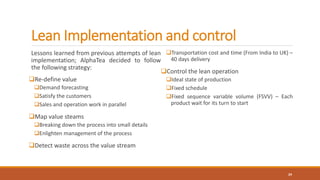
Lean Implementation and control
Lessons learned from previous attempts of lean
implementation; AlphaTea decided to follow
the following strategy:
Re-define value
Demand forecasting
Satisfy the customers
Sales and operation work in parallel
Map value steams
Breaking down the process into small details
Enlighten management of the process
Detect waste across the value stream
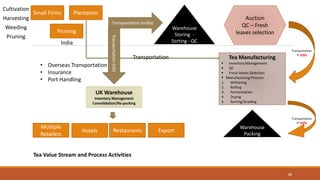
Transportation cost and time (From India to UK) –
40 days delivery
Control the lean operation
Ideal state of production
Fixed schedule
Fixed sequence variable volume (FSVV) – Each
product wait for its turn to start
24
25
Small Firms Plantation
Pruning
Cultivation
Harvesting
Weeding
Pruning
Transportation (India)
Warehouse
Storing -
Sorting - QC
Auction
QC – Fresh
leaves selection
Transportation
in India
Tea Manufacturing
 Inventory Management
 QC
 Fresh leaves Selection
 Manufacturing Process:
1. Withering
2. Rolling
3. Fermentation
4. Drying
5. Sorting/Grading
Warehouse
Packing
Transportation
in India
Transportation
UK Warehouse
Inventory Management
Consolidation/Re-packing
Transportation(UK)
• Overseas Transportation
• Insurance
• Port Handling
Multiple
Retailers
Hotels Restaurants Export
Tea Value Stream and Process Activities
India
Operation/Production Philosophy (Ideal
State)
26
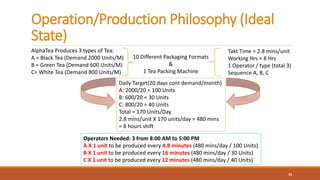
AlphaTea Produces 3 types of Tea:
A = Black Tea (Demand 2000 Units/M)
B = Green Tea (Demand 600 Units/M)
C= White Tea (Demand 800 Units/M)
10 Different Packaging Formats
&
1 Tea Packing Machine
Takt Time = 2.8 mins/unit
Working Hrs = 8 Hrs
1 Operator / type (total 3)
Sequence A, B, C
Daily Target(20 days cont demand/month)
A: 2000/20 = 100 Units
B: 600/20 = 30 Units
C: 800/20 = 40 Units
Total = 170 Units/Day
2.8 mins/unit X 170 units/day = 480 mins
= 8 hours shift
Operators Needed: 3 from 8:00 AM to 5:00 PM
A X 1 unit to be produced every 4.8 minutes (480 mins/day / 100 Units)
B X 1 unit to be produced every 16 minutes (480 mins/day / 30 Units)
C X 1 unit to be produced every 12 minutes (480 mins/day / 40 Units)
Quality Management
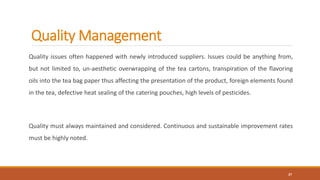
Quality issues often happened with newly introduced suppliers. Issues could be anything from,
but not limited to, un-aesthetic overwrapping of the tea cartons, transpiration of the flavoring
oils into the tea bag paper thus affecting the presentation of the product, foreign elements found
in the tea, defective heat sealing of the catering pouches, high levels of pesticides.
Quality must always maintained and considered. Continuous and sustainable improvement rates
must be highly noted.
27
Conclusion
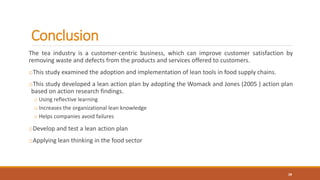
The tea industry is a customer-centric business, which can improve customer satisfaction by
removing waste and defects from the products and services offered to customers.
oThis study examined the adoption and implementation of lean tools in food supply chains.
oThis study developed a lean action plan by adopting the Womack and Jones (2005 ) action plan
based on action research findings.
o Using reflective learning
o Increases the organizational lean knowledge
o Helps companies avoid failures
oDevelop and test a lean action plan
oApplying lean thinking in the food sector
28
Conclusion
The tea industry is a customer-centric business, which can improve customer satisfaction by
removing waste and defects from the products and services offered to customers.
This study examined the adoption and implementation of lean tools in food supply chains.
This study developed a lean action plan by adopting the Womack and Jones (2005 ) action plan
based on action research findings.
Using reflective learning, the interim lean diagnosis is a learning experience that increases the
organizational lean knowledge and helps companies avoid failures due to lack of top
management support, lean knowledge or operational easiness.
The research contribution of this lean study is threefold. Firstly, it developed and tested a lean
action plan adapted to the capacity of small and medium companies. Secondly, it applied lean
thinking in the food sector, extending the research scope into an area characterized with low
productivity, low value added and high value waste across the food supply chain.
29
References
Vlachos, I. P. (2011) Lean Thinking in the European Hotel Industry, 4th Euromed conference of
the Euromed academy of business, Agios Nikolaos - Crete, Greece, October 19-22, 2011 2.
Vlachos, I. P., (2004a) E-business in European Food and Beverages Industry: Current Applications
& Future Trends, International Conference On Information Systems & Innovative Technologies In
Agriculture, Food And Environment (HAICTA), Thessaloniki Greece, 18-20 March.
Vlachos, I. P. (2004b) Critical Success Factors of Business to Business (B2B) E-commerce
Solutions to Supply Chain Management, In: Supply Chain and Finance Ed(s), P.M.Pardalos,
A.Migdalas and G. Baourakis. World Scientific Publ Co Inc, pp. 162-174.
Womack, J., and D. Jones. 1996a. “Beyond Toyota: How to Root Out Waste and Pursue
Perfection.” Harvard Business Review 74 (5): 4–16
Kubiak, T. M. 2011. “The Way to Fail.” Quality Progress 44 (12): 64–66.
30
THANK YOU!
31

Applying lean thinking in the food supply chain presentation

  • 1.
    By: Fayssal Al-Kilani MScEngineering Management Lean Thinking in the food Supply Chains “THERE ARE SO MANY PEOPLE WHO CAN FIGURE COSTS, AND SO FEW WHO CAN MEASURE VALUES”
  • 2.
    Outline Lean Thinking Definition Introduction FoodSector Brief Review of Literature Lean Tools and Techniques Lean Action Plan for Perfection Case Study UK Tea Industry Conclusion References 1
  • 3.
    What is leanthinking? A fundamental business logic, based on the approach developed by Toyota (in the 1990s) It is focused on eliminating waste from business processes and thereby enhancing value to the customer It aims to optimize the whole value stream for a product or service; not optimizing the activities of individual organizations, departments or assets 2
  • 4.
    Lean Thinking 3 seiri, seiton,seio, seiketsu, and shitsuke
  • 5.
    Introduction In the timeof recession, most of the big companies in all sectors and sub-sectors of the market, were facing troubles with overrun costs and losses in their projects despite high quality products. Thus, the new generations’ management started to think of adopting new ways to deliver their product considering the following lean technique: Cost reduction High quality products Waste elimination Improving customer’s satisfaction (Quality) 4
  • 6.
    Food Sector Brief Wasteis not new for the food sector. 1.3 Billion Metric Tons are wasted per year approximately 179 KGs/Person Aim Eliminating the waste by systematic way of thinking Combat Hunger Raise Income Improve food security Raise economic development Protect the environment Majority of the companies are small and medium enterprises (SME) 5
  • 7.
    Review of Literature Thereis consensus that lean techniques can eliminate waste and reduce risk to manufacturing and services sectors including construction, aerospace, services, tourism, hospitals and public administration. Impact on the way company do business: Strategic Level: Define Values. Operational Level: Tools to eliminate waste. The remainder will be the action plan of the implementation of lean thinking to food industry. 6
  • 8.
    Lean Tools andTechniques (Womack and Jones (1996) Overproduction Waiting Transport Inappropriate processing Unnecessary inventory Unnecessary motion and defects 7 Value • Ultimate Customer end Value Identification • Identify valuable activities that are creating waste • Adding theses activities into the steps Elimination of waste • Process re-engineering • Continuous flow Pull System • Customers' triggers the production • Similar to Make-To-Order Step into perfection • Complete elimination of waste • All activities create valueStepsfromvaluetoperfection WhyLean?
  • 9.
    Lean Tools andTechniques contd… The are numerous lean tools available for companies includes the single minute exchange of dies (SMED) and value steam mapping. Piecemeal Unsystematic application of a single lean tool  Reduce waste without obstruction Lean Thinking Set of principals Business philosophy (Tsasis and Bruce-Barret, 2008) Lean action plan Systematic application Sustainable results Reduce waste High value for customers 8
  • 10.
    Lean Action Planto Perfection Wang and Chen proposed in their article published September, 2009, that after an organization makes a commitment to implement lean, the journey to lean includes three major activities: Lean Training Value Stream Mapping Lean Assessment Pointing out that knowledge and experience are the key element to identify the lean tool to apply i.e. lean assessment is considered as a learning process that helps companies to evaluate and identify: What went wrong Learn from their mistakes Expand their knowledge via lean training 9
  • 11.
    Lean Action Planto Perfection contd… Womack and Jones published an article in 2003, that stipulate a broader perspective of lean transformation mainly as follows 1. Finding a lean change agent 2. Get the knowledge 3. Find a lever by seizing a crisis or creating one 4. Forget grand strategy for the moment 5. Map your value streams 6. Begin as soon as possible with an important and visible activity - Confidence 7. Demand immediate results 8. As soon as you have momentum, expand your scope 10
  • 12.
    Failures to deliverlean results Womack and Jones proposed action plan was mainly focused to manufacturing projects, it is not universal lean tools. Only 5% of lean projects delivered within the expected results in 2011 (according to Manufacturer Magazine). Researches for Lean failures is classified into three categories: oLeadership oBusiness Culture and people issues oAction Plan Customization 11
  • 13.
    Leadership Cudney and Elrodhighlighted in their article published in 2011, that there are 6 factors are the core lead to contribute to lean failures: Short Term Commitment Lack of focus on a specific issue Poor Planning Poor Employee involvement Ineffective training method Poor understanding from top managers 12
  • 14.
    Leadership contd… On theother hand, Kubiak (2011) was reviewing the lean Six Sigma initiative and supporting processes of a large multinational organizations, the outcome was that this failure is due to Organization’s leadership desired fast results. Sarkar (2011), reported that failure of Lean Six Sigma for production is due to the following: Not having a mindshare of leadership Not working of the right business priorities Not having a larger roadmap in place Not being a methodology agnostic Not having the right number of change agents Not being able to coach the TOP MANAGEMENT (Agrees with Kubiak) Not focusing on values necessary for creating continuous improvement culture Not having the right organizational culture 13
  • 15.
    Leadership (McManus 2008)cond… 14 Leaders Unlearn Relearn RadicalChange
  • 16.
    Business culture andpeople issues Companies trying the implementation of the lean management for the past two decades; despite that, failure was reoccurring. The studies was focused in large scale companies in China; Chen and Meng listed the following reasons in 2010: Companies failed to recognize the strategic importance of lean thinking and focused too much on lean tools Companies were eager for quick results and abandoned the lean process with the first failure Companies attempted to imitate and copy success practices without adopting them to their own business culture Knowledge of lean tools was superficial without analytical skills to pinpoint problems 15
  • 17.
    Lean action plancustomization Important for the social and technical specifies of the adopting organization Operational issues can limit the implementation Leadership is a strong factor of limiting the customization Business culture can as well is a barrier 16
  • 18.
    Application of LeanThinking to the Tea Industry in the UK 17
  • 19.
    The UK teaIndustry Drunk by approximately 9 per 10 Britons Retails value sales: 655 Million Pounds in 2011 High growth up to 22% in the past 5 years Present in every British home Distribution: Through supermarkets Brand Leaders: Unilever, Tetley, Twining and Typhoo (90% of the Western trades are dealing with these multinational companies) Very High demand 18
  • 20.
    Methodology (AlphaTea Company) Case-basedaction research  Finding of the right company that requires performance improvement The research design  Planning; Taking actions; Observing processes and outcomes and collecting data's on all levers; Reflective learning Validity, reliability and sources of evidence  Finding the problems and their root cause based on the available data and people feedback The case company  AlphaTea (UK Based)  Small to Medium sized (less than 250 employees)  Operating in 5 different countries  30% annual growth  Variety of products  High inventory ◦ Factory in India 19
  • 21.
    Findings Lean implementation tookplace in 3 stages: 1. Preparing for Lean 2. Diagnosis and Judgments 3. Lean Operations and Control 20 Action Taken prior to the lean implementation: 1. Decision to go to lean 2. Forecasting customer demand 3. Visit the factory 4. Seek management support
  • 22.
    Preparing for Lean Partialapplication of Womack and Jones Technique: 1. Finding a change agent 1. Recruitment 2. Maintain good quality 2. Get the practical knowledge 1. Meetings with tea buyers 2. Control the buffer 3. Find a lever – visit to the factory to seize a crisis 1. Lack of collaboration between company and suppliers 2. Poor forecasting 4. Suspend grand strategy 1. 𝑇𝑎𝑘𝑡 𝑡𝑖𝑚𝑒 = 𝑊𝑜𝑟𝑘𝑖𝑛𝑔 ℎ𝑜𝑢𝑟𝑠/𝑑𝑎𝑦 𝑊𝑜𝑟𝑘𝑖𝑛𝑔 𝑑𝑎𝑦𝑠/𝑚𝑜𝑛𝑡ℎ 2. 𝐷𝑎𝑖𝑙𝑦 𝑑𝑒𝑚𝑎𝑛𝑑 = 𝑀𝑜𝑛𝑡ℎ𝑙𝑦 𝑑𝑒𝑚𝑎𝑛𝑑 𝑊𝑜𝑟𝑘𝑖𝑛𝑔 𝑑𝑎𝑦𝑠/𝑚𝑜𝑛𝑡ℎ 3. 𝑁𝑜. 𝑜𝑓 𝑜𝑝𝑒𝑟𝑎𝑡𝑜𝑟𝑠 𝑛𝑒𝑒𝑑𝑒𝑑 = 𝑂𝑝𝑒𝑟𝑡𝑔 𝑐𝑦𝑐𝑙𝑒 𝑡𝑚𝑒 𝑡𝑎𝑘𝑡 𝑡𝑖𝑚𝑒 4. 𝑁𝑜. 𝑜𝑓 𝐾𝑎𝑛𝑏𝑎𝑛 𝑟𝑒𝑞𝑢𝑖𝑟𝑒𝑑 = 𝐷𝑎𝑖𝑙𝑦 𝑑𝑒𝑚𝑎𝑛𝑑 × (𝑙𝑒𝑎𝑑 𝑡𝑖𝑚𝑒+𝑏𝑢𝑓𝑓𝑒𝑟𝑠) 𝐶𝑎𝑠𝑒𝑠 𝑝𝑒𝑟 𝑝𝑎𝑙𝑙𝑒𝑡 21
  • 23.
    22 A - Plan Finda change agent Get the knowledge Find a lever Forget grant strategy B - Diagnosis Management Support Expert Knowledge Operational Easiness C – Operate and Control Re-Define Value Map Value Steams Detect Waste Ideal State Develop Pull Strategy
  • 24.
    Interim/Temporary Lean diagnosis Initiallythe lean project faced difficulties and unsuccessful results. However, AlphaTea conducted interim lean diagnosis to identify the problems; the following are the results: Lack of Top Management Support No direct involvement Lack of expert knowledge Uneducation of lean tools and techniques Not following the right lean process Operational easiness Price changes No control over waste No crisis to change the company’s spirit 23
  • 25.
    Lean Implementation andcontrol Lessons learned from previous attempts of lean implementation; AlphaTea decided to follow the following strategy: Re-define value Demand forecasting Satisfy the customers Sales and operation work in parallel Map value steams Breaking down the process into small details Enlighten management of the process Detect waste across the value stream Transportation cost and time (From India to UK) – 40 days delivery Control the lean operation Ideal state of production Fixed schedule Fixed sequence variable volume (FSVV) – Each product wait for its turn to start 24
  • 26.
    25 Small Firms Plantation Pruning Cultivation Harvesting Weeding Pruning Transportation(India) Warehouse Storing - Sorting - QC Auction QC – Fresh leaves selection Transportation in India Tea Manufacturing  Inventory Management  QC  Fresh leaves Selection  Manufacturing Process: 1. Withering 2. Rolling 3. Fermentation 4. Drying 5. Sorting/Grading Warehouse Packing Transportation in India Transportation UK Warehouse Inventory Management Consolidation/Re-packing Transportation(UK) • Overseas Transportation • Insurance • Port Handling Multiple Retailers Hotels Restaurants Export Tea Value Stream and Process Activities India
  • 27.
    Operation/Production Philosophy (Ideal State) 26 AlphaTeaProduces 3 types of Tea: A = Black Tea (Demand 2000 Units/M) B = Green Tea (Demand 600 Units/M) C= White Tea (Demand 800 Units/M) 10 Different Packaging Formats & 1 Tea Packing Machine Takt Time = 2.8 mins/unit Working Hrs = 8 Hrs 1 Operator / type (total 3) Sequence A, B, C Daily Target(20 days cont demand/month) A: 2000/20 = 100 Units B: 600/20 = 30 Units C: 800/20 = 40 Units Total = 170 Units/Day 2.8 mins/unit X 170 units/day = 480 mins = 8 hours shift Operators Needed: 3 from 8:00 AM to 5:00 PM A X 1 unit to be produced every 4.8 minutes (480 mins/day / 100 Units) B X 1 unit to be produced every 16 minutes (480 mins/day / 30 Units) C X 1 unit to be produced every 12 minutes (480 mins/day / 40 Units)
  • 28.
    Quality Management Quality issuesoften happened with newly introduced suppliers. Issues could be anything from, but not limited to, un-aesthetic overwrapping of the tea cartons, transpiration of the flavoring oils into the tea bag paper thus affecting the presentation of the product, foreign elements found in the tea, defective heat sealing of the catering pouches, high levels of pesticides. Quality must always maintained and considered. Continuous and sustainable improvement rates must be highly noted. 27
  • 29.
    Conclusion The tea industryis a customer-centric business, which can improve customer satisfaction by removing waste and defects from the products and services offered to customers. oThis study examined the adoption and implementation of lean tools in food supply chains. oThis study developed a lean action plan by adopting the Womack and Jones (2005 ) action plan based on action research findings. o Using reflective learning o Increases the organizational lean knowledge o Helps companies avoid failures oDevelop and test a lean action plan oApplying lean thinking in the food sector 28
  • 30.
    Conclusion The tea industryis a customer-centric business, which can improve customer satisfaction by removing waste and defects from the products and services offered to customers. This study examined the adoption and implementation of lean tools in food supply chains. This study developed a lean action plan by adopting the Womack and Jones (2005 ) action plan based on action research findings. Using reflective learning, the interim lean diagnosis is a learning experience that increases the organizational lean knowledge and helps companies avoid failures due to lack of top management support, lean knowledge or operational easiness. The research contribution of this lean study is threefold. Firstly, it developed and tested a lean action plan adapted to the capacity of small and medium companies. Secondly, it applied lean thinking in the food sector, extending the research scope into an area characterized with low productivity, low value added and high value waste across the food supply chain. 29
  • 31.
    References Vlachos, I. P.(2011) Lean Thinking in the European Hotel Industry, 4th Euromed conference of the Euromed academy of business, Agios Nikolaos - Crete, Greece, October 19-22, 2011 2. Vlachos, I. P., (2004a) E-business in European Food and Beverages Industry: Current Applications & Future Trends, International Conference On Information Systems & Innovative Technologies In Agriculture, Food And Environment (HAICTA), Thessaloniki Greece, 18-20 March. Vlachos, I. P. (2004b) Critical Success Factors of Business to Business (B2B) E-commerce Solutions to Supply Chain Management, In: Supply Chain and Finance Ed(s), P.M.Pardalos, A.Migdalas and G. Baourakis. World Scientific Publ Co Inc, pp. 162-174. Womack, J., and D. Jones. 1996a. “Beyond Toyota: How to Root Out Waste and Pursue Perfection.” Harvard Business Review 74 (5): 4–16 Kubiak, T. M. 2011. “The Way to Fail.” Quality Progress 44 (12): 64–66. 30
  • 32.