14 July 2014
Creating the right Culture for
implementing Lean in Service
Industries
Jodie McIlwain and Ketan Varia
W: www.kinetik.uk.com | E: bebetter@kinetik.uk.com | T: 0203 397 0686
Kinetik Solutions Ltd. Registered in England & Wales, No 6067771. Registered Office: 16 Wychwood Close, Edgware, Middlesex, HA8 6TE. VAT GB 839 9186 67
- 2 -
Confidential not to be used without consent
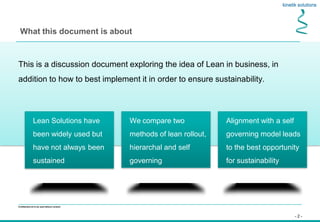
This is a discussion document exploring the idea of Lean in business, in
addition to how to best implement it in order to ensure sustainability.
What this document is about
Lean Solutions have
been widely used but
have not always been
sustained
We compare two
methods of lean rollout,
hierarchal and self
governing
Alignment with a self
governing model leads
to the best opportunity
for sustainability
- 3 -
Confidential not to be used without consent
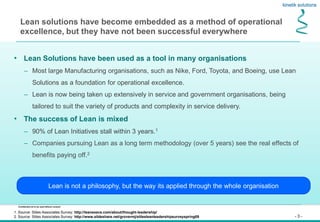
Lean solutions have become embedded as a method of operational
excellence, but they have not been successful everywhere
• Lean Solutions have been used as a tool in many organisations
– Most large Manufacturing organisations, such as Nike, Ford, Toyota, and Boeing, use Lean
Solutions as a foundation for operational excellence.
– Lean is now being taken up extensively in service and government organisations, being
tailored to suit the variety of products and complexity in service delivery.
• The success of Lean is mixed
– 90% of Lean Initiatives stall within 3 years.1
– Companies pursuing Lean as a long term methodology (over 5 years) see the real effects of
benefits paying off.2
Lean is not a philosophy, but the way its applied through the whole organisation
1. Source: Stiles Associates Survey: http://leanexecs.com/about/thought-leadership/
2. Source: Stiles Associates Survey: http://www.slideshare.net/grovermj/stilesleanleadershipsurveyspring09
- 4 -
Confidential not to be used without consent
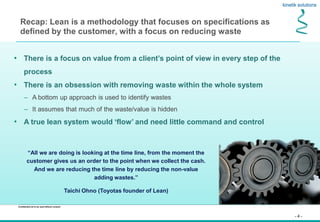
Recap: Lean is a methodology that focuses on specifications as
defined by the customer, with a focus on reducing waste
• There is a focus on value from a client‟s point of view in every step of the
process
• There is an obsession with removing waste within the whole system
– A bottom up approach is used to identify wastes
– It assumes that much of the waste/value is hidden
• A true lean system would „flow‟ and need little command and control
“All we are doing is looking at the time line, from the moment the
customer gives us an order to the point when we collect the cash.
And we are reducing the time line by reducing the non-value
adding wastes.”
Taichi Ohno (Toyotas founder of Lean)
- 5 -
Confidential not to be used without consent
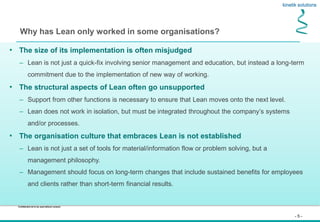
Why has Lean only worked in some organisations?
• The size of its implementation is often misjudged
– Lean is not just a quick-fix involving senior management and education, but instead a long-term
commitment due to the implementation of new way of working.
• The structural aspects of Lean often go unsupported
– Support from other functions is necessary to ensure that Lean moves onto the next level.
– Lean does not work in isolation, but must be integrated throughout the company’s systems
and/or processes.
• The organisation culture that embraces Lean is not established
– Lean is not just a set of tools for material/information flow or problem solving, but a
management philosophy.
– Management should focus on long-term changes that include sustained benefits for employees
and clients rather than short-term financial results.
- 6 -
Confidential not to be used without consent
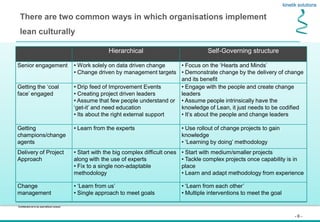
There are two common ways in which organisations implement
lean culturally
Hierarchical Self-Governing structure
Senior engagement • Work solely on data driven change
• Change driven by management targets
• Focus on the ‘Hearts and Minds’
• Demonstrate change by the delivery of change
and its benefit
Getting the ‘coal
face’ engaged
• Drip feed of Improvement Events
• Creating project driven leaders
• Assume that few people understand or
‘get-it’ and need education
• Its about the right external support
• Engage with the people and create change
leaders
• Assume people intrinsically have the
knowledge of Lean, it just needs to be codified
• It’s about the people and change leaders
Getting
champions/change
agents
• Learn from the experts • Use rollout of change projects to gain
knowledge
• ‘Learning by doing’ methodology
Delivery of Project
Approach
• Start with the big complex difficult ones
along with the use of experts
• Fix to a single non-adaptable
methodology
• Start with medium/smaller projects
• Tackle complex projects once capability is in
place
• Learn and adapt methodology from experience
Change
management
• ‘Learn from us’
• Single approach to meet goals
• ‘Learn from each other’
• Multiple interventions to meet the goal
- 7 -
Confidential not to be used without consent
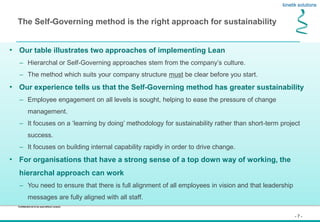
The Self-Governing method is the right approach for sustainability
• Our table illustrates two approaches of implementing Lean
– Hierarchal or Self-Governing approaches stem from the company’s culture.
– The method which suits your company structure must be clear before you start.
• Our experience tells us that the Self-Governing method has greater sustainability
– Employee engagement on all levels is sought, helping to ease the pressure of change
management.
– It focuses on a ‘learning by doing’ methodology for sustainability rather than short-term project
success.
– It focuses on building internal capability rapidly in order to drive change.
• For organisations that have a strong sense of a top down way of working, the
hierarchal approach can work
– You need to ensure that there is full alignment of all employees in vision and that leadership
messages are fully aligned with all staff.
- 8 -
Confidential not to be used without consent
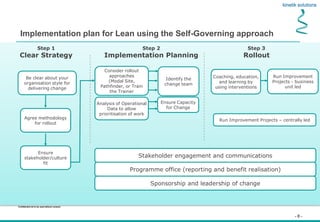
Step 1
Clear Strategy
Step 2
Implementation Planning
Step 3
Rollout
Ensure
stakeholder/culture
fit
Agree methodology
for rollout
Coaching, education,
and learning by
using interventions
Stakeholder engagement and communications
Be clear about your
organisation style for
delivering change
Consider rollout
approaches
(Modal Site,
Pathfinder, or Train
the Trainer
Implementation plan for Lean using the Self-Governing approach
Analysis of Operational
Data to allow
prioritisation of work
Run Improvement
Projects - business
unit led
Run Improvement Projects – centrally led
Programme office (reporting and benefit realisation)
Sponsorship and leadership of change
Identify the
change team
Ensure Capacity
for Change
Kinetik Solutions Ltd
Registered in England & Wales, No 6067771
Registered Office 16 • Wychwood Close
Edgware • Middlesex • HA8 6TE
VAT GB 839 9186 67
www.kinetik.uk.com
bebetter@kinetik.uk.com
020 3397 0686
kinetik solutions
agility to sustain change
Consultancy profile
• Established in 2007, kinetik solutions delivers complex change for large
organisations in the public and private sectors
• Our team consists of highly experienced consultants each with over 10 years
change management experience in blue-chip organisations or a ‘Big 4’
management consultancy
• We continually invest in learning to offer the latest thinking in transformational
change to our clients. We run regular public events on Lean learning for our
NHS clients and are members of:
- Lean Enterprise Group
- Deming Alliance
- Operational Excellence Group
- Enterprise Thinking Group
Our solution areas
• Complex Transformation Programmes
We make change happen in a sustainable way
• Operational Design and Improvement
Strategic design for complex processes and their implementation
• Systems Implementation
Integrating process and IT change to achieve operational effectiveness
• Facilitated Workshops
Fast, informed decision making, from strategy to continuous improvement
• Digital Content Collaboration
Creating structures for rapid delivery in digital supply chains
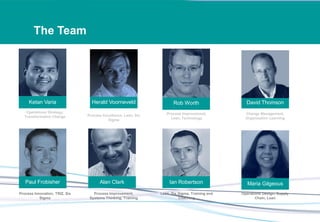
The kinetik team
Ketan Varia Rob Worth
David Thomson
Alan Clark Maria Gilgeous
Operational Strategy,
Transformative Change Process Excellence, Lean, Six
Sigma
Process Improvement,
Lean, Technology
Change Management,
Organisation Learning
Process Innovation, TRIZ, Six
Sigma
Process Improvement,
Systems Thinking, Training
Lean, Six Sigma, Training and
Coaching
Operations Design, Supply
Chain, Lean
Ian Robertson
Herald Voorneveld
Paul Frobisher
David Thomson
The Team
We work with a range of clients in a variety of sectors
Kinetik Solutions Ltd
Registered in England & Wales, No 6067771
Registered Office 16 • Wychwood Close
Edgware • Middlesex • HA8 6TE
VAT GB 839 9186 67
www.kinetik.uk.com
bebetter@kinetik.uk.com
020 3397 0686
kinetik solutions
agility to sustain change

Culture for implementing lean

  • 1.
    14 July 2014 Creatingthe right Culture for implementing Lean in Service Industries Jodie McIlwain and Ketan Varia W: www.kinetik.uk.com | E: bebetter@kinetik.uk.com | T: 0203 397 0686 Kinetik Solutions Ltd. Registered in England & Wales, No 6067771. Registered Office: 16 Wychwood Close, Edgware, Middlesex, HA8 6TE. VAT GB 839 9186 67
  • 2.
    - 2 - Confidentialnot to be used without consent This is a discussion document exploring the idea of Lean in business, in addition to how to best implement it in order to ensure sustainability. What this document is about Lean Solutions have been widely used but have not always been sustained We compare two methods of lean rollout, hierarchal and self governing Alignment with a self governing model leads to the best opportunity for sustainability
  • 3.
    - 3 - Confidentialnot to be used without consent Lean solutions have become embedded as a method of operational excellence, but they have not been successful everywhere • Lean Solutions have been used as a tool in many organisations – Most large Manufacturing organisations, such as Nike, Ford, Toyota, and Boeing, use Lean Solutions as a foundation for operational excellence. – Lean is now being taken up extensively in service and government organisations, being tailored to suit the variety of products and complexity in service delivery. • The success of Lean is mixed – 90% of Lean Initiatives stall within 3 years.1 – Companies pursuing Lean as a long term methodology (over 5 years) see the real effects of benefits paying off.2 Lean is not a philosophy, but the way its applied through the whole organisation 1. Source: Stiles Associates Survey: http://leanexecs.com/about/thought-leadership/ 2. Source: Stiles Associates Survey: http://www.slideshare.net/grovermj/stilesleanleadershipsurveyspring09
  • 4.
    - 4 - Confidentialnot to be used without consent Recap: Lean is a methodology that focuses on specifications as defined by the customer, with a focus on reducing waste • There is a focus on value from a client‟s point of view in every step of the process • There is an obsession with removing waste within the whole system – A bottom up approach is used to identify wastes – It assumes that much of the waste/value is hidden • A true lean system would „flow‟ and need little command and control “All we are doing is looking at the time line, from the moment the customer gives us an order to the point when we collect the cash. And we are reducing the time line by reducing the non-value adding wastes.” Taichi Ohno (Toyotas founder of Lean)
  • 5.
    - 5 - Confidentialnot to be used without consent Why has Lean only worked in some organisations? • The size of its implementation is often misjudged – Lean is not just a quick-fix involving senior management and education, but instead a long-term commitment due to the implementation of new way of working. • The structural aspects of Lean often go unsupported – Support from other functions is necessary to ensure that Lean moves onto the next level. – Lean does not work in isolation, but must be integrated throughout the company’s systems and/or processes. • The organisation culture that embraces Lean is not established – Lean is not just a set of tools for material/information flow or problem solving, but a management philosophy. – Management should focus on long-term changes that include sustained benefits for employees and clients rather than short-term financial results.
  • 6.
    - 6 - Confidentialnot to be used without consent There are two common ways in which organisations implement lean culturally Hierarchical Self-Governing structure Senior engagement • Work solely on data driven change • Change driven by management targets • Focus on the ‘Hearts and Minds’ • Demonstrate change by the delivery of change and its benefit Getting the ‘coal face’ engaged • Drip feed of Improvement Events • Creating project driven leaders • Assume that few people understand or ‘get-it’ and need education • Its about the right external support • Engage with the people and create change leaders • Assume people intrinsically have the knowledge of Lean, it just needs to be codified • It’s about the people and change leaders Getting champions/change agents • Learn from the experts • Use rollout of change projects to gain knowledge • ‘Learning by doing’ methodology Delivery of Project Approach • Start with the big complex difficult ones along with the use of experts • Fix to a single non-adaptable methodology • Start with medium/smaller projects • Tackle complex projects once capability is in place • Learn and adapt methodology from experience Change management • ‘Learn from us’ • Single approach to meet goals • ‘Learn from each other’ • Multiple interventions to meet the goal
  • 7.
    - 7 - Confidentialnot to be used without consent The Self-Governing method is the right approach for sustainability • Our table illustrates two approaches of implementing Lean – Hierarchal or Self-Governing approaches stem from the company’s culture. – The method which suits your company structure must be clear before you start. • Our experience tells us that the Self-Governing method has greater sustainability – Employee engagement on all levels is sought, helping to ease the pressure of change management. – It focuses on a ‘learning by doing’ methodology for sustainability rather than short-term project success. – It focuses on building internal capability rapidly in order to drive change. • For organisations that have a strong sense of a top down way of working, the hierarchal approach can work – You need to ensure that there is full alignment of all employees in vision and that leadership messages are fully aligned with all staff.
  • 8.
    - 8 - Confidentialnot to be used without consent Step 1 Clear Strategy Step 2 Implementation Planning Step 3 Rollout Ensure stakeholder/culture fit Agree methodology for rollout Coaching, education, and learning by using interventions Stakeholder engagement and communications Be clear about your organisation style for delivering change Consider rollout approaches (Modal Site, Pathfinder, or Train the Trainer Implementation plan for Lean using the Self-Governing approach Analysis of Operational Data to allow prioritisation of work Run Improvement Projects - business unit led Run Improvement Projects – centrally led Programme office (reporting and benefit realisation) Sponsorship and leadership of change Identify the change team Ensure Capacity for Change
  • 9.
    Kinetik Solutions Ltd Registeredin England & Wales, No 6067771 Registered Office 16 • Wychwood Close Edgware • Middlesex • HA8 6TE VAT GB 839 9186 67 www.kinetik.uk.com bebetter@kinetik.uk.com 020 3397 0686 kinetik solutions agility to sustain change
  • 10.
    Consultancy profile • Establishedin 2007, kinetik solutions delivers complex change for large organisations in the public and private sectors • Our team consists of highly experienced consultants each with over 10 years change management experience in blue-chip organisations or a ‘Big 4’ management consultancy • We continually invest in learning to offer the latest thinking in transformational change to our clients. We run regular public events on Lean learning for our NHS clients and are members of: - Lean Enterprise Group - Deming Alliance - Operational Excellence Group - Enterprise Thinking Group
  • 11.
    Our solution areas •Complex Transformation Programmes We make change happen in a sustainable way • Operational Design and Improvement Strategic design for complex processes and their implementation • Systems Implementation Integrating process and IT change to achieve operational effectiveness • Facilitated Workshops Fast, informed decision making, from strategy to continuous improvement • Digital Content Collaboration Creating structures for rapid delivery in digital supply chains
  • 12.
    The kinetik team KetanVaria Rob Worth David Thomson Alan Clark Maria Gilgeous Operational Strategy, Transformative Change Process Excellence, Lean, Six Sigma Process Improvement, Lean, Technology Change Management, Organisation Learning Process Innovation, TRIZ, Six Sigma Process Improvement, Systems Thinking, Training Lean, Six Sigma, Training and Coaching Operations Design, Supply Chain, Lean Ian Robertson Herald Voorneveld Paul Frobisher David Thomson The Team
  • 13.
    We work witha range of clients in a variety of sectors
  • 14.
    Kinetik Solutions Ltd Registeredin England & Wales, No 6067771 Registered Office 16 • Wychwood Close Edgware • Middlesex • HA8 6TE VAT GB 839 9186 67 www.kinetik.uk.com bebetter@kinetik.uk.com 020 3397 0686 kinetik solutions agility to sustain change