THE ABDOMINAL
EXAM
ACS/ASE Medical Student Simulation-based
Surgical Skills Curriculum
CREDITS
 Author
 Ebondo Mpinga, MD,FACS
 Contributors
 Michael Hughes, MD ,FACS (expert performance video)
 Richard Damewood, MD,FACS (modified score assessment tool)
 Duane Patterson, PhD (technical support)
 Paul Schreck (videographer )
 Editors
 Keith Clancy, MD, FACS
 Amanda Beattie, MD , R5
 York Hospital Department of Surgery, York, PA
OBJECTIVES
 After the completion of this module the
student should be able to:
1. Perform a complete abdominal exam.
2. Recognize the signs of peritonitis.
3. Arrive at a differential diagnosis based upon the
findings elicited during the exam.
ABDOMINAL EXAM
 Although we will focus on the abdominal exam, it cannot
be overemphasized that a thorough physical exam
(head to toes) is important to help in arriving at a
comprehensive differential diagnosis list.
 Examples :
 presence of jaundice may add consideration of a biliary
/hepatic etiology
 Irregularly irregular heart rate atrial fibrillation->
mesenteric ischemia
 Crackle at lung bases pneumonia
 Skin lesions (pyoderma gangrenosum) -> IBD
ABDOMINAL WALL
DESCRIPTION
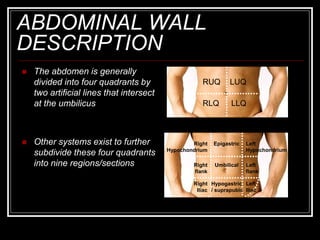
 The abdomen is generally
divided into four quadrants by
two artificial lines that intersect
at the umbilicus
 Other systems exist to further
subdivide these four quadrants
into nine regions/sections
RUQ LUQ
LLQ
RLQ
Epigastric
Right
Hypochondrium
Right
flank
Left
flank
Umbilical
Right
Iliac
Left
Iliac
Hypogastric
/ suprapubic
Left
Hypochondrium
ABDOMINAL EXAM
 The exam should be performed in this specific order
 General appearance
 Vital signs
 Inspection
 Auscultation
 Percussion
 Palpation
 It should include
 An examination of the inguinal area
 including the external genitalia in males (testes)
 A rectal exam (discussed in a separate module)
 A pelvic exam in women (discussed in a separate module)
DESCRIPTION
OF TECHNIQUES
General Appearance
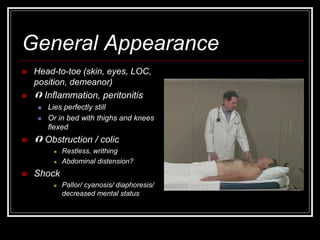
 Head-to-toe (skin, eyes, LOC,
position, demeanor)
  Inflammation, peritonitis
 Lies perfectly still
 Or in bed with thighs and knees
flexed
  Obstruction / colic
 Restless, writhing
 Abdominal distension?
 Shock
 Pallor/ cyanosis/ diaphoresis/
decreased mental status
Vital Signs
 Tachycardia
 ? Early shock (may present prior to hypotension)
 May be absent if on Beta blockers
 Rapid shallow breathing (splinting)
 Peritonitis
 Hypotension
 May be late finding depending on pre-existing state of health
 Fever
 Infectious etiology or perforation
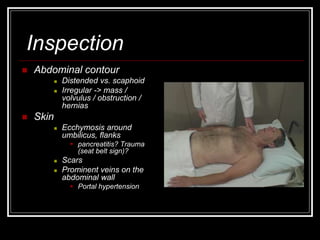
Inspection
 Abdominal contour
 Distended vs. scaphoid
 Irregular -> mass /
volvulus / obstruction /
hernias
 Skin
 Ecchymosis around
umbilicus, flanks
 pancreatitis? Trauma
(seat belt sign)?
 Scars
 Prominent veins on the
abdominal wall
 Portal hypertension
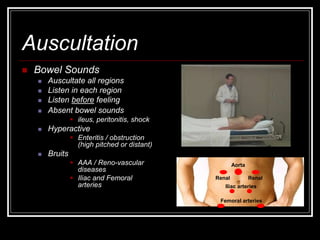
Auscultation
 Bowel Sounds
 Auscultate all regions
 Listen in each region
 Listen before feeling
 Absent bowel sounds
 ileus, peritonitis, shock
 Hyperactive
 Enteritis / obstruction
(high pitched or distant)
 Bruits
 AAA / Reno-vascular
diseases
 Iliac and Femoral
arteries
Aorta
Femoral arteries
Iliac arteries
Renal Renal
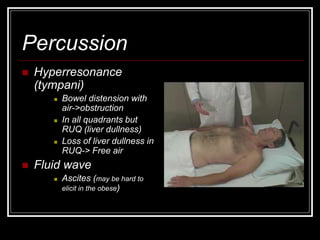
Percussion
 Hyperresonance
(tympani)
 Bowel distension with
air->obstruction
 In all quadrants but
RUQ (liver dullness)
 Loss of liver dullness in
RUQ-> Free air
 Fluid wave
 Ascites (may be hard to
elicit in the obese)
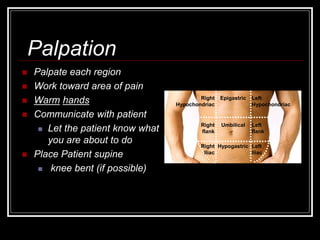
 Palpate each region
 Work toward area of pain
 Warm hands
 Communicate with patient
 Let the patient know what
you are about to do
 Place Patient supine
 knee bent (if possible)
Epigastric Left
Hypochondriac
Right
Hypochondriac
Right
flank
Left
flank
Umbilical
Right
Iliac
Left
Iliac
Hypogastric
Palpation
Palpation
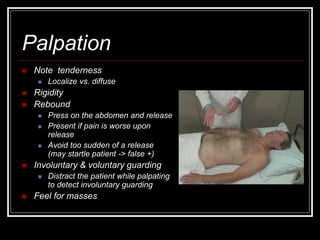
 Note tenderness
 Localize vs. diffuse
 Rigidity
 Rebound
 Press on the abdomen and release
 Present if pain is worse upon
release
 Avoid too sudden of a release
(may startle patient -> false +)
 Involuntary & voluntary guarding
 Distract the patient while palpating
to detect involuntary guarding
 Feel for masses
Signs highly suggestive of
peritonitis
 Tenderness to percussion
 Tenderness elicited when the examiner firmly taps
on the Iliac crest
 Tenderness elicited when the examiner firmly taps
on the heel of the patient’s extended leg
 Tenderness when the bed is gently shaken or the
patient coughs
 Rebound tenderness
Abdominal exam:
findings that suggest specific etiology
 Biliary / hepatic etiology
 Courvoisier' sign
 Palpable gallbladder in the
presence of painless jaundice
  periampullary tumor
 Caput medusa (Cruveilhier sign)
 Varicose veins at umbilicus
cirrhosis with portal HTN
 Murphy’s sign
 Pain caused during inspiration
while palpating the RUQ-> acute
cholecystitis
 Ransohoff sign
 Periumbilical yellow discoloration
-> ruptured CBD
Abdominal exam:
findings that suggest specific etiology
 Appendicitis
 Rovsing’s sign
 Palpation on the LLQ produces
tenderness at McBurney’s point
 Ten Horn test
 Pain caused by gentle traction of the
right testicle
 Aaron sign
 Persistent pressure applied at
McBurney ‘s point causes pressure
in the epigatrium and upper chest
wall
Abdominal exam:
findings that suggest specific etiology
 Pelvic inflammation/abscess
 Iliopsoas sign
 Allow patient to lie on the opposite
side of the pain
 Extend the thigh on the affected side
 This should cause pain if there is
irritation of the iliopsoas muscle
(seen with appendicitis as well)
 Obturator sign
 Flexion and internal rotation of the
right thigh while supine elicits
hypogastric pain
 Indicates irritation of obturator
internus muscle (seen with
appendicitis as well)
 Chandelier sign
 Extreme lower abdominal/pelvic pain
with movement of the cervix
Abdominal exam:
findings that suggest specific etiology
 Hemoperitoneum
 Hemorrhagic pancreatitis
 Cullen’s sign
 periumbilical bruising-> hemoperitoneum
 Grey Turner’s sign
 Local area of discoloration around the flanks-> acute
hemorrhagic pancreatitis
 Danforth sign
 shoulder pain on inspiration-> hemoperitoneum
 Kehr’s sign
 Left shoulder pain when supine or pressure applied to LUQ->
splenic rupture
Inguinal exam
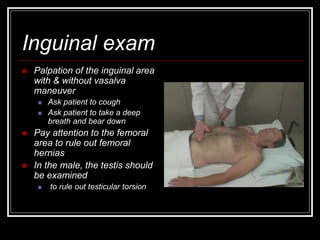
 Palpation of the inguinal area
with & without vasalva
maneuver
 Ask patient to cough
 Ask patient to take a deep
breath and bear down
 Pay attention to the femoral
area to rule out femoral
hernias
 In the male, the testis should
be examined
 to rule out testicular torsion
COMMON ERRORS
 Focus only on the abdomen
 Begin with palpation prior to inspection, auscultation and percussion
 Not asking the patient to localize the pain and therefore beginning
palpation of the affected area first, exacerbating the pain and thus
precluding complete examination of the abdomen
 Skipping the rectal, pelvic and groin exam
 Putting too much weight on the absence of rebound tenderness to r/o
peritonitis
 Putting to much weight on the physical exam in an immunosuppressed
patient who may not exhibit normal signs of peritonitis
 Forgetting to consider mesenteric ischemia when there is pain out of
proportion to clinical exam
GROUPING OF
SIGNS AND
SYMPTOMS
DIFFERENTIAL DIAGNOSIS
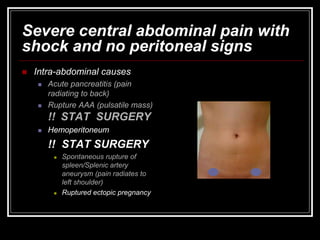
Severe central abdominal pain with
shock and no peritoneal signs
 Intra-abdominal causes
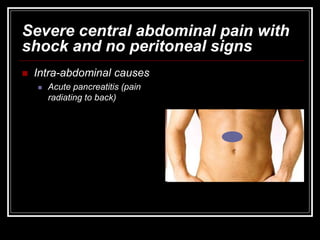
 Acute pancreatitis (pain
radiating to back)
Severe central abdominal pain with
shock and no peritoneal signs
 Intra-abdominal causes
 Acute pancreatitis (pain
radiating to back)
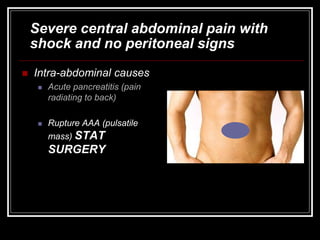
 Rupture AAA (pulsatile
mass) STAT
SURGERY
Severe central abdominal pain with
shock and no peritoneal signs
 Intra-abdominal causes
 Acute pancreatitis (pain
radiating to back)
 Rupture AAA (pulsatile
mass) !! STAT
SURGERY
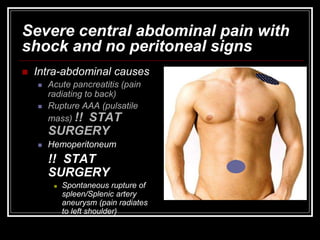
 Hemoperitoneum
!! STAT
SURGERY
 Spontaneous rupture of
spleen/Splenic artery
aneurysm (pain radiates
to left shoulder)
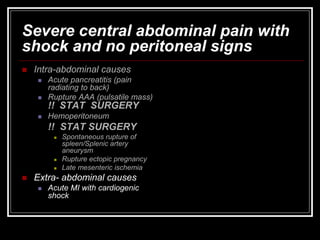
Severe central abdominal pain with
shock and no peritoneal signs
 Intra-abdominal causes
 Acute pancreatitis (pain
radiating to back)
 Rupture AAA (pulsatile mass)
!! STAT SURGERY
 Hemoperitoneum
!! STAT SURGERY
 Spontaneous rupture of
spleen/Splenic artery
aneurysm (pain radiates to
left shoulder)
 Ruptured ectopic pregnancy
Severe central abdominal pain with
shock and no peritoneal signs
 Intra-abdominal causes
 Acute pancreatitis (pain
radiating to back)
 Rupture AAA (pulsatile mass)
!! STAT SURGERY
 Hemoperitoneum
!! STAT SURGERY
 Spontaneous rupture of
spleen/Splenic artery
aneurysm
 Rupture ectopic pregnancy
 Late mesenteric ischemia
 Extra- abdominal causes
 Acute MI with cardiogenic
shock
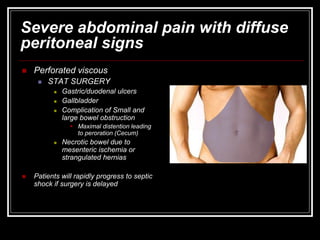
Severe abdominal pain with diffuse
peritoneal signs
 Perforated viscous
 STAT SURGERY
 Gastric/duodenal ulcers
 Gallbladder
 Complication of Small and
large bowel obstruction
 Maximal distention leading
to peroration (Cecum)
 Necrotic bowel due to
mesenteric ischemia or
strangulated hernias
 Patients will rapidly progress to septic
shock if surgery is delayed
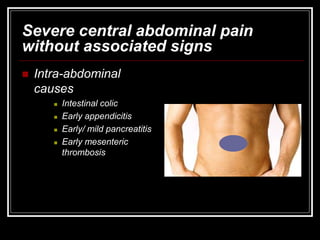
Severe central abdominal pain
without associated signs
 Intra-abdominal
causes
 Intestinal colic
 Early appendicitis
 Early/ mild pancreatitis
 Early mesenteric
thrombosis
Severe central abdominal pain
without associated signs
 Intra-abdominal causes
 Intestinal colic
 Early appendicitis
 Early/ mild pancreatitis
 Early mesenteric
thrombosis
 Extra- abdominal causes
 Herpes Zoster (rash in
dermatome distribution)
 CAD (ECG/Enzymes)
 Glaucoma
 Tabes dorsalis (rare)
Severe central abdominal pain with
distension, no vomiting & peritoneal
signs
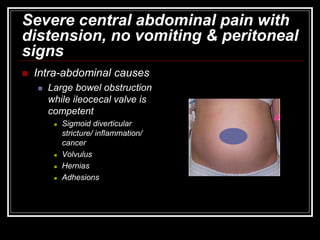
 Intra-abdominal causes
 Large bowel obstruction
while ileocecal valve is
competent
 Sigmoid diverticular
stricture/ inflammation/
cancer
 Volvulus
 Hernias
 Adhesions
Severe central abdominal pain with
distension, no vomiting & peritoneal
signs
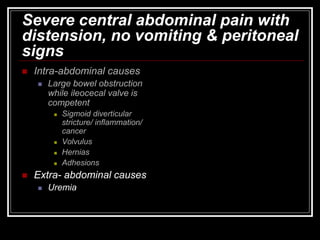
 Intra-abdominal causes
 Large bowel obstruction
while ileocecal valve is
competent
 Sigmoid diverticular
stricture/ inflammation/
cancer
 Volvulus
 Hernias
 Adhesions
 Extra- abdominal causes
 Uremia
Severe central abdominal pain with
vomiting, distension & no peritoneal
signs
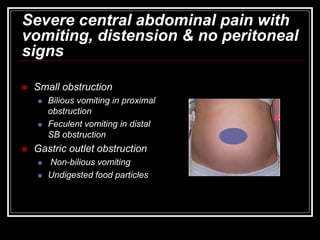
 Small obstruction
 Bilious vomiting in proximal
obstruction
 Feculent vomiting in distal
SB obstruction
 Gastric outlet obstruction
 Non-bilious vomiting
 Undigested food particles
Severe abdominal pain with
localized peritoneal signs
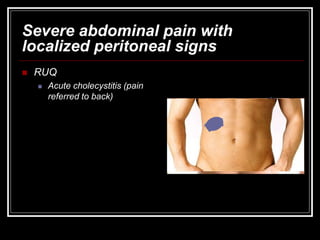
 RUQ
 Acute cholecystitis (pain
referred to back)
Severe abdominal pain with
localized peritoneal signs
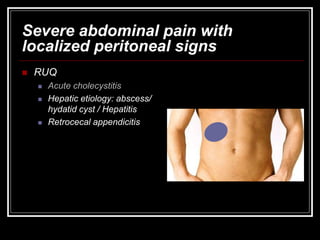
 RUQ
 Acute cholecystitis
 Hepatic etiology: abscess/
hydatid cyst / Hepatitis
 Retrocecal appendicitis
Severe abdominal pain with
localized peritoneal signs
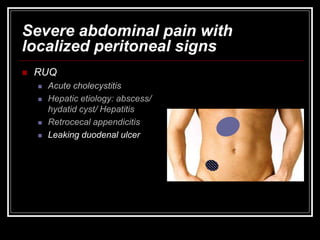
 RUQ
 Acute cholecystitis
 Hepatic etiology: abscess/
hydatid cyst/ Hepatitis
 Retrocecal appendicitis
 Leaking duodenal ulcer
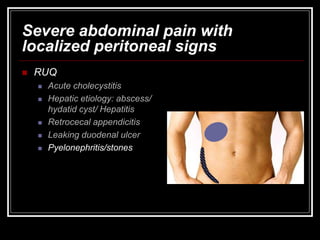
Severe abdominal pain with
localized peritoneal signs
 RUQ
 Acute cholecystitis
 Hepatic etiology: abscess/
hydatid cyst/ Hepatitis
 Retrocecal appendicitis
 Leaking duodenal ulcer
 Pyelonephritis/stones
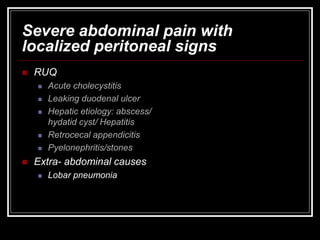
Severe abdominal pain with
localized peritoneal signs
 RUQ
 Acute cholecystitis
 Leaking duodenal ulcer
 Hepatic etiology: abscess/
hydatid cyst/ Hepatitis
 Retrocecal appendicitis
 Pyelonephritis/stones
 Extra- abdominal causes
 Lobar pneumonia
Severe abdominal pain with
localized peritoneal signs
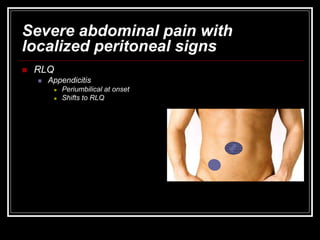
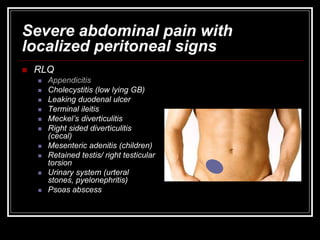
 RLQ
 Appendicitis
 Periumbilical at onset
 Shifts to RLQ
Severe abdominal pain with
localized peritoneal signs
 RLQ
 Appendicitis
 Cholecystitis (low lying GB)
 Leaking duodenal ulcer
 Terminal ileitis
 Meckel’s diverticulitis
 Right sided diverticulitis
(cecal)
 Mesenteric adenitis (children)
 Retained testis/ right testicular
torsion
 Urinary system (urteral
stones, pyelonephritis)
 Psoas abscess
Severe abdominal pain with
localized peritoneal signs
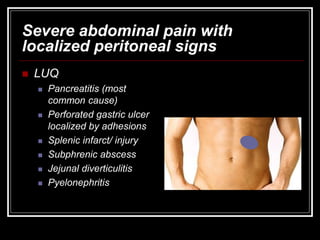
 LUQ
 Pancreatitis (most
common cause)
 Perforated gastric ulcer
localized by adhesions
 Splenic infarct/ injury
 Subphrenic abscess
 Jejunal diverticulitis
 Pyelonephritis
Severe abdominal pain with
localized peritoneal signs
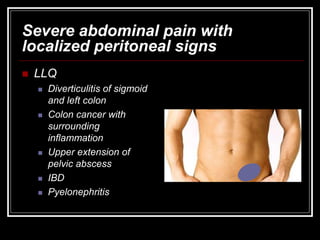
 LLQ
 Diverticulitis of sigmoid
and left colon
 Colon cancer with
surrounding
inflammation
 Upper extension of
pelvic abscess
 IBD
 Pyelonephritis
Severe abdominal pain with
localized peritoneal signs
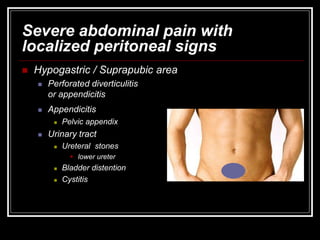
 Hypogastric / Suprapubic area
 Perforated diverticulitis
or appendicitis
 Appendicitis
 Pelvic appendix
 Urinary tract
 Ureteral stones
 lower ureter
 Bladder distention
 Cystitis
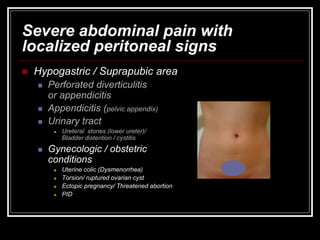
Severe abdominal pain with
localized peritoneal signs
 Hypogastric / Suprapubic area
 Perforated diverticulitis
or appendicitis
 Appendicitis (pelvic appendix)
 Urinary tract
 Ureteral stones (lower ureter)/
Bladder distention / cystitis
 Gynecologic / obstetric
conditions
 Uterine colic (Dysmenorrhea)
 Torsion/ ruptured ovarian cyst
 Ectopic pregnancy/ Threatened abortion
 PID

Abdominal Exam.ppt

  • 1.
    THE ABDOMINAL EXAM ACS/ASE MedicalStudent Simulation-based Surgical Skills Curriculum
  • 2.
    CREDITS  Author  EbondoMpinga, MD,FACS  Contributors  Michael Hughes, MD ,FACS (expert performance video)  Richard Damewood, MD,FACS (modified score assessment tool)  Duane Patterson, PhD (technical support)  Paul Schreck (videographer )  Editors  Keith Clancy, MD, FACS  Amanda Beattie, MD , R5  York Hospital Department of Surgery, York, PA
  • 3.
    OBJECTIVES  After thecompletion of this module the student should be able to: 1. Perform a complete abdominal exam. 2. Recognize the signs of peritonitis. 3. Arrive at a differential diagnosis based upon the findings elicited during the exam.
  • 4.
    ABDOMINAL EXAM  Althoughwe will focus on the abdominal exam, it cannot be overemphasized that a thorough physical exam (head to toes) is important to help in arriving at a comprehensive differential diagnosis list.  Examples :  presence of jaundice may add consideration of a biliary /hepatic etiology  Irregularly irregular heart rate atrial fibrillation-> mesenteric ischemia  Crackle at lung bases pneumonia  Skin lesions (pyoderma gangrenosum) -> IBD
  • 5.
    ABDOMINAL WALL DESCRIPTION  Theabdomen is generally divided into four quadrants by two artificial lines that intersect at the umbilicus  Other systems exist to further subdivide these four quadrants into nine regions/sections RUQ LUQ LLQ RLQ Epigastric Right Hypochondrium Right flank Left flank Umbilical Right Iliac Left Iliac Hypogastric / suprapubic Left Hypochondrium
  • 6.
    ABDOMINAL EXAM  Theexam should be performed in this specific order  General appearance  Vital signs  Inspection  Auscultation  Percussion  Palpation  It should include  An examination of the inguinal area  including the external genitalia in males (testes)  A rectal exam (discussed in a separate module)  A pelvic exam in women (discussed in a separate module)
  • 7.
  • 8.
    General Appearance  Head-to-toe(skin, eyes, LOC, position, demeanor)   Inflammation, peritonitis  Lies perfectly still  Or in bed with thighs and knees flexed   Obstruction / colic  Restless, writhing  Abdominal distension?  Shock  Pallor/ cyanosis/ diaphoresis/ decreased mental status
  • 9.
    Vital Signs  Tachycardia ? Early shock (may present prior to hypotension)  May be absent if on Beta blockers  Rapid shallow breathing (splinting)  Peritonitis  Hypotension  May be late finding depending on pre-existing state of health  Fever  Infectious etiology or perforation
  • 10.
    Inspection  Abdominal contour Distended vs. scaphoid  Irregular -> mass / volvulus / obstruction / hernias  Skin  Ecchymosis around umbilicus, flanks  pancreatitis? Trauma (seat belt sign)?  Scars  Prominent veins on the abdominal wall  Portal hypertension
  • 11.
    Auscultation  Bowel Sounds Auscultate all regions  Listen in each region  Listen before feeling  Absent bowel sounds  ileus, peritonitis, shock  Hyperactive  Enteritis / obstruction (high pitched or distant)  Bruits  AAA / Reno-vascular diseases  Iliac and Femoral arteries Aorta Femoral arteries Iliac arteries Renal Renal
  • 12.
    Percussion  Hyperresonance (tympani)  Boweldistension with air->obstruction  In all quadrants but RUQ (liver dullness)  Loss of liver dullness in RUQ-> Free air  Fluid wave  Ascites (may be hard to elicit in the obese)
  • 13.
     Palpate eachregion  Work toward area of pain  Warm hands  Communicate with patient  Let the patient know what you are about to do  Place Patient supine  knee bent (if possible) Epigastric Left Hypochondriac Right Hypochondriac Right flank Left flank Umbilical Right Iliac Left Iliac Hypogastric Palpation
  • 14.
    Palpation  Note tenderness Localize vs. diffuse  Rigidity  Rebound  Press on the abdomen and release  Present if pain is worse upon release  Avoid too sudden of a release (may startle patient -> false +)  Involuntary & voluntary guarding  Distract the patient while palpating to detect involuntary guarding  Feel for masses
  • 15.
    Signs highly suggestiveof peritonitis  Tenderness to percussion  Tenderness elicited when the examiner firmly taps on the Iliac crest  Tenderness elicited when the examiner firmly taps on the heel of the patient’s extended leg  Tenderness when the bed is gently shaken or the patient coughs  Rebound tenderness
  • 16.
    Abdominal exam: findings thatsuggest specific etiology  Biliary / hepatic etiology  Courvoisier' sign  Palpable gallbladder in the presence of painless jaundice   periampullary tumor  Caput medusa (Cruveilhier sign)  Varicose veins at umbilicus cirrhosis with portal HTN  Murphy’s sign  Pain caused during inspiration while palpating the RUQ-> acute cholecystitis  Ransohoff sign  Periumbilical yellow discoloration -> ruptured CBD
  • 17.
    Abdominal exam: findings thatsuggest specific etiology  Appendicitis  Rovsing’s sign  Palpation on the LLQ produces tenderness at McBurney’s point  Ten Horn test  Pain caused by gentle traction of the right testicle  Aaron sign  Persistent pressure applied at McBurney ‘s point causes pressure in the epigatrium and upper chest wall
  • 18.
    Abdominal exam: findings thatsuggest specific etiology  Pelvic inflammation/abscess  Iliopsoas sign  Allow patient to lie on the opposite side of the pain  Extend the thigh on the affected side  This should cause pain if there is irritation of the iliopsoas muscle (seen with appendicitis as well)  Obturator sign  Flexion and internal rotation of the right thigh while supine elicits hypogastric pain  Indicates irritation of obturator internus muscle (seen with appendicitis as well)  Chandelier sign  Extreme lower abdominal/pelvic pain with movement of the cervix
  • 19.
    Abdominal exam: findings thatsuggest specific etiology  Hemoperitoneum  Hemorrhagic pancreatitis  Cullen’s sign  periumbilical bruising-> hemoperitoneum  Grey Turner’s sign  Local area of discoloration around the flanks-> acute hemorrhagic pancreatitis  Danforth sign  shoulder pain on inspiration-> hemoperitoneum  Kehr’s sign  Left shoulder pain when supine or pressure applied to LUQ-> splenic rupture
  • 20.
    Inguinal exam  Palpationof the inguinal area with & without vasalva maneuver  Ask patient to cough  Ask patient to take a deep breath and bear down  Pay attention to the femoral area to rule out femoral hernias  In the male, the testis should be examined  to rule out testicular torsion
  • 21.
    COMMON ERRORS  Focusonly on the abdomen  Begin with palpation prior to inspection, auscultation and percussion  Not asking the patient to localize the pain and therefore beginning palpation of the affected area first, exacerbating the pain and thus precluding complete examination of the abdomen  Skipping the rectal, pelvic and groin exam  Putting too much weight on the absence of rebound tenderness to r/o peritonitis  Putting to much weight on the physical exam in an immunosuppressed patient who may not exhibit normal signs of peritonitis  Forgetting to consider mesenteric ischemia when there is pain out of proportion to clinical exam
  • 22.
  • 23.
    Severe central abdominalpain with shock and no peritoneal signs  Intra-abdominal causes  Acute pancreatitis (pain radiating to back)
  • 24.
    Severe central abdominalpain with shock and no peritoneal signs  Intra-abdominal causes  Acute pancreatitis (pain radiating to back)  Rupture AAA (pulsatile mass) STAT SURGERY
  • 25.
    Severe central abdominalpain with shock and no peritoneal signs  Intra-abdominal causes  Acute pancreatitis (pain radiating to back)  Rupture AAA (pulsatile mass) !! STAT SURGERY  Hemoperitoneum !! STAT SURGERY  Spontaneous rupture of spleen/Splenic artery aneurysm (pain radiates to left shoulder)
  • 26.
    Severe central abdominalpain with shock and no peritoneal signs  Intra-abdominal causes  Acute pancreatitis (pain radiating to back)  Rupture AAA (pulsatile mass) !! STAT SURGERY  Hemoperitoneum !! STAT SURGERY  Spontaneous rupture of spleen/Splenic artery aneurysm (pain radiates to left shoulder)  Ruptured ectopic pregnancy
  • 27.
    Severe central abdominalpain with shock and no peritoneal signs  Intra-abdominal causes  Acute pancreatitis (pain radiating to back)  Rupture AAA (pulsatile mass) !! STAT SURGERY  Hemoperitoneum !! STAT SURGERY  Spontaneous rupture of spleen/Splenic artery aneurysm  Rupture ectopic pregnancy  Late mesenteric ischemia  Extra- abdominal causes  Acute MI with cardiogenic shock
  • 28.
    Severe abdominal painwith diffuse peritoneal signs  Perforated viscous  STAT SURGERY  Gastric/duodenal ulcers  Gallbladder  Complication of Small and large bowel obstruction  Maximal distention leading to peroration (Cecum)  Necrotic bowel due to mesenteric ischemia or strangulated hernias  Patients will rapidly progress to septic shock if surgery is delayed
  • 29.
    Severe central abdominalpain without associated signs  Intra-abdominal causes  Intestinal colic  Early appendicitis  Early/ mild pancreatitis  Early mesenteric thrombosis
  • 30.
    Severe central abdominalpain without associated signs  Intra-abdominal causes  Intestinal colic  Early appendicitis  Early/ mild pancreatitis  Early mesenteric thrombosis  Extra- abdominal causes  Herpes Zoster (rash in dermatome distribution)  CAD (ECG/Enzymes)  Glaucoma  Tabes dorsalis (rare)
  • 31.
    Severe central abdominalpain with distension, no vomiting & peritoneal signs  Intra-abdominal causes  Large bowel obstruction while ileocecal valve is competent  Sigmoid diverticular stricture/ inflammation/ cancer  Volvulus  Hernias  Adhesions
  • 32.
    Severe central abdominalpain with distension, no vomiting & peritoneal signs  Intra-abdominal causes  Large bowel obstruction while ileocecal valve is competent  Sigmoid diverticular stricture/ inflammation/ cancer  Volvulus  Hernias  Adhesions  Extra- abdominal causes  Uremia
  • 33.
    Severe central abdominalpain with vomiting, distension & no peritoneal signs  Small obstruction  Bilious vomiting in proximal obstruction  Feculent vomiting in distal SB obstruction  Gastric outlet obstruction  Non-bilious vomiting  Undigested food particles
  • 34.
    Severe abdominal painwith localized peritoneal signs  RUQ  Acute cholecystitis (pain referred to back)
  • 35.
    Severe abdominal painwith localized peritoneal signs  RUQ  Acute cholecystitis  Hepatic etiology: abscess/ hydatid cyst / Hepatitis  Retrocecal appendicitis
  • 36.
    Severe abdominal painwith localized peritoneal signs  RUQ  Acute cholecystitis  Hepatic etiology: abscess/ hydatid cyst/ Hepatitis  Retrocecal appendicitis  Leaking duodenal ulcer
  • 37.
    Severe abdominal painwith localized peritoneal signs  RUQ  Acute cholecystitis  Hepatic etiology: abscess/ hydatid cyst/ Hepatitis  Retrocecal appendicitis  Leaking duodenal ulcer  Pyelonephritis/stones
  • 38.
    Severe abdominal painwith localized peritoneal signs  RUQ  Acute cholecystitis  Leaking duodenal ulcer  Hepatic etiology: abscess/ hydatid cyst/ Hepatitis  Retrocecal appendicitis  Pyelonephritis/stones  Extra- abdominal causes  Lobar pneumonia
  • 39.
    Severe abdominal painwith localized peritoneal signs  RLQ  Appendicitis  Periumbilical at onset  Shifts to RLQ
  • 40.
    Severe abdominal painwith localized peritoneal signs  RLQ  Appendicitis  Cholecystitis (low lying GB)  Leaking duodenal ulcer  Terminal ileitis  Meckel’s diverticulitis  Right sided diverticulitis (cecal)  Mesenteric adenitis (children)  Retained testis/ right testicular torsion  Urinary system (urteral stones, pyelonephritis)  Psoas abscess
  • 41.
    Severe abdominal painwith localized peritoneal signs  LUQ  Pancreatitis (most common cause)  Perforated gastric ulcer localized by adhesions  Splenic infarct/ injury  Subphrenic abscess  Jejunal diverticulitis  Pyelonephritis
  • 42.
    Severe abdominal painwith localized peritoneal signs  LLQ  Diverticulitis of sigmoid and left colon  Colon cancer with surrounding inflammation  Upper extension of pelvic abscess  IBD  Pyelonephritis
  • 43.
    Severe abdominal painwith localized peritoneal signs  Hypogastric / Suprapubic area  Perforated diverticulitis or appendicitis  Appendicitis  Pelvic appendix  Urinary tract  Ureteral stones  lower ureter  Bladder distention  Cystitis
  • 44.
    Severe abdominal painwith localized peritoneal signs  Hypogastric / Suprapubic area  Perforated diverticulitis or appendicitis  Appendicitis (pelvic appendix)  Urinary tract  Ureteral stones (lower ureter)/ Bladder distention / cystitis  Gynecologic / obstetric conditions  Uterine colic (Dysmenorrhea)  Torsion/ ruptured ovarian cyst  Ectopic pregnancy/ Threatened abortion  PID