Interactions of Radiation
With Matter
Objectives
We have focused in previous lectures on
the source of radiation and the types of
radiation. We are now in a position to
consider what happens when this
radiation interacts with matter
(mechanisms of energy transfer and its
effects on the physical-chemical- and
biological level)
Objectives
Our main reason for doing this is to find
out what happens to the radiation as it
passes through matter and also to set
ourselves up for considering how it
interacts with living tissue and understand
the chain of events leading to radiation
injury. This knowledge also forms the
bases of radiation therapy and diagnostic
radiology.
Objectives
Also, Since all radiation detectors are
made from some form of matter it is
useful to first of all know how radiation
interacts so that we can exploit the
effects in the design of such detectors
and know how it works.
Ionizing radiation
Ionizing radiation is radiation that has
sufficient energy to remove electrons
from atoms, creating ions.
Ionizing radiation can be classified into
two groups: photons (gamma and X-
rays) and particles (alpha, beta, and
neutrons (
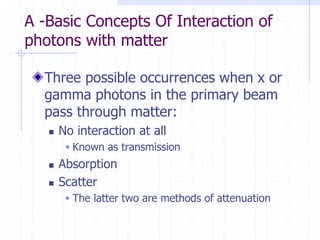
A -Basic Concepts Of Interaction of
photons with matter
Three possible occurrences when x or
gamma photons in the primary beam
pass through matter:
 No interaction at all
 Known as transmission
 Absorption
 Scatter
 The latter two are methods of attenuation
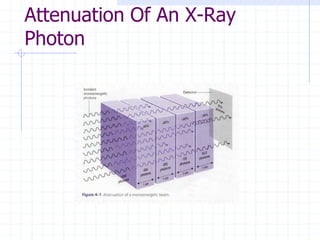
Attenuation Of An X-Ray
Photon
The Three main Interactions Of X
and Gamma Rays With Matter
Photoelectric effect
 Very important in diagnostic radiology
Compton scatter
 Very important in diagnostic radiology
Pair production
 Very important in therapeutic & diagnostic
radiology
Photoelectric Effect
All of the energy of the incoming photon is
totally transferred to the atom
 Following interaction, the photon ceases to exist
The incoming photon interacts with an orbital
electron in an inner shell – usually K
The orbital electron is dislodged
To dislodge the electron, the energy of the
incoming photon must be equal to, or greater
than the electron’s energy
Photoelectric Effect
The incoming photon gives up all its energy,
and ceases to exist
The ejected electron is now a photoelectron
This photoelectron now contains the energy
of the incoming photon minus the binding
energy of the electron shell
This photoelectron can interact with other
atoms until all its energy is spent
Photoelectric Effect
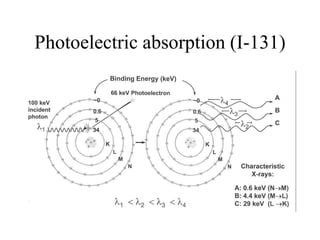
A vacancy now exists in the inner shell
To fill this gap, an electron from an outer
shell drops down to fill the gap
Once the gap is filled, the electron releases
its energy in the form of a characteristic
photon
This process continues, with each electron
emitting characteristic photons, until the
atom is stable
The characteristic photon produces relatively
low energies and is generally absorbed in
tissue
Photoelectric absorption (I-131)
The Byproducts of the
Photoelectric Effect
Photoelectrons
Characteristic photons
The Probability of Occurrence
Depends on the following:
 The energy of the incident photon(E)
 The atomic number of the irradiated object(Z)
 It increases as the photon energy decreases, and
the atomic number of the irradiated object
increases
 The probability of photoelectric absorption, is
roughly proportional to (Z/E)3
 This type of interaction is prevalent in the
diagnostic keV range – 30 - 150
What Does This All Mean?
Bones are more likely to absorb
radiation(Higher Z)
 This is why they appear white on the film
Soft tissue allows more radiation to pass
through than bone (Lower Z)
 These structures will appear gray on the film
Air-containing structures allow more radiation
to pass through
 These structures will appear black on the film
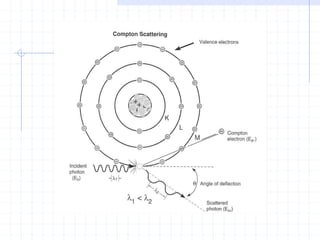
Compton Scattering
An incoming photon is partially absorbed in
an outer shell electron
The electron absorbs enough energy to break
the binding energy, and is ejected
The ejected electron is now a Compton
electron
Not much energy is needed to eject an
electron from an outer shell
The incoming photon, continues on a
different path with less energy as scattered
radiation
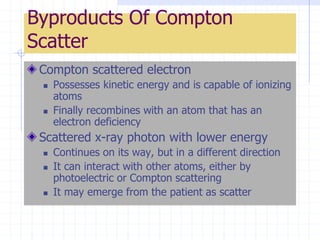
Byproducts Of Compton
Scatter
Compton scattered electron
 Possesses kinetic energy and is capable of ionizing
atoms
 Finally recombines with an atom that has an
electron deficiency
Scattered x-ray photon with lower energy
 Continues on its way, but in a different direction
 It can interact with other atoms, either by
photoelectric or Compton scattering
 It may emerge from the patient as scatter
Probability Of Compton
Scatter Occurring
Increases as the incoming photon energy
increases up to certain limit then decreases
as the photon energy increases.
Independent on Z of the absorber.
The Compton process is most important for
energy absorption for soft tissues in the
range from 100 keV to 2MeV.
Pair Production
Incoming photon must have an energy of at
least 1.02 MeV
This process is a conversion of energy into
matter and then matter back into energy
Two electrons are produced in this interaction
Pair Production
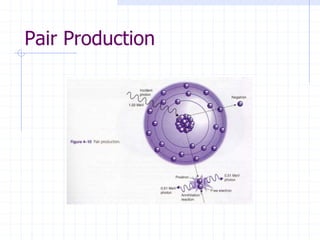
An incoming photon of 1.02 MeV or greater
interacts with the nucleus of an atom
The incoming photon disappears
The transformation of energy results in the
formation of two particles
Negatron
 Possesses negative charge
Positron
 Possesses a positive charge
Pair Production
Positrons
Considered antimatter
Do not exist freely in nature
Cannot exist near matter
Will interact with the first electron they
encounter
An electron and the positron destroy each
other during interaction
 Known as the annihilation reaction
This converts matter back into energy
Both the positron and electron disappear
Two gamma photons are released with an
Pair Production
The produced gamma photons may
interact with matter through pair
production or Compton scatter
Pair production is used for positron
emission tomography, a nuclear
medicine imaging procedure
It is also used in radiation therapy
Pair production probability
· Increases with increasing photon
energy
· Increases with atomic number
approximately as Z2
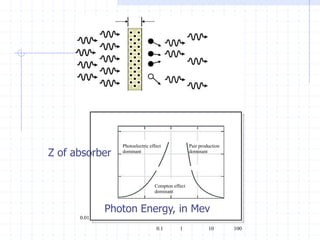
Photoelectric effect
dominant
Pair production
dominant
Compton effect
dominant
0.01
0.1 1 10 100
Z of absorber
Photon Energy, in Mev
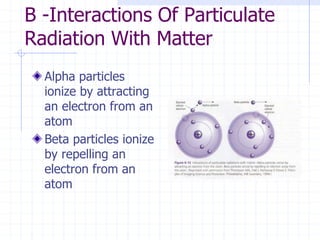
B -Interactions Of Particulate
Radiation With Matter
Alpha particles
ionize by attracting
an electron from an
atom
Beta particles ionize
by repelling an
electron from an
atom
Particle interactions
Energetic charged particles
interact with matter by
electrical forces and lose kinetic
energy via:
 Excitation
 Ionization
 Radiative losses
Charged Particle Tracks
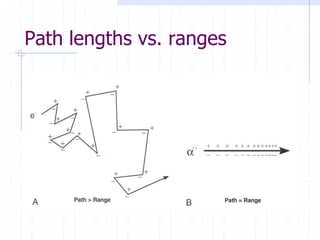
Electrons follow tortuous paths in matter as
the result of multiple scattering events
 Ionization track is sparse and nonuniform
Larger mass of heavy charged particle results
in dense and usually linear ionization track
Path length is actual distance particle travels;
range is actual depth of penetration in matter
Path lengths vs. ranges
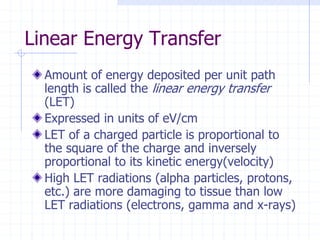
Linear Energy Transfer
Amount of energy deposited per unit path
length is called the linear energy transfer
(LET)
Expressed in units of eV/cm
LET of a charged particle is proportional to
the square of the charge and inversely
proportional to its kinetic energy(velocity)
High LET radiations (alpha particles, protons,
etc.) are more damaging to tissue than low
LET radiations (electrons, gamma and x-rays)
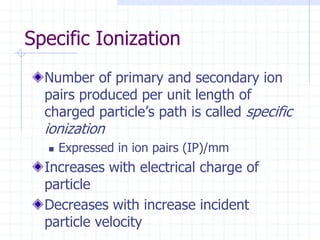
Specific Ionization
Number of primary and secondary ion
pairs produced per unit length of
charged particle’s path is called specific
ionization
 Expressed in ion pairs (IP)/mm
Increases with electrical charge of
particle
Decreases with increase incident
particle velocity
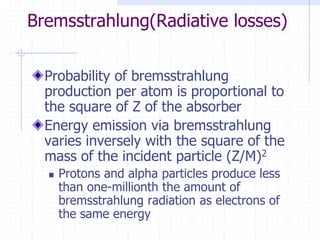
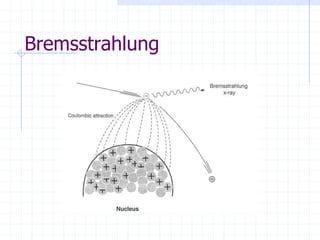
Bremsstrahlung(Radiative losses)
Probability of bremsstrahlung
production per atom is proportional to
the square of Z of the absorber
Energy emission via bremsstrahlung
varies inversely with the square of the
mass of the incident particle (Z/M)2
 Protons and alpha particles produce less
than one-millionth the amount of
bremsstrahlung radiation as electrons of
the same energy
Bremsstrahlung
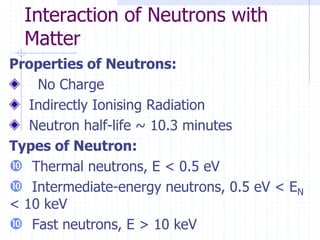
Properties of Neutrons:
No Charge
Indirectly Ionising Radiation
Neutron half-life ~ 10.3 minutes
Types of Neutron:
 Thermal neutrons, E < 0.5 eV
 Intermediate-energy neutrons, 0.5 eV < EN
< 10 keV
 Fast neutrons, E > 10 keV
Interaction of Neutrons with
Matter
Interaction of Neutrons with
Matter
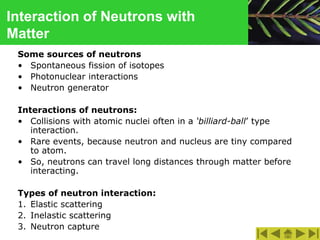
Some sources of neutrons
• Spontaneous fission of isotopes
• Photonuclear interactions
• Neutron generator
Interactions of neutrons:
• Collisions with atomic nuclei often in a ‘billiard-ball’ type
interaction.
• Rare events, because neutron and nucleus are tiny compared
to atom.
• So, neutrons can travel long distances through matter before
interacting.
Types of neutron interaction:
1. Elastic scattering
2. Inelastic scattering
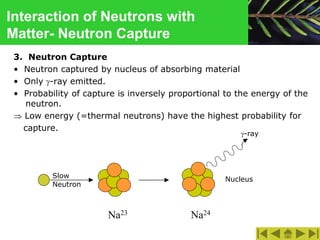
3. Neutron capture
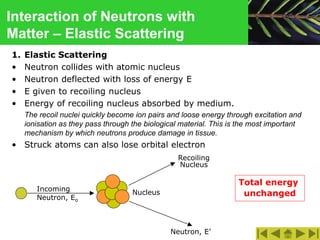
1. Elastic Scattering
• Neutron collides with atomic nucleus
• Neutron deflected with loss of energy E
• E given to recoiling nucleus
• Energy of recoiling nucleus absorbed by medium.
The recoil nuclei quickly become ion pairs and loose energy through excitation and
ionisation as they pass through the biological material. This is the most important
mechanism by which neutrons produce damage in tissue.
• Struck atoms can also lose orbital electron
Interaction of Neutrons with
Matter – Elastic Scattering
Neutron, E’
Recoiling
Nucleus
Incoming
Neutron, Eo
Nucleus
Total energy
unchanged
Interaction of Neutrons with
Matter – Elastic Scattering
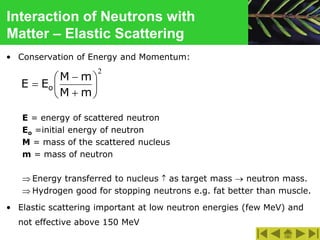
• Conservation of Energy and Momentum:
E = energy of scattered neutron
Eo =initial energy of neutron
M = mass of the scattered nucleus
m = mass of neutron
 Energy transferred to nucleus  as target mass  neutron mass.
 Hydrogen good for stopping neutrons e.g. fat better than muscle.
• Elastic scattering important at low neutron energies (few MeV) and
not effective above 150 MeV
2









m
M
m
M
E
E o
Interaction of Neutrons with
Matter – Inelastic Scattering
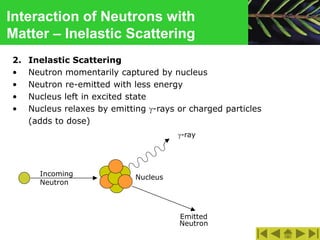
2. Inelastic Scattering
• Neutron momentarily captured by nucleus
• Neutron re-emitted with less energy
• Nucleus left in excited state
• Nucleus relaxes by emitting g-rays or charged particles
(adds to dose)
Emitted
Neutron
g-ray
Incoming
Neutron
Nucleus
Interaction of Neutrons with
Matter – Inelastic Scattering
• Interaction probability  as: neutron energy 
target size 
 Important at high neutron energies in heavy materials
• Energy transferred to the target nucleus and emitted energy:
E = Eo - Eg
E = Energy of the neutron after collision
Eo = Initial energy of the neutron
Interaction of Neutrons with
Matter- Neutron Capture
3. Neutron Capture
• Neutron captured by nucleus of absorbing material
• Only g-ray emitted.
• Probability of capture is inversely proportional to the energy of the
neutron.
 Low energy (=thermal neutrons) have the highest probability for
capture.
Slow
Neutron
g-ray
Nucleus
Na23 Na24
Interaction of Neutrons with
Matter
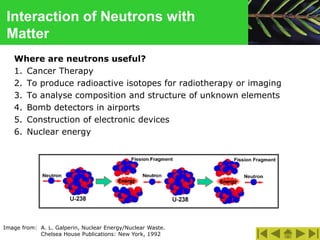
Where are neutrons useful?
1. Cancer Therapy
2. To produce radioactive isotopes for radiotherapy or imaging
3. To analyse composition and structure of unknown elements
4. Bomb detectors in airports
5. Construction of electronic devices
6. Nuclear energy
Image from: A. L. Galperin, Nuclear Energy/Nuclear Waste.
Chelsea House Publications: New York, 1992
Interaction of Neutrons with
Matter
Neutrons for Radiotherapy
• Neutrons have good tumour killing capabilities
• Tissue damage is primarily by nuclear interactions
• Neutrons are high LET radiation + have high B.E.
 Lower chance of tumour repair
 Often lower dose required
 Good for radioresistant tumours
Question 1
What are the factors affecting The
Probability of Occurrence of :
Photoelectric effect
Compton scattering
Pair production
Bremsstrahlung
Question 2
What are the byproducts of :
Photoelectric effect
Compton scattering
Pair production
Bremsstrahlung
Question 3
Give the scientific reason for:
Bones appear more clear than soft
tissues in the radiographic film?
Lead is used for sheading gamma
emitters?
Plastic is preferred than lead for
sheading Beta emitters?
How many interactions does a 1 MeV
electron typically undergo before
coming to a stop?
A: 100,000
Of these two sub-atomic particles,
which has the largest LET?
Photon? Neutron?
A: Neutron
Which of these is a form of
DIRECTLY ionising radiation?
Electron? Neutron?
A: Electron
What is produced when an electron and
a positron annihilate?
A: Two g-rays
In which material do electrons of the
same energy have the longest
range?
Bone? Fat?
A: Fat
Radiation that is easily stopped in
matter, has a HIGH or LOW LET?
A: High
What is the probability that a
charged particle will pass
through a medium without
interaction?
A: Zero

lecture_6_20.ppt

  • 1.
  • 2.
    Objectives We have focusedin previous lectures on the source of radiation and the types of radiation. We are now in a position to consider what happens when this radiation interacts with matter (mechanisms of energy transfer and its effects on the physical-chemical- and biological level)
  • 3.
    Objectives Our main reasonfor doing this is to find out what happens to the radiation as it passes through matter and also to set ourselves up for considering how it interacts with living tissue and understand the chain of events leading to radiation injury. This knowledge also forms the bases of radiation therapy and diagnostic radiology.
  • 4.
    Objectives Also, Since allradiation detectors are made from some form of matter it is useful to first of all know how radiation interacts so that we can exploit the effects in the design of such detectors and know how it works.
  • 5.
    Ionizing radiation Ionizing radiationis radiation that has sufficient energy to remove electrons from atoms, creating ions. Ionizing radiation can be classified into two groups: photons (gamma and X- rays) and particles (alpha, beta, and neutrons (
  • 6.
    A -Basic ConceptsOf Interaction of photons with matter Three possible occurrences when x or gamma photons in the primary beam pass through matter:  No interaction at all  Known as transmission  Absorption  Scatter  The latter two are methods of attenuation
  • 7.
    Attenuation Of AnX-Ray Photon
  • 8.
    The Three mainInteractions Of X and Gamma Rays With Matter Photoelectric effect  Very important in diagnostic radiology Compton scatter  Very important in diagnostic radiology Pair production  Very important in therapeutic & diagnostic radiology
  • 9.
    Photoelectric Effect All ofthe energy of the incoming photon is totally transferred to the atom  Following interaction, the photon ceases to exist The incoming photon interacts with an orbital electron in an inner shell – usually K The orbital electron is dislodged To dislodge the electron, the energy of the incoming photon must be equal to, or greater than the electron’s energy
  • 10.
    Photoelectric Effect The incomingphoton gives up all its energy, and ceases to exist The ejected electron is now a photoelectron This photoelectron now contains the energy of the incoming photon minus the binding energy of the electron shell This photoelectron can interact with other atoms until all its energy is spent
  • 11.
    Photoelectric Effect A vacancynow exists in the inner shell To fill this gap, an electron from an outer shell drops down to fill the gap Once the gap is filled, the electron releases its energy in the form of a characteristic photon This process continues, with each electron emitting characteristic photons, until the atom is stable The characteristic photon produces relatively low energies and is generally absorbed in tissue
  • 12.
  • 13.
    The Byproducts ofthe Photoelectric Effect Photoelectrons Characteristic photons
  • 14.
    The Probability ofOccurrence Depends on the following:  The energy of the incident photon(E)  The atomic number of the irradiated object(Z)  It increases as the photon energy decreases, and the atomic number of the irradiated object increases  The probability of photoelectric absorption, is roughly proportional to (Z/E)3  This type of interaction is prevalent in the diagnostic keV range – 30 - 150
  • 15.
    What Does ThisAll Mean? Bones are more likely to absorb radiation(Higher Z)  This is why they appear white on the film Soft tissue allows more radiation to pass through than bone (Lower Z)  These structures will appear gray on the film Air-containing structures allow more radiation to pass through  These structures will appear black on the film
  • 16.
    Compton Scattering An incomingphoton is partially absorbed in an outer shell electron The electron absorbs enough energy to break the binding energy, and is ejected The ejected electron is now a Compton electron Not much energy is needed to eject an electron from an outer shell The incoming photon, continues on a different path with less energy as scattered radiation
  • 18.
    Byproducts Of Compton Scatter Comptonscattered electron  Possesses kinetic energy and is capable of ionizing atoms  Finally recombines with an atom that has an electron deficiency Scattered x-ray photon with lower energy  Continues on its way, but in a different direction  It can interact with other atoms, either by photoelectric or Compton scattering  It may emerge from the patient as scatter
  • 19.
    Probability Of Compton ScatterOccurring Increases as the incoming photon energy increases up to certain limit then decreases as the photon energy increases. Independent on Z of the absorber. The Compton process is most important for energy absorption for soft tissues in the range from 100 keV to 2MeV.
  • 20.
    Pair Production Incoming photonmust have an energy of at least 1.02 MeV This process is a conversion of energy into matter and then matter back into energy Two electrons are produced in this interaction
  • 21.
    Pair Production An incomingphoton of 1.02 MeV or greater interacts with the nucleus of an atom The incoming photon disappears The transformation of energy results in the formation of two particles Negatron  Possesses negative charge Positron  Possesses a positive charge
  • 22.
  • 23.
    Positrons Considered antimatter Do notexist freely in nature Cannot exist near matter Will interact with the first electron they encounter An electron and the positron destroy each other during interaction  Known as the annihilation reaction This converts matter back into energy Both the positron and electron disappear Two gamma photons are released with an
  • 24.
    Pair Production The producedgamma photons may interact with matter through pair production or Compton scatter Pair production is used for positron emission tomography, a nuclear medicine imaging procedure It is also used in radiation therapy
  • 25.
    Pair production probability ·Increases with increasing photon energy · Increases with atomic number approximately as Z2
  • 26.
    Photoelectric effect dominant Pair production dominant Comptoneffect dominant 0.01 0.1 1 10 100 Z of absorber Photon Energy, in Mev
  • 27.
    B -Interactions OfParticulate Radiation With Matter Alpha particles ionize by attracting an electron from an atom Beta particles ionize by repelling an electron from an atom
  • 28.
    Particle interactions Energetic chargedparticles interact with matter by electrical forces and lose kinetic energy via:  Excitation  Ionization  Radiative losses
  • 29.
    Charged Particle Tracks Electronsfollow tortuous paths in matter as the result of multiple scattering events  Ionization track is sparse and nonuniform Larger mass of heavy charged particle results in dense and usually linear ionization track Path length is actual distance particle travels; range is actual depth of penetration in matter
  • 30.
  • 31.
    Linear Energy Transfer Amountof energy deposited per unit path length is called the linear energy transfer (LET) Expressed in units of eV/cm LET of a charged particle is proportional to the square of the charge and inversely proportional to its kinetic energy(velocity) High LET radiations (alpha particles, protons, etc.) are more damaging to tissue than low LET radiations (electrons, gamma and x-rays)
  • 32.
    Specific Ionization Number ofprimary and secondary ion pairs produced per unit length of charged particle’s path is called specific ionization  Expressed in ion pairs (IP)/mm Increases with electrical charge of particle Decreases with increase incident particle velocity
  • 33.
    Bremsstrahlung(Radiative losses) Probability ofbremsstrahlung production per atom is proportional to the square of Z of the absorber Energy emission via bremsstrahlung varies inversely with the square of the mass of the incident particle (Z/M)2  Protons and alpha particles produce less than one-millionth the amount of bremsstrahlung radiation as electrons of the same energy
  • 34.
  • 35.
    Properties of Neutrons: NoCharge Indirectly Ionising Radiation Neutron half-life ~ 10.3 minutes Types of Neutron:  Thermal neutrons, E < 0.5 eV  Intermediate-energy neutrons, 0.5 eV < EN < 10 keV  Fast neutrons, E > 10 keV Interaction of Neutrons with Matter
  • 36.
    Interaction of Neutronswith Matter Some sources of neutrons • Spontaneous fission of isotopes • Photonuclear interactions • Neutron generator Interactions of neutrons: • Collisions with atomic nuclei often in a ‘billiard-ball’ type interaction. • Rare events, because neutron and nucleus are tiny compared to atom. • So, neutrons can travel long distances through matter before interacting. Types of neutron interaction: 1. Elastic scattering 2. Inelastic scattering 3. Neutron capture
  • 37.
    1. Elastic Scattering •Neutron collides with atomic nucleus • Neutron deflected with loss of energy E • E given to recoiling nucleus • Energy of recoiling nucleus absorbed by medium. The recoil nuclei quickly become ion pairs and loose energy through excitation and ionisation as they pass through the biological material. This is the most important mechanism by which neutrons produce damage in tissue. • Struck atoms can also lose orbital electron Interaction of Neutrons with Matter – Elastic Scattering Neutron, E’ Recoiling Nucleus Incoming Neutron, Eo Nucleus Total energy unchanged
  • 38.
    Interaction of Neutronswith Matter – Elastic Scattering • Conservation of Energy and Momentum: E = energy of scattered neutron Eo =initial energy of neutron M = mass of the scattered nucleus m = mass of neutron  Energy transferred to nucleus  as target mass  neutron mass.  Hydrogen good for stopping neutrons e.g. fat better than muscle. • Elastic scattering important at low neutron energies (few MeV) and not effective above 150 MeV 2          m M m M E E o
  • 39.
    Interaction of Neutronswith Matter – Inelastic Scattering 2. Inelastic Scattering • Neutron momentarily captured by nucleus • Neutron re-emitted with less energy • Nucleus left in excited state • Nucleus relaxes by emitting g-rays or charged particles (adds to dose) Emitted Neutron g-ray Incoming Neutron Nucleus
  • 40.
    Interaction of Neutronswith Matter – Inelastic Scattering • Interaction probability  as: neutron energy  target size   Important at high neutron energies in heavy materials • Energy transferred to the target nucleus and emitted energy: E = Eo - Eg E = Energy of the neutron after collision Eo = Initial energy of the neutron
  • 41.
    Interaction of Neutronswith Matter- Neutron Capture 3. Neutron Capture • Neutron captured by nucleus of absorbing material • Only g-ray emitted. • Probability of capture is inversely proportional to the energy of the neutron.  Low energy (=thermal neutrons) have the highest probability for capture. Slow Neutron g-ray Nucleus Na23 Na24
  • 42.
    Interaction of Neutronswith Matter Where are neutrons useful? 1. Cancer Therapy 2. To produce radioactive isotopes for radiotherapy or imaging 3. To analyse composition and structure of unknown elements 4. Bomb detectors in airports 5. Construction of electronic devices 6. Nuclear energy Image from: A. L. Galperin, Nuclear Energy/Nuclear Waste. Chelsea House Publications: New York, 1992
  • 43.
    Interaction of Neutronswith Matter Neutrons for Radiotherapy • Neutrons have good tumour killing capabilities • Tissue damage is primarily by nuclear interactions • Neutrons are high LET radiation + have high B.E.  Lower chance of tumour repair  Often lower dose required  Good for radioresistant tumours
  • 44.
    Question 1 What arethe factors affecting The Probability of Occurrence of : Photoelectric effect Compton scattering Pair production Bremsstrahlung
  • 45.
    Question 2 What arethe byproducts of : Photoelectric effect Compton scattering Pair production Bremsstrahlung
  • 46.
    Question 3 Give thescientific reason for: Bones appear more clear than soft tissues in the radiographic film? Lead is used for sheading gamma emitters? Plastic is preferred than lead for sheading Beta emitters?
  • 47.
    How many interactionsdoes a 1 MeV electron typically undergo before coming to a stop? A: 100,000
  • 48.
    Of these twosub-atomic particles, which has the largest LET? Photon? Neutron? A: Neutron
  • 49.
    Which of theseis a form of DIRECTLY ionising radiation? Electron? Neutron? A: Electron
  • 50.
    What is producedwhen an electron and a positron annihilate? A: Two g-rays
  • 51.
    In which materialdo electrons of the same energy have the longest range? Bone? Fat? A: Fat
  • 52.
    Radiation that iseasily stopped in matter, has a HIGH or LOW LET? A: High
  • 53.
    What is theprobability that a charged particle will pass through a medium without interaction? A: Zero