Dr. BASAVARAJAIAH S. M.
Assistant Professor and Coordinator
P.G. Department of Chemistry
Vijaya College
Bangalore-560004
ASYMMETRIC SYNTHESIS
(Part-II)
I. STEREOCHEMICAL ASPECTSOF ORGANIC SYNTHESIS
II. Acyclic stereoselection.
III. Diastereoselectionin cyclic system.
IV. Enantioselective synthesis.
CONTENTS
General Terms:
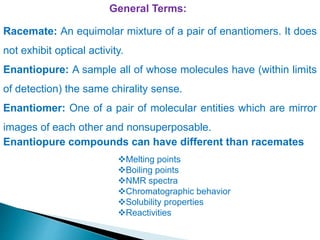
Racemate: An equimolar mixture of a pair of enantiomers. It does
not exhibit optical activity.
Enantiopure: A sample all of whose molecules have (within limits
of detection) the same chirality sense.
Enantiomer: One of a pair of molecular entities which are mirror
images of each other and nonsuperposable.
Melting points
Boiling points
NMR spectra
Chromatographic behavior
Solubility properties
Reactivities
Enantiopure compounds can have different than racemates
STEREOCHEMICAL ASPECTS OF ORGANIC SYNTHESIS
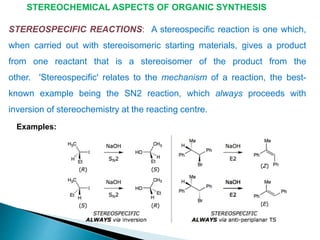
STEREOSPECIFIC REACTIONS: A stereospecific reaction is one which,
when carried out with stereoisomeric starting materials, gives a product
from one reactant that is a stereoisomer of the product from the
other. 'Stereospecific' relates to the mechanism of a reaction, the best-
known example being the SN2 reaction, which always proceeds with
inversion of stereochemistry at the reacting centre.
Examples:
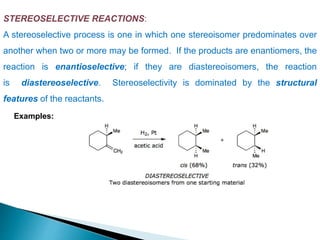
STEREOSELECTIVE REACTIONS:
A stereoselective process is one in which one stereoisomer predominates over
another when two or more may be formed. If the products are enantiomers, the
reaction is enantioselective; if they are diastereoisomers, the reaction
is diastereoselective. Stereoselectivity is dominated by the structural
features of the reactants.
Examples:
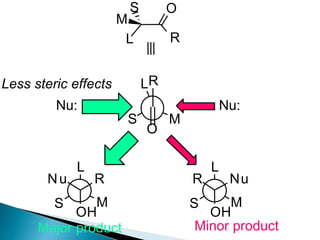
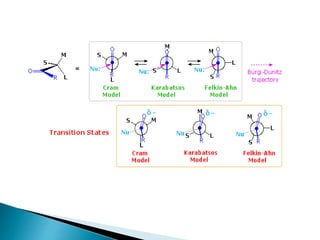
Cram's rule:
Cram's rule, proposed by Donald Cram in 1952,[1] was the earliest model
proposed for rationalizing the stereoselectivity of nucleophilic additions to
carbonyl groups with α-stereocentres. The model involved assigning each α-
substituent a relative "size" (small, medium, and large), then placing the
carbonyl oxygen antiperiplanar to the largest of these three groups. The
nucleophile then attacks the carbonyl group opposite the larger of the two
remaining groups (i.e., the medium group). This is best explained with a
diagram:
C X
* diastereomeric
faces
X = C, O, N
stereogenic
R
M
S
L
O
L
RNu
OH
MS
L
NuR
OH
MS
Nu:
Less steric effects
Major product
Nu:
Minor product
O
MS
RL
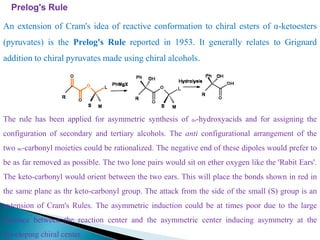
Prelog's Rule
An extension of Cram's idea of reactive conformation to chiral esters of α-ketoesters
(pyruvates) is the Prelog's Rule reported in 1953. It generally relates to Grignard
addition to chiral pyruvates made using chiral alcohols.
The rule has been applied for asymmetric synthesis of αα-hydroxyacids and for assigning the
configuration of secondary and tertiary alcohols. The anti configurational arrangement of the
two αα-carbonyl moieties could be rationalized. The negative end of these dipoles would prefer to
be as far removed as possible. The two lone pairs would sit on ether oxygen like the 'Rabit Ears'.
The keto-carbonyl would orient between the two ears. This will place the bonds shown in red in
the same plane as thr keto-carbonyl group. The attack from the side of the small (S) group is an
extension of Cram's Rules. The asymmetric induction could be at times poor due to the large
distance between the reaction center and the asymmetric center inducing asymmetry at the
developing chiral center.
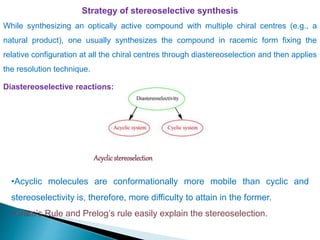
Strategy of stereoselective synthesis
While synthesizing an optically active compound with multiple chiral centres (e.g., a
natural product), one usually synthesizes the compound in racemic form fixing the
relative configuration at all the chiral centres through diastereoselection and then applies
the resolution technique.
Diastereoselective reactions:
•Acyclic molecules are conformationally more mobile than cyclic and
stereoselectivity is, therefore, more difficulty to attain in the former.
•Cram’s Rule and Prelog’s rule easily explain the stereoselection.
Acyclicstereoselection
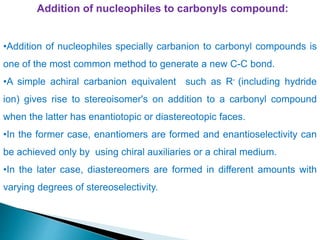
Addition of nucleophiles to carbonyls compound:
•Addition of nucleophiles specially carbanion to carbonyl compounds is
one of the most common method to generate a new C-C bond.
•A simple achiral carbanion equivalent such as R- (including hydride
ion) gives rise to stereoisomer's on addition to a carbonyl compound
when the latter has enantiotopic or diastereotopic faces.
•In the former case, enantiomers are formed and enantioselectivity can
be achieved only by using chiral auxiliaries or a chiral medium.
•In the later case, diastereomers are formed in different amounts with
varying degrees of stereoselectivity.
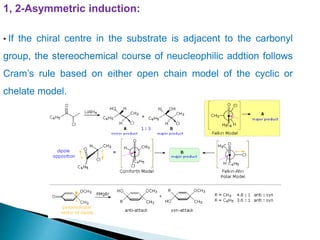
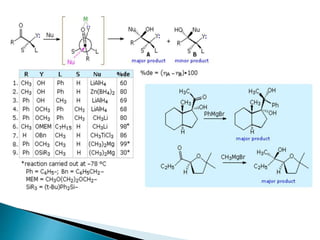
1, 2-Asymmetric induction:
• If the chiral centre in the substrate is adjacent to the carbonyl
group, the stereochemical course of neucleophilic addtion follows
Cram’s rule based on either open chain model of the cyclic or
chelate model.
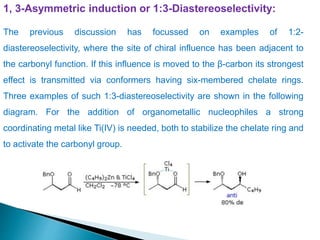
1, 3-Asymmetric induction or 1:3-Diastereoselectivity:
The previous discussion has focussed on examples of 1:2-
diastereoselectivity, where the site of chiral influence has been adjacent to
the carbonyl function. If this influence is moved to the β-carbon its strongest
effect is transmitted via conformers having six-membered chelate rings.
Three examples of such 1:3-diastereoselectivity are shown in the following
diagram. For the addition of organometallic nucleophiles a strong
coordinating metal like Ti(IV) is needed, both to stabilize the chelate ring and
to activate the carbonyl group.
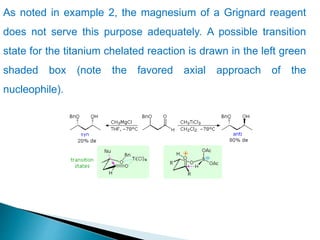
As noted in example 2, the magnesium of a Grignard reagent
does not serve this purpose adequately. A possible transition
state for the titanium chelated reaction is drawn in the left green
shaded box (note the favored axial approach of the
nucleophile).
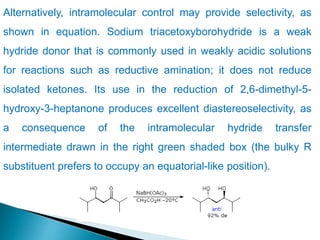
Alternatively, intramolecular control may provide selectivity, as
shown in equation. Sodium triacetoxyborohydride is a weak
hydride donor that is commonly used in weakly acidic solutions
for reactions such as reductive amination; it does not reduce
isolated ketones. Its use in the reduction of 2,6-dimethyl-5-
hydroxy-3-heptanone produces excellent diastereoselectivity, as
a consequence of the intramolecular hydride transfer
intermediate drawn in the right green shaded box (the bulky R
substituent prefers to occupy an equatorial-like position).
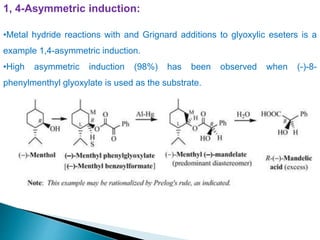
1, 4-Asymmetric induction:
•Metal hydride reactions with and Grignard additions to glyoxylic eseters is a
example 1,4-asymmetric induction.
•High asymmetric induction (98%) has been observed when (-)-8-
phenylmenthyl glyoxylate is used as the substrate.
Asymmetric aldol condensation
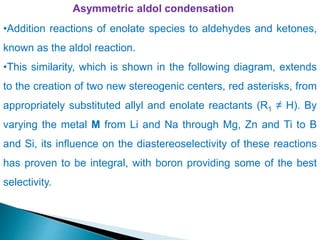
•Addition reactions of enolate species to aldehydes and ketones,
known as the aldol reaction.
•This similarity, which is shown in the following diagram, extends
to the creation of two new stereogenic centers, red asterisks, from
appropriately substituted allyl and enolate reactants (R1 ≠ H). By
varying the metal M from Li and Na through Mg, Zn and Ti to B
and Si, its influence on the diastereoselectivity of these reactions
has proven to be integral, with boron providing some of the best
selectivity.
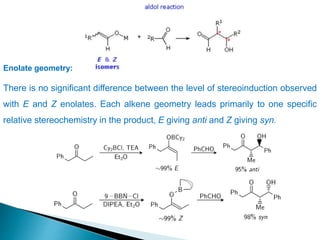
There is no significant difference between the level of stereoinduction observed
with E and Z enolates. Each alkene geometry leads primarily to one specific
relative stereochemistry in the product, E giving anti and Z giving syn.
Enolate geometry:
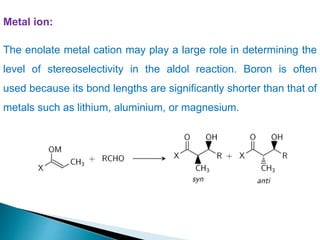
Metal ion:
The enolate metal cation may play a large role in determining the
level of stereoselectivity in the aldol reaction. Boron is often
used because its bond lengths are significantly shorter than that of
metals such as lithium, aluminium, or magnesium.
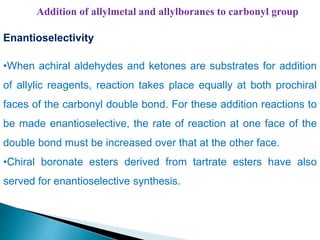
Addition of allylmetal and allylboranes to carbonyl group
Enantioselectivity
•When achiral aldehydes and ketones are substrates for addition
of allylic reagents, reaction takes place equally at both prochiral
faces of the carbonyl double bond. For these addition reactions to
be made enantioselective, the rate of reaction at one face of the
double bond must be increased over that at the other face.
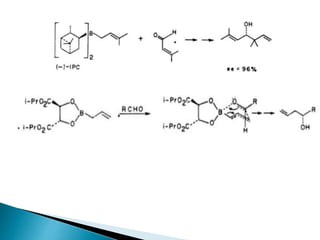
•Chiral boronate esters derived from tartrate esters have also
served for enantioselective synthesis.
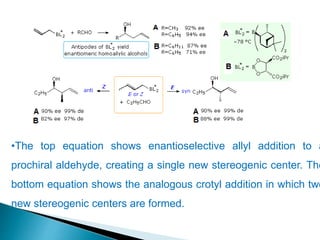
•The top equation shows enantioselective allyl addition to a
prochiral aldehyde, creating a single new stereogenic center. The
bottom equation shows the analogous crotyl addition in which two
new stereogenic centers are formed.
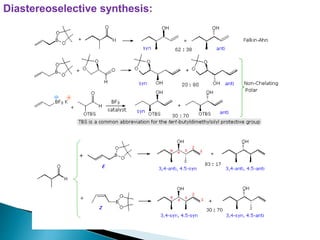
Diastereoselective synthesis:
Diastereoselection in cyclic system:
Many natural products e.g. terpenes & steroids and alkaloids are cyclic
compound with multiple chiral centres. There total syntheses and
particularly those achieve during the last four decades & illustrate the
various strategies used in designing stereo selecting reaction in cyclic
system.
Nucleophilic addition to cyclic ketones:
The most extensive study has been made on the stereo chemistry of additions
of nucleophiles specially hydrides, to cyclohexanones, cyclopentanones. And a
few bicycle ketones. There are two possibilities: stereoselective formation of
axial (more stable) alcohols. Considerable success has been had in both
directions, especially in hydride reductions, which are discussed.
Formation of axial alcohols:
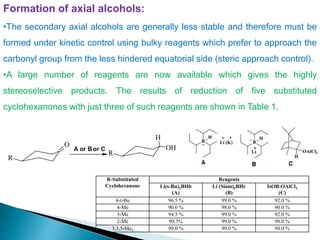
•The secondary axial alcohols are generally less stable and therefore must be
formed under kinetic control using bulky reagents which prefer to approach the
carbonyl group from the less hindered equatorial side (steric approach control).
•A large number of reagents are now available which gives the highly
stereoselective products. The results of reduction of five substituted
cyclohexanones with just three of such reagents are shown in Table 1.
R-Substituted
Cyclohexanone
Reagents
Li(s-Bu)3BHb
(A)
Li (Siam)3BHc
(B)
IsOB-OAlCl2
(C)
4-t-Bu 96.5 % 99.0 % 92.0 %
4-Me 90.0 % 98.0 % 90.0 %
3-Me 94.5 % 99.0 % 92.0 %
2-Me 99.3% 99.0 % 98.0 %
3,3,5-Me3 99.0 % 99.0 % 98.0 %
O
R
A or B or C
R
H
OH
Formation of equatorial alcohols:
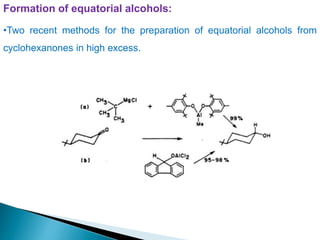
•Two recent methods for the preparation of equatorial alcohols from
cyclohexanones in high excess.
CATALYTIC HYDROGENATION
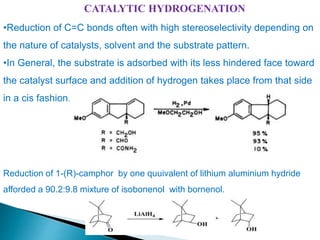
•Reduction of C=C bonds often with high stereoselectivity depending on
the nature of catalysts, solvent and the substrate pattern.
•In General, the substrate is adsorbed with its less hindered face toward
the catalyst surface and addition of hydrogen takes place from that side
in a cis fashion.
Reduction of 1-(R)-camphor by one quuivalent of lithium aluminium hydride
afforded a 90.2:9.8 mixture of isobonenol with bornenol.
DIASTEREOSELECTIVE OXIDATIONS
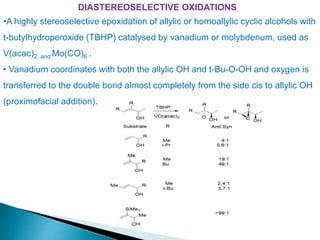
•A highly stereoselective epoxidation of allylic or homoallylic cyclic alcohols with
t-butylhydroperoxide (TBHP) catalysed by vanadium or molybdenum, used as
V(acac)2 and Mo(CO)6 .
• Vanadium coordinates with both the allylic OH and t-Bu-O-OH and oxygen is
transferred to the double bond almost completely from the side cis to allylic OH
(proximofacial addition).
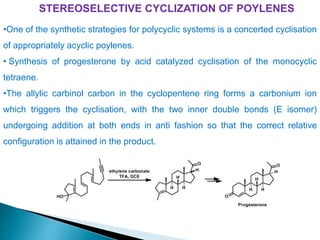
STEREOSELECTIVE CYCLIZATION OF POYLENES
•One of the synthetic strategies for polycyclic systems is a concerted cyclisation
of appropriately acyclic poylenes.
• Synthesis of progesterone by acid catalyzed cyclisation of the monocyclic
tetraene.
•The allylic carbinol carbon in the cyclopentene ring forms a carbonium ion
which triggers the cyclisation, with the two inner double bonds (E isomer)
undergoing addition at both ends in anti fashion so that the correct relative
configuration is attained in the product.
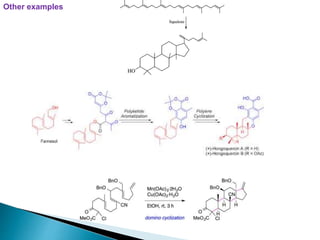
Other examples
Enantioselective synthesis:
The following criteria should be generally fulfilled in any good asymmetric
synthesis.
• The reagents must be of high optical purity and be easily available.
• The product must be easily separable from reaction mixture.
• The Chirality of the reagents must be provide desired ee.
•The enantioselectivity must be high to have practical applicability.
•The mechanism of the reaction should be known.
Enantioselective synthesis is a key process in modern chemistry and is
particularly important in the field of pharmaceuticals, as the
different enantiomers or diastereomers of a molecule often have
different biological activity.
Reduction with chiral hydride donors (Asymmetric hydrogenation):
A large number of chiral reagents have been developed which reduce (acyclic)
prochiral ketones and α-deuterated aldehydes by the transfer of hydrogen with
varying degrees of enantioselection.
Asymmetric hydrogenation is a chemical reaction that adds two atoms
of hydrogen preferentially to one of two faces of an unsaturated substrate
molecule, such as an alkene or ketone. The selectivity derives from the
manner that the substrate binds to the chiral catalysts. In jargon, this binding
transmits spatial information (what chemists refer to as chirality) from the
catalyst to the target, favoring the product as a single enantiomer.
This enzyme-like selectivity is particularly applied to bioactive products such
as pharmaceutical agents and agrochemicals.
(S)-PBMgCl
•S-2-Phenyl butyl magnesium chloride [(S)-PBMgCl] is the most
enantioselective.
•The highest enantioselective (82%) has been reported for the reduction of
isopropyl phenyl ketone.
C2H5
MgCl
H
O
(S)-PBMgCl
OH
ee 82%
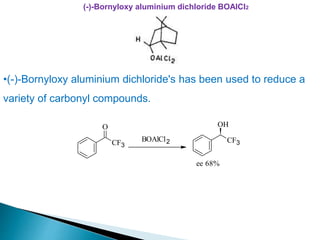
(-)-Bornyloxy aluminium dichloride BOAlCl2
•(-)-Bornyloxy aluminium dichloride's has been used to reduce a
variety of carbonyl compounds.
CF3
O
BOAlCl2 CF3
OH
ee 68%
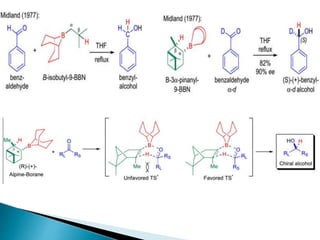
Alpine-borane or IPC-BBN
• B-(3α-Pinanyl)-9-borabicyclo[3.3.1]nonane.
•Prepared from 1,5-cycloctadiene, borane and α -pinene.
•It is an extremely efficient enantioselective reducing agent.
O
Alphine-borane
OH
ee 83%
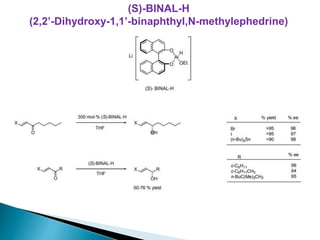
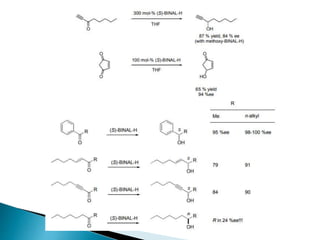
(S)-BINAL-H
(2,2’-Dihydroxy-1,1’-binaphthyl,N-methylephedrine)
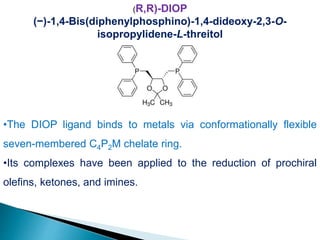
(R,R)-DIOP
(−)-1,4-Bis(diphenylphosphino)-1,4-dideoxy-2,3-O-
isopropylidene-L-threitol
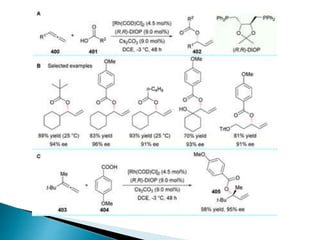
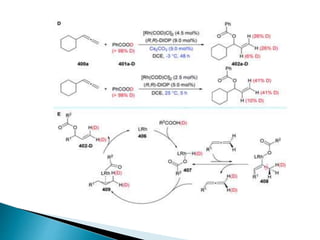
•The DIOP ligand binds to metals via conformationally flexible
seven-membered C4P2M chelate ring.
•Its complexes have been applied to the reduction of prochiral
olefins, ketones, and imines.
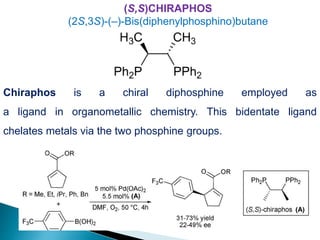
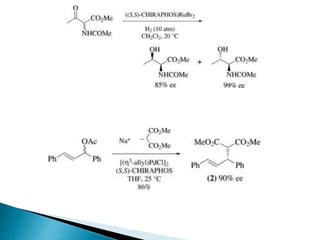
(S,S)CHIRAPHOS
(2S,3S)-(–)-Bis(diphenylphosphino)butane
Chiraphos is a chiral diphosphine employed as
a ligand in organometallic chemistry. This bidentate ligand
chelates metals via the two phosphine groups.
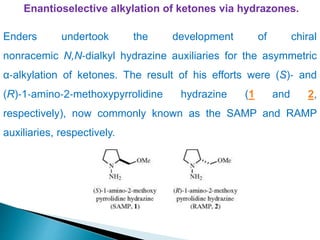
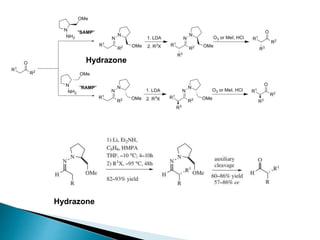
Enantioselective alkylation of ketones via hydrazones.
Enders undertook the development of chiral
nonracemic N,N‐dialkyl hydrazine auxiliaries for the asymmetric
α‐alkylation of ketones. The result of his efforts were (S)‐ and
(R)‐1‐amino‐2‐methoxypyrrolidine hydrazine (1 and 2,
respectively), now commonly known as the SAMP and RAMP
auxiliaries, respectively.
Hydrazone
Hydrazone
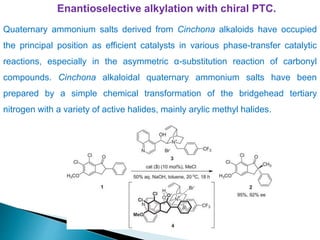
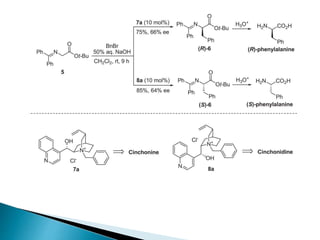
Enantioselective alkylation with chiral PTC.
Quaternary ammonium salts derived from Cinchona alkaloids have occupied
the principal position as efficient catalysts in various phase-transfer catalytic
reactions, especially in the asymmetric α-substitution reaction of carbonyl
compounds. Cinchona alkaloidal quaternary ammonium salts have been
prepared by a simple chemical transformation of the bridgehead tertiary
nitrogen with a variety of active halides, mainly arylic methyl halides.
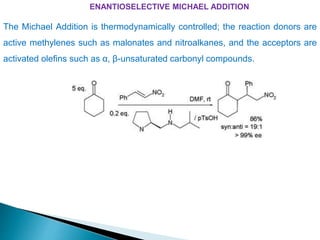
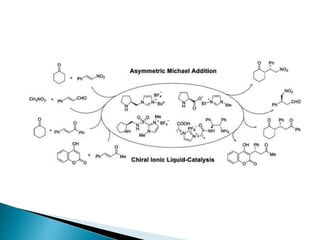
ENANTIOSELECTIVE MICHAEL ADDITION
The Michael Addition is thermodynamically controlled; the reaction donors are
active methylenes such as malonates and nitroalkanes, and the acceptors are
activated olefins such as α, β-unsaturated carbonyl compounds.
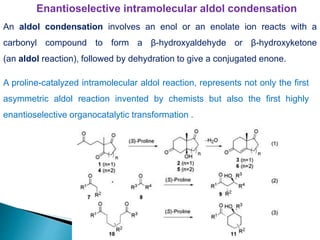
Enantioselective intramolecular aldol condensation
A proline-catalyzed intramolecular aldol reaction, represents not only the first
asymmetric aldol reaction invented by chemists but also the first highly
enantioselective organocatalytic transformation .
An aldol condensation involves an enol or an enolate ion reacts with a
carbonyl compound to form a β-hydroxyaldehyde or β-hydroxyketone
(an aldol reaction), followed by dehydration to give a conjugated enone.
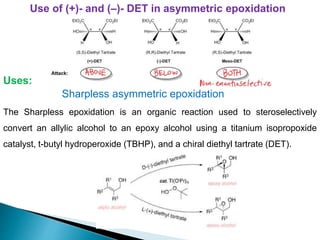
Use of (+)- and (–)- DET in asymmetric epoxidation
Sharpless asymmetric epoxidation
Uses:
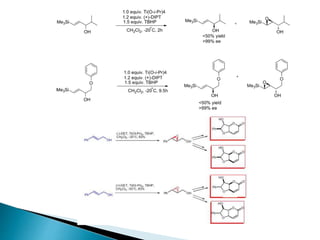
The Sharpless epoxidation is an organic reaction used to steroselectively
convert an allylic alcohol to an epoxy alcohol using a titanium isopropoxide
catalyst, t-butyl hydroperoxide (TBHP), and a chiral diethyl tartrate (DET).
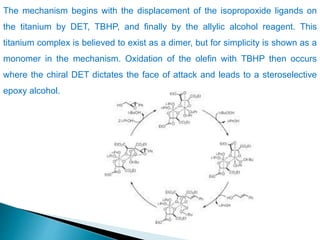
The mechanism begins with the displacement of the isopropoxide ligands on
the titanium by DET, TBHP, and finally by the allylic alcohol reagent. This
titanium complex is believed to exist as a dimer, but for simplicity is shown as a
monomer in the mechanism. Oxidation of the olefin with TBHP then occurs
where the chiral DET dictates the face of attack and leads to a steroselective
epoxy alcohol.
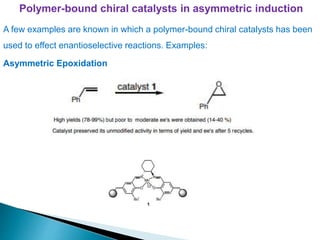
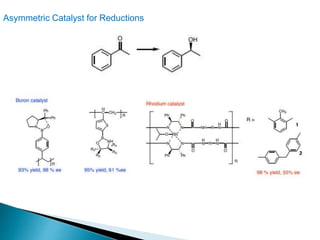
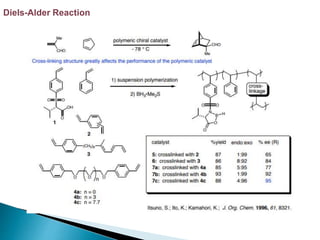
Polymer-bound chiral catalysts in asymmetric induction
Asymmetric Epoxidation
A few examples are known in which a polymer-bound chiral catalysts has been
used to effect enantioselective reactions. Examples:
Asymmetric Catalyst for Reductions
Diels-Alder Reaction
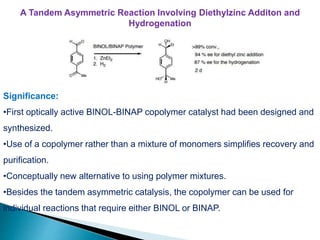
A Tandem Asymmetric Reaction Involving Diethylzinc Additon and
Hydrogenation
Significance:
•First optically active BINOL-BINAP copolymer catalyst had been designed and
synthesized.
•Use of a copolymer rather than a mixture of monomers simplifies recovery and
purification.
•Conceptually new alternative to using polymer mixtures.
•Besides the tandem asymmetric catalysis, the copolymer can be used for
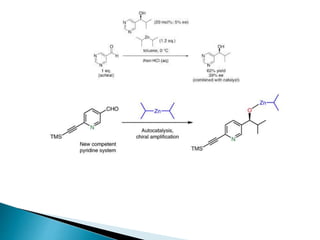
individual reactions that require either BINOL or BINAP.
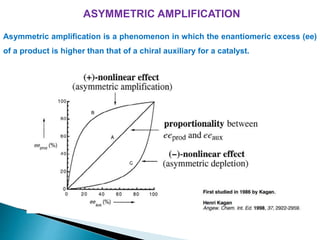
ASYMMETRIC AMPLIFICATION
Asymmetric amplification is a phenomenon in which the enantiomeric excess (ee)
of a product is higher than that of a chiral auxiliary for a catalyst.
Stereochemistry of Organic Compounds: Principles and
Applications-By D. Nasipuri.
Principles of Asymmetric Synthesis-
By Robert Gawley Jeffrey Aube.
Asymmetric Synthesis- By James Morrison.
SUGGESTED BOOKS
THANK YOU

Asymmetric synthesis ii

  • 1.
    Dr. BASAVARAJAIAH S.M. Assistant Professor and Coordinator P.G. Department of Chemistry Vijaya College Bangalore-560004 ASYMMETRIC SYNTHESIS (Part-II)
  • 2.
    I. STEREOCHEMICAL ASPECTSOFORGANIC SYNTHESIS II. Acyclic stereoselection. III. Diastereoselectionin cyclic system. IV. Enantioselective synthesis. CONTENTS
  • 3.
    General Terms: Racemate: Anequimolar mixture of a pair of enantiomers. It does not exhibit optical activity. Enantiopure: A sample all of whose molecules have (within limits of detection) the same chirality sense. Enantiomer: One of a pair of molecular entities which are mirror images of each other and nonsuperposable. Melting points Boiling points NMR spectra Chromatographic behavior Solubility properties Reactivities Enantiopure compounds can have different than racemates
  • 4.
    STEREOCHEMICAL ASPECTS OFORGANIC SYNTHESIS STEREOSPECIFIC REACTIONS: A stereospecific reaction is one which, when carried out with stereoisomeric starting materials, gives a product from one reactant that is a stereoisomer of the product from the other. 'Stereospecific' relates to the mechanism of a reaction, the best- known example being the SN2 reaction, which always proceeds with inversion of stereochemistry at the reacting centre. Examples:
  • 5.
    STEREOSELECTIVE REACTIONS: A stereoselectiveprocess is one in which one stereoisomer predominates over another when two or more may be formed. If the products are enantiomers, the reaction is enantioselective; if they are diastereoisomers, the reaction is diastereoselective. Stereoselectivity is dominated by the structural features of the reactants. Examples:
  • 6.
    Cram's rule: Cram's rule,proposed by Donald Cram in 1952,[1] was the earliest model proposed for rationalizing the stereoselectivity of nucleophilic additions to carbonyl groups with α-stereocentres. The model involved assigning each α- substituent a relative "size" (small, medium, and large), then placing the carbonyl oxygen antiperiplanar to the largest of these three groups. The nucleophile then attacks the carbonyl group opposite the larger of the two remaining groups (i.e., the medium group). This is best explained with a diagram: C X * diastereomeric faces X = C, O, N stereogenic
  • 7.
  • 8.
    Prelog's Rule An extensionof Cram's idea of reactive conformation to chiral esters of α-ketoesters (pyruvates) is the Prelog's Rule reported in 1953. It generally relates to Grignard addition to chiral pyruvates made using chiral alcohols. The rule has been applied for asymmetric synthesis of αα-hydroxyacids and for assigning the configuration of secondary and tertiary alcohols. The anti configurational arrangement of the two αα-carbonyl moieties could be rationalized. The negative end of these dipoles would prefer to be as far removed as possible. The two lone pairs would sit on ether oxygen like the 'Rabit Ears'. The keto-carbonyl would orient between the two ears. This will place the bonds shown in red in the same plane as thr keto-carbonyl group. The attack from the side of the small (S) group is an extension of Cram's Rules. The asymmetric induction could be at times poor due to the large distance between the reaction center and the asymmetric center inducing asymmetry at the developing chiral center.
  • 9.
    Strategy of stereoselectivesynthesis While synthesizing an optically active compound with multiple chiral centres (e.g., a natural product), one usually synthesizes the compound in racemic form fixing the relative configuration at all the chiral centres through diastereoselection and then applies the resolution technique. Diastereoselective reactions: •Acyclic molecules are conformationally more mobile than cyclic and stereoselectivity is, therefore, more difficulty to attain in the former. •Cram’s Rule and Prelog’s rule easily explain the stereoselection. Acyclicstereoselection
  • 10.
    Addition of nucleophilesto carbonyls compound: •Addition of nucleophiles specially carbanion to carbonyl compounds is one of the most common method to generate a new C-C bond. •A simple achiral carbanion equivalent such as R- (including hydride ion) gives rise to stereoisomer's on addition to a carbonyl compound when the latter has enantiotopic or diastereotopic faces. •In the former case, enantiomers are formed and enantioselectivity can be achieved only by using chiral auxiliaries or a chiral medium. •In the later case, diastereomers are formed in different amounts with varying degrees of stereoselectivity.
  • 12.
    1, 2-Asymmetric induction: •If the chiral centre in the substrate is adjacent to the carbonyl group, the stereochemical course of neucleophilic addtion follows Cram’s rule based on either open chain model of the cyclic or chelate model.
  • 14.
    1, 3-Asymmetric inductionor 1:3-Diastereoselectivity: The previous discussion has focussed on examples of 1:2- diastereoselectivity, where the site of chiral influence has been adjacent to the carbonyl function. If this influence is moved to the β-carbon its strongest effect is transmitted via conformers having six-membered chelate rings. Three examples of such 1:3-diastereoselectivity are shown in the following diagram. For the addition of organometallic nucleophiles a strong coordinating metal like Ti(IV) is needed, both to stabilize the chelate ring and to activate the carbonyl group.
  • 15.
    As noted inexample 2, the magnesium of a Grignard reagent does not serve this purpose adequately. A possible transition state for the titanium chelated reaction is drawn in the left green shaded box (note the favored axial approach of the nucleophile).
  • 16.
    Alternatively, intramolecular controlmay provide selectivity, as shown in equation. Sodium triacetoxyborohydride is a weak hydride donor that is commonly used in weakly acidic solutions for reactions such as reductive amination; it does not reduce isolated ketones. Its use in the reduction of 2,6-dimethyl-5- hydroxy-3-heptanone produces excellent diastereoselectivity, as a consequence of the intramolecular hydride transfer intermediate drawn in the right green shaded box (the bulky R substituent prefers to occupy an equatorial-like position).
  • 17.
    1, 4-Asymmetric induction: •Metalhydride reactions with and Grignard additions to glyoxylic eseters is a example 1,4-asymmetric induction. •High asymmetric induction (98%) has been observed when (-)-8- phenylmenthyl glyoxylate is used as the substrate.
  • 18.
    Asymmetric aldol condensation •Additionreactions of enolate species to aldehydes and ketones, known as the aldol reaction. •This similarity, which is shown in the following diagram, extends to the creation of two new stereogenic centers, red asterisks, from appropriately substituted allyl and enolate reactants (R1 ≠ H). By varying the metal M from Li and Na through Mg, Zn and Ti to B and Si, its influence on the diastereoselectivity of these reactions has proven to be integral, with boron providing some of the best selectivity.
  • 19.
    There is nosignificant difference between the level of stereoinduction observed with E and Z enolates. Each alkene geometry leads primarily to one specific relative stereochemistry in the product, E giving anti and Z giving syn. Enolate geometry:
  • 20.
    Metal ion: The enolatemetal cation may play a large role in determining the level of stereoselectivity in the aldol reaction. Boron is often used because its bond lengths are significantly shorter than that of metals such as lithium, aluminium, or magnesium.
  • 21.
    Addition of allylmetaland allylboranes to carbonyl group Enantioselectivity •When achiral aldehydes and ketones are substrates for addition of allylic reagents, reaction takes place equally at both prochiral faces of the carbonyl double bond. For these addition reactions to be made enantioselective, the rate of reaction at one face of the double bond must be increased over that at the other face. •Chiral boronate esters derived from tartrate esters have also served for enantioselective synthesis.
  • 22.
    •The top equationshows enantioselective allyl addition to a prochiral aldehyde, creating a single new stereogenic center. The bottom equation shows the analogous crotyl addition in which two new stereogenic centers are formed.
  • 24.
  • 25.
    Diastereoselection in cyclicsystem: Many natural products e.g. terpenes & steroids and alkaloids are cyclic compound with multiple chiral centres. There total syntheses and particularly those achieve during the last four decades & illustrate the various strategies used in designing stereo selecting reaction in cyclic system. Nucleophilic addition to cyclic ketones: The most extensive study has been made on the stereo chemistry of additions of nucleophiles specially hydrides, to cyclohexanones, cyclopentanones. And a few bicycle ketones. There are two possibilities: stereoselective formation of axial (more stable) alcohols. Considerable success has been had in both directions, especially in hydride reductions, which are discussed.
  • 26.
    Formation of axialalcohols: •The secondary axial alcohols are generally less stable and therefore must be formed under kinetic control using bulky reagents which prefer to approach the carbonyl group from the less hindered equatorial side (steric approach control). •A large number of reagents are now available which gives the highly stereoselective products. The results of reduction of five substituted cyclohexanones with just three of such reagents are shown in Table 1. R-Substituted Cyclohexanone Reagents Li(s-Bu)3BHb (A) Li (Siam)3BHc (B) IsOB-OAlCl2 (C) 4-t-Bu 96.5 % 99.0 % 92.0 % 4-Me 90.0 % 98.0 % 90.0 % 3-Me 94.5 % 99.0 % 92.0 % 2-Me 99.3% 99.0 % 98.0 % 3,3,5-Me3 99.0 % 99.0 % 98.0 % O R A or B or C R H OH
  • 27.
    Formation of equatorialalcohols: •Two recent methods for the preparation of equatorial alcohols from cyclohexanones in high excess.
  • 28.
    CATALYTIC HYDROGENATION •Reduction ofC=C bonds often with high stereoselectivity depending on the nature of catalysts, solvent and the substrate pattern. •In General, the substrate is adsorbed with its less hindered face toward the catalyst surface and addition of hydrogen takes place from that side in a cis fashion. Reduction of 1-(R)-camphor by one quuivalent of lithium aluminium hydride afforded a 90.2:9.8 mixture of isobonenol with bornenol.
  • 29.
    DIASTEREOSELECTIVE OXIDATIONS •A highlystereoselective epoxidation of allylic or homoallylic cyclic alcohols with t-butylhydroperoxide (TBHP) catalysed by vanadium or molybdenum, used as V(acac)2 and Mo(CO)6 . • Vanadium coordinates with both the allylic OH and t-Bu-O-OH and oxygen is transferred to the double bond almost completely from the side cis to allylic OH (proximofacial addition).
  • 30.
    STEREOSELECTIVE CYCLIZATION OFPOYLENES •One of the synthetic strategies for polycyclic systems is a concerted cyclisation of appropriately acyclic poylenes. • Synthesis of progesterone by acid catalyzed cyclisation of the monocyclic tetraene. •The allylic carbinol carbon in the cyclopentene ring forms a carbonium ion which triggers the cyclisation, with the two inner double bonds (E isomer) undergoing addition at both ends in anti fashion so that the correct relative configuration is attained in the product.
  • 31.
  • 32.
    Enantioselective synthesis: The followingcriteria should be generally fulfilled in any good asymmetric synthesis. • The reagents must be of high optical purity and be easily available. • The product must be easily separable from reaction mixture. • The Chirality of the reagents must be provide desired ee. •The enantioselectivity must be high to have practical applicability. •The mechanism of the reaction should be known. Enantioselective synthesis is a key process in modern chemistry and is particularly important in the field of pharmaceuticals, as the different enantiomers or diastereomers of a molecule often have different biological activity.
  • 33.
    Reduction with chiralhydride donors (Asymmetric hydrogenation): A large number of chiral reagents have been developed which reduce (acyclic) prochiral ketones and α-deuterated aldehydes by the transfer of hydrogen with varying degrees of enantioselection. Asymmetric hydrogenation is a chemical reaction that adds two atoms of hydrogen preferentially to one of two faces of an unsaturated substrate molecule, such as an alkene or ketone. The selectivity derives from the manner that the substrate binds to the chiral catalysts. In jargon, this binding transmits spatial information (what chemists refer to as chirality) from the catalyst to the target, favoring the product as a single enantiomer. This enzyme-like selectivity is particularly applied to bioactive products such as pharmaceutical agents and agrochemicals.
  • 34.
    (S)-PBMgCl •S-2-Phenyl butyl magnesiumchloride [(S)-PBMgCl] is the most enantioselective. •The highest enantioselective (82%) has been reported for the reduction of isopropyl phenyl ketone. C2H5 MgCl H O (S)-PBMgCl OH ee 82%
  • 35.
    (-)-Bornyloxy aluminium dichlorideBOAlCl2 •(-)-Bornyloxy aluminium dichloride's has been used to reduce a variety of carbonyl compounds. CF3 O BOAlCl2 CF3 OH ee 68%
  • 36.
    Alpine-borane or IPC-BBN •B-(3α-Pinanyl)-9-borabicyclo[3.3.1]nonane. •Prepared from 1,5-cycloctadiene, borane and α -pinene. •It is an extremely efficient enantioselective reducing agent. O Alphine-borane OH ee 83%
  • 38.
  • 40.
    (R,R)-DIOP (−)-1,4-Bis(diphenylphosphino)-1,4-dideoxy-2,3-O- isopropylidene-L-threitol •The DIOP ligandbinds to metals via conformationally flexible seven-membered C4P2M chelate ring. •Its complexes have been applied to the reduction of prochiral olefins, ketones, and imines.
  • 43.
    (S,S)CHIRAPHOS (2S,3S)-(–)-Bis(diphenylphosphino)butane Chiraphos is achiral diphosphine employed as a ligand in organometallic chemistry. This bidentate ligand chelates metals via the two phosphine groups.
  • 45.
    Enantioselective alkylation ofketones via hydrazones. Enders undertook the development of chiral nonracemic N,N‐dialkyl hydrazine auxiliaries for the asymmetric α‐alkylation of ketones. The result of his efforts were (S)‐ and (R)‐1‐amino‐2‐methoxypyrrolidine hydrazine (1 and 2, respectively), now commonly known as the SAMP and RAMP auxiliaries, respectively.
  • 46.
  • 47.
    Enantioselective alkylation withchiral PTC. Quaternary ammonium salts derived from Cinchona alkaloids have occupied the principal position as efficient catalysts in various phase-transfer catalytic reactions, especially in the asymmetric α-substitution reaction of carbonyl compounds. Cinchona alkaloidal quaternary ammonium salts have been prepared by a simple chemical transformation of the bridgehead tertiary nitrogen with a variety of active halides, mainly arylic methyl halides.
  • 49.
    ENANTIOSELECTIVE MICHAEL ADDITION TheMichael Addition is thermodynamically controlled; the reaction donors are active methylenes such as malonates and nitroalkanes, and the acceptors are activated olefins such as α, β-unsaturated carbonyl compounds.
  • 51.
    Enantioselective intramolecular aldolcondensation A proline-catalyzed intramolecular aldol reaction, represents not only the first asymmetric aldol reaction invented by chemists but also the first highly enantioselective organocatalytic transformation . An aldol condensation involves an enol or an enolate ion reacts with a carbonyl compound to form a β-hydroxyaldehyde or β-hydroxyketone (an aldol reaction), followed by dehydration to give a conjugated enone.
  • 52.
    Use of (+)-and (–)- DET in asymmetric epoxidation Sharpless asymmetric epoxidation Uses: The Sharpless epoxidation is an organic reaction used to steroselectively convert an allylic alcohol to an epoxy alcohol using a titanium isopropoxide catalyst, t-butyl hydroperoxide (TBHP), and a chiral diethyl tartrate (DET).
  • 53.
    The mechanism beginswith the displacement of the isopropoxide ligands on the titanium by DET, TBHP, and finally by the allylic alcohol reagent. This titanium complex is believed to exist as a dimer, but for simplicity is shown as a monomer in the mechanism. Oxidation of the olefin with TBHP then occurs where the chiral DET dictates the face of attack and leads to a steroselective epoxy alcohol.
  • 55.
    Polymer-bound chiral catalystsin asymmetric induction Asymmetric Epoxidation A few examples are known in which a polymer-bound chiral catalysts has been used to effect enantioselective reactions. Examples:
  • 56.
  • 57.
  • 58.
    A Tandem AsymmetricReaction Involving Diethylzinc Additon and Hydrogenation Significance: •First optically active BINOL-BINAP copolymer catalyst had been designed and synthesized. •Use of a copolymer rather than a mixture of monomers simplifies recovery and purification. •Conceptually new alternative to using polymer mixtures. •Besides the tandem asymmetric catalysis, the copolymer can be used for individual reactions that require either BINOL or BINAP.
  • 59.
    ASYMMETRIC AMPLIFICATION Asymmetric amplificationis a phenomenon in which the enantiomeric excess (ee) of a product is higher than that of a chiral auxiliary for a catalyst.
  • 61.
    Stereochemistry of OrganicCompounds: Principles and Applications-By D. Nasipuri. Principles of Asymmetric Synthesis- By Robert Gawley Jeffrey Aube. Asymmetric Synthesis- By James Morrison. SUGGESTED BOOKS
  • 62.