2.1 Color Perception
PSYC 579 Topic Presentation,
University of British Columbia
Diliara Nasirova
School of Interactive Art and Technology,
Simon Fraser University
January 26, 2011
2
Outline
1.  The Physical Description of Light
■  Light Components
■  Electromagnetic Spectrum
2.  The Psychological Description of Color
■  Color Space
3.  Theories of Color Vision
■  Trichromatic Theory
■  Opponent Process Theory
Diliara Nasirova | PSYC 579 | Jan 26, 2011
4.  Basic Phenomena
■  Color Blindness
■  Color Afterimage
■  Color Contrast
5.  Application to Visual Design
■  Color Specification Interfaces
■  Color for Labeling
3
References
1.  C. Ware, “Information Visualization: Perception for Design”, ch. 4 “Color”
2.  SE. Palmer, “Vision Science”
3.  E. Tufte, “Envisioning Information”, ch. 5 “Color and information”
4.  P Rheingans. (1999). “Task-based Color Scale Design”
5.  CA Brewer. (2005). “Designing Better Maps”, ch. 5 “Color Decisions for
Mapping”
6.  C. Ware, “Visual Thinking for Design”, ch. 4 “Color”
7.  M. Stone, “Color in Information Display” workshop, Vis08
Diliara Nasirova | PSYC 579 | Jan 26, 2011
4
The Physical Description of Light
Light Components
Diliara Nasirova | PSYC 579 | Jan 26, 2011
•  Sir Isaac Newton, 1666
5
The Physical Description of Light
Electromagnetic Spectrum
Diliara Nasirova | PSYC 579 | Jan 26, 2011
6
The Psychological Description of Color
Color Space
•  All colors experiences can be
described in terms of three
dimensions:
■  Hue
■  Value (lightness)
■  Saturation (chroma)
Diliara Nasirova | PSYC 579 | Jan 26, 2011
7
The Psychological Description of Color
Color Space
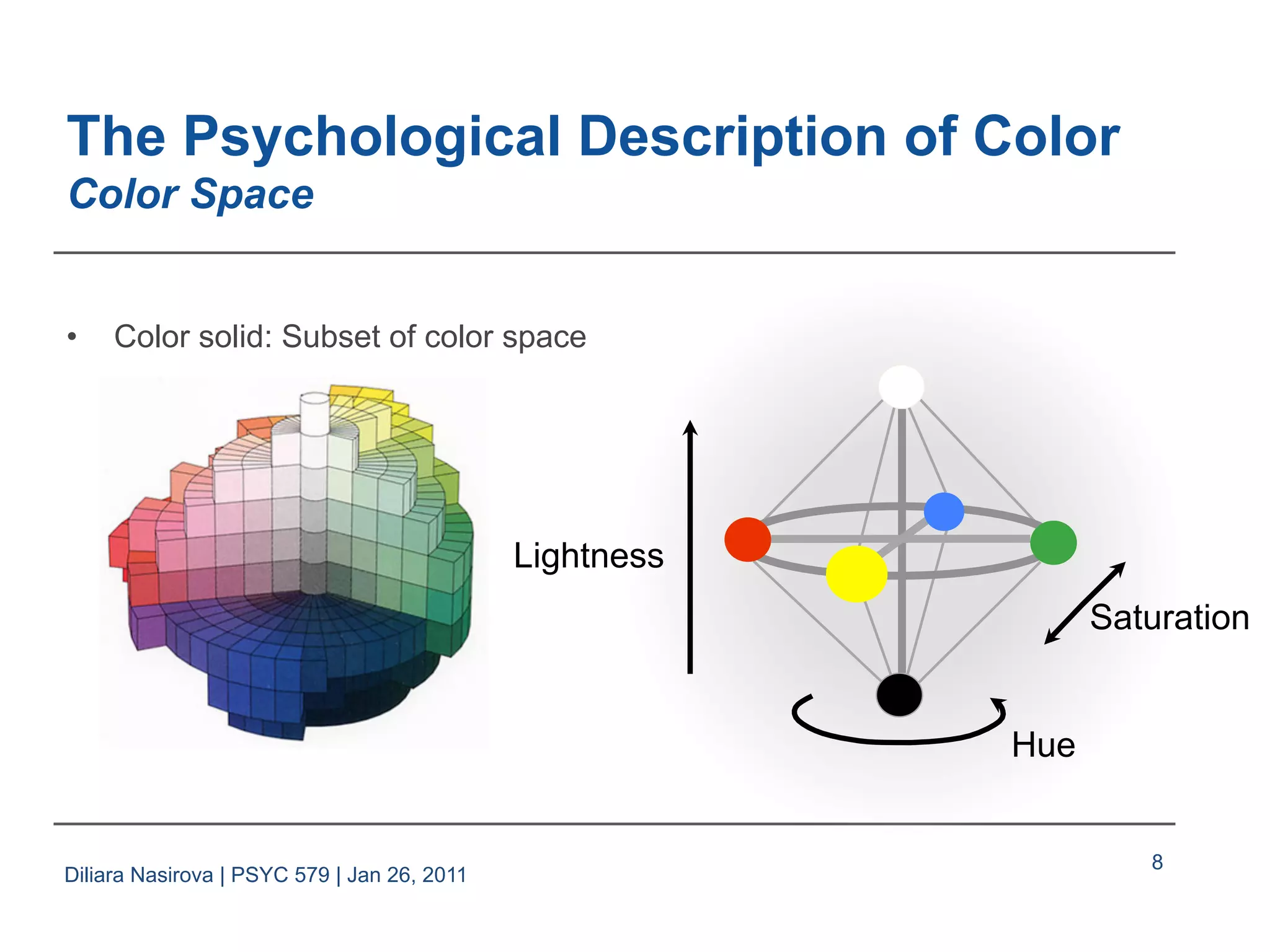
•  Color space:
■  A three dimensional coordinate
system
■  Each color can be represented as a
single point with a unique position.
Diliara Nasirova | PSYC 579 | Jan 26, 2011
8
The Psychological Description of Color
Color Space
•  Color solid: Subset of color space
Diliara Nasirova | PSYC 579 | Jan 26, 2011
Lightness
Hue
Saturation
9
Theories of Color Vision
Trichromatic Theory
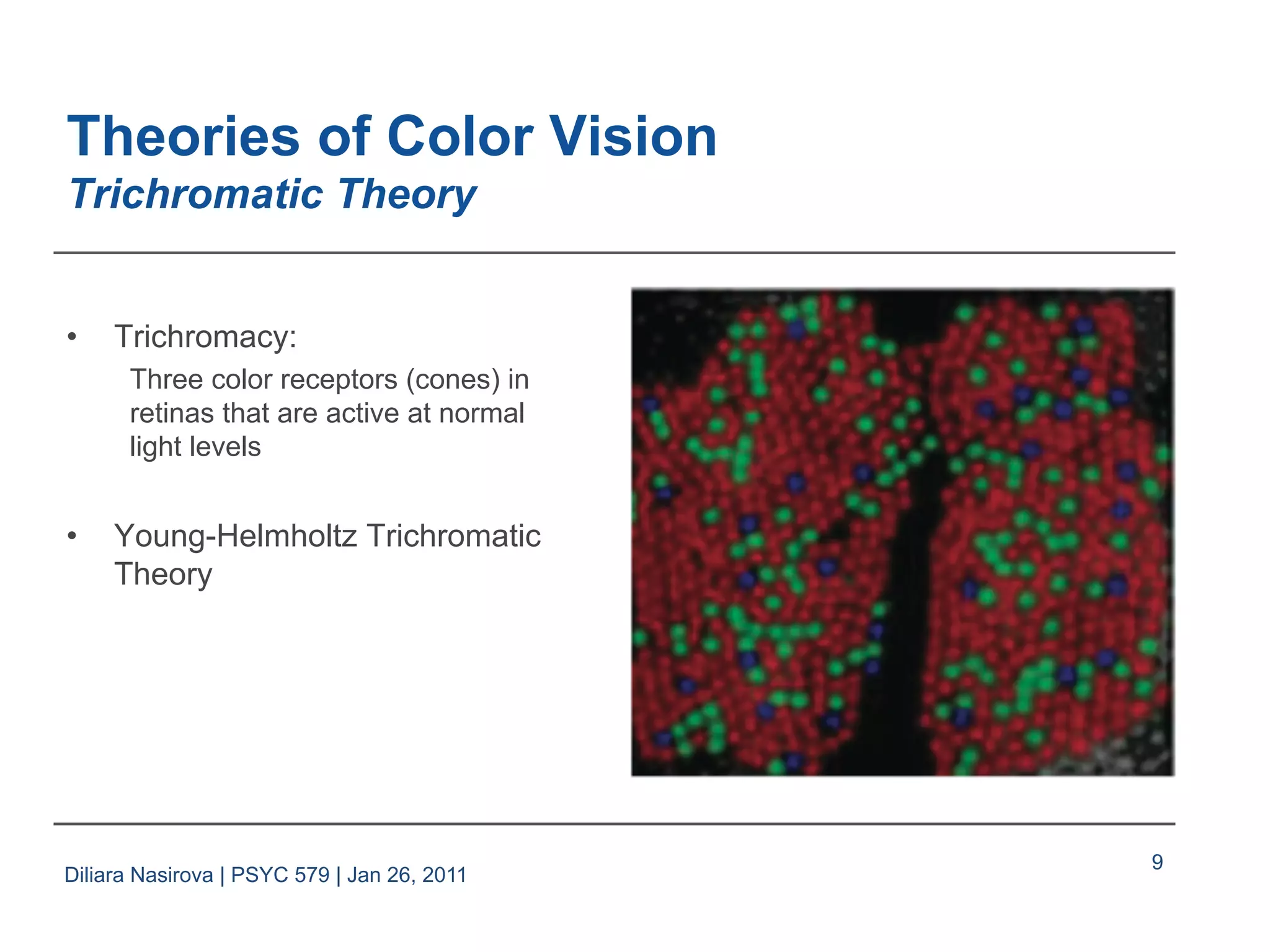
•  Trichromacy:
Three color receptors (cones) in
retinas that are active at normal
light levels
•  Young-Helmholtz Trichromatic
Theory
Diliara Nasirova | PSYC 579 | Jan 26, 2011
10
The Physical Description of Light
Spectral Diagram
Diliara Nasirova | PSYC 579 | Jan 26, 2011
•  Human cone sensitivity
functions.
•  Cones sensitive to
■  S (blue)
■  M (green)
■  L (red)
11
The Physical Description of Light
Spectral Diagram: Short wavelength sensitive cones
Diliara Nasirova | PSYC 579 | Jan 26, 2011
Blue text on a dark background
is to be avoided. We have very few
short-wavelength sensitive cones in
the retina and they are not very
sensitive.
Blue text on a dark background
is to be avoided. We have very few
short-wavelength sensitive cones in
the retina and they are not very
sensitive.
12
The Physical Description of Light
Spectral Diagram: Short wavelength sensitive cones
Diliara Nasirova | PSYC 579 | Jan 26, 2011
Blue text on a dark background
is to be avoided. We have very few
short-wavelength sensitive cones in
the retina and they are not very
sensitive.
Blue text on a dark background
is to be avoided. We have very few
short-wavelength sensitive cones in
the retina and they are not very
sensitive.
13
Theories of Color Vision
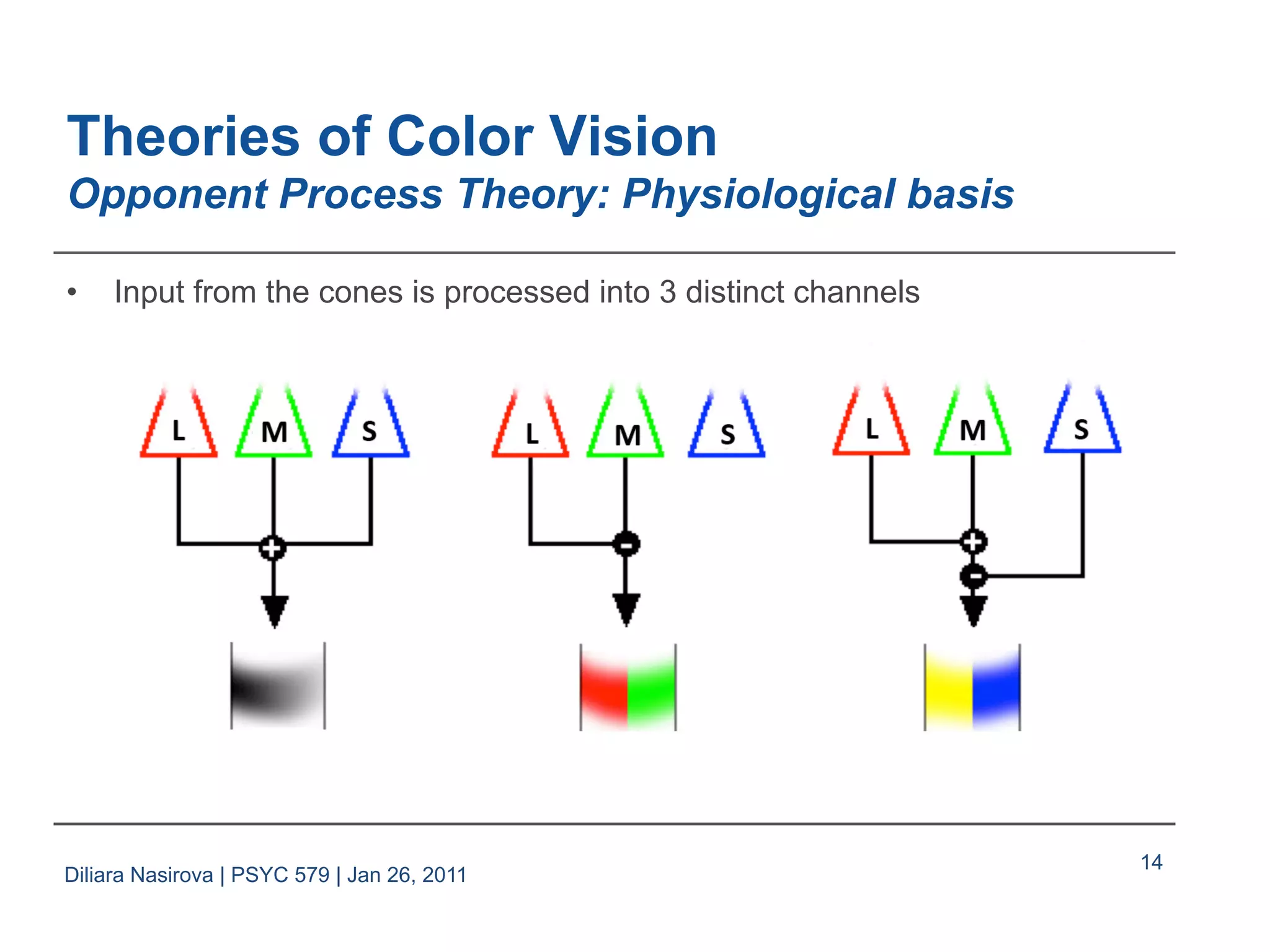
Opponent Process Theory
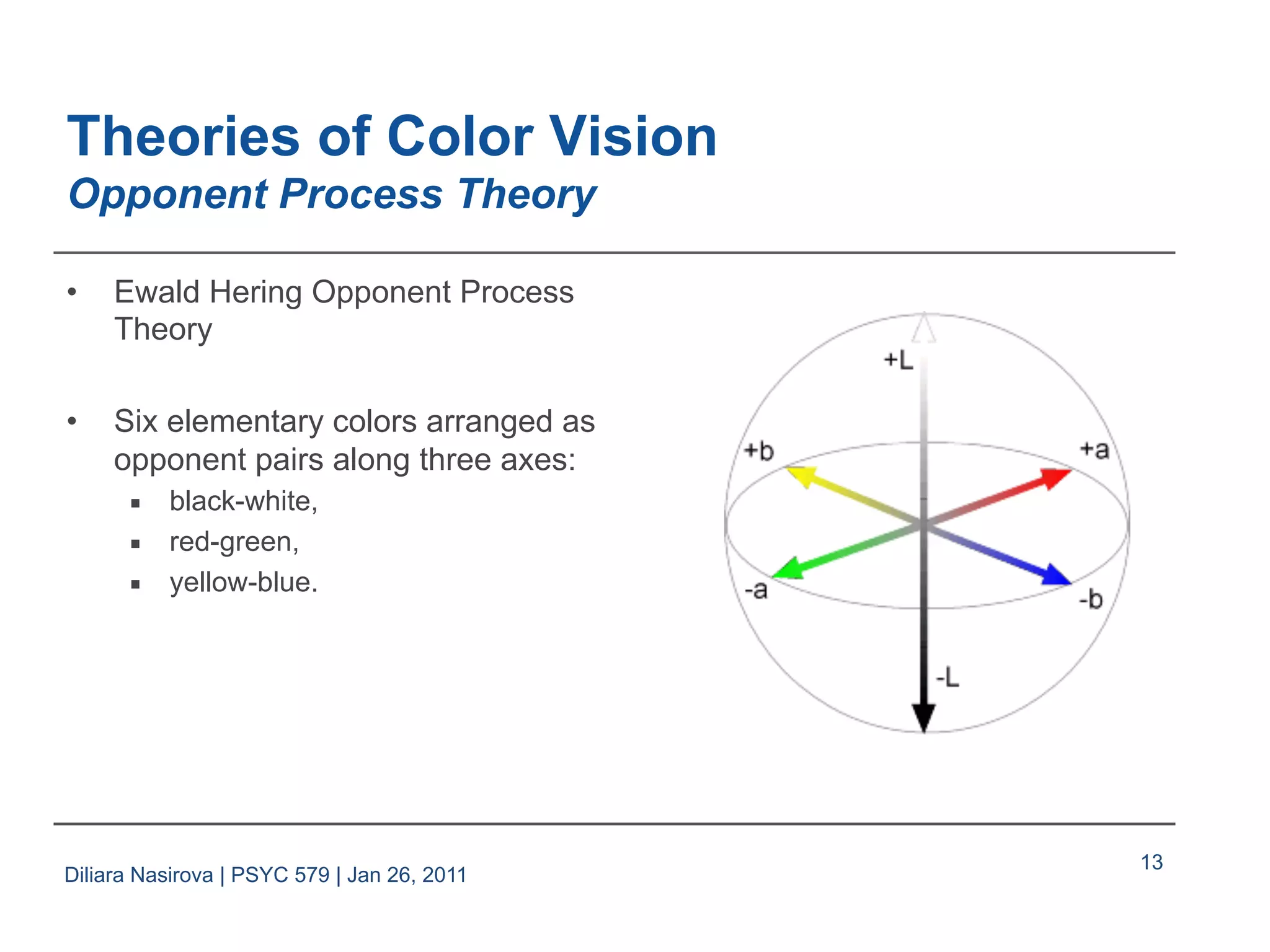
•  Ewald Hering Opponent Process
Theory
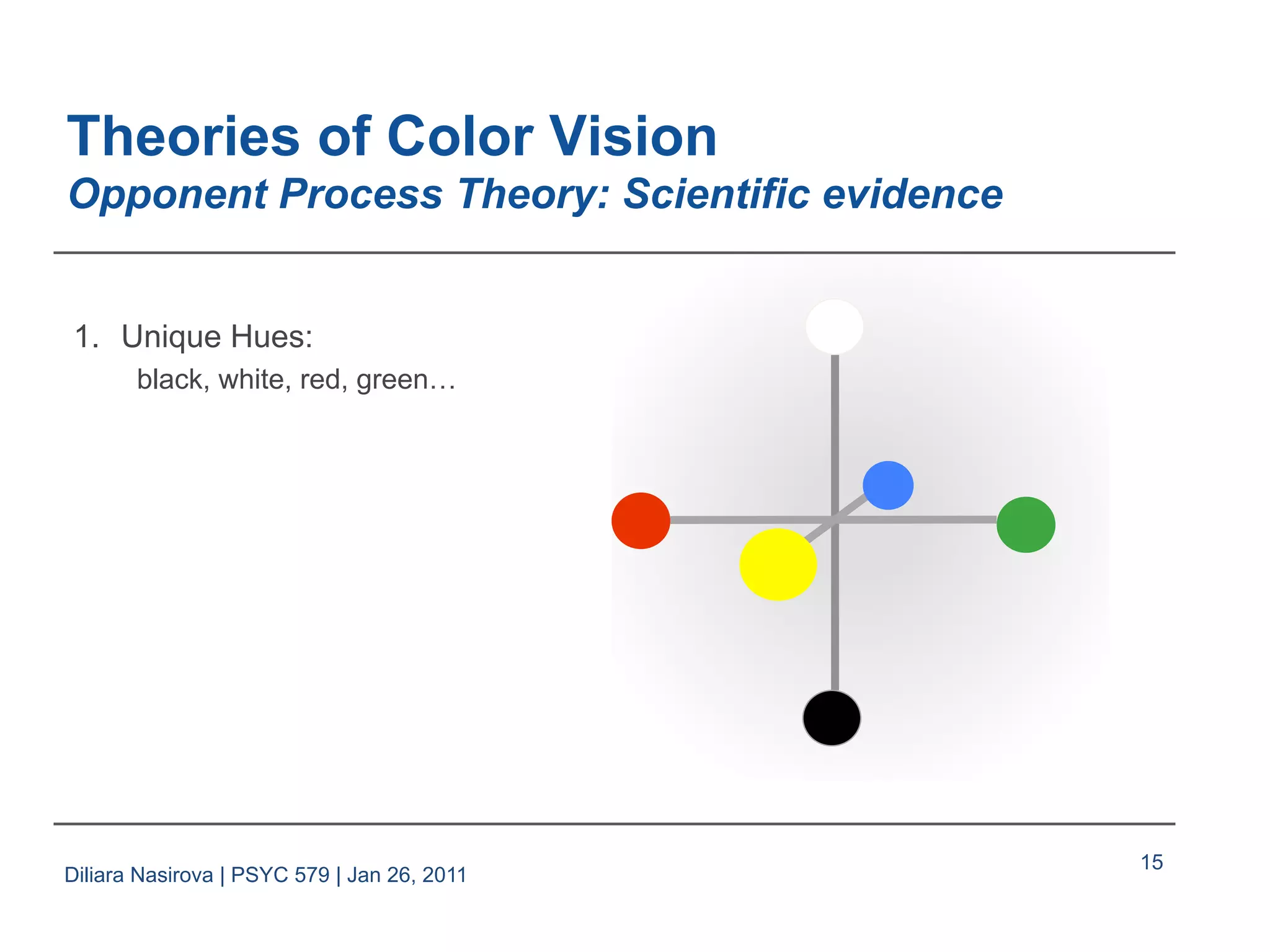
•  Six elementary colors arranged as
opponent pairs along three axes:
■  black-white,
■  red-green,
■  yellow-blue.
Diliara Nasirova | PSYC 579 | Jan 26, 2011
14
Theories of Color Vision
Opponent Process Theory: Physiological basis
•  Input from the cones is processed into 3 distinct channels
Diliara Nasirova | PSYC 579 | Jan 26, 2011
15
Theories of Color Vision
Opponent Process Theory: Scientific evidence
1.  Unique Hues:
black, white, red, green…
Diliara Nasirova | PSYC 579 | Jan 26, 2011
16
Theories of Color Vision
Opponent Process Theory: Scientific evidence
2.  Naming and Cross-Cultural Naming:
“yellowish green”, but no “yellowish blue”
Diliara Nasirova | PSYC 579 | Jan 26, 2011
17
3.  Neurophysiology: cells in visual
cortexes of monkeys that have
properties of opponency
Diliara Nasirova | PSYC 579 | Jan 26, 2011
Theories of Color Vision
Opponent Process Theory: Scientific evidence
18
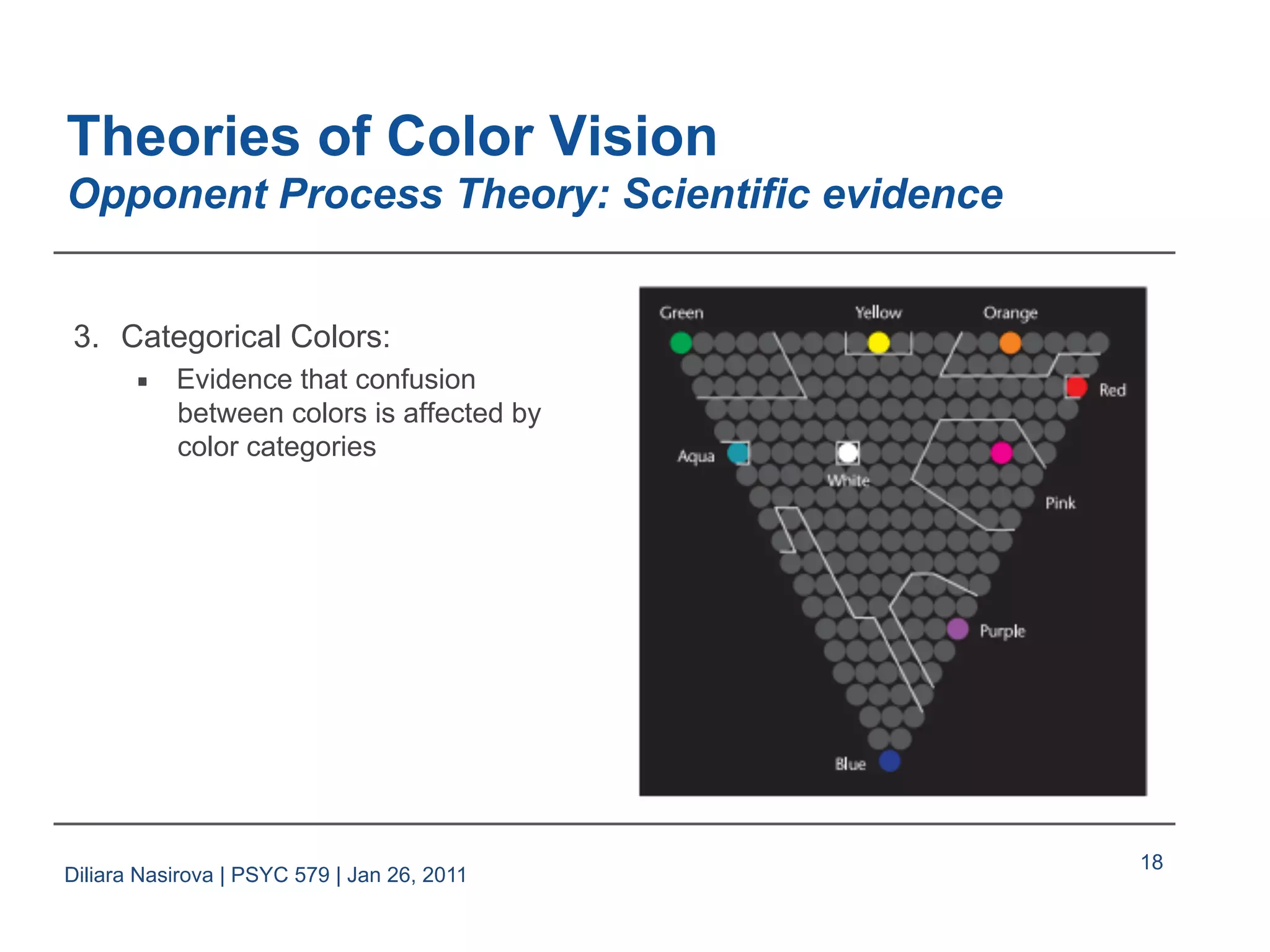
3.  Categorical Colors:
■  Evidence that confusion
between colors is affected by
color categories
Diliara Nasirova | PSYC 579 | Jan 26, 2011
Theories of Color Vision
Opponent Process Theory: Scientific evidence
19
Diliara Nasirova | PSYC 579 | Jan 26, 2011
Theories of Color Vision
Opponent Process Theory: Scientific evidence
20
Theories of Color Vision
Opponent Process Theory: Color Channels Properties
•  Chromatic channels carry ~1/3
the amount of detail carried by
the black–white channel.
•  Difficult to read the text where
luminance is equal, despite a
large chromatic difference
Diliara Nasirova | PSYC 579 | Jan 26, 2011
21
Theories of Color Vision
Opponent Process Theory: Color Channels Properties
Diliara Nasirova | PSYC 579 | Jan 26, 2011
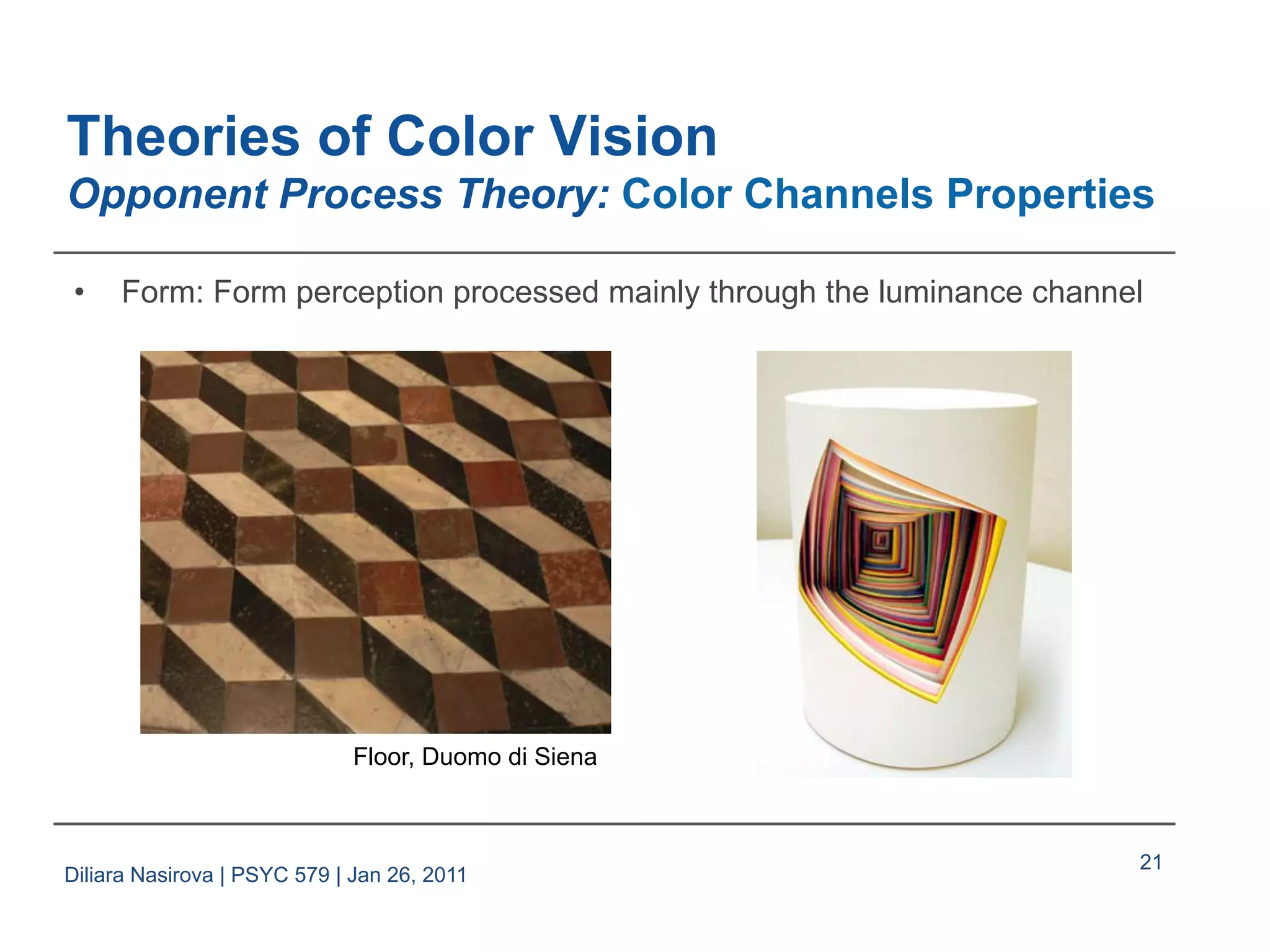
•  Form: Form perception processed mainly through the luminance channel
Floor, Duomo di Siena
22
Theories of Color Vision
Opponent Process Theory: Color Channels Properties
Diliara Nasirova | PSYC 579 | Jan 26, 2011
•  Form: Pseudocolor sequences for maps
23
Basic Phenomena
Color Contrast
Diliara Nasirova | PSYC 579 | Jan 26, 2011
•  Colors are perceived relative to their overall context
24
Basic Phenomena
Color Blindness
•  ~10% of the male and ~1% of the female population have some form of
color vision deficiency.
Original
Deuteranope (r/g)
Protanope (r/g)
Tritanope (y/b)
25
Basic Phenomena
Color Blindness
Diliara Nasirova | PSYC 579 | Jan 26, 2011
26
Basic Phenomena
Color Blindness
Diliara Nasirova | PSYC 579 | Jan 26, 2011
Normal
vision: no
number
Color blind
vision: “45”
27
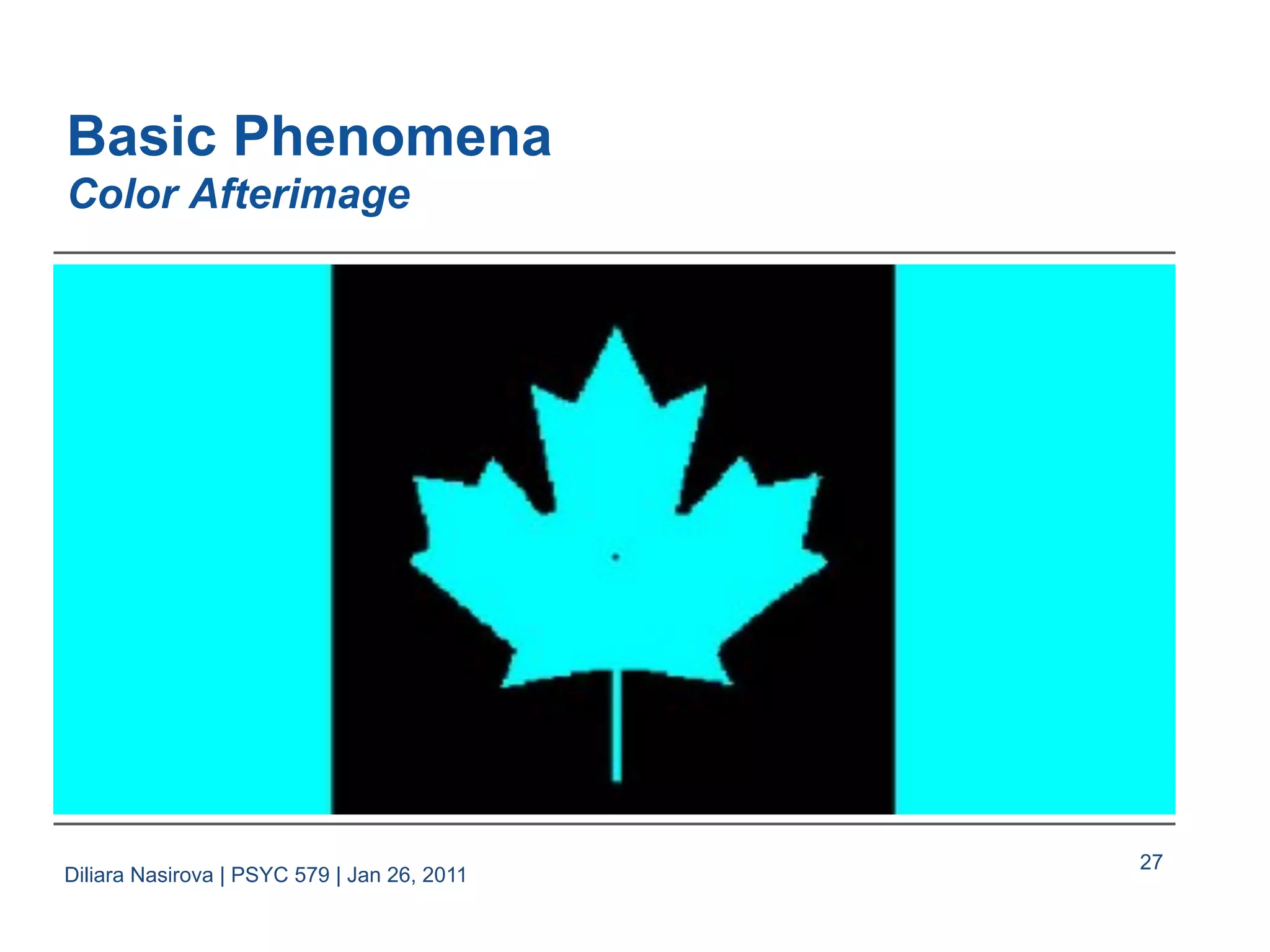
Basic Phenomena
Color Afterimage
Diliara Nasirova | PSYC 579 | Jan 26, 2011
28
Basic Phenomena
Color Afterimage
Diliara Nasirova | PSYC 579 | Jan 26, 2011
.
29
Basic Phenomena
Color Afterimage
•  BMW commercial:
http://www.huffingtonpost.com/2010/12/16/bmw-ad-vide-burns-logo-into-eyes-
_n_797981.html
Diliara Nasirova | PSYC 579 | Jan 26, 2011
30
Application to Visual Design
Color Specification Interfaces
Diliara Nasirova | PSYC 579 | Jan 26, 2011
•  One of the most widely used color
interfaces in computer graphics is
based on the HSV color space
saturation
hue value
31
Application to Visual Design
Color Specification Interfaces
Diliara Nasirova | PSYC 579 | Jan 26, 2011
32
Application to Visual Design
Color for Labeling
•  Labeling: nominal information
coding
•  Color can be extremely effective
as a nominal code.
Diliara Nasirova | PSYC 579 | Jan 26, 2011
33
Application to Visual Design
Color for Labeling
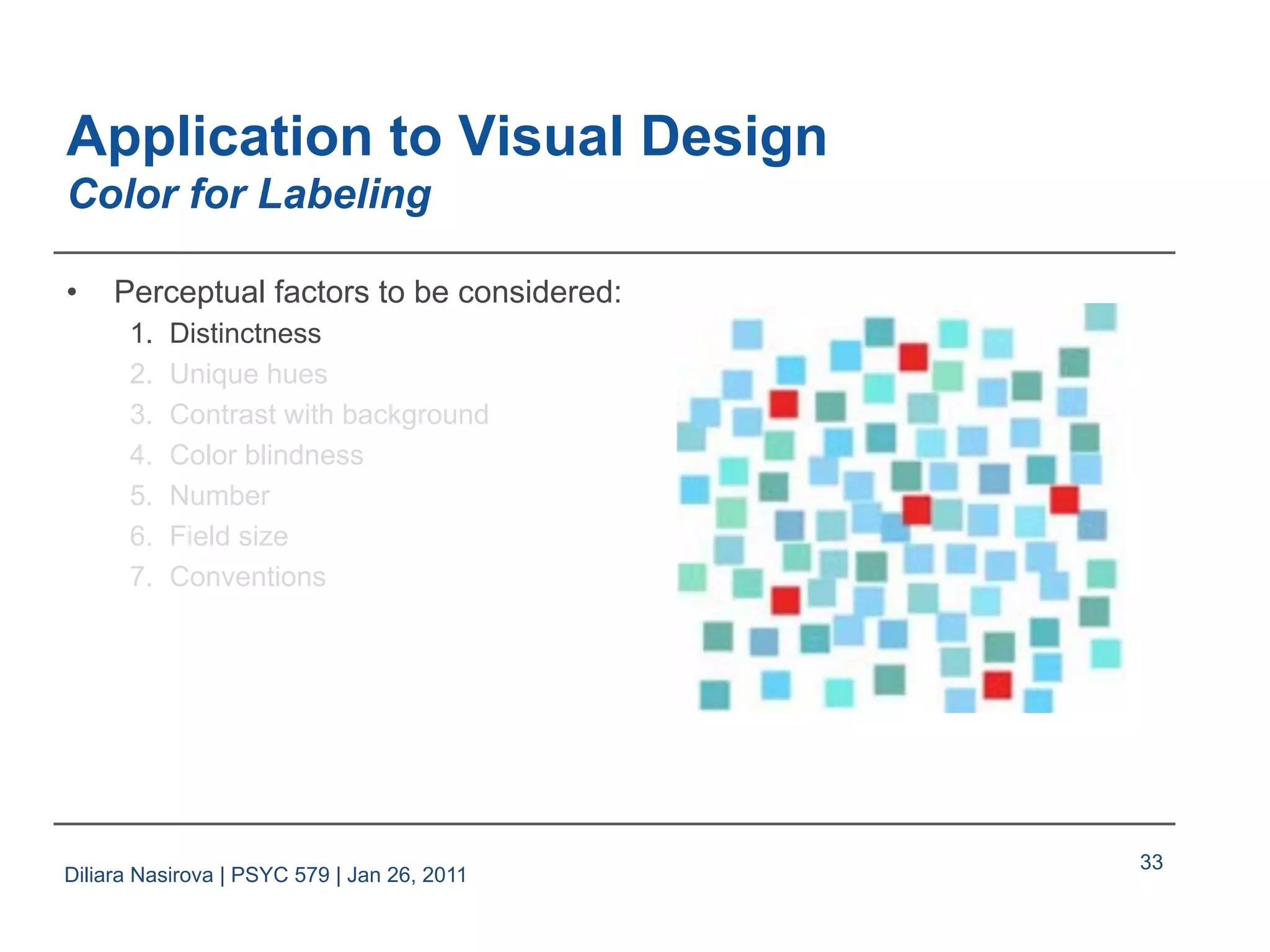
•  Perceptual factors to be considered:
1.  Distinctness
2.  Unique hues
3.  Contrast with background
4.  Color blindness
5.  Number
6.  Field size
7.  Conventions
Diliara Nasirova | PSYC 579 | Jan 26, 2011
34
Application to Visual Design
Color for Labeling
Diliara Nasirova | PSYC 579 | Jan 26, 2011
•  Perceptual factors to be considered:
1.  Distinctness
2.  Unique hues
3.  Contrast with background
4.  Color blindness
5.  Number
6.  Field size
7.  Conventions
35
Application to Visual Design
Color for Labeling
Diliara Nasirova | PSYC 579 | Jan 26, 2011
•  Perceptual factors to be considered:
1.  Distinctness
2.  Unique hues
3.  Contrast with background
4.  Color blindness
5.  Number
6.  Field size
7.  Conventions
36
Application to Visual Design
Color for Labeling
Diliara Nasirova | PSYC 579 | Jan 26, 2011
•  Perceptual factors to be considered:
1.  Distinctness
2.  Unique hues
3.  Contrast with background
4.  Color blindness
5.  Number
6.  Field size
7.  Conventions
37
Application to Visual Design
Color for Labeling
Diliara Nasirova | PSYC 579 | Jan 26, 2011
•  Perceptual factors to be considered:
1.  Distinctness
2.  Unique hues
3.  Contrast with background
4.  Color blindness
5.  Number
6.  Field size
7.  Conventions
38
Application to Visual Design
Color for Labeling
Diliara Nasirova | PSYC 579 | Jan 26, 2011
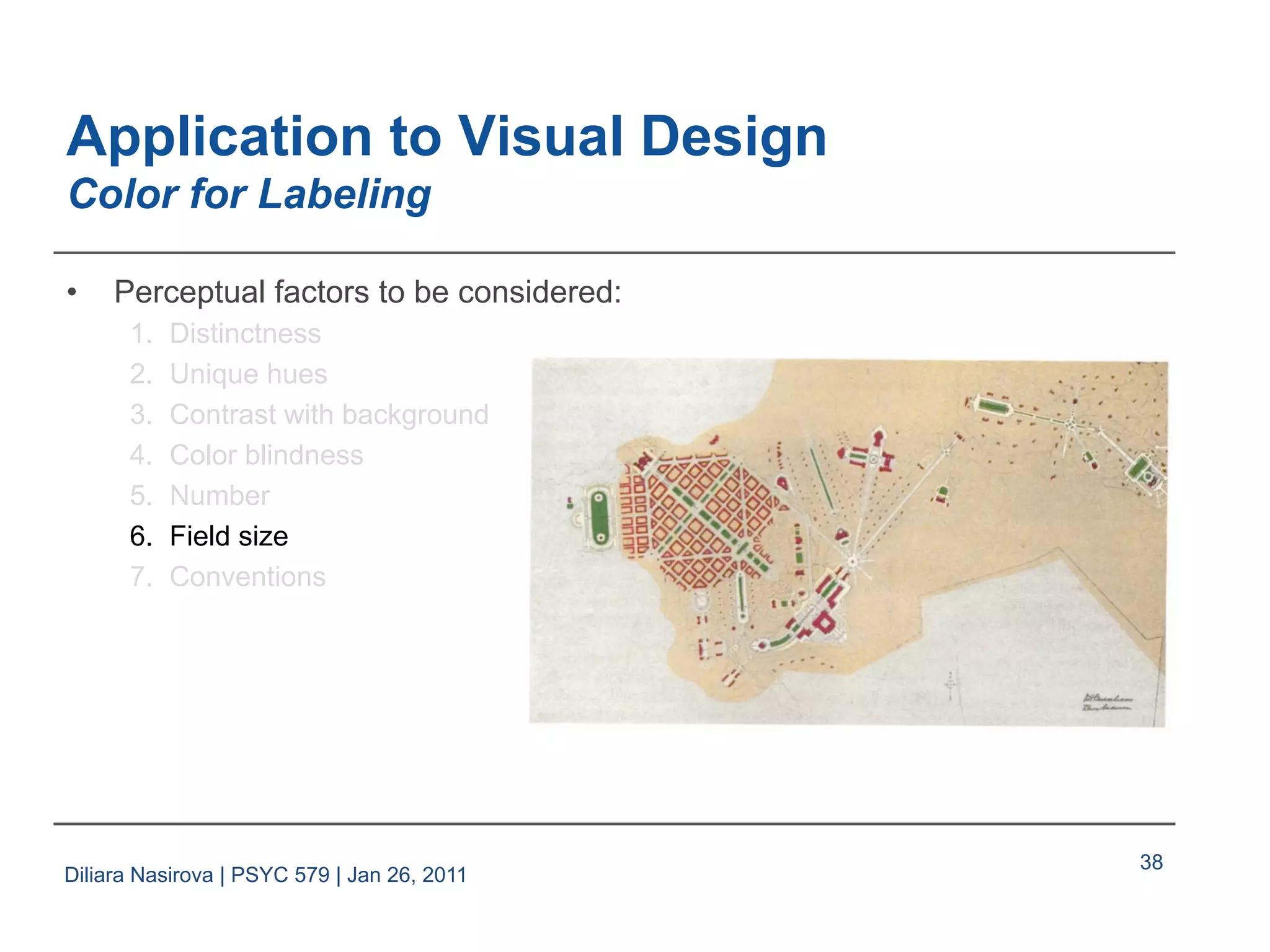
•  Perceptual factors to be considered:
1.  Distinctness
2.  Unique hues
3.  Contrast with background
4.  Color blindness
5.  Number
6.  Field size
7.  Conventions
39
Application to Visual Design
Color for Labeling
Diliara Nasirova | PSYC 579 | Jan 26, 2011
•  Perceptual factors to be considered:
1.  Distinctness
2.  Unique hues
3.  Contrast with background
4.  Color blindness
5.  Number
6.  Field size
7.  Conventions
40
Application to Visual Design
Color for Labeling
Diliara Nasirova | PSYC 579 | Jan 26, 2011
•  12 colors recommended for use in coding.
41
Conclusion

Colour perception

  • 1.
    2.1 Color Perception PSYC579 Topic Presentation, University of British Columbia Diliara Nasirova School of Interactive Art and Technology, Simon Fraser University January 26, 2011
  • 2.
    2 Outline 1.  The PhysicalDescription of Light ■  Light Components ■  Electromagnetic Spectrum 2.  The Psychological Description of Color ■  Color Space 3.  Theories of Color Vision ■  Trichromatic Theory ■  Opponent Process Theory Diliara Nasirova | PSYC 579 | Jan 26, 2011 4.  Basic Phenomena ■  Color Blindness ■  Color Afterimage ■  Color Contrast 5.  Application to Visual Design ■  Color Specification Interfaces ■  Color for Labeling
  • 3.
    3 References 1.  C. Ware,“Information Visualization: Perception for Design”, ch. 4 “Color” 2.  SE. Palmer, “Vision Science” 3.  E. Tufte, “Envisioning Information”, ch. 5 “Color and information” 4.  P Rheingans. (1999). “Task-based Color Scale Design” 5.  CA Brewer. (2005). “Designing Better Maps”, ch. 5 “Color Decisions for Mapping” 6.  C. Ware, “Visual Thinking for Design”, ch. 4 “Color” 7.  M. Stone, “Color in Information Display” workshop, Vis08 Diliara Nasirova | PSYC 579 | Jan 26, 2011
  • 4.
    4 The Physical Descriptionof Light Light Components Diliara Nasirova | PSYC 579 | Jan 26, 2011 •  Sir Isaac Newton, 1666
  • 5.
    5 The Physical Descriptionof Light Electromagnetic Spectrum Diliara Nasirova | PSYC 579 | Jan 26, 2011
  • 6.
    6 The Psychological Descriptionof Color Color Space •  All colors experiences can be described in terms of three dimensions: ■  Hue ■  Value (lightness) ■  Saturation (chroma) Diliara Nasirova | PSYC 579 | Jan 26, 2011
  • 7.
    7 The Psychological Descriptionof Color Color Space •  Color space: ■  A three dimensional coordinate system ■  Each color can be represented as a single point with a unique position. Diliara Nasirova | PSYC 579 | Jan 26, 2011
  • 8.
    8 The Psychological Descriptionof Color Color Space •  Color solid: Subset of color space Diliara Nasirova | PSYC 579 | Jan 26, 2011 Lightness Hue Saturation
  • 9.
    9 Theories of ColorVision Trichromatic Theory •  Trichromacy: Three color receptors (cones) in retinas that are active at normal light levels •  Young-Helmholtz Trichromatic Theory Diliara Nasirova | PSYC 579 | Jan 26, 2011
  • 10.
    10 The Physical Descriptionof Light Spectral Diagram Diliara Nasirova | PSYC 579 | Jan 26, 2011 •  Human cone sensitivity functions. •  Cones sensitive to ■  S (blue) ■  M (green) ■  L (red)
  • 11.
    11 The Physical Descriptionof Light Spectral Diagram: Short wavelength sensitive cones Diliara Nasirova | PSYC 579 | Jan 26, 2011 Blue text on a dark background is to be avoided. We have very few short-wavelength sensitive cones in the retina and they are not very sensitive. Blue text on a dark background is to be avoided. We have very few short-wavelength sensitive cones in the retina and they are not very sensitive.
  • 12.
    12 The Physical Descriptionof Light Spectral Diagram: Short wavelength sensitive cones Diliara Nasirova | PSYC 579 | Jan 26, 2011 Blue text on a dark background is to be avoided. We have very few short-wavelength sensitive cones in the retina and they are not very sensitive. Blue text on a dark background is to be avoided. We have very few short-wavelength sensitive cones in the retina and they are not very sensitive.
  • 13.
    13 Theories of ColorVision Opponent Process Theory •  Ewald Hering Opponent Process Theory •  Six elementary colors arranged as opponent pairs along three axes: ■  black-white, ■  red-green, ■  yellow-blue. Diliara Nasirova | PSYC 579 | Jan 26, 2011
  • 14.
    14 Theories of ColorVision Opponent Process Theory: Physiological basis •  Input from the cones is processed into 3 distinct channels Diliara Nasirova | PSYC 579 | Jan 26, 2011
  • 15.
    15 Theories of ColorVision Opponent Process Theory: Scientific evidence 1.  Unique Hues: black, white, red, green… Diliara Nasirova | PSYC 579 | Jan 26, 2011
  • 16.
    16 Theories of ColorVision Opponent Process Theory: Scientific evidence 2.  Naming and Cross-Cultural Naming: “yellowish green”, but no “yellowish blue” Diliara Nasirova | PSYC 579 | Jan 26, 2011
  • 17.
    17 3.  Neurophysiology: cellsin visual cortexes of monkeys that have properties of opponency Diliara Nasirova | PSYC 579 | Jan 26, 2011 Theories of Color Vision Opponent Process Theory: Scientific evidence
  • 18.
    18 3.  Categorical Colors: ■ Evidence that confusion between colors is affected by color categories Diliara Nasirova | PSYC 579 | Jan 26, 2011 Theories of Color Vision Opponent Process Theory: Scientific evidence
  • 19.
    19 Diliara Nasirova |PSYC 579 | Jan 26, 2011 Theories of Color Vision Opponent Process Theory: Scientific evidence
  • 20.
    20 Theories of ColorVision Opponent Process Theory: Color Channels Properties •  Chromatic channels carry ~1/3 the amount of detail carried by the black–white channel. •  Difficult to read the text where luminance is equal, despite a large chromatic difference Diliara Nasirova | PSYC 579 | Jan 26, 2011
  • 21.
    21 Theories of ColorVision Opponent Process Theory: Color Channels Properties Diliara Nasirova | PSYC 579 | Jan 26, 2011 •  Form: Form perception processed mainly through the luminance channel Floor, Duomo di Siena
  • 22.
    22 Theories of ColorVision Opponent Process Theory: Color Channels Properties Diliara Nasirova | PSYC 579 | Jan 26, 2011 •  Form: Pseudocolor sequences for maps
  • 23.
    23 Basic Phenomena Color Contrast DiliaraNasirova | PSYC 579 | Jan 26, 2011 •  Colors are perceived relative to their overall context
  • 24.
    24 Basic Phenomena Color Blindness • ~10% of the male and ~1% of the female population have some form of color vision deficiency. Original Deuteranope (r/g) Protanope (r/g) Tritanope (y/b)
  • 25.
    25 Basic Phenomena Color Blindness DiliaraNasirova | PSYC 579 | Jan 26, 2011
  • 26.
    26 Basic Phenomena Color Blindness DiliaraNasirova | PSYC 579 | Jan 26, 2011 Normal vision: no number Color blind vision: “45”
  • 27.
    27 Basic Phenomena Color Afterimage DiliaraNasirova | PSYC 579 | Jan 26, 2011
  • 28.
    28 Basic Phenomena Color Afterimage DiliaraNasirova | PSYC 579 | Jan 26, 2011 .
  • 29.
    29 Basic Phenomena Color Afterimage • BMW commercial: http://www.huffingtonpost.com/2010/12/16/bmw-ad-vide-burns-logo-into-eyes- _n_797981.html Diliara Nasirova | PSYC 579 | Jan 26, 2011
  • 30.
    30 Application to VisualDesign Color Specification Interfaces Diliara Nasirova | PSYC 579 | Jan 26, 2011 •  One of the most widely used color interfaces in computer graphics is based on the HSV color space saturation hue value
  • 31.
    31 Application to VisualDesign Color Specification Interfaces Diliara Nasirova | PSYC 579 | Jan 26, 2011
  • 32.
    32 Application to VisualDesign Color for Labeling •  Labeling: nominal information coding •  Color can be extremely effective as a nominal code. Diliara Nasirova | PSYC 579 | Jan 26, 2011
  • 33.
    33 Application to VisualDesign Color for Labeling •  Perceptual factors to be considered: 1.  Distinctness 2.  Unique hues 3.  Contrast with background 4.  Color blindness 5.  Number 6.  Field size 7.  Conventions Diliara Nasirova | PSYC 579 | Jan 26, 2011
  • 34.
    34 Application to VisualDesign Color for Labeling Diliara Nasirova | PSYC 579 | Jan 26, 2011 •  Perceptual factors to be considered: 1.  Distinctness 2.  Unique hues 3.  Contrast with background 4.  Color blindness 5.  Number 6.  Field size 7.  Conventions
  • 35.
    35 Application to VisualDesign Color for Labeling Diliara Nasirova | PSYC 579 | Jan 26, 2011 •  Perceptual factors to be considered: 1.  Distinctness 2.  Unique hues 3.  Contrast with background 4.  Color blindness 5.  Number 6.  Field size 7.  Conventions
  • 36.
    36 Application to VisualDesign Color for Labeling Diliara Nasirova | PSYC 579 | Jan 26, 2011 •  Perceptual factors to be considered: 1.  Distinctness 2.  Unique hues 3.  Contrast with background 4.  Color blindness 5.  Number 6.  Field size 7.  Conventions
  • 37.
    37 Application to VisualDesign Color for Labeling Diliara Nasirova | PSYC 579 | Jan 26, 2011 •  Perceptual factors to be considered: 1.  Distinctness 2.  Unique hues 3.  Contrast with background 4.  Color blindness 5.  Number 6.  Field size 7.  Conventions
  • 38.
    38 Application to VisualDesign Color for Labeling Diliara Nasirova | PSYC 579 | Jan 26, 2011 •  Perceptual factors to be considered: 1.  Distinctness 2.  Unique hues 3.  Contrast with background 4.  Color blindness 5.  Number 6.  Field size 7.  Conventions
  • 39.
    39 Application to VisualDesign Color for Labeling Diliara Nasirova | PSYC 579 | Jan 26, 2011 •  Perceptual factors to be considered: 1.  Distinctness 2.  Unique hues 3.  Contrast with background 4.  Color blindness 5.  Number 6.  Field size 7.  Conventions
  • 40.
    40 Application to VisualDesign Color for Labeling Diliara Nasirova | PSYC 579 | Jan 26, 2011 •  12 colors recommended for use in coding.
  • 41.