PERCEPTION OF SPACE,DISTANCE AND DEPTH...
Becoming aware of something via the senses…
Define:
 Space
 Spatial attribute
 2D &3D & how this occurs ???
 Depth
 Cues:
 1.Binocular
 2.Monocular
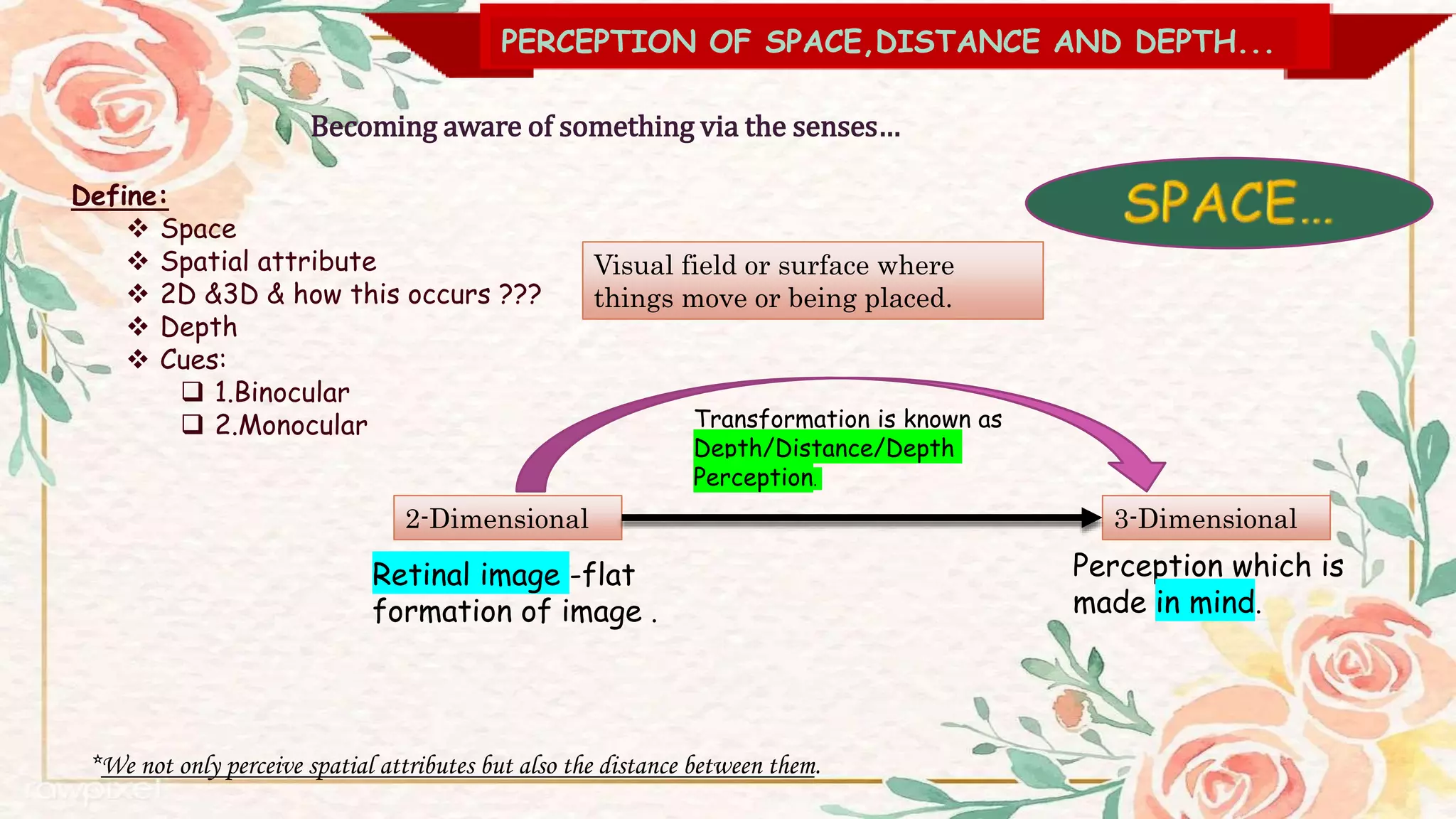
Visual field or surface where
things move or being placed.
3-Dimensional
2-Dimensional
Retinal image -flat
formation of image .
Perception which is
made in mind.
Transformation is known as
Depth/Distance/Depth
Perception.
*We not only perceive spatial attributes but also the distance between them.
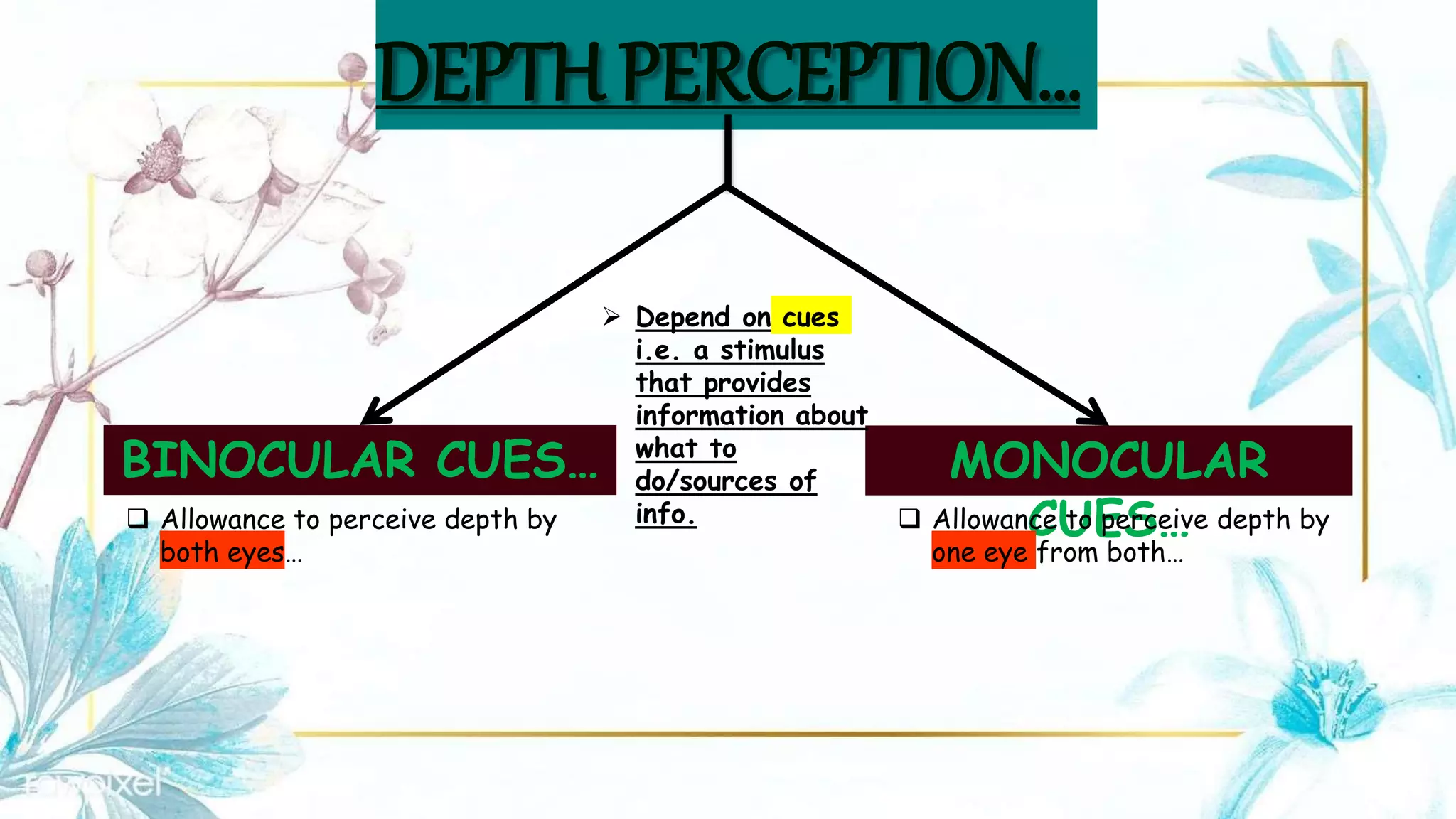
DEPTH PERCEPTION…
BINOCULAR CUES… MONOCULAR
CUES…
 Depend on cues
i.e. a stimulus
that provides
information about
what to
do/sources of
info.
 Allowance to perceive depth by
both eyes…
 Allowance to perceive depth by
one eye from both…
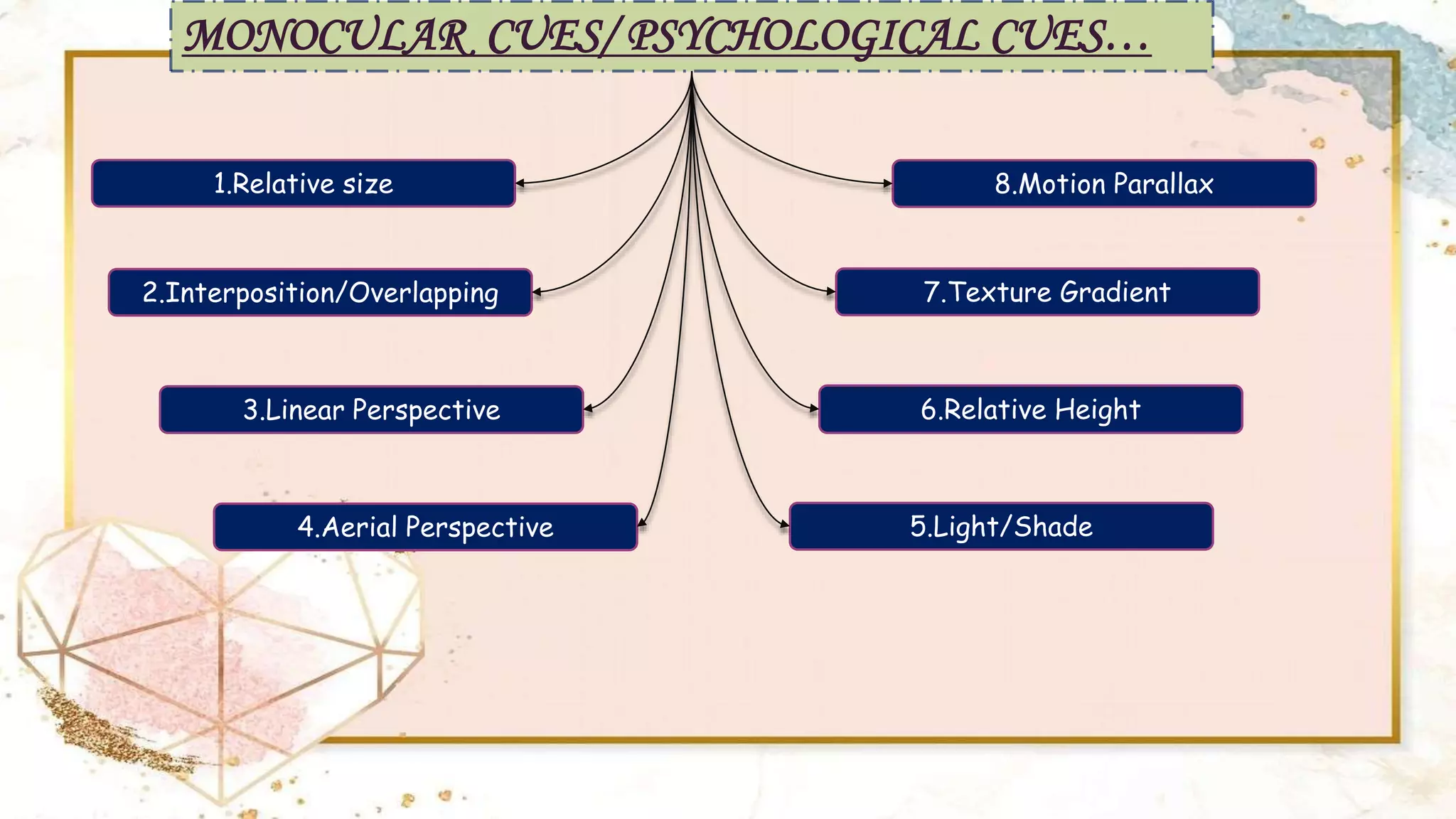
MONOCULAR CUES/ PSYCHOLOGICAL CUES…
1.Relative size
2.Interposition/Overlapping
3.Linear Perspective
4.Aerial Perspective 5.Light/Shade
6.Relative Height
7.Texture Gradient
8.Motion Parallax
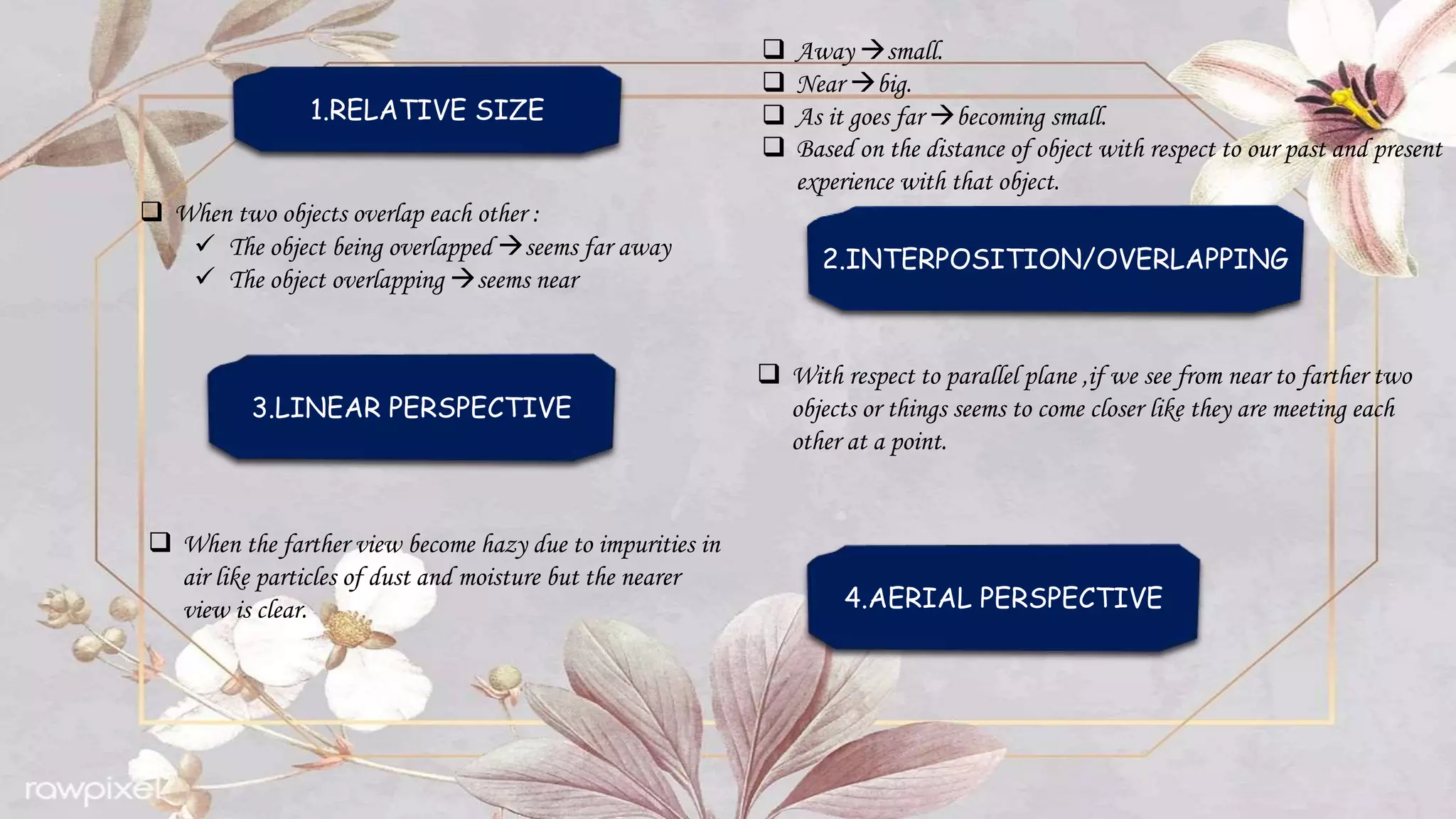
 Away small.
 Near big.
 As it goes far becoming small.
 Based on the distance of object with respect to our past and present
experience with that object.
1.RELATIVE SIZE
 With respect to parallel plane ,if we see from near to farther two
objects or things seems to come closer like they are meeting each
other at a point.
3.LINEAR PERSPECTIVE
 When two objects overlap each other :
 The object being overlapped seems far away
 The object overlapping seems near
2.INTERPOSITION/OVERLAPPING
4.AERIAL PERSPECTIVE
 When the farther view become hazy due to impurities in
air like particles of dust and moisture but the nearer
view is clear.
5.LIGHT AND SHADE
8.MOTION PARALLAX
7.TEXTURE GRADIENT
6.RELATIVE HEIGHT
 Larger objects seems to be nearer and the smaller objects seems
to be farther away from the person perceiving the objects.
 Sometimes two objects seems similar in size but they r not.
PERCEPTION OF SPACE,DEPTH AND DISTANCE.pptx

PERCEPTION OF SPACE,DEPTH AND DISTANCE.pptx

  • 1.
    PERCEPTION OF SPACE,DISTANCEAND DEPTH... Becoming aware of something via the senses… Define:  Space  Spatial attribute  2D &3D & how this occurs ???  Depth  Cues:  1.Binocular  2.Monocular Visual field or surface where things move or being placed. 3-Dimensional 2-Dimensional Retinal image -flat formation of image . Perception which is made in mind. Transformation is known as Depth/Distance/Depth Perception. *We not only perceive spatial attributes but also the distance between them.
  • 2.
    DEPTH PERCEPTION… BINOCULAR CUES…MONOCULAR CUES…  Depend on cues i.e. a stimulus that provides information about what to do/sources of info.  Allowance to perceive depth by both eyes…  Allowance to perceive depth by one eye from both…
  • 3.
    MONOCULAR CUES/ PSYCHOLOGICALCUES… 1.Relative size 2.Interposition/Overlapping 3.Linear Perspective 4.Aerial Perspective 5.Light/Shade 6.Relative Height 7.Texture Gradient 8.Motion Parallax
  • 4.
     Away small. Near big.  As it goes far becoming small.  Based on the distance of object with respect to our past and present experience with that object. 1.RELATIVE SIZE  With respect to parallel plane ,if we see from near to farther two objects or things seems to come closer like they are meeting each other at a point. 3.LINEAR PERSPECTIVE  When two objects overlap each other :  The object being overlapped seems far away  The object overlapping seems near 2.INTERPOSITION/OVERLAPPING 4.AERIAL PERSPECTIVE  When the farther view become hazy due to impurities in air like particles of dust and moisture but the nearer view is clear.
  • 5.
    5.LIGHT AND SHADE 8.MOTIONPARALLAX 7.TEXTURE GRADIENT 6.RELATIVE HEIGHT  Larger objects seems to be nearer and the smaller objects seems to be farther away from the person perceiving the objects.  Sometimes two objects seems similar in size but they r not.