Color Theory: Overview
• Color is one of the most expressive elements because
• its quality affects our emotions directly and immediately.
• In representational art, color serves to identify objects
• and to create the effect of illusionistic space
• This part is continued from Color Theory – part 1, it contains
history of the colors & Physiological Principles of Color
Historical Background
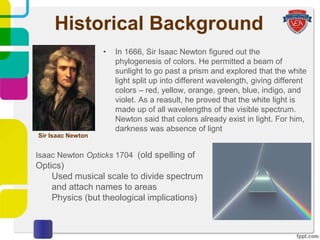
• In 1666, Sir Isaac Newton figured out the
phylogenesis of colors. He permitted a beam of
sunlight to go past a prism and explored that the white
light split up into different wavelength, giving different
colors – red, yellow, orange, green, blue, indigo, and
violet. As a reasult, he proved that the white light is
made up of all wavelengths of the visible spectrum.
Newton said that colors already exist in light. For him,
darkness was absence of lignt
Sir Isaac Newton
Isaac Newton Opticks 1704 (old spelling of
Optics)
Used musical scale to divide spectrum
and attach names to areas
Physics (but theological implications)
Historical Background
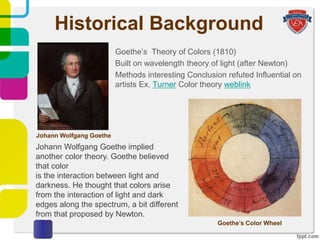
• Goethe’s Theory of Colors (1810)
• Built on wavelength theory of light (after Newton)
• Methods interesting Conclusion refuted Influential on
artists Ex. Turner Color theory weblink
Johann Wolfgang Goethe
Johann Wolfgang Goethe implied
another color theory. Goethe believed
that color
is the interaction between light and
darkness. He thought that colors arise
from the interaction of light and dark
edges along the spectrum, a bit different
from that proposed by Newton.
Goethe’s Color Wheel
• 1510
• Leonardo da Vinci
• Designed a sketch of linear view of colors
that traversed from yellow to green to blue
and all the way to red.
• 1611
• Aron Sigfrid Forsius
• Wrote a treatment on the subject of color.
His theory tells us that white and black are
the primary colors of the world from which all
other
• colors are derived.
• 1613
• Franciscus Aguilonius
• Came up with a color diagram in his 1613
work on optics. It is
• arguably the ancient system to use the
combination of red, yellow and blue during
which colors were I
defined within a linear division.
• 1630
• Robert Fludd
• Created the first printed color wheel in a
medical journal
1659
Rembrandt
Proposed that yellow darkened to brown and red
was half yellow, so it darkened to brown too. A
problem always pops up when brown is
darkened with black instead of its opposite color
ultramarine blue.
•1731
•Jacques Christopher Le Blon
•Invented the fundamental three-color palette
and explained his palette with many dyes. Le
Blon never extended his organized color system
properly.
•1755
•Tobias Mayer
•Developed color theory by the use of
mathematics, and his choice of triad colors (red,
blue and yellow) was created. Mayer tried to find
out the exact number of colors which the eye is
able to perceive.
•1766
•Moses Harris
•Developed the first use of a color wheel; the
wheel had red, yellow and blue but he added
black as the only neutral color.
•1772
•J. Heinrich Lambert
•Showed his first three-dimensional color system.
Historical Background
Emotional Response of Colors
• Red Hot, danger, negative, stop, excitement
• Dark blue Stable, mature, calming, trustworthy,
• Light blue Cool, youthful, masculine
• Green Positive, growth, organic, go, comforting
• Brown Wholesome, unpretentious, organic
• Yellow Emotional, caution, positive
• Orange Emotional, organic, positive
• Purple Royal, contemporary, youthful
• Pink Youthful, warm, feminine
• Pastels Feminine, sensitive, soft, youthful
• Gold Conservative, elegant, stable
• Black Death, heavy, serious
• Grey Cool, mature, neutral, integrity
• White Pure, clean
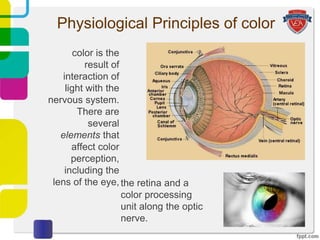
Physiological Principles of color
color is the
result of
interaction of
light with the
nervous system.
There are
several
elements that
affect color
perception,
including the
lens of the eye, the retina and a
color processing
unit along the optic
nerve.
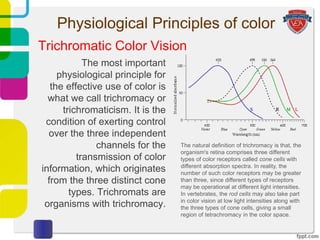
Trichromatic Color Vision
The most important
physiological principle for
the effective use of color is
what we call trichromacy or
trichromaticism. It is the
condition of exerting control
over the three independent
channels for the
transmission of color
information, which originates
from the three distinct cone
types. Trichromats are
organisms with trichromacy.
Physiological Principles of color
The natural definition of trichromacy is that, the
organism's retina comprises three different
types of color receptors called cone cells with
different absorption spectra. In reality, the
number of such color receptors may be greater
than three, since different types of receptors
may be operational at different light intensities.
In vertebrates, the rod cells may also take part
in color vision at low light intensities along with
the three types of cone cells, giving a small
region of tetrachromacy in the color space.
Human Visual System
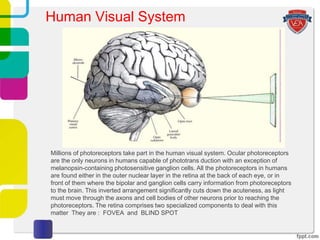
Millions of photoreceptors take part in the human visual system. Ocular photoreceptors
are the only neurons in humans capable of phototrans duction with an exception of
melanopsin-containing photosensitive ganglion cells. All the photoreceptors in humans
are found either in the outer nuclear layer in the retina at the back of each eye, or in
front of them where the bipolar and ganglion cells carry information from photoreceptors
to the brain. This inverted arrangement significantly cuts down the acuteness, as light
must move through the axons and cell bodies of other neurons prior to reaching the
photoreceptors. The retina comprises two specialized components to deal with this
matter They are : FOVEA and BLIND SPOT
Graphic Designer – Qualification
A bachelor’s degree in graphic
design is usually required for
most entry-level and advanced
graphic design positions.
Veda conduct a Diploma Course
“Diploma in Graphics Designing
& Creative writing”.
Course Duration : 1 Year
https://www.veda-edu.com
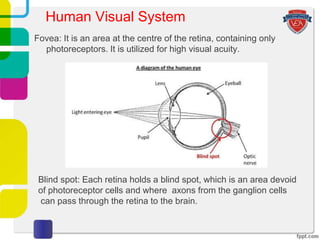
Fovea: It is an area at the centre of the retina, containing only
photoreceptors. It is utilized for high visual acuity.
Blind spot: Each retina holds a blind spot, which is an area devoid
of photoreceptor cells and where axons from the ganglion cells
can pass through the retina to the brain.
Human Visual System
• Phototransduction is a process by which light is converted
into electrical signals in the rod cells, cone cells and photosensitive
ganglion cells of the retina of the eye.
• The visual cycle is the biological conversion of a photon into an
electrical signal in the retina. This process occurs via G-protein coupled
receptors called opsins which contain the chromophore 11-cis
retinal. 11-cis retinal is covalently linked to the opsin receptor via Schiff
base forming retinylidene protein. When struck by a photon, 11-cis
retinal undergoes photoisomerization to all-trans retinal which changes
the conformation of the opsin GPCR leading to signal transduction
cascades which causes closure of cyclic GMP-gated cation channel,
and hyper polarization of the photoreceptor cell
Animation Phototransduction
Visit the site
http://sites.sinauer.com/neuroscience5e/animations11.02.html
Phototransduction
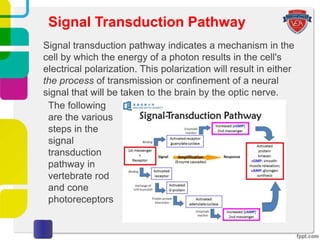
Signal Transduction Pathway
Signal transduction pathway indicates a mechanism in the
cell by which the energy of a photon results in the cell's
electrical polarization. This polarization will result in either
the process of transmission or confinement of a neural
signal that will be taken to the brain by the optic nerve.
The following
are the various
steps in the
signal
transduction
pathway in
vertebrate rod
and cone
photoreceptors
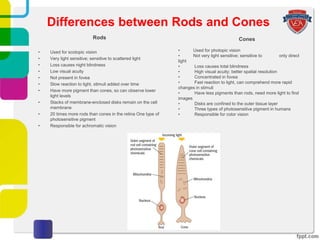
Rods
• Used for scotopic vision
• Very light sensitive; sensitive to scattered light
• Loss causes night blindness
• Low visual acuity
• Not present in fovea
• Slow reaction to light, stimuli added over time
• Have more pigment than cones, so can observe lower
light levels
• Stacks of membrane-enclosed disks remain on the cell
membrane
• 20 times more rods than cones in the retina One type of
photosensitive pigment
• Responsible for achromatic vision
Cones
• Used for photopic vision
• Not very light sensitive; sensitive to only direct
light
• Loss causes total blindness
• High visual acuity; better spatial resolution
• Concentrated in fovea
• Fast reaction to light, can comprehend more rapid
changes in stimuli
• Have less pigments than rods, need more light to find
images
• Disks are confined to the outer tissue layer
• Three types of photosensitive pigment in humans
• Responsible for color vision
Differences between Rods and Cones
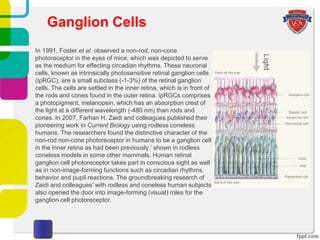
In 1991, Foster et al. observed a non-rod, non-cone
photoreceptor in the eyes of mice, which was depicted to serve
as the medium for effecting circadian rhythms. These neuronal
cells, known as intrinsically photosensitive retinal ganglion cells
(ipRGC), are a small subclass (-1-3%) of the retinal ganglion
cells. The cells are settled in the inner retina, which is in front of
the rods and cones found in the outer retina. ipRGCs comprises
a photopigment, melanopsin, which has an absorption crest of
the light at a different wavelength (-480 nm) than rods and
cones. In 2007, Farhan H. Zaidi and colleagues published their
pioneering work in Current Biology using rodless coneless
humans. The researchers found the distinctive character of the
non-rod non-cone photoreceptor in humans to be a ganglion cell
in the inner retina as had been previously ' shown in rodless
coneless models in some other mammals. Human retinal
ganglion cell photoreceptor takes part in conscious sight as well
as in non-image-forming functions such as circadian rhythms,
behavior and pupil reactions. The groundbreaking research of
Zaidi and colleagues' with rodless and coneless human subjects
also opened the door into image-forming (visual) roles for the
ganglion cell photoreceptor.
Ganglion Cells
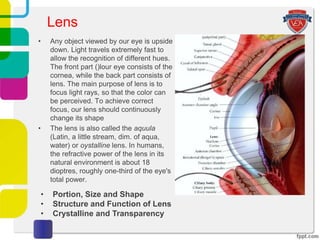
• Any object viewed by our eye is upside
down. Light travels extremely fast to
allow the recognition of different hues.
The front part ()lour eye consists of the
cornea, while the back part consists of
lens. The main purpose of lens is to
focus light rays, so that the color can
be perceived. To achieve correct
focus, our lens should continuously
change its shape
• The lens is also called the aquula
(Latin, a little stream, dim. of aqua,
water) or oystalline lens. In humans,
the refractive power of the lens in its
natural environment is about 18
dioptres, roughly one-third of the eye's
total power.
Lens
• Portion, Size and Shape
• Structure and Function of Lens
• Crystalline and Transparency
Retina
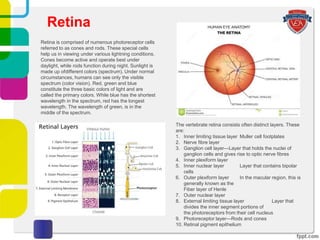
Retina is comprised of numerous photoreceptor cells
referred to as cones and rods. These special cells
help us in viewing under various lightning conditions.
Cones become active and operate best under
daylight, while rods function during night. Sunlight is
made up ofdifferent colors (spectrum). Under normal
circumstances, humans can see only the visible
spectrum (color vision). Red, green and blue
constitute the three basic colors of light and are
called the primary colors. While blue has the shortest
wavelength in the spectrum, red has the longest
wavelength. The wavelength of green, is in the
middle of the spectrum.
The vertebrate retina consists often distinct layers. These
are:
1. Inner limiting tissue layer Muller cell footplates
2. Nerve fibre layer
3. Ganglion cell layer—Layer that holds the nuclei of
ganglion cells and gives rise to optic nerve fibres
4. Inner plexiform layer
5. Inner nuclear layer Layer that contains bipolar
cells
6. Outer plexiform layer In the macular region, this is
generally known as the
Fiber layer of Henle
7. Outer nuclear layer
8. External limiting tissue layer Layer that
divides the inner segment portions of
the photoreceptors from their cell nucleus
9. Photoreceptor layer—Rods and cones
10. Retinal pigment epithelium
Graphic Designer – Qualification
A animation degree course which
includes all the aspects of graphic
designing can help you to
understand all the in & outs of the
designing concepts like using
colors, which is a must
requirement for an professional.
Veda conduct a Animation Degree
course
“B.sc. Media Graphics & Animation”.
Course Duration : 1 Year
https://www.veda-edu.com
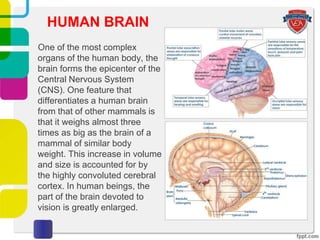
One of the most complex
organs of the human body, the
brain forms the epicenter of the
Central Nervous System
(CNS). One feature that
differentiates a human brain
from that of other mammals is
that it weighs almost three
times as big as the brain of a
mammal of similar body
weight. This increase in volume
and size is accounted for by
the highly convoluted cerebral
cortex. In human beings, the
part of the brain devoted to
vision is greatly enlarged.
HUMAN BRAIN
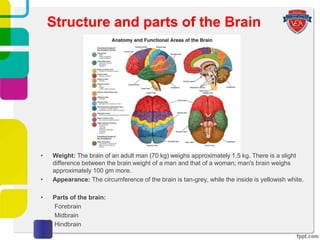
• Weight: The brain of an adult man (70 kg) weighs approximately 1.5 kg. There is a slight
difference between the brain weight of a man and that of a woman; man's brain weighs
approximately 100 gm more.
• Appearance: The circumference of the brain is tan-grey, while the inside is yellowish white.
• Parts of the brain:
Forebrain
Midbrain
Hindbrain
Structure and parts of the Brain
• A basic knowledge of color theory definitely helps in making a harmonious combination which is pleasing to the
eyes.
• With the basic knowledge of color theory, one can easily understand how to make effective use of colors in our daily
life.
• For a person who belongs to art background, judgement about colors and their meaning is easy.
• For a lay man visualizing colors is not an easy task. Apoor and undeveloped sense of color proves to be a great
hindrance in making good color decisions.
• In the visual arts, color theory refers to the visual impact created by different types of colors, both individually and in
combination with each other.
• color balance refers to the use of congruous colors in a design.
• color scheme is the choice of colors used in a design for a range of media used in color theory. color schemes are
basically used to create style and appeal.
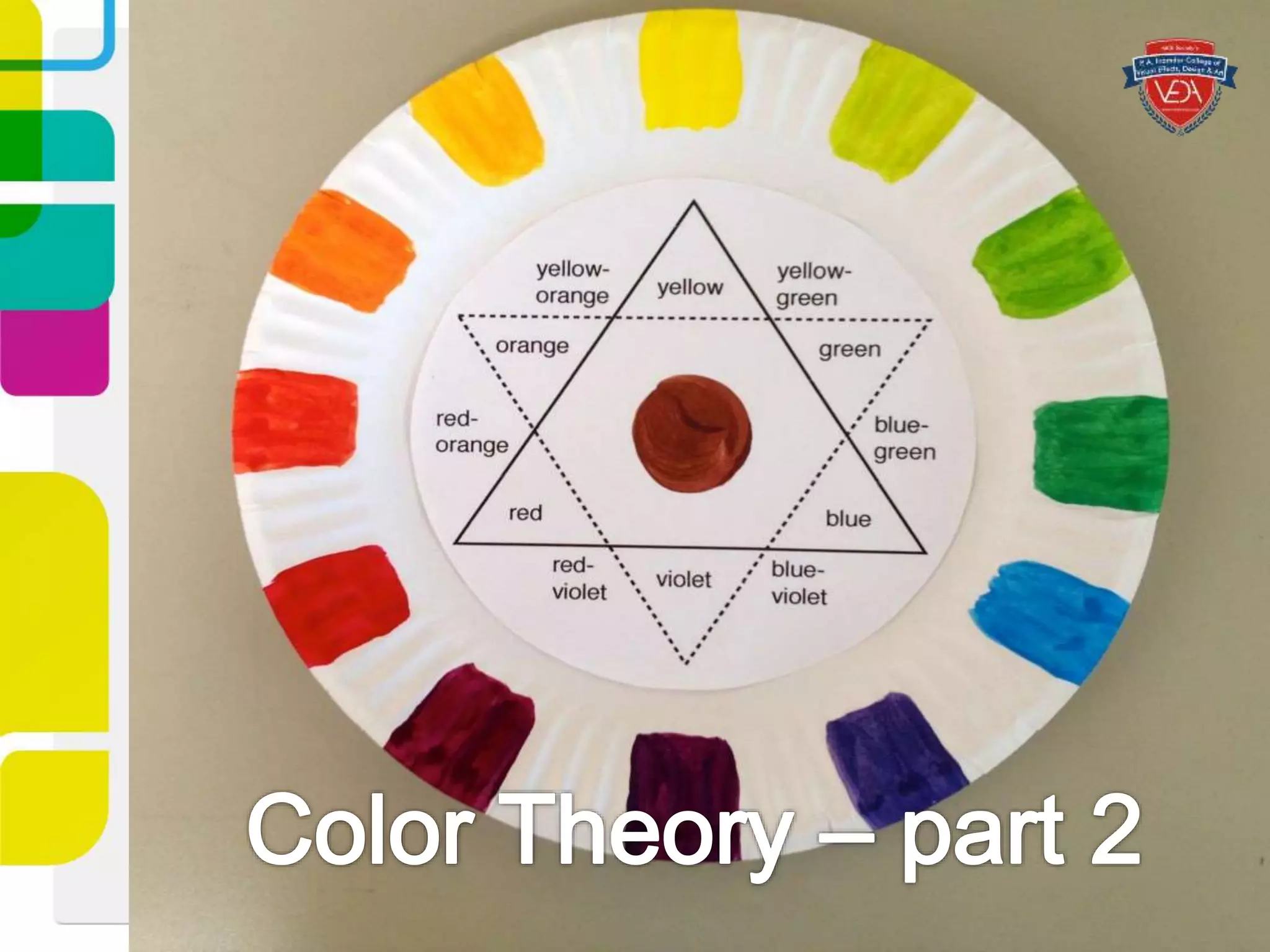
• Complementary color scheme includes a combination of any two colors that are positioned opposite to each other
on the color wheel. Analogous colors appear next to each other on the color wheel.
• Warm colors are bright and pleasing. They are generally associated with daylight and cool colors with night.
• color theory helps us to understand the various possible combinations that would look harmonious together.
• An organism's retina comprises three different types ofcolor receptors called cone cells with different absorption
spectra.
• Trichromatic color vision is the natural aptitude of humans and some other animals to see different colors,
interposed by interactions among three types of color-sensing cone cells.
• A photoreceptor is a specialized type of nerve cell that is capable of phototransduction.
• Phototransduction is the composite process through which the energy o fa photon is utilized to alter the intrinsic
membrane potential of the photoreceptor.
• Signals are conducted by polarization and depolarization of the neurons.
• One ofthe most important differences between rods and cones is that while rods are meant for scotopic vision, while
cones are responsible for photopic vision.
• Lens along with the cornea plays a major role in refracting light to be focused on the retina.
Summary
• Lens functions to change the focal distance of the eye so that it can focus°, objects at various distances, thus
allowing a sharp real image of the object interest to be formed on the retina.
• Accommodation is the process where one can centre the eye on an object al dissimilar distances from it by
changing the curvature ofthe lens. Retina is comprised by numerous photoreceptor cells referred to as cones and
rods.
• Cones become active and operate best under daylight, while rods function during night.
• Fovea is a region at the centre of the macula and forms the most sensitive an in the retina.
• The three major parts ofthe brain are the forebrain, the midbrain and the hindbrai
• The forebrain controls the motor functions of the body as well the autonomi functions.
• The midbrain plays an important role in auditory and visual responses.
• The hindbrain controls the autonomic functions besides maintaining th, equilibrium, motor function and conducts
sensory information.
Summary
MCE Society’s P.A. Inamdar College of
Visual Effects,Design & Art
Ground floor, Hotel Management Building,
Azam Campus, Camp,
Pune – 411001.
Maharashtra, India.
Contact No:(020) 64013441/44
Email :enquiry[at]veda-edu[dot]com
Web : https://www.veda-edu.com
For any question or admission query please contact
Disclaimer: Images used in this presentation is purely for the reference purpose. We do not own any copyright on
Images other then Veda college. Source of images : https://en.wikipedia.org, https://light2015blog.org/category/chemistry/, https://en.wikipedia.org/wiki/Johann_Wolfgang_von_Goethe, ,
https://justinpamute.wordpress.com http://www.openculture.com/2013/09/goethes-theory-of-colors-and-kandinsky.html, https://www.lhup.edu, http://www.colourblindawareness.org/colour-blindness/types-of-colour-blindness/,
http://www.cgadvertising.com, http://www.planet-science.com, https://pharmaceuticalintelligence.com, http://www.webexhibits.org, http://blog.tauedu.org, https://www.designmantic.com,
http://www.cgadvertising.com/pages/cg/rules-in-design/trichromatic-vision.php
THANK YOU

Color theory part 2

  • 2.
    Color Theory: Overview •Color is one of the most expressive elements because • its quality affects our emotions directly and immediately. • In representational art, color serves to identify objects • and to create the effect of illusionistic space • This part is continued from Color Theory – part 1, it contains history of the colors & Physiological Principles of Color
  • 3.
    Historical Background • In1666, Sir Isaac Newton figured out the phylogenesis of colors. He permitted a beam of sunlight to go past a prism and explored that the white light split up into different wavelength, giving different colors – red, yellow, orange, green, blue, indigo, and violet. As a reasult, he proved that the white light is made up of all wavelengths of the visible spectrum. Newton said that colors already exist in light. For him, darkness was absence of lignt Sir Isaac Newton Isaac Newton Opticks 1704 (old spelling of Optics) Used musical scale to divide spectrum and attach names to areas Physics (but theological implications)
  • 4.
    Historical Background • Goethe’sTheory of Colors (1810) • Built on wavelength theory of light (after Newton) • Methods interesting Conclusion refuted Influential on artists Ex. Turner Color theory weblink Johann Wolfgang Goethe Johann Wolfgang Goethe implied another color theory. Goethe believed that color is the interaction between light and darkness. He thought that colors arise from the interaction of light and dark edges along the spectrum, a bit different from that proposed by Newton. Goethe’s Color Wheel
  • 5.
    • 1510 • Leonardoda Vinci • Designed a sketch of linear view of colors that traversed from yellow to green to blue and all the way to red. • 1611 • Aron Sigfrid Forsius • Wrote a treatment on the subject of color. His theory tells us that white and black are the primary colors of the world from which all other • colors are derived. • 1613 • Franciscus Aguilonius • Came up with a color diagram in his 1613 work on optics. It is • arguably the ancient system to use the combination of red, yellow and blue during which colors were I defined within a linear division. • 1630 • Robert Fludd • Created the first printed color wheel in a medical journal 1659 Rembrandt Proposed that yellow darkened to brown and red was half yellow, so it darkened to brown too. A problem always pops up when brown is darkened with black instead of its opposite color ultramarine blue. •1731 •Jacques Christopher Le Blon •Invented the fundamental three-color palette and explained his palette with many dyes. Le Blon never extended his organized color system properly. •1755 •Tobias Mayer •Developed color theory by the use of mathematics, and his choice of triad colors (red, blue and yellow) was created. Mayer tried to find out the exact number of colors which the eye is able to perceive. •1766 •Moses Harris •Developed the first use of a color wheel; the wheel had red, yellow and blue but he added black as the only neutral color. •1772 •J. Heinrich Lambert •Showed his first three-dimensional color system. Historical Background
  • 6.
    Emotional Response ofColors • Red Hot, danger, negative, stop, excitement • Dark blue Stable, mature, calming, trustworthy, • Light blue Cool, youthful, masculine • Green Positive, growth, organic, go, comforting • Brown Wholesome, unpretentious, organic • Yellow Emotional, caution, positive • Orange Emotional, organic, positive • Purple Royal, contemporary, youthful • Pink Youthful, warm, feminine • Pastels Feminine, sensitive, soft, youthful • Gold Conservative, elegant, stable • Black Death, heavy, serious • Grey Cool, mature, neutral, integrity • White Pure, clean
  • 7.
    Physiological Principles ofcolor color is the result of interaction of light with the nervous system. There are several elements that affect color perception, including the lens of the eye, the retina and a color processing unit along the optic nerve.
  • 8.
    Trichromatic Color Vision Themost important physiological principle for the effective use of color is what we call trichromacy or trichromaticism. It is the condition of exerting control over the three independent channels for the transmission of color information, which originates from the three distinct cone types. Trichromats are organisms with trichromacy. Physiological Principles of color The natural definition of trichromacy is that, the organism's retina comprises three different types of color receptors called cone cells with different absorption spectra. In reality, the number of such color receptors may be greater than three, since different types of receptors may be operational at different light intensities. In vertebrates, the rod cells may also take part in color vision at low light intensities along with the three types of cone cells, giving a small region of tetrachromacy in the color space.
  • 9.
    Human Visual System Millionsof photoreceptors take part in the human visual system. Ocular photoreceptors are the only neurons in humans capable of phototrans duction with an exception of melanopsin-containing photosensitive ganglion cells. All the photoreceptors in humans are found either in the outer nuclear layer in the retina at the back of each eye, or in front of them where the bipolar and ganglion cells carry information from photoreceptors to the brain. This inverted arrangement significantly cuts down the acuteness, as light must move through the axons and cell bodies of other neurons prior to reaching the photoreceptors. The retina comprises two specialized components to deal with this matter They are : FOVEA and BLIND SPOT
  • 10.
    Graphic Designer –Qualification A bachelor’s degree in graphic design is usually required for most entry-level and advanced graphic design positions. Veda conduct a Diploma Course “Diploma in Graphics Designing & Creative writing”. Course Duration : 1 Year https://www.veda-edu.com
  • 11.
    Fovea: It isan area at the centre of the retina, containing only photoreceptors. It is utilized for high visual acuity. Blind spot: Each retina holds a blind spot, which is an area devoid of photoreceptor cells and where axons from the ganglion cells can pass through the retina to the brain. Human Visual System
  • 12.
    • Phototransduction isa process by which light is converted into electrical signals in the rod cells, cone cells and photosensitive ganglion cells of the retina of the eye. • The visual cycle is the biological conversion of a photon into an electrical signal in the retina. This process occurs via G-protein coupled receptors called opsins which contain the chromophore 11-cis retinal. 11-cis retinal is covalently linked to the opsin receptor via Schiff base forming retinylidene protein. When struck by a photon, 11-cis retinal undergoes photoisomerization to all-trans retinal which changes the conformation of the opsin GPCR leading to signal transduction cascades which causes closure of cyclic GMP-gated cation channel, and hyper polarization of the photoreceptor cell Animation Phototransduction Visit the site http://sites.sinauer.com/neuroscience5e/animations11.02.html Phototransduction
  • 13.
    Signal Transduction Pathway Signaltransduction pathway indicates a mechanism in the cell by which the energy of a photon results in the cell's electrical polarization. This polarization will result in either the process of transmission or confinement of a neural signal that will be taken to the brain by the optic nerve. The following are the various steps in the signal transduction pathway in vertebrate rod and cone photoreceptors
  • 14.
    Rods • Used forscotopic vision • Very light sensitive; sensitive to scattered light • Loss causes night blindness • Low visual acuity • Not present in fovea • Slow reaction to light, stimuli added over time • Have more pigment than cones, so can observe lower light levels • Stacks of membrane-enclosed disks remain on the cell membrane • 20 times more rods than cones in the retina One type of photosensitive pigment • Responsible for achromatic vision Cones • Used for photopic vision • Not very light sensitive; sensitive to only direct light • Loss causes total blindness • High visual acuity; better spatial resolution • Concentrated in fovea • Fast reaction to light, can comprehend more rapid changes in stimuli • Have less pigments than rods, need more light to find images • Disks are confined to the outer tissue layer • Three types of photosensitive pigment in humans • Responsible for color vision Differences between Rods and Cones
  • 15.
    In 1991, Fosteret al. observed a non-rod, non-cone photoreceptor in the eyes of mice, which was depicted to serve as the medium for effecting circadian rhythms. These neuronal cells, known as intrinsically photosensitive retinal ganglion cells (ipRGC), are a small subclass (-1-3%) of the retinal ganglion cells. The cells are settled in the inner retina, which is in front of the rods and cones found in the outer retina. ipRGCs comprises a photopigment, melanopsin, which has an absorption crest of the light at a different wavelength (-480 nm) than rods and cones. In 2007, Farhan H. Zaidi and colleagues published their pioneering work in Current Biology using rodless coneless humans. The researchers found the distinctive character of the non-rod non-cone photoreceptor in humans to be a ganglion cell in the inner retina as had been previously ' shown in rodless coneless models in some other mammals. Human retinal ganglion cell photoreceptor takes part in conscious sight as well as in non-image-forming functions such as circadian rhythms, behavior and pupil reactions. The groundbreaking research of Zaidi and colleagues' with rodless and coneless human subjects also opened the door into image-forming (visual) roles for the ganglion cell photoreceptor. Ganglion Cells
  • 16.
    • Any objectviewed by our eye is upside down. Light travels extremely fast to allow the recognition of different hues. The front part ()lour eye consists of the cornea, while the back part consists of lens. The main purpose of lens is to focus light rays, so that the color can be perceived. To achieve correct focus, our lens should continuously change its shape • The lens is also called the aquula (Latin, a little stream, dim. of aqua, water) or oystalline lens. In humans, the refractive power of the lens in its natural environment is about 18 dioptres, roughly one-third of the eye's total power. Lens • Portion, Size and Shape • Structure and Function of Lens • Crystalline and Transparency
  • 17.
    Retina Retina is comprisedof numerous photoreceptor cells referred to as cones and rods. These special cells help us in viewing under various lightning conditions. Cones become active and operate best under daylight, while rods function during night. Sunlight is made up ofdifferent colors (spectrum). Under normal circumstances, humans can see only the visible spectrum (color vision). Red, green and blue constitute the three basic colors of light and are called the primary colors. While blue has the shortest wavelength in the spectrum, red has the longest wavelength. The wavelength of green, is in the middle of the spectrum. The vertebrate retina consists often distinct layers. These are: 1. Inner limiting tissue layer Muller cell footplates 2. Nerve fibre layer 3. Ganglion cell layer—Layer that holds the nuclei of ganglion cells and gives rise to optic nerve fibres 4. Inner plexiform layer 5. Inner nuclear layer Layer that contains bipolar cells 6. Outer plexiform layer In the macular region, this is generally known as the Fiber layer of Henle 7. Outer nuclear layer 8. External limiting tissue layer Layer that divides the inner segment portions of the photoreceptors from their cell nucleus 9. Photoreceptor layer—Rods and cones 10. Retinal pigment epithelium
  • 18.
    Graphic Designer –Qualification A animation degree course which includes all the aspects of graphic designing can help you to understand all the in & outs of the designing concepts like using colors, which is a must requirement for an professional. Veda conduct a Animation Degree course “B.sc. Media Graphics & Animation”. Course Duration : 1 Year https://www.veda-edu.com
  • 19.
    One of themost complex organs of the human body, the brain forms the epicenter of the Central Nervous System (CNS). One feature that differentiates a human brain from that of other mammals is that it weighs almost three times as big as the brain of a mammal of similar body weight. This increase in volume and size is accounted for by the highly convoluted cerebral cortex. In human beings, the part of the brain devoted to vision is greatly enlarged. HUMAN BRAIN
  • 20.
    • Weight: Thebrain of an adult man (70 kg) weighs approximately 1.5 kg. There is a slight difference between the brain weight of a man and that of a woman; man's brain weighs approximately 100 gm more. • Appearance: The circumference of the brain is tan-grey, while the inside is yellowish white. • Parts of the brain: Forebrain Midbrain Hindbrain Structure and parts of the Brain
  • 21.
    • A basicknowledge of color theory definitely helps in making a harmonious combination which is pleasing to the eyes. • With the basic knowledge of color theory, one can easily understand how to make effective use of colors in our daily life. • For a person who belongs to art background, judgement about colors and their meaning is easy. • For a lay man visualizing colors is not an easy task. Apoor and undeveloped sense of color proves to be a great hindrance in making good color decisions. • In the visual arts, color theory refers to the visual impact created by different types of colors, both individually and in combination with each other. • color balance refers to the use of congruous colors in a design. • color scheme is the choice of colors used in a design for a range of media used in color theory. color schemes are basically used to create style and appeal. • Complementary color scheme includes a combination of any two colors that are positioned opposite to each other on the color wheel. Analogous colors appear next to each other on the color wheel. • Warm colors are bright and pleasing. They are generally associated with daylight and cool colors with night. • color theory helps us to understand the various possible combinations that would look harmonious together. • An organism's retina comprises three different types ofcolor receptors called cone cells with different absorption spectra. • Trichromatic color vision is the natural aptitude of humans and some other animals to see different colors, interposed by interactions among three types of color-sensing cone cells. • A photoreceptor is a specialized type of nerve cell that is capable of phototransduction. • Phototransduction is the composite process through which the energy o fa photon is utilized to alter the intrinsic membrane potential of the photoreceptor. • Signals are conducted by polarization and depolarization of the neurons. • One ofthe most important differences between rods and cones is that while rods are meant for scotopic vision, while cones are responsible for photopic vision. • Lens along with the cornea plays a major role in refracting light to be focused on the retina. Summary
  • 22.
    • Lens functionsto change the focal distance of the eye so that it can focus°, objects at various distances, thus allowing a sharp real image of the object interest to be formed on the retina. • Accommodation is the process where one can centre the eye on an object al dissimilar distances from it by changing the curvature ofthe lens. Retina is comprised by numerous photoreceptor cells referred to as cones and rods. • Cones become active and operate best under daylight, while rods function during night. • Fovea is a region at the centre of the macula and forms the most sensitive an in the retina. • The three major parts ofthe brain are the forebrain, the midbrain and the hindbrai • The forebrain controls the motor functions of the body as well the autonomi functions. • The midbrain plays an important role in auditory and visual responses. • The hindbrain controls the autonomic functions besides maintaining th, equilibrium, motor function and conducts sensory information. Summary
  • 23.
    MCE Society’s P.A.Inamdar College of Visual Effects,Design & Art Ground floor, Hotel Management Building, Azam Campus, Camp, Pune – 411001. Maharashtra, India. Contact No:(020) 64013441/44 Email :enquiry[at]veda-edu[dot]com Web : https://www.veda-edu.com For any question or admission query please contact Disclaimer: Images used in this presentation is purely for the reference purpose. We do not own any copyright on Images other then Veda college. Source of images : https://en.wikipedia.org, https://light2015blog.org/category/chemistry/, https://en.wikipedia.org/wiki/Johann_Wolfgang_von_Goethe, , https://justinpamute.wordpress.com http://www.openculture.com/2013/09/goethes-theory-of-colors-and-kandinsky.html, https://www.lhup.edu, http://www.colourblindawareness.org/colour-blindness/types-of-colour-blindness/, http://www.cgadvertising.com, http://www.planet-science.com, https://pharmaceuticalintelligence.com, http://www.webexhibits.org, http://blog.tauedu.org, https://www.designmantic.com, http://www.cgadvertising.com/pages/cg/rules-in-design/trichromatic-vision.php
  • 24.