Topic: Truth table
Discrete Mathematics
Department of CSE
Introduction
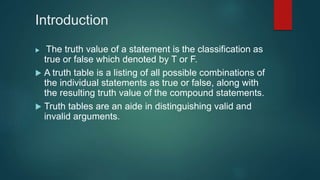
 The truth value of a statement is the classification as
true or false which denoted by T or F.
 A truth table is a listing of all possible combinations of
the individual statements as true or false, along with
the resulting truth value of the compound statements.
 Truth tables are an aide in distinguishing valid and
invalid arguments.
 Conjunction
 Disjunction
 Negation
 Logical equivalence
Conjunction
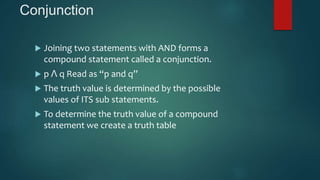
 Joining two statements with AND forms a
compound statement called a conjunction.
 p Λ q Read as “p and q”
 The truth value is determined by the possible
values of ITS sub statements.
 To determine the truth value of a compound
statement we create a truth table
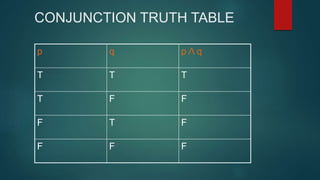
CONJUNCTION TRUTH TABLE
p q p Λ q
T T T
T F F
F T F
F F F
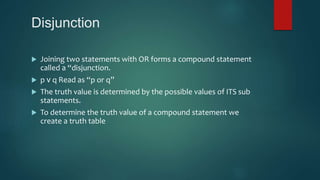
Disjunction
 Joining two statements with OR forms a compound statement
called a “disjunction.
 p ν q Read as “p or q”
 The truth value is determined by the possible values of ITS sub
statements.
 To determine the truth value of a compound statement we
create a truth table
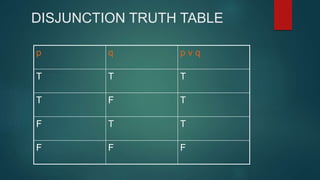
DISJUNCTION TRUTH TABLE
p q p ν q
T T T
T F T
F T T
F F F
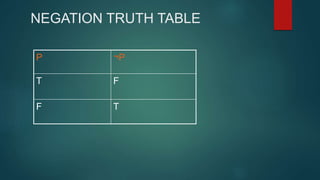
NEGATION
 ¬Type equation here. p read as not p
 Negation reverses the truth value of any statement
NEGATION TRUTH TABLE
P ¬P
T F
F T
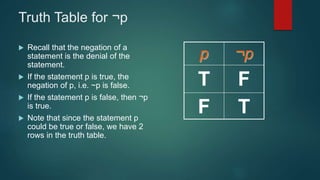
Truth Table for ¬p
 Recall that the negation of a
statement is the denial of the
statement.
 If the statement p is true, the
negation of p, i.e. ~p is false.
 If the statement p is false, then ¬p
is true.
 Note that since the statement p
could be true or false, we have 2
rows in the truth table.
p ¬p
T F
F T
LOGICAL EQUIVALENCE
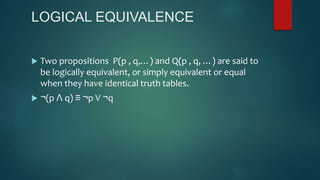
 Two propositions P(p , q,…) and Q(p , q, …) are said to
be logically equivalent, or simply equivalent or equal
when they have identical truth tables.
 ¬(p Λ q) ≡ ¬p V ¬q
Logical Equivalence
p q p^q ¬(p^q)
T T T F
T F F T
F T F T
F F F T
p q ¬p ¬q ¬pV¬q
T T F F F
T F F T T
F T T F T
F F T T T
Truth Table for p ^ q
 Recall that the conjunction is the
joining of two statements with the
word and.
 The number of rows in this truth
table will be 4. (Since p has 2 values,
and q has 2 value.)
 For p ^ q to be true, then both
statements p, q, must be true.
 If either statement or if both
statements are false, then the
conjunction is false.
p q p ^ q
T T T
T F F
F T F
F F F
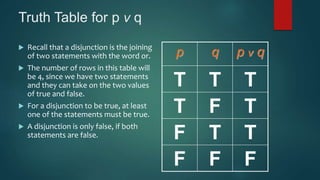
Truth Table for p v q
 Recall that a disjunction is the joining
of two statements with the word or.
 The number of rows in this table will
be 4, since we have two statements
and they can take on the two values
of true and false.
 For a disjunction to be true, at least
one of the statements must be true.
 A disjunction is only false, if both
statements are false.
p q p v q
T T T
T F T
F T T
F F F
Truth Table for p  q
 Recall that conditional is a compound
statement of the form “if p then q”.
 Think of a conditional as a promise.
 If I don’t keep my promise, in other
words q is false, then the conditional
is false if the premise is true.
 If I keep my promise, that is q is true,
and the premise is true, then the
conditional is true.
 When the premise is false (i.e. p is
false), then there was no promise.
Hence by default the conditional is
true.
p q p  q
T T T
T F F
F T T
F F T
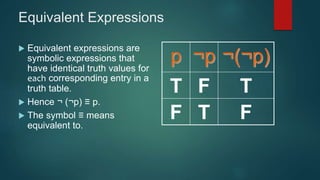
Equivalent Expressions
 Equivalent expressions are
symbolic expressions that
have identical truth values for
each corresponding entry in a
truth table.
 Hence ¬ (¬p) ≡ p.
 The symbol ≡ means
equivalent to.
p ¬p ¬(¬p)
T F T
F T F
De Morgan’s Laws
 The negation of the conjunction p ^ q is given by ~(p ^ q) ≡ ~p v ~q.
“Not p and q” is equivalent to “not p or not q.”
 The negation of the disjunction p v q is given by ~(p v q) ≡ ~p ^ ~q.
“Not p or q” is equivalent to “not p and not q.”

Discrete math Truth Table

  • 1.
    Topic: Truth table DiscreteMathematics Department of CSE
  • 2.
    Introduction  The truthvalue of a statement is the classification as true or false which denoted by T or F.  A truth table is a listing of all possible combinations of the individual statements as true or false, along with the resulting truth value of the compound statements.  Truth tables are an aide in distinguishing valid and invalid arguments.
  • 3.
     Conjunction  Disjunction Negation  Logical equivalence
  • 4.
    Conjunction  Joining twostatements with AND forms a compound statement called a conjunction.  p Λ q Read as “p and q”  The truth value is determined by the possible values of ITS sub statements.  To determine the truth value of a compound statement we create a truth table
  • 5.
    CONJUNCTION TRUTH TABLE pq p Λ q T T T T F F F T F F F F
  • 6.
    Disjunction  Joining twostatements with OR forms a compound statement called a “disjunction.  p ν q Read as “p or q”  The truth value is determined by the possible values of ITS sub statements.  To determine the truth value of a compound statement we create a truth table
  • 7.
    DISJUNCTION TRUTH TABLE pq p ν q T T T T F T F T T F F F
  • 8.
    NEGATION  ¬Type equationhere. p read as not p  Negation reverses the truth value of any statement
  • 9.
  • 10.
    Truth Table for¬p  Recall that the negation of a statement is the denial of the statement.  If the statement p is true, the negation of p, i.e. ~p is false.  If the statement p is false, then ¬p is true.  Note that since the statement p could be true or false, we have 2 rows in the truth table. p ¬p T F F T
  • 11.
    LOGICAL EQUIVALENCE  Twopropositions P(p , q,…) and Q(p , q, …) are said to be logically equivalent, or simply equivalent or equal when they have identical truth tables.  ¬(p Λ q) ≡ ¬p V ¬q
  • 12.
    Logical Equivalence p qp^q ¬(p^q) T T T F T F F T F T F T F F F T p q ¬p ¬q ¬pV¬q T T F F F T F F T T F T T F T F F T T T
  • 13.
    Truth Table forp ^ q  Recall that the conjunction is the joining of two statements with the word and.  The number of rows in this truth table will be 4. (Since p has 2 values, and q has 2 value.)  For p ^ q to be true, then both statements p, q, must be true.  If either statement or if both statements are false, then the conjunction is false. p q p ^ q T T T T F F F T F F F F
  • 14.
    Truth Table forp v q  Recall that a disjunction is the joining of two statements with the word or.  The number of rows in this table will be 4, since we have two statements and they can take on the two values of true and false.  For a disjunction to be true, at least one of the statements must be true.  A disjunction is only false, if both statements are false. p q p v q T T T T F T F T T F F F
  • 15.
    Truth Table forp  q  Recall that conditional is a compound statement of the form “if p then q”.  Think of a conditional as a promise.  If I don’t keep my promise, in other words q is false, then the conditional is false if the premise is true.  If I keep my promise, that is q is true, and the premise is true, then the conditional is true.  When the premise is false (i.e. p is false), then there was no promise. Hence by default the conditional is true. p q p  q T T T T F F F T T F F T
  • 16.
    Equivalent Expressions  Equivalentexpressions are symbolic expressions that have identical truth values for each corresponding entry in a truth table.  Hence ¬ (¬p) ≡ p.  The symbol ≡ means equivalent to. p ¬p ¬(¬p) T F T F T F
  • 17.
    De Morgan’s Laws The negation of the conjunction p ^ q is given by ~(p ^ q) ≡ ~p v ~q. “Not p and q” is equivalent to “not p or not q.”  The negation of the disjunction p v q is given by ~(p v q) ≡ ~p ^ ~q. “Not p or q” is equivalent to “not p and not q.”