ICRU reports in External Beam
Radiotherapy
-Dr Deepika Malik
-Resident Radiation Oncology
ICRU
• originally known as the International X-Ray Unit
Committee
• later named International Committee for
Radiological Units
• Conceived at the First International Congress of
Radiology (ICR) in London in 1925 and officially
came into being at ICR-2 in Stockholm in 1928.
• Initially meetings were held every 3 years at ICR
congresses with one physicist and one radiologist
from each participating country
In the late 1950s the ICRU started publishing
reports on an irregular basis - on average two
to three a year.
 In 2001 the publication cycle was regularised
and reports are now published bi-annually
under the banner "Journal of the ICRU"
Principal objective of ICRU
The development of internationally accepted
recommendations regarding:
• (1) quantities and units of radiation and radioactivity;
• (2) procedures suitable for the measurement and
application of these quantities in diagnostic radiology,
radiation therapy, radiation biology, nuclear medicine,
radiation protection, and industrial and environmental
activities;
• (3) physical data needed in the application of these
procedures, the use of which assures uniformity in
reporting.
ICRU reports pertaining to EBRT
photon therapy
ICRU Report 29
“Dose specification for reporting external beam
therapy in photons and electrons”
• The ICRU first addressed the issue of
consistent volume and dose specification in
radiation therapy with the publication of ICRU
Report 29 in 1978.
• Even though published in the 2D era, it attempted to
address spatial uncertainties by pointing out that the size
and shape of a target volume may change during the
course of a treatment and that one should take into
account the following parameters when describing the
target volume-
• 1. expected movements (e.g., caused by breathing) of those
tissues that contain the target volume relative to anatomic
reference points (e.g., skin markings, suprasternal notch),
• 2.expected variation in shape and size of the target volume
during a course of treatment (e.g., urinary bladder,
stomach), and
• 3.inaccuracies or variations in treatment setup during the
course of treatment.
What all was defined by ICRU 29
• Target Volume
• Treatment Volume
• Irradiated Volume
• Organs at Risk
• Hot Spot
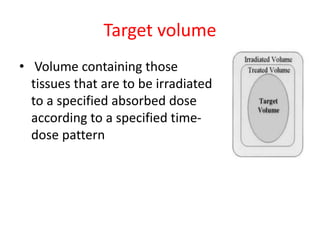
Target volume
• Volume containing those
tissues that are to be irradiated
to a specified absorbed dose
according to a specified time-
dose pattern
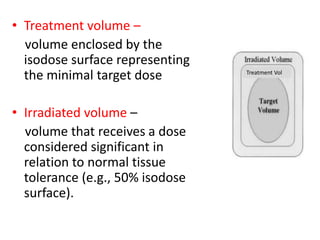
• Treatment volume –
volume enclosed by the
isodose surface representing
the minimal target dose
• Irradiated volume –
volume that receives a dose
considered significant in
relation to normal tissue
tolerance (e.g., 50% isodose
surface).
Treatment Vol
• Organs at risk (OAR) - specially radiosensitive
organs in or near the target volume whose
presence influences treatment planning and/or
prescribed dose.
• Hot Spot- tissues outside the target area that
received a dose higher than 100% of the specified
target dose ; and was considered clinically
meaningful only if the corresponding isodose
curve enclosed an area of at least 2 cm2 in a
section.
• ICRU Report 29 recommendations were well
suited for the technology of the 1970s and
1980s, that is, using a conventional simulator
to generate a planning radiograph for
designing beam portals based on bony and
soft tissue landmarks for standardized beam
arrangement techniques applied to whole
classes of comparable patients.
Limitations of ICRU 29
• Did not address the issues of coordinate
systems (e.g., patient vs. treatment machine)
• No attempt was made to define and separate
the margins for the different types of
uncertainties
ICRU Report 50
“Prescribing, Recording, and Reporting photon
beam therapy”
• In 1993, the ICRU updated its
recommendations for specifying dose/volume
in Report 50, and were well suited for
conformal therapy
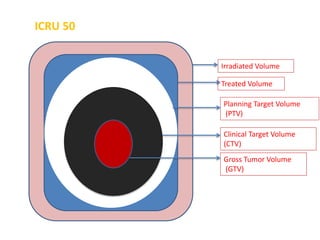
Gross tumour volume
Clinical target volume
Planning target volume
Organs at risk
Treated volume
Irradiated volume
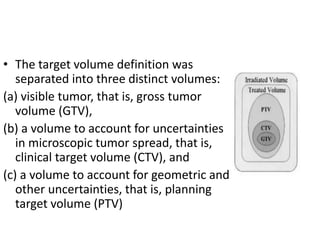
• The target volume definition was
separated into three distinct volumes:
(a) visible tumor, that is, gross tumor
volume (GTV),
(b) a volume to account for uncertainties
in microscopic tumor spread, that is,
clinical target volume (CTV), and
(c) a volume to account for geometric and
other uncertainties, that is, planning
target volume (PTV)
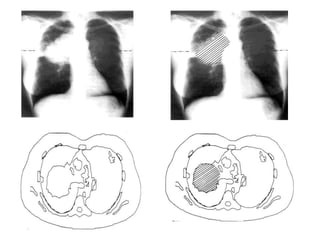
• Gross Tumour Volume-
• Gross demonstrable extent and location of the
disease
• It consists of :
- Primary tumor(GTV primary)( GTV –T)
- Metastatic lymphadenopathy(GTV nodal)(GTV-N)
- Other metastasis(GTV M)
• Determination of shape,size and location of the GTV
• Clinical examination
(Inspection, palpation, endoscopy)
• Various imaging techniques
X-ray,CT,USG,MRI ,Radionucleotide methods like PET
• Corresponds to those parts of the malignant
growthwhere the tumor density is largest.
• If the tumor has been removed prior to
radiotherapy then no GTV can be defined.
Significance of identification of GTV :
• 1. An adequate dose should be delivered to
the whole of GTV to obtain local tumor
control in radical treatments.
• 2. To allow for recording of tumor response in
relation to dose and its variation, and to other
relevant factors.
• Clinical Target Volume-
• tissue volume that contains a GTV and/or
subclinical microscopic disease, which has to
be eliminated
• In specifying the CTV, the physician must not
only consider microextensions of the disease
near the GTV, but also the natural avenues of
spread for the particular disease and site,
including lymph node, perivascular, and
perineural extensions
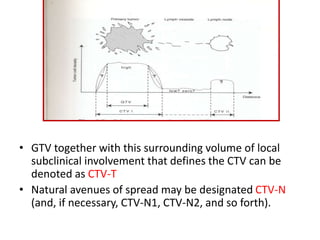
• GTV together with this surrounding volume of local
subclinical involvement that defines the CTV can be
denoted as CTV-T
• Natural avenues of spread may be designated CTV-N
(and, if necessary, CTV-N1, CTV-N2, and so forth).
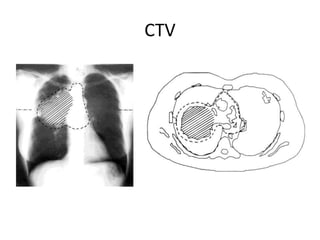
CTV
• The delineation of GTV and CTV are based on
purely anatomic-topographic and biological
considerations without regard to technical
factors of treatment.
• Planning Target Volume-
• geometrical concept,
• defined to select appropriate beam sizes and
beam arrangements, taking into consideration
the net effect of all the possible geometrical
varaitions and inaccuracies in order to ensure
that the prescribed dose is actually absorbed
in the CTV.
• PTV is defined by specifying the margins that must be
added around the CTV to manage the effects of organ,
tumor and patient movements, inaccuracies in beam
and patient setup, and any other uncertainties.
• The PTV is a static, geometrical concept used for
treatment planning and for specification of dose.
• Its size and shape depend primarily on that of the
GTV/CTV and the effects caused by internal motions of
organs and the tumor, technical aspects of treatment
technique (e.g., patient fixation).
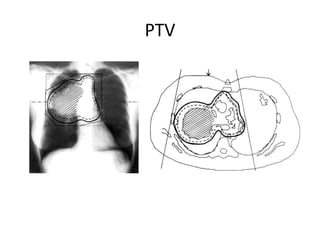
• The PTV can be considered a 3D envelope in
which the tumor and any microscopic
extensions reside and move within this
envelope.
• Once the PTV is defined, appropriate beam
sizes to account for penumbra and beam
arrangements must be selected to ensure the
desired dose coverage of the PTV.
PTV
• Multiple PTVs may be defined for a patient's
radiation therapy treatment.
• For example, it is common practice to plan a
higher dose to the PTV enclosing the GTV, and
a lower dose to the PTV containing the CTV.
• Such planning volumes are typically
subscripted using the dose level prescribed;
for example, PTVs for 66 Gy and 54 Gy can be
represented as PTV66 and PTV54.
• ICRU Report 50 retained the definition of the two dose
volumes defined in ICRU Report 29,
• changing the treatment volume name to treated
volume, and refining the definition-- volume enclosed
by an isodose surface, selected and specified by the
radiation oncologist as being appropriate to achieve
the purpose of treatment (e.g., tumor eradication,
palliation
• irradiated volume as that tissue volume that receives a
dose that is considered significant in relation to normal
tissue tolerance.
• The hot spot definition was modified
- volume outside the PTV that received a dose
larger than 100% of the specified PTV dose.
;considered clinically meaningful only if the
minimum diameter exceeded 15 mm (note:
previously it had been 2 cm2).
- However, if the hot spot occurs in a small organ,
such as the optic nerve, a dimension smaller
than the recommended 15 mm should be
considered.
ICRU 50
Irradiated Volume
Treated Volume
Planning Target Volume
(PTV)
Clinical Target Volume
(CTV)
Gross Tumor Volume
(GTV)
ICRU -62
Supplement to ICRU Report No: 50
• In response to the developments, in imaging
procedures (e.g., PET, MRI) which even more
information on functionality, the location, shape,
and limits of tumor/target volumes, and organs at
risk.; and advent of IMRT;
• ICRU in 1999 published Report 62
• expanded on some of the definitions and
concepts of Report 50
• intended to complement the recommendations
contained in Report 50, and not to replace it.
ICRU-62
• Gives more detailed recommendations on the
differentmargins that must be considered to
account for anatomical and geometrical
variations and uncertainties.
• Introduces a Conformity Index ( CI )
• Gives information about how to classify Organs at
Risk.
• Introduces a Planning Organ at Risk Volume ( PRV
)
• Gives recommendations on graphics.
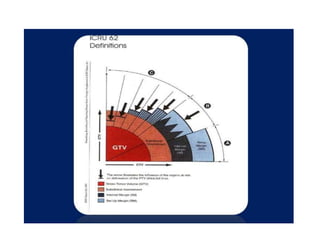
• Volumes defined prior to treatment planning : - -
-Gross Tumor Volume (GTV) Same as ICRU 50
- Clinical Target Volume (CTV)
• Volumes defined during the treatment planning :
- Planning target Volume (PTV)
- Treated Volume
- Irradiated Volume
- Planning Organ at Risk Volume (PRV)
Redefined the definition of PTV by introducing
the concept of
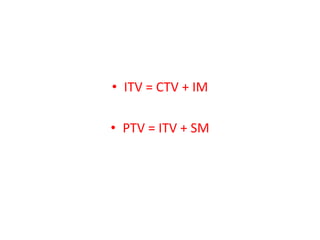
• Internal margin
• Setup margin
these two types of margins is needed as they
compensate for different types of
uncertainties
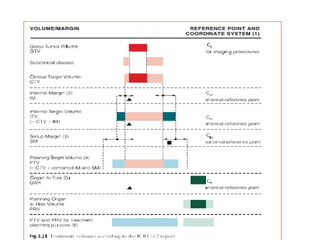
• Internal margin -to take into account
variations in size, shape, and position of the
CTV in reference to the patient's coordinate
system using anatomic reference points
• Internal margin uncertainties are due to
physiologic variations (e.g., filling of rectum,
movements due to respiration) and are
difficult or almost impossible to control from a
practical viewpoint
• Setup margin -to take into account all
uncertainties in patient-beam positioning in
reference to the treatment machine
coordinate system
• Setup margin uncertainties are related largely
to technical factors that can be dealt with by
- more accurate setup and immobilization of
the patient
- improved mechanical stability of the machine
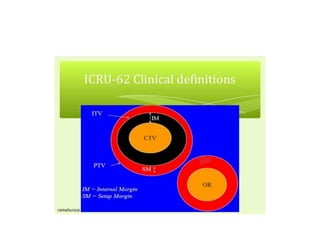
• ITV = CTV + IM
• PTV = ITV + SM
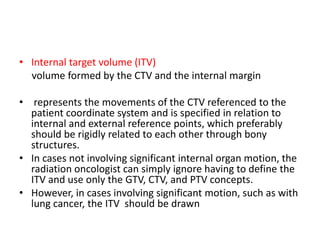
• Internal target volume (ITV)
volume formed by the CTV and the internal margin
• represents the movements of the CTV referenced to the
patient coordinate system and is specified in relation to
internal and external reference points, which preferably
should be rigidly related to each other through bony
structures.
• In cases not involving significant internal organ motion, the
radiation oncologist can simply ignore having to define the
ITV and use only the GTV, CTV, and PTV concepts.
• However, in cases involving significant motion, such as with
lung cancer, the ITV should be drawn
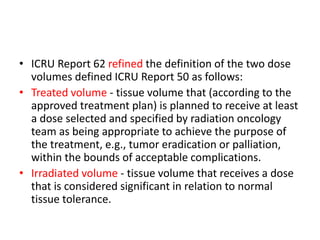
• ICRU Report 62 refined the definition of the two dose
volumes defined ICRU Report 50 as follows:
• Treated volume - tissue volume that (according to the
approved treatment plan) is planned to receive at least
a dose selected and specified by radiation oncology
team as being appropriate to achieve the purpose of
the treatment, e.g., tumor eradication or palliation,
within the bounds of acceptable complications.
• Irradiated volume - tissue volume that receives a dose
that is considered significant in relation to normal
tissue tolerance.
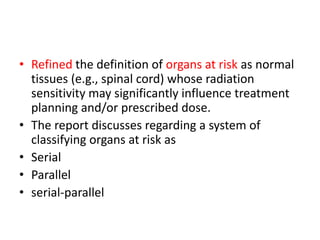
• Refined the definition of organs at risk as normal
tissues (e.g., spinal cord) whose radiation
sensitivity may significantly influence treatment
planning and/or prescribed dose.
• The report discusses regarding a system of
classifying organs at risk as
• Serial
• Parallel
• serial-parallel
CLASSIFICATION OF ORGANS AT RISK
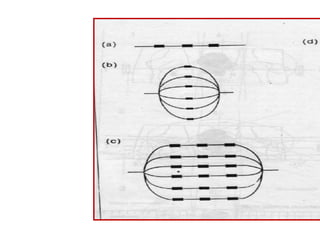
• Classified as :
Serial – organ is a continuous unit and damage at one
point will cause complete damage of the organ (spinal
cord, digestive system). So even point dose is
significant.
Parallel – organ consists of several functional units
and if one part is damaged, the rest of the organ
makes up for the loss (lung, bladder). Dose delivered
to a given volume or average/mean dose is considered
Serial-parallel – kidney (glomerulus- parallel, tubules-
serial), heart (myocardium- parallel, coronary arteries-
serial).
• Report 62 also addressed what was perhaps
the most criticized limitation of Report 50,
which was that it did not provide a method to
account for organ at risk movements and
changes in shape and/or size, as well as setup
uncertainties
Planning organ at risk volume (PRV), in which a margin is
added around the organ at risk to compensate for that
organ's geometric uncertainties.
• The PRV margin around the organ at risk is analogous
to the PTV margin around the CTV.
• For example, it is common practice to add a 0.5-cm
rind around the spinal cord contour.
• PTV and the PRV may overlap, and often do so, which
implies searching for a compromise in weighting the
importance of each in the planning process
• CONFORMITY INDEX ( CI )
• It is defined as the quotient of the Treated
Volume and the volume of PTV.
• It can be employed when the PTV is fully
enclosed by the Treated Volume.
• It can be used as a part of the optimization
procedure ?
GRAPHICS
• These are used to delineate the different volumes and the
other landmarks.
• These are in different colors for an easy and uniform
interpretation.
• The convention recommended and used in ICRU 62 are:
GTV - Dark Red
CTV – Light Red
ITV – Dark Blue
PTV – Light Blue
OR – Dark Green
PRV – Light Green
Landmarks - Black
Doses
• ICRU Reports 50 and 62 define a series of
doses, including the
• Minimum dose
• Maximum dose
• ICRU Reference Dose (defined at the ICRU
Reference Point).
• The ICRU Reference Point for a particular
treatment plan should be chosen based on
the following criteria:
-be clinically relevant and can be defined in an
unambiguous way;
-be located where the dose can be accurately
determined; and
-be located in a region where there are no steep
dose gradients
• In general, this point should be in the central
part of the PTV.
• In cases where the treatment beams intersect
at a given point, it is recommended that the
intersection point be chosen as the ICRU
Reference Point.
• Note- ICRU Reports 50 and 62 do not make
strict recommendations regarding dose
prescription; rather ICRU states that the
radiation oncologist should have the freedom
to prescribe the parameters in his/her own
way, mainly using what is current practice to
produce an expected clinical outcome of the
treatment
MAXIMUM DOSE ( Dmax )
• It is the maximum dose to the PTV and the Organ at Risk.
• The maximum dose to normal tissue is important for
limiting and for evaluating the side-effects of treatment.
• Dose is reported as maximum only when a volume of
tissue of diameter more than 15mm is involved (smaller
volumes are considered for smaller organs like eye, optic
nerve, larynx).
• When the maximum dose outside PTV exceeds the
prescribed dose, then a “Hot Spot” can be identified.
MINIMUM DOSE ( Dmin )
• It is the smallest dose in a defined volume.
• In contrast to maximum adsorbed dose, no volume limit
is recommended when reporting minimum dose.
• According to the recommendations of ICRU, as
a basic requirement, the following doses
should always be reported :
• • the dose at ICRU reference point •
• the maximum dose to the PTV •
• the minimum dose to the PTV
• Thank you

Icru reports in external beam radiotherapy

  • 1.
    ICRU reports inExternal Beam Radiotherapy -Dr Deepika Malik -Resident Radiation Oncology
  • 2.
    ICRU • originally knownas the International X-Ray Unit Committee • later named International Committee for Radiological Units • Conceived at the First International Congress of Radiology (ICR) in London in 1925 and officially came into being at ICR-2 in Stockholm in 1928. • Initially meetings were held every 3 years at ICR congresses with one physicist and one radiologist from each participating country
  • 3.
    In the late1950s the ICRU started publishing reports on an irregular basis - on average two to three a year.  In 2001 the publication cycle was regularised and reports are now published bi-annually under the banner "Journal of the ICRU"
  • 4.
    Principal objective ofICRU The development of internationally accepted recommendations regarding: • (1) quantities and units of radiation and radioactivity; • (2) procedures suitable for the measurement and application of these quantities in diagnostic radiology, radiation therapy, radiation biology, nuclear medicine, radiation protection, and industrial and environmental activities; • (3) physical data needed in the application of these procedures, the use of which assures uniformity in reporting.
  • 5.
    ICRU reports pertainingto EBRT photon therapy
  • 6.
    ICRU Report 29 “Dosespecification for reporting external beam therapy in photons and electrons”
  • 7.
    • The ICRUfirst addressed the issue of consistent volume and dose specification in radiation therapy with the publication of ICRU Report 29 in 1978.
  • 8.
    • Even thoughpublished in the 2D era, it attempted to address spatial uncertainties by pointing out that the size and shape of a target volume may change during the course of a treatment and that one should take into account the following parameters when describing the target volume- • 1. expected movements (e.g., caused by breathing) of those tissues that contain the target volume relative to anatomic reference points (e.g., skin markings, suprasternal notch), • 2.expected variation in shape and size of the target volume during a course of treatment (e.g., urinary bladder, stomach), and • 3.inaccuracies or variations in treatment setup during the course of treatment.
  • 9.
    What all wasdefined by ICRU 29 • Target Volume • Treatment Volume • Irradiated Volume • Organs at Risk • Hot Spot
  • 10.
    Target volume • Volumecontaining those tissues that are to be irradiated to a specified absorbed dose according to a specified time- dose pattern
  • 11.
    • Treatment volume– volume enclosed by the isodose surface representing the minimal target dose • Irradiated volume – volume that receives a dose considered significant in relation to normal tissue tolerance (e.g., 50% isodose surface). Treatment Vol
  • 12.
    • Organs atrisk (OAR) - specially radiosensitive organs in or near the target volume whose presence influences treatment planning and/or prescribed dose. • Hot Spot- tissues outside the target area that received a dose higher than 100% of the specified target dose ; and was considered clinically meaningful only if the corresponding isodose curve enclosed an area of at least 2 cm2 in a section.
  • 13.
    • ICRU Report29 recommendations were well suited for the technology of the 1970s and 1980s, that is, using a conventional simulator to generate a planning radiograph for designing beam portals based on bony and soft tissue landmarks for standardized beam arrangement techniques applied to whole classes of comparable patients.
  • 14.
    Limitations of ICRU29 • Did not address the issues of coordinate systems (e.g., patient vs. treatment machine) • No attempt was made to define and separate the margins for the different types of uncertainties
  • 15.
    ICRU Report 50 “Prescribing,Recording, and Reporting photon beam therapy”
  • 16.
    • In 1993,the ICRU updated its recommendations for specifying dose/volume in Report 50, and were well suited for conformal therapy
  • 17.
    Gross tumour volume Clinicaltarget volume Planning target volume Organs at risk Treated volume Irradiated volume
  • 18.
    • The targetvolume definition was separated into three distinct volumes: (a) visible tumor, that is, gross tumor volume (GTV), (b) a volume to account for uncertainties in microscopic tumor spread, that is, clinical target volume (CTV), and (c) a volume to account for geometric and other uncertainties, that is, planning target volume (PTV)
  • 19.
    • Gross TumourVolume- • Gross demonstrable extent and location of the disease • It consists of : - Primary tumor(GTV primary)( GTV –T) - Metastatic lymphadenopathy(GTV nodal)(GTV-N) - Other metastasis(GTV M)
  • 20.
    • Determination ofshape,size and location of the GTV • Clinical examination (Inspection, palpation, endoscopy) • Various imaging techniques X-ray,CT,USG,MRI ,Radionucleotide methods like PET
  • 21.
    • Corresponds tothose parts of the malignant growthwhere the tumor density is largest. • If the tumor has been removed prior to radiotherapy then no GTV can be defined.
  • 22.
    Significance of identificationof GTV : • 1. An adequate dose should be delivered to the whole of GTV to obtain local tumor control in radical treatments. • 2. To allow for recording of tumor response in relation to dose and its variation, and to other relevant factors.
  • 24.
    • Clinical TargetVolume- • tissue volume that contains a GTV and/or subclinical microscopic disease, which has to be eliminated
  • 25.
    • In specifyingthe CTV, the physician must not only consider microextensions of the disease near the GTV, but also the natural avenues of spread for the particular disease and site, including lymph node, perivascular, and perineural extensions
  • 26.
    • GTV togetherwith this surrounding volume of local subclinical involvement that defines the CTV can be denoted as CTV-T • Natural avenues of spread may be designated CTV-N (and, if necessary, CTV-N1, CTV-N2, and so forth).
  • 27.
  • 28.
    • The delineationof GTV and CTV are based on purely anatomic-topographic and biological considerations without regard to technical factors of treatment.
  • 29.
    • Planning TargetVolume- • geometrical concept, • defined to select appropriate beam sizes and beam arrangements, taking into consideration the net effect of all the possible geometrical varaitions and inaccuracies in order to ensure that the prescribed dose is actually absorbed in the CTV.
  • 30.
    • PTV isdefined by specifying the margins that must be added around the CTV to manage the effects of organ, tumor and patient movements, inaccuracies in beam and patient setup, and any other uncertainties. • The PTV is a static, geometrical concept used for treatment planning and for specification of dose. • Its size and shape depend primarily on that of the GTV/CTV and the effects caused by internal motions of organs and the tumor, technical aspects of treatment technique (e.g., patient fixation).
  • 31.
    • The PTVcan be considered a 3D envelope in which the tumor and any microscopic extensions reside and move within this envelope. • Once the PTV is defined, appropriate beam sizes to account for penumbra and beam arrangements must be selected to ensure the desired dose coverage of the PTV.
  • 32.
  • 33.
    • Multiple PTVsmay be defined for a patient's radiation therapy treatment. • For example, it is common practice to plan a higher dose to the PTV enclosing the GTV, and a lower dose to the PTV containing the CTV. • Such planning volumes are typically subscripted using the dose level prescribed; for example, PTVs for 66 Gy and 54 Gy can be represented as PTV66 and PTV54.
  • 34.
    • ICRU Report50 retained the definition of the two dose volumes defined in ICRU Report 29, • changing the treatment volume name to treated volume, and refining the definition-- volume enclosed by an isodose surface, selected and specified by the radiation oncologist as being appropriate to achieve the purpose of treatment (e.g., tumor eradication, palliation • irradiated volume as that tissue volume that receives a dose that is considered significant in relation to normal tissue tolerance.
  • 35.
    • The hotspot definition was modified - volume outside the PTV that received a dose larger than 100% of the specified PTV dose. ;considered clinically meaningful only if the minimum diameter exceeded 15 mm (note: previously it had been 2 cm2). - However, if the hot spot occurs in a small organ, such as the optic nerve, a dimension smaller than the recommended 15 mm should be considered.
  • 36.
    ICRU 50 Irradiated Volume TreatedVolume Planning Target Volume (PTV) Clinical Target Volume (CTV) Gross Tumor Volume (GTV)
  • 37.
    ICRU -62 Supplement toICRU Report No: 50
  • 38.
    • In responseto the developments, in imaging procedures (e.g., PET, MRI) which even more information on functionality, the location, shape, and limits of tumor/target volumes, and organs at risk.; and advent of IMRT; • ICRU in 1999 published Report 62 • expanded on some of the definitions and concepts of Report 50 • intended to complement the recommendations contained in Report 50, and not to replace it.
  • 39.
    ICRU-62 • Gives moredetailed recommendations on the differentmargins that must be considered to account for anatomical and geometrical variations and uncertainties. • Introduces a Conformity Index ( CI ) • Gives information about how to classify Organs at Risk. • Introduces a Planning Organ at Risk Volume ( PRV ) • Gives recommendations on graphics.
  • 40.
    • Volumes definedprior to treatment planning : - - -Gross Tumor Volume (GTV) Same as ICRU 50 - Clinical Target Volume (CTV) • Volumes defined during the treatment planning : - Planning target Volume (PTV) - Treated Volume - Irradiated Volume - Planning Organ at Risk Volume (PRV)
  • 41.
    Redefined the definitionof PTV by introducing the concept of • Internal margin • Setup margin these two types of margins is needed as they compensate for different types of uncertainties
  • 42.
    • Internal margin-to take into account variations in size, shape, and position of the CTV in reference to the patient's coordinate system using anatomic reference points • Internal margin uncertainties are due to physiologic variations (e.g., filling of rectum, movements due to respiration) and are difficult or almost impossible to control from a practical viewpoint
  • 43.
    • Setup margin-to take into account all uncertainties in patient-beam positioning in reference to the treatment machine coordinate system • Setup margin uncertainties are related largely to technical factors that can be dealt with by - more accurate setup and immobilization of the patient - improved mechanical stability of the machine
  • 44.
    • ITV =CTV + IM • PTV = ITV + SM
  • 45.
    • Internal targetvolume (ITV) volume formed by the CTV and the internal margin • represents the movements of the CTV referenced to the patient coordinate system and is specified in relation to internal and external reference points, which preferably should be rigidly related to each other through bony structures. • In cases not involving significant internal organ motion, the radiation oncologist can simply ignore having to define the ITV and use only the GTV, CTV, and PTV concepts. • However, in cases involving significant motion, such as with lung cancer, the ITV should be drawn
  • 46.
    • ICRU Report62 refined the definition of the two dose volumes defined ICRU Report 50 as follows: • Treated volume - tissue volume that (according to the approved treatment plan) is planned to receive at least a dose selected and specified by radiation oncology team as being appropriate to achieve the purpose of the treatment, e.g., tumor eradication or palliation, within the bounds of acceptable complications. • Irradiated volume - tissue volume that receives a dose that is considered significant in relation to normal tissue tolerance.
  • 47.
    • Refined thedefinition of organs at risk as normal tissues (e.g., spinal cord) whose radiation sensitivity may significantly influence treatment planning and/or prescribed dose. • The report discusses regarding a system of classifying organs at risk as • Serial • Parallel • serial-parallel
  • 48.
    CLASSIFICATION OF ORGANSAT RISK • Classified as : Serial – organ is a continuous unit and damage at one point will cause complete damage of the organ (spinal cord, digestive system). So even point dose is significant. Parallel – organ consists of several functional units and if one part is damaged, the rest of the organ makes up for the loss (lung, bladder). Dose delivered to a given volume or average/mean dose is considered Serial-parallel – kidney (glomerulus- parallel, tubules- serial), heart (myocardium- parallel, coronary arteries- serial).
  • 51.
    • Report 62also addressed what was perhaps the most criticized limitation of Report 50, which was that it did not provide a method to account for organ at risk movements and changes in shape and/or size, as well as setup uncertainties
  • 52.
    Planning organ atrisk volume (PRV), in which a margin is added around the organ at risk to compensate for that organ's geometric uncertainties. • The PRV margin around the organ at risk is analogous to the PTV margin around the CTV. • For example, it is common practice to add a 0.5-cm rind around the spinal cord contour. • PTV and the PRV may overlap, and often do so, which implies searching for a compromise in weighting the importance of each in the planning process
  • 54.
    • CONFORMITY INDEX( CI ) • It is defined as the quotient of the Treated Volume and the volume of PTV. • It can be employed when the PTV is fully enclosed by the Treated Volume. • It can be used as a part of the optimization procedure ?
  • 55.
    GRAPHICS • These areused to delineate the different volumes and the other landmarks. • These are in different colors for an easy and uniform interpretation. • The convention recommended and used in ICRU 62 are: GTV - Dark Red CTV – Light Red ITV – Dark Blue PTV – Light Blue OR – Dark Green PRV – Light Green Landmarks - Black
  • 57.
    Doses • ICRU Reports50 and 62 define a series of doses, including the • Minimum dose • Maximum dose • ICRU Reference Dose (defined at the ICRU Reference Point).
  • 58.
    • The ICRUReference Point for a particular treatment plan should be chosen based on the following criteria: -be clinically relevant and can be defined in an unambiguous way; -be located where the dose can be accurately determined; and -be located in a region where there are no steep dose gradients
  • 59.
    • In general,this point should be in the central part of the PTV. • In cases where the treatment beams intersect at a given point, it is recommended that the intersection point be chosen as the ICRU Reference Point.
  • 60.
    • Note- ICRUReports 50 and 62 do not make strict recommendations regarding dose prescription; rather ICRU states that the radiation oncologist should have the freedom to prescribe the parameters in his/her own way, mainly using what is current practice to produce an expected clinical outcome of the treatment
  • 61.
    MAXIMUM DOSE (Dmax ) • It is the maximum dose to the PTV and the Organ at Risk. • The maximum dose to normal tissue is important for limiting and for evaluating the side-effects of treatment. • Dose is reported as maximum only when a volume of tissue of diameter more than 15mm is involved (smaller volumes are considered for smaller organs like eye, optic nerve, larynx). • When the maximum dose outside PTV exceeds the prescribed dose, then a “Hot Spot” can be identified.
  • 62.
    MINIMUM DOSE (Dmin ) • It is the smallest dose in a defined volume. • In contrast to maximum adsorbed dose, no volume limit is recommended when reporting minimum dose.
  • 63.
    • According tothe recommendations of ICRU, as a basic requirement, the following doses should always be reported : • • the dose at ICRU reference point • • the maximum dose to the PTV • • the minimum dose to the PTV
  • 64.