Learning Object
Standing Waves: Resonant Frequencies
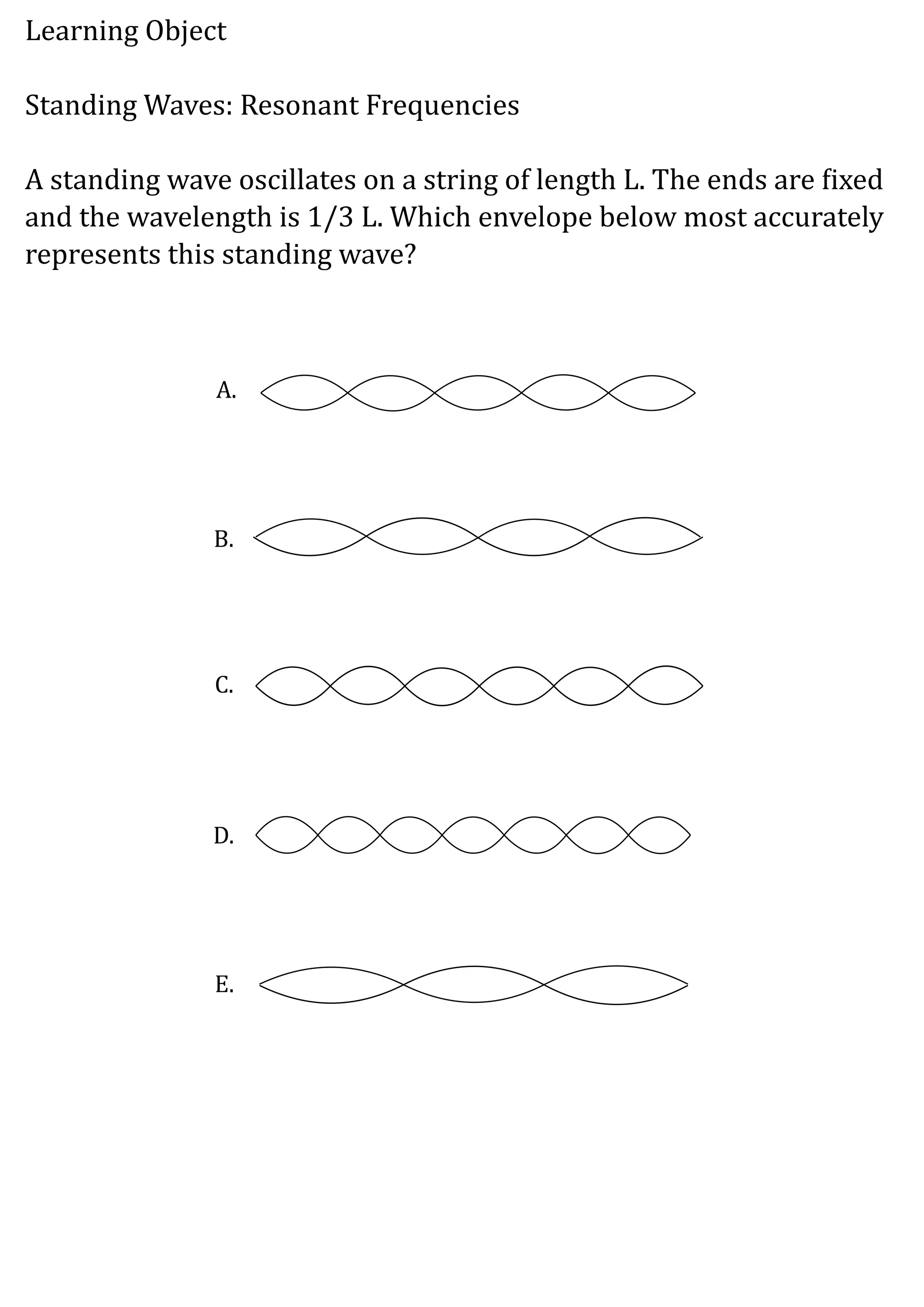
A standing wave oscillates on a string of length L. The ends are ixed
and the wavelength is 1/3 L. Which envelope below most accurately
represents this standing wave?
A.
B.
C.
D.
E.
Learning Object
Standing Waves: Resonant Frequencies
Solution
C.
Reference
R. Hawkes et al., Physics for Scientists and Engineers: An Interactive Approach, Revised Custom Vol 1. (Nelson, Toronto, CA, 2015), pp. 409-413.
Method 1 - Number of Wavelengths in L
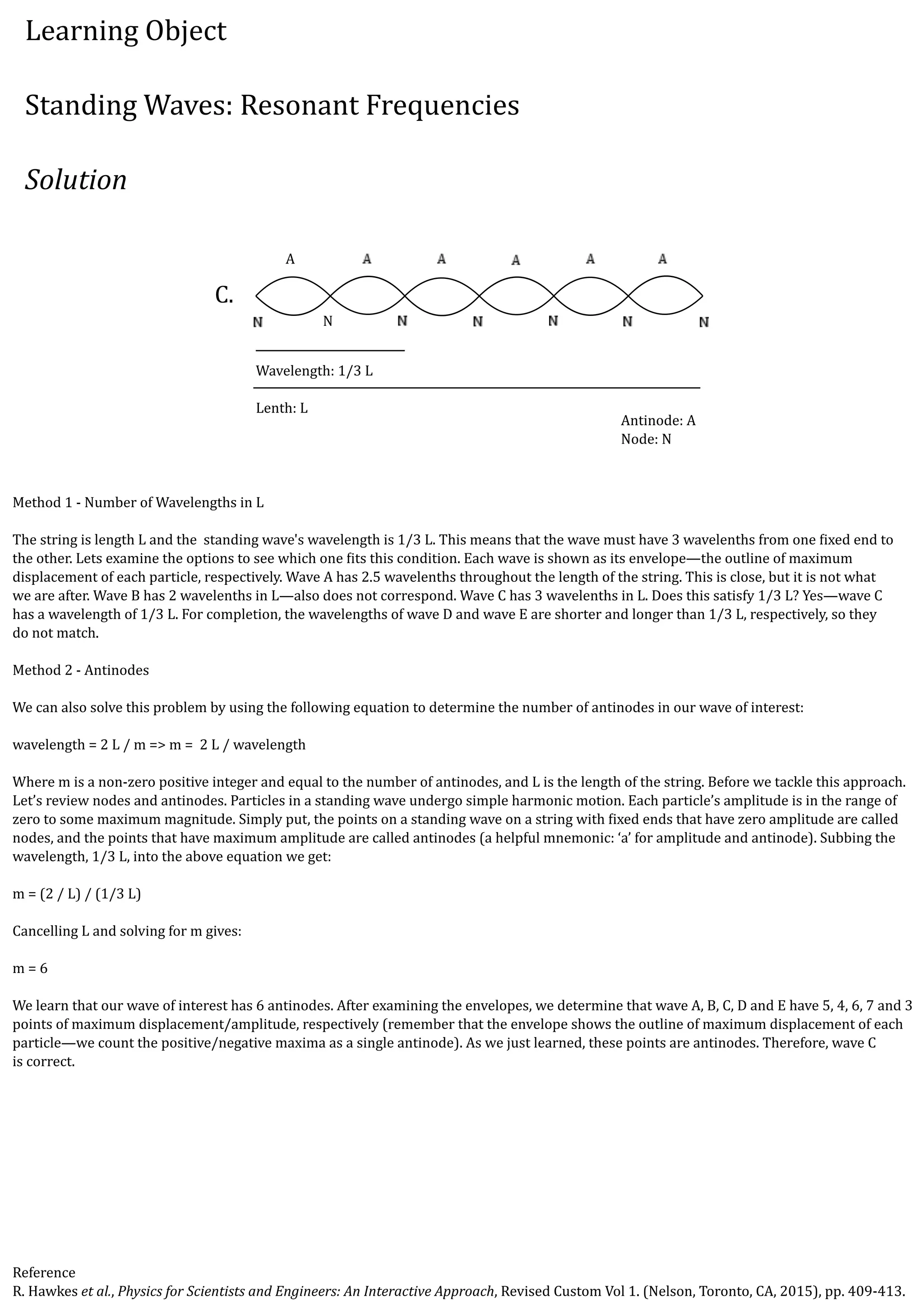
The string is length L and the standing wave's wavelength is 1/3 L. This means that the wave must have 3 wavelenths from one ixed end to
the other. Lets examine the options to see which one its this condition. Each wave is shown as its envelope—the outline of maximum
displacement of each particle, respectively. Wave A has 2.5 wavelenths throughout the length of the string. This is close, but it is not what
we are after. Wave B has 2 wavelenths in L—also does not correspond. Wave C has 3 wavelenths in L. Does this satisfy 1/3 L? Yes—wave C
has a wavelength of 1/3 L. For completion, the wavelengths of wave D and wave E are shorter and longer than 1/3 L, respectively, so they
do not match.
Method 2 - Antinodes
We can also solve this problem by using the following equation to determine the number of antinodes in our wave of interest:
wavelength = 2 L / m => m = 2 L / wavelength
Where m is a non-zero positive integer and equal to the number of antinodes, and L is the length of the string. Before we tackle this approach.
Let’s review nodes and antinodes. Particles in a standing wave undergo simple harmonic motion. Each particle’s amplitude is in the range of
zero to some maximum magnitude. Simply put, the points on a standing wave on a string with ixed ends that have zero amplitude are called
nodes, and the points that have maximum amplitude are called antinodes (a helpful mnemonic: ‘a’ for amplitude and antinode). Subbing the
wavelength, 1/3 L, into the above equation we get:
m = (2 / L) / (1/3 L)
Cancelling L and solving for m gives:
m = 6
We learn that our wave of interest has 6 antinodes. After examining the envelopes, we determine that wave A, B, C, D and E have 5, 4, 6, 7 and 3
points of maximum displacement/amplitude, respectively (remember that the envelope shows the outline of maximum displacement of each
particle—we count the positive/negative maxima as a single antinode). As we just learned, these points are antinodes. Therefore, wave C
is correct.
Antinode: A
Node: N
A
N
Wavelength: 1/3 L
Lenth: L

Standing Waves: Resonant Frequencies

  • 1.
    Learning Object Standing Waves:Resonant Frequencies A standing wave oscillates on a string of length L. The ends are ixed and the wavelength is 1/3 L. Which envelope below most accurately represents this standing wave? A. B. C. D. E.
  • 2.
    Learning Object Standing Waves:Resonant Frequencies Solution C. Reference R. Hawkes et al., Physics for Scientists and Engineers: An Interactive Approach, Revised Custom Vol 1. (Nelson, Toronto, CA, 2015), pp. 409-413. Method 1 - Number of Wavelengths in L The string is length L and the standing wave's wavelength is 1/3 L. This means that the wave must have 3 wavelenths from one ixed end to the other. Lets examine the options to see which one its this condition. Each wave is shown as its envelope—the outline of maximum displacement of each particle, respectively. Wave A has 2.5 wavelenths throughout the length of the string. This is close, but it is not what we are after. Wave B has 2 wavelenths in L—also does not correspond. Wave C has 3 wavelenths in L. Does this satisfy 1/3 L? Yes—wave C has a wavelength of 1/3 L. For completion, the wavelengths of wave D and wave E are shorter and longer than 1/3 L, respectively, so they do not match. Method 2 - Antinodes We can also solve this problem by using the following equation to determine the number of antinodes in our wave of interest: wavelength = 2 L / m => m = 2 L / wavelength Where m is a non-zero positive integer and equal to the number of antinodes, and L is the length of the string. Before we tackle this approach. Let’s review nodes and antinodes. Particles in a standing wave undergo simple harmonic motion. Each particle’s amplitude is in the range of zero to some maximum magnitude. Simply put, the points on a standing wave on a string with ixed ends that have zero amplitude are called nodes, and the points that have maximum amplitude are called antinodes (a helpful mnemonic: ‘a’ for amplitude and antinode). Subbing the wavelength, 1/3 L, into the above equation we get: m = (2 / L) / (1/3 L) Cancelling L and solving for m gives: m = 6 We learn that our wave of interest has 6 antinodes. After examining the envelopes, we determine that wave A, B, C, D and E have 5, 4, 6, 7 and 3 points of maximum displacement/amplitude, respectively (remember that the envelope shows the outline of maximum displacement of each particle—we count the positive/negative maxima as a single antinode). As we just learned, these points are antinodes. Therefore, wave C is correct. Antinode: A Node: N A N Wavelength: 1/3 L Lenth: L