1
SAJJAD 2
 What is Granulation.
 Why we need Granules.
 Types of granulation.
 Excepients.
 Modern Granulation techniques.
SAJJAD 3
 Granulation is the size enlargement process in
which primary powder particles are made to
adhere to form larger, multi particle entities
called granules.
 It is the process of collecting particles together by
creating bonds between them.
Bonds are formed by
Slugging (Dry Granulation)
or
Using a binding agent. (Wet Granulation)
SAJJAD 4
WHY we prepare Granules when we have
powders…….?
SAJJAD 5
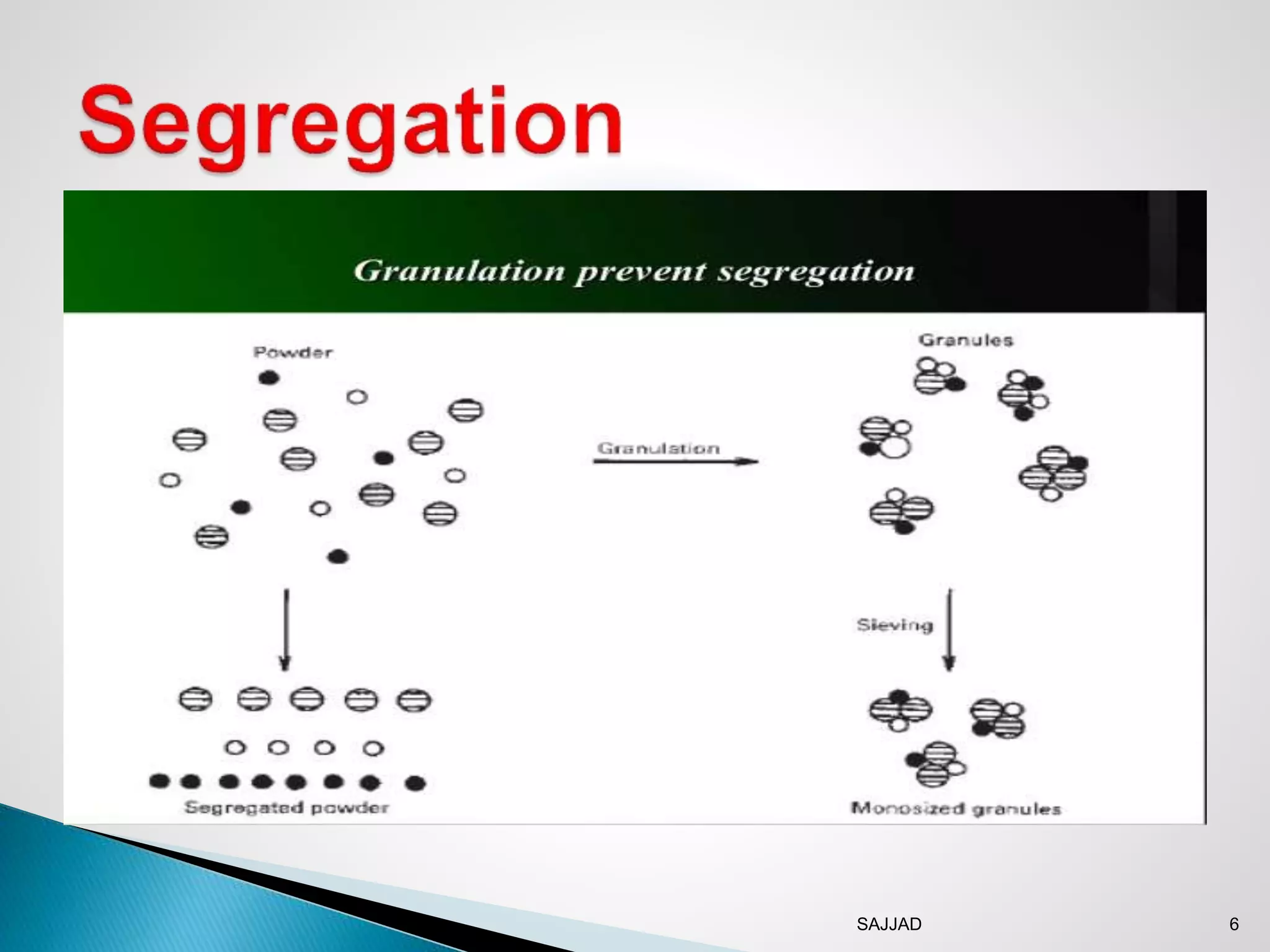
 To enhance flow of powders.
 To avoid weight variation.
 To produce uniform mixture.
 To avoid poor content uniformity.
 To improve compaction.
 To produce dust free enviornment.
 To avoid powder segregation.
SAJJAD 6
SAJJAD 7
 Wet Granulation
 Dry Granulation
 Direct Compression
SAJJAD 8
 Most widely used method.
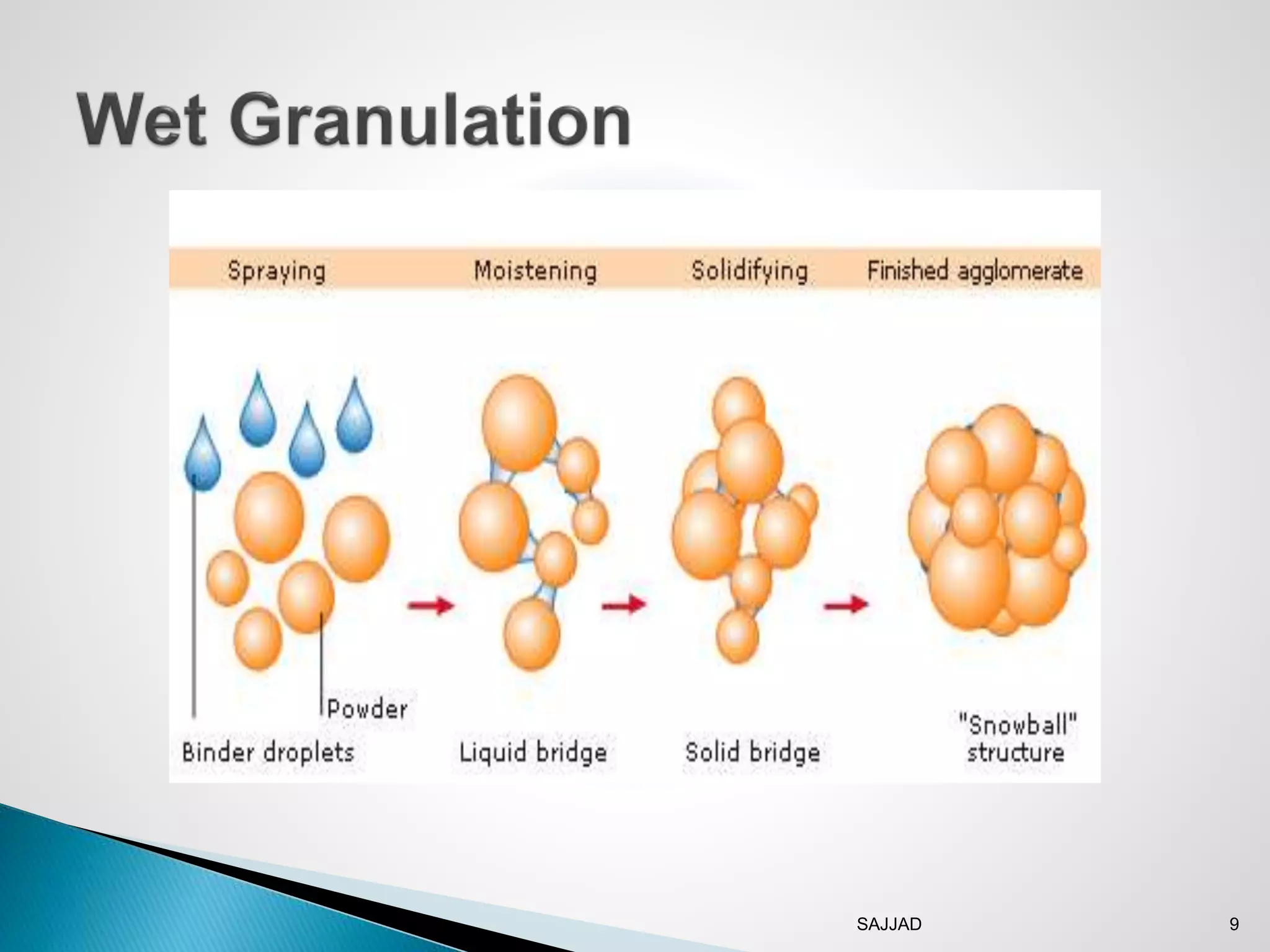
 It involves addition of liquid solution to
powder to form wet mass.
 When to use…….
 For the Products not degraded by
 Moisture
 Heat
SAJJAD 9
SAJJAD 10
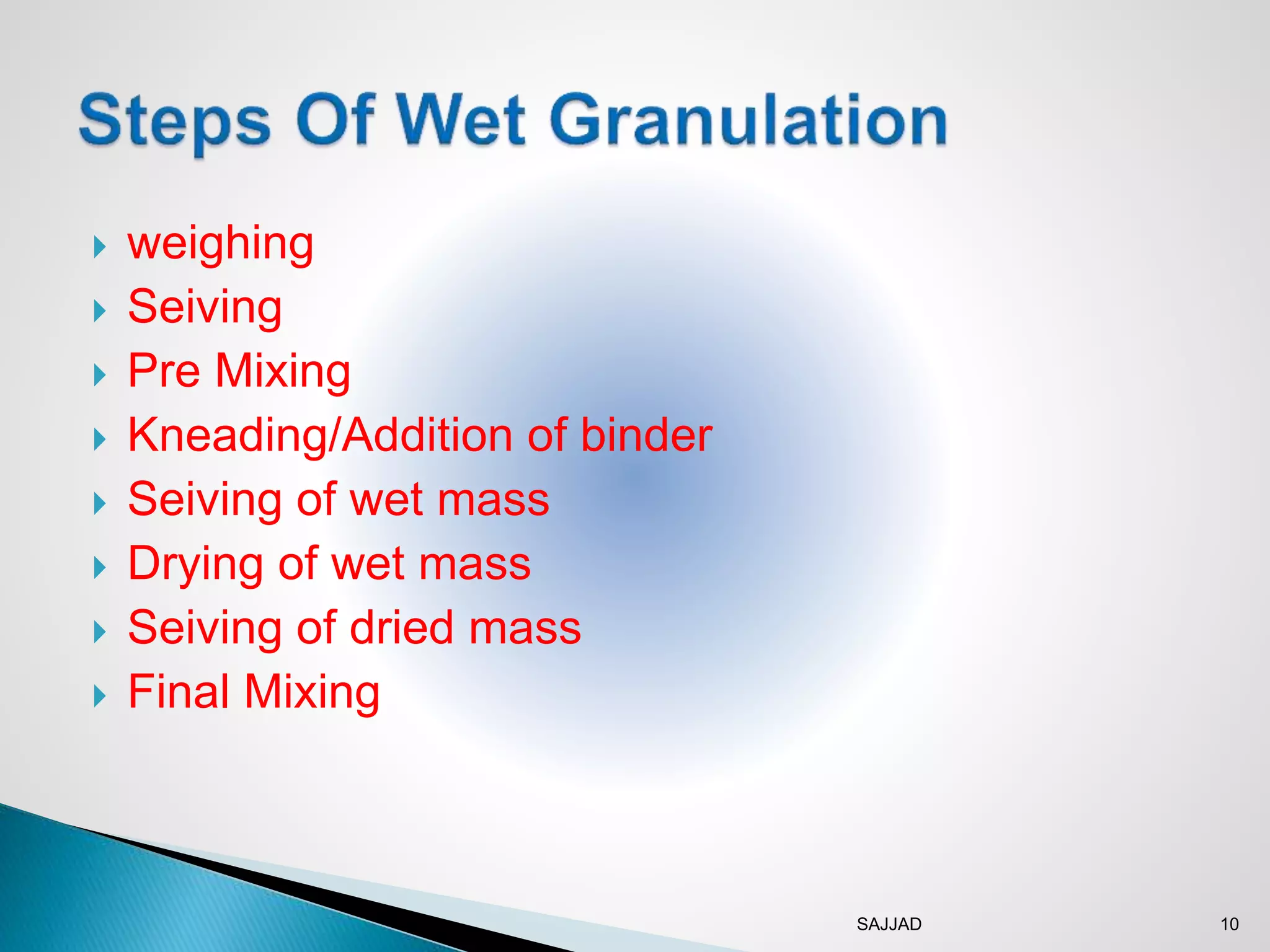
 weighing
 Seiving
 Pre Mixing
 Kneading/Addition of binder
 Seiving of wet mass
 Drying of wet mass
 Seiving of dried mass
 Final Mixing
SAJJAD 11
 Weighing
Acuretly weigh all the excepients and API.
 Sieving
 Sieving reduce particle size and ensure uniform mixing due to similar particle
size.
 Increase surface area.
 Enhance rate of dissolution.
 Different seive numbers are used.
 Pre Mixing
 To achieve optimum mixing of different ingredients for wetting.
Depends upon formulation
 API+diluents
 API+diluents+Disintegrents
Equipment used are sigma mixer,cone mixer,high sher Granulators.
SAJJAD 12
 Addition Of Binder
Binder may be in form of
 Solution (PVP in IPA)
 Suspension (HPC in IPA)
 Paste (Starch in Hot water)
Solvent used should be
 Volatile
 Non Toxic
Solvent With Or Without Binder Convert Powder into
Wet mass.
Equipment used are sigma mixer,Diosna mixer,High
sheer Granulators.
SAJJAD 13
Seiving Of wet Mass
 wet mass produced is not of uniform size.
 Wet mass is seived to obtain uniform size.
 To increase surface area of wet grains.
 Increased surface area results in decreased drying time.
Drying of wet mass
seived wet mass is dried either in
 FBD
or
 Tray dryers
Hot air evaporates solvent leaving behind dried grains.wet mass is dried
untill residual moisture content 2-3% or according to specifications.
SAJJAD 14
Seiving of Dried Mass
 Dried mass have not uniform size.
 Dried mass is seived to obtain uniform sized grains.
 Dried mass is passed throuhg a specified seive No.e.g 12,16,20 etc.
 For small size tablets higher seive no is used to facilitate uniform die
filling.
 For large size tablet usually small seive no is used.(Exception
Dissolution problem)
Final Mixing
 Last step of wet granulation.
 Dried seived grains are mixed with specified exceptients
e.g Disintegrants,colourants,Flavourants,Glidents or lubricants.
SAJJAD 15
 To enhance bulk weight.
 Examples
Lactose Starch
Manitol Dextrose
DCP
Disintegrents
 To break down tablets and granules.
 Examples
Sodium Starch glycolate (Primojel) Crosslinked PVP
Cross Carmilose Sodium (Ac Di Sol) Starch
Cellulose Derivatives
SAJJAD 16
 Binders
 For binding the powder particles
 Examples
Natural Semi Synthetic Synthetic
Gums Methyl Cellulose PVP
Starch HPMC
Cellulose HPC
Gelatin
SAJJAD 17
 Glidents
 Reduce inter particle friction.
 Enhance Flow.
Examples
Colloidal silicon dioxide (Aerosil)
Lubricants
 Reduce friction between grains and machine Parts.
 Prevent sticking.
 Are of 2 types
1 Hydrophobic e.g Mg Stearate
2 Hydrophylic e.g Sodium steryl Fumarate
SAJJAD 18
Amount Of binder
 Increased binder results in harder grains.
 Effect dissolution and D.T.
 Less amount of binder results fragile grains.
 Results friability and capping.
Amount Of Solvent
 Higher quantity of solvent may cause Over wetting.
 Over wetting results in harder grains.
 Lower solvent quantity may cause under wetting.
 Under wetting results fragile grains.
 Increased amount of fines.
Kneeding/Wetting Time
Increased mixing time after addition of solvent results in harder grains.
SAJJAD 19
Drying Time
 Over drying results friability and capping.
 Under drying results picking and sticking.
 Produce higher quantity of fine.
Blending/Mixing Time
 Lower mixing time effects content uniformity.
 Prolong mixing results in segregation.
 Prolong mixing after hydrophobic Lubricants effects Disintegration
and Dissolution.
SAJJAD 20
 Large no of materials can be granulated by this
method.
 Higher quality grains are produced by this method.
 Wide range of excepients is available.
 Good content Uniformity.
De-Merits Of Wet Granulation
 Large no of equipments are required.
 Time consuming,
 More exceptients needed.
 Coastly procedure.
SAJJAD 21
What Is Dry Granulation
It is the process in which granules are formed by the
application of pressure.
Pressure can be applied by using
Rotery Compression
or
Chilsonater
When to Use……….
For Materials sensitive to
 Heat
 Moisture
SAJJAD 22
 Weighing
 Seiving
 Pre Mixing
 Formation Of Sluggs/Powder Sheets
 Screening of Sluggs/Powder Sheets
 Final Mixing
SAJJAD 23
 Weighing
Acuretly weigh all the excepients and API.
 Sieving
 Sieving reduce particle size and ensure uniform mixing due to similar
particle size.
 Increase surface are
 Enhance rate of dissolution
 Different seive numbers are used.
 Pre Mixing
 To achieve optimum mixing of different ingredients for slugging.
Depends upon formulation
 API+diluents
 API+diluents+Disintegrents
Equipment used are sigma mixer,cone mixer.
SAJJAD 24
Formation Of Sluggs/Powder Sheets
Fine powder is converted into grains by two
methods
 Slugging (Large Size Tablets)
 chilsonator (Roller Compaction)
Slugging (Large Size Tablets)
 Tablet press is used.
 Fine powder is converted into slugs by using flat
punches and high pressure.
SAJJAD 25
Chilsonater (Roller Compaction)
 Fine powder is converted into powder sheets.
 Two counter rotating rollers are used for pressure.
 Powder is passed through the rollers and the
pressure of rollers convert fine powder into
powder sheets.
Screening of Sluggs/Powder Sheets
 Sluggs or powder sheets are crushed by using
osscilating granulator or Fitz Petrik Mill to obtain
grains.
SAJJAD 26
Final Mixing
 Last step of Dry granulation.
 Seived grains are mixed with specified exceptients
e.g Disintegrants,colourants,Flavourants,Glidents or
lubricants.
Exceptients For Dry Granulation
 Dilluents
Disintegrents
Glidants
Lubricants
SAJJAD 27
 Less number of equipments are required.
 No Need of moisture and heat.
 Coast effective.
De-Merits Of Dry Granulation.
 Pre compression is required.
 Produce dust.
SAJJAD 28
 When to use……….
 For crystalline materials.
 For free flowing materials.
 For materials having good compressibility properties.
 For direct compression granular exceptients are
preffered e.g Lactose S.D,Avicel pH 102,200 etc.
Steps For Direct Compression
 Weighing
 Seiving
 Mixing
 Compression
SAJJAD 29
 Simple,easy and quick.
 Require few exceptients.
 Time saving.
 coast effective.
Demerits Of Direct Compression
Segregation in hoper may occur.
Flow problem may occur.
Weight variation due to poor flow.
SAJJAD 30
 Steam Granulation
 Melt/Thermoplastic Granulation
 Moisture Activated Dry Granulation (MADG)
 Moist Granulation Technique(MGT)
 Thermal Adhesion Granulation Process
 Foam Granulation
SAJJAD 31
SAJJAD 32
email @
sajjad_formanite@yahoo.com

Granulation ppt

  • 1.
  • 2.
    SAJJAD 2  Whatis Granulation.  Why we need Granules.  Types of granulation.  Excepients.  Modern Granulation techniques.
  • 3.
    SAJJAD 3  Granulationis the size enlargement process in which primary powder particles are made to adhere to form larger, multi particle entities called granules.  It is the process of collecting particles together by creating bonds between them. Bonds are formed by Slugging (Dry Granulation) or Using a binding agent. (Wet Granulation)
  • 4.
    SAJJAD 4 WHY weprepare Granules when we have powders…….?
  • 5.
    SAJJAD 5  Toenhance flow of powders.  To avoid weight variation.  To produce uniform mixture.  To avoid poor content uniformity.  To improve compaction.  To produce dust free enviornment.  To avoid powder segregation.
  • 6.
  • 7.
    SAJJAD 7  WetGranulation  Dry Granulation  Direct Compression
  • 8.
    SAJJAD 8  Mostwidely used method.  It involves addition of liquid solution to powder to form wet mass.  When to use…….  For the Products not degraded by  Moisture  Heat
  • 9.
  • 10.
    SAJJAD 10  weighing Seiving  Pre Mixing  Kneading/Addition of binder  Seiving of wet mass  Drying of wet mass  Seiving of dried mass  Final Mixing
  • 11.
    SAJJAD 11  Weighing Acuretlyweigh all the excepients and API.  Sieving  Sieving reduce particle size and ensure uniform mixing due to similar particle size.  Increase surface area.  Enhance rate of dissolution.  Different seive numbers are used.  Pre Mixing  To achieve optimum mixing of different ingredients for wetting. Depends upon formulation  API+diluents  API+diluents+Disintegrents Equipment used are sigma mixer,cone mixer,high sher Granulators.
  • 12.
    SAJJAD 12  AdditionOf Binder Binder may be in form of  Solution (PVP in IPA)  Suspension (HPC in IPA)  Paste (Starch in Hot water) Solvent used should be  Volatile  Non Toxic Solvent With Or Without Binder Convert Powder into Wet mass. Equipment used are sigma mixer,Diosna mixer,High sheer Granulators.
  • 13.
    SAJJAD 13 Seiving Ofwet Mass  wet mass produced is not of uniform size.  Wet mass is seived to obtain uniform size.  To increase surface area of wet grains.  Increased surface area results in decreased drying time. Drying of wet mass seived wet mass is dried either in  FBD or  Tray dryers Hot air evaporates solvent leaving behind dried grains.wet mass is dried untill residual moisture content 2-3% or according to specifications.
  • 14.
    SAJJAD 14 Seiving ofDried Mass  Dried mass have not uniform size.  Dried mass is seived to obtain uniform sized grains.  Dried mass is passed throuhg a specified seive No.e.g 12,16,20 etc.  For small size tablets higher seive no is used to facilitate uniform die filling.  For large size tablet usually small seive no is used.(Exception Dissolution problem) Final Mixing  Last step of wet granulation.  Dried seived grains are mixed with specified exceptients e.g Disintegrants,colourants,Flavourants,Glidents or lubricants.
  • 15.
    SAJJAD 15  Toenhance bulk weight.  Examples Lactose Starch Manitol Dextrose DCP Disintegrents  To break down tablets and granules.  Examples Sodium Starch glycolate (Primojel) Crosslinked PVP Cross Carmilose Sodium (Ac Di Sol) Starch Cellulose Derivatives
  • 16.
    SAJJAD 16  Binders For binding the powder particles  Examples Natural Semi Synthetic Synthetic Gums Methyl Cellulose PVP Starch HPMC Cellulose HPC Gelatin
  • 17.
    SAJJAD 17  Glidents Reduce inter particle friction.  Enhance Flow. Examples Colloidal silicon dioxide (Aerosil) Lubricants  Reduce friction between grains and machine Parts.  Prevent sticking.  Are of 2 types 1 Hydrophobic e.g Mg Stearate 2 Hydrophylic e.g Sodium steryl Fumarate
  • 18.
    SAJJAD 18 Amount Ofbinder  Increased binder results in harder grains.  Effect dissolution and D.T.  Less amount of binder results fragile grains.  Results friability and capping. Amount Of Solvent  Higher quantity of solvent may cause Over wetting.  Over wetting results in harder grains.  Lower solvent quantity may cause under wetting.  Under wetting results fragile grains.  Increased amount of fines. Kneeding/Wetting Time Increased mixing time after addition of solvent results in harder grains.
  • 19.
    SAJJAD 19 Drying Time Over drying results friability and capping.  Under drying results picking and sticking.  Produce higher quantity of fine. Blending/Mixing Time  Lower mixing time effects content uniformity.  Prolong mixing results in segregation.  Prolong mixing after hydrophobic Lubricants effects Disintegration and Dissolution.
  • 20.
    SAJJAD 20  Largeno of materials can be granulated by this method.  Higher quality grains are produced by this method.  Wide range of excepients is available.  Good content Uniformity. De-Merits Of Wet Granulation  Large no of equipments are required.  Time consuming,  More exceptients needed.  Coastly procedure.
  • 21.
    SAJJAD 21 What IsDry Granulation It is the process in which granules are formed by the application of pressure. Pressure can be applied by using Rotery Compression or Chilsonater When to Use………. For Materials sensitive to  Heat  Moisture
  • 22.
    SAJJAD 22  Weighing Seiving  Pre Mixing  Formation Of Sluggs/Powder Sheets  Screening of Sluggs/Powder Sheets  Final Mixing
  • 23.
    SAJJAD 23  Weighing Acuretlyweigh all the excepients and API.  Sieving  Sieving reduce particle size and ensure uniform mixing due to similar particle size.  Increase surface are  Enhance rate of dissolution  Different seive numbers are used.  Pre Mixing  To achieve optimum mixing of different ingredients for slugging. Depends upon formulation  API+diluents  API+diluents+Disintegrents Equipment used are sigma mixer,cone mixer.
  • 24.
    SAJJAD 24 Formation OfSluggs/Powder Sheets Fine powder is converted into grains by two methods  Slugging (Large Size Tablets)  chilsonator (Roller Compaction) Slugging (Large Size Tablets)  Tablet press is used.  Fine powder is converted into slugs by using flat punches and high pressure.
  • 25.
    SAJJAD 25 Chilsonater (RollerCompaction)  Fine powder is converted into powder sheets.  Two counter rotating rollers are used for pressure.  Powder is passed through the rollers and the pressure of rollers convert fine powder into powder sheets. Screening of Sluggs/Powder Sheets  Sluggs or powder sheets are crushed by using osscilating granulator or Fitz Petrik Mill to obtain grains.
  • 26.
    SAJJAD 26 Final Mixing Last step of Dry granulation.  Seived grains are mixed with specified exceptients e.g Disintegrants,colourants,Flavourants,Glidents or lubricants. Exceptients For Dry Granulation  Dilluents Disintegrents Glidants Lubricants
  • 27.
    SAJJAD 27  Lessnumber of equipments are required.  No Need of moisture and heat.  Coast effective. De-Merits Of Dry Granulation.  Pre compression is required.  Produce dust.
  • 28.
    SAJJAD 28  Whento use……….  For crystalline materials.  For free flowing materials.  For materials having good compressibility properties.  For direct compression granular exceptients are preffered e.g Lactose S.D,Avicel pH 102,200 etc. Steps For Direct Compression  Weighing  Seiving  Mixing  Compression
  • 29.
    SAJJAD 29  Simple,easyand quick.  Require few exceptients.  Time saving.  coast effective. Demerits Of Direct Compression Segregation in hoper may occur. Flow problem may occur. Weight variation due to poor flow.
  • 30.
    SAJJAD 30  SteamGranulation  Melt/Thermoplastic Granulation  Moisture Activated Dry Granulation (MADG)  Moist Granulation Technique(MGT)  Thermal Adhesion Granulation Process  Foam Granulation
  • 31.
  • 32.