BY:
DEBASREE GHOSH
JR. ENGINEER (CIVIL DEPT.)
(Work of 2014, 8th Sem, NIT AGARTALA)
WHAT IS A BRIDGE?
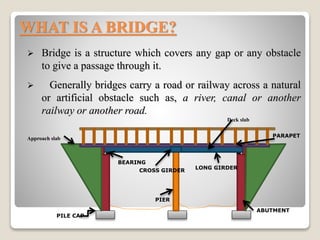
 Bridge is a structure which covers any gap or any obstacle
to give a passage through it.
 Generally bridges carry a road or railway across a natural
or artificial obstacle such as, a river, canal or another
railway or another road.
Approach slab
Deck slab
PARAPET
ABUTMENT
PIER
BEARING
PILE CAP
LONG GIRDER
CROSS GIRDER
WHAT IS FOUNDATION?
 A foundation is the part constructed under the
pier/abutment and over the underlying soil or rock.
 The loads transmitted by the foundation to the underling
soil must not cause soil shear failure or damaging settlement
of the superstructure.
 The foundations of a bridge are particularly critical
because they must support the entire weight of the bridge and
the traffic loads that it will carry.
PURPOSE OF FOUNDATION
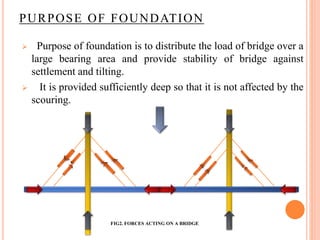
 Purpose of foundation is to distribute the load of bridge over a
large bearing area and provide stability of bridge against
settlement and tilting.
 It is provided sufficiently deep so that it is not affected by the
scouring.
FIG2. FORCES ACTING ON A BRIDGE
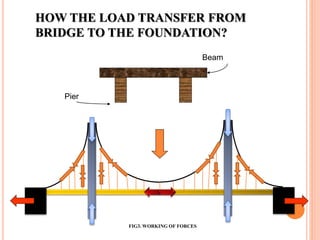
HOW THE LOAD TRANSFER FROM
BRIDGE TO THE FOUNDATION?
Beam
Pier
FIG3. WORKING OF FORCES
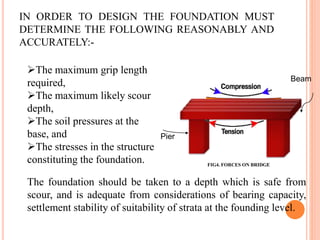
IN ORDER TO DESIGN THE FOUNDATION MUST
DETERMINE THE FOLLOWING REASONABLY AND
ACCURATELY:-
The maximum grip length
required,
The maximum likely scour
depth,
The soil pressures at the
base, and
The stresses in the structure
constituting the foundation.
The foundation should be taken to a depth which is safe from
scour, and is adequate from considerations of bearing capacity,
settlement stability of suitability of strata at the founding level.
FIG4. FORCES ON BRIDGE
Beam
Pier
SOME BASIC CONCEPTS
Scour depth: Scour denotes the washing away of the bed
material in a stream due to the passage of a flood.
It depends on discharge, bed slope, bed material, direction
of flow and alignment of pier.
Grip length: It can be defined as the extra length provided to
ensure stability under heavy flood condition.
For road bridge: 1/3 (max scour depth) and
For railway bridge: ½ (max scour depth)
TYPES OF FOUNDATIONS
 The type of foundation is designed when subsoil data of
bridge site is obtained. The different types of foundations for
bridges are given following;
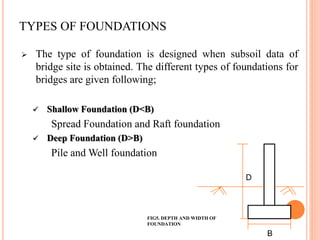
 Shallow Foundation (D<B)
Spread Foundation and Raft foundation
 Deep Foundation (D>B)
Pile and Well foundation
B
D
FIG5. DEPTH AND WIDTH OF
FOUNDATION
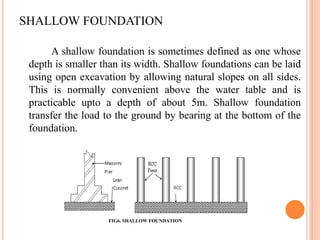
SHALLOW FOUNDATION
A shallow foundation is sometimes defined as one whose
depth is smaller than its width. Shallow foundations can be laid
using open excavation by allowing natural slopes on all sides.
This is normally convenient above the water table and is
practicable upto a depth of about 5m. Shallow foundation
transfer the load to the ground by bearing at the bottom of the
foundation.
FIG6. SHALLOW FOUNDATION
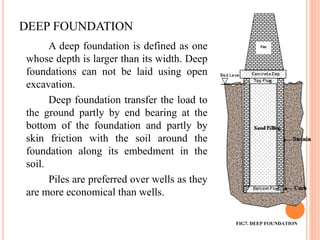
DEEP FOUNDATION
A deep foundation is defined as one
whose depth is larger than its width. Deep
foundations can not be laid using open
excavation.
Deep foundation transfer the load to
the ground partly by end bearing at the
bottom of the foundation and partly by
skin friction with the soil around the
foundation along its embedment in the
soil.
Piles are preferred over wells as they
are more economical than wells.
FIG7. DEEP FOUNDATION
WHICH TYPE OF FOUNDATION IS
PREFERABLE FOR BRIDGES & WHY?
A bridge is a highly important structure comprising heavy
structural loads constituting its own weight, overburdens
around the supports, discharge loads, etc.
Due to this high intensity of loading deep foundations are
generally preferred for the construction of bridges.
CONCLUSION:
For small bridges or culverts shallow foundations may be
used whereas for long span bridges having very high loading
conditions or loose soil strata then deep foundations are used.
REFERENCES
 IRC Bridge Code – Section VII.
 Book of “Essential of bridge Engineering” sixth edition
reprinted 2009 by D. Johnson Victor.
 www.howstuffworks.com
 IRC: 78. for the depth of foundation for the worst
loading combination.
 Picture courtesy: Nat Geo
 www.slideshare.net
Bridge foundation and its loading system

Bridge foundation and its loading system

  • 1.
    BY: DEBASREE GHOSH JR. ENGINEER(CIVIL DEPT.) (Work of 2014, 8th Sem, NIT AGARTALA)
  • 2.
    WHAT IS ABRIDGE?  Bridge is a structure which covers any gap or any obstacle to give a passage through it.  Generally bridges carry a road or railway across a natural or artificial obstacle such as, a river, canal or another railway or another road. Approach slab Deck slab PARAPET ABUTMENT PIER BEARING PILE CAP LONG GIRDER CROSS GIRDER
  • 3.
    WHAT IS FOUNDATION? A foundation is the part constructed under the pier/abutment and over the underlying soil or rock.  The loads transmitted by the foundation to the underling soil must not cause soil shear failure or damaging settlement of the superstructure.  The foundations of a bridge are particularly critical because they must support the entire weight of the bridge and the traffic loads that it will carry.
  • 4.
    PURPOSE OF FOUNDATION Purpose of foundation is to distribute the load of bridge over a large bearing area and provide stability of bridge against settlement and tilting.  It is provided sufficiently deep so that it is not affected by the scouring. FIG2. FORCES ACTING ON A BRIDGE
  • 5.
    HOW THE LOADTRANSFER FROM BRIDGE TO THE FOUNDATION? Beam Pier FIG3. WORKING OF FORCES
  • 6.
    IN ORDER TODESIGN THE FOUNDATION MUST DETERMINE THE FOLLOWING REASONABLY AND ACCURATELY:- The maximum grip length required, The maximum likely scour depth, The soil pressures at the base, and The stresses in the structure constituting the foundation. The foundation should be taken to a depth which is safe from scour, and is adequate from considerations of bearing capacity, settlement stability of suitability of strata at the founding level. FIG4. FORCES ON BRIDGE Beam Pier
  • 7.
    SOME BASIC CONCEPTS Scourdepth: Scour denotes the washing away of the bed material in a stream due to the passage of a flood. It depends on discharge, bed slope, bed material, direction of flow and alignment of pier. Grip length: It can be defined as the extra length provided to ensure stability under heavy flood condition. For road bridge: 1/3 (max scour depth) and For railway bridge: ½ (max scour depth)
  • 8.
    TYPES OF FOUNDATIONS The type of foundation is designed when subsoil data of bridge site is obtained. The different types of foundations for bridges are given following;  Shallow Foundation (D<B) Spread Foundation and Raft foundation  Deep Foundation (D>B) Pile and Well foundation B D FIG5. DEPTH AND WIDTH OF FOUNDATION
  • 9.
    SHALLOW FOUNDATION A shallowfoundation is sometimes defined as one whose depth is smaller than its width. Shallow foundations can be laid using open excavation by allowing natural slopes on all sides. This is normally convenient above the water table and is practicable upto a depth of about 5m. Shallow foundation transfer the load to the ground by bearing at the bottom of the foundation. FIG6. SHALLOW FOUNDATION
  • 10.
    DEEP FOUNDATION A deepfoundation is defined as one whose depth is larger than its width. Deep foundations can not be laid using open excavation. Deep foundation transfer the load to the ground partly by end bearing at the bottom of the foundation and partly by skin friction with the soil around the foundation along its embedment in the soil. Piles are preferred over wells as they are more economical than wells. FIG7. DEEP FOUNDATION
  • 11.
    WHICH TYPE OFFOUNDATION IS PREFERABLE FOR BRIDGES & WHY? A bridge is a highly important structure comprising heavy structural loads constituting its own weight, overburdens around the supports, discharge loads, etc. Due to this high intensity of loading deep foundations are generally preferred for the construction of bridges. CONCLUSION: For small bridges or culverts shallow foundations may be used whereas for long span bridges having very high loading conditions or loose soil strata then deep foundations are used.
  • 12.
    REFERENCES  IRC BridgeCode – Section VII.  Book of “Essential of bridge Engineering” sixth edition reprinted 2009 by D. Johnson Victor.  www.howstuffworks.com  IRC: 78. for the depth of foundation for the worst loading combination.  Picture courtesy: Nat Geo  www.slideshare.net