Role Change: The Ever
Changing Role of the Online
Instructor
Cynthia Sistek-Chandler,
Associate Professor, National University
Hoppy Chandler, Educator,
iHigh Virtual Academy,
San Diego Unified School District
Introductions
Cynthia Sistek-Chandler, Ed D
http://bit.ly/18VDiiU
cchandler@nu.edu
Mr. Hoppy Chandler
hoppyc1@netscape.net
Online education should be built on
a highly interactive model, one that
promotes social presence, helps
establish relationships among all
stakeholders, and encourages the
creation of a learning community.
(Sistek-Chandler & Serdyukov, 2012)
Role Change
The focus of this presentation and subsequent
paper is focused on the roles of an online
educator.
Based on definitions by Stephen Downes (2010)
and T. C. Smith (2005), there are a myriad of
roles and responsibilities for the online
educator.
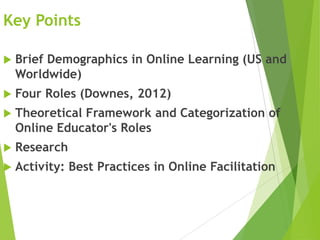
Key Points
 Brief Demographics in Online Learning (US and
Worldwide)
 Four Roles (Downes, 2012)
 Theoretical Framework and Categorization of
Online Educator's Roles
 Research
 Activity: Best Practices in Online Facilitation
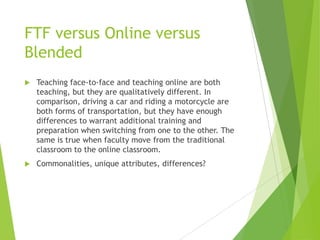
FTF versus Online versus
Blended
 Teaching face-to-face and teaching online are both
teaching, but they are qualitatively different. In
comparison, driving a car and riding a motorcycle are
both forms of transportation, but they have enough
differences to warrant additional training and
preparation when switching from one to the other. The
same is true when faculty move from the traditional
classroom to the online classroom.
 Commonalities, unique attributes, differences?
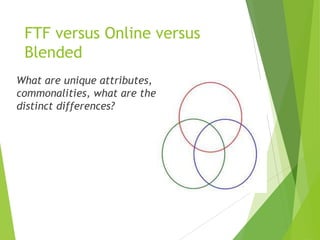
FTF versus Online versus
Blended
What are unique attributes,
commonalities, what are the
distinct differences?
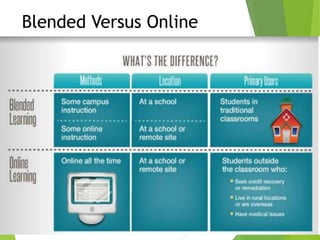
Blended Versus Online
Teacher Forecast by 2015
http://www.edudemic.com/2013/0
5/how-many-teachers-will-we-
need-by-2015/
Online Students
 Number of Online students
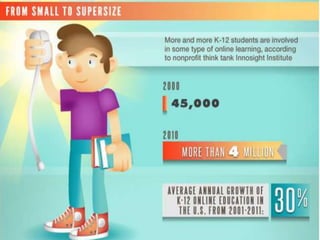
 K12 (2000) 45,000 students
 2010, 4 million- formal online learning
 Since 2010, Pre-K through 12 online
population growth 43 percent
 Higher Education (Half of all Post-secondary
students will take at least one online course
in their college experience by 2014).
Online Educators Projections K12
http://www.onlineschools.com/in-
focus/k-12-blended-learning.html
Online and Blended Learning: A Survey of Policy and Practice of K-12 Schools
Around the World, International Association for K-12 Online Learning,
November 2011
Online Education Higher Ed
Over 6.7 million students were taking at
least one online course during the fall
2011.
Thirty-two percent of higher education
students now take at least one course
online.
Babson Survey Research Group & the College Board U.S.
Agency for Standards iNacol
International Association for
K12 Online Learning
Online instructors
 Keeping Pace with K-12 Online and Blended Learning
(2012)
 Held to standards through quality assurance measures
 Pedagogical strength and hold professional
qualifications
Quality Online Teaching
http://vimeo.com/channels/qualityonline
teaching
 Key Points
Discussion Board
Synchronous Discussion
What are the roles of the
Online Instructor?
Four Roles (Downes, 2010)
1.Instructor
2. Social Director
3. Program Manager
4. Technician
Four Roles (Downes)
1. Instructor
2.Social Director
3. Program Manager
4. Technician
Four Roles (Downes)
1. Instructor
2. Social Director
3.Program
Manager
4. Technician
Four Roles (Downes)
1. Instructor
2. Social Director
3. Program Manager
4.Technician
Attributes of an
Online Instructor
Smith (2005) identifies and describes 51 competencies
needed by online instructors, among them:
 Create a warm and inviting atmosphere that promotes the
development of a sense of community among participants
 Develop reciprocity and cooperation among students
 Develop relationships
 Encourage contacts between students and faculty
 Mandate participation. Step in and set limits if participation
wanes or if the conversation is headed in the wrong direction
 Model good participation
 Teach students about online learning
 Most of all have fun and open yourself to learning as much
from your students as they will learn from one another and
from you!
How the Roles are Changing?
 Reliance on content quality and
updating of resources
 Instructional designer, the instructor
in many cases needs to be able to
curate content from a variety of
sources.
 Facilitation skills
 Planned Synchronous Discussions
 Building your flat classroom with
Global Connections
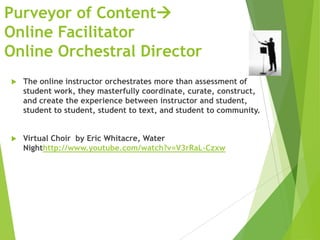
Purveyor of Content
Online Facilitator
Online Orchestral Director
 The online instructor orchestrates more than assessment of
student work, they masterfully coordinate, curate, construct,
and create the experience between instructor and student,
student to student, student to text, and student to community.
 Virtual Choir by Eric Whitacre, Water
Nighthttp://www.youtube.com/watch?v=V3rRaL-Czxw
5 Roles (Sistek-Chandler & Chandler, 2013)
1. Orchestral Director
2. Psycho-Social Director
1. Empathy and cultural understanding
2. Relationship development
3. Understand the basis of social division (Stuart,
2013)
3. Online Instructor Co-Learner (Bull, 2013)
4. Coach (Bull, 2013 and Bray, 2002)
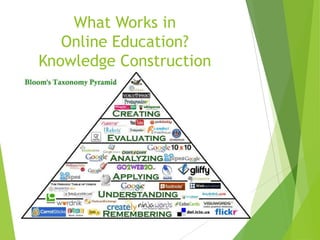
5. Mentor of Applied Learning and Knowledge
Construction
What Works in
Online Education?
Knowledge Construction
Online Community of Inquiry
Relationships
(Research Serdyukov & Sistek-Chandler, 2012)
 85% of respondents believe that relationships in the class affect
the outcome of student learning.
 67% agree online learning promotes relationships in the class,
while 31% disagree; this reflects previous opinions of the
social/asocial character of this educational format.
 88% believe online classes should be personalized in the way that
students develop more personal relationships in the class with the
peers and with the instructor;
 86% believe instructors need to establish empathy, emotions, and
personal relationships in an online class. This is an important
recommendation for practicing online educators.
Points to Remember about the
Online Instructional Role
 Social Emotional Environment
 Role of Relationships
 Move from Impersonal to more Personal
 Interactivity is the Key
 Communication needs to be clear and concise
Teacher Roles in the Blended
Classroom (e2020)
 Monitor
 Coach
 Mentor
 Teach
How are you going to encourage
engagement, deep learning, and
interactivity?
1. One technique to try
2. A second
3. A third
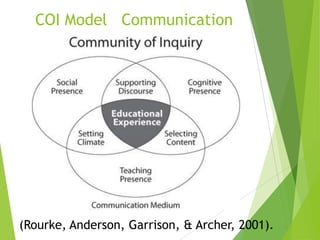
COI Model Communication
(Rourke, Anderson, Garrison, & Archer, 2001).
Online education should be built on
a highly interactive model, one that
promotes social presence, helps
establish relationships among all
stakeholders, and encourages the
creation of a learning community.
(Sistek-Chandler & Serdyukov, 2012)
References
 Babson Research Group and the College Board (2012). Changing Course: Ten Years of Tracking
Online Education in the United
Stateshttp://sloanconsortium.org/publications/survey/changing_course_2012
 Barbour, M.K., Brown, R., Waters, L.H., Hoey, R., Hunt, J., Kennedy, K., Ounsworth, C.,
Powell, A., & Trimm, T., iNACOL,Online and Blended Learning: A Survey of Policy and
Practice of K-12 Schools Around the World, International Association for K-12 Online
Learning, November 2011.
 Bull, B. (June 3, 2013). Higher Ed Teaching Strategies Newsletter/Blog. Magna
Publications,http://www.facultyfocus.com/articles/online-education/eight-roles-of-an-effective-online-
teacher/
 Christensen, C.M., Horn, M. B. & Johnson, C. W. Disrupting Class: How Disruptive Innovation Will Change
the Way the World Learns, (New York: McGraw-Hill, 2008), 91.
 Downes, S. (2012). http://www.huffingtonpost.com/stephen-downes/the-role-of-the-
educator_b_790937.html
 e2020, Role of Online and Blended Instructor.
 Garrison, D. R., Anderson, T., & Archer, W. (2000). Critical inquiry in a text-based environment: Computer
conferencing in higher education. The Internet and Higher Education, 2(2-3), 87-105. pdf Full Text
 Sistek-Chandler, C. M. & Serdyukov, P. (2012). Online Learning, Less Personal, More Social? Published
Abstract, WCCE, 2013.
 Smith, T. C., “Fifty-One Competencies for Online Instruction”, Journal of Educators Online, (2)2, (2005)

Online Instructor Roles

  • 1.
    Role Change: TheEver Changing Role of the Online Instructor Cynthia Sistek-Chandler, Associate Professor, National University Hoppy Chandler, Educator, iHigh Virtual Academy, San Diego Unified School District
  • 2.
    Introductions Cynthia Sistek-Chandler, EdD http://bit.ly/18VDiiU cchandler@nu.edu Mr. Hoppy Chandler hoppyc1@netscape.net
  • 3.
    Online education shouldbe built on a highly interactive model, one that promotes social presence, helps establish relationships among all stakeholders, and encourages the creation of a learning community. (Sistek-Chandler & Serdyukov, 2012)
  • 4.
    Role Change The focusof this presentation and subsequent paper is focused on the roles of an online educator. Based on definitions by Stephen Downes (2010) and T. C. Smith (2005), there are a myriad of roles and responsibilities for the online educator.
  • 5.
    Key Points  BriefDemographics in Online Learning (US and Worldwide)  Four Roles (Downes, 2012)  Theoretical Framework and Categorization of Online Educator's Roles  Research  Activity: Best Practices in Online Facilitation
  • 6.
    FTF versus Onlineversus Blended  Teaching face-to-face and teaching online are both teaching, but they are qualitatively different. In comparison, driving a car and riding a motorcycle are both forms of transportation, but they have enough differences to warrant additional training and preparation when switching from one to the other. The same is true when faculty move from the traditional classroom to the online classroom.  Commonalities, unique attributes, differences?
  • 7.
    FTF versus Onlineversus Blended What are unique attributes, commonalities, what are the distinct differences?
  • 8.
  • 9.
    Teacher Forecast by2015 http://www.edudemic.com/2013/0 5/how-many-teachers-will-we- need-by-2015/
  • 10.
    Online Students  Numberof Online students  K12 (2000) 45,000 students  2010, 4 million- formal online learning  Since 2010, Pre-K through 12 online population growth 43 percent  Higher Education (Half of all Post-secondary students will take at least one online course in their college experience by 2014).
  • 12.
    Online Educators ProjectionsK12 http://www.onlineschools.com/in- focus/k-12-blended-learning.html Online and Blended Learning: A Survey of Policy and Practice of K-12 Schools Around the World, International Association for K-12 Online Learning, November 2011
  • 13.
    Online Education HigherEd Over 6.7 million students were taking at least one online course during the fall 2011. Thirty-two percent of higher education students now take at least one course online. Babson Survey Research Group & the College Board U.S.
  • 14.
    Agency for StandardsiNacol International Association for K12 Online Learning Online instructors  Keeping Pace with K-12 Online and Blended Learning (2012)  Held to standards through quality assurance measures  Pedagogical strength and hold professional qualifications
  • 15.
    Quality Online Teaching http://vimeo.com/channels/qualityonline teaching Key Points Discussion Board Synchronous Discussion
  • 16.
    What are theroles of the Online Instructor?
  • 17.
    Four Roles (Downes,2010) 1.Instructor 2. Social Director 3. Program Manager 4. Technician
  • 18.
    Four Roles (Downes) 1.Instructor 2.Social Director 3. Program Manager 4. Technician
  • 19.
    Four Roles (Downes) 1.Instructor 2. Social Director 3.Program Manager 4. Technician
  • 20.
    Four Roles (Downes) 1.Instructor 2. Social Director 3. Program Manager 4.Technician
  • 21.
    Attributes of an OnlineInstructor Smith (2005) identifies and describes 51 competencies needed by online instructors, among them:  Create a warm and inviting atmosphere that promotes the development of a sense of community among participants  Develop reciprocity and cooperation among students  Develop relationships  Encourage contacts between students and faculty  Mandate participation. Step in and set limits if participation wanes or if the conversation is headed in the wrong direction  Model good participation  Teach students about online learning  Most of all have fun and open yourself to learning as much from your students as they will learn from one another and from you!
  • 22.
    How the Rolesare Changing?  Reliance on content quality and updating of resources  Instructional designer, the instructor in many cases needs to be able to curate content from a variety of sources.  Facilitation skills  Planned Synchronous Discussions  Building your flat classroom with Global Connections
  • 23.
    Purveyor of Content OnlineFacilitator Online Orchestral Director  The online instructor orchestrates more than assessment of student work, they masterfully coordinate, curate, construct, and create the experience between instructor and student, student to student, student to text, and student to community.  Virtual Choir by Eric Whitacre, Water Nighthttp://www.youtube.com/watch?v=V3rRaL-Czxw
  • 24.
    5 Roles (Sistek-Chandler& Chandler, 2013) 1. Orchestral Director 2. Psycho-Social Director 1. Empathy and cultural understanding 2. Relationship development 3. Understand the basis of social division (Stuart, 2013) 3. Online Instructor Co-Learner (Bull, 2013) 4. Coach (Bull, 2013 and Bray, 2002) 5. Mentor of Applied Learning and Knowledge Construction
  • 25.
    What Works in OnlineEducation? Knowledge Construction
  • 26.
    Online Community ofInquiry Relationships (Research Serdyukov & Sistek-Chandler, 2012)  85% of respondents believe that relationships in the class affect the outcome of student learning.  67% agree online learning promotes relationships in the class, while 31% disagree; this reflects previous opinions of the social/asocial character of this educational format.  88% believe online classes should be personalized in the way that students develop more personal relationships in the class with the peers and with the instructor;  86% believe instructors need to establish empathy, emotions, and personal relationships in an online class. This is an important recommendation for practicing online educators.
  • 27.
    Points to Rememberabout the Online Instructional Role  Social Emotional Environment  Role of Relationships  Move from Impersonal to more Personal  Interactivity is the Key  Communication needs to be clear and concise
  • 28.
    Teacher Roles inthe Blended Classroom (e2020)  Monitor  Coach  Mentor  Teach
  • 29.
    How are yougoing to encourage engagement, deep learning, and interactivity? 1. One technique to try 2. A second 3. A third
  • 30.
    COI Model Communication (Rourke,Anderson, Garrison, & Archer, 2001).
  • 31.
    Online education shouldbe built on a highly interactive model, one that promotes social presence, helps establish relationships among all stakeholders, and encourages the creation of a learning community. (Sistek-Chandler & Serdyukov, 2012)
  • 32.
    References  Babson ResearchGroup and the College Board (2012). Changing Course: Ten Years of Tracking Online Education in the United Stateshttp://sloanconsortium.org/publications/survey/changing_course_2012  Barbour, M.K., Brown, R., Waters, L.H., Hoey, R., Hunt, J., Kennedy, K., Ounsworth, C., Powell, A., & Trimm, T., iNACOL,Online and Blended Learning: A Survey of Policy and Practice of K-12 Schools Around the World, International Association for K-12 Online Learning, November 2011.  Bull, B. (June 3, 2013). Higher Ed Teaching Strategies Newsletter/Blog. Magna Publications,http://www.facultyfocus.com/articles/online-education/eight-roles-of-an-effective-online- teacher/  Christensen, C.M., Horn, M. B. & Johnson, C. W. Disrupting Class: How Disruptive Innovation Will Change the Way the World Learns, (New York: McGraw-Hill, 2008), 91.  Downes, S. (2012). http://www.huffingtonpost.com/stephen-downes/the-role-of-the- educator_b_790937.html  e2020, Role of Online and Blended Instructor.  Garrison, D. R., Anderson, T., & Archer, W. (2000). Critical inquiry in a text-based environment: Computer conferencing in higher education. The Internet and Higher Education, 2(2-3), 87-105. pdf Full Text  Sistek-Chandler, C. M. & Serdyukov, P. (2012). Online Learning, Less Personal, More Social? Published Abstract, WCCE, 2013.  Smith, T. C., “Fifty-One Competencies for Online Instruction”, Journal of Educators Online, (2)2, (2005)

Editor's Notes

  • #9 Role Definition of the classroom
  • #10 Info Grahic about growth of k-12 online schoolsAll pre-service teachers must take an Computer Integration course for teaching credential. http://www.onlineschools.com/in-focus/k-12-blended-learning.html
  • #11 In 2000, roughly 45,000 K–12 students took an online course.† But by 2010,over 4 million students were participating in some kind of formal online-learning program. The preK–12 online population is now growing by a five-year CAGR of 43 percent—and that rateis accelerating.
  • #13 Info Grahic about growth of k-12 online schoolshttp://www.onlineschools.com/in-focus/k-12-blended-learning.html
  • #14 2011 term, an increase of 570,000 students over the previous year.Thirty-two percent of higher education students now take at least one course online.Seventy-seven percent of academic leaders rate the learning outcomes in online education as the same or superior to those in face-to-face.Only 30.2 percent of chief academic officers believe that their faculty accept the value and legitimacy
  • #15 Info Grahic about growth of k-12 online schools
  • #18 Teach as we have always taught, with a familiar structure, syllabus, expectations, course outcomes, clear expectations for assessment etc. But it is how we achieve those outcomes that defines who we are as instructors and how we provide experiences for our students to achieve those outcomes
  • #21 How do I do?
  • #24 There are thousands of faces in the skyscraper windows in this music video, each a webcam capture of a singer -- 5,905 of them to be exact.
  • #25 Learning Coach (Bull) Role of teacher = role model. Assign Applied ProjectsGreat teachers are lifelong learners, and they can model that learning for their students in a variety of ways in the online classroom. Teaching face-to-face and teaching online are both teaching, but they are qualitatively different. In comparison, driving a car and riding a motorcycle are both forms of transportation, but they have enough differences to warrant additional training and preparation when switching from one to the other. The same is true when faculty move from the traditional classroom to the online classroom. There are some things that the two have in common, but there are also plenty of differences. With this in mind, consider the following eight roles of an effective online teacher.
  • #26 Critical Friends Consultancy ProtocolPresentersEveryoneAudiencePresenters
  • #28 A competent online instructor understands the social nature of the classroom and how it can contribute to the success of the students; he or she applies and promotes interactivity with students and between students. Such an understanding is needed to effectively reduce student feeling of isolation, increase active learning, and develop synergetic relationships in the classroom. (Varvel, 2007)
  • #31 How are you going to encourage engagement, deep learning, and interactivity.