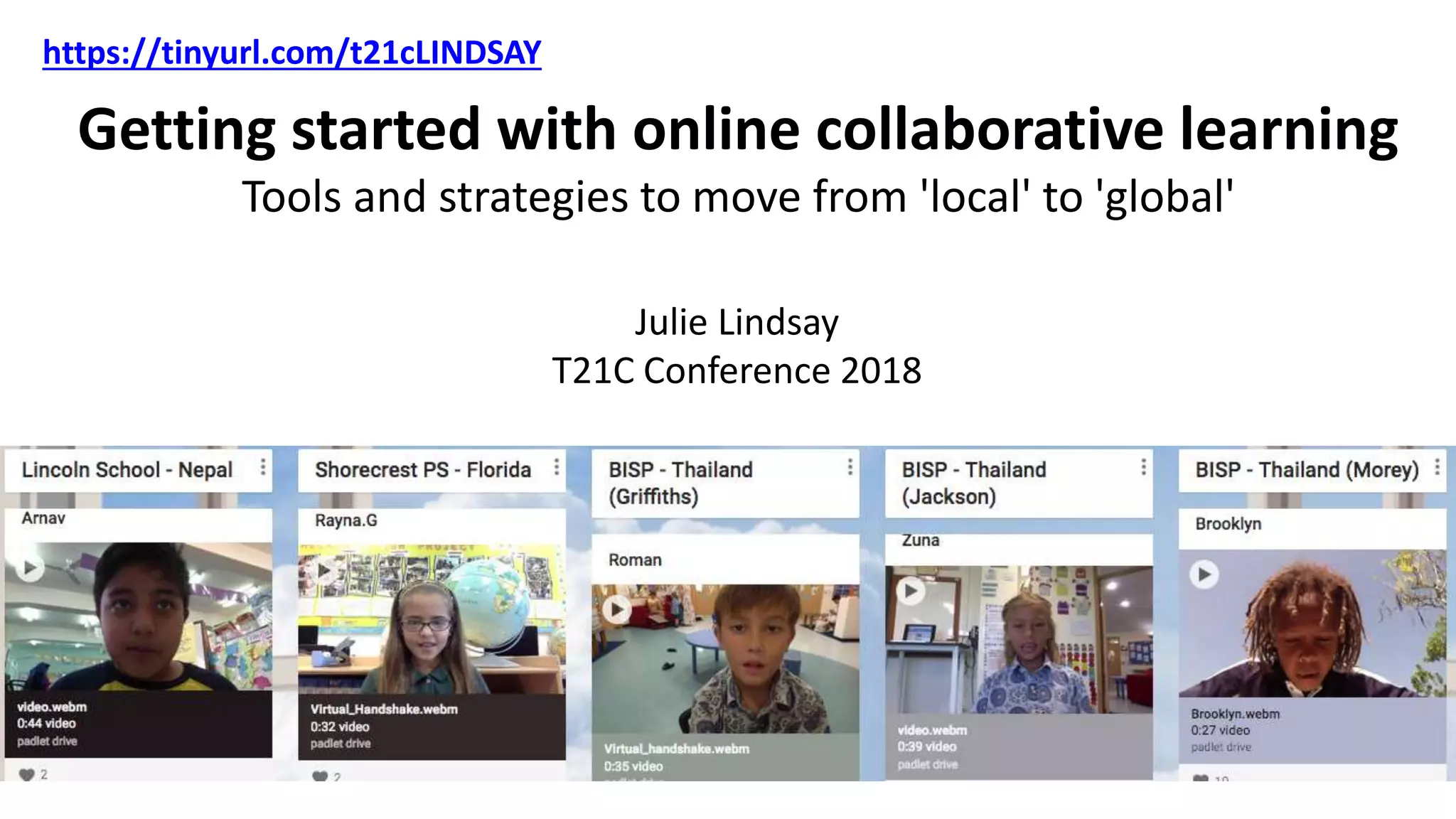
Getting started with online collaborative learning
Tools and strategies to move from 'local' to 'global'
Julie Lindsay
T21C Conference 2018
https://tinyurl.com/t21cLINDSAY
Connect with me | Julie Lindsay
Founder & CEO, Flat Connections
Open Pathways Design Leader (CSU)
- (uImagine, Division of Learning and Teaching)
Online Lecturer (CSU)
- MEd Knowledge Networks and Digital Innovation
- (School of Information Studies, CSU)
PhD student – (University of Southern
Queensland)
- Thesis title ‘Online global collaborative educators
and pedagogical change’
Twitter: @julielindsay
Email: jlindsay@csu.edu.au
Or lindsay.julie@gmail.com
Profile: http://about.me/julielindsay
http://about.me/julielindsay
@julielindsay on Twitter
Learning outcomes from this workshop:
• Define online collaborative learning
• Define online global collaboration
• Describe tools for online collaboration
• Explain how to start designing online global
collaborative learning for all levels
https://tinyurl.com/t21cLINDSAY
Collaborative Learning
Collaborative learning
“[C]ollaborative production is simple: no one person can take
credit for what gets created, and the project could not come into
being without the participation of many.”
Clay Shirky, Here comes everybody
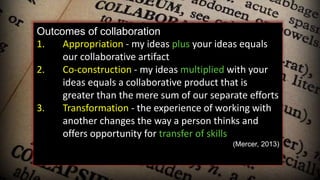
Outcomes of collaboration
1. Appropriation - my ideas plus your ideas equals
our collaborative artifact
2. Co-construction - my ideas multiplied with your
ideas equals a collaborative product that is
greater than the mere sum of our separate efforts
3. Transformation - the experience of working with
another changes the way a person thinks and
offers opportunity for transfer of skills
(Mercer, 2013)
Online Collaboration
• Purpose
• Skills
• Tools
“Through the marriage of collaboration and mobile technology,
students have a unique opportunity to transform the way they think
and learn, and teachers have the opportunity to initiate true and
lasting change in the social and cognitive development of their
students”
(Boyd, 2016)
https://tinyurl.com/t21cLINDSAY
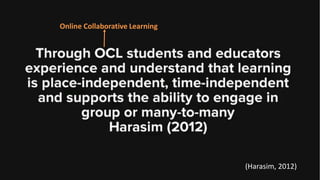
(Harasim, 2012)
Online Collaborative Learning
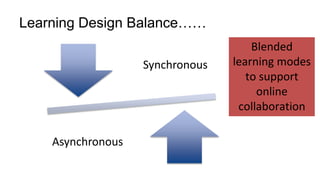
Learning Design Balance……
Synchronous
Asynchronous
Blended
learning modes
to support
online
collaboration
Online Collaboration
Share your story of success (or
frustration!)
• Purpose
• Skills
• Tools
https://tinyurl.com/t21cLINDSAY
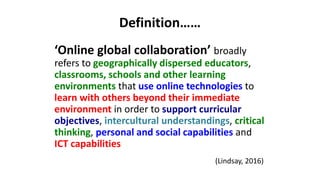
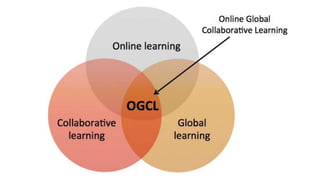
Definition……
‘Online global collaboration’ broadly
refers to geographically dispersed educators,
classrooms, schools and other learning
environments that use online technologies to
learn with others beyond their immediate
environment in order to support curricular
objectives, intercultural understandings, critical
thinking, personal and social capabilities and
ICT capabilities
(Lindsay, 2016)
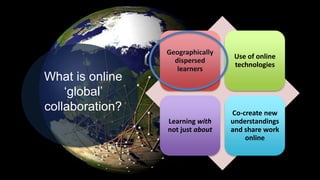
Geographically
dispersed
learners
Use of online
technologies
Learning with
not just about
Co-create new
understandings
and share work
online
What is online
‘global’
collaboration?
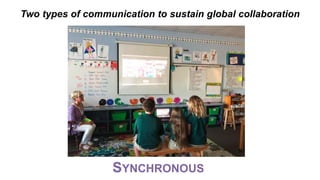
Two types of communication to sustain global collaboration
SYNCHRONOUS
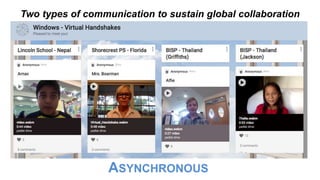
Two types of communication to sustain global collaboration
ASYNCHRONOUS
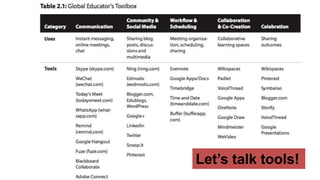
Let’s talk tools!
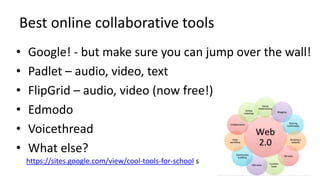
Best online collaborative tools
• Google! - but make sure you can jump over the wall!
• Padlet – audio, video, text
• FlipGrid – audio, video (now free!)
• Edmodo
• Voicethread
• What else?
https://sites.google.com/view/cool-tools-for-school s
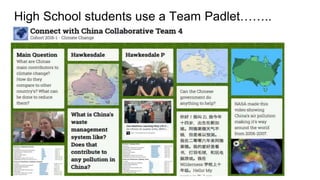
High School students use a Team Padlet……..
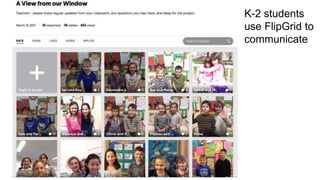
K-2 students
use FlipGrid to
communicate
Online global collaborative learning
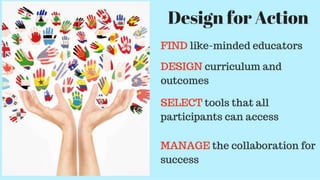
Design for Success
Case Study:
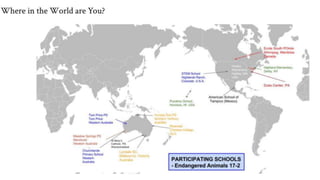
Endangered Animals Global Project
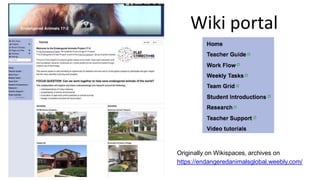
Wiki portal
Originally on Wikispaces, archives on
https://endangeredanimalsglobal.weebly.com/
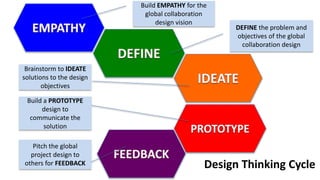
Build EMPATHY for the
global collaboration
design vision
DEFINE the problem and
objectives of the global
collaboration design
Brainstorm to IDEATE
solutions to the design
objectives
Build a PROTOTYPE
design to
communicate the
solution
Pitch the global
project design to
others for FEEDBACK Design Thinking Cycle
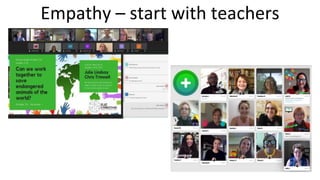
Empathy – start with teachers
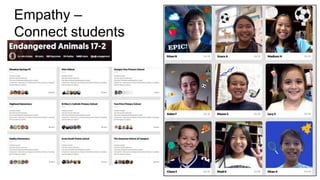
Empathy –
Connect students
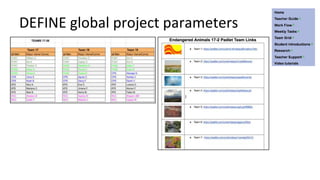
DEFINE global project parameters
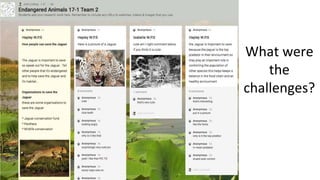
What were
the
challenges?
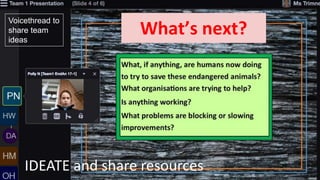
What’s next?
Voicethread to
share team
ideas
IDEATE and share resources
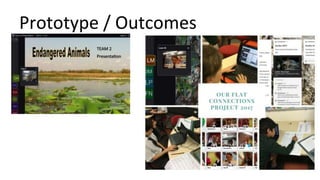
Prototype / Outcomes
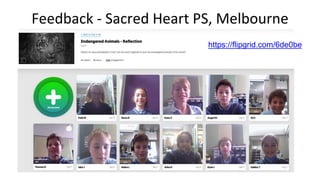
Feedback - Sacred Heart PS, Melbourne
https://flipgrid.com/6de0be
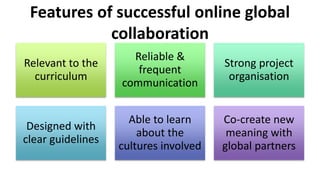
Features of successful online global
collaboration
Relevant to the
curriculum
Reliable &
frequent
communication
Strong project
organisation
Designed with
clear guidelines
Able to learn
about the
cultures involved
Co-create new
meaning with
global partners
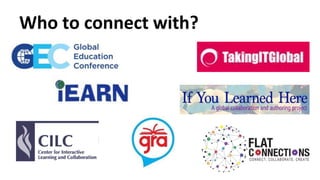
Who to connect with?
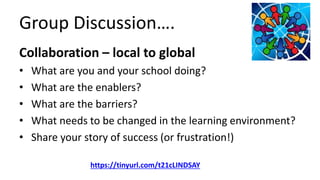
Group Discussion….
Collaboration – local to global
• What are you and your school doing?
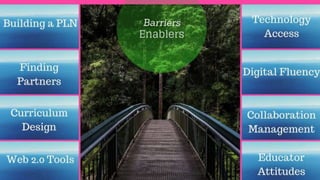
• What are the enablers?
• What are the barriers?
• What needs to be changed in the learning environment?
• Share your story of success (or frustration!)
https://tinyurl.com/t21cLINDSAY
Global educators
impact the world
– one
collaboration at
a time
Thank you!
Please stay connected with me:
Julie Lindsay @julielindsay
lindsay.julie@gmail.com
http://flatconnections.com
http://www.julielindsay.net
Learning about the world, with the world
https://tinyurl.com/t21cLINDSAY
References
Boyd, N. L. (2016). Collaboration via Technology as a Means for Social and Cognitive Development within the K-
12 Classroom. Handbook of Research on Mobile Learning in Contemporary Classrooms, 181-203.
doi:10.4018/978-1-5225-0251-7.ch009
Harasim, L. (2017). Learning theory and online technologies (2nd ed.). New York, NY: Routledge.
Lindsay, J. (2016). The global educator: Leveraging technology for collaborative learning & teaching. Eugene,
Oregon/Arlington, VA: International Society for Technology in Education.
Mercer, N. (2013). The Social Brain, Language, and Goal-Directed Collective Thinking: A Social Conception of
Cognition and Its Implications for Understanding How We Think, Teach, and Learn. Educational Psychologist,
48(3), 148–168. doi:10.1080/00461520.2013.804394

Getting started with online collaborative learning

  • 1.
    Getting started withonline collaborative learning Tools and strategies to move from 'local' to 'global' Julie Lindsay T21C Conference 2018 https://tinyurl.com/t21cLINDSAY
  • 2.
    Connect with me| Julie Lindsay Founder & CEO, Flat Connections Open Pathways Design Leader (CSU) - (uImagine, Division of Learning and Teaching) Online Lecturer (CSU) - MEd Knowledge Networks and Digital Innovation - (School of Information Studies, CSU) PhD student – (University of Southern Queensland) - Thesis title ‘Online global collaborative educators and pedagogical change’ Twitter: @julielindsay Email: jlindsay@csu.edu.au Or lindsay.julie@gmail.com Profile: http://about.me/julielindsay
  • 3.
  • 4.
    Learning outcomes fromthis workshop: • Define online collaborative learning • Define online global collaboration • Describe tools for online collaboration • Explain how to start designing online global collaborative learning for all levels https://tinyurl.com/t21cLINDSAY
  • 5.
  • 6.
    Collaborative learning “[C]ollaborative productionis simple: no one person can take credit for what gets created, and the project could not come into being without the participation of many.” Clay Shirky, Here comes everybody
  • 7.
    Outcomes of collaboration 1.Appropriation - my ideas plus your ideas equals our collaborative artifact 2. Co-construction - my ideas multiplied with your ideas equals a collaborative product that is greater than the mere sum of our separate efforts 3. Transformation - the experience of working with another changes the way a person thinks and offers opportunity for transfer of skills (Mercer, 2013)
  • 8.
    Online Collaboration • Purpose •Skills • Tools “Through the marriage of collaboration and mobile technology, students have a unique opportunity to transform the way they think and learn, and teachers have the opportunity to initiate true and lasting change in the social and cognitive development of their students” (Boyd, 2016) https://tinyurl.com/t21cLINDSAY
  • 9.
  • 10.
  • 11.
    Online Collaboration Share yourstory of success (or frustration!) • Purpose • Skills • Tools https://tinyurl.com/t21cLINDSAY
  • 12.
    Definition…… ‘Online global collaboration’broadly refers to geographically dispersed educators, classrooms, schools and other learning environments that use online technologies to learn with others beyond their immediate environment in order to support curricular objectives, intercultural understandings, critical thinking, personal and social capabilities and ICT capabilities (Lindsay, 2016)
  • 13.
    Geographically dispersed learners Use of online technologies Learningwith not just about Co-create new understandings and share work online What is online ‘global’ collaboration?
  • 16.
    Two types ofcommunication to sustain global collaboration SYNCHRONOUS
  • 17.
    Two types ofcommunication to sustain global collaboration ASYNCHRONOUS
  • 18.
  • 19.
    Best online collaborativetools • Google! - but make sure you can jump over the wall! • Padlet – audio, video, text • FlipGrid – audio, video (now free!) • Edmodo • Voicethread • What else? https://sites.google.com/view/cool-tools-for-school s
  • 20.
    High School studentsuse a Team Padlet……..
  • 21.
  • 22.
    Online global collaborativelearning Design for Success
  • 23.
  • 24.
    Wiki portal Originally onWikispaces, archives on https://endangeredanimalsglobal.weebly.com/
  • 26.
    Build EMPATHY forthe global collaboration design vision DEFINE the problem and objectives of the global collaboration design Brainstorm to IDEATE solutions to the design objectives Build a PROTOTYPE design to communicate the solution Pitch the global project design to others for FEEDBACK Design Thinking Cycle
  • 27.
    Empathy – startwith teachers
  • 28.
  • 29.
  • 30.
  • 31.
    What’s next? Voicethread to shareteam ideas IDEATE and share resources
  • 32.
  • 33.
    Feedback - SacredHeart PS, Melbourne https://flipgrid.com/6de0be
  • 34.
    Features of successfulonline global collaboration Relevant to the curriculum Reliable & frequent communication Strong project organisation Designed with clear guidelines Able to learn about the cultures involved Co-create new meaning with global partners
  • 36.
  • 37.
    Group Discussion…. Collaboration –local to global • What are you and your school doing? • What are the enablers? • What are the barriers? • What needs to be changed in the learning environment? • Share your story of success (or frustration!) https://tinyurl.com/t21cLINDSAY
  • 39.
    Global educators impact theworld – one collaboration at a time Thank you! Please stay connected with me: Julie Lindsay @julielindsay lindsay.julie@gmail.com http://flatconnections.com http://www.julielindsay.net Learning about the world, with the world https://tinyurl.com/t21cLINDSAY
  • 40.
    References Boyd, N. L.(2016). Collaboration via Technology as a Means for Social and Cognitive Development within the K- 12 Classroom. Handbook of Research on Mobile Learning in Contemporary Classrooms, 181-203. doi:10.4018/978-1-5225-0251-7.ch009 Harasim, L. (2017). Learning theory and online technologies (2nd ed.). New York, NY: Routledge. Lindsay, J. (2016). The global educator: Leveraging technology for collaborative learning & teaching. Eugene, Oregon/Arlington, VA: International Society for Technology in Education. Mercer, N. (2013). The Social Brain, Language, and Goal-Directed Collective Thinking: A Social Conception of Cognition and Its Implications for Understanding How We Think, Teach, and Learn. Educational Psychologist, 48(3), 148–168. doi:10.1080/00461520.2013.804394