SREB Standards for  Quality Online Teaching: Why They Are So Important Barbara Treacy SREB Online Teacher Meeting April 30, 2008
Why Are Teaching Standards Important? For the same reason teachers are important! “ The most important factor affecting student learning is the teacher.”  – SREB Standards for Quality Online Teaching
What Do Teaching Standards Do? Enable accountability  Ensure quality instruction  Ground instruction in effective teaching and learning principles Provide guidelines while not restricting creativity or learning
Why Are  Online  Teaching Standards Important? Online teachers need to meet the same quality teaching standards as f2f teachers Online teachers need to understand how to do this in the online environment
What’s So Different About Teaching Online? Online curriculum  Social dynamic  Increased importance of written communication Online facilitation strategies & “online voice”  Assessment strategies Technical challenges occur  Classroom management  New support & parental communication systems
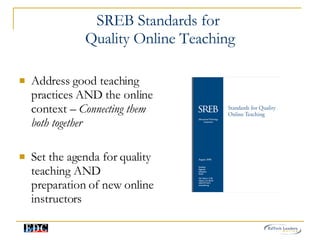
SREB Standards for  Quality Online Teaching Address good teaching practices AND the online context –  Connecting them both together Set the agenda for quality teaching AND preparation of new online instructors
Example: EDC/EdTech Leaders Online Virtual School Instructor Training Based on SREB standards Emphasize need for initial  and  ongoing PD Online Instructor Course: initial training (8 wks) Follow-Up: Building a Community in a VS course (4 wks) Ongoing support and national online forum Online course, with “model” online instructor
 
Instructor Training Course  Sessions   1: Introduction to teaching students in  online    courses   2: Building an online learning community    3: Identifying supporting resources for an    online course    4: Using the course management system's    instructor tools    5: The power of online discussion in virtual    courses    6: Managing diverse learning needs in a    virtual classroom    7: Assessing students in virtual courses
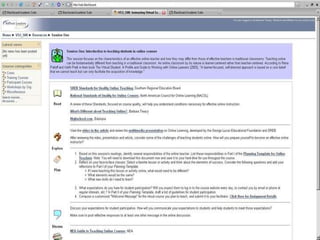
SREB Standards as a Guide to Action:  Basis for the Instructor Training Courses Academic Preparation: for Certified Teachers Content Knowledge, Skills, and Temperament for Instructional Technology Experimentation Course Incorporation of Web 2.0 technologies  Online course: provides experience in CMS and online environment
Standards as a Guide to Action, cont. Online Teaching and Learning Methodology, Management, Knowledge, Skills and Delivery Online discussion techniques and skills:  Scenarios  Online voice and netiquette Approaches, tools, techniques for online classroom management and to differentiate instruction Clear expectations:  Welcome Letter Online assessment and regular feedback Project-based:  Final Planning Template   Legal, ethical and online safety issues Online experience with model instructor  Pre and post course data informs instruction
How are online instructors changing teaching? Virtual School Instructors Understand how to teach with technology Incorporate new strategies for individualized instruction and collaborative activities Increase student engagement and/or facilitate deeper discussions with effective questioning techniques Can be much more accessible to their students Use innovative approaches to assessment Virtual schools are “labs of reform” and virtual teachers are in the forefront!
A few quotes… “ This course has influenced my teaching in the physical classroom as well as offering thorough preparation and excellent resources for online courses that I may teach.” -Louisiana Virtual School instructor “ I can plainly see that each of my colleagues are as intrigued and inspired to teach as I am!  Each of us brings something to the table of educating and if we just take the time to glean from each other -- WOW!... I tell you this information alone has taken my level of excellence in teaching to higher level.”  -Mississippi Virtual School instructor
Thank you! Barbara Treacy  [email_address] EdTech Leaders Online http://www.edtechleaders.org Education Development Center http://www.edc.org

Sreb Online Teacher2 May2008

  • 1.
    SREB Standards for Quality Online Teaching: Why They Are So Important Barbara Treacy SREB Online Teacher Meeting April 30, 2008
  • 2.
    Why Are TeachingStandards Important? For the same reason teachers are important! “ The most important factor affecting student learning is the teacher.” – SREB Standards for Quality Online Teaching
  • 3.
    What Do TeachingStandards Do? Enable accountability Ensure quality instruction Ground instruction in effective teaching and learning principles Provide guidelines while not restricting creativity or learning
  • 4.
    Why Are Online Teaching Standards Important? Online teachers need to meet the same quality teaching standards as f2f teachers Online teachers need to understand how to do this in the online environment
  • 5.
    What’s So DifferentAbout Teaching Online? Online curriculum Social dynamic Increased importance of written communication Online facilitation strategies & “online voice” Assessment strategies Technical challenges occur Classroom management New support & parental communication systems
  • 6.
    SREB Standards for Quality Online Teaching Address good teaching practices AND the online context – Connecting them both together Set the agenda for quality teaching AND preparation of new online instructors
  • 7.
    Example: EDC/EdTech LeadersOnline Virtual School Instructor Training Based on SREB standards Emphasize need for initial and ongoing PD Online Instructor Course: initial training (8 wks) Follow-Up: Building a Community in a VS course (4 wks) Ongoing support and national online forum Online course, with “model” online instructor
  • 8.
  • 9.
    Instructor Training Course Sessions 1: Introduction to teaching students in online courses 2: Building an online learning community 3: Identifying supporting resources for an online course 4: Using the course management system's instructor tools 5: The power of online discussion in virtual courses 6: Managing diverse learning needs in a virtual classroom 7: Assessing students in virtual courses
  • 10.
    SREB Standards asa Guide to Action: Basis for the Instructor Training Courses Academic Preparation: for Certified Teachers Content Knowledge, Skills, and Temperament for Instructional Technology Experimentation Course Incorporation of Web 2.0 technologies Online course: provides experience in CMS and online environment
  • 11.
    Standards as aGuide to Action, cont. Online Teaching and Learning Methodology, Management, Knowledge, Skills and Delivery Online discussion techniques and skills: Scenarios Online voice and netiquette Approaches, tools, techniques for online classroom management and to differentiate instruction Clear expectations: Welcome Letter Online assessment and regular feedback Project-based: Final Planning Template Legal, ethical and online safety issues Online experience with model instructor Pre and post course data informs instruction
  • 12.
    How are onlineinstructors changing teaching? Virtual School Instructors Understand how to teach with technology Incorporate new strategies for individualized instruction and collaborative activities Increase student engagement and/or facilitate deeper discussions with effective questioning techniques Can be much more accessible to their students Use innovative approaches to assessment Virtual schools are “labs of reform” and virtual teachers are in the forefront!
  • 13.
    A few quotes…“ This course has influenced my teaching in the physical classroom as well as offering thorough preparation and excellent resources for online courses that I may teach.” -Louisiana Virtual School instructor “ I can plainly see that each of my colleagues are as intrigued and inspired to teach as I am!  Each of us brings something to the table of educating and if we just take the time to glean from each other -- WOW!... I tell you this information alone has taken my level of excellence in teaching to higher level.” -Mississippi Virtual School instructor
  • 14.
    Thank you! BarbaraTreacy [email_address] EdTech Leaders Online http://www.edtechleaders.org Education Development Center http://www.edc.org