Oregon State University Seminar December 5, 2008
Better understand and facilitate the variety of ways in which people of all ages and backgrounds engage in science and mathematics learning throughout their day and lifespan.
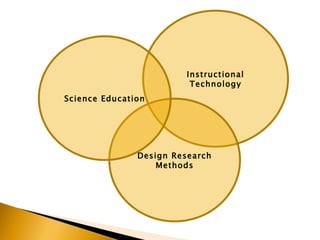
Instructional Technology Design Research Methods Science Education
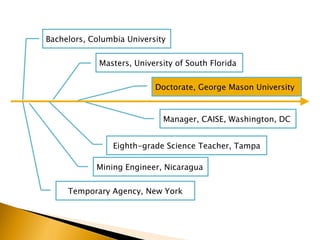
Temporary Agency, New York Doctorate, George Mason University Masters, University of South Florida Eighth-grade Science Teacher, Tampa Mining Engineer, Nicaragua Bachelors, Columbia University Manager, CAISE, Washington, DC
Coordinate an online Masters of Science and Mathematics Education in Free-Choice Learning degree program.
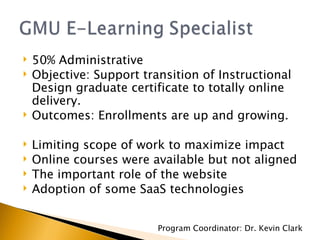
50% Administrative Objective: Support transition of Instructional Design graduate certificate to totally online delivery. Outcomes: Enrollments are up and growing. Limiting scope of work to maximize impact Online courses were available but not aligned The important role of the website Adoption of some SaaS technologies Program Coordinator: Dr. Kevin Clark
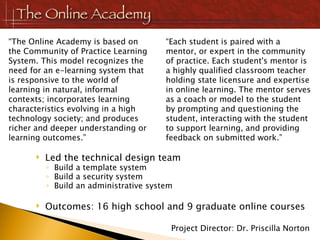
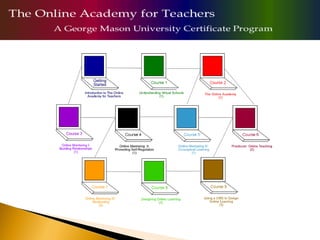
Led the technical design team Build a template system Build a security system Build an administrative system Outcomes: 16 high school and 9 graduate online courses “ The Online Academy is based on the Community of Practice Learning System. This model recognizes the need for an e-learning system that is responsive to the world of learning in natural, informal contexts; incorporates learning characteristics evolving in a high technology society; and produces richer and deeper understanding or learning outcomes.” “ Each student is paired with a mentor, or expert in the community of practice. Each student's mentor is a highly qualified classroom teacher holding state licensure and expertise in online learning. The mentor serves as a coach or model to the student by prompting and questioning the student, interacting with the student to support learning, and providing feedback on submitted work.” Project Director: Dr. Priscilla Norton
 
CAISE Leadership & Diversity Fellows Program Leadership Development in ISE Cohort 1: Proposal Development Cohort 2: CAISE Inquiry Groups Underrepresented groups and geographic regions Distance program, monthly dial-in seminars CAISE Director: Ellen McCallie L & D Chair: Preeti Gupta
Work with other faculty in support of the Department, including teaching, doctoral student advising, committees and other activities as appropriate
50% Teaching  Included course design in WebCT Podcasting (Face-to-Face or Online) Instructional Design (Blended) Mid-Program Masters Portfolio Assessment (F2F or Online) End-Program Masters Portfolio Assessment (Online) Department Chair: Dr. Kevin Clark
Formal science education background Inquiry, constructivist, and action research orientation
Research methods Integrating digital media with STEM education
Secure funding, conduct and publish original research in the area of free-choice learning
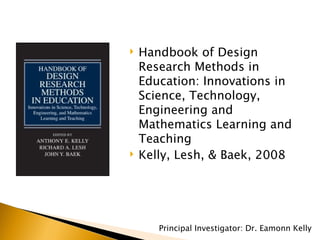
Handbook of Design Research Methods in Education: Innovations in Science, Technology, Engineering and Mathematics Learning and Teaching Kelly, Lesh, & Baek, 2008 Principal Investigator: Dr. Eamonn Kelly
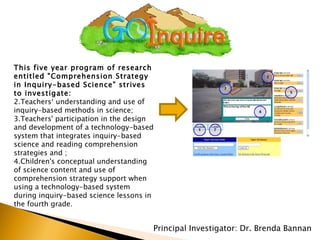
Principal Investigator: Dr. Brenda Bannan This five year program of research entitled "Comprehension Strategy in Inquiry-based Science" strives to investigate:  Teachers‘ understanding and use of inquiry-based methods in science;  Teachers' participation in the design and development of a technology-based system that integrates inquiry-based science and reading comprehension strategies and ;  Children's conceptual understanding of science content and use of comprehension strategy support when using a technology-based system during inquiry-based science lessons in the fourth grade.
NARST 2006 Design Research on the Means of Support for Teaching and Learning Geological Observation ICTMA 2007 The Perception of Slope and Geological Observation Performance: Exploring the Mathematical Component of a  Geoscience Domain Model Dissertation 2007 Exploring the Assessment of Geological Observation with Design Research AERA 2008 Design Research on a Diet: A Methodological Framework Called Design Assessment NARST 2009 Design Research on the Assessment of Geological Observation: The Components of Perception, Explanation, and Gestures
Educational goal:  Improve  geoscience learning, instruction and assessment.  Design goal: Build solutions that support  authentic  geological observation performance. Practical goal: Research activities occur within the actual setting in which improvements are expected.  Diffusion goal: Solutions are accessed, adopted and used by all teachers and students.  Research goal: Explore how to  assess  student geological observations.
How can the performance of geological observation be assessed?
Field testing Student work Video recording Mixed-methods analysis Typology development Non-parametric analyses Item difficulty analysis Data consolidation
18 fourth grade: Katerina & Oscar 21 fifth grade: Katerina & Sylvia Dual language immersion school Suburban-urban school district 7 classroom visits 3 field tests of GO Inquire 2 field tests of cutting task 2 field tests of fieldguide task
How can the performance of geological observation be assessed? Assessing Perception Assessing Explanation Assessing Gesture
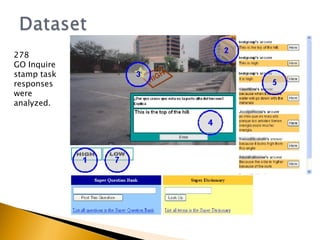
278  GO Inquire stamp task responses were analyzed.
Did they see “high” in the photo? Distinction between Perception & Identification Irrelevance -> Relevance -> Seeing Process
“ Verbal Retreat” in reverse Incorrect -> Static Descriptions -> Process Descriptions -> Explanations Explaining how the object came to be.
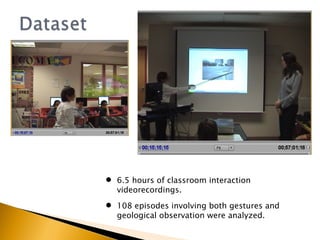
6.5 hours of classroom interaction videorecordings.  108 episodes involving both gestures and geological observation were analyzed.
Continuing to retreat back to non-verbal communication Deictic -> Iconic gestures Stamping, acts like gestures
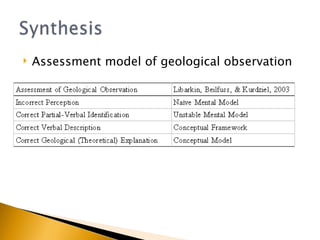
Assessment model of geological observation
Conceptual development of geological processes is indicated by perceptual development. Scientific language develops when communicating what one sees, given progressively difficult tasks. Geoscientific cognitive development is indicated by communicating mental models of geological processes. Motivational support is vital for geoscientific cognitive development. We used visual tasks, social computing, and field trips. Many interactions need to be monitored in the design. User-computer, student-teacher, student-student, student-task.
 

2008 Osu Job Talk 12 05

  • 1.
    Oregon State UniversitySeminar December 5, 2008
  • 2.
    Better understand andfacilitate the variety of ways in which people of all ages and backgrounds engage in science and mathematics learning throughout their day and lifespan.
  • 3.
    Instructional Technology DesignResearch Methods Science Education
  • 4.
    Temporary Agency, NewYork Doctorate, George Mason University Masters, University of South Florida Eighth-grade Science Teacher, Tampa Mining Engineer, Nicaragua Bachelors, Columbia University Manager, CAISE, Washington, DC
  • 5.
    Coordinate an onlineMasters of Science and Mathematics Education in Free-Choice Learning degree program.
  • 6.
    50% Administrative Objective:Support transition of Instructional Design graduate certificate to totally online delivery. Outcomes: Enrollments are up and growing. Limiting scope of work to maximize impact Online courses were available but not aligned The important role of the website Adoption of some SaaS technologies Program Coordinator: Dr. Kevin Clark
  • 7.
    Led the technicaldesign team Build a template system Build a security system Build an administrative system Outcomes: 16 high school and 9 graduate online courses “ The Online Academy is based on the Community of Practice Learning System. This model recognizes the need for an e-learning system that is responsive to the world of learning in natural, informal contexts; incorporates learning characteristics evolving in a high technology society; and produces richer and deeper understanding or learning outcomes.” “ Each student is paired with a mentor, or expert in the community of practice. Each student's mentor is a highly qualified classroom teacher holding state licensure and expertise in online learning. The mentor serves as a coach or model to the student by prompting and questioning the student, interacting with the student to support learning, and providing feedback on submitted work.” Project Director: Dr. Priscilla Norton
  • 8.
  • 9.
    CAISE Leadership &Diversity Fellows Program Leadership Development in ISE Cohort 1: Proposal Development Cohort 2: CAISE Inquiry Groups Underrepresented groups and geographic regions Distance program, monthly dial-in seminars CAISE Director: Ellen McCallie L & D Chair: Preeti Gupta
  • 10.
    Work with otherfaculty in support of the Department, including teaching, doctoral student advising, committees and other activities as appropriate
  • 11.
    50% Teaching Included course design in WebCT Podcasting (Face-to-Face or Online) Instructional Design (Blended) Mid-Program Masters Portfolio Assessment (F2F or Online) End-Program Masters Portfolio Assessment (Online) Department Chair: Dr. Kevin Clark
  • 12.
    Formal science educationbackground Inquiry, constructivist, and action research orientation
  • 13.
    Research methods Integratingdigital media with STEM education
  • 14.
    Secure funding, conductand publish original research in the area of free-choice learning
  • 15.
    Handbook of DesignResearch Methods in Education: Innovations in Science, Technology, Engineering and Mathematics Learning and Teaching Kelly, Lesh, & Baek, 2008 Principal Investigator: Dr. Eamonn Kelly
  • 16.
    Principal Investigator: Dr.Brenda Bannan This five year program of research entitled "Comprehension Strategy in Inquiry-based Science" strives to investigate: Teachers‘ understanding and use of inquiry-based methods in science; Teachers' participation in the design and development of a technology-based system that integrates inquiry-based science and reading comprehension strategies and ; Children's conceptual understanding of science content and use of comprehension strategy support when using a technology-based system during inquiry-based science lessons in the fourth grade.
  • 17.
    NARST 2006 DesignResearch on the Means of Support for Teaching and Learning Geological Observation ICTMA 2007 The Perception of Slope and Geological Observation Performance: Exploring the Mathematical Component of a Geoscience Domain Model Dissertation 2007 Exploring the Assessment of Geological Observation with Design Research AERA 2008 Design Research on a Diet: A Methodological Framework Called Design Assessment NARST 2009 Design Research on the Assessment of Geological Observation: The Components of Perception, Explanation, and Gestures
  • 18.
    Educational goal: Improve geoscience learning, instruction and assessment. Design goal: Build solutions that support authentic geological observation performance. Practical goal: Research activities occur within the actual setting in which improvements are expected. Diffusion goal: Solutions are accessed, adopted and used by all teachers and students. Research goal: Explore how to assess student geological observations.
  • 19.
    How can theperformance of geological observation be assessed?
  • 20.
    Field testing Studentwork Video recording Mixed-methods analysis Typology development Non-parametric analyses Item difficulty analysis Data consolidation
  • 21.
    18 fourth grade:Katerina & Oscar 21 fifth grade: Katerina & Sylvia Dual language immersion school Suburban-urban school district 7 classroom visits 3 field tests of GO Inquire 2 field tests of cutting task 2 field tests of fieldguide task
  • 22.
    How can theperformance of geological observation be assessed? Assessing Perception Assessing Explanation Assessing Gesture
  • 23.
    278 GOInquire stamp task responses were analyzed.
  • 24.
    Did they see“high” in the photo? Distinction between Perception & Identification Irrelevance -> Relevance -> Seeing Process
  • 25.
    “ Verbal Retreat”in reverse Incorrect -> Static Descriptions -> Process Descriptions -> Explanations Explaining how the object came to be.
  • 26.
    6.5 hours ofclassroom interaction videorecordings. 108 episodes involving both gestures and geological observation were analyzed.
  • 27.
    Continuing to retreatback to non-verbal communication Deictic -> Iconic gestures Stamping, acts like gestures
  • 28.
    Assessment model ofgeological observation
  • 29.
    Conceptual development ofgeological processes is indicated by perceptual development. Scientific language develops when communicating what one sees, given progressively difficult tasks. Geoscientific cognitive development is indicated by communicating mental models of geological processes. Motivational support is vital for geoscientific cognitive development. We used visual tasks, social computing, and field trips. Many interactions need to be monitored in the design. User-computer, student-teacher, student-student, student-task.
  • 30.

Editor's Notes

  • #2 Welcome, my name is John Baek. Thank you all for coming. This talk should run about 20 to 30 minutes. I'll be briefly describing my portfolio of work, before diving deeper into the research I completed for my dissertation. Please, feel free to ask questions as they occur to you. I'm also happy to revisit a topic in more depth at the end of the slides stack. Before I begin, I'd like to know who is in the room and know what your interests are. That way I can emphasize certain aspects of my work. [Begin introductions] Name and interest. … Great. Thank you all.