Know Your Role
EAC 539 – Teaching in the Online Environment
Spring 2014
Terry Herring
Matt Misuraca
Jenny Taylor
Beth Vincent
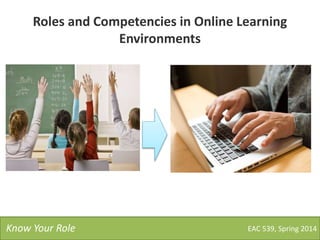
Roles and Competencies in Online Learning
Environments
EAC 539, Spring 2014Know Your Role
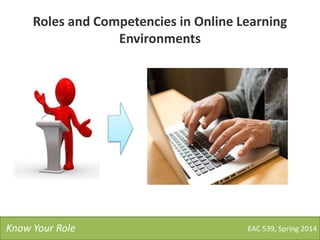
Roles and Competencies in Online Learning
Environments
EAC 539, Spring 2014Know Your Role
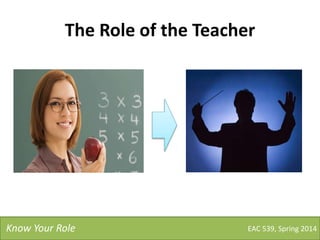
The Role of the Teacher
EAC 539, Spring 2014Know Your Role
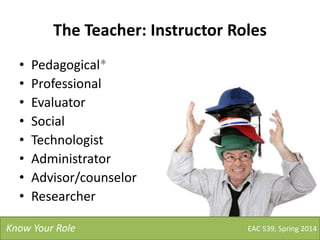
The Teacher: Instructor Roles
• Pedagogical*
• Professional
• Evaluator
• Social
• Technologist
• Administrator
• Advisor/counselor
• Researcher
EAC 539, Spring 2014Know Your Role
The Teacher: The Pedagogical Role
• Competencies
– Design instructional strategies
– Develop appropriate learning resources
– Implement instructional strategies
– Facilitate participation among students
– Sustain students’ motivation
EAC 539, Spring 2014Know Your Role
Bawane & Spector, 2009, p. 392
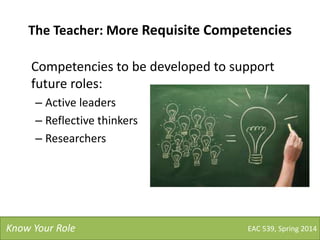
The Teacher: More Requisite Competencies
Competencies to be developed to support
future roles:
– Active leaders
– Reflective thinkers
– Researchers
EAC 539, Spring 2014Know Your Role
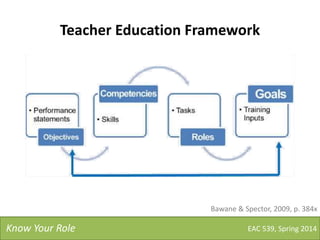
Teacher Education Framework
EAC 539, Spring 2014Know Your Role
Bawane & Spector, 2009, p. 384x
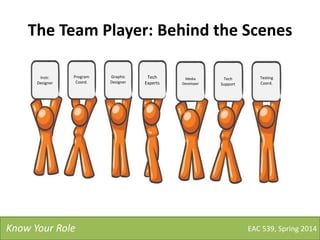
The Team Player: Behind the Scenes
EAC 539, Spring 2014Know Your Role
Instr.
Designer
Program
Coord.
Graphic
Designer
Tech
Experts
Media
Developer
Tech
Support
Testing
Coord.
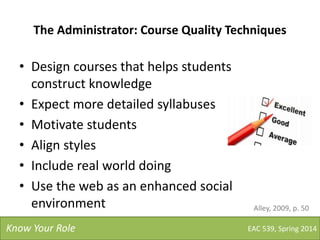
The Administrator: Course Quality Techniques
• Design courses that helps students
construct knowledge
• Expect more detailed syllabuses
• Motivate students
• Align styles
• Include real world doing
• Use the web as an enhanced social
environment
EAC 539, Spring 2014Know Your Role
Alley, 2009, p. 50
The Administrator: Course Quality Techniques
Rely on great teachers as pioneers and mentors.
EAC 539, Spring 2014Know Your Role
Alley, 2009, p. 55
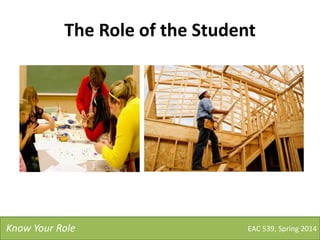
The Role of the Student
EAC 539, Spring 2014Know Your Role
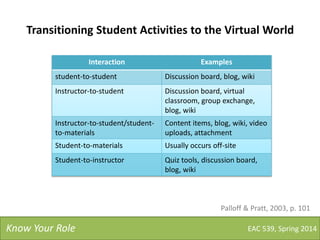
Transitioning Student Activities to the Virtual World
Interaction Examples
student-to-student Discussion board, blog, wiki
Instructor-to-student Discussion board, virtual
classroom, group exchange,
blog, wiki
Instructor-to-student/student-
to-materials
Content items, blog, wiki, video
uploads, attachment
Student-to-materials Usually occurs off-site
Student-to-instructor Quiz tools, discussion board,
blog, wiki
EAC 539, Spring 2014Know Your Role
Palloff & Pratt, 2003, p. 101
EAC 539, Spring 2014Know Your Role
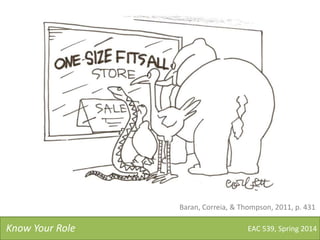
Baran, Correia, & Thompson, 2011, p. 431
Roles: Bringing it Together
• Roles & competencies
will continually evolve.
– Technology continues to
advance
– Our approaches to
online learning develop
– More research is
conducted
EAC 539, Spring 2014Know Your Role
Bawane & Spector, 2009
The Future
Instructor’s responsibility
to continually research
leading practices,
evaluate technological
advances and shifts
within the online
teaching profession, to
ensure personal
pedagogy and
approaches are evolving
and growing over time
EAC 539, Spring 2014Know Your Role
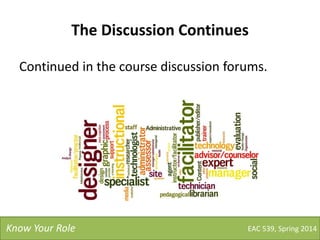
The Discussion Continues
Continued in the course discussion forums.
EAC 539, Spring 2014Know Your Role
References
Alley, L. (2001). What makes a good online course? The administrator’s role in quality assurance of
online learning. Converge, 4(11), 50, 52+, retrieved from Education Research Complete (EBSCO),
November 2007.
Baran, E., Correia, A.P. & Thompson, A. (2011). Transforming Online Teaching Practice: Critical Analysis
of the Literature on the Roles and Competencies of Online Teachers. Distance Education, 32(3),
421-439.
Bawane, J. & Spector, J.M. (2009). Prioritization of Online Instructor Roles: Implications for
Competency-Based Teacher Education Programs. Distance Education. 30 (3), pp. 383-397.
EAC 539, Spring 2014Know Your Role

EAC 539 Presentation: Know Your Role

  • 1.
    Know Your Role EAC539 – Teaching in the Online Environment Spring 2014 Terry Herring Matt Misuraca Jenny Taylor Beth Vincent
  • 2.
    Roles and Competenciesin Online Learning Environments EAC 539, Spring 2014Know Your Role
  • 3.
    Roles and Competenciesin Online Learning Environments EAC 539, Spring 2014Know Your Role
  • 4.
    The Role ofthe Teacher EAC 539, Spring 2014Know Your Role
  • 5.
    The Teacher: InstructorRoles • Pedagogical* • Professional • Evaluator • Social • Technologist • Administrator • Advisor/counselor • Researcher EAC 539, Spring 2014Know Your Role
  • 6.
    The Teacher: ThePedagogical Role • Competencies – Design instructional strategies – Develop appropriate learning resources – Implement instructional strategies – Facilitate participation among students – Sustain students’ motivation EAC 539, Spring 2014Know Your Role Bawane & Spector, 2009, p. 392
  • 7.
    The Teacher: MoreRequisite Competencies Competencies to be developed to support future roles: – Active leaders – Reflective thinkers – Researchers EAC 539, Spring 2014Know Your Role
  • 8.
    Teacher Education Framework EAC539, Spring 2014Know Your Role Bawane & Spector, 2009, p. 384x
  • 9.
    The Team Player:Behind the Scenes EAC 539, Spring 2014Know Your Role Instr. Designer Program Coord. Graphic Designer Tech Experts Media Developer Tech Support Testing Coord.
  • 10.
    The Administrator: CourseQuality Techniques • Design courses that helps students construct knowledge • Expect more detailed syllabuses • Motivate students • Align styles • Include real world doing • Use the web as an enhanced social environment EAC 539, Spring 2014Know Your Role Alley, 2009, p. 50
  • 11.
    The Administrator: CourseQuality Techniques Rely on great teachers as pioneers and mentors. EAC 539, Spring 2014Know Your Role Alley, 2009, p. 55
  • 12.
    The Role ofthe Student EAC 539, Spring 2014Know Your Role
  • 13.
    Transitioning Student Activitiesto the Virtual World Interaction Examples student-to-student Discussion board, blog, wiki Instructor-to-student Discussion board, virtual classroom, group exchange, blog, wiki Instructor-to-student/student- to-materials Content items, blog, wiki, video uploads, attachment Student-to-materials Usually occurs off-site Student-to-instructor Quiz tools, discussion board, blog, wiki EAC 539, Spring 2014Know Your Role Palloff & Pratt, 2003, p. 101
  • 14.
    EAC 539, Spring2014Know Your Role Baran, Correia, & Thompson, 2011, p. 431
  • 15.
    Roles: Bringing itTogether • Roles & competencies will continually evolve. – Technology continues to advance – Our approaches to online learning develop – More research is conducted EAC 539, Spring 2014Know Your Role Bawane & Spector, 2009
  • 16.
    The Future Instructor’s responsibility tocontinually research leading practices, evaluate technological advances and shifts within the online teaching profession, to ensure personal pedagogy and approaches are evolving and growing over time EAC 539, Spring 2014Know Your Role
  • 17.
    The Discussion Continues Continuedin the course discussion forums. EAC 539, Spring 2014Know Your Role
  • 18.
    References Alley, L. (2001).What makes a good online course? The administrator’s role in quality assurance of online learning. Converge, 4(11), 50, 52+, retrieved from Education Research Complete (EBSCO), November 2007. Baran, E., Correia, A.P. & Thompson, A. (2011). Transforming Online Teaching Practice: Critical Analysis of the Literature on the Roles and Competencies of Online Teachers. Distance Education, 32(3), 421-439. Bawane, J. & Spector, J.M. (2009). Prioritization of Online Instructor Roles: Implications for Competency-Based Teacher Education Programs. Distance Education. 30 (3), pp. 383-397. EAC 539, Spring 2014Know Your Role