Computer System
Servicing NC II Grade 12
Lesson1: Understanding
Server-Client Networking
E X P E C T A T I O N
After completing the lesson the learners should be able to:
1.define Client-Server Network
2.diffentiate Client from Server
3.cite the importance of securing server for the client
UNDERSTANDING CLIENT-SERVER
Introduction
Client-server networking grew in popularity during the 1990s as personal
computers became the alternative to mainframe computers. Client-server networking
refers to a computer networking model that uses both client hardware devices and
servers, each with specific functions. The client-server model can be used on the
internet as well as on a local area network (LAN). Examples of client-server systems
on the internet include web browsers and web servers, FTP clients and servers, and
the DNS.
This lesson will broaden your understanding about server client networking.
L E S S O N
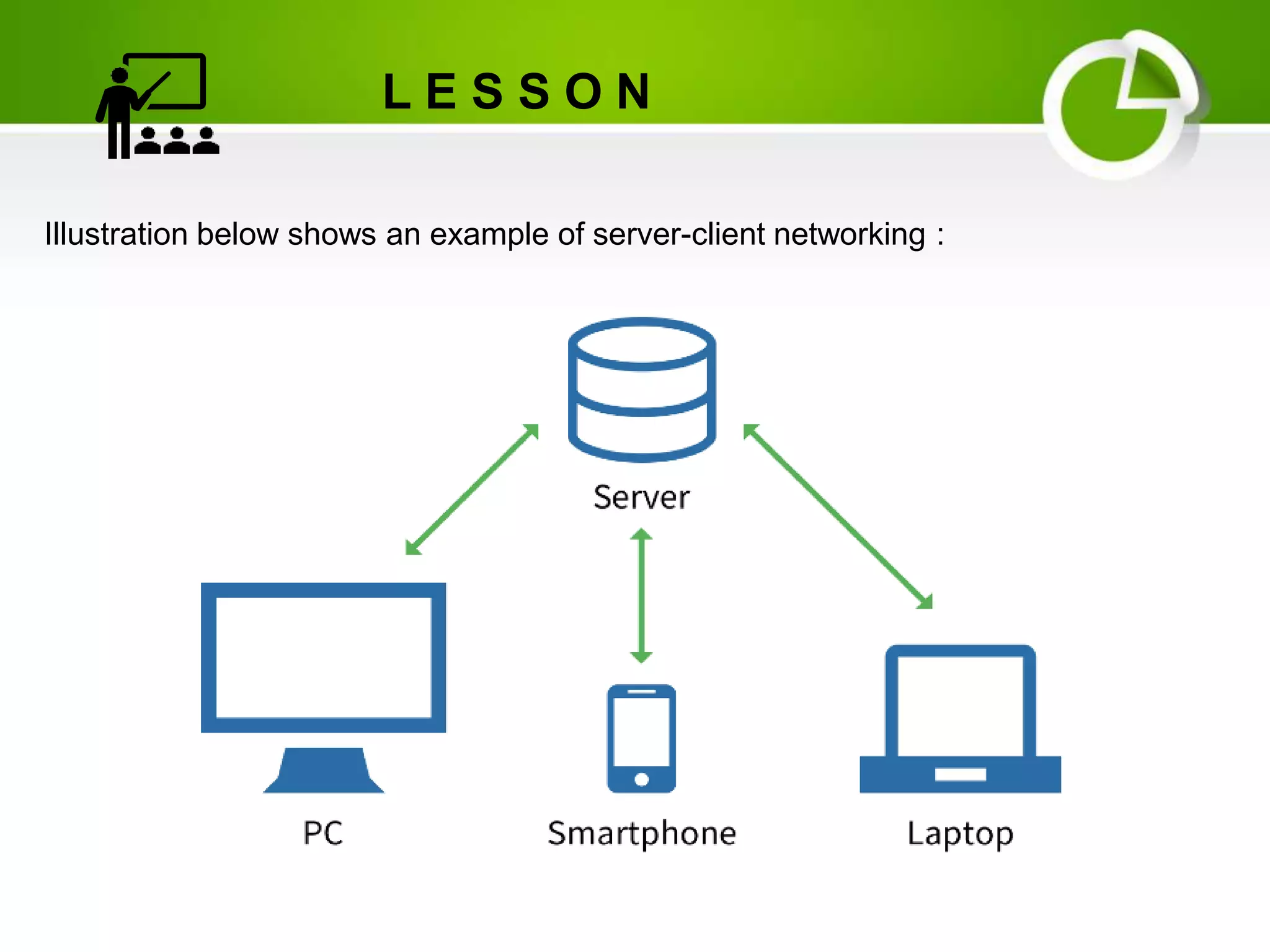
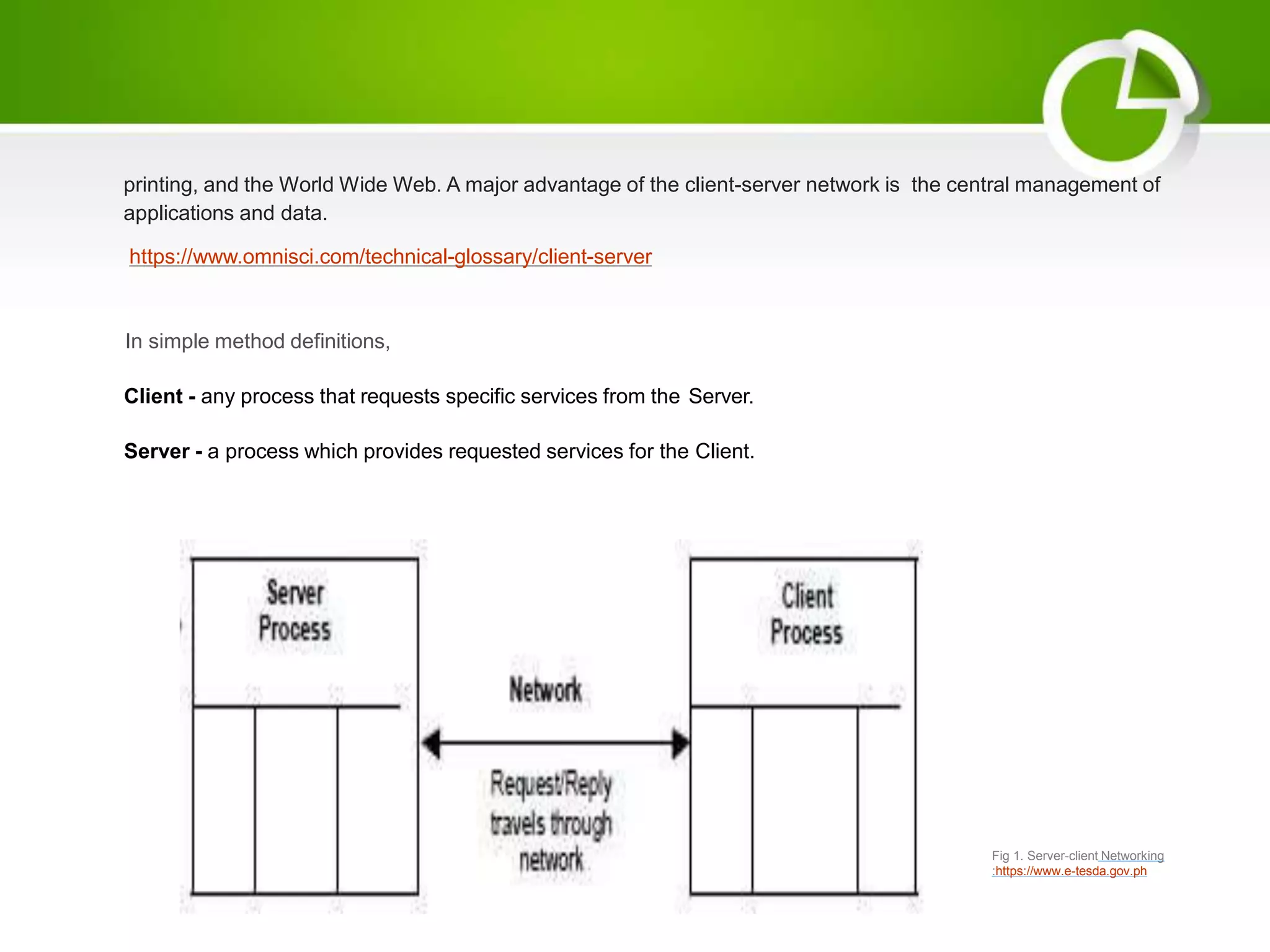
Illustration below shows an example of server-client networking :
L E S S O N
Server-Client Networking Defined
Client-server denotes a relationship between cooperating programs in an
application, composed of clients initiating requests for services and servers
providing that function or service.
A client-server network is the medium through which clients access
resources and services from a central computer, via either a local area
network (LAN) or a widearea network (WAN), such as the Internet. A unique
server called a daemon may be employed for the sole purpose of awaiting
client requests, at which point the network connection is initiated until the
client request has been fulfilled.
Network traffic is categorized as client-to-server (north-south traffic) or
server- toserver (east-west traffic). Popular network services include e-
mail, file sharing,
printing, and the World Wide Web. A major advantage of the client-server network is the central management of
applications and data.
https://www.omnisci.com/technical-glossary/client-server
In simple method definitions,
Client - any process that requests specific services from the Server.
Server - a process which provides requested services for the Client.
Fig 1. Server-client Networking
:https://www.e-tesda.gov.ph
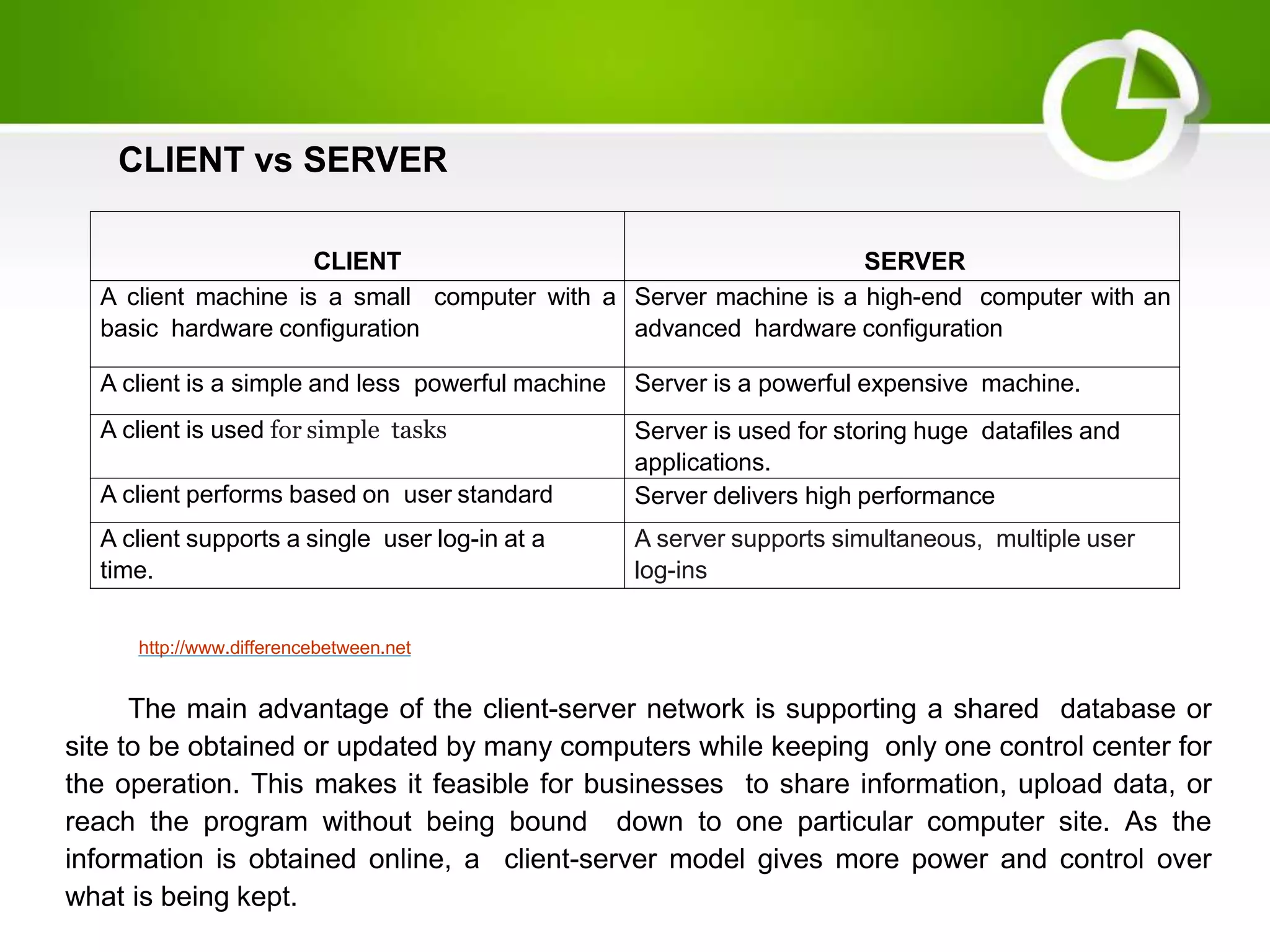
CLIENT vs SERVER
CLIENT SERVER
A client machine is a small computer with a
basic hardware configuration
Server machine is a high-end computer with an
advanced hardware configuration
A client is a simple and less powerful machine Server is a powerful expensive machine.
A client is used for simple tasks Server is used for storing huge datafiles and
applications.
A client performs based on user standard Server delivers high performance
A client supports a single user log-in at a
time.
A server supports simultaneous, multiple user
log-ins
http://www.differencebetween.net
The main advantage of the client-server network is supporting a shared database or
site to be obtained or updated by many computers while keeping only one control center for
the operation. This makes it feasible for businesses to share information, upload data, or
reach the program without being bound down to one particular computer site. As the
information is obtained online, a client-server model gives more power and control over
what is being kept.
Additionally, this model has improved security, usually with
encryption, making sure that the data is only available to authorized
people. A client-server model also makes it simpler to back up valuable
information than if it was collected across many devices. A network
administrator can easily configure a backup for the server, and if the
first data were to be destroyed, he or she would only want to recover
the single backup.
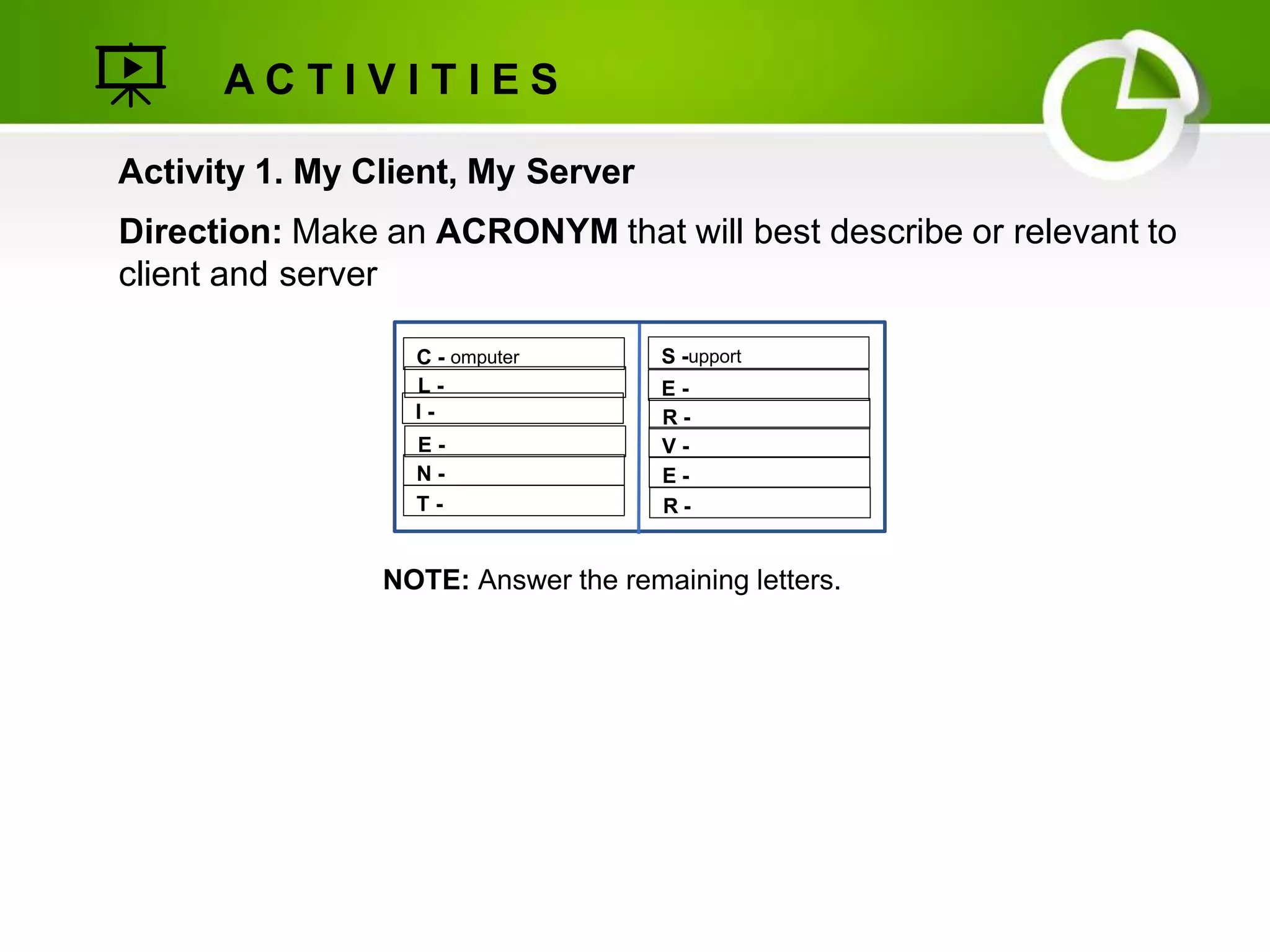
Activity 1. My Client, My Server
Direction: Make an ACRONYM that will best describe or relevant to
client and server
A C T I V I T I E S
NOTE: Answer the remaining letters.
C - omputer
L -
I -
E -
N -
T -
S -upport
E -
R -
V -
E -
R -
W R A P – U P
Client-server networking refers to a computer networking model that uses
both client hardware devices and servers, each with specific
functions. The clientserver model can be used on the internet as well as on a local
area network (LAN).
Client-server denotes a relationship between cooperating programs in an
application, composed of clients initiating requests for services and servers providing
that function or service. In simple definition, Client is any process that requests
specific services from the Server while Server is a process which provides
requested services for the Client. The main advantage of the client-server network
is supporting a shared database or site to be obtained or updated by many
computers while keeping only one control center for the operation. this model has
improved security, usually with encryption, making sure that the data is only
available to authorized people. A clientserver model also makes it simpler to back
up valuable information than if it wascollected across many devices. A network
administrator can easily configure a backup for the server, and if the first data were
to be destroyed, he or she would only want to recover the single backup.

CSS 12 - Q1 - Lesson1.pptx

  • 1.
    Computer System Servicing NCII Grade 12 Lesson1: Understanding Server-Client Networking
  • 2.
    E X PE C T A T I O N After completing the lesson the learners should be able to: 1.define Client-Server Network 2.diffentiate Client from Server 3.cite the importance of securing server for the client
  • 3.
    UNDERSTANDING CLIENT-SERVER Introduction Client-server networkinggrew in popularity during the 1990s as personal computers became the alternative to mainframe computers. Client-server networking refers to a computer networking model that uses both client hardware devices and servers, each with specific functions. The client-server model can be used on the internet as well as on a local area network (LAN). Examples of client-server systems on the internet include web browsers and web servers, FTP clients and servers, and the DNS. This lesson will broaden your understanding about server client networking. L E S S O N
  • 4.
    Illustration below showsan example of server-client networking : L E S S O N
  • 5.
    Server-Client Networking Defined Client-serverdenotes a relationship between cooperating programs in an application, composed of clients initiating requests for services and servers providing that function or service. A client-server network is the medium through which clients access resources and services from a central computer, via either a local area network (LAN) or a widearea network (WAN), such as the Internet. A unique server called a daemon may be employed for the sole purpose of awaiting client requests, at which point the network connection is initiated until the client request has been fulfilled. Network traffic is categorized as client-to-server (north-south traffic) or server- toserver (east-west traffic). Popular network services include e- mail, file sharing,
  • 6.
    printing, and theWorld Wide Web. A major advantage of the client-server network is the central management of applications and data. https://www.omnisci.com/technical-glossary/client-server In simple method definitions, Client - any process that requests specific services from the Server. Server - a process which provides requested services for the Client. Fig 1. Server-client Networking :https://www.e-tesda.gov.ph
  • 7.
    CLIENT vs SERVER CLIENTSERVER A client machine is a small computer with a basic hardware configuration Server machine is a high-end computer with an advanced hardware configuration A client is a simple and less powerful machine Server is a powerful expensive machine. A client is used for simple tasks Server is used for storing huge datafiles and applications. A client performs based on user standard Server delivers high performance A client supports a single user log-in at a time. A server supports simultaneous, multiple user log-ins http://www.differencebetween.net The main advantage of the client-server network is supporting a shared database or site to be obtained or updated by many computers while keeping only one control center for the operation. This makes it feasible for businesses to share information, upload data, or reach the program without being bound down to one particular computer site. As the information is obtained online, a client-server model gives more power and control over what is being kept.
  • 8.
    Additionally, this modelhas improved security, usually with encryption, making sure that the data is only available to authorized people. A client-server model also makes it simpler to back up valuable information than if it was collected across many devices. A network administrator can easily configure a backup for the server, and if the first data were to be destroyed, he or she would only want to recover the single backup.
  • 9.
    Activity 1. MyClient, My Server Direction: Make an ACRONYM that will best describe or relevant to client and server A C T I V I T I E S NOTE: Answer the remaining letters. C - omputer L - I - E - N - T - S -upport E - R - V - E - R -
  • 10.
    W R AP – U P Client-server networking refers to a computer networking model that uses both client hardware devices and servers, each with specific functions. The clientserver model can be used on the internet as well as on a local area network (LAN). Client-server denotes a relationship between cooperating programs in an application, composed of clients initiating requests for services and servers providing that function or service. In simple definition, Client is any process that requests specific services from the Server while Server is a process which provides requested services for the Client. The main advantage of the client-server network is supporting a shared database or site to be obtained or updated by many computers while keeping only one control center for the operation. this model has improved security, usually with encryption, making sure that the data is only available to authorized people. A clientserver model also makes it simpler to back up valuable information than if it wascollected across many devices. A network administrator can easily configure a backup for the server, and if the first data were to be destroyed, he or she would only want to recover the single backup.