The Global Development Institute
Lecture Series
#GDILecture
@GlobalDevInst
@schant2
Professor Sylvia Chant
LSE
s.chant@lse.ac.uk
http://personal.lse.ac.uk/chant/
@schant2@LSEUPD
#BeBoldForChange (IWD, 2017)
University of Manchester
Global Development Institute Lecture
8 March 2017
Gender, Urbanisation and Poverty:
Principles, Practice and the Space
of Slums
5.
6. From ‘feminising cities’ to ‘feminist cities’? What, who and how?
2
Interlocking penalties for slum-dwelling women and girls
1. The importance of a gendered ‘urban lens’
2. ‘Feminising’ cities in the Global South
3. Urbanisation and gender equality: principles and practice
4. Slums and their significance for gendered poverty and inequality –
introducing the ‘gender-urban-slum interface’ (Chant and McIlwaine,
2016).
Presentation outline
1)Hiatus between principle/proclamation and practice
Despite the conventional wisdom (unqualified supposition?) that urbanisation is ‘good for
women and girls’, this does not apply to all women, with considerable evidence that barriers
to gender equality and ‘female empowerment’ (as advocated/promoted by BPFA, MDGs,
SDGs etc) remain widespread in urban environments.
2)Historical marginalisation/neglect of ‘feminised spheres’ of urban life
‘Private’/domestic feminised spaces often left out of conceptual framing and policy and
planning (see Buckley & Strauss, 2016; Fenster, 1999,2005)
3) Need for (re)-theorisation on gender and cities which departs from Global North and
globalising ‘norms’
Inappropriate universalisms/generalisations derived from Global North experiences,
especially in relation to neglect of extensive informal urbanisation in Global South and the
particular challenges of slums (Chant & McIlwaine, 2016)
3
The importance of a ‘gender lens’ in urban analysis and
policy in Global South
4)Intrinsic importance of women’s (and girls’) rights and gender justice – the
imperative of addressing under-valorisation and exclusion in context of mismatch
between inputs and outcome
Women play a significant role in contributing to urban development and ‘’prosperity’ in
Global South (e.g. housing stock, household livelihoods), but non-commensurate with
outcomes (e.g. ‘decent work’ and equal pay, tenure rights, civic representation)
‘The persistent undervaluation of women’s efforts… constitute a compelling moral, economic,
political and policy rationale to understand how prevailing inequalities between women and
men play out in urban environments, and how these might most effectively be addressed’
(Chant and McIlwaine, 2016:29-30).
5) Distinctive/intensified ‘urban’ vs ‘rural’ gendered vulnerabilities
Heightened vulnerability for urban women and girls (esp. poor/slumdwellers) vis-à-vis their
rural counterparts due to environmental threats (including in domestic spaces), health risks
e.g. communicable disease, fatigue, HIV/AIDS, CMDs, and gender-based violence
(GBV)/Violence Against Women and Girls (VAWG).
6) Feminising urban demographics
Nearly all future demographic growth in developing countries will be in cities (and majority
4female)
The importance of a ‘gender lens’ in urban analysis and
policy in Global South (cont.)
5
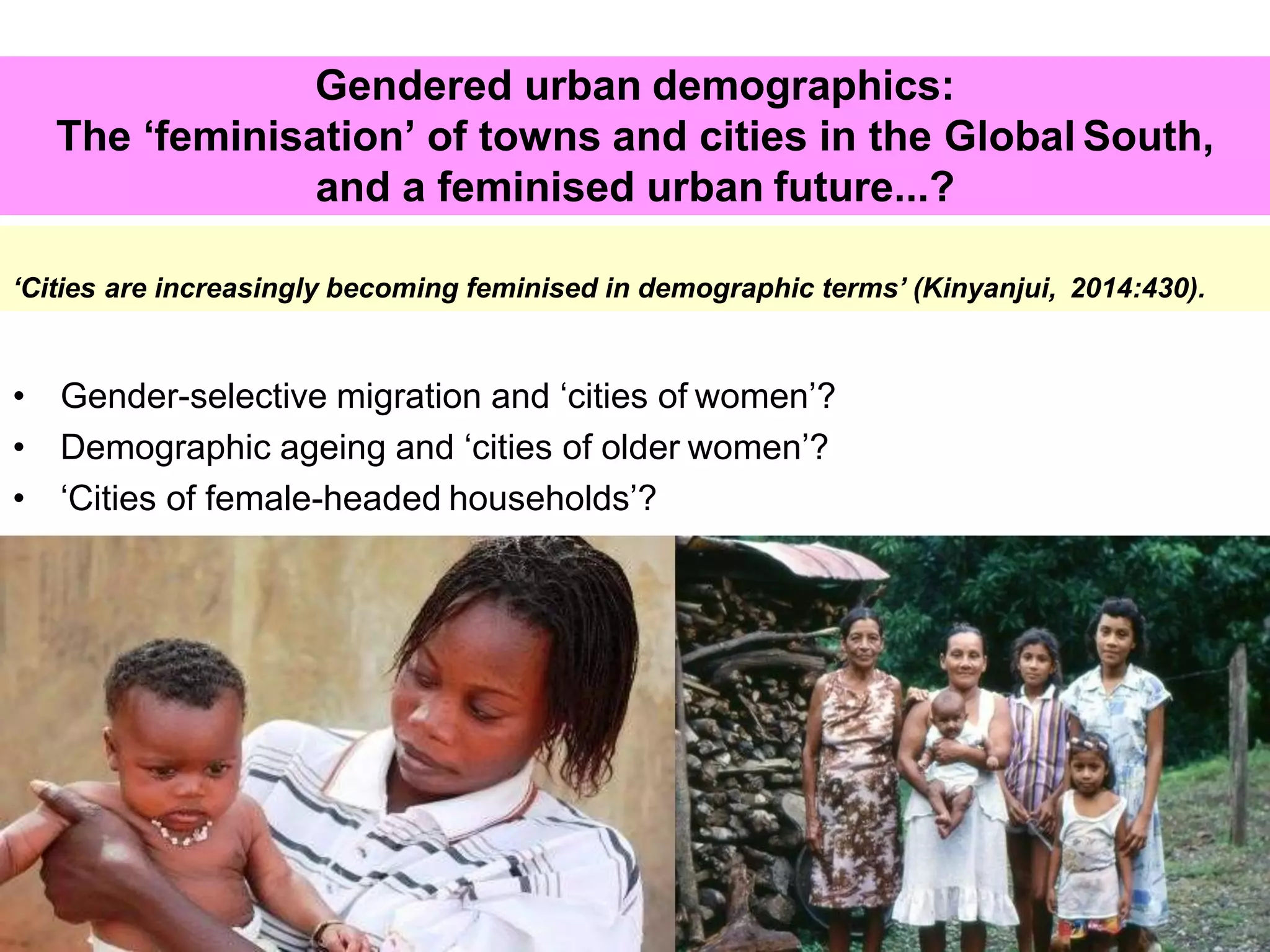
Gendered urban demographics:
The ‘feminisation’ of towns and cities in the Global South,
and a feminised urban future...?
‘Cities are increasingly becoming feminised in demographic terms’ (Kinyanjui, 2014:430).
• Gender-selective migration and ‘cities of women’?
• Demographic ageing and ‘cities of older women’?
• ‘Cities of female-headed households’?
6
DIMENSIONS AND DYNAMICS OF SEX-SELECTIVITY
IN RURAL-URBAN MIGRATION
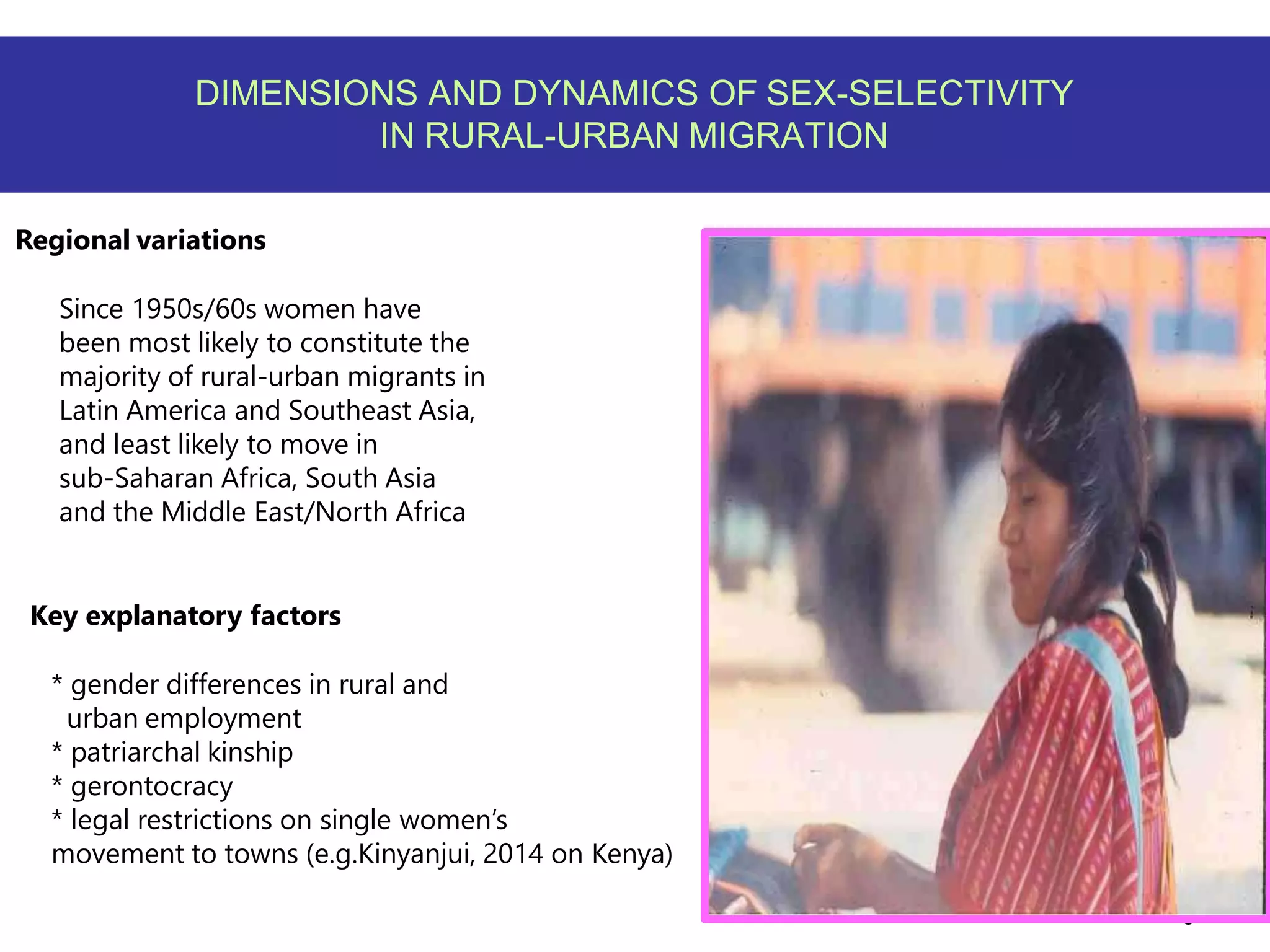
Regional variations
Since 1950s/60s women have
been most likely to constitute the
majority of rural-urban migrants in
Latin America and Southeast Asia,
and least likely to move in
sub-Saharan Africa, South Asia
and the Middle East/North Africa
Key explanatory factors
* gender differences in rural and
urban employment
* patriarchal kinship
* gerontocracy
* legal restrictions on single women’s
movement to towns (e.g.Kinyanjui, 2014 on Kenya)
7
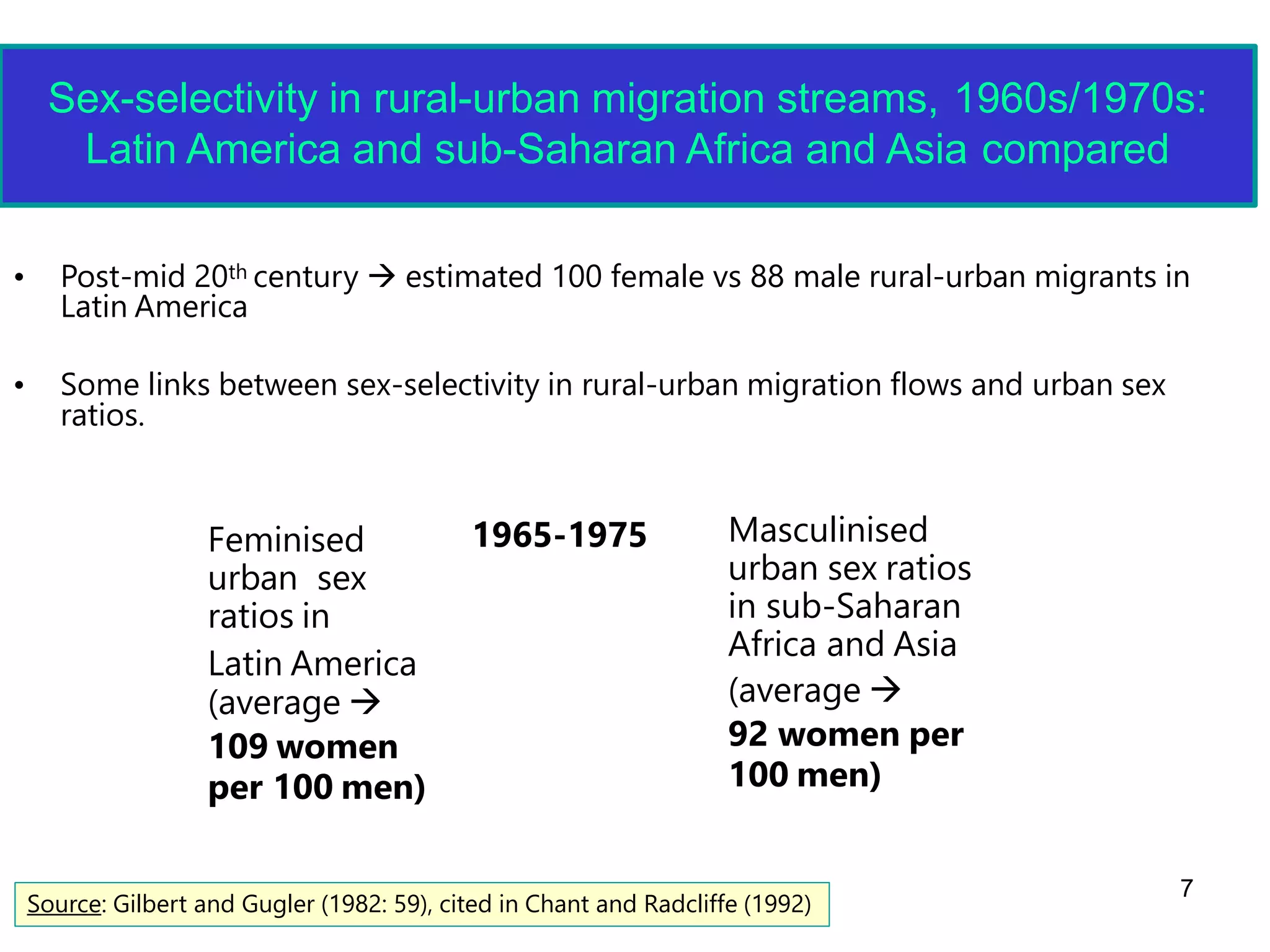
Sex-selectivity in rural-urban migration streams, 1960s/1970s:
Latin America and sub-Saharan Africa and Asia compared
• Post-mid 20th century  estimated 100 female vs 88 male rural-urban migrants in
Latin America
• Some links between sex-selectivity in rural-urban migration flows and urban sex
ratios.
1965-1975
Source: Gilbert and Gugler (1982: 59), cited in Chant and Radcliffe (1992)
Feminised
urban sex
ratios in
Latin America
(average 
109 women
per 100 men)
Masculinised
urban sex ratios
in sub-Saharan
Africa and Asia
(average 
92 women per
100 men)
8
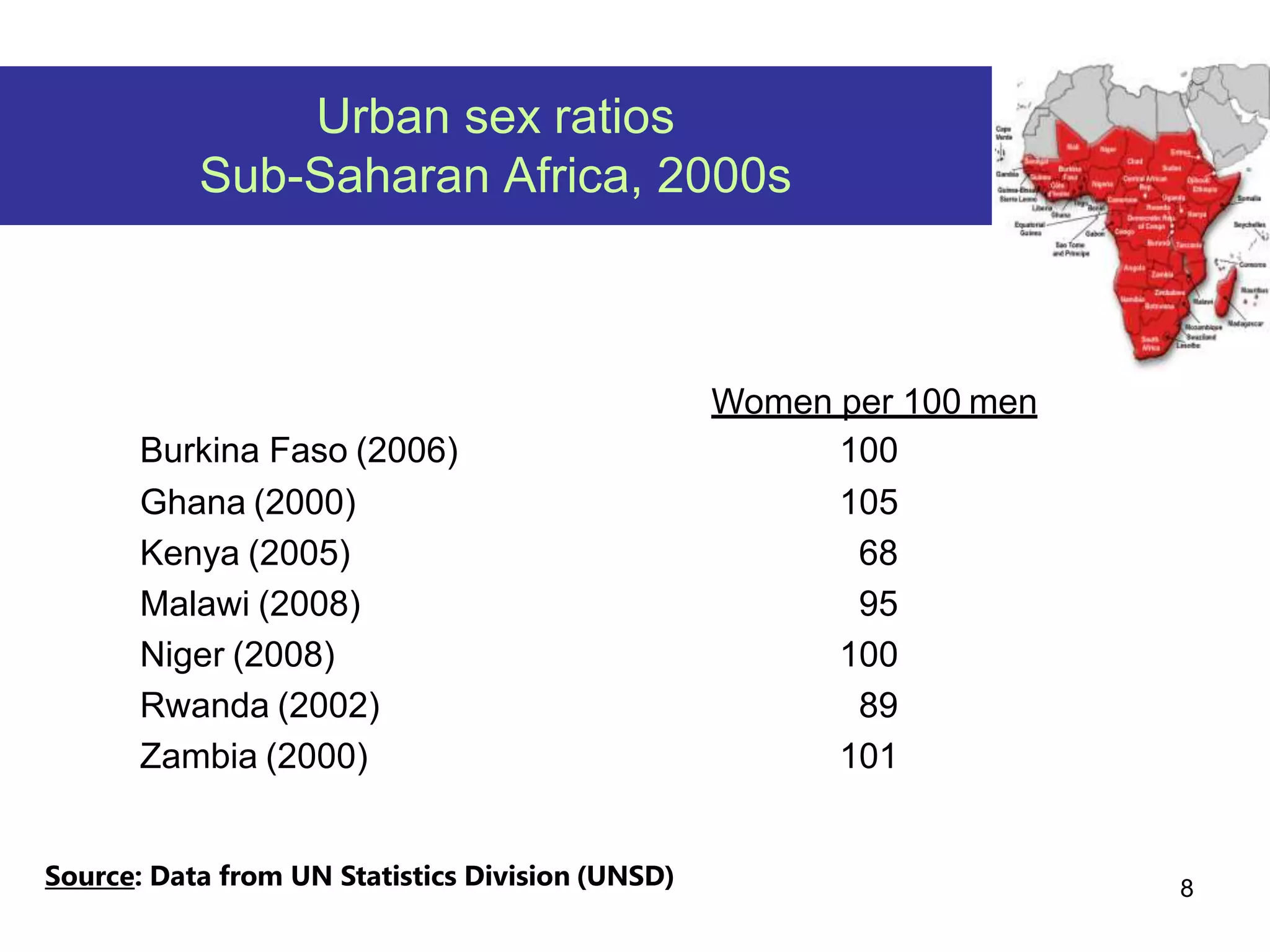
Urban sex ratios
Sub-Saharan Africa, 2000s
Women per 100 men
Burkina Faso (2006) 100
Ghana (2000) 105
Kenya (2005) 68
Malawi (2008) 95
Niger (2008) 100
Rwanda (2002) 89
Zambia (2000) 101
Source: Data from UN Statistics Division (UNSD)
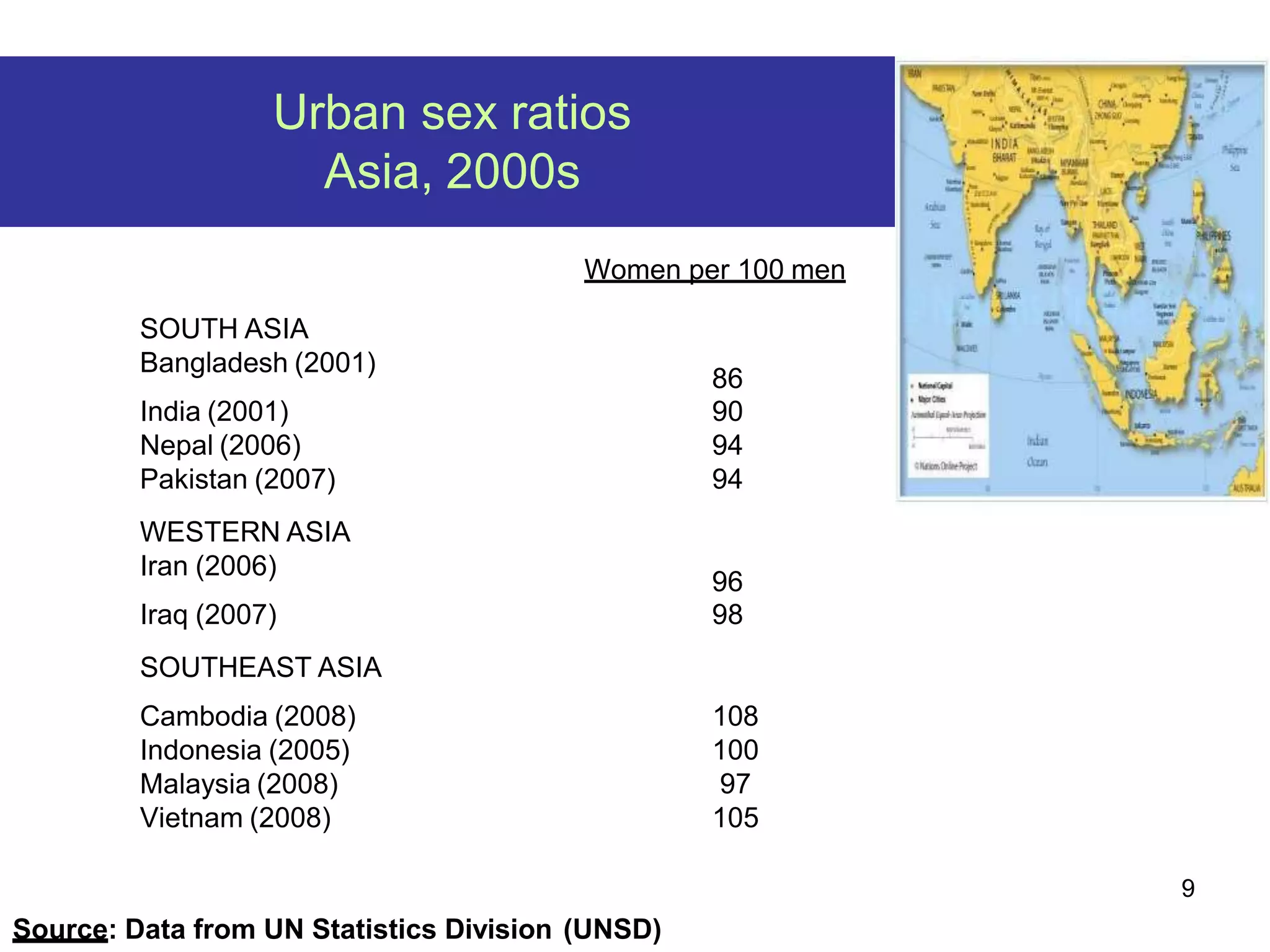
Urban sex ratios
Asia, 2000s
Women per 100 men
SOUTH ASIA
Bangladesh (2001)
86
India (2001) 90
Nepal (2006) 94
Pakistan (2007) 94
WESTERN ASIA
Iran (2006)
96
Iraq (2007) 98
SOUTHEAST ASIA
Cambodia (2008) 108
Indonesia (2005) 100
Malaysia (2008) 97
Vietnam (2008) 105
9
Source: Data from UN Statistics Division (UNSD)
10
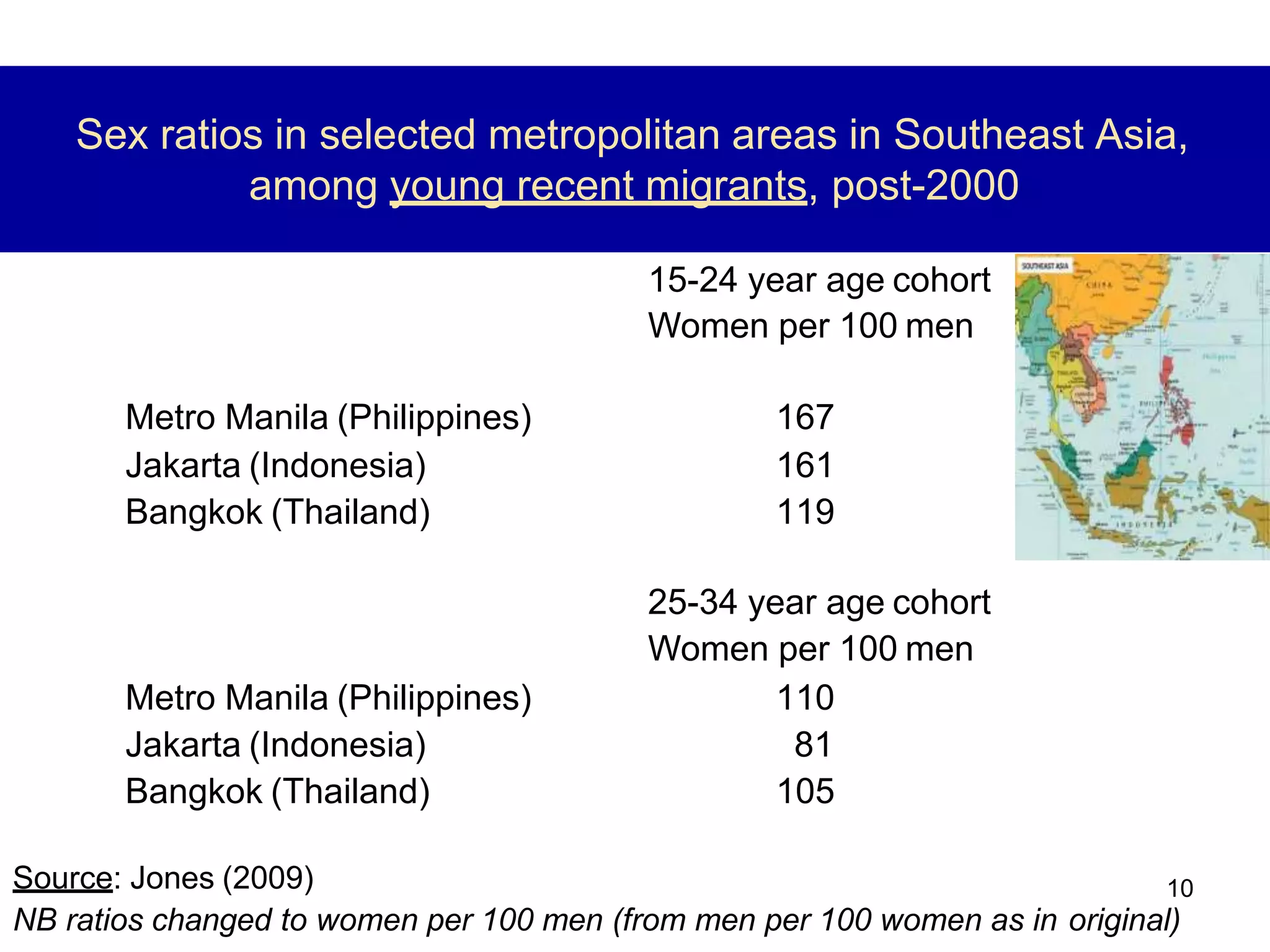
Sex ratios in selected metropolitan areas in Southeast Asia,
among young recent migrants, post-2000
15-24 year age cohort
Women per 100 men
Metro Manila (Philippines) 167
Jakarta (Indonesia) 161
Bangkok (Thailand) 119
25-34 year age cohort
Women per 100 men
Metro Manila (Philippines) 110
Jakarta (Indonesia) 81
Bangkok (Thailand) 105
Source: Jones (2009)
NB ratios changed to women per 100 men (from men per 100 women as in original)
11
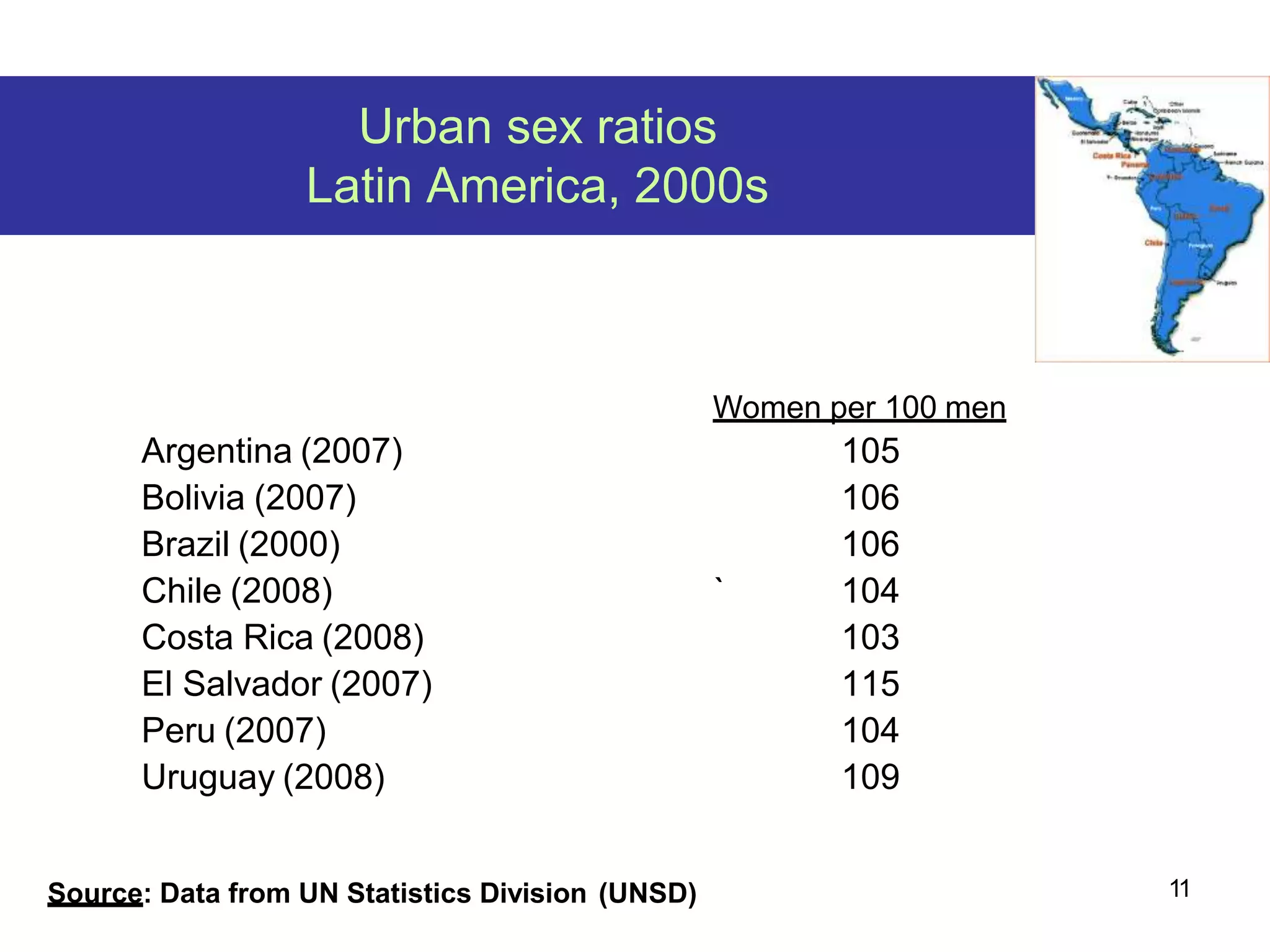
Urban sex ratios
Latin America, 2000s
Women per 100 men
Argentina (2007) 105
Bolivia (2007) 106
Brazil (2000) 106
Chile (2008) ` 104
Costa Rica (2008) 103
El Salvador (2007) 115
Peru (2007) 104
Uruguay (2008) 109
Source: Data from UN Statistics Division (UNSD)
12
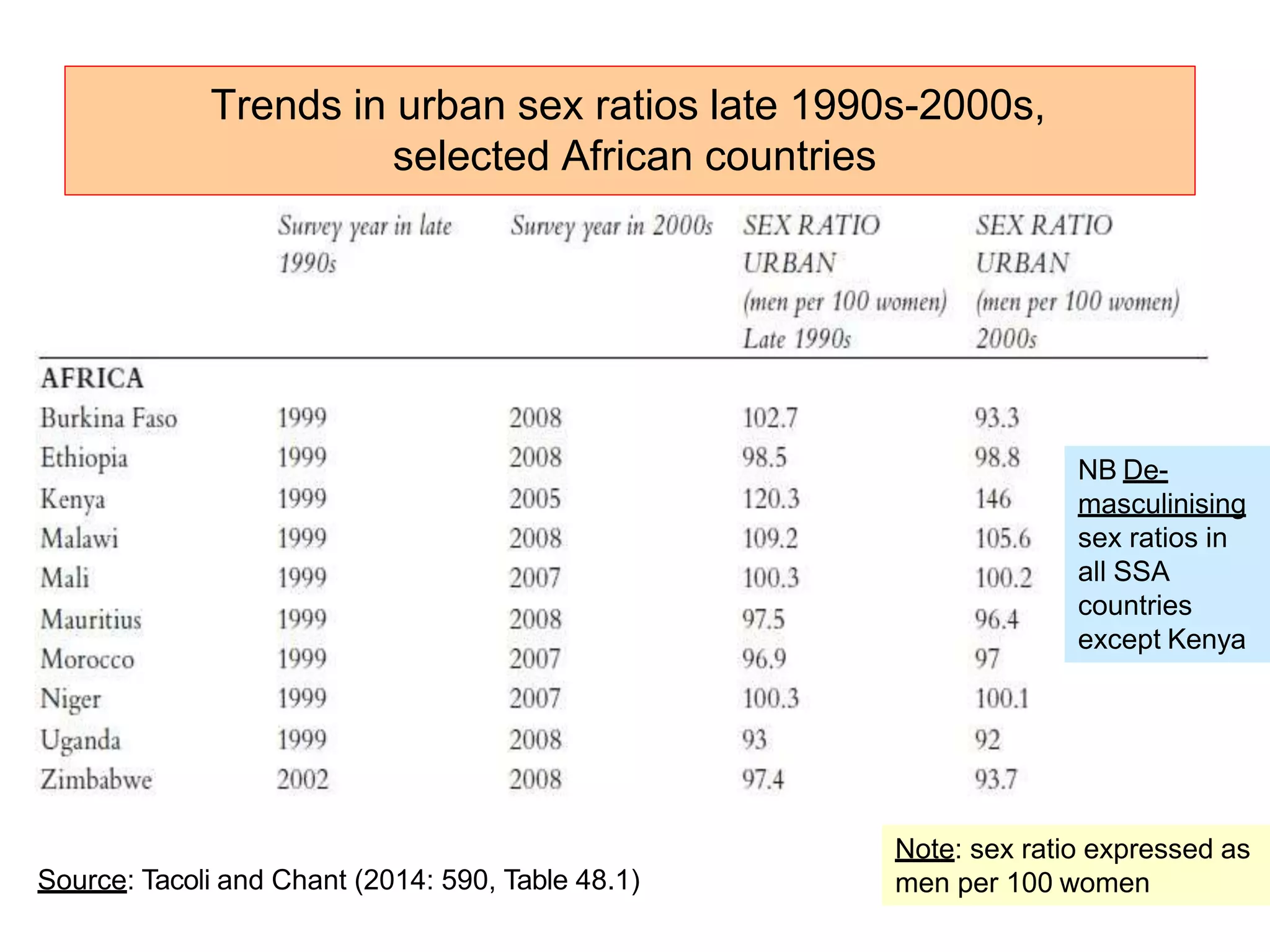
Trends in urban sex ratios late 1990s-2000s,
selected African countries
Source: Tacoli and Chant (2014: 590, Table 48.1)
Note: sex ratio expressed as
men per 100 women
NB De-
masculinising
sex ratios in
all SSA
countries
except Kenya
13
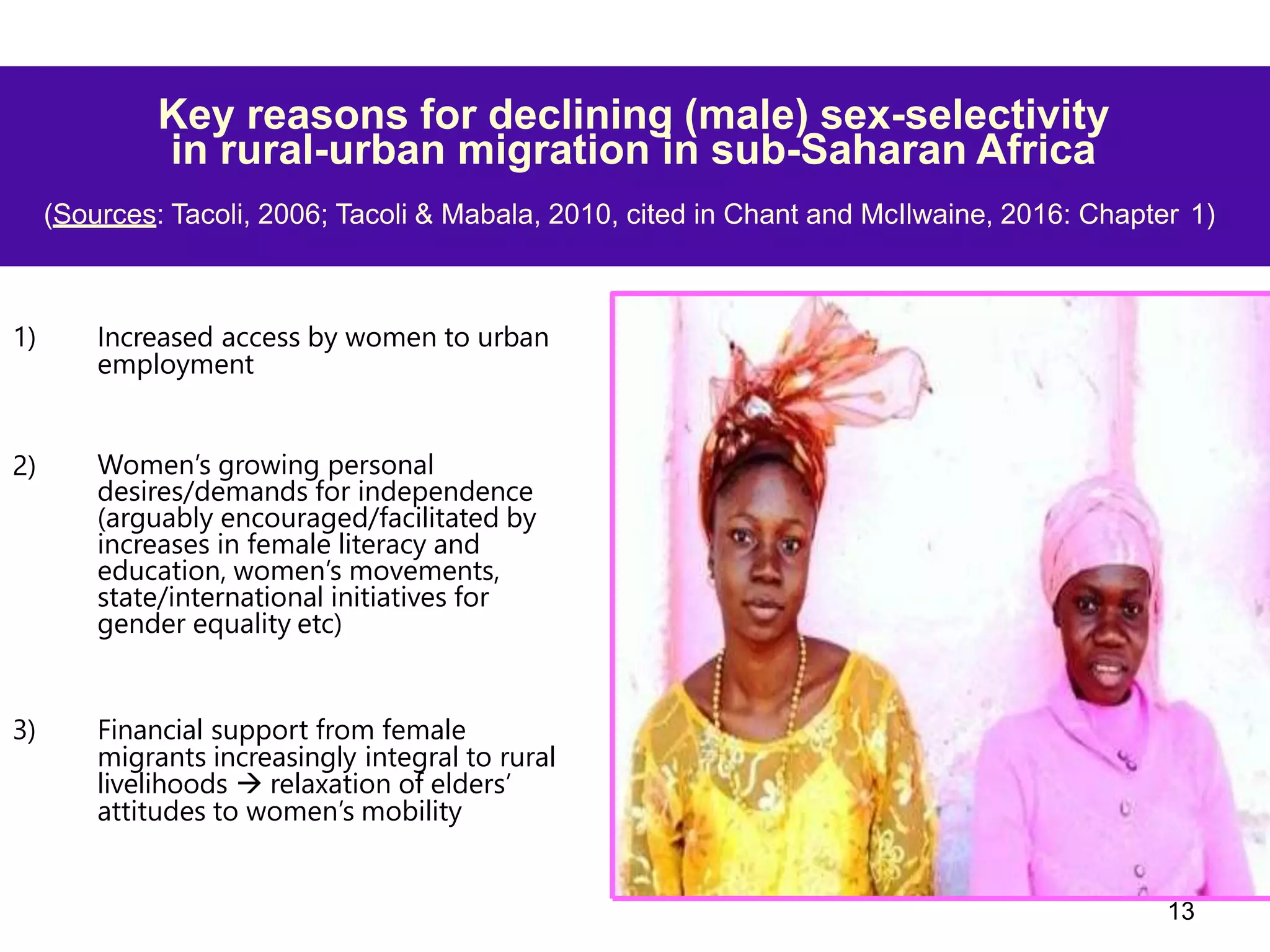
Key reasons for declining (male) sex-selectivity
in rural-urban migration in sub-Saharan Africa
(Sources: Tacoli, 2006; Tacoli & Mabala, 2010, cited in Chant and McIlwaine, 2016: Chapter 1)
1) Increased access by women to urban
employment
2) Women’s growing personal
desires/demands for independence
(arguably encouraged/facilitated by
increases in female literacy and
education, women’s movements,
state/international initiatives for
gender equality etc)
3) Financial support from female
migrants increasingly integral to rural
livelihoods  relaxation of elders’
attitudes to women’s mobility
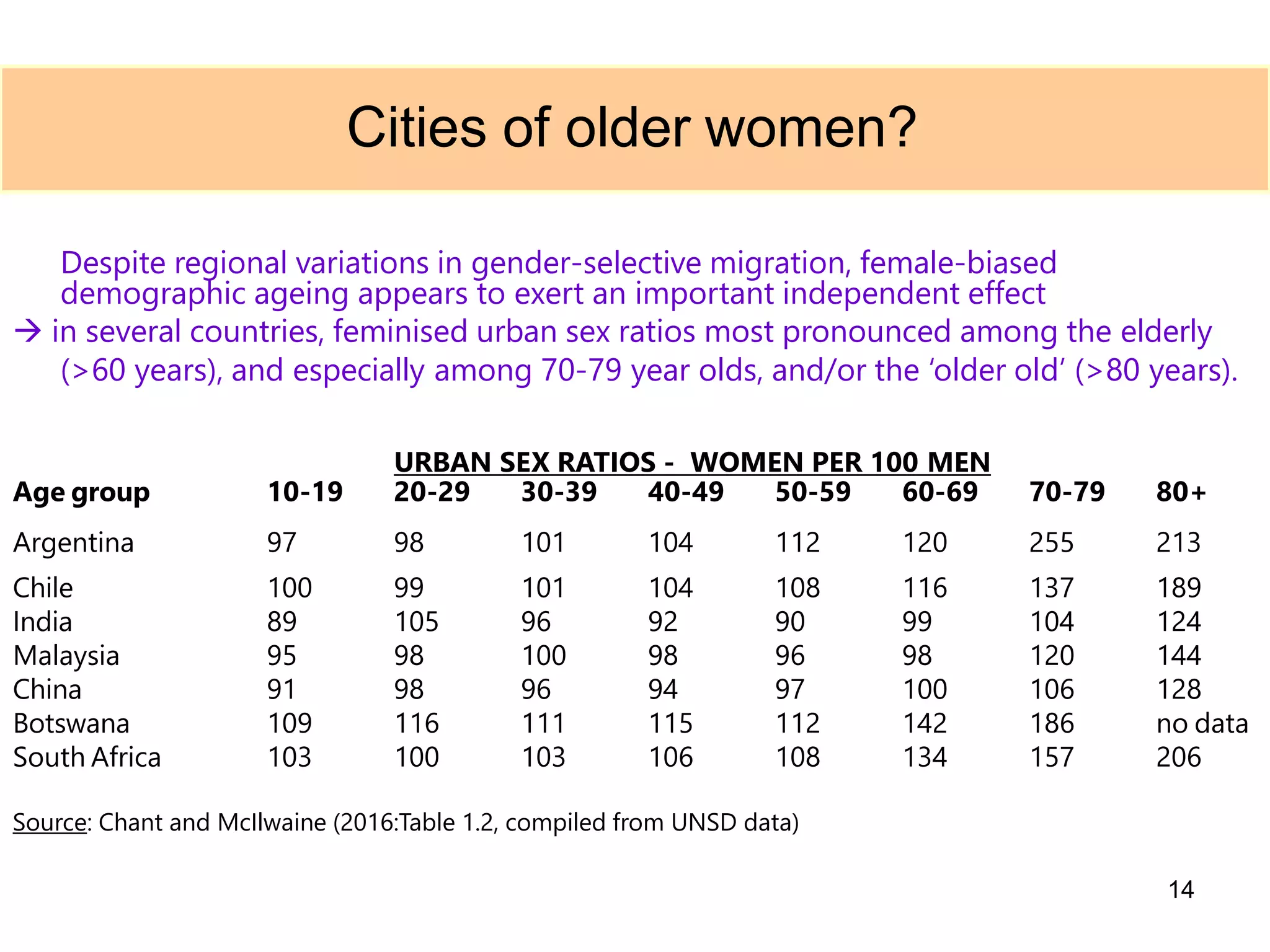
Despite regional variations in gender-selective migration, female-biased
demographic ageing appears to exert an important independent effect
 in several countries, feminised urban sex ratios most pronounced among the elderly
(>60 years), and especially among 70-79 year olds, and/or the ‘older old’ (>80 years).
URBAN SEX RATIOS - WOMEN PER 100 MEN
Cities of older women?
Age group 10-19 20-29 30-39 40-49 50-59 60-69 70-79 80+
Argentina 97 98 101 104 112 120 255 213
Chile 100 99 101 104 108 116 137 189
India 89 105 96 92 90 99 104 124
Malaysia 95 98 100 98 96 98 120 144
China 91 98 96 94 97 100 106 128
Botswana 109 116 111 115 112 142 186 no data
South Africa 103 100 103 106 108 134 157 206
Source: Chant and McIlwaine (2016:Table 1.2, compiled from UNSD data)
14
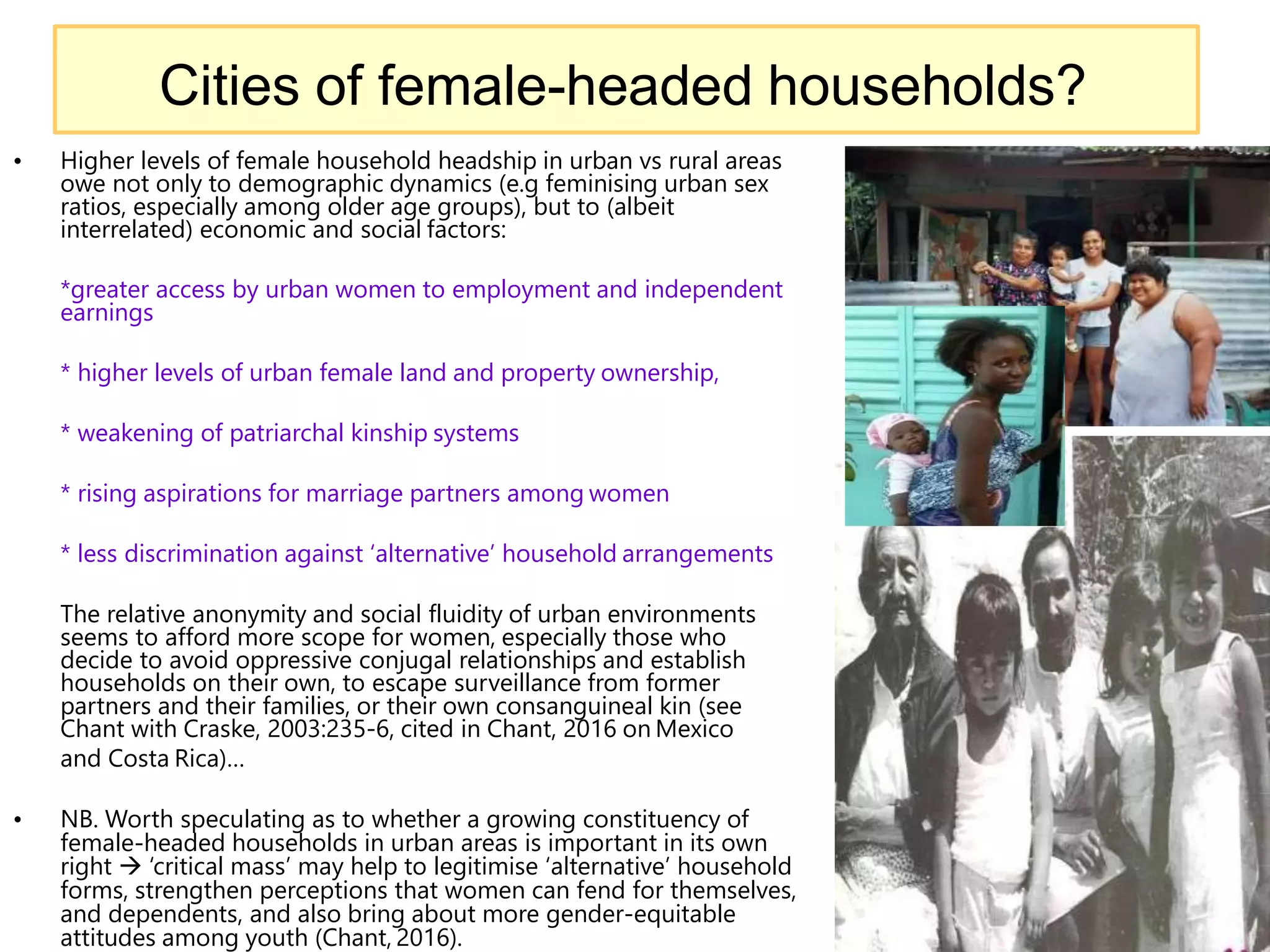
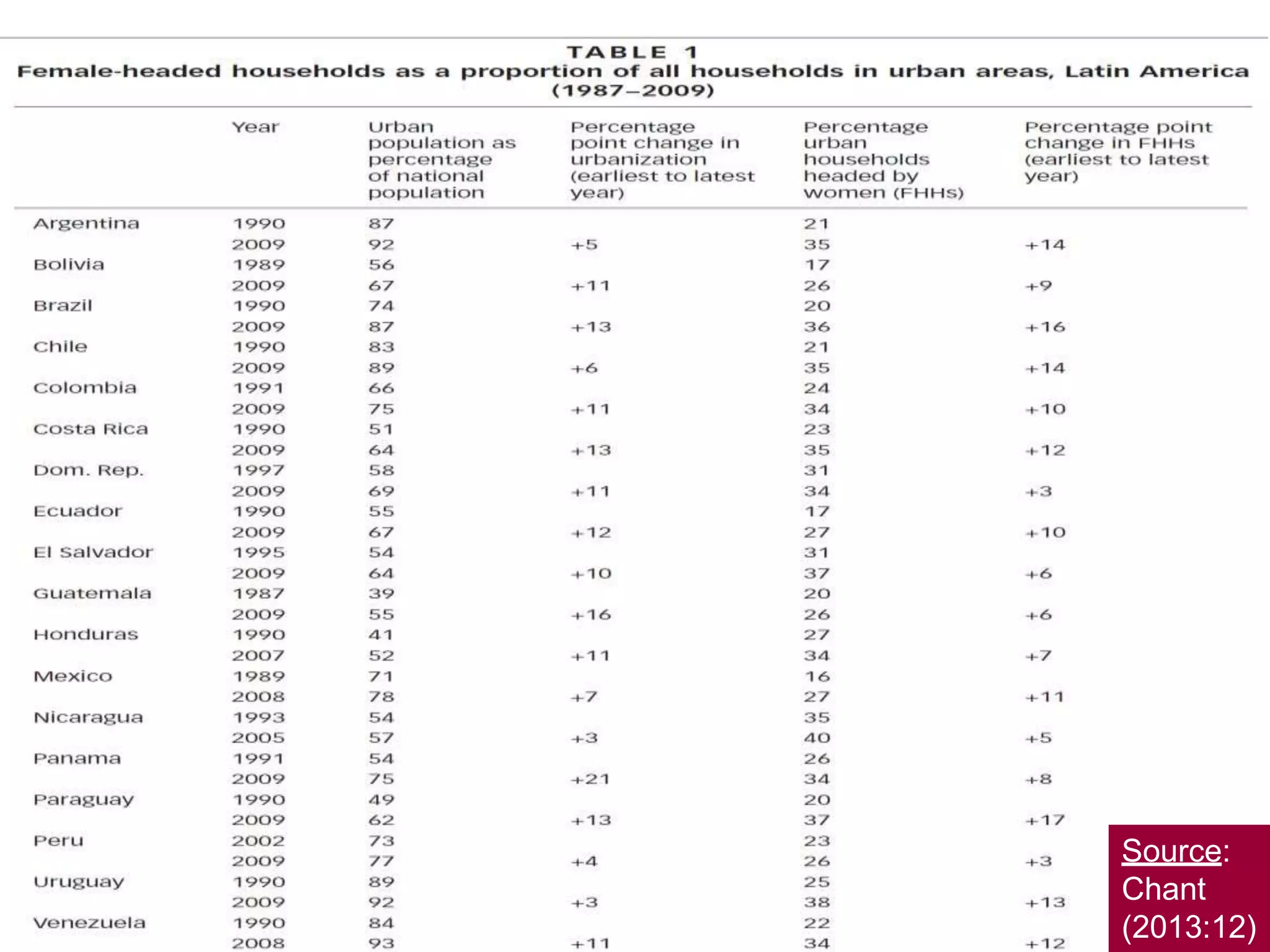
• Higher levels of female household headship in urban vs rural areas
owe not only to demographic dynamics (e.g feminising urban sex
ratios, especially among older age groups), but to (albeit
interrelated) economic and social factors:
*greater access by urban women to employment and independent
earnings
* higher levels of urban female land and property ownership,
* weakening of patriarchal kinship systems
* rising aspirations for marriage partners among women
* less discrimination against ‘alternative’ household arrangements
The relative anonymity and social fluidity of urban environments
seems to afford more scope for women, especially those who
decide to avoid oppressive conjugal relationships and establish
households on their own, to escape surveillance from former
partners and their families, or their own consanguineal kin (see
Chant with Craske, 2003:235-6, cited in Chant, 2016 on Mexico
and Costa Rica)…
• NB. Worth speculating as to whether a growing constituency of
female-headed households in urban areas is important in its own
right  ‘critical mass’ may help to legitimise ‘alternative’ household
forms, strengthen perceptions that women can fend for themselves,
and dependents, and also bring about more gender-equitable
attitudes among youth (Chant, 2016).
15
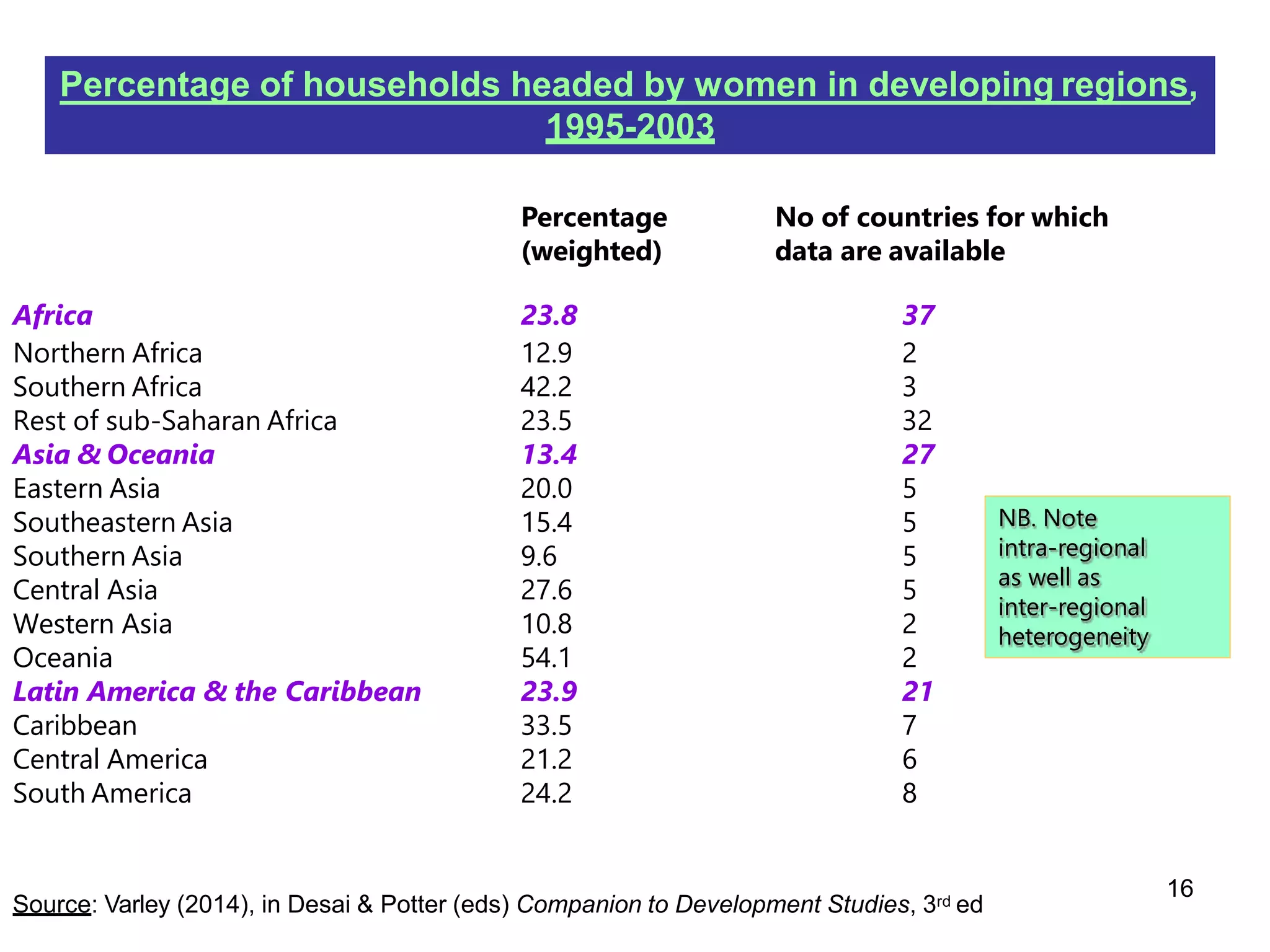
Cities of female-headed households?
16
Percentage of households headed by women in developing regions,
1995-2003
Percentage
(weighted)
No of countries for which
data are available
Africa 23.8 37
Northern Africa 12.9 2
Southern Africa 42.2 3
Rest of sub-Saharan Africa 23.5 32
Asia & Oceania 13.4 27
Eastern Asia 20.0 5
Southeastern Asia 15.4 5
Southern Asia 9.6 5
Central Asia 27.6 5
Western Asia 10.8 2
Oceania 54.1 2
Latin America & the Caribbean 23.9 21
Caribbean 33.5 7
Central America 21.2 6
South America 24.2 8
Source: Varley (2014), in Desai & Potter (eds) Companion to Development Studies, 3rd ed
NB. Note
intra-regional
as well as
inter-regional
heterogeneity
17
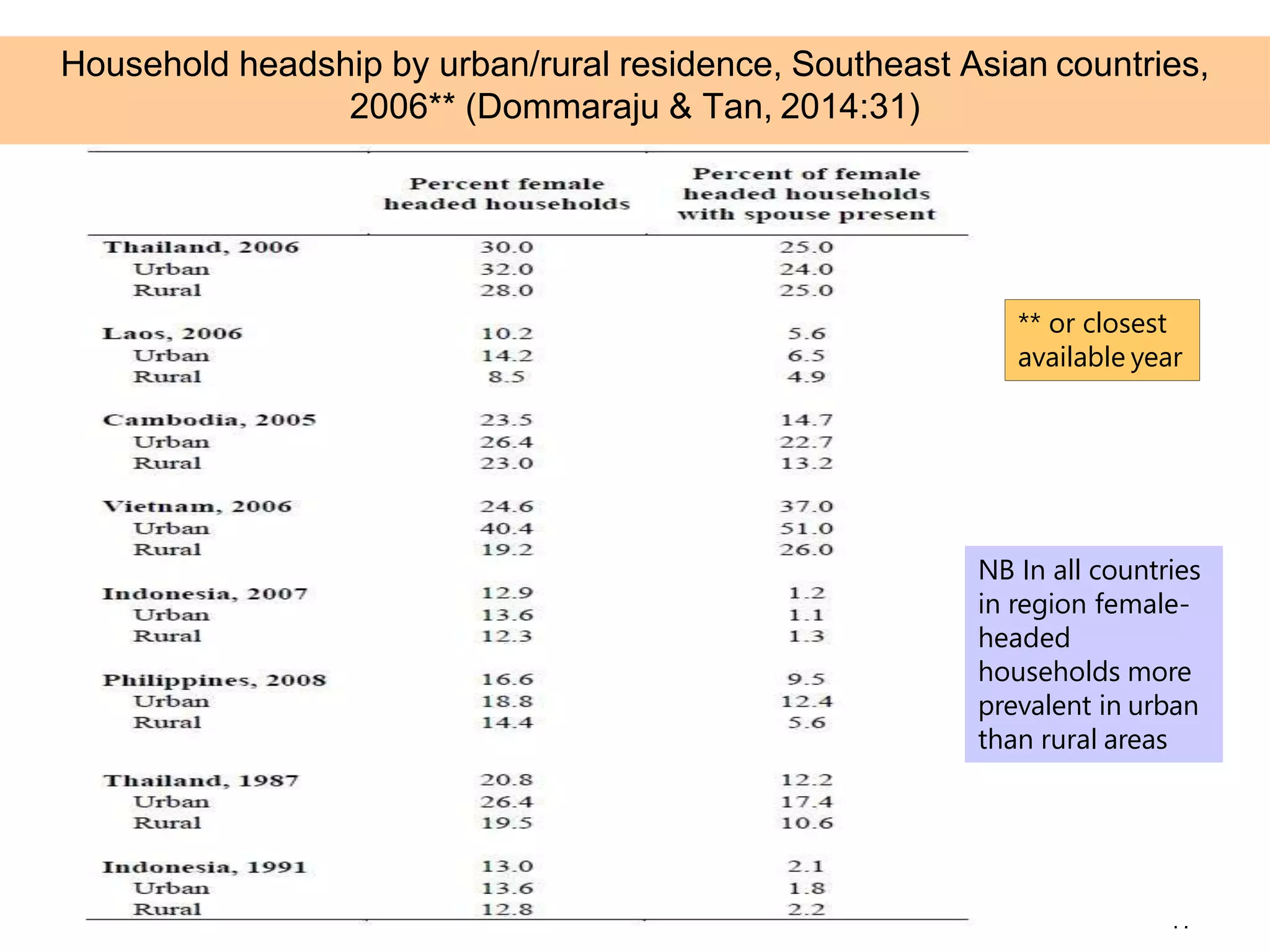
Household headship by urban/rural residence, Southeast Asian countries,
2006** (Dommaraju & Tan, 2014:31)
** or closest
available year
NB In all countries
in region female-
headed
households more
prevalent in urban
than rural areas
18
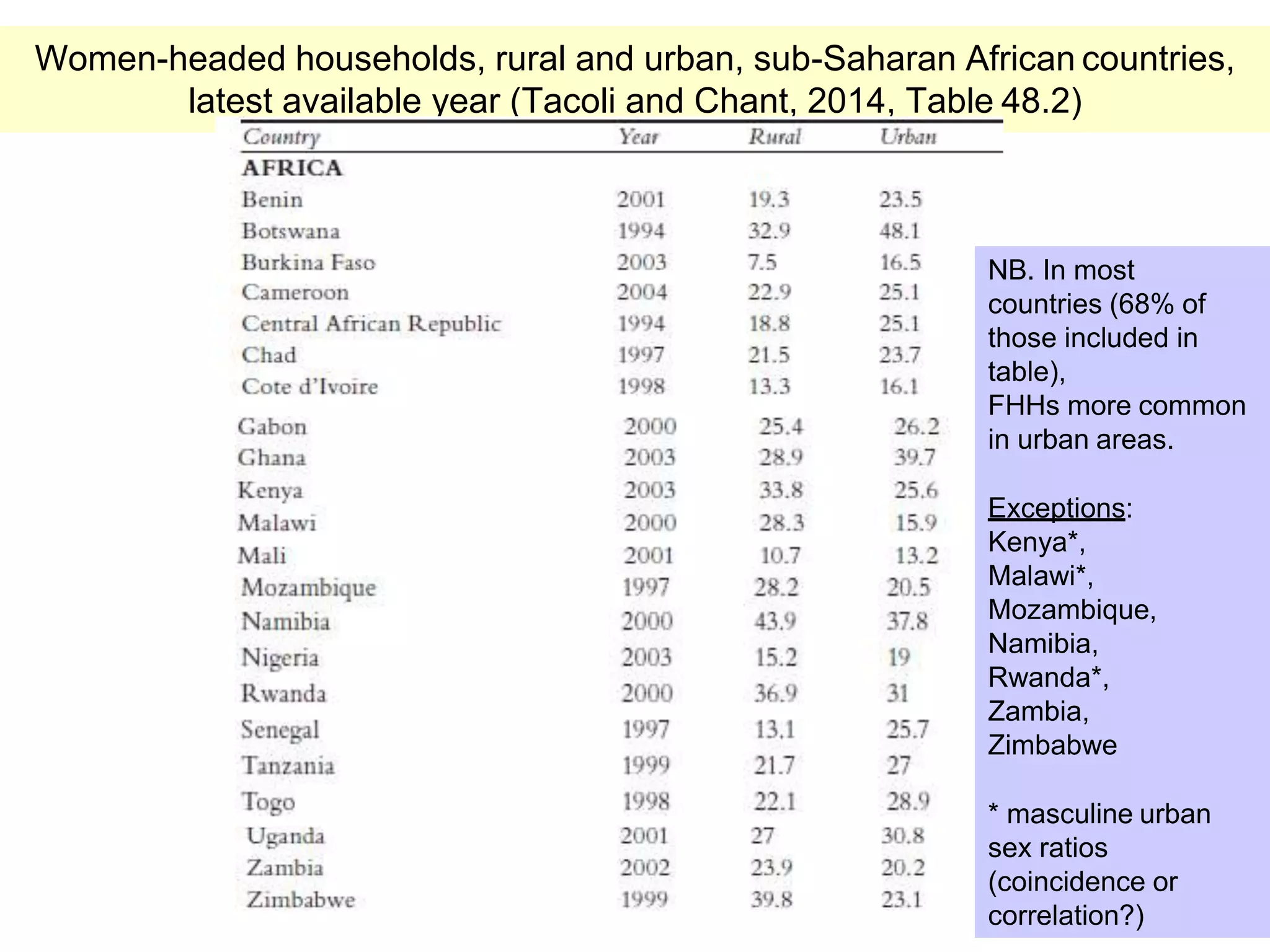
Women-headed households, rural and urban, sub-Saharan African countries,
latest available year (Tacoli and Chant, 2014, Table 48.2)
NB. In most
countries (68% of
those included in
table),
FHHs more common
in urban areas.
Exceptions:
Kenya*,
Malawi*,
Mozambique,
Namibia,
Rwanda*,
Zambia,
Zimbabwe
* masculine urban
sex ratios
(coincidence or
correlation?)
19
Source:
Chant
(2013:12)
‘It is … in cities that societal progress such as the advancement of women and
increasing levels of gender equality take place’ (UN-HABITAT, 2010:3)
• weakening of patriarchal family systems (inc patrilocality) and social control associated with physical
distancing of rural-urban migrants from kin, greater detachment of women from ‘home’; act/experience of
migration may be intrinsically ‘empowering’ (Chant and McIlwaine, 2016; Varley, 2015)
• greater opportunities for female education, employment, independent earnings
• reduced demands on time and unpaid labour associated with subsistence provision
• lower fertility and declining demands of childcare
• reduced demands of elder care with assumed ‘nuclearisation’ of households
• ‘norm change’ in ‘progressive urban cultures’
-educated, urban men likely to have more gender-equitable attitudes (Barker, 2014, cited in Chant and
McIlwaine, 2016:225)
-increased economic value of women can alter their roles and status in households and families (e.g. as
daughters and wives), and thereby diminish ‘son preference’ (Varley, 2015) (although not everywhere e.g.
India)
20
Urbanisation and Gender in Global South:
Cities as emancipatory spaces for women and girls?
‘… most urban women experience profound disadvantages compared to men in their
daily lives’ (Tacoli and Satterthwaite, 2013:3, cited in Chant and Mcllwaine, 2016:2).
• ‘Moral impropriety’ often linked with female migration and urban work (Varley, 2015)  social
opprobrium/ostracism
• Anticipated nuclearisation of households not the case in many urban contexts  overall burden of carework
may not decline (e.g. elder care in extended/multi-generational hhs), besides which extra-domestic ‘duties of
care’ may remain feminised.
• ‘Norm change’ may not run in the direction of greater equality e.g. predicament of ‘leftover women’ in urban
China (Fincher, 2014), ‘patriarchal pushback’ in terms of men’s disaffection by rising presence of women in
workforce, politics etc (Chant and McIlwaine, 2016)
• Persistent – and new – disadvantages and/or inequalities
‘Urbanisation creates physical demands on women due to new waged work, urban stressors, limited
convenient transportation, demands on their time, and new complexities in their lives’ (Meleis, 2011:5,
cited in Chant and McIlwaine, 2016:2)
21
Urbanisation and Gender in Global South:
Cautions re cities as emancipatory spaces for women and girls
The ‘urban century’ may NOT offer a ‘golden age’ for accelerating/enhancing female empowerment and
equality (Chant, 2013)  little evidence (quantitative or qualitative) to support systematic association of
urbanisation with greater gender equality (Chant and McIlwaine, 2016:2-3).
For poor and/or slum-dwelling women constraints and challenges may not be that dissimilar to those faced
by their rural counterparts, and in some instances be more pronounced (e.g. GBV)
22
The difference that space makes in
diversity and intersectionality
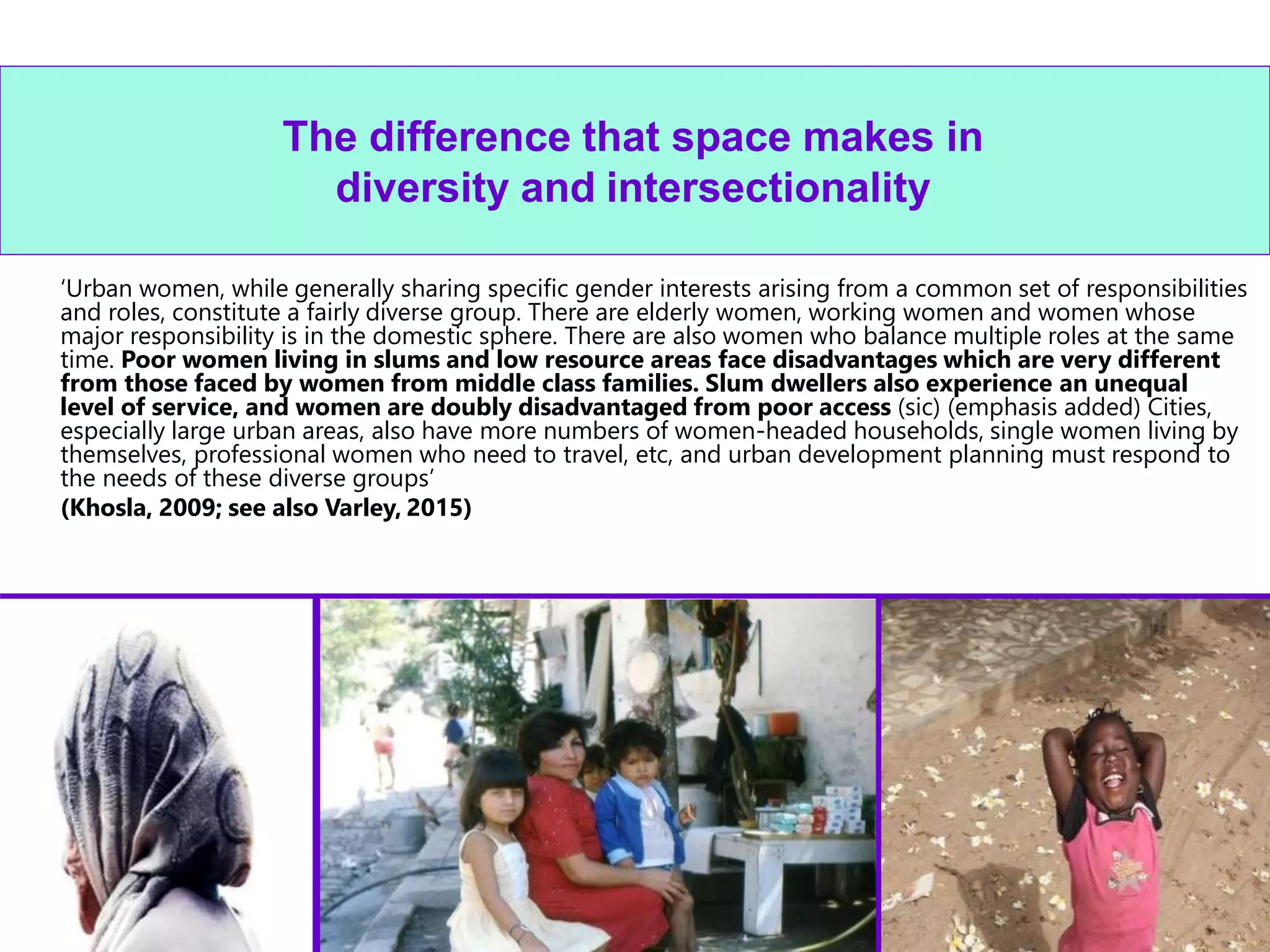
‘Urban women, while generally sharing specific gender interests arising from a common set of responsibilities
and roles, constitute a fairly diverse group. There are elderly women, working women and women whose
major responsibility is in the domestic sphere. There are also women who balance multiple roles at the same
time. Poor women living in slums and low resource areas face disadvantages which are very different
from those faced by women from middle class families. Slum dwellers also experience an unequal
level of service, and women are doubly disadvantaged from poor access (sic) (emphasis added) Cities,
especially large urban areas, also have more numbers of women-headed households, single women living by
themselves, professional women who need to travel, etc, and urban development planning must respond to
the needs of these diverse groups’
(Khosla, 2009; see also Varley, 2015)
Cities as variegated spaces for gender equality and women’s empowerment:
slums as ‘spatial poverty traps’?
• As part of their assessment of the Beijing Platform for Action+20, UN Women (2015:9) highlighted that
while urbanisation has helped to present new possibilities for gender equality, there are major
challenges too, not least on account of the growth of informal settlements which produce
‘new kinds of urban spaces marked by destitution and insecurity on a vast scale’.
• Women who are poorer (in income terms), and who inhabit disadvantaged or marginalised urban
communities (particularly ‘slums’) are arguably those least ‘empowered’ by urbanisation  ‘urban
slums in the Global South present particularly trenchant barriers to gender and other forms of
equality’ (Chant and McIlwaine, 2016:11)
• Persuasive evidence that female slum residents can become locked in ‘spatial poverty traps’
(Unterhalter, 2009:16; also Chant and Datu, 2015; Harriss-White et al, 2013) due, inter alia, to:
*multiple labour and time burdens of coping with/compensating for deficient housing, poor
services and infrastructure
* constrained mobility/connectivity to other parts of the city
*enforced operation of home-based enterprise in weak localised markets
*lack of freedoms and opportunities in control/use of domestic and/or community space
23
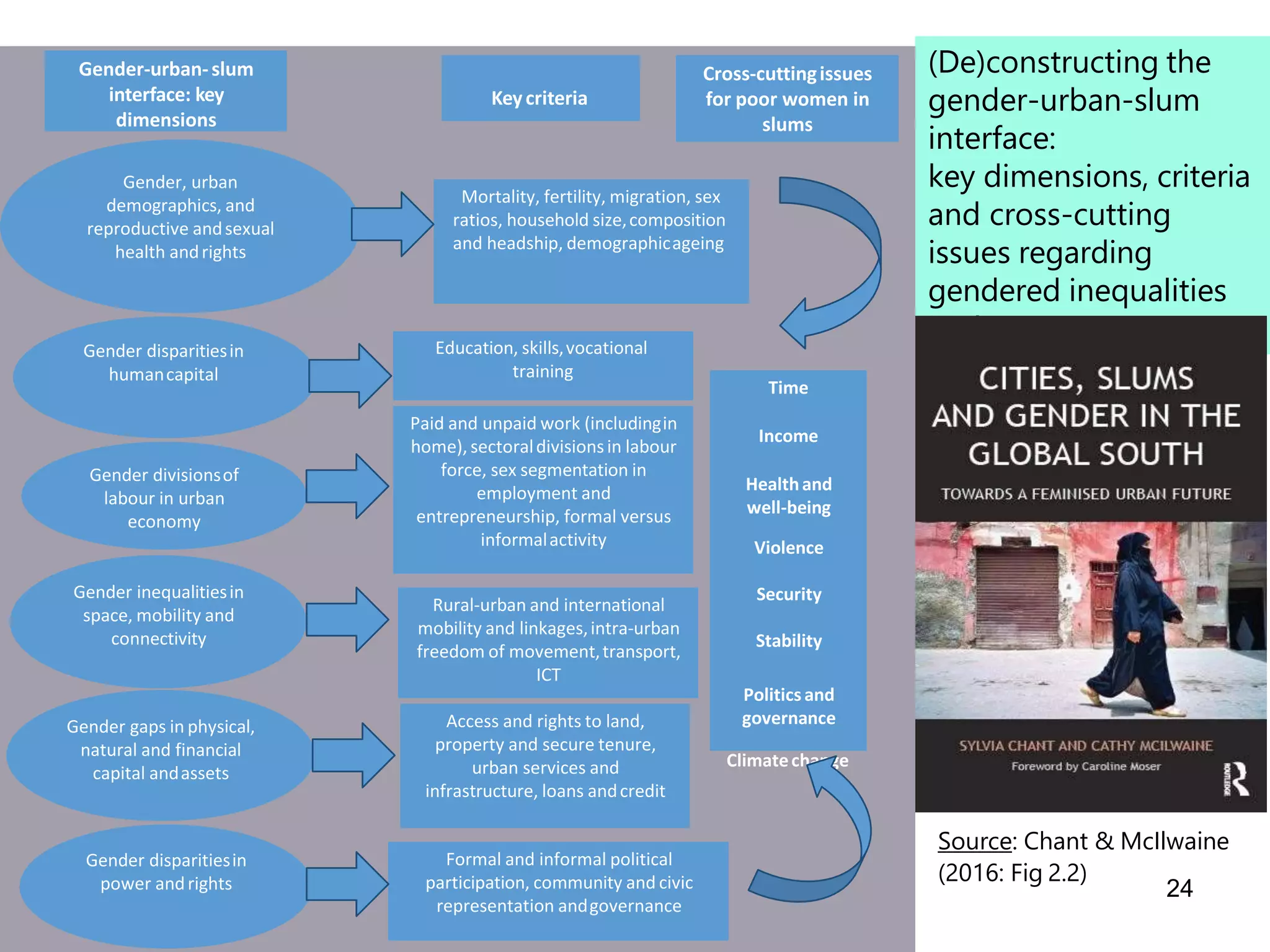
24
(De)constructing the
gender-urban-slum
interface:
key dimensions, criteria
and cross-cutting
issues regarding
gendered inequalities
in slums
Gender, urban
demographics, and
reproductive andsexual
health andrights
Gender disparitiesin
power andrights
Gender divisionsof
labour in urban
economy
Gender inequalitiesin
space, mobility and
connectivity
Cross-cuttingissues
for poor women in
slums
Gender gaps in physical,
natural and financial
capital andassets
Gender disparitiesin
humancapital
Gender-urban-slum
interface: key
dimensions
Time
Income
Healthand
well-being
Violence
Security
Stability
Politicsand
governance
Climatechange
Keycriteria
Mortality, fertility, migration, sex
ratios, household size,composition
and headship, demographicageing
Education, skills,vocational
training
Rural-urban and international
mobility and linkages,intra-urban
freedom of movement,transport,
ICT
Paid and unpaid work (includingin
home), sectoraldivisionsin labour
force, sex segmentation in
employment and
entrepreneurship, formal versus
informalactivity
Access and rights to land,
property and secure tenure,
urban services and
infrastructure, loans andcredit
Formal and informal political
participation, community and civic
representation andgovernance
Source: Chant & McIlwaine
(2016: Fig 2.2)
25
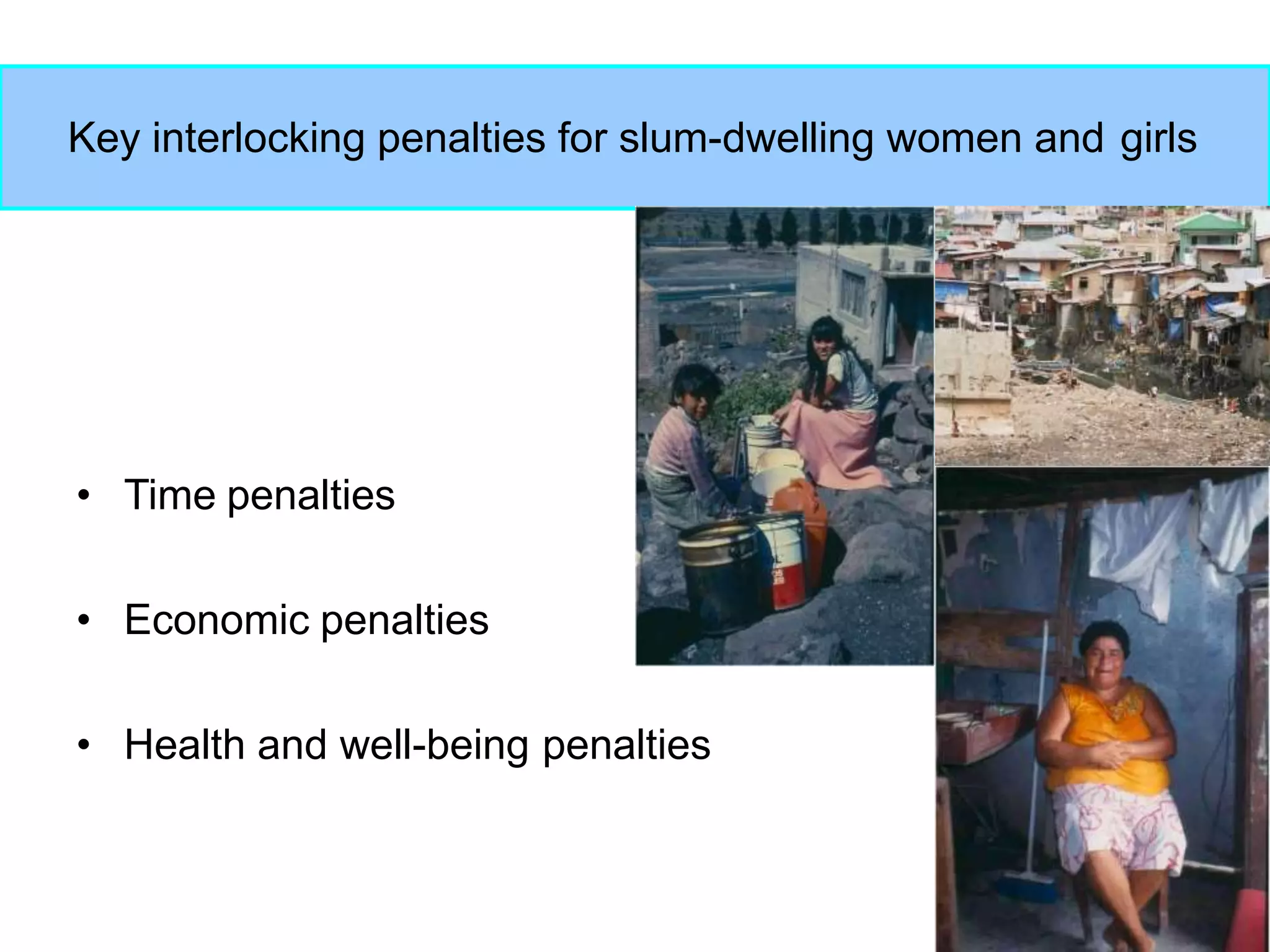
Key interlocking penalties for slum-dwelling women and girls
• Time penalties
• Economic penalties
• Health and well-being penalties
26
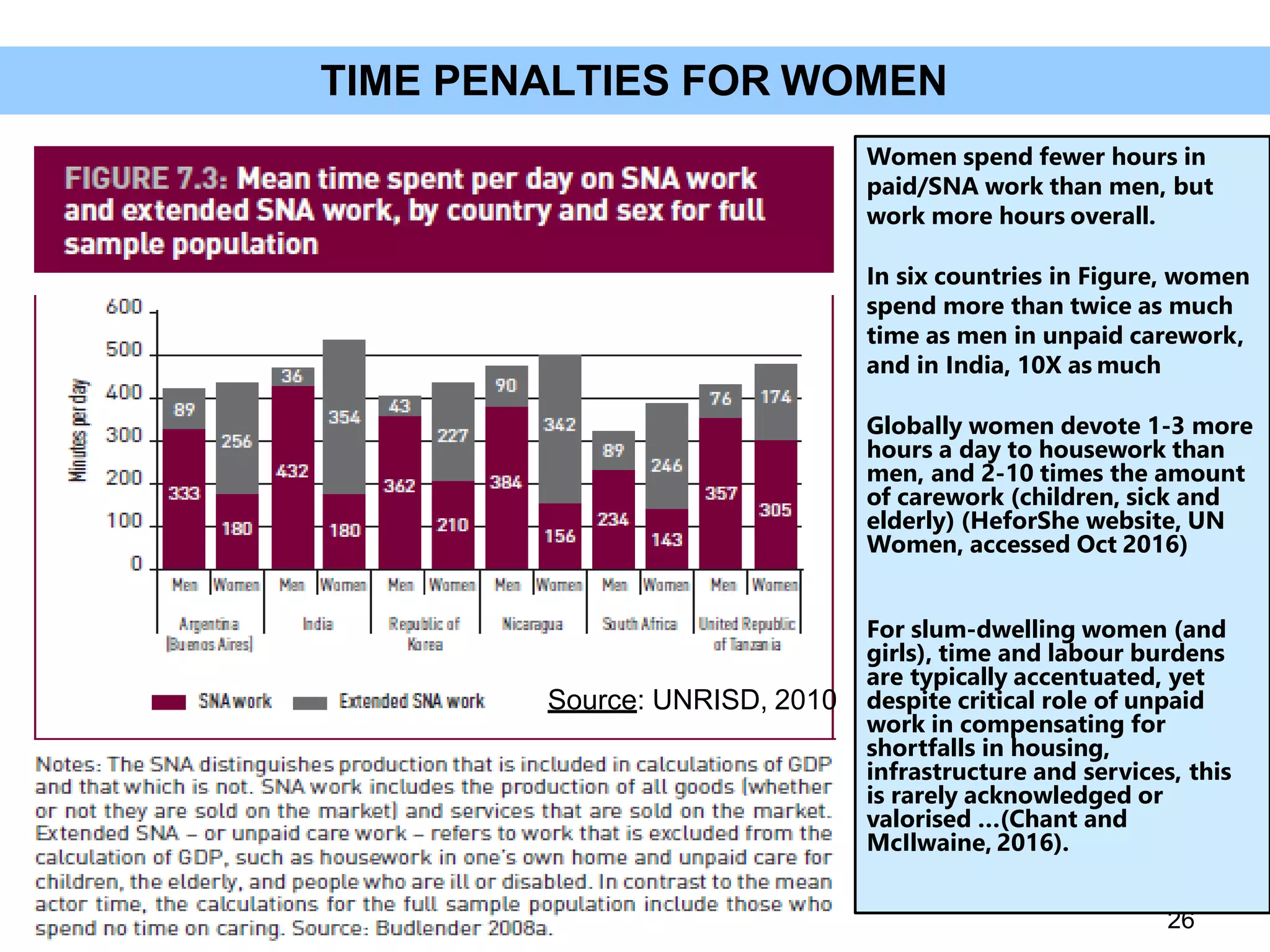
TIME PENALTIES FOR WOMEN
Women spend fewer hours in
paid/SNA work than men, but
work more hours overall.
In six countries in Figure, women
spend more than twice as much
time as men in unpaid carework,
and in India, 10X as much
Globally women devote 1-3 more
hours a day to housework than
men, and 2-10 times the amount
of carework (children, sick and
elderly) (HeforShe website, UN
Women, accessed Oct 2016)
For slum-dwelling women (and
girls), time and labour burdens
are typically accentuated, yet
despite critical role of unpaid
work in compensating for
shortfalls in housing,
infrastructure and services, this
is rarely acknowledged or
valorised …(Chant and
McIlwaine, 2016).
Source: UNRISD, 2010
27
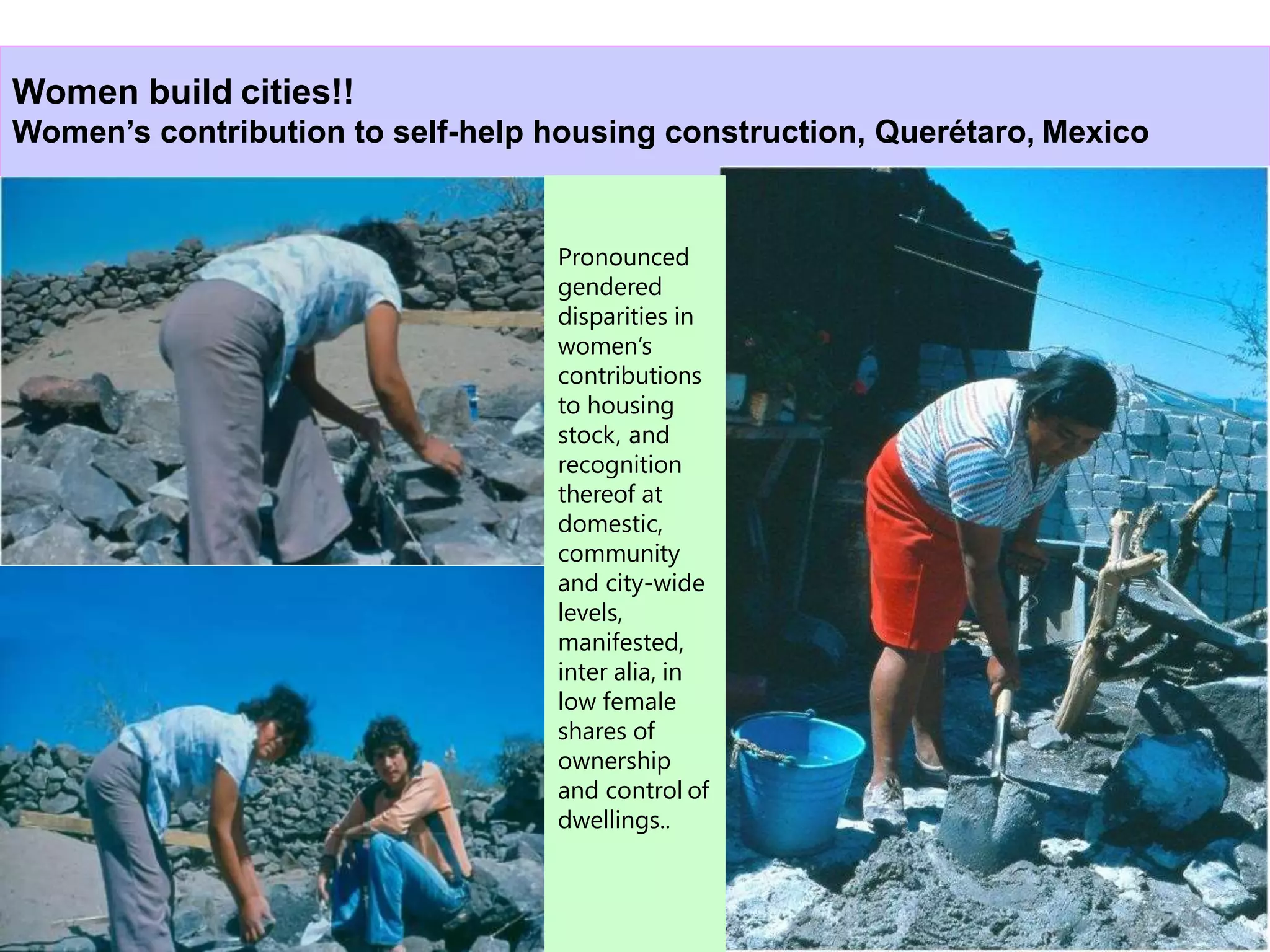
Women build cities!!
Women’s contribution to self-help housing construction, Querétaro, Mexico
Pronounced
gendered
disparities in
women’s
contributions
to housing
stock, and
recognition
thereof at
domestic,
community
and city-wide
levels,
manifested,
inter alia, in
low female
shares of
ownership
and control of
dwellings..
28
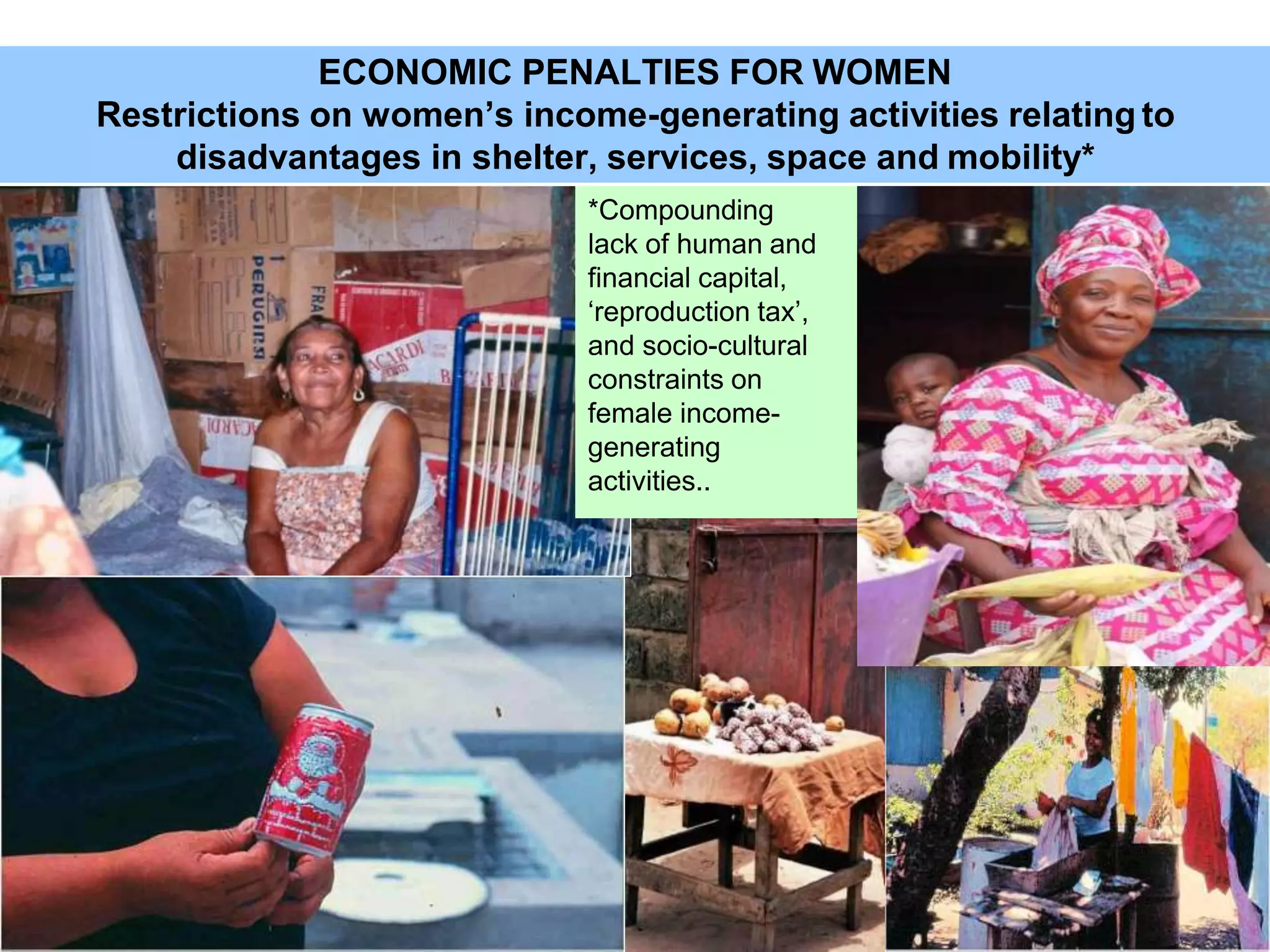
ECONOMIC PENALTIES FOR WOMEN
Restrictions on women’s income-generating activities relating to
disadvantages in shelter, services, space and mobility*
*Compounding
lack of human and
financial capital,
‘reproduction tax’,
and socio-cultural
constraints on
female income-
generating
activities..
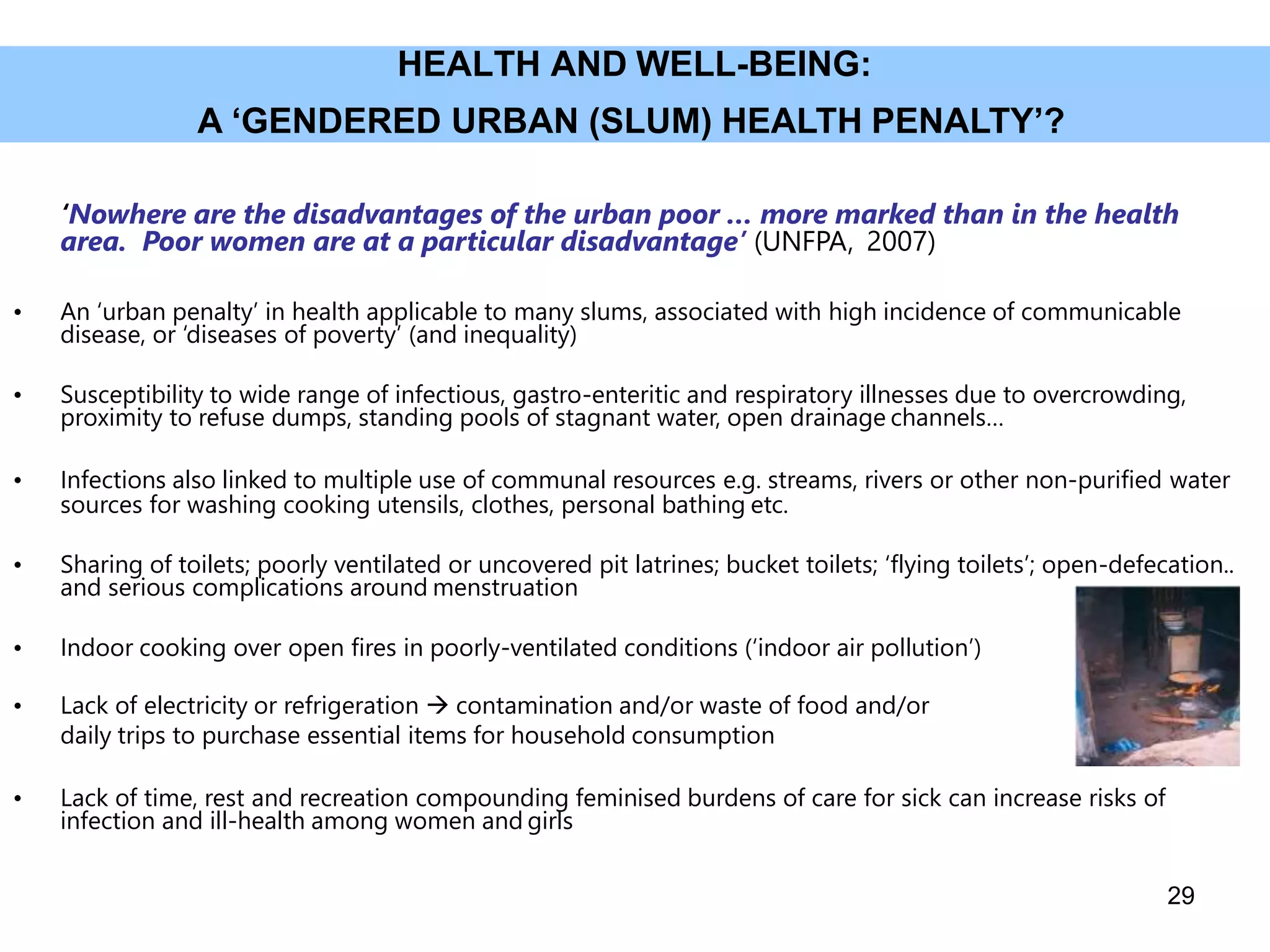
HEALTH AND WELL-BEING:
A ‘GENDERED URBAN (SLUM) HEALTH PENALTY’?
‘Nowhere are the disadvantages of the urban poor … more marked than in the health
area. Poor women are at a particular disadvantage’ (UNFPA, 2007)
• An ‘urban penalty’ in health applicable to many slums, associated with high incidence of communicable
disease, or ‘diseases of poverty’ (and inequality)
• Susceptibility to wide range of infectious, gastro-enteritic and respiratory illnesses due to overcrowding,
proximity to refuse dumps, standing pools of stagnant water, open drainage channels…
• Infections also linked to multiple use of communal resources e.g. streams, rivers or other non-purified water
sources for washing cooking utensils, clothes, personal bathing etc.
• Sharing of toilets; poorly ventilated or uncovered pit latrines; bucket toilets; ‘flying toilets’; open-defecation..
and serious complications around menstruation
• Indoor cooking over open fires in poorly-ventilated conditions (‘indoor air pollution’)
• Lack of electricity or refrigeration  contamination and/or waste of food and/or
daily trips to purchase essential items for household consumption
• Lack of time, rest and recreation compounding feminised burdens of care for sick can increase risks of
infection and ill-health among women and girls
29
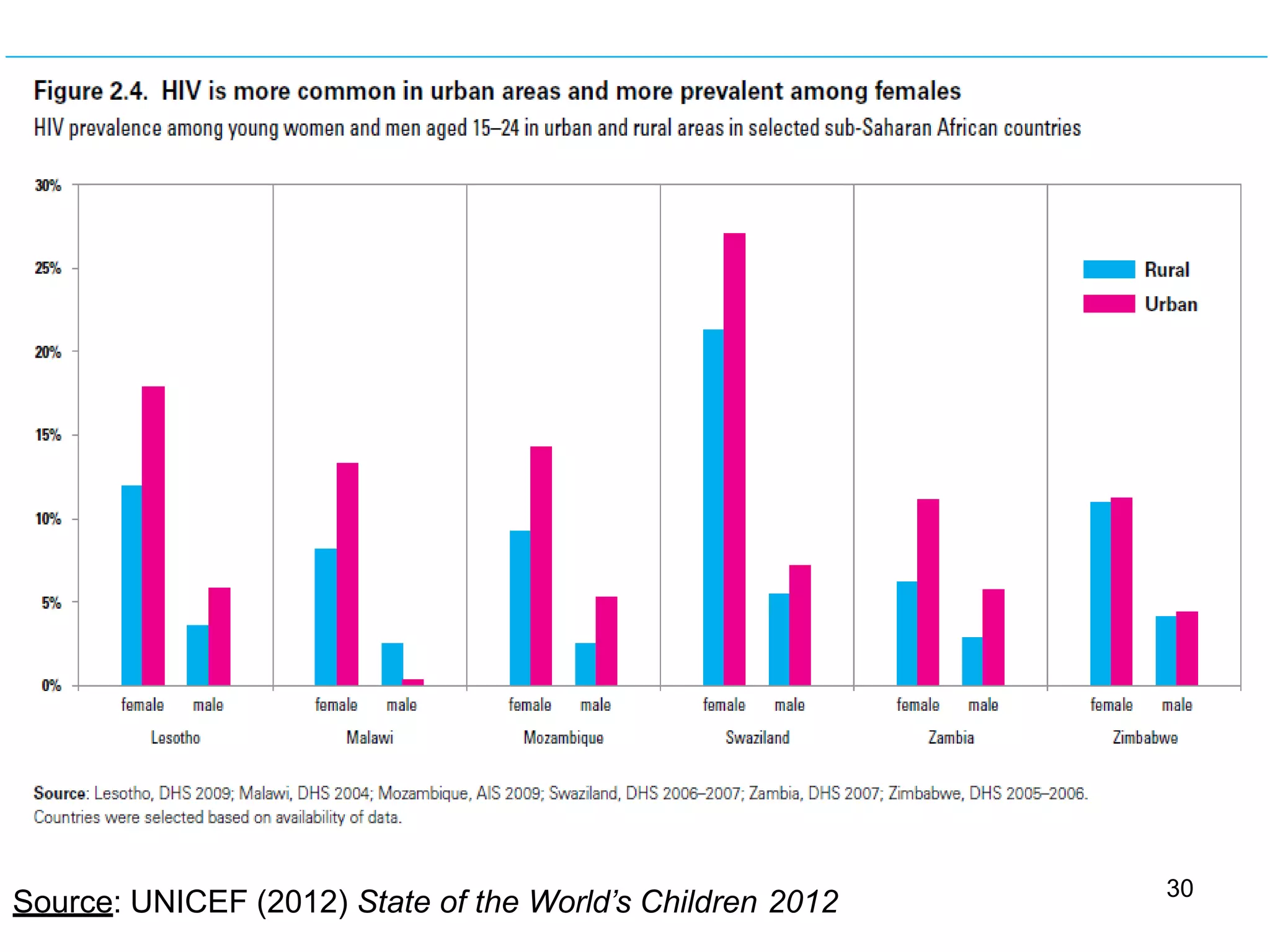
30
Source: UNICEF (2012) State of the World’s Children 2012
31
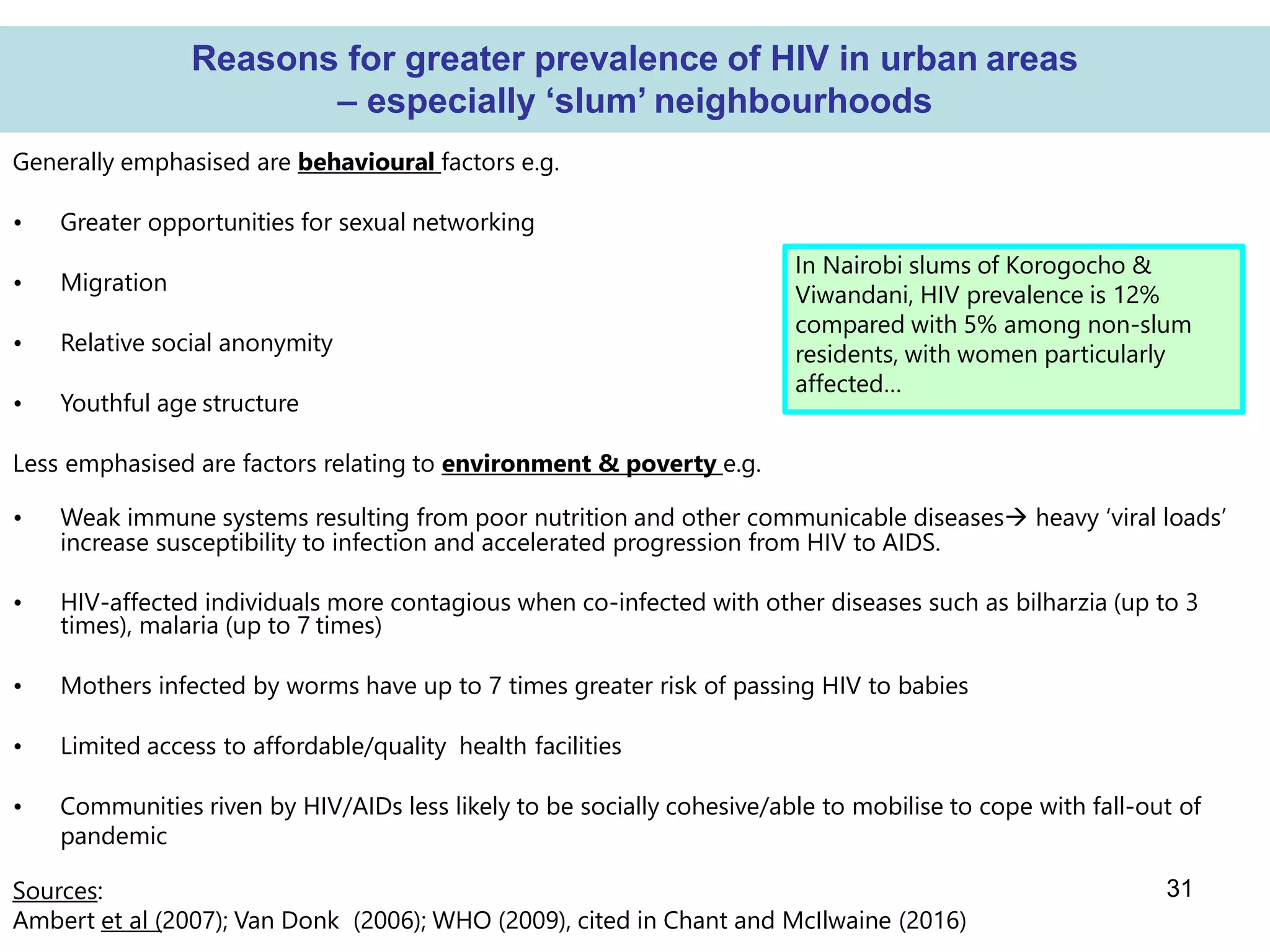
Reasons for greater prevalence of HIV in urban areas
– especially ‘slum’ neighbourhoods
Generally emphasised are behavioural factors e.g.
• Greater opportunities for sexual networking
• Migration
• Relative social anonymity
• Youthful age structure
Less emphasised are factors relating to environment & poverty e.g.
• Weak immune systems resulting from poor nutrition and other communicable diseases heavy ‘viral loads’
increase susceptibility to infection and accelerated progression from HIV to AIDS.
• HIV-affected individuals more contagious when co-infected with other diseases such as bilharzia (up to 3
times), malaria (up to 7 times)
• Mothers infected by worms have up to 7 times greater risk of passing HIV to babies
• Limited access to affordable/quality health facilities
• Communities riven by HIV/AIDs less likely to be socially cohesive/able to mobilise to cope with fall-out of
pandemic
Sources:
Ambert et al (2007); Van Donk (2006); WHO (2009), cited in Chant and McIlwaine (2016)
In Nairobi slums of Korogocho &
Viwandani, HIV prevalence is 12%
compared with 5% among non-slum
residents, with women particularly
affected…
• greater likelihood of early sexual debut
associated with lack of privacy, insecurity
and gender-based violence (individual and
gang-based) in urban slums
Women’s greater vulnerability to HIV owes
to socio-cultural as well as physiological
factors (e.g. likelihood of first intercourse
with sexually-experienced older men).
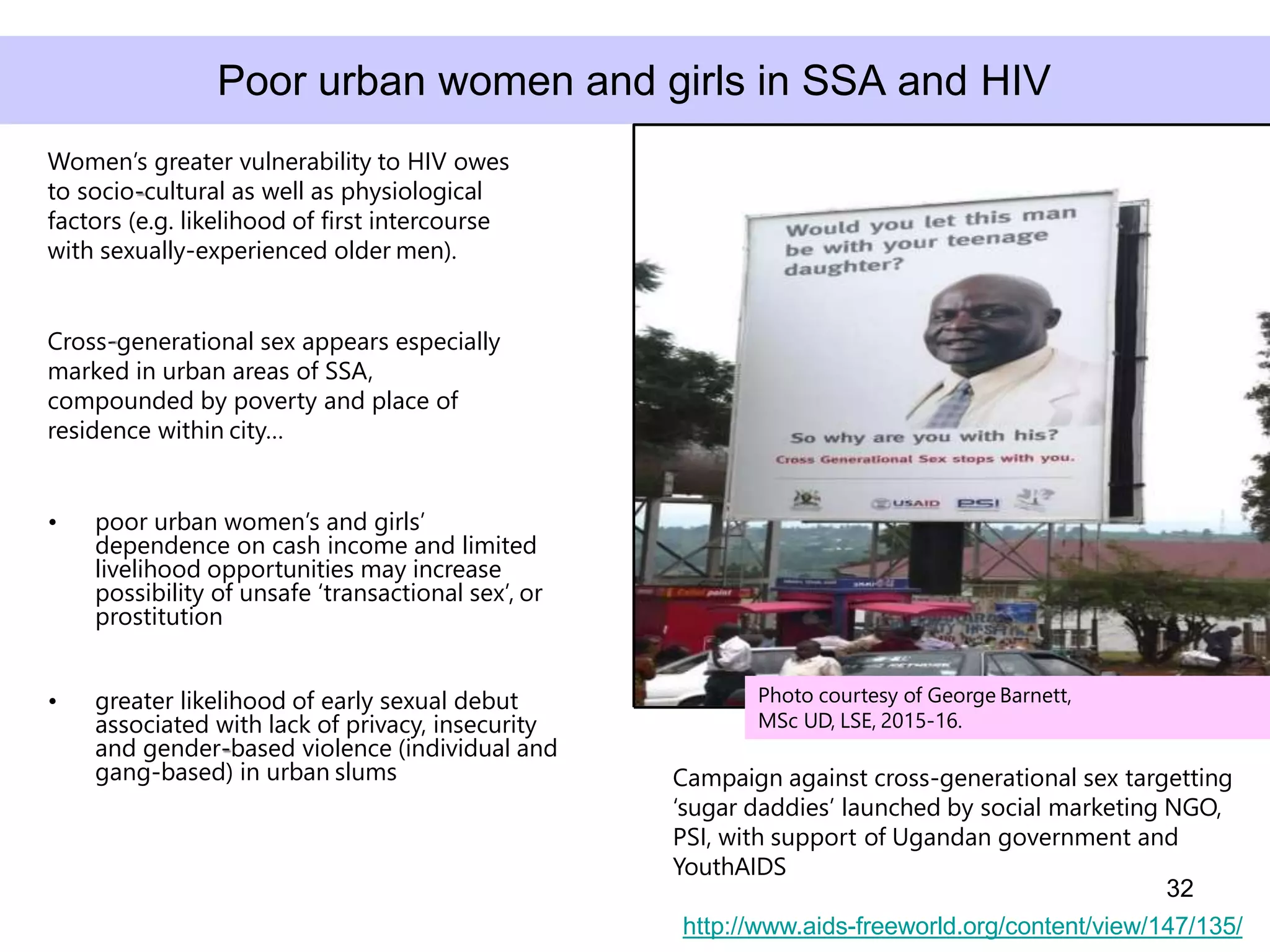
Cross-generational sex appears especially
marked in urban areas of SSA,
compounded by poverty and place of
residence within city…
• poor urban women’s and girls’
dependence on cash income and limited
livelihood opportunities may increase
possibility of unsafe ‘transactional sex’, or
prostitution
32
Poor urban women and girls in SSA and HIV
http://www.aids-freeworld.org/content/view/147/135/
Campaign against cross-generational sex targetting
‘sugar daddies’ launched by social marketing NGO,
PSI, with support of Ugandan government and
YouthAIDS
Photo courtesy of George Barnett,
MSc UD, LSE, 2015-16.
33
Anatomies of GBV in Global South Cities: In Brief
• Urban women estimated to be TWICE as likely to experience GBV as rural women, although IPV (intimate
partner violence) typically greater in rural areas (McIlwaine, 2013:67). In Kenya, Austrian et al (2015) found far
higher levels of violence against urban adolescent girls (30%) than rural peers (5%).
 within cities combined risks of ‘public’ and ‘private’ violence = greater burden on women and girls
• Conceivable that levels of general GBV higher in urban areas due to greater reporting (partly because urban
women less likely to tolerate VAWG – McIlwaine, 2013), and/or greater opportunities to report.
• However, also plausible that risks of GBV in cities are exacerbated given
a)higher levels of urban versus rural violence in general (e.g. gangs, civil conflict, urban crimes involving
violence)
b)multiplicity of urban sites (e.g. public spaces, streets, hostelries, transport routes and hubs) in which
violence from ‘strangers’ may occur, especially when limited surveillance/policing
c) greater social anonymity and impunity
d)‘male backlash’/’patriarchal pushback’ in wake of nominal advances for women and girls in urban areas
(e.g. education, employment, political visibility)
e)high levels of occupancy in poor, informal, precarious residential neighbourhoods (‘slums’) lacking privacy
and protection
‘Violence against women in … slums is rampant… and emerges as perhaps the strongest cross-cutting
theme’ (COHRE, 2008:14):
‘Although accelerating rates of violence and crime are by no means an urban-specific problem, they
are particularly problematic in urban areas. The sheer scale of violence in poor areas or slums means
that, in many contexts, it has become “routinised” or “normalised” into the functional reality ofdaily
life’ (Moser, 2004.:6).
Urban poor and/or slum-dwelling women and GBV
Poor (and/or slum-dwelling) urban women may be especially prone to violence from
strangers as well as intimate partners and household/family members, due to:
* Higher levels of violence in general in urban areas, and often especially in slums (gangs)
* Anonymity/social isolation, particularly where households lack visible male ‘heads’ e.g. choice
of annexed rental housing by FHHs in Angola often determined by considerations of security
* Flimsy housing offering scant protection against forced entry (e.g. escalation of sexual violence
in ‘tent cities’ in aftermath of 2010 earthquake in Haiti)
* Poor lighting (at domestic and community level)
* Inaccessible/unreliable/unaffordable/inappropriate/unsafe pedestrian infrastructure or public
transportation – e.g. routes, links, timing, conditions in waiting areas.
* Inadequate WASH (water, sanitation and hygiene) facilities, and where flush toilets and
washblocks do exist, frequently communal and/or non sex-segregated
* Lack of and/or corrupt policing in low-income neighbourhoods; few ‘gender-
sensitised’/’trained’, or female, officers
* Economic pressures on women and girls to undertake risky or hazardous work
34
Vulnerability of poor and/or slum-dwelling women to
‘common mental diseases’ (CMDs)
• WHO/WB ‘Global Burden of Disease’ project (2004) points to female bias in mental illness,
compounding widely-noted association between poverty and mental ill-health
http://www.who.int/topics/global_burden_of_disease/en/
• Poor women tend to suffer more than their male counterparts from common mental
disorders (CMDs) such as depression, anxiety, fatigue –attributed to gender-selective
‘stressors’ associated with employment, residence/long periods of day/night in ‘slum’
neighbourhoods, risks of GBV, insecurity of tenure/property rights
• Added stress on women from trauma of losing babies, infants and children from
malnutrition, anaemia, untreated perinatal complications, and infectious diseases
• Depression one of side effects of ART (more access to ART in urban areas, with women
having ‘double portal’ through maternity)
• Stigmatisation of female household headship – isolation, gossip, social opprobrium
• Social isolation/lack of support networks among recent migrants
35
*Land tenure and housing as central to women’s economic empowerment, security and well-being
*Women in local government and decision-making positions, including local-to-local dialogue and peer
learning and collaboration among local governments, worker movements and community groups
*Safety in the city
*Income and growth creation (in line with the Equal Growth Pillar of CA’s Medium Term Strategy ‘to
demonstrate the linkages between equal growth and gender equality’)
*Working with men and boys to develop their understanding of the importance of gender equality, and to
include them as allies in the pursuit of gender equality prevention of discrimination against women and GBV
*Collection of data disaggregated by age and sex in all activities, and support local governments in capacities
and practices in disaggregated data collection and analysis
36
Moving towards more gender-fair cities..
CITIES ALLIANCE GENDER EQUALITY STRATEGY
SUGGESTED AREAS OF COLLABORATION
(Cities Alliance, 2015:17)
37
Moving towards more gender-fair cities..
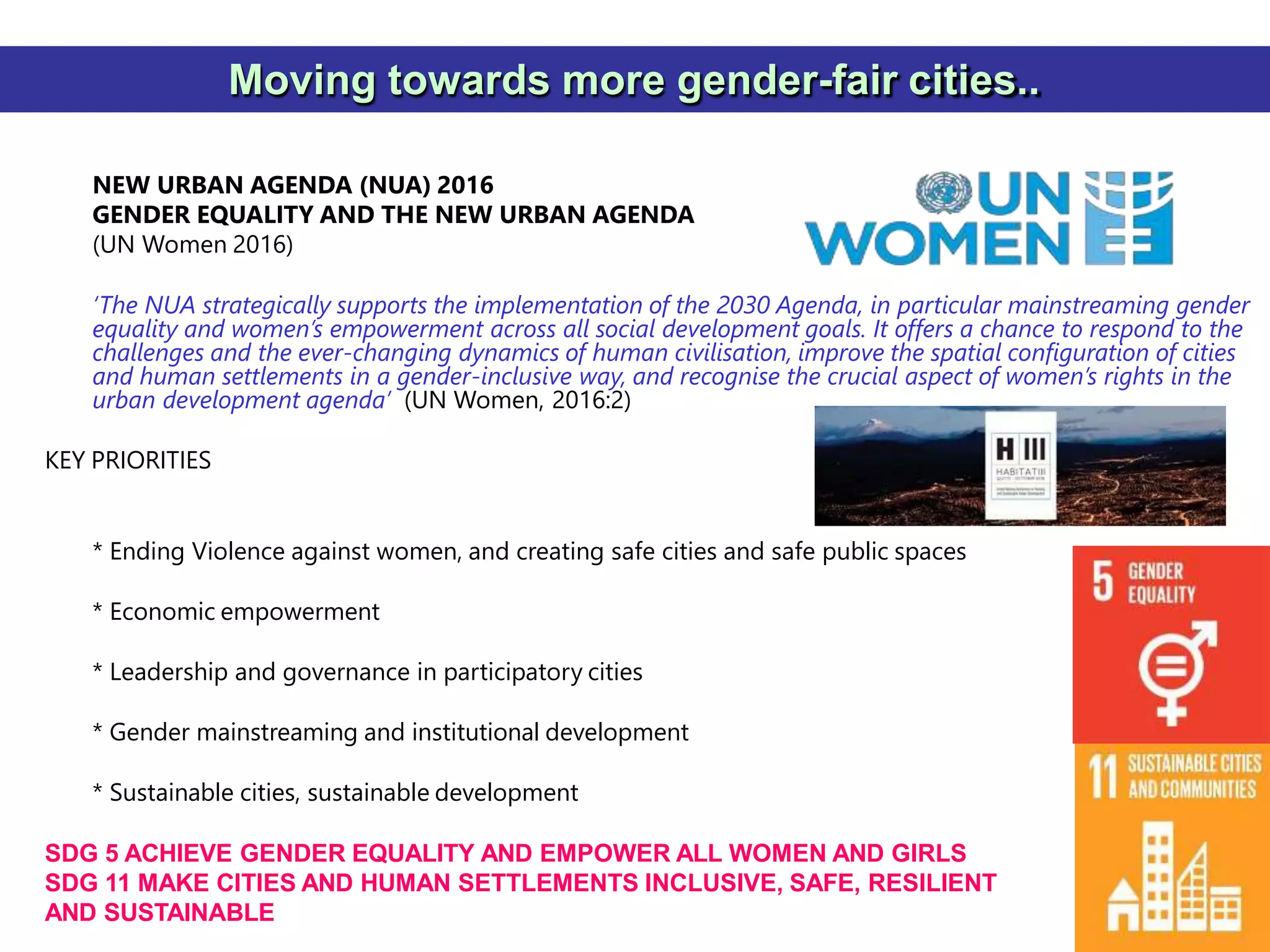
NEW URBAN AGENDA (NUA) 2016
GENDER EQUALITY AND THE NEW URBAN AGENDA
(UN Women 2016)
‘The NUA strategically supports the implementation of the 2030 Agenda, in particular mainstreaming gender
equality and women’s empowerment across all social development goals. It offers a chance to respond to the
challenges and the ever-changing dynamics of human civilisation, improve the spatial configuration of cities
and human settlements in a gender-inclusive way, and recognise the crucial aspect of women’s rights in the
urban development agenda’ (UN Women, 2016:2)
KEY PRIORITIES
* Ending Violence against women, and creating safe cities and safe public spaces
* Economic empowerment
* Leadership and governance in participatory cities
* Gender mainstreaming and institutional development
* Sustainable cities, sustainable development
SDG 5 ACHIEVE GENDER EQUALITY AND EMPOWER ALL WOMEN AND GIRLS
SDG 11 MAKE CITIES AND HUMAN SETTLEMENTS INCLUSIVE, SAFE, RESILIENT
AND SUSTAINABLE
38
Specific strategies and interventions
• Investments in everyday infrastructure,
services, and shelter in slums (and slum-
upgrading) including female participation in
design,(e.g. Crosscutting Agra Programme (India)
• Community sensitisation/
‘neighbourhood watch’ schemes e.g. Bantay
Banay (Philippines)
• Working with men and boys to promote gender
equality and to eliminate GBV e.g. Promundo
(Brazil), Parivartan and Priya’s Mirror (India)
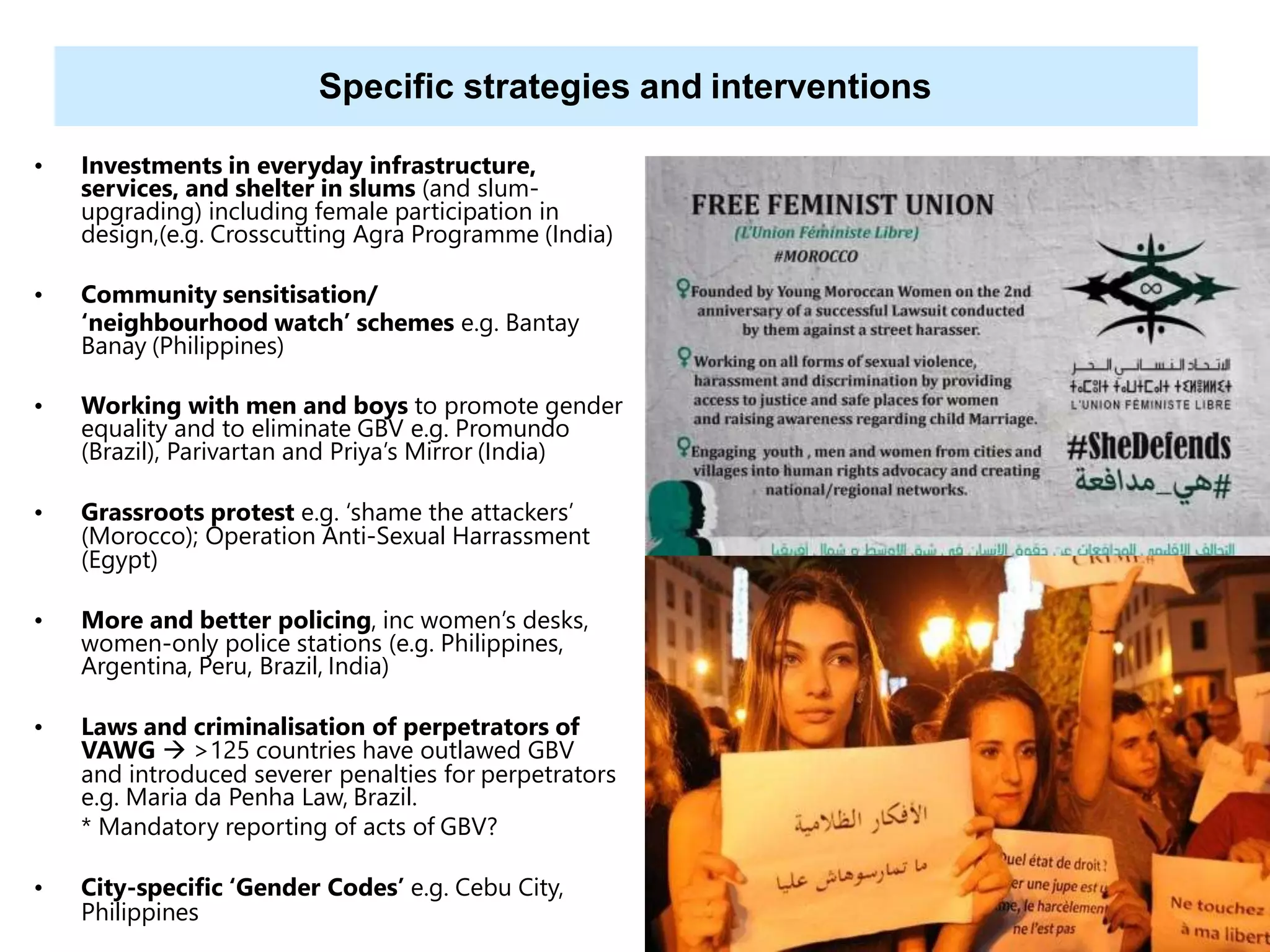
• Grassroots protest e.g. ‘shame the attackers’
(Morocco); Operation Anti-Sexual Harrassment
(Egypt)
• More and better policing, inc women’s desks,
women-only police stations (e.g. Philippines,
Argentina, Peru, Brazil, India)
• Laws and criminalisation of perpetrators of
VAWG  >125 countries have outlawed GBV
and introduced severer penalties for perpetrators
e.g. Maria da Penha Law, Brazil.
* Mandatory reporting of acts of GBV?
• City-specific ‘Gender Codes’ e.g. Cebu City,
Philippines
39
Specific strategies and interventions (cont.)
• Safety Audits/Digital Grassroots Mapping of GBV e.g. Blank
Noise and SafetiPin (India, launched 2003 and 2013), Harrass
Map (Egypt, launched 2010)
• Greater pedestrianisation of city streets, and support of
public transport > private vehicles
e.g. Bogotá and ‘Medellín miracle’ mayoral makeovers
(Enrique Peñalosa, mayor of Bogotá 1998-2001, 2016-19:
‘Cities are for people, not cars’)
• Segregated public transport e.g. women-only buses, train/tube
carriages – although perhaps only temporarily since goal should
be ‘to create cities where woman can travel and enjoy the city
independently and at any time of day’ (García-Moreno and
Chawla, 2011: 62, cited in Chant and McIlwaine, 2016: 162)
• ‘Crime Prevention Through Environmental Design’ (CPTED),
inaugurated by UN-Habitat involving community-based
consultations to create ‘safe cites’
• Public-private partnerships (PPPs) e.g. ‘Adopt a Light’ (Nairobi)
• International initiatives/inducements/competitions e.g. UN-
Habitat’s ‘Safer Cities Programme’ and ‘Global Programme on
Safe Cities Free From Violence Against Women’ (see Chant and
McIlwaine, 2016: Chapter 6), and Plan International/WICI/ Habitat
Safer Cities for Girls.
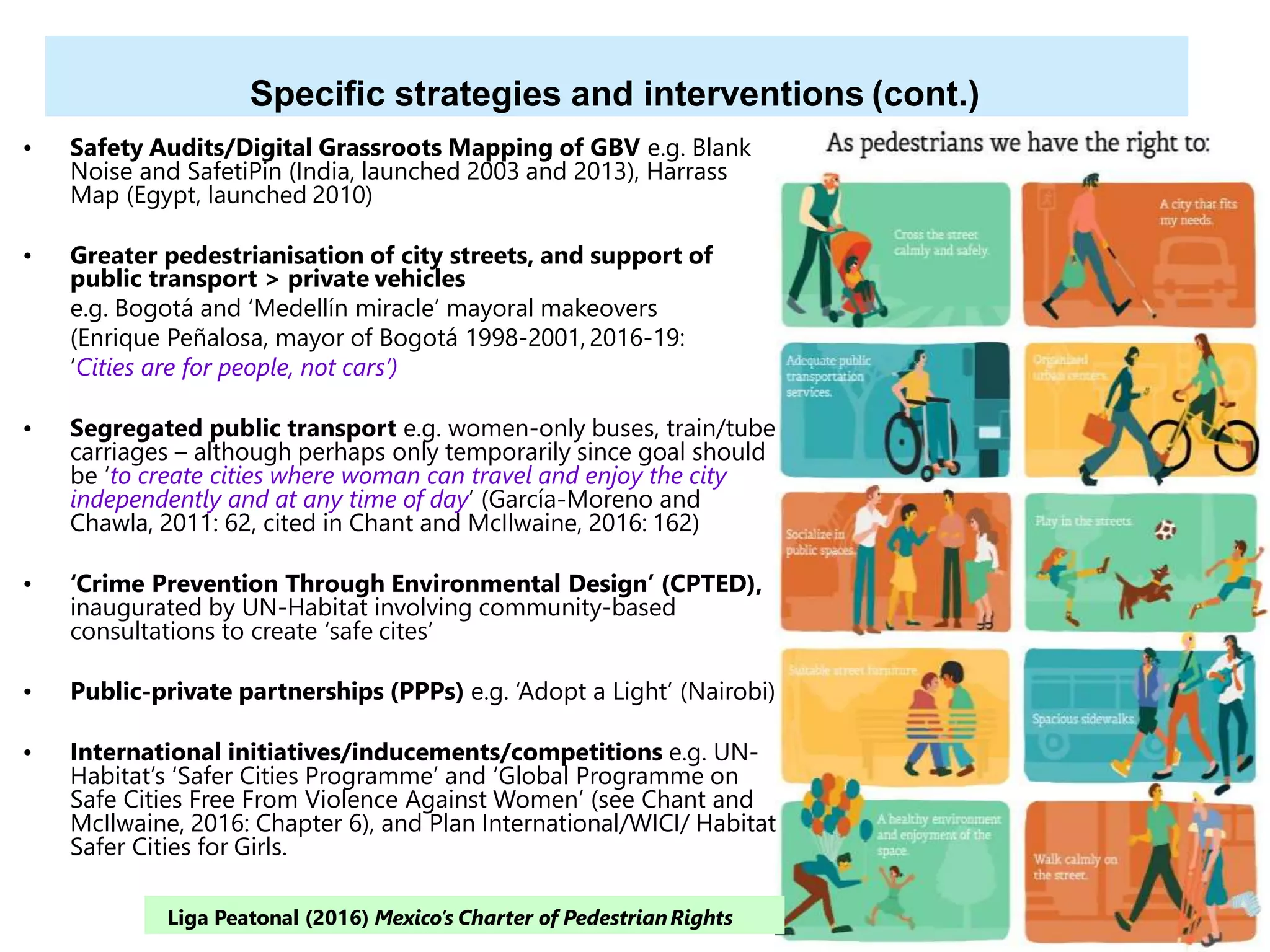
Liga Peatonal (2016) Mexico’s Charter of PedestrianRights
Echoes and further thoughts on making future cities gender-fair,
‘empowering’ for women and girls … and ‘feminist’
• More collection and dissemination of spatially-disaggregated (e.g. slum/non-slum) as well as
sex-disaggregated data (e.g. on time-use)?
‘What gets counted is more likely to get addressed’ (Moser [Annalise], 2007:7, cited in Chant and
McIlwaine, 2016)
• Greater recognition, assessment and valorisation of ‘unpaid economy’ and ‘care economy’
More attention to gender-differentiated responsibilities for unpaid labour and care
• Strategies required to address social relations between women and men which underpin
gendered divisions of labour – SDG 5, ‘50/50 by 2030’?
Work with men and boys to incentivise more equitable responsibilities for unpaid work, as well
as other household obligations such as control of income and consumption
• More attention to intersectionality – e.g. LGBT rights absent in NUA
• Move from ‘gender mainstreaming’ to ‘gender transformation’ (Moser,2016)
• Ensure that calls for ‘women’s empowerment’ and gender equality are not subordinated to
efficiency objectives -- poverty alleviation and economic growth are likely corollaries of more
gender-equitable cities but they should be treated as positive outcomes rather than the goals
that drive the gender agenda.
40
41
In context of ‘deep informality’ of urban development, in which global South women
act as ‘unpaid urban developers and urbanisers’, based on assumptions about
infinite and elastic female labour supply, ‘capitalism relies on women’s free and
underpaid work to compensate for neoliberalism’s erosion of the public realm and
abandonment of civic responsibilities’
(Miraftab, 2010:646).
In relation to ‘post-neoliberal states of Ecuador and Venezuela ‘….poor women
increasingly have been viewed as the “answer” to a weak welfare state as well as a
source of cheap labour. This has led to their disempowerment rather than
empowerment or “integration into the development process”’
(Lind, 2007, cited in Chant and McIlwaine, 2016: Chapter 9; also Lind, 2010)
(A) model of ‘participatory development and non-confrontational negotiation’
obtains, in which ‘slum subjectivities’ have been constructed through gendered
discourses that have ‘elevated women’s participation both as a development
solution and as a benefit to the poor’, with the ‘feminisation of participation’ being
characterised by ‘an inherently divided subjectivity’ which ‘has privileged women’s
domestic social-reproductive roles as “housewives” to the exclusion of those with
working lives outside of the home’
Doshi (2013:857).
‘Discrimination against women in cities has a price’
Cities Alliance Gender Equality Strategy 2014-2017
Concerns about capitalising on women’s work in cities and slums
42
World Bank summary of main ‘conclusions’ and ‘lessons learned’ from CAMEBA slum
upgrading project, Carácas, Venezuela
• Women’s constant presence in the slums makes them direct project interlocutors and crucial agents during
project implementation
• Women’s commitment to solving the problems of their communities makes them an indispensable ally for
projects aimed at improving community services
• In the case of CAMEBA, women’s engagement in the project has translated into better-quality civil works,
improved work maintenance, smoother project-community relations and higher project impact
• At the same time, their participation has benefited women, their families and communities by means of
improving households’ well-being and strengthening community institutionalcapacity
Source: World Bank (2003) Gender in Urban Infrastructure Projects: The Case of the Carácas Slum-Upgrading
Project (Washington DC: World Bank) (http://wb0018.worldbank.org/LAC/lacinfoclient.nsf)
Relying on women in slums?
SDI video, Women = Minding the Finance Gap (2.21 mins)
https://www.youtube.com/watch?v=Z3RONWgVO-E
FEMALE PARTICIPATION AS PANACEA … OR PRESSURE…
IN SLUMS AND CITIES OF THE GLOBAL SOUTH?
43
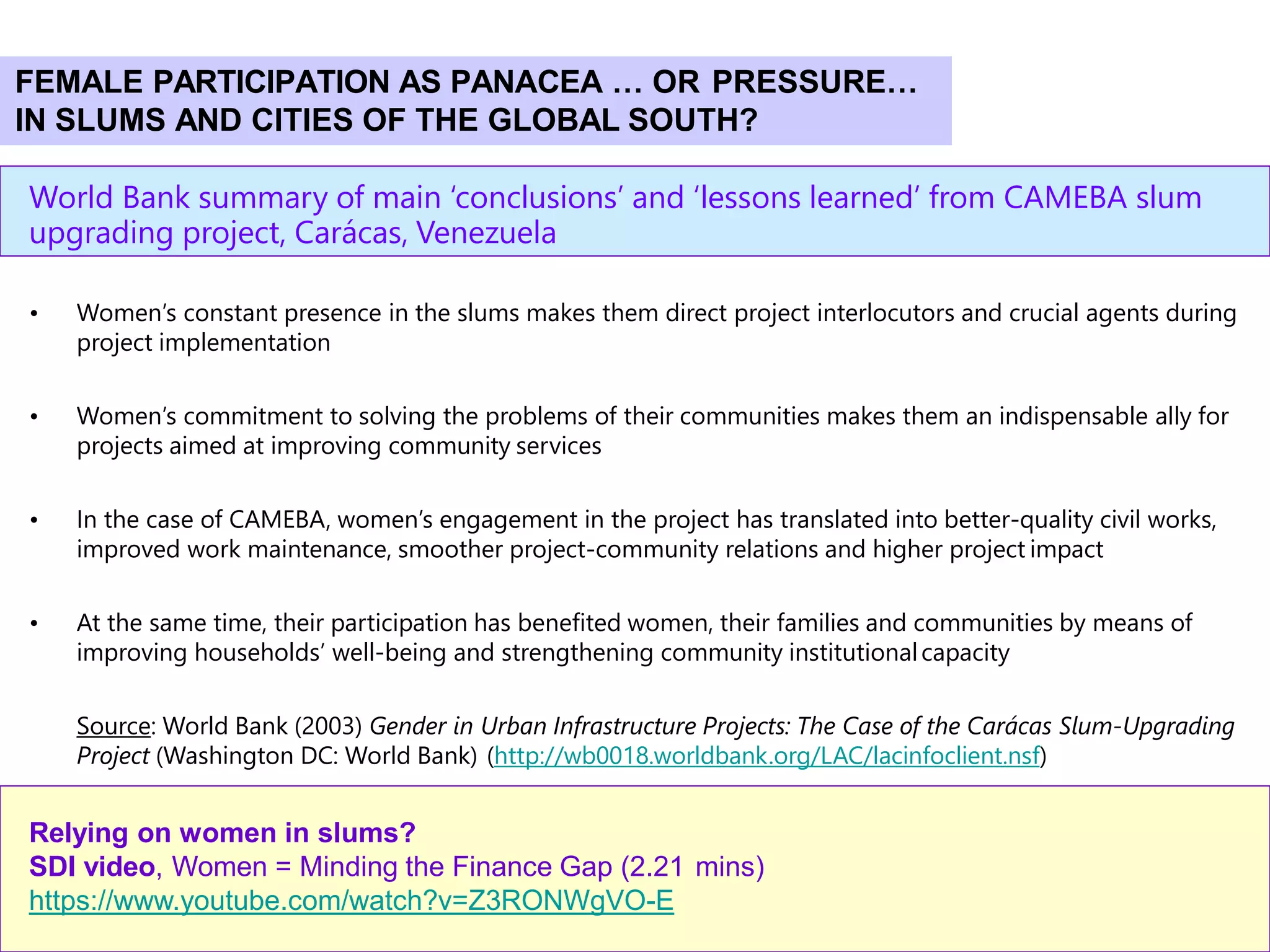
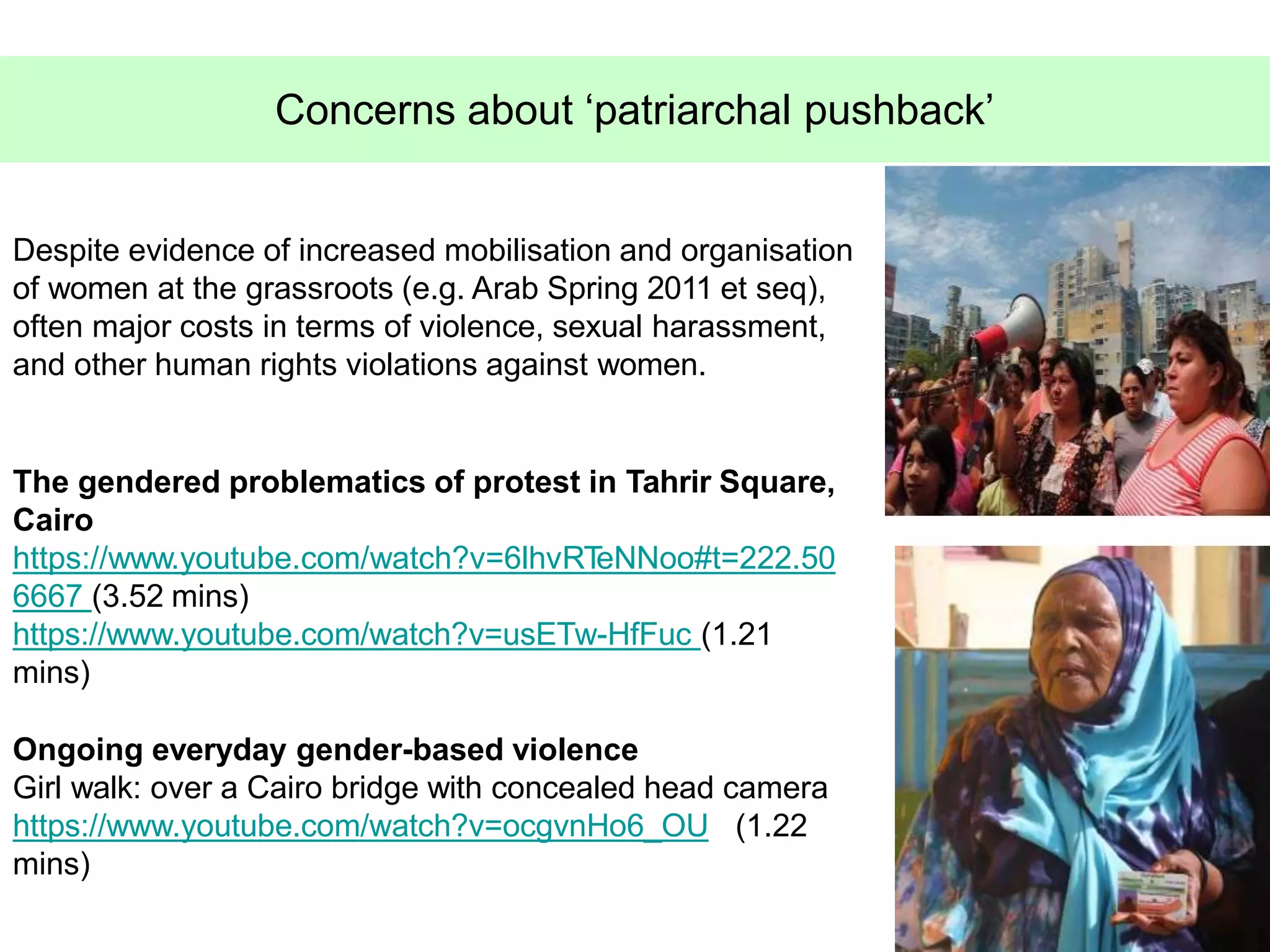
Concerns about ‘patriarchal pushback’
Despite evidence of increased mobilisation and organisation
of women at the grassroots (e.g. Arab Spring 2011 et seq),
often major costs in terms of violence, sexual harassment,
and other human rights violations against women.
The gendered problematics of protest in Tahrir Square,
Cairo
https://www.youtube.com/watch?v=6lhvRTeNNoo#t=222.50
6667 (3.52 mins)
https://www.youtube.com/watch?v=usETw-HfFuc (1.21
mins)
Ongoing everyday gender-based violence
Girl walk: over a Cairo bridge with concealed head camera
https://www.youtube.com/watch?v=ocgvnHo6_OU (1.22
mins)
44
From ‘feminised’ to ‘feminist’ cities?
Through a ‘gender lens’ – looking at cities
and slums anew..
The Global Goals – and Girl Power
https://www.youtube.com/watch?v=sZQ2RUFd54o

Gender, Urbanisation and Poverty: Principles, Practice, and the Space of Slums Professor Sylvia Chant

  • 1.
    The Global DevelopmentInstitute Lecture Series #GDILecture @GlobalDevInst @schant2
  • 2.
    Professor Sylvia Chant LSE s.chant@lse.ac.uk http://personal.lse.ac.uk/chant/ @schant2@LSEUPD #BeBoldForChange(IWD, 2017) University of Manchester Global Development Institute Lecture 8 March 2017 Gender, Urbanisation and Poverty: Principles, Practice and the Space of Slums
  • 3.
    5. 6. From ‘feminisingcities’ to ‘feminist cities’? What, who and how? 2 Interlocking penalties for slum-dwelling women and girls 1. The importance of a gendered ‘urban lens’ 2. ‘Feminising’ cities in the Global South 3. Urbanisation and gender equality: principles and practice 4. Slums and their significance for gendered poverty and inequality – introducing the ‘gender-urban-slum interface’ (Chant and McIlwaine, 2016). Presentation outline
  • 4.
    1)Hiatus between principle/proclamationand practice Despite the conventional wisdom (unqualified supposition?) that urbanisation is ‘good for women and girls’, this does not apply to all women, with considerable evidence that barriers to gender equality and ‘female empowerment’ (as advocated/promoted by BPFA, MDGs, SDGs etc) remain widespread in urban environments. 2)Historical marginalisation/neglect of ‘feminised spheres’ of urban life ‘Private’/domestic feminised spaces often left out of conceptual framing and policy and planning (see Buckley & Strauss, 2016; Fenster, 1999,2005) 3) Need for (re)-theorisation on gender and cities which departs from Global North and globalising ‘norms’ Inappropriate universalisms/generalisations derived from Global North experiences, especially in relation to neglect of extensive informal urbanisation in Global South and the particular challenges of slums (Chant & McIlwaine, 2016) 3 The importance of a ‘gender lens’ in urban analysis and policy in Global South
  • 5.
    4)Intrinsic importance ofwomen’s (and girls’) rights and gender justice – the imperative of addressing under-valorisation and exclusion in context of mismatch between inputs and outcome Women play a significant role in contributing to urban development and ‘’prosperity’ in Global South (e.g. housing stock, household livelihoods), but non-commensurate with outcomes (e.g. ‘decent work’ and equal pay, tenure rights, civic representation) ‘The persistent undervaluation of women’s efforts… constitute a compelling moral, economic, political and policy rationale to understand how prevailing inequalities between women and men play out in urban environments, and how these might most effectively be addressed’ (Chant and McIlwaine, 2016:29-30). 5) Distinctive/intensified ‘urban’ vs ‘rural’ gendered vulnerabilities Heightened vulnerability for urban women and girls (esp. poor/slumdwellers) vis-à-vis their rural counterparts due to environmental threats (including in domestic spaces), health risks e.g. communicable disease, fatigue, HIV/AIDS, CMDs, and gender-based violence (GBV)/Violence Against Women and Girls (VAWG). 6) Feminising urban demographics Nearly all future demographic growth in developing countries will be in cities (and majority 4female) The importance of a ‘gender lens’ in urban analysis and policy in Global South (cont.)
  • 6.
    5 Gendered urban demographics: The‘feminisation’ of towns and cities in the Global South, and a feminised urban future...? ‘Cities are increasingly becoming feminised in demographic terms’ (Kinyanjui, 2014:430). • Gender-selective migration and ‘cities of women’? • Demographic ageing and ‘cities of older women’? • ‘Cities of female-headed households’?
  • 7.
    6 DIMENSIONS AND DYNAMICSOF SEX-SELECTIVITY IN RURAL-URBAN MIGRATION Regional variations Since 1950s/60s women have been most likely to constitute the majority of rural-urban migrants in Latin America and Southeast Asia, and least likely to move in sub-Saharan Africa, South Asia and the Middle East/North Africa Key explanatory factors * gender differences in rural and urban employment * patriarchal kinship * gerontocracy * legal restrictions on single women’s movement to towns (e.g.Kinyanjui, 2014 on Kenya)
  • 8.
    7 Sex-selectivity in rural-urbanmigration streams, 1960s/1970s: Latin America and sub-Saharan Africa and Asia compared • Post-mid 20th century  estimated 100 female vs 88 male rural-urban migrants in Latin America • Some links between sex-selectivity in rural-urban migration flows and urban sex ratios. 1965-1975 Source: Gilbert and Gugler (1982: 59), cited in Chant and Radcliffe (1992) Feminised urban sex ratios in Latin America (average  109 women per 100 men) Masculinised urban sex ratios in sub-Saharan Africa and Asia (average  92 women per 100 men)
  • 9.
    8 Urban sex ratios Sub-SaharanAfrica, 2000s Women per 100 men Burkina Faso (2006) 100 Ghana (2000) 105 Kenya (2005) 68 Malawi (2008) 95 Niger (2008) 100 Rwanda (2002) 89 Zambia (2000) 101 Source: Data from UN Statistics Division (UNSD)
  • 10.
    Urban sex ratios Asia,2000s Women per 100 men SOUTH ASIA Bangladesh (2001) 86 India (2001) 90 Nepal (2006) 94 Pakistan (2007) 94 WESTERN ASIA Iran (2006) 96 Iraq (2007) 98 SOUTHEAST ASIA Cambodia (2008) 108 Indonesia (2005) 100 Malaysia (2008) 97 Vietnam (2008) 105 9 Source: Data from UN Statistics Division (UNSD)
  • 11.
    10 Sex ratios inselected metropolitan areas in Southeast Asia, among young recent migrants, post-2000 15-24 year age cohort Women per 100 men Metro Manila (Philippines) 167 Jakarta (Indonesia) 161 Bangkok (Thailand) 119 25-34 year age cohort Women per 100 men Metro Manila (Philippines) 110 Jakarta (Indonesia) 81 Bangkok (Thailand) 105 Source: Jones (2009) NB ratios changed to women per 100 men (from men per 100 women as in original)
  • 12.
    11 Urban sex ratios LatinAmerica, 2000s Women per 100 men Argentina (2007) 105 Bolivia (2007) 106 Brazil (2000) 106 Chile (2008) ` 104 Costa Rica (2008) 103 El Salvador (2007) 115 Peru (2007) 104 Uruguay (2008) 109 Source: Data from UN Statistics Division (UNSD)
  • 13.
    12 Trends in urbansex ratios late 1990s-2000s, selected African countries Source: Tacoli and Chant (2014: 590, Table 48.1) Note: sex ratio expressed as men per 100 women NB De- masculinising sex ratios in all SSA countries except Kenya
  • 14.
    13 Key reasons fordeclining (male) sex-selectivity in rural-urban migration in sub-Saharan Africa (Sources: Tacoli, 2006; Tacoli & Mabala, 2010, cited in Chant and McIlwaine, 2016: Chapter 1) 1) Increased access by women to urban employment 2) Women’s growing personal desires/demands for independence (arguably encouraged/facilitated by increases in female literacy and education, women’s movements, state/international initiatives for gender equality etc) 3) Financial support from female migrants increasingly integral to rural livelihoods  relaxation of elders’ attitudes to women’s mobility
  • 15.
    Despite regional variationsin gender-selective migration, female-biased demographic ageing appears to exert an important independent effect  in several countries, feminised urban sex ratios most pronounced among the elderly (>60 years), and especially among 70-79 year olds, and/or the ‘older old’ (>80 years). URBAN SEX RATIOS - WOMEN PER 100 MEN Cities of older women? Age group 10-19 20-29 30-39 40-49 50-59 60-69 70-79 80+ Argentina 97 98 101 104 112 120 255 213 Chile 100 99 101 104 108 116 137 189 India 89 105 96 92 90 99 104 124 Malaysia 95 98 100 98 96 98 120 144 China 91 98 96 94 97 100 106 128 Botswana 109 116 111 115 112 142 186 no data South Africa 103 100 103 106 108 134 157 206 Source: Chant and McIlwaine (2016:Table 1.2, compiled from UNSD data) 14
  • 16.
    • Higher levelsof female household headship in urban vs rural areas owe not only to demographic dynamics (e.g feminising urban sex ratios, especially among older age groups), but to (albeit interrelated) economic and social factors: *greater access by urban women to employment and independent earnings * higher levels of urban female land and property ownership, * weakening of patriarchal kinship systems * rising aspirations for marriage partners among women * less discrimination against ‘alternative’ household arrangements The relative anonymity and social fluidity of urban environments seems to afford more scope for women, especially those who decide to avoid oppressive conjugal relationships and establish households on their own, to escape surveillance from former partners and their families, or their own consanguineal kin (see Chant with Craske, 2003:235-6, cited in Chant, 2016 on Mexico and Costa Rica)… • NB. Worth speculating as to whether a growing constituency of female-headed households in urban areas is important in its own right  ‘critical mass’ may help to legitimise ‘alternative’ household forms, strengthen perceptions that women can fend for themselves, and dependents, and also bring about more gender-equitable attitudes among youth (Chant, 2016). 15 Cities of female-headed households?
  • 17.
    16 Percentage of householdsheaded by women in developing regions, 1995-2003 Percentage (weighted) No of countries for which data are available Africa 23.8 37 Northern Africa 12.9 2 Southern Africa 42.2 3 Rest of sub-Saharan Africa 23.5 32 Asia & Oceania 13.4 27 Eastern Asia 20.0 5 Southeastern Asia 15.4 5 Southern Asia 9.6 5 Central Asia 27.6 5 Western Asia 10.8 2 Oceania 54.1 2 Latin America & the Caribbean 23.9 21 Caribbean 33.5 7 Central America 21.2 6 South America 24.2 8 Source: Varley (2014), in Desai & Potter (eds) Companion to Development Studies, 3rd ed NB. Note intra-regional as well as inter-regional heterogeneity
  • 18.
    17 Household headship byurban/rural residence, Southeast Asian countries, 2006** (Dommaraju & Tan, 2014:31) ** or closest available year NB In all countries in region female- headed households more prevalent in urban than rural areas
  • 19.
    18 Women-headed households, ruraland urban, sub-Saharan African countries, latest available year (Tacoli and Chant, 2014, Table 48.2) NB. In most countries (68% of those included in table), FHHs more common in urban areas. Exceptions: Kenya*, Malawi*, Mozambique, Namibia, Rwanda*, Zambia, Zimbabwe * masculine urban sex ratios (coincidence or correlation?)
  • 20.
  • 21.
    ‘It is …in cities that societal progress such as the advancement of women and increasing levels of gender equality take place’ (UN-HABITAT, 2010:3) • weakening of patriarchal family systems (inc patrilocality) and social control associated with physical distancing of rural-urban migrants from kin, greater detachment of women from ‘home’; act/experience of migration may be intrinsically ‘empowering’ (Chant and McIlwaine, 2016; Varley, 2015) • greater opportunities for female education, employment, independent earnings • reduced demands on time and unpaid labour associated with subsistence provision • lower fertility and declining demands of childcare • reduced demands of elder care with assumed ‘nuclearisation’ of households • ‘norm change’ in ‘progressive urban cultures’ -educated, urban men likely to have more gender-equitable attitudes (Barker, 2014, cited in Chant and McIlwaine, 2016:225) -increased economic value of women can alter their roles and status in households and families (e.g. as daughters and wives), and thereby diminish ‘son preference’ (Varley, 2015) (although not everywhere e.g. India) 20 Urbanisation and Gender in Global South: Cities as emancipatory spaces for women and girls?
  • 22.
    ‘… most urbanwomen experience profound disadvantages compared to men in their daily lives’ (Tacoli and Satterthwaite, 2013:3, cited in Chant and Mcllwaine, 2016:2). • ‘Moral impropriety’ often linked with female migration and urban work (Varley, 2015)  social opprobrium/ostracism • Anticipated nuclearisation of households not the case in many urban contexts  overall burden of carework may not decline (e.g. elder care in extended/multi-generational hhs), besides which extra-domestic ‘duties of care’ may remain feminised. • ‘Norm change’ may not run in the direction of greater equality e.g. predicament of ‘leftover women’ in urban China (Fincher, 2014), ‘patriarchal pushback’ in terms of men’s disaffection by rising presence of women in workforce, politics etc (Chant and McIlwaine, 2016) • Persistent – and new – disadvantages and/or inequalities ‘Urbanisation creates physical demands on women due to new waged work, urban stressors, limited convenient transportation, demands on their time, and new complexities in their lives’ (Meleis, 2011:5, cited in Chant and McIlwaine, 2016:2) 21 Urbanisation and Gender in Global South: Cautions re cities as emancipatory spaces for women and girls The ‘urban century’ may NOT offer a ‘golden age’ for accelerating/enhancing female empowerment and equality (Chant, 2013)  little evidence (quantitative or qualitative) to support systematic association of urbanisation with greater gender equality (Chant and McIlwaine, 2016:2-3). For poor and/or slum-dwelling women constraints and challenges may not be that dissimilar to those faced by their rural counterparts, and in some instances be more pronounced (e.g. GBV)
  • 23.
    22 The difference thatspace makes in diversity and intersectionality ‘Urban women, while generally sharing specific gender interests arising from a common set of responsibilities and roles, constitute a fairly diverse group. There are elderly women, working women and women whose major responsibility is in the domestic sphere. There are also women who balance multiple roles at the same time. Poor women living in slums and low resource areas face disadvantages which are very different from those faced by women from middle class families. Slum dwellers also experience an unequal level of service, and women are doubly disadvantaged from poor access (sic) (emphasis added) Cities, especially large urban areas, also have more numbers of women-headed households, single women living by themselves, professional women who need to travel, etc, and urban development planning must respond to the needs of these diverse groups’ (Khosla, 2009; see also Varley, 2015)
  • 24.
    Cities as variegatedspaces for gender equality and women’s empowerment: slums as ‘spatial poverty traps’? • As part of their assessment of the Beijing Platform for Action+20, UN Women (2015:9) highlighted that while urbanisation has helped to present new possibilities for gender equality, there are major challenges too, not least on account of the growth of informal settlements which produce ‘new kinds of urban spaces marked by destitution and insecurity on a vast scale’. • Women who are poorer (in income terms), and who inhabit disadvantaged or marginalised urban communities (particularly ‘slums’) are arguably those least ‘empowered’ by urbanisation  ‘urban slums in the Global South present particularly trenchant barriers to gender and other forms of equality’ (Chant and McIlwaine, 2016:11) • Persuasive evidence that female slum residents can become locked in ‘spatial poverty traps’ (Unterhalter, 2009:16; also Chant and Datu, 2015; Harriss-White et al, 2013) due, inter alia, to: *multiple labour and time burdens of coping with/compensating for deficient housing, poor services and infrastructure * constrained mobility/connectivity to other parts of the city *enforced operation of home-based enterprise in weak localised markets *lack of freedoms and opportunities in control/use of domestic and/or community space 23
  • 25.
    24 (De)constructing the gender-urban-slum interface: key dimensions,criteria and cross-cutting issues regarding gendered inequalities in slums Gender, urban demographics, and reproductive andsexual health andrights Gender disparitiesin power andrights Gender divisionsof labour in urban economy Gender inequalitiesin space, mobility and connectivity Cross-cuttingissues for poor women in slums Gender gaps in physical, natural and financial capital andassets Gender disparitiesin humancapital Gender-urban-slum interface: key dimensions Time Income Healthand well-being Violence Security Stability Politicsand governance Climatechange Keycriteria Mortality, fertility, migration, sex ratios, household size,composition and headship, demographicageing Education, skills,vocational training Rural-urban and international mobility and linkages,intra-urban freedom of movement,transport, ICT Paid and unpaid work (includingin home), sectoraldivisionsin labour force, sex segmentation in employment and entrepreneurship, formal versus informalactivity Access and rights to land, property and secure tenure, urban services and infrastructure, loans andcredit Formal and informal political participation, community and civic representation andgovernance Source: Chant & McIlwaine (2016: Fig 2.2)
  • 26.
    25 Key interlocking penaltiesfor slum-dwelling women and girls • Time penalties • Economic penalties • Health and well-being penalties
  • 27.
    26 TIME PENALTIES FORWOMEN Women spend fewer hours in paid/SNA work than men, but work more hours overall. In six countries in Figure, women spend more than twice as much time as men in unpaid carework, and in India, 10X as much Globally women devote 1-3 more hours a day to housework than men, and 2-10 times the amount of carework (children, sick and elderly) (HeforShe website, UN Women, accessed Oct 2016) For slum-dwelling women (and girls), time and labour burdens are typically accentuated, yet despite critical role of unpaid work in compensating for shortfalls in housing, infrastructure and services, this is rarely acknowledged or valorised …(Chant and McIlwaine, 2016). Source: UNRISD, 2010
  • 28.
    27 Women build cities!! Women’scontribution to self-help housing construction, Querétaro, Mexico Pronounced gendered disparities in women’s contributions to housing stock, and recognition thereof at domestic, community and city-wide levels, manifested, inter alia, in low female shares of ownership and control of dwellings..
  • 29.
    28 ECONOMIC PENALTIES FORWOMEN Restrictions on women’s income-generating activities relating to disadvantages in shelter, services, space and mobility* *Compounding lack of human and financial capital, ‘reproduction tax’, and socio-cultural constraints on female income- generating activities..
  • 30.
    HEALTH AND WELL-BEING: A‘GENDERED URBAN (SLUM) HEALTH PENALTY’? ‘Nowhere are the disadvantages of the urban poor … more marked than in the health area. Poor women are at a particular disadvantage’ (UNFPA, 2007) • An ‘urban penalty’ in health applicable to many slums, associated with high incidence of communicable disease, or ‘diseases of poverty’ (and inequality) • Susceptibility to wide range of infectious, gastro-enteritic and respiratory illnesses due to overcrowding, proximity to refuse dumps, standing pools of stagnant water, open drainage channels… • Infections also linked to multiple use of communal resources e.g. streams, rivers or other non-purified water sources for washing cooking utensils, clothes, personal bathing etc. • Sharing of toilets; poorly ventilated or uncovered pit latrines; bucket toilets; ‘flying toilets’; open-defecation.. and serious complications around menstruation • Indoor cooking over open fires in poorly-ventilated conditions (‘indoor air pollution’) • Lack of electricity or refrigeration  contamination and/or waste of food and/or daily trips to purchase essential items for household consumption • Lack of time, rest and recreation compounding feminised burdens of care for sick can increase risks of infection and ill-health among women and girls 29
  • 31.
    30 Source: UNICEF (2012)State of the World’s Children 2012
  • 32.
    31 Reasons for greaterprevalence of HIV in urban areas – especially ‘slum’ neighbourhoods Generally emphasised are behavioural factors e.g. • Greater opportunities for sexual networking • Migration • Relative social anonymity • Youthful age structure Less emphasised are factors relating to environment & poverty e.g. • Weak immune systems resulting from poor nutrition and other communicable diseases heavy ‘viral loads’ increase susceptibility to infection and accelerated progression from HIV to AIDS. • HIV-affected individuals more contagious when co-infected with other diseases such as bilharzia (up to 3 times), malaria (up to 7 times) • Mothers infected by worms have up to 7 times greater risk of passing HIV to babies • Limited access to affordable/quality health facilities • Communities riven by HIV/AIDs less likely to be socially cohesive/able to mobilise to cope with fall-out of pandemic Sources: Ambert et al (2007); Van Donk (2006); WHO (2009), cited in Chant and McIlwaine (2016) In Nairobi slums of Korogocho & Viwandani, HIV prevalence is 12% compared with 5% among non-slum residents, with women particularly affected…
  • 33.
    • greater likelihoodof early sexual debut associated with lack of privacy, insecurity and gender-based violence (individual and gang-based) in urban slums Women’s greater vulnerability to HIV owes to socio-cultural as well as physiological factors (e.g. likelihood of first intercourse with sexually-experienced older men). Cross-generational sex appears especially marked in urban areas of SSA, compounded by poverty and place of residence within city… • poor urban women’s and girls’ dependence on cash income and limited livelihood opportunities may increase possibility of unsafe ‘transactional sex’, or prostitution 32 Poor urban women and girls in SSA and HIV http://www.aids-freeworld.org/content/view/147/135/ Campaign against cross-generational sex targetting ‘sugar daddies’ launched by social marketing NGO, PSI, with support of Ugandan government and YouthAIDS Photo courtesy of George Barnett, MSc UD, LSE, 2015-16.
  • 34.
    33 Anatomies of GBVin Global South Cities: In Brief • Urban women estimated to be TWICE as likely to experience GBV as rural women, although IPV (intimate partner violence) typically greater in rural areas (McIlwaine, 2013:67). In Kenya, Austrian et al (2015) found far higher levels of violence against urban adolescent girls (30%) than rural peers (5%).  within cities combined risks of ‘public’ and ‘private’ violence = greater burden on women and girls • Conceivable that levels of general GBV higher in urban areas due to greater reporting (partly because urban women less likely to tolerate VAWG – McIlwaine, 2013), and/or greater opportunities to report. • However, also plausible that risks of GBV in cities are exacerbated given a)higher levels of urban versus rural violence in general (e.g. gangs, civil conflict, urban crimes involving violence) b)multiplicity of urban sites (e.g. public spaces, streets, hostelries, transport routes and hubs) in which violence from ‘strangers’ may occur, especially when limited surveillance/policing c) greater social anonymity and impunity d)‘male backlash’/’patriarchal pushback’ in wake of nominal advances for women and girls in urban areas (e.g. education, employment, political visibility) e)high levels of occupancy in poor, informal, precarious residential neighbourhoods (‘slums’) lacking privacy and protection ‘Violence against women in … slums is rampant… and emerges as perhaps the strongest cross-cutting theme’ (COHRE, 2008:14): ‘Although accelerating rates of violence and crime are by no means an urban-specific problem, they are particularly problematic in urban areas. The sheer scale of violence in poor areas or slums means that, in many contexts, it has become “routinised” or “normalised” into the functional reality ofdaily life’ (Moser, 2004.:6).
  • 35.
    Urban poor and/orslum-dwelling women and GBV Poor (and/or slum-dwelling) urban women may be especially prone to violence from strangers as well as intimate partners and household/family members, due to: * Higher levels of violence in general in urban areas, and often especially in slums (gangs) * Anonymity/social isolation, particularly where households lack visible male ‘heads’ e.g. choice of annexed rental housing by FHHs in Angola often determined by considerations of security * Flimsy housing offering scant protection against forced entry (e.g. escalation of sexual violence in ‘tent cities’ in aftermath of 2010 earthquake in Haiti) * Poor lighting (at domestic and community level) * Inaccessible/unreliable/unaffordable/inappropriate/unsafe pedestrian infrastructure or public transportation – e.g. routes, links, timing, conditions in waiting areas. * Inadequate WASH (water, sanitation and hygiene) facilities, and where flush toilets and washblocks do exist, frequently communal and/or non sex-segregated * Lack of and/or corrupt policing in low-income neighbourhoods; few ‘gender- sensitised’/’trained’, or female, officers * Economic pressures on women and girls to undertake risky or hazardous work 34
  • 36.
    Vulnerability of poorand/or slum-dwelling women to ‘common mental diseases’ (CMDs) • WHO/WB ‘Global Burden of Disease’ project (2004) points to female bias in mental illness, compounding widely-noted association between poverty and mental ill-health http://www.who.int/topics/global_burden_of_disease/en/ • Poor women tend to suffer more than their male counterparts from common mental disorders (CMDs) such as depression, anxiety, fatigue –attributed to gender-selective ‘stressors’ associated with employment, residence/long periods of day/night in ‘slum’ neighbourhoods, risks of GBV, insecurity of tenure/property rights • Added stress on women from trauma of losing babies, infants and children from malnutrition, anaemia, untreated perinatal complications, and infectious diseases • Depression one of side effects of ART (more access to ART in urban areas, with women having ‘double portal’ through maternity) • Stigmatisation of female household headship – isolation, gossip, social opprobrium • Social isolation/lack of support networks among recent migrants 35
  • 37.
    *Land tenure andhousing as central to women’s economic empowerment, security and well-being *Women in local government and decision-making positions, including local-to-local dialogue and peer learning and collaboration among local governments, worker movements and community groups *Safety in the city *Income and growth creation (in line with the Equal Growth Pillar of CA’s Medium Term Strategy ‘to demonstrate the linkages between equal growth and gender equality’) *Working with men and boys to develop their understanding of the importance of gender equality, and to include them as allies in the pursuit of gender equality prevention of discrimination against women and GBV *Collection of data disaggregated by age and sex in all activities, and support local governments in capacities and practices in disaggregated data collection and analysis 36 Moving towards more gender-fair cities.. CITIES ALLIANCE GENDER EQUALITY STRATEGY SUGGESTED AREAS OF COLLABORATION (Cities Alliance, 2015:17)
  • 38.
    37 Moving towards moregender-fair cities.. NEW URBAN AGENDA (NUA) 2016 GENDER EQUALITY AND THE NEW URBAN AGENDA (UN Women 2016) ‘The NUA strategically supports the implementation of the 2030 Agenda, in particular mainstreaming gender equality and women’s empowerment across all social development goals. It offers a chance to respond to the challenges and the ever-changing dynamics of human civilisation, improve the spatial configuration of cities and human settlements in a gender-inclusive way, and recognise the crucial aspect of women’s rights in the urban development agenda’ (UN Women, 2016:2) KEY PRIORITIES * Ending Violence against women, and creating safe cities and safe public spaces * Economic empowerment * Leadership and governance in participatory cities * Gender mainstreaming and institutional development * Sustainable cities, sustainable development SDG 5 ACHIEVE GENDER EQUALITY AND EMPOWER ALL WOMEN AND GIRLS SDG 11 MAKE CITIES AND HUMAN SETTLEMENTS INCLUSIVE, SAFE, RESILIENT AND SUSTAINABLE
  • 39.
    38 Specific strategies andinterventions • Investments in everyday infrastructure, services, and shelter in slums (and slum- upgrading) including female participation in design,(e.g. Crosscutting Agra Programme (India) • Community sensitisation/ ‘neighbourhood watch’ schemes e.g. Bantay Banay (Philippines) • Working with men and boys to promote gender equality and to eliminate GBV e.g. Promundo (Brazil), Parivartan and Priya’s Mirror (India) • Grassroots protest e.g. ‘shame the attackers’ (Morocco); Operation Anti-Sexual Harrassment (Egypt) • More and better policing, inc women’s desks, women-only police stations (e.g. Philippines, Argentina, Peru, Brazil, India) • Laws and criminalisation of perpetrators of VAWG  >125 countries have outlawed GBV and introduced severer penalties for perpetrators e.g. Maria da Penha Law, Brazil. * Mandatory reporting of acts of GBV? • City-specific ‘Gender Codes’ e.g. Cebu City, Philippines
  • 40.
    39 Specific strategies andinterventions (cont.) • Safety Audits/Digital Grassroots Mapping of GBV e.g. Blank Noise and SafetiPin (India, launched 2003 and 2013), Harrass Map (Egypt, launched 2010) • Greater pedestrianisation of city streets, and support of public transport > private vehicles e.g. Bogotá and ‘Medellín miracle’ mayoral makeovers (Enrique Peñalosa, mayor of Bogotá 1998-2001, 2016-19: ‘Cities are for people, not cars’) • Segregated public transport e.g. women-only buses, train/tube carriages – although perhaps only temporarily since goal should be ‘to create cities where woman can travel and enjoy the city independently and at any time of day’ (García-Moreno and Chawla, 2011: 62, cited in Chant and McIlwaine, 2016: 162) • ‘Crime Prevention Through Environmental Design’ (CPTED), inaugurated by UN-Habitat involving community-based consultations to create ‘safe cites’ • Public-private partnerships (PPPs) e.g. ‘Adopt a Light’ (Nairobi) • International initiatives/inducements/competitions e.g. UN- Habitat’s ‘Safer Cities Programme’ and ‘Global Programme on Safe Cities Free From Violence Against Women’ (see Chant and McIlwaine, 2016: Chapter 6), and Plan International/WICI/ Habitat Safer Cities for Girls. Liga Peatonal (2016) Mexico’s Charter of PedestrianRights
  • 41.
    Echoes and furtherthoughts on making future cities gender-fair, ‘empowering’ for women and girls … and ‘feminist’ • More collection and dissemination of spatially-disaggregated (e.g. slum/non-slum) as well as sex-disaggregated data (e.g. on time-use)? ‘What gets counted is more likely to get addressed’ (Moser [Annalise], 2007:7, cited in Chant and McIlwaine, 2016) • Greater recognition, assessment and valorisation of ‘unpaid economy’ and ‘care economy’ More attention to gender-differentiated responsibilities for unpaid labour and care • Strategies required to address social relations between women and men which underpin gendered divisions of labour – SDG 5, ‘50/50 by 2030’? Work with men and boys to incentivise more equitable responsibilities for unpaid work, as well as other household obligations such as control of income and consumption • More attention to intersectionality – e.g. LGBT rights absent in NUA • Move from ‘gender mainstreaming’ to ‘gender transformation’ (Moser,2016) • Ensure that calls for ‘women’s empowerment’ and gender equality are not subordinated to efficiency objectives -- poverty alleviation and economic growth are likely corollaries of more gender-equitable cities but they should be treated as positive outcomes rather than the goals that drive the gender agenda. 40
  • 42.
    41 In context of‘deep informality’ of urban development, in which global South women act as ‘unpaid urban developers and urbanisers’, based on assumptions about infinite and elastic female labour supply, ‘capitalism relies on women’s free and underpaid work to compensate for neoliberalism’s erosion of the public realm and abandonment of civic responsibilities’ (Miraftab, 2010:646). In relation to ‘post-neoliberal states of Ecuador and Venezuela ‘….poor women increasingly have been viewed as the “answer” to a weak welfare state as well as a source of cheap labour. This has led to their disempowerment rather than empowerment or “integration into the development process”’ (Lind, 2007, cited in Chant and McIlwaine, 2016: Chapter 9; also Lind, 2010) (A) model of ‘participatory development and non-confrontational negotiation’ obtains, in which ‘slum subjectivities’ have been constructed through gendered discourses that have ‘elevated women’s participation both as a development solution and as a benefit to the poor’, with the ‘feminisation of participation’ being characterised by ‘an inherently divided subjectivity’ which ‘has privileged women’s domestic social-reproductive roles as “housewives” to the exclusion of those with working lives outside of the home’ Doshi (2013:857). ‘Discrimination against women in cities has a price’ Cities Alliance Gender Equality Strategy 2014-2017 Concerns about capitalising on women’s work in cities and slums
  • 43.
    42 World Bank summaryof main ‘conclusions’ and ‘lessons learned’ from CAMEBA slum upgrading project, Carácas, Venezuela • Women’s constant presence in the slums makes them direct project interlocutors and crucial agents during project implementation • Women’s commitment to solving the problems of their communities makes them an indispensable ally for projects aimed at improving community services • In the case of CAMEBA, women’s engagement in the project has translated into better-quality civil works, improved work maintenance, smoother project-community relations and higher project impact • At the same time, their participation has benefited women, their families and communities by means of improving households’ well-being and strengthening community institutionalcapacity Source: World Bank (2003) Gender in Urban Infrastructure Projects: The Case of the Carácas Slum-Upgrading Project (Washington DC: World Bank) (http://wb0018.worldbank.org/LAC/lacinfoclient.nsf) Relying on women in slums? SDI video, Women = Minding the Finance Gap (2.21 mins) https://www.youtube.com/watch?v=Z3RONWgVO-E FEMALE PARTICIPATION AS PANACEA … OR PRESSURE… IN SLUMS AND CITIES OF THE GLOBAL SOUTH?
  • 44.
    43 Concerns about ‘patriarchalpushback’ Despite evidence of increased mobilisation and organisation of women at the grassroots (e.g. Arab Spring 2011 et seq), often major costs in terms of violence, sexual harassment, and other human rights violations against women. The gendered problematics of protest in Tahrir Square, Cairo https://www.youtube.com/watch?v=6lhvRTeNNoo#t=222.50 6667 (3.52 mins) https://www.youtube.com/watch?v=usETw-HfFuc (1.21 mins) Ongoing everyday gender-based violence Girl walk: over a Cairo bridge with concealed head camera https://www.youtube.com/watch?v=ocgvnHo6_OU (1.22 mins)
  • 45.
    44 From ‘feminised’ to‘feminist’ cities? Through a ‘gender lens’ – looking at cities and slums anew.. The Global Goals – and Girl Power https://www.youtube.com/watch?v=sZQ2RUFd54o