Workshop for Dryland Systems: ESA Flagships
Evidence based Transformation
Amman: 26-27 May 2014
Katherine Snyder, Everisto Mapedza, Nicoline de Haan, Nelson Mango and Cecilia
Turin
Strategic Gender Research Planning Workshop
26th June – 27th May, 2014
Holiday Inn Hotel - Amman, Jordan
1
Strategic Gender Research Planning
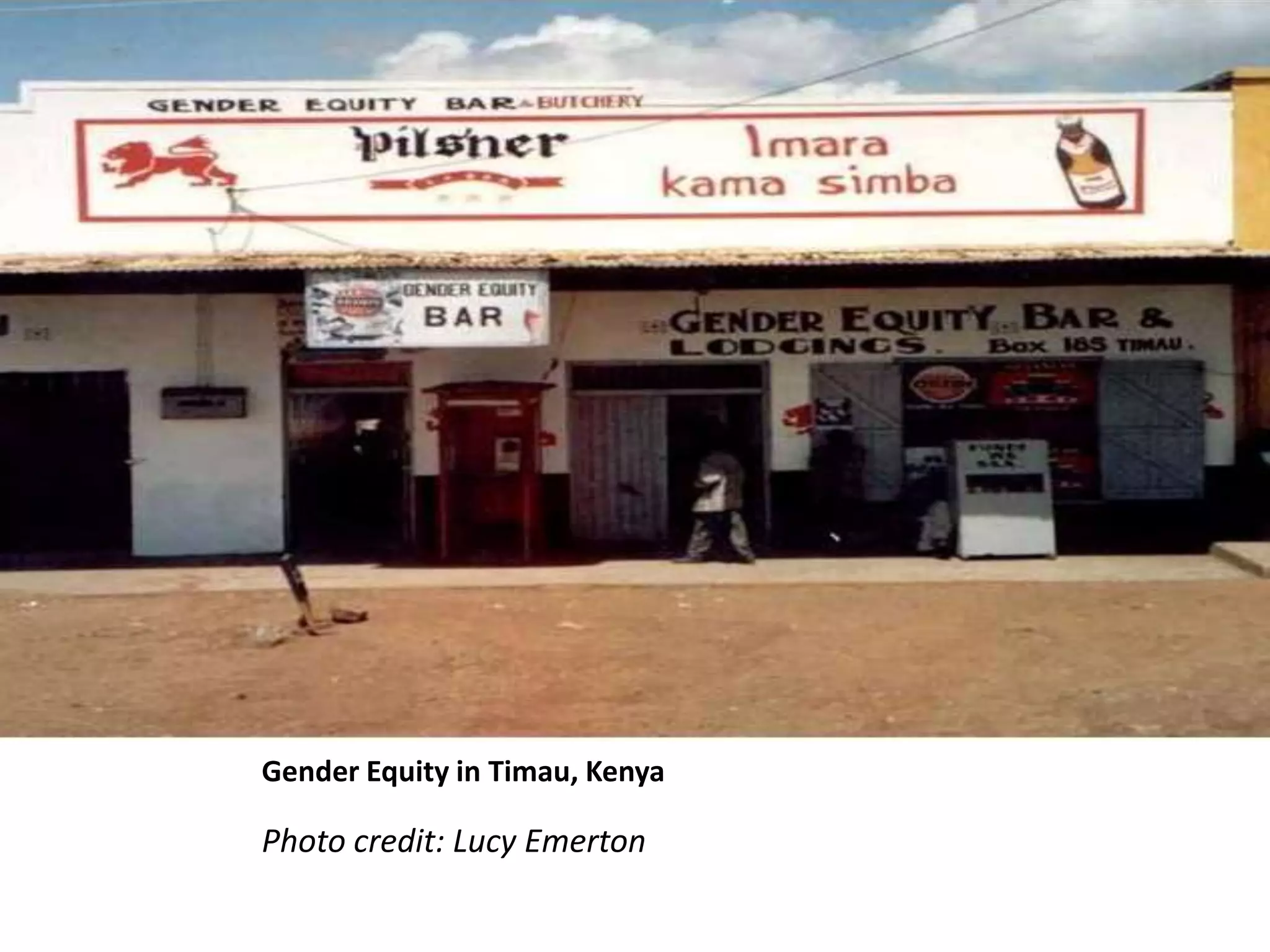
Photo credit: Lucy Emerton
Gender Equity in Timau, Kenya
Key points about gender
• Remembering that gender is not just women.
• Women and men not homogenous groups.
• Gender is a social and cultural construction and so
varies considerably according to context.
• Gender: “the ways in which members of the two sexes
are perceived, evaluated, and expected to behave.”
• Understanding gender in drylands involves unpacking
the complex social systems in the program sites.
• Gender research needs to look at gender relations –
how men and women relate and are define d in
relation to one another.
3
Key points from the gender strategy
• Power: people’s capacity to make choices and exercise
influence - in relation to themselves as well as others
• Empowerment: processes by which this capacity is
acquired by those who have been denied it
• Agency: the capacity to exercise choice and pursue
goals. Agency gives people the power to challenge or
renegotiate unequal power relations. It operates by
providing:
• Voice - to seek individually or collectively ways to bring
about desired change, and
• Exit - to withdraw from or withhold cooperation in an
unfavourable situation
4
Data and analysis
• Just asking women what they want or what they
do (gender division of labor) and collecting
gender-disaggregated data)- will tell you what
patterns exist but not why and without the why,
entry points can be wrongly identified.
• Gender needs to be integrated into research
questions from the beginning, not tacked on
midway through or thought about at the end
when impact needs to be assessed.
• Understanding differences within gender for
better targeting.
5
Gender and power
• Gender is about a system of power relations.
• Addressing poverty will not in itself solve the
issues of gender equity.
• Gender can only be understood by examining the
wider cultural, economic and political context in
which it is situated.
• Essentializing gender might only deepen
inequalities and poverty.
• Need to understand formal versus informal rights.
6
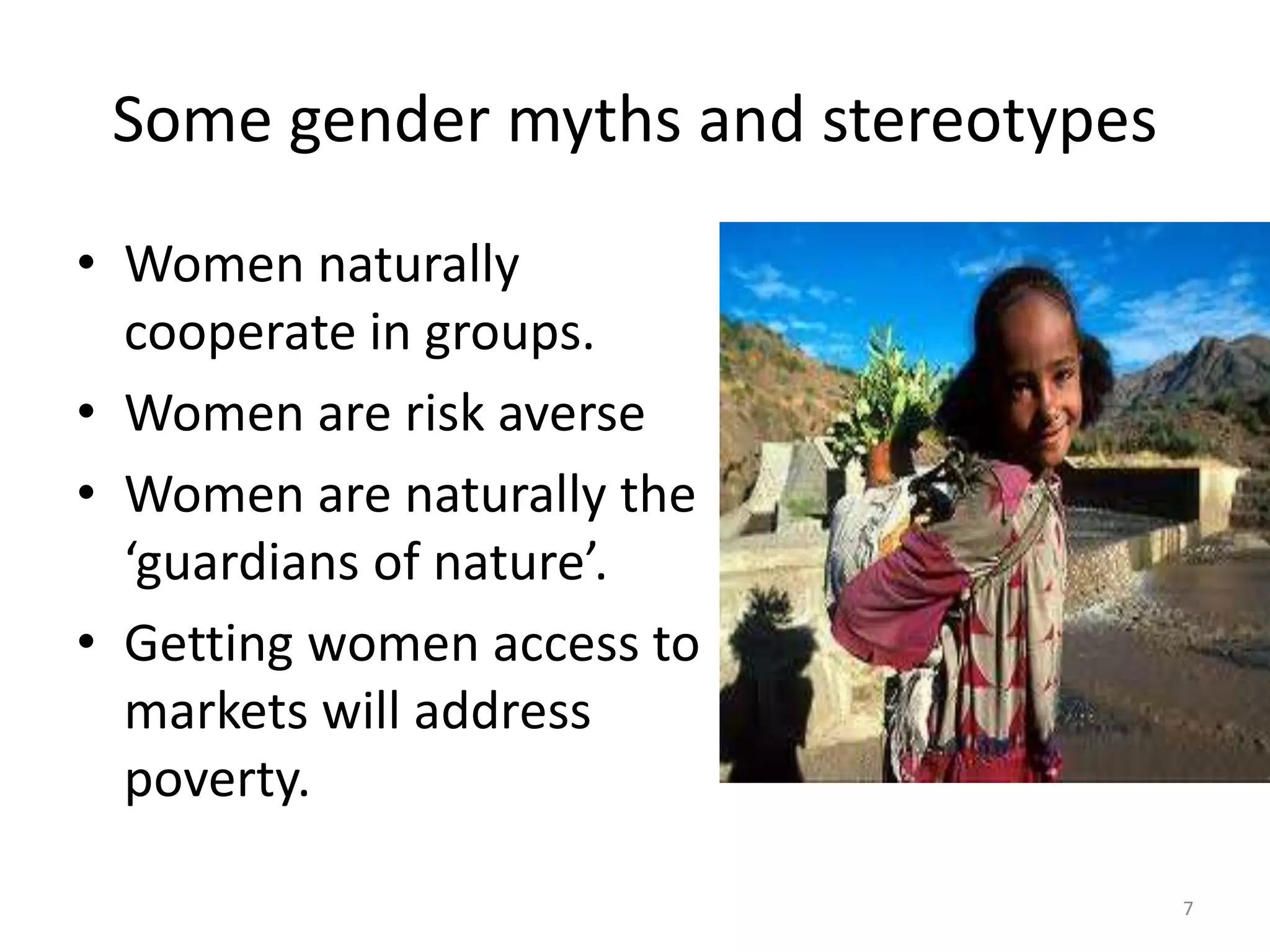
Some gender myths and stereotypes
• Women naturally
cooperate in groups.
• Women are risk averse
• Women are naturally the
‘guardians of nature’.
• Getting women access to
markets will address
poverty.
7
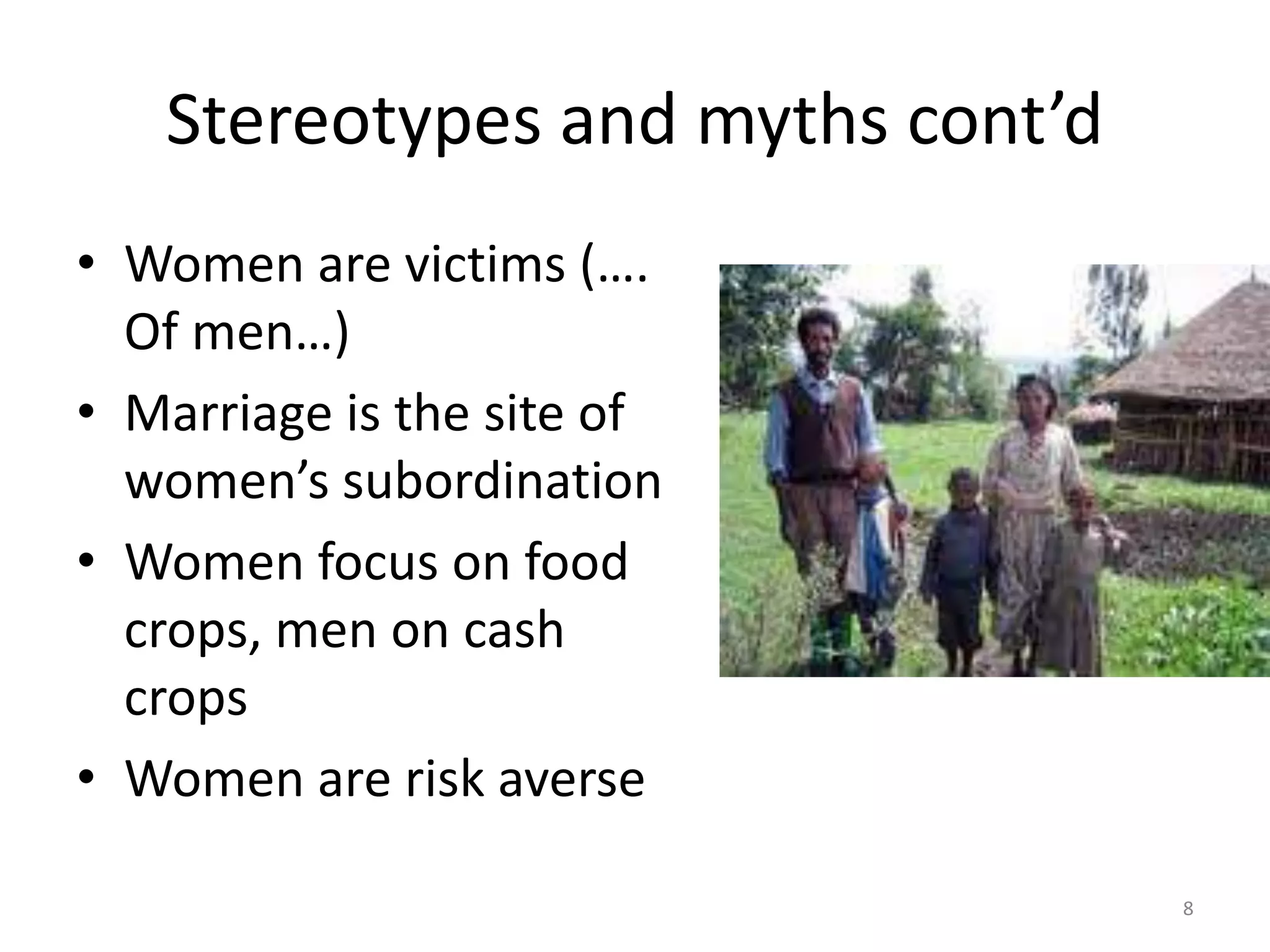
Stereotypes and myths cont’d
• Women are victims (….
Of men…)
• Marriage is the site of
women’s subordination
• Women focus on food
crops, men on cash
crops
• Women are risk averse
8
Problems with simplification
• Households are made up of individuals with
separate sometimes complementary
sometimes opposed gender interests.
• Need to be cautious about applicability of
Western models to non-Western contexts.
9
Interventions and their effects
• Creating new institutions with emphasis on
consensus may only marginalize women and
poor men more.
• Having urban women fieldworkers may not
necessarily mean better understanding of
rural women.
• Perspectives on marginal men or differences
among women often missing.
10
Interventions
• Polygamy in Botswana.
• Targeting only women can create a backlash.
• Technical interventions without advocacy and
awareness raising unlikely to address
underlying gender inequities.
• Research should link to NGO/civil society
sector as well as government.
11
Unsubstantiated claims
• Paper by Doss et al: Gender Inequalities in Ownership
and Control of Land in Africa: Myths versus Reality
(IFPRI)
• debunking statements like “women own only 2
percent of land in the world” as gross over-
simplifications.
• To understand land ownership, one has to
understand how ‘ownership’ is defined and
conceived in a given context.
• Ownership needs to look at men as well.
• Cultural context in which men and women live
critical to understand.
12
Conclusion
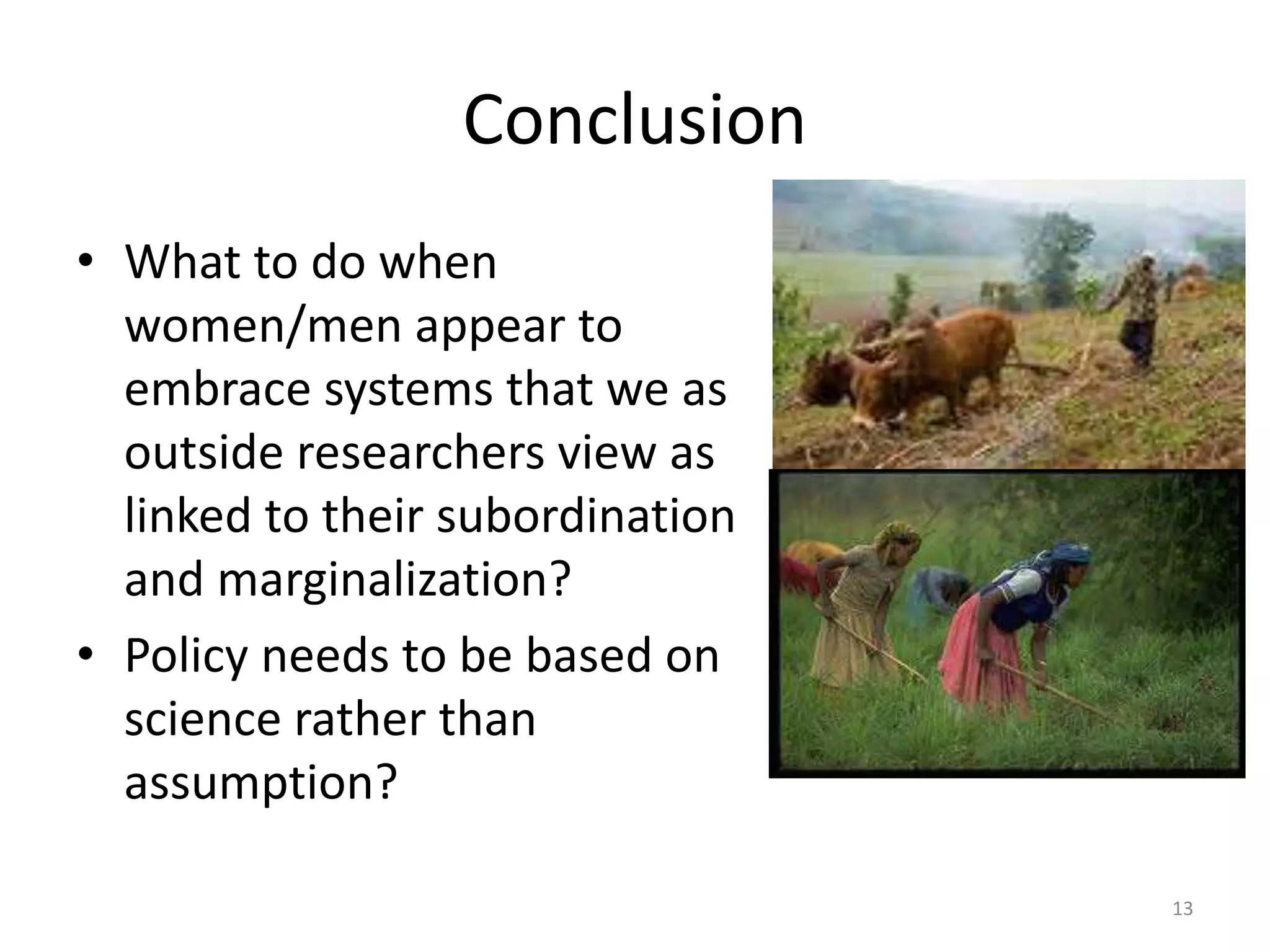
• What to do when
women/men appear to
embrace systems that we as
outside researchers view as
linked to their subordination
and marginalization?
• Policy needs to be based on
science rather than
assumption?
13

ESA Flagships

  • 1.
    Workshop for DrylandSystems: ESA Flagships Evidence based Transformation Amman: 26-27 May 2014 Katherine Snyder, Everisto Mapedza, Nicoline de Haan, Nelson Mango and Cecilia Turin Strategic Gender Research Planning Workshop 26th June – 27th May, 2014 Holiday Inn Hotel - Amman, Jordan 1 Strategic Gender Research Planning
  • 2.
    Photo credit: LucyEmerton Gender Equity in Timau, Kenya
  • 3.
    Key points aboutgender • Remembering that gender is not just women. • Women and men not homogenous groups. • Gender is a social and cultural construction and so varies considerably according to context. • Gender: “the ways in which members of the two sexes are perceived, evaluated, and expected to behave.” • Understanding gender in drylands involves unpacking the complex social systems in the program sites. • Gender research needs to look at gender relations – how men and women relate and are define d in relation to one another. 3
  • 4.
    Key points fromthe gender strategy • Power: people’s capacity to make choices and exercise influence - in relation to themselves as well as others • Empowerment: processes by which this capacity is acquired by those who have been denied it • Agency: the capacity to exercise choice and pursue goals. Agency gives people the power to challenge or renegotiate unequal power relations. It operates by providing: • Voice - to seek individually or collectively ways to bring about desired change, and • Exit - to withdraw from or withhold cooperation in an unfavourable situation 4
  • 5.
    Data and analysis •Just asking women what they want or what they do (gender division of labor) and collecting gender-disaggregated data)- will tell you what patterns exist but not why and without the why, entry points can be wrongly identified. • Gender needs to be integrated into research questions from the beginning, not tacked on midway through or thought about at the end when impact needs to be assessed. • Understanding differences within gender for better targeting. 5
  • 6.
    Gender and power •Gender is about a system of power relations. • Addressing poverty will not in itself solve the issues of gender equity. • Gender can only be understood by examining the wider cultural, economic and political context in which it is situated. • Essentializing gender might only deepen inequalities and poverty. • Need to understand formal versus informal rights. 6
  • 7.
    Some gender mythsand stereotypes • Women naturally cooperate in groups. • Women are risk averse • Women are naturally the ‘guardians of nature’. • Getting women access to markets will address poverty. 7
  • 8.
    Stereotypes and mythscont’d • Women are victims (…. Of men…) • Marriage is the site of women’s subordination • Women focus on food crops, men on cash crops • Women are risk averse 8
  • 9.
    Problems with simplification •Households are made up of individuals with separate sometimes complementary sometimes opposed gender interests. • Need to be cautious about applicability of Western models to non-Western contexts. 9
  • 10.
    Interventions and theireffects • Creating new institutions with emphasis on consensus may only marginalize women and poor men more. • Having urban women fieldworkers may not necessarily mean better understanding of rural women. • Perspectives on marginal men or differences among women often missing. 10
  • 11.
    Interventions • Polygamy inBotswana. • Targeting only women can create a backlash. • Technical interventions without advocacy and awareness raising unlikely to address underlying gender inequities. • Research should link to NGO/civil society sector as well as government. 11
  • 12.
    Unsubstantiated claims • Paperby Doss et al: Gender Inequalities in Ownership and Control of Land in Africa: Myths versus Reality (IFPRI) • debunking statements like “women own only 2 percent of land in the world” as gross over- simplifications. • To understand land ownership, one has to understand how ‘ownership’ is defined and conceived in a given context. • Ownership needs to look at men as well. • Cultural context in which men and women live critical to understand. 12
  • 13.
    Conclusion • What todo when women/men appear to embrace systems that we as outside researchers view as linked to their subordination and marginalization? • Policy needs to be based on science rather than assumption? 13