Swiss Association for Development and Cooperation
Dhobighat, Lalitpur-3 , G.P.O. Box 688,Kathmandu, Nepal
Phone +977 1 5524925, 5522013, Fax + 977 1 5531109
po@helvetasnepal.org.np, www.helvetasnepal.org.np
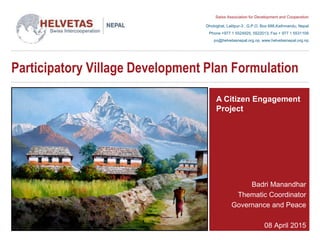
Participatory Village Development Plan Formulation
Badri Manandhar
Thematic Coordinator
Governance and Peace
08 April 2015
A Citizen Engagement
Project
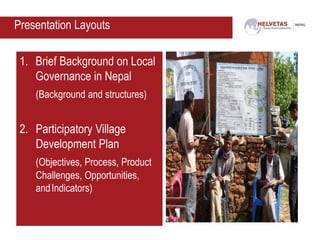
1. Brief Background on Local
Governance in Nepal
(Background and structures)
2. Participatory Village
Development Plan
(Objectives, Process, Product
Challenges, Opportunities,
andIndicators)
Presentation Layouts
Brief Background
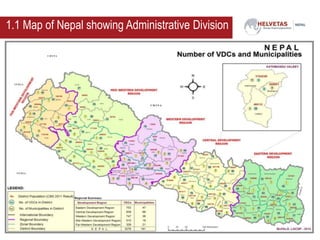
1.1 Map of Nepal showing Administrative Division
Local Self Governance Acts (LSGA) (1999) and Rules (2000):
Framework for decentralization in Nepal
Recognized Local Bodies as independent & autonomous units and
devolved some sectoral authorities (agriculture, education & health)
A two-tier system of local governance, with village and municipal
bodies as the lower tier and district bodies as the higher tier
Village level bodies: Village Development Committees (VDCs) in rural
areas and Municipalities (MNs) in urban areas; District level bodies:
District Development Committees (DDCs)
3276 VDCs, 191 MNs and 75 DDCs
Effective implementation of LSGA hindered mainly due to a decade
long armed conflict and absence of elected representatives in local
bodies
1.2 Brief Overview of Local Governance
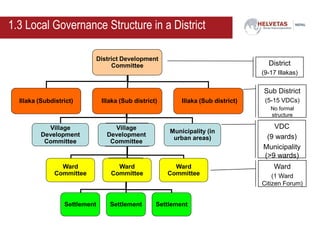
Settlement Settlement Settlement
Ward
Committee
Ward
Committee
Ward
Committee
Village
Development
Committee
Village
Development
Committee
Municipality (in
urban areas)
District Development
Committee
Illaka (Subdistrict) Illaka (Sub district) Illaka (Sub district)
VDC
(9 wards)
Municipality
(>9 wards)
Ward
(1 Ward
Citizen Forum)
Sub District
(5-15 VDCs)
No formal
structure
District
(9-17 Illakas)
1.3 Local Governance Structure in a District
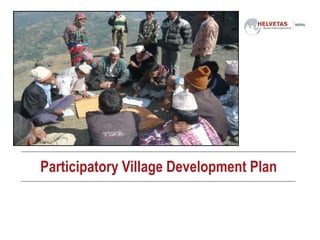
Participatory Village Development Plan
2.1 Problems
1. Inadequate capacities of local bodies,
2. Lack of commitment at central level,
3. Absence of elected representatives at local level.
4. Scattered and uncoordinated development interventions
leading to overlapping and duplication of resources and
activities,
5. High transaction costs for local communities
6. Complete bypassing of local bodies and local citizens
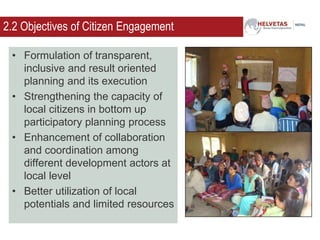
2.2 Objectives of Citizen Engagement
• Formulation of transparent,
inclusive and result oriented
planning and its execution
• Strengthening the capacity of
local citizens in bottom up
participatory planning process
• Enhancement of collaboration
and coordination among
different development actors at
local level
• Better utilization of local
potentials and limited resources
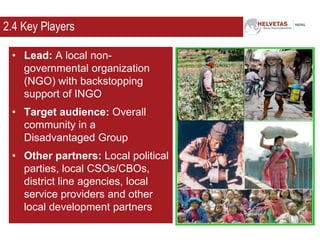
2.4 Key Players
• Lead: A local non-
governmental organization
(NGO) with backstopping
support of INGO
• Target audience: Overall
community in a
Disadvantaged Group
• Other partners: Local political
parties, local CSOs/CBOs,
district line agencies, local
service providers and other
local development partners
2.3 Key Elements of the Proposed Process:
• Focus on non-tech tools: “Digital immigrants”
• Representation and participation by all social groups
• Thick engagement of local citizens
• Open decision making with all local level stakeholders
• Accommodation of diverse and multiple interests
• Use of deliberative communication process
• Opportunity of long route as well as short route to
accountability
• Emphasis on closing the feedback loop
• A plan that focuses on the prioritized sub/sectors
2.4 Proposed Process
1. Consultation with and orientation to all local level stakeholders
2. Baseline information collection, needs/gaps identification & analysis,
and preparation of VDC profile
3. Selection of and training to local facilitators and their mobilization
4. Interaction & orientation & formation of plan formulation committee
5. Conduction of participatory village development planning workshop:
a. Presentation of VDC profile, identification of sub/sectors &
periodic goal setting
b. Formation of sectorial working groups & plan preparation
c. Preparation of three year action plan for the prioritized sub/sectors
6. Preparation of five year action plan for the prioritized sub/sectors
7. Endorsement of the plan by VDC council & publication/ distribution
8. Facilitates VDC to implement the prepared periodic plan and annual
plan
2.5 Proposed Product
A document which
• identifies and illustrates appropriate
policies, strategies and priorities
(Content)
• to attain the goals and objectives of
overall development (Purpose)
• of a particular VDC (Space)
• within a stipulated timeframe (3-5 years)
(Time)
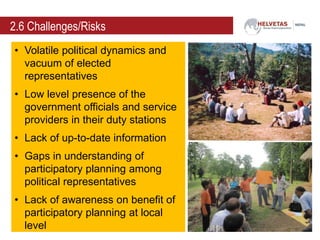
2.6 Challenges/Risks
• Volatile political dynamics and
vacuum of elected
representatives
• Low level presence of the
government officials and service
providers in their duty stations
• Lack of up-to-date information
• Gaps in understanding of
participatory planning among
political representatives
• Lack of awareness on benefit of
participatory planning at local
level
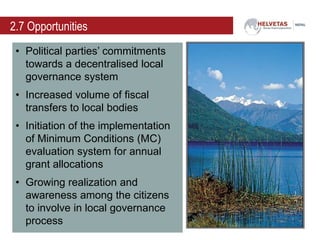
2.7 Opportunities
• Political parties’ commitments
towards a decentralised local
governance system
• Increased volume of fiscal
transfers to local bodies
• Initiation of the implementation
of Minimum Conditions (MC)
evaluation system for annual
grant allocations
• Growing realization and
awareness among the citizens
to involve in local governance
process
2.8 Important Metrics/Indicators & Measurement
Some Important Metrics/Indicators:
• Success rate of VDCs in the Minimum Conditions assessment
• Shifting of the citizen engagement from the tactical one to the
strategic one i.e. as a campaign beyond the local level
• Number of “bites” (results or outcomes) made by “voices” (citizens’
views) along with “teeth” (service providers’ responsiveness)
• Improvement in the citizens’ satisfaction rate
Potential Tools for Measurement:
• Citizen monitoring and social audit
• Public Audit Practices (Public hearing, public review and public audit)
• Citizen satisfaction survey and citizen report card survey
• Community score card survey
• Independent third party monitoring by NGOs
• Periodic assessment and evaluation
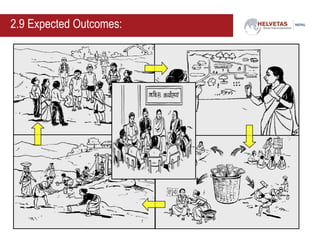
2.9 Expected Outcomes:
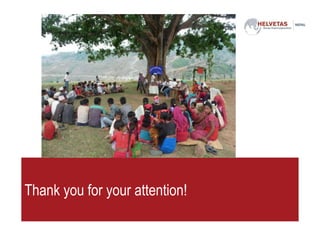
Thank you for your attention!

Participatory village development planning

  • 1.
    Swiss Association forDevelopment and Cooperation Dhobighat, Lalitpur-3 , G.P.O. Box 688,Kathmandu, Nepal Phone +977 1 5524925, 5522013, Fax + 977 1 5531109 po@helvetasnepal.org.np, www.helvetasnepal.org.np Participatory Village Development Plan Formulation Badri Manandhar Thematic Coordinator Governance and Peace 08 April 2015 A Citizen Engagement Project
  • 2.
    1. Brief Backgroundon Local Governance in Nepal (Background and structures) 2. Participatory Village Development Plan (Objectives, Process, Product Challenges, Opportunities, andIndicators) Presentation Layouts
  • 3.
  • 4.
    1.1 Map ofNepal showing Administrative Division
  • 5.
    Local Self GovernanceActs (LSGA) (1999) and Rules (2000): Framework for decentralization in Nepal Recognized Local Bodies as independent & autonomous units and devolved some sectoral authorities (agriculture, education & health) A two-tier system of local governance, with village and municipal bodies as the lower tier and district bodies as the higher tier Village level bodies: Village Development Committees (VDCs) in rural areas and Municipalities (MNs) in urban areas; District level bodies: District Development Committees (DDCs) 3276 VDCs, 191 MNs and 75 DDCs Effective implementation of LSGA hindered mainly due to a decade long armed conflict and absence of elected representatives in local bodies 1.2 Brief Overview of Local Governance
  • 6.
    Settlement Settlement Settlement Ward Committee Ward Committee Ward Committee Village Development Committee Village Development Committee Municipality(in urban areas) District Development Committee Illaka (Subdistrict) Illaka (Sub district) Illaka (Sub district) VDC (9 wards) Municipality (>9 wards) Ward (1 Ward Citizen Forum) Sub District (5-15 VDCs) No formal structure District (9-17 Illakas) 1.3 Local Governance Structure in a District
  • 7.
  • 8.
    2.1 Problems 1. Inadequatecapacities of local bodies, 2. Lack of commitment at central level, 3. Absence of elected representatives at local level. 4. Scattered and uncoordinated development interventions leading to overlapping and duplication of resources and activities, 5. High transaction costs for local communities 6. Complete bypassing of local bodies and local citizens
  • 9.
    2.2 Objectives ofCitizen Engagement • Formulation of transparent, inclusive and result oriented planning and its execution • Strengthening the capacity of local citizens in bottom up participatory planning process • Enhancement of collaboration and coordination among different development actors at local level • Better utilization of local potentials and limited resources
  • 10.
    2.4 Key Players •Lead: A local non- governmental organization (NGO) with backstopping support of INGO • Target audience: Overall community in a Disadvantaged Group • Other partners: Local political parties, local CSOs/CBOs, district line agencies, local service providers and other local development partners
  • 11.
    2.3 Key Elementsof the Proposed Process: • Focus on non-tech tools: “Digital immigrants” • Representation and participation by all social groups • Thick engagement of local citizens • Open decision making with all local level stakeholders • Accommodation of diverse and multiple interests • Use of deliberative communication process • Opportunity of long route as well as short route to accountability • Emphasis on closing the feedback loop • A plan that focuses on the prioritized sub/sectors
  • 12.
    2.4 Proposed Process 1.Consultation with and orientation to all local level stakeholders 2. Baseline information collection, needs/gaps identification & analysis, and preparation of VDC profile 3. Selection of and training to local facilitators and their mobilization 4. Interaction & orientation & formation of plan formulation committee 5. Conduction of participatory village development planning workshop: a. Presentation of VDC profile, identification of sub/sectors & periodic goal setting b. Formation of sectorial working groups & plan preparation c. Preparation of three year action plan for the prioritized sub/sectors 6. Preparation of five year action plan for the prioritized sub/sectors 7. Endorsement of the plan by VDC council & publication/ distribution 8. Facilitates VDC to implement the prepared periodic plan and annual plan
  • 13.
    2.5 Proposed Product Adocument which • identifies and illustrates appropriate policies, strategies and priorities (Content) • to attain the goals and objectives of overall development (Purpose) • of a particular VDC (Space) • within a stipulated timeframe (3-5 years) (Time)
  • 14.
    2.6 Challenges/Risks • Volatilepolitical dynamics and vacuum of elected representatives • Low level presence of the government officials and service providers in their duty stations • Lack of up-to-date information • Gaps in understanding of participatory planning among political representatives • Lack of awareness on benefit of participatory planning at local level
  • 15.
    2.7 Opportunities • Politicalparties’ commitments towards a decentralised local governance system • Increased volume of fiscal transfers to local bodies • Initiation of the implementation of Minimum Conditions (MC) evaluation system for annual grant allocations • Growing realization and awareness among the citizens to involve in local governance process
  • 16.
    2.8 Important Metrics/Indicators& Measurement Some Important Metrics/Indicators: • Success rate of VDCs in the Minimum Conditions assessment • Shifting of the citizen engagement from the tactical one to the strategic one i.e. as a campaign beyond the local level • Number of “bites” (results or outcomes) made by “voices” (citizens’ views) along with “teeth” (service providers’ responsiveness) • Improvement in the citizens’ satisfaction rate Potential Tools for Measurement: • Citizen monitoring and social audit • Public Audit Practices (Public hearing, public review and public audit) • Citizen satisfaction survey and citizen report card survey • Community score card survey • Independent third party monitoring by NGOs • Periodic assessment and evaluation
  • 17.
  • 18.
    Thank you foryour attention!