Techniques for “Medium-sized n” Qualitative Field Research 
Patti Petesch │ Consultant │ patti@pattipetesch.com 
IFPRI July 25, 2013
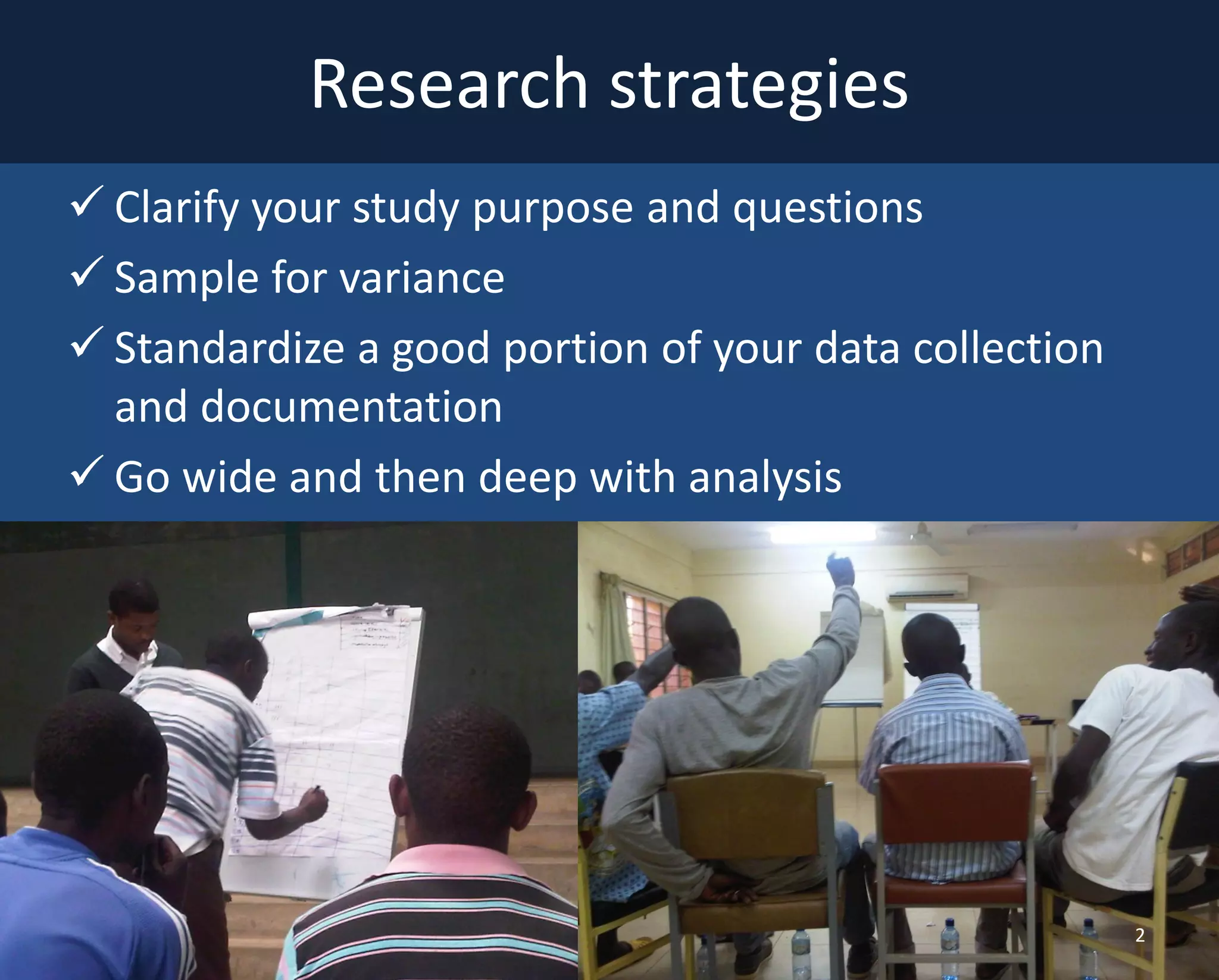
Research strategies 
Clarify your study purpose and questions 
Sample for variance 
Standardize a good portion of your data collection and documentation 
Go wide and then deep with analysis 
2
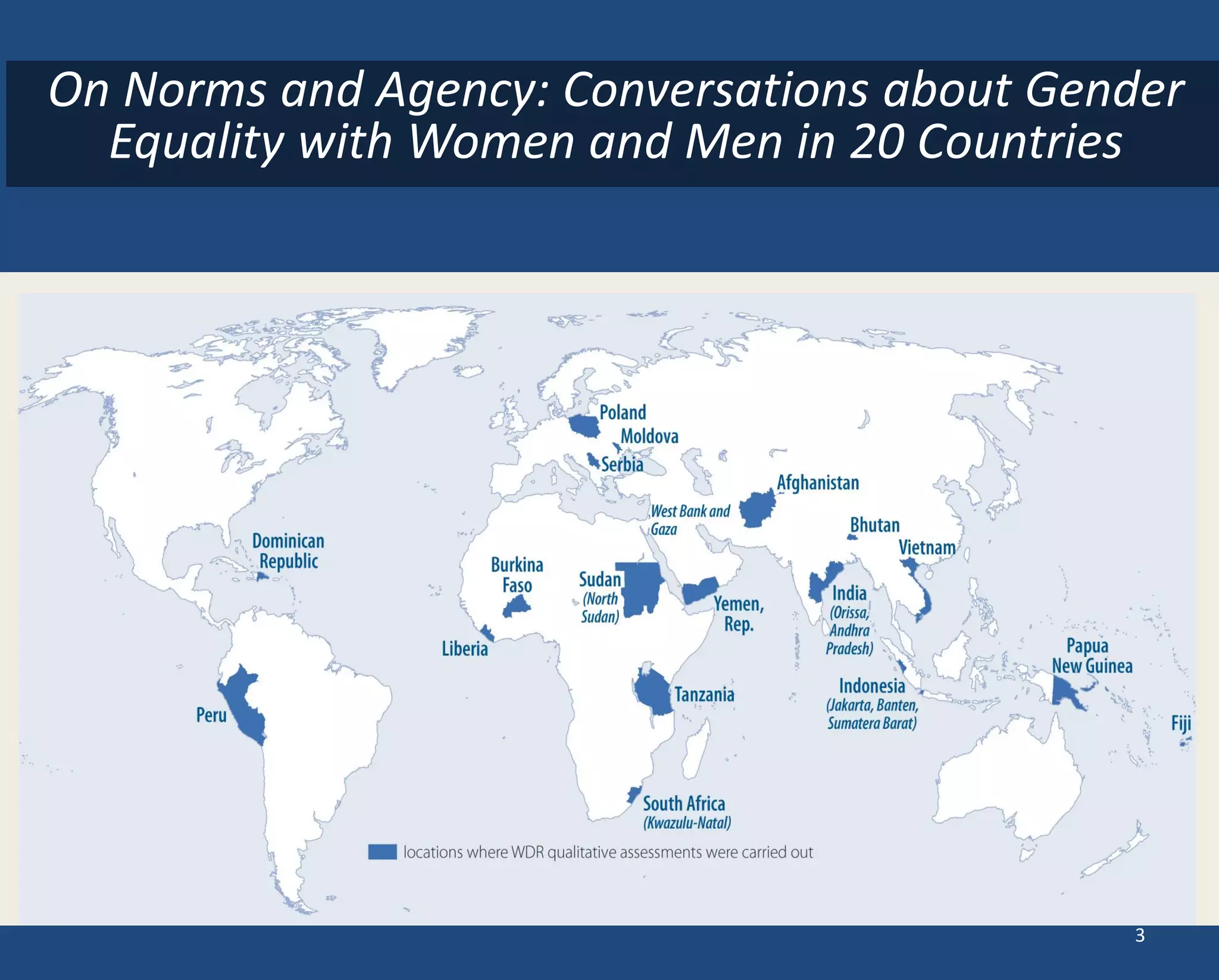
On Norms and Agency: Conversations about Gender Equality with Women and Men in 20 Countries 
3
Assessing Changes in Agency 
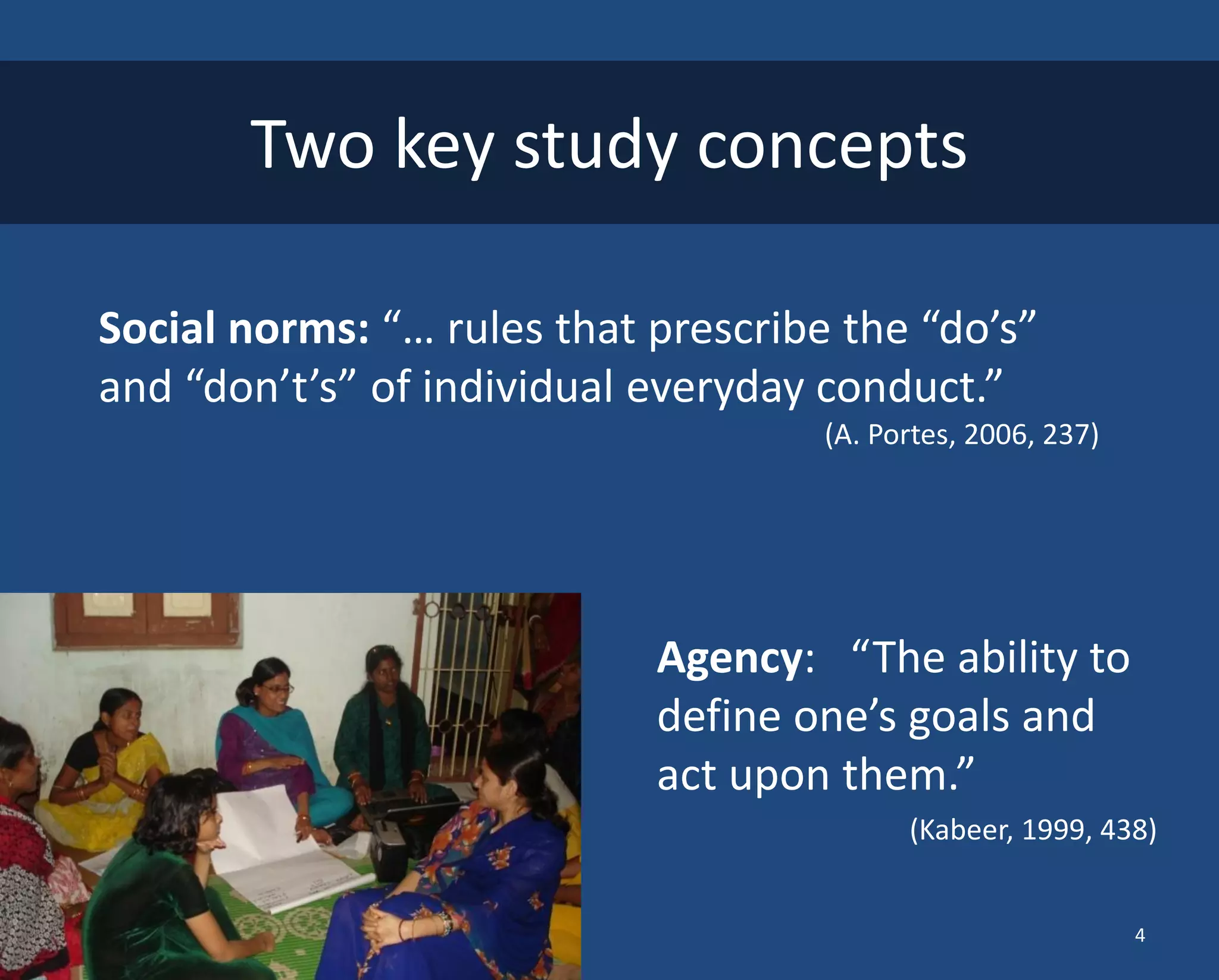
Agency: “The ability to define one’s goals and act upon them.” 
(Kabeer, 1999, 438) 
Two key study concepts 
Social norms: “… rules that prescribe the “do’s” and “don’t’s” of individual everyday conduct.” 
(A. Portes, 2006, 237) 
4
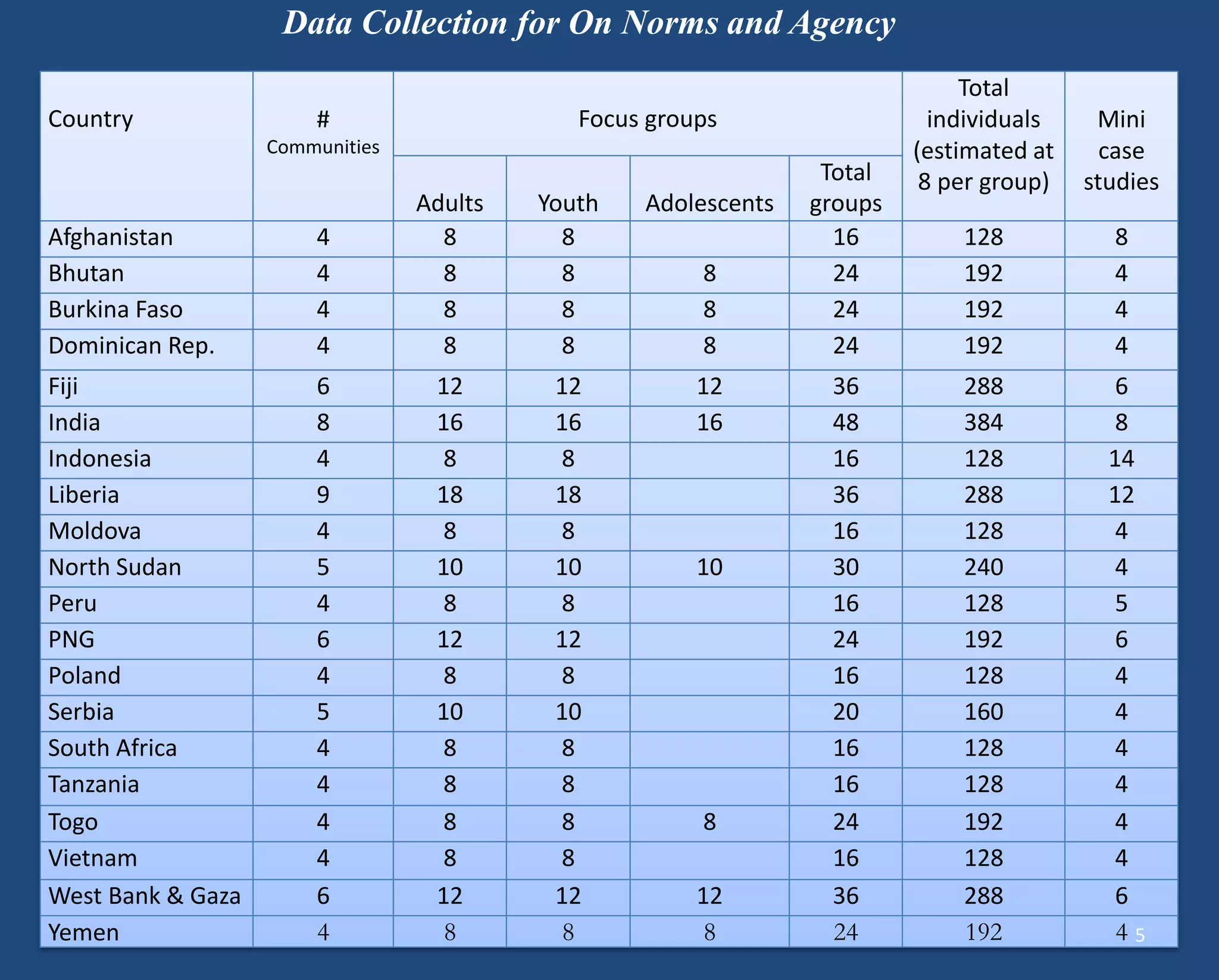
Data Collection for On Norms and Agency 
Country 
# 
Communities 
Focus groups 
Total individuals (estimated at 8 per group) 
Mini case studies 
Adults 
Youth 
Adolescents 
Total groups 
Afghanistan 
4 
8 
8 
16 
128 
8 
Bhutan 
4 
8 
8 
8 
24 
192 
4 
Burkina Faso 
4 
8 
8 
8 
24 
192 
4 
Dominican Rep. 
4 
8 
8 
8 
24 
192 
4 
Fiji 
6 
12 
12 
12 
36 
288 
6 
India 
8 
16 
16 
16 
48 
384 
8 
Indonesia 
4 
8 
8 
16 
128 
14 
Liberia 
9 
18 
18 
36 
288 
12 
Moldova 
4 
8 
8 
16 
128 
4 
North Sudan 
5 
10 
10 
10 
30 
240 
4 
Peru 
4 
8 
8 
16 
128 
5 
PNG 
6 
12 
12 
24 
192 
6 
Poland 
4 
8 
8 
16 
128 
4 
Serbia 
5 
10 
10 
20 
160 
4 
South Africa 
4 
8 
8 
16 
128 
4 
Tanzania 
4 
8 
8 
16 
128 
4 
Togo 
4 
8 
8 
8 
24 
192 
4 
Vietnam 
4 
8 
8 
16 
128 
4 
West Bank & Gaza 
6 
12 
12 
12 
36 
288 
6 
Yemen 
4 
8 
8 
8 
24 
192 
4 
5
A Good Wife and a Good Husband (Woman’s focus group, Hanoi) 
•FACILITATOR: I’d now like to discuss the topic of a good wife and a good husband. For a woman to be seen as a good wife in this community what is she like? What does she do? 
–A good wife is the one who takes good care for her house, her family, children, and meals in the family. 
–To be responsible for the family expenses – to spend money wisely and do not waste. 
–To contribute to family economy financially or by labor. 
–Keep good relationship with husband’s family 
–To serve parents in-law carefully. 
–A good wife should have a job that brings income to the family. 
–A good wife is not necessary to have a job, but she has to take good care of family activities in thoughtful and responsible way. 
•“I think a good wife is a person who should also care for family, relatives, to keep all relationships in harmony – in her family, and outside her family. She should show she is a good person, a role model to her family and to her work. She can contribute to the family economy but it depends on circumstances. Some good wives could not earn good money but they can keep the family happy and stable. She can contribute to the family financially if she can.” (Lan, 53 years old) 
6
A good wife 
A good husband 
Now 
Previous generation 
Now 
Previous generation 
-Responsible for family activities 
-Care for kinship /relatives 
-Contribute to the family income (not necessary) 
-Take good responsibilities of housework 
-To be a good backup/supporter for husband‘s career and study. 
-To be responsible for family, kinship and society. 
-Contribute to family income. 
-get merit in service; 
-Get position in work 
-Success in career. 
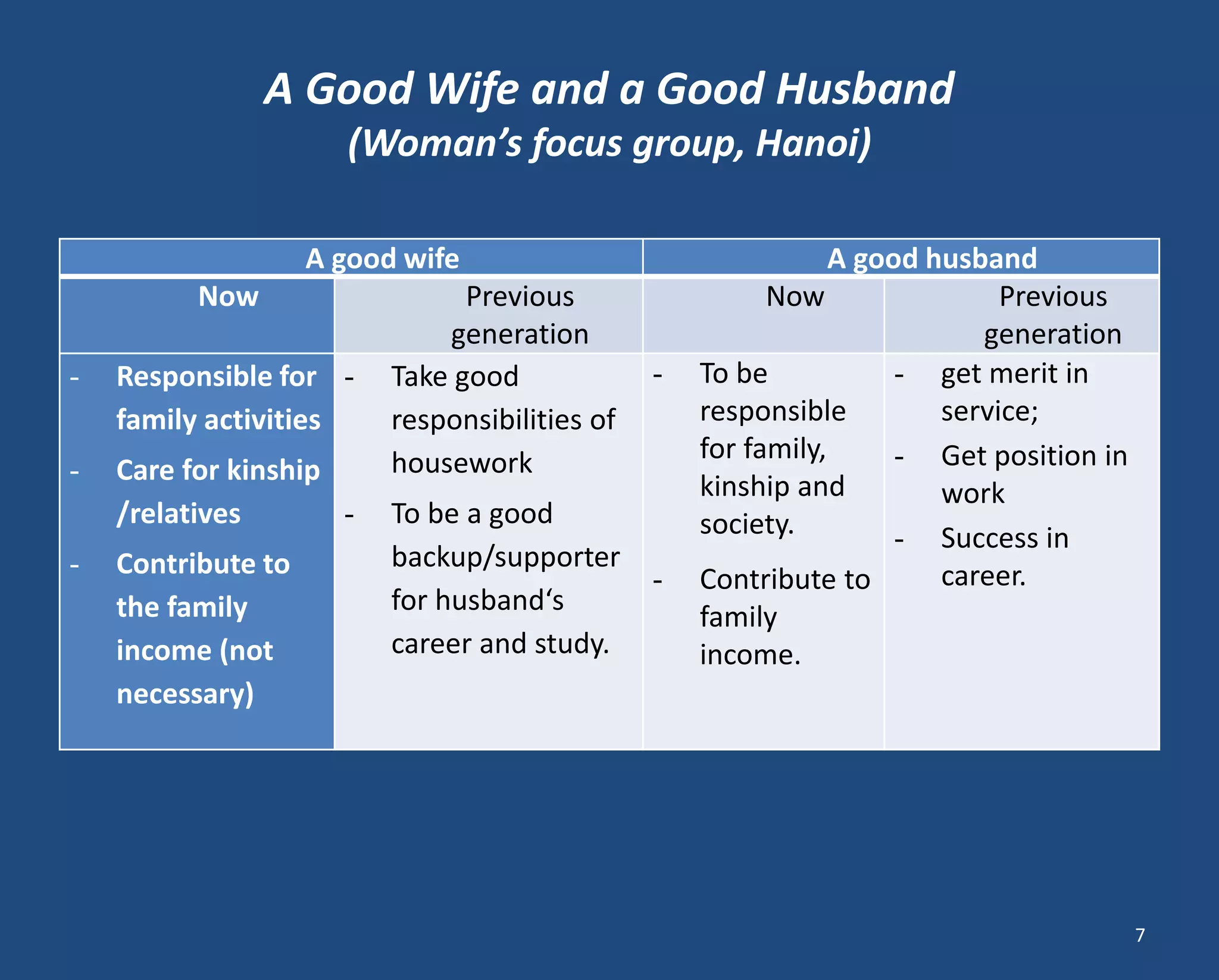
A Good Wife and a Good Husband 
(Woman’s focus group, Hanoi) 
7
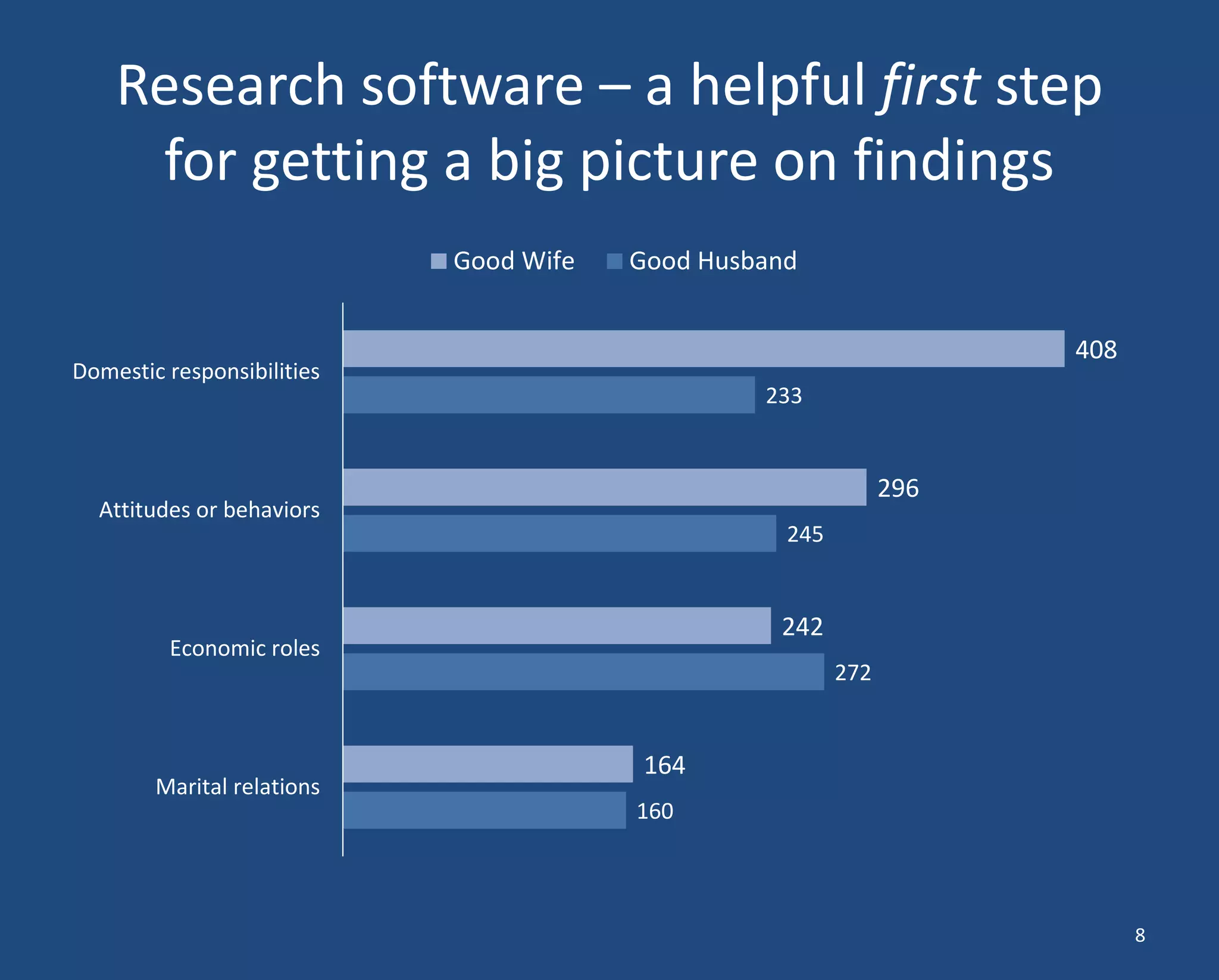
Research software – a helpful first step for getting a big picture on findings 
160 
272 
245 
233 
164 
242 
296 
408 
Marital relations 
Economic roles 
Attitudes or behaviors 
Domestic responsibilities 
Good Wife 
Good Husband 
8
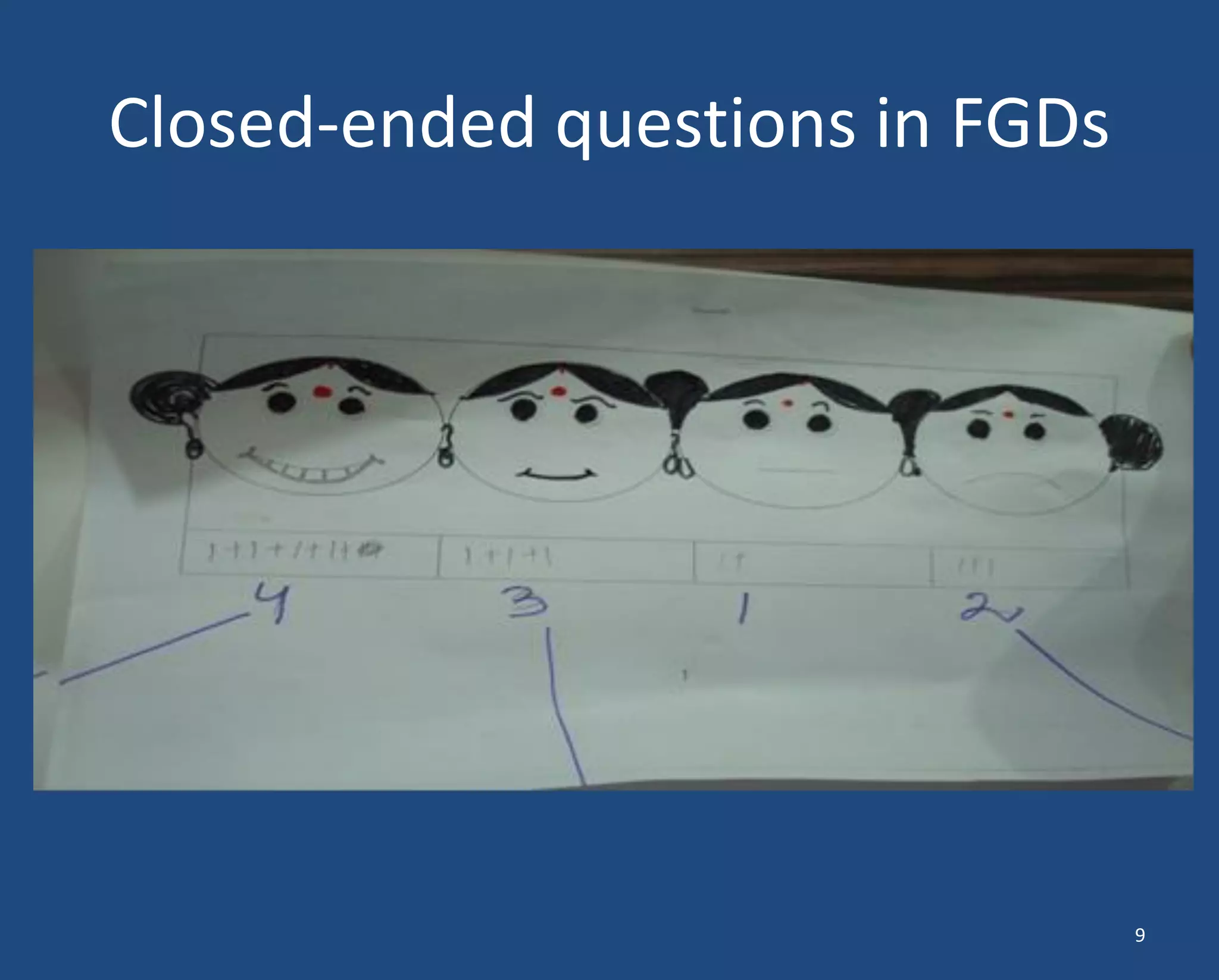
Closed-ended questions in FGDs 
9
Almost never happens here [1] 
Occasionally happens here [2] 
Regularly happens here [3] 
Frequently happens here [4] 
Now 
Ten years ago 
•FGDA6. Taking into account just the experiences of this community, how would you rate the presence of violence against women in their households on a scale of 1 to 4? almost never happens here..................... 1 occasionally happens here.…………………….2 regularly happens here……………….….………3 frequently happens here…..…………..……….4 
10
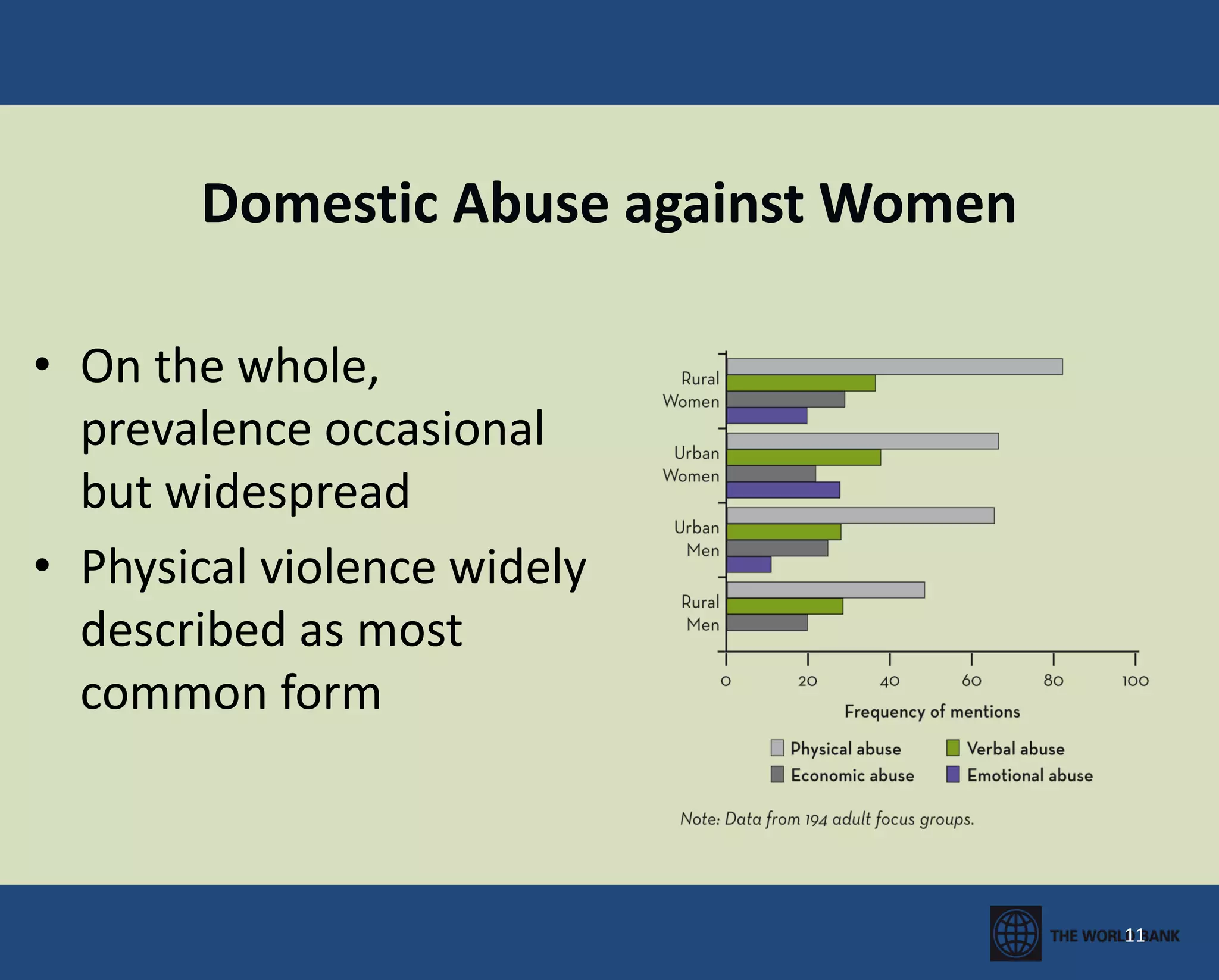
Domestic Abuse against Women 
•On the whole, prevalence occasional but widespread 
•Physical violence widely described as most common form 
11
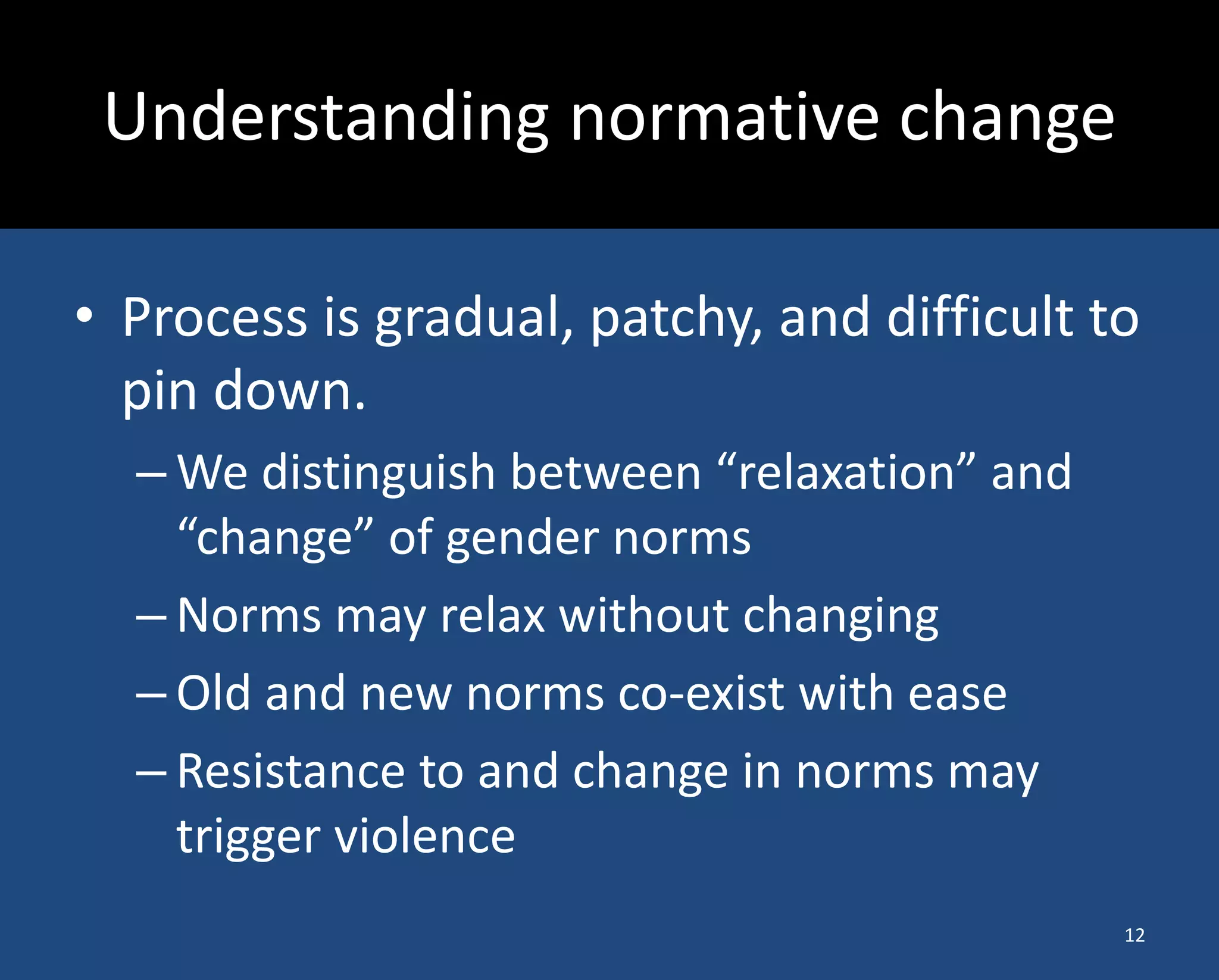
•Process is gradual, patchy, and difficult to pin down. 
–We distinguish between “relaxation” and “change” of gender norms 
–Norms may relax without changing 
–Old and new norms co-exist with ease 
–Resistance to and change in norms may trigger violence 
Understanding normative change 
12
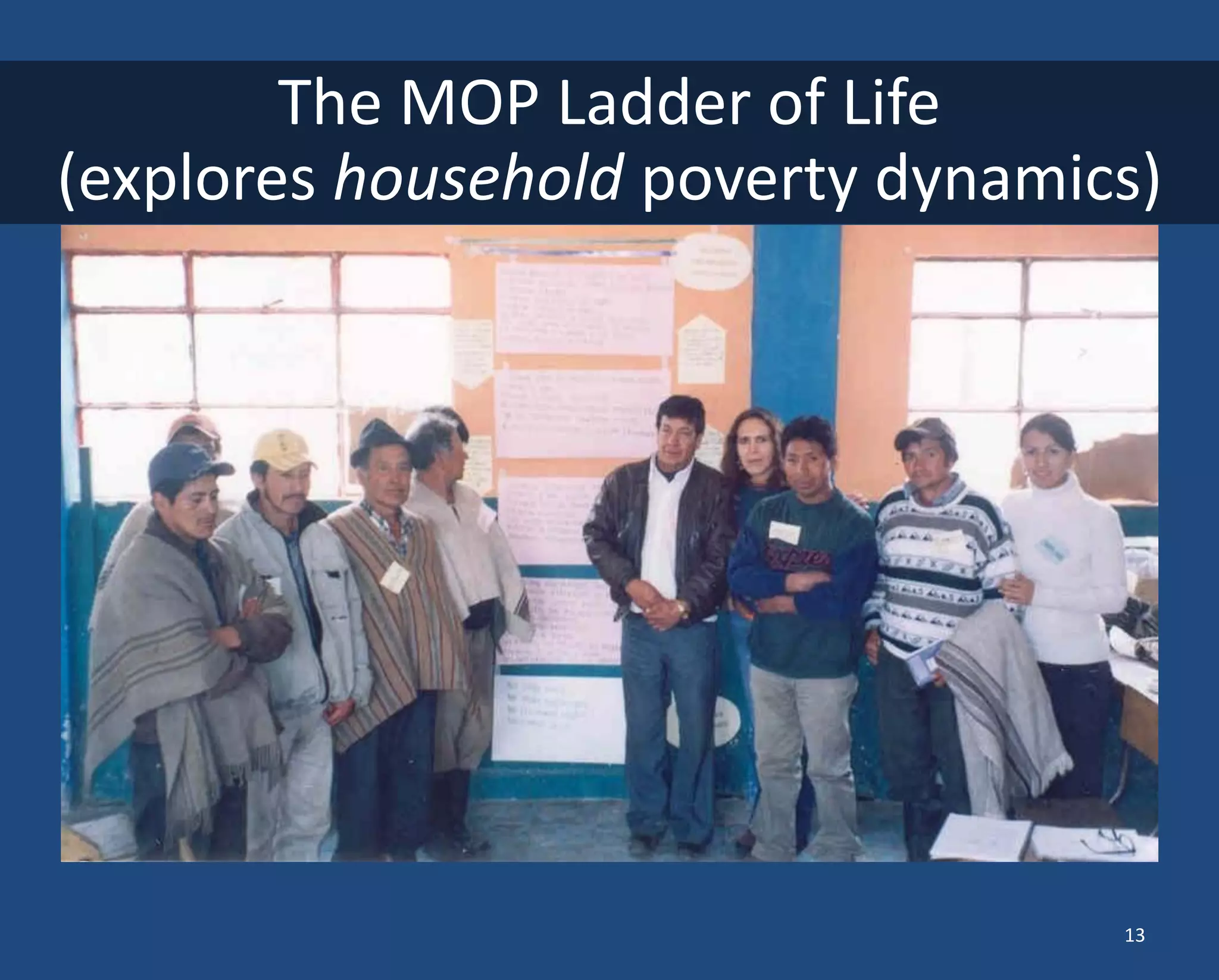
MOP Household Ladders 
The MOP Ladder of Life 
(explores household poverty dynamics) 
13
1 
BEST 
CONDITION 
SS 
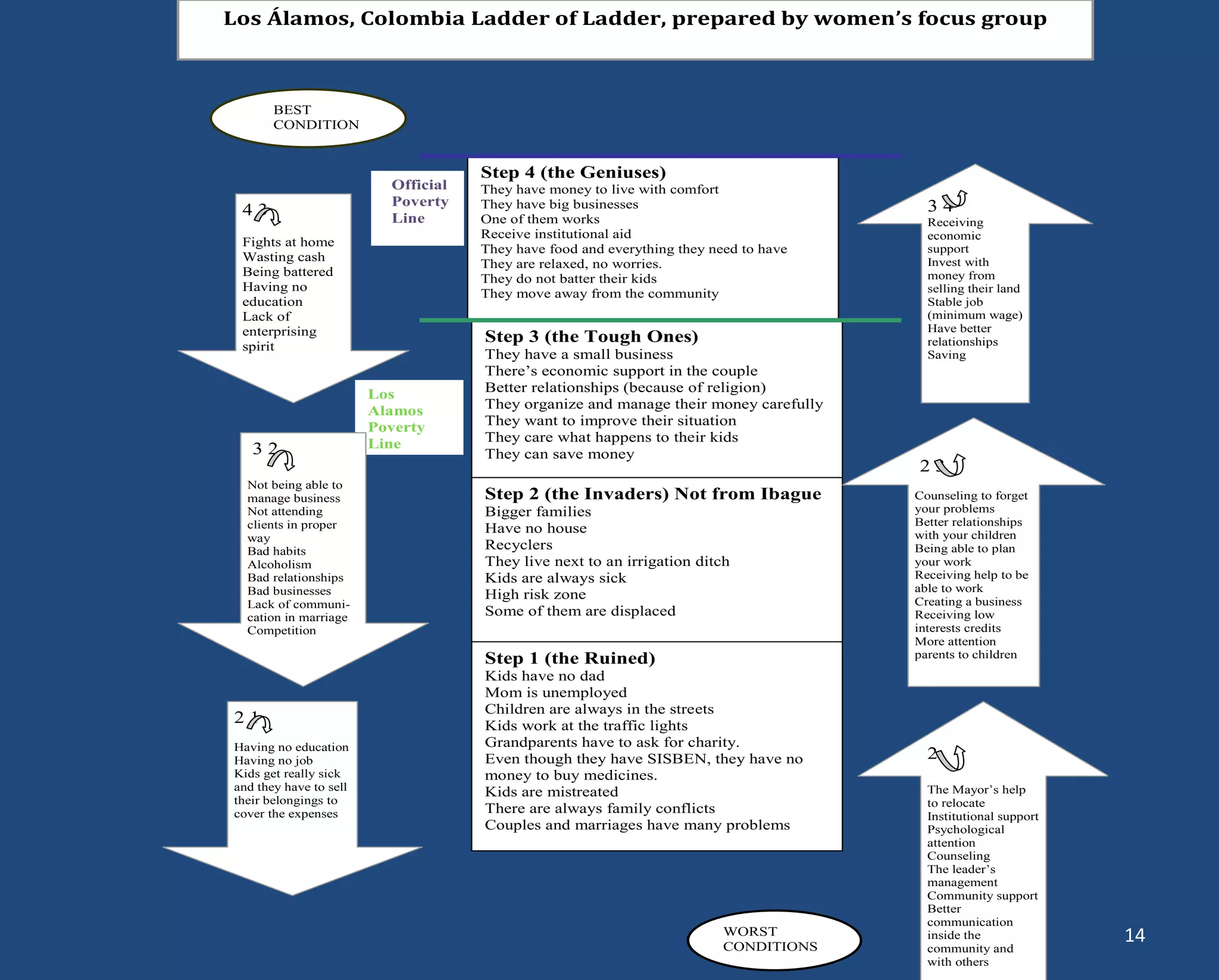
Los Álamos, Colombia Ladder of Ladder, prepared by women’s focus group 
Step 2 (the Invaders) Not from Ibague 
Bigger families 
Have no house 
Recyclers 
They live next to an irrigation ditch 
Kids are always sick 
High risk zone 
Some of them are displaced 
Step 3 (the Tough Ones) 
They have a small business 
There’s economic support in the couple 
Better relationships (because of religion) 
They organize and manage their money carefully 
They want to improve their situation 
They care what happens to their kids 
They can save money 
WORST 
CONDITIONS 
Step 1 (the Ruined) 
Kids have no dad 
Mom is unemployed 
Children are always in the streets 
Kids work at the traffic lights 
Grandparents have to ask for charity. 
Even though they have SISBEN, they have no 
money to buy medicines. 
Kids are mistreated 
There are always family conflicts 
Couples and marriages have many problems 
Los 
Alamos 
Poverty 
Line 
Official 
Poverty 
Line 
4 3 
Fights at home 
Wasting cash 
Being battered 
Having no 
education 
Lack of 
enterprising 
spirit 
3 2 
Not being able to 
manage business 
Not attending 
clients in proper 
way 
Bad habits 
Alcoholism 
Bad relationships 
Bad businesses 
Lack of communi-cation 
in marriage 
Competition 
3 4 
Receiving 
economic 
support 
Invest with 
money from 
selling their land 
Stable job 
(minimum wage) 
Have better 
relationships 
Saving 
2 3 
Counseling to forget 
your problems 
Better relationships 
with your children 
Being able to plan 
your work 
Receiving help to be 
able to work 
Creating a business 
Receiving low 
interests credits 
More attention 
parents to children 
2 
The Mayor’s help 
to relocate 
Institutional support 
Psychological 
attention 
Counseling 
The leader’s 
management 
Community support 
Better 
communication 
inside the 
community and 
with others 
2 1 
Having no education 
Having no job 
Kids get really sick 
and they have to sell 
their belongings to 
cover the expenses 
Step 4 (the Geniuses) 
They have money to live with comfort 
They have big businesses 
One of them works 
Receive institutional aid 
They have food and everything they need to have 
They are relaxed, no worries. 
They do not batter their kids 
They move away from the community 
14
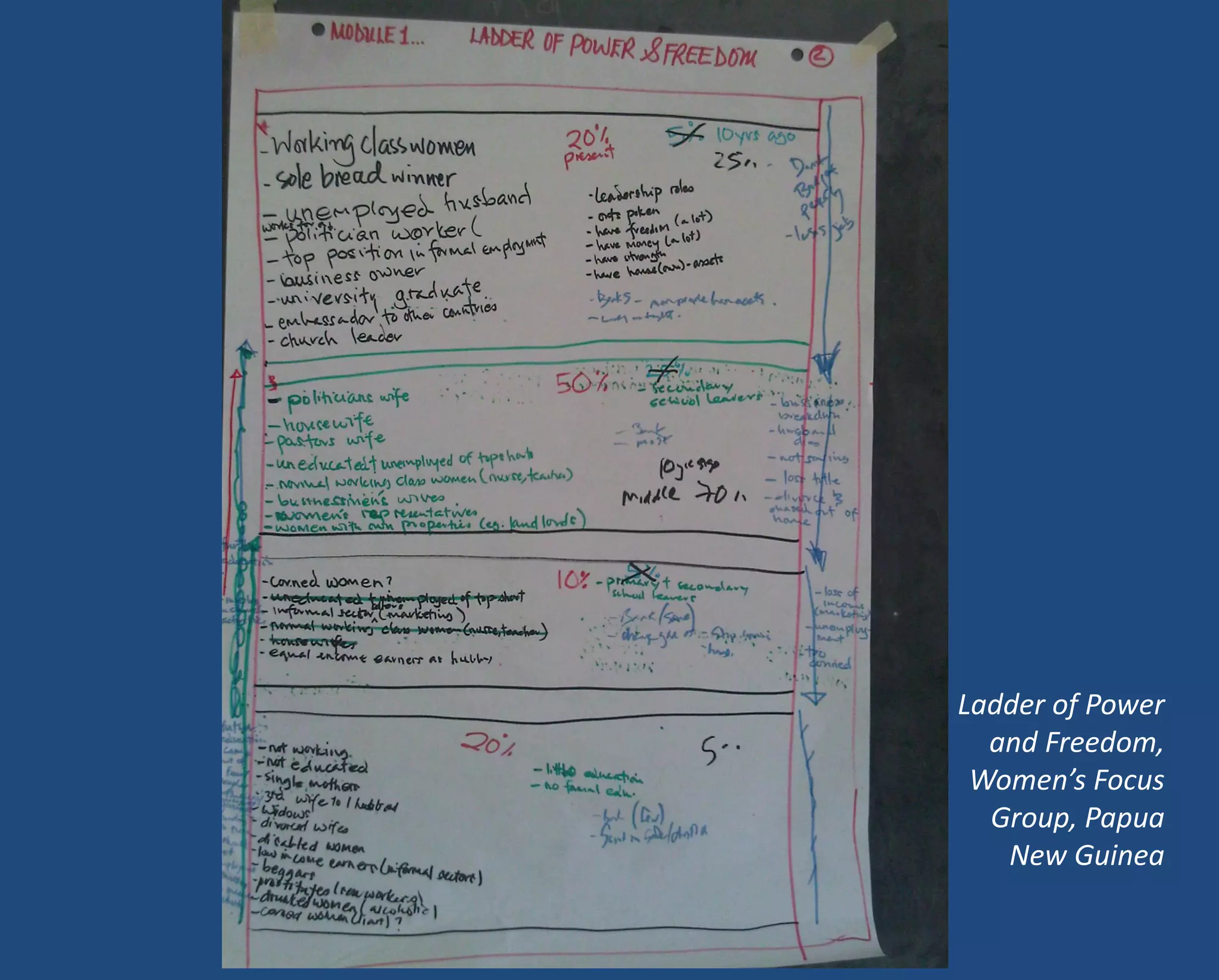
Ladder of Power and Freedom, Women’s Focus Group, Papua New Guinea
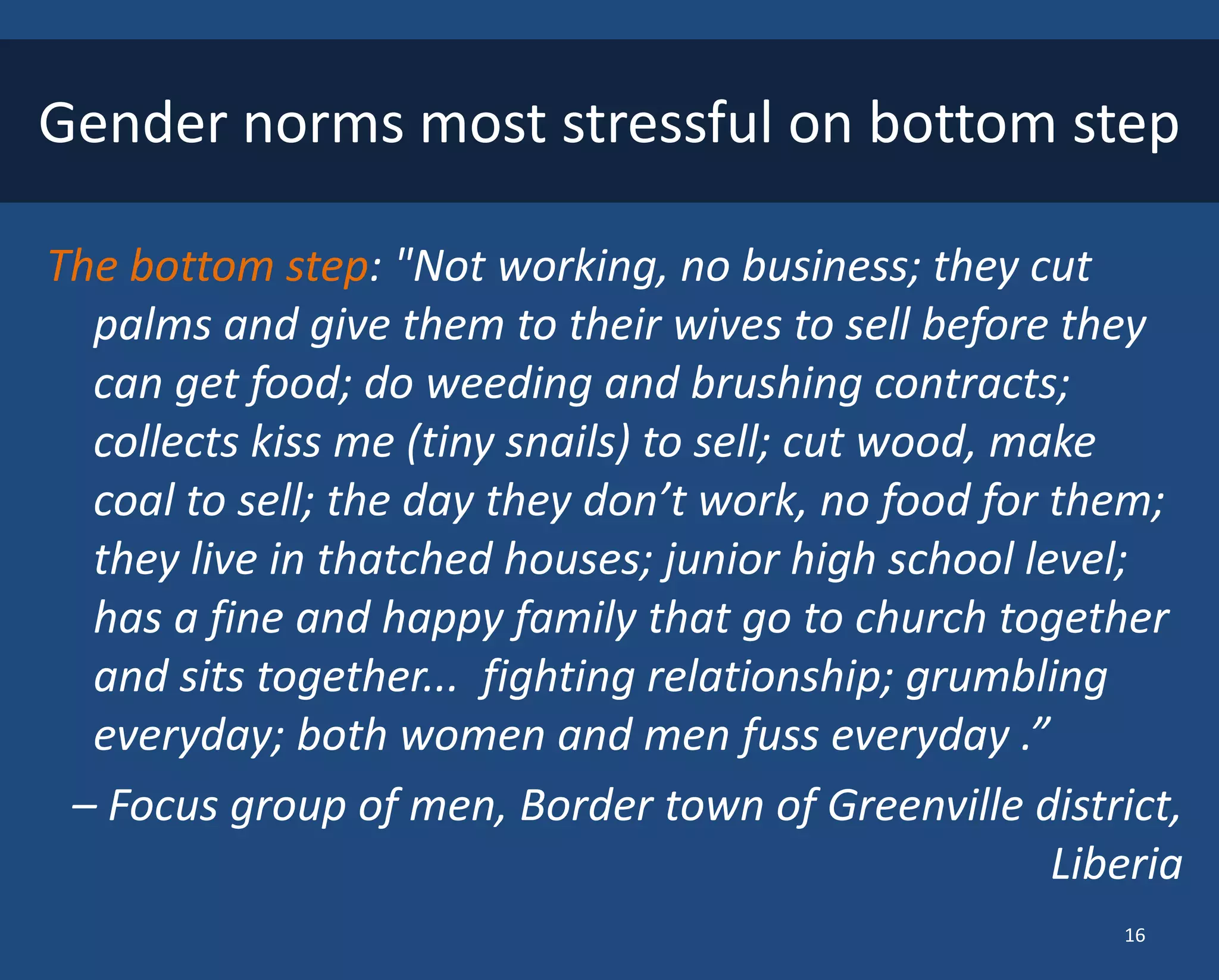
Gender norms most stressful on bottom step 
The bottom step: "Not working, no business; they cut palms and give them to their wives to sell before they can get food; do weeding and brushing contracts; collects kiss me (tiny snails) to sell; cut wood, make coal to sell; the day they don’t work, no food for them; they live in thatched houses; junior high school level; has a fine and happy family that go to church together and sits together... fighting relationship; grumbling everyday; both women and men fuss everyday .” 
– Focus group of men, Border town of Greenville district, Liberia 
16
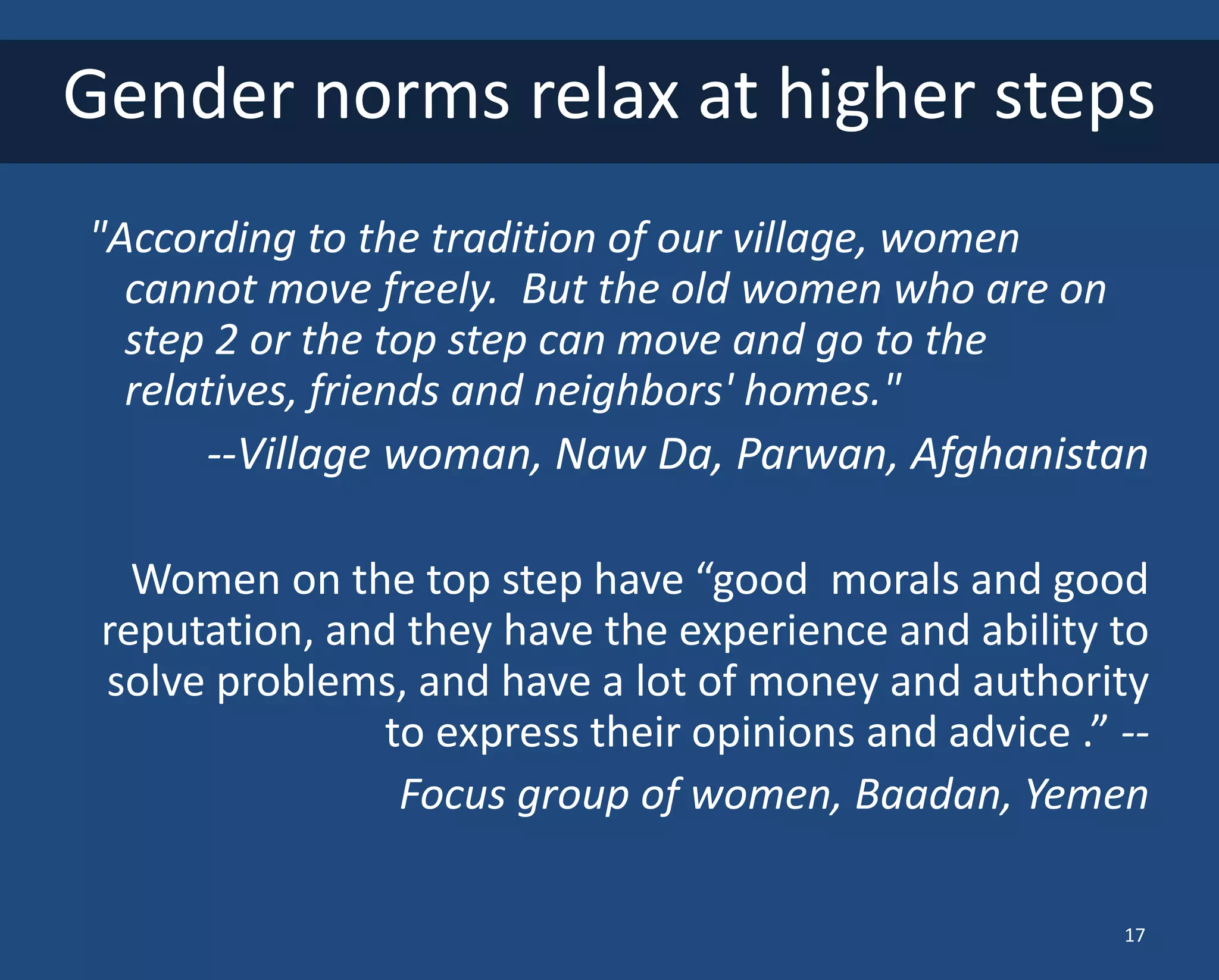
What is Power? Freedom? 
"According to the tradition of our village, women cannot move freely. But the old women who are on step 2 or the top step can move and go to the relatives, friends and neighbors' homes." 
--Village woman, Naw Da, Parwan, Afghanistan 
Women on the top step have “good morals and good reputation, and they have the experience and ability to solve problems, and have a lot of money and authority to express their opinions and advice .” -- 
Focus group of women, Baadan, Yemen 
Gender norms relax at higher steps 
17
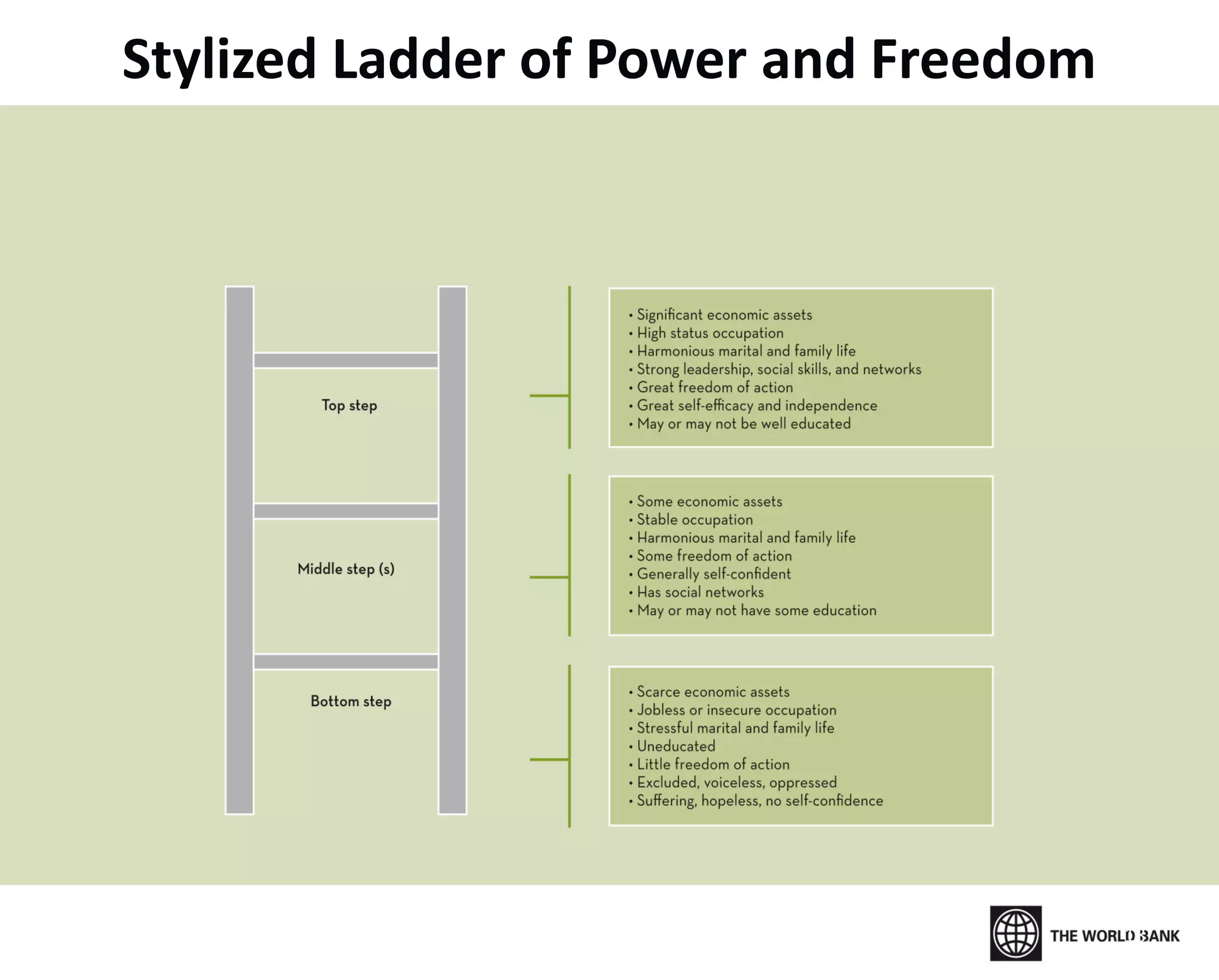
Stylized Ladder of Power and Freedom 
18
0.00 
0.05 
0.10 
0.15 
0.20 
0.25 
0.30 
0.35 
0.40 
0.45 
Occupational 
and economic 
Behavioral and 
psychological 
Education and 
training 
Marital and 
familial 
Social 
networks 
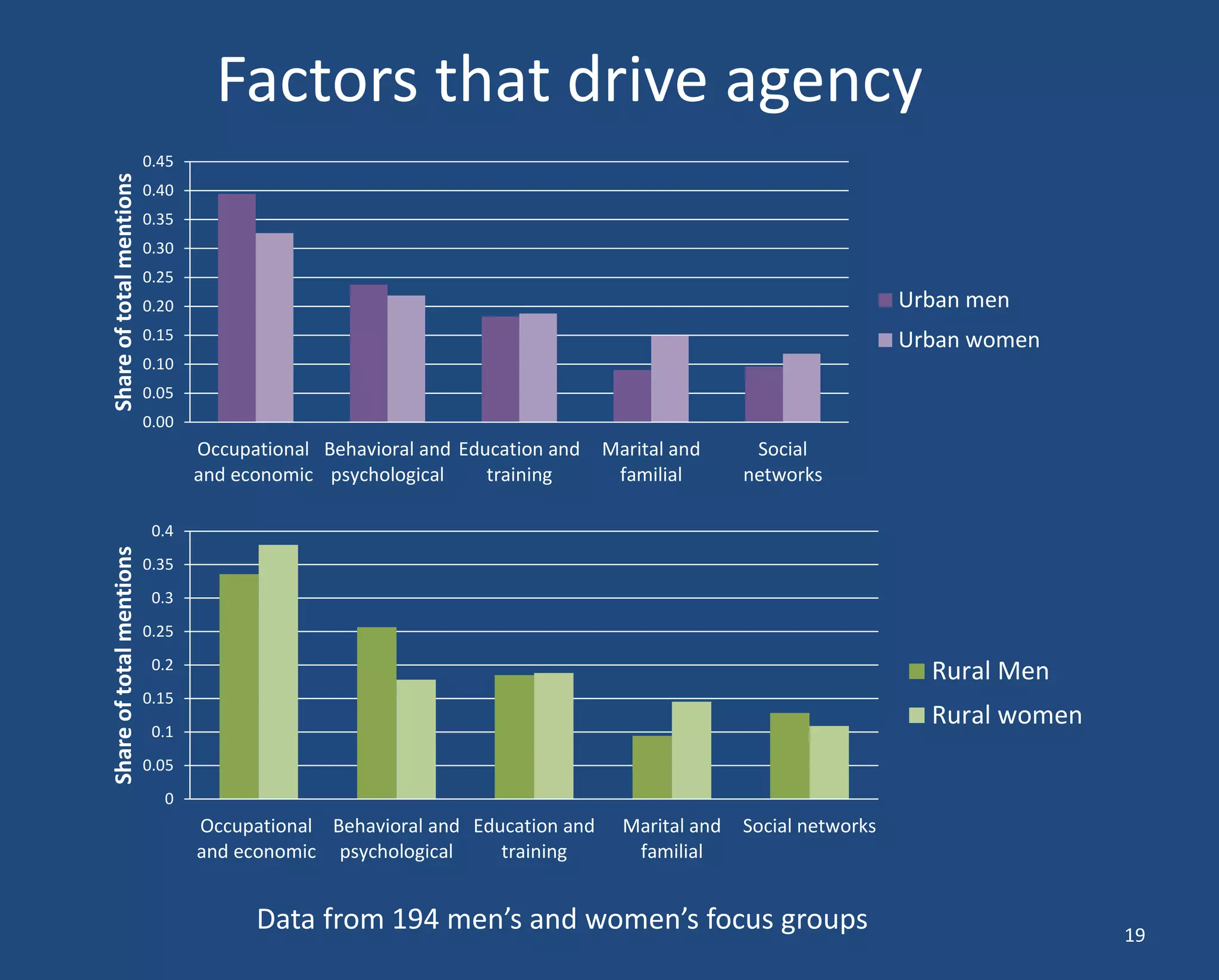
Share of total mentions 
Urban men 
Urban women 
0 
0.05 
0.1 
0.15 
0.2 
0.25 
0.3 
0.35 
0.4 
Occupational 
and economic 
Behavioral and 
psychological 
Education and 
training 
Marital and 
familial 
Social networks 
Share of total mentions 
Rural Men 
Rural women 
Factors that drive agency 
Data from 194 men’s and women’s focus groups 
19
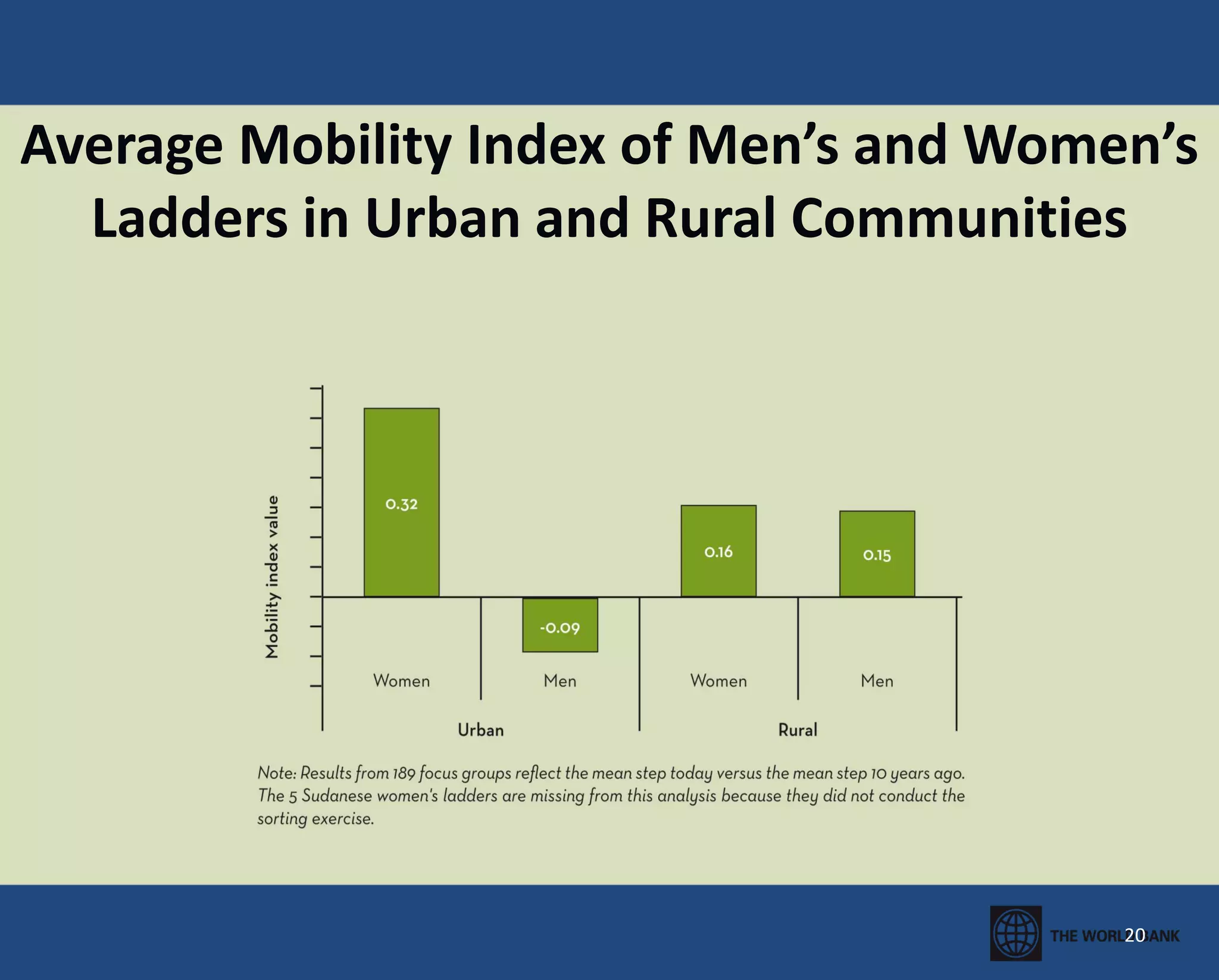
Average Mobility Index of Men’s and Women’s Ladders in Urban and Rural Communities 
20
Country 
Community 
Country Code 
Community Code 
Sex of the Group (women =1, men=0) 
Weighed Mean 10 years ago 
Weighed Mean now 
Difference in means 
IND 
Umapada 
6 
3 
1 
2.26 
2.75 
0.49 
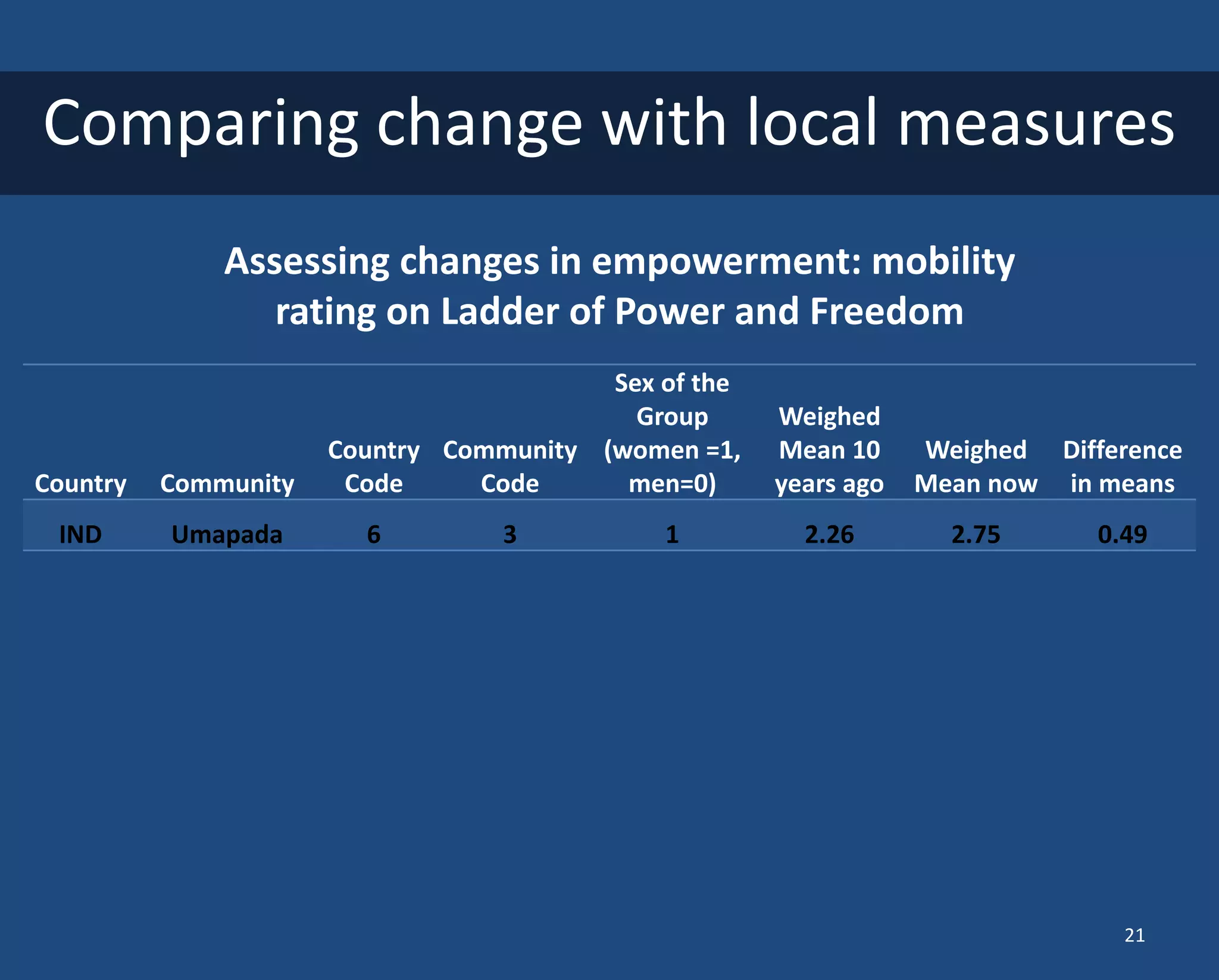
Comparing change with local measures 
Assessing changes in empowerment: mobility rating on Ladder of Power and Freedom 
21
0.33 
-0.11 
0.24 
0.07 
Women 
Men 
Women 
Men 
Conflict communities 
(n=24) 
Nonconflict 
communities (n=73) 
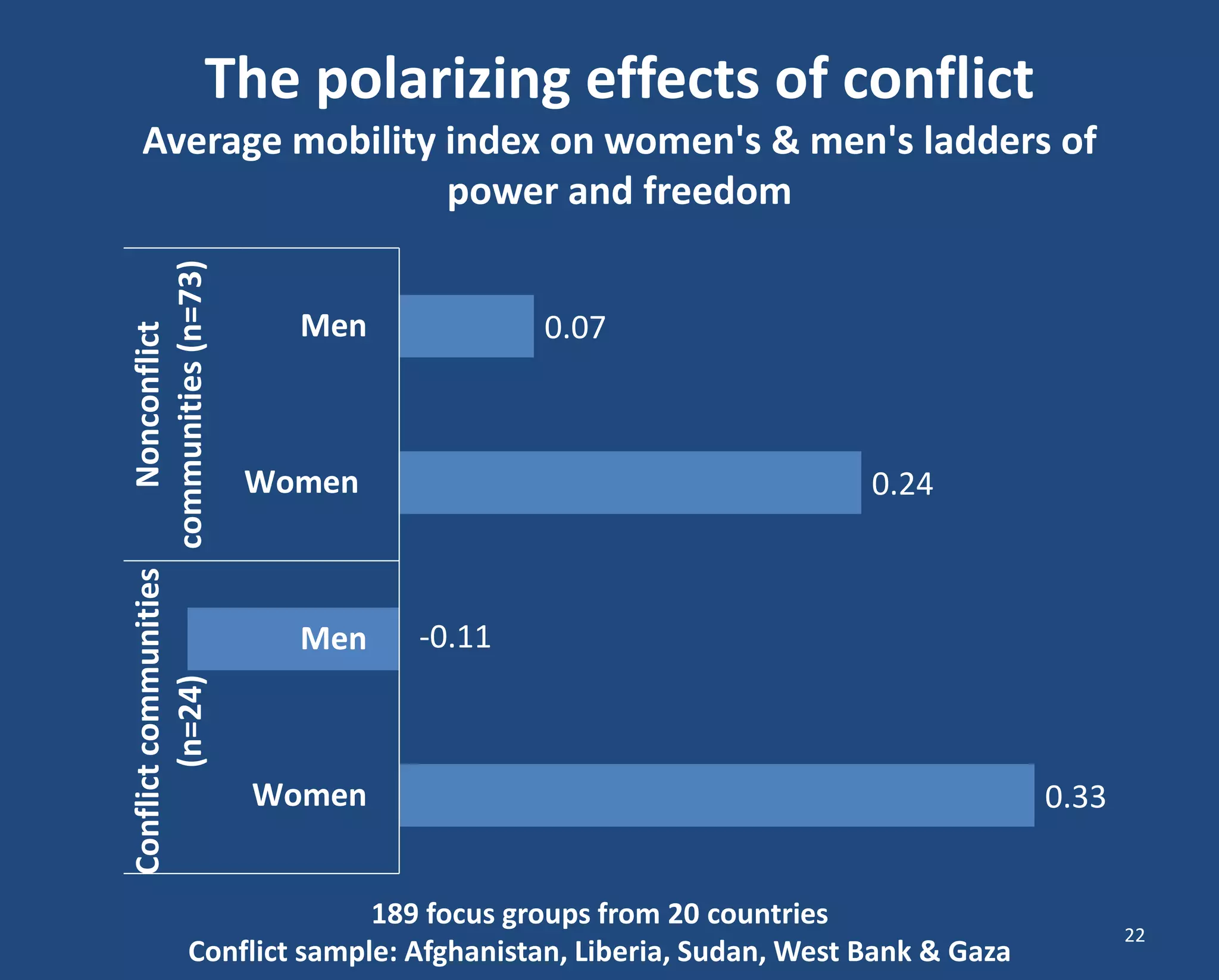
The polarizing effects of conflict 
Average mobility index on women's & men's ladders of power and freedom 
189 focus groups from 20 countries 
Conflict sample: Afghanistan, Liberia, Sudan, West Bank & Gaza 
22
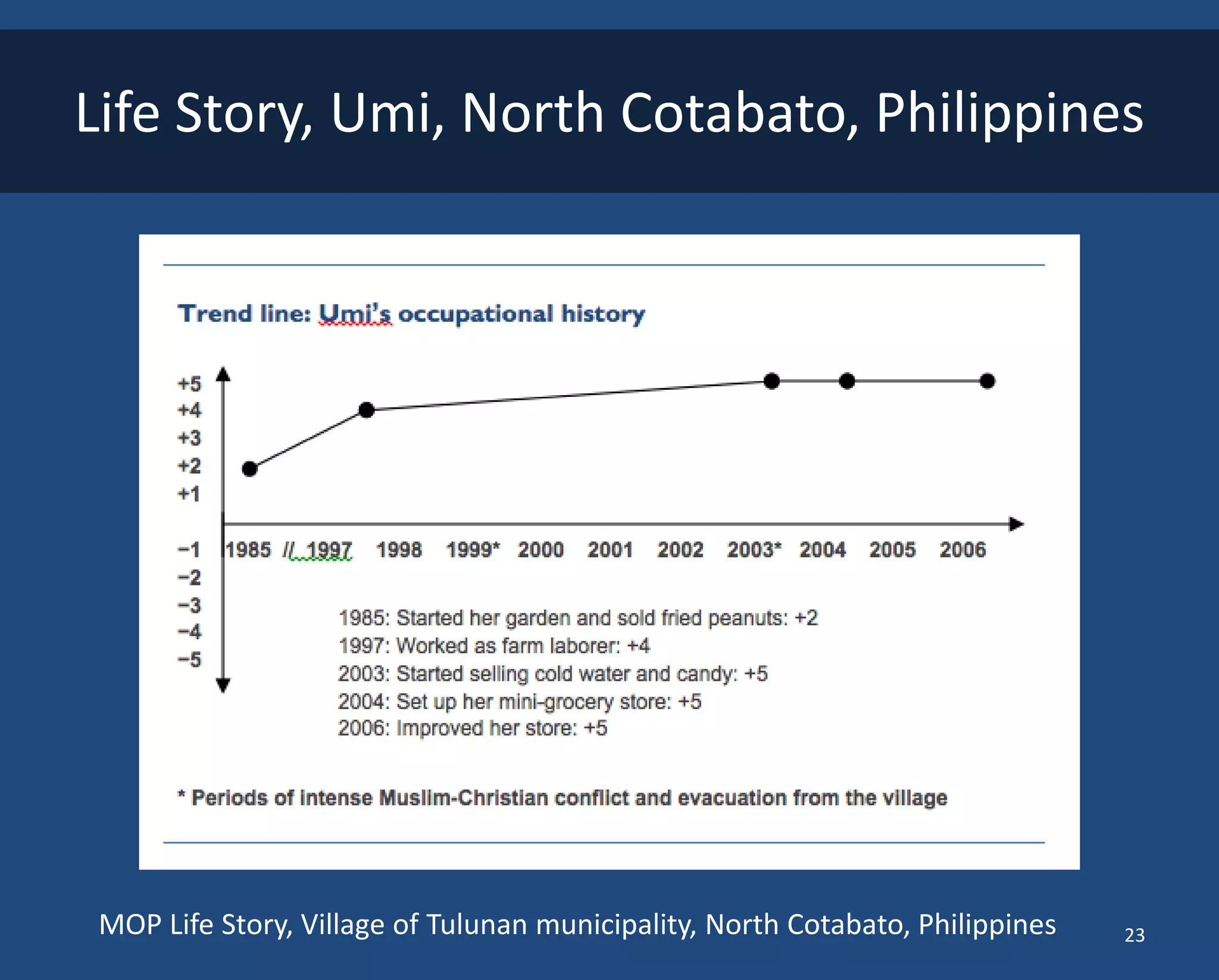
Life Story, Umi, North Cotabato, Philippines 
MOP Life Story, Village of Tulunan municipality, North Cotabato, Philippines 
23
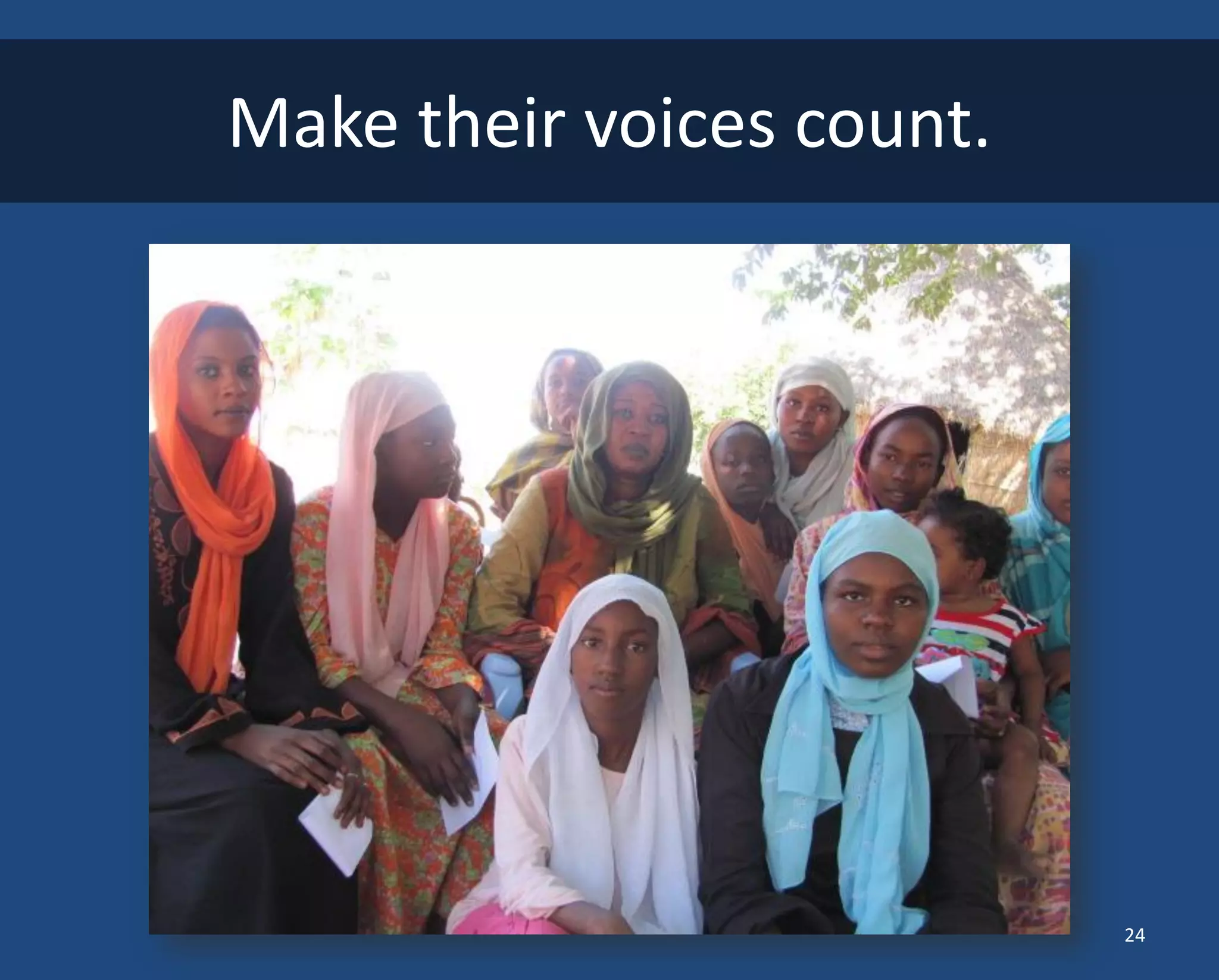
Make their voices count. 
24

Qualitative Field Research for Medium-Sized "N" - IFPRI Gender Methods Seminar

  • 1.
    Techniques for “Medium-sizedn” Qualitative Field Research Patti Petesch │ Consultant │ patti@pattipetesch.com IFPRI July 25, 2013
  • 2.
    Research strategies Clarifyyour study purpose and questions Sample for variance Standardize a good portion of your data collection and documentation Go wide and then deep with analysis 2
  • 3.
    On Norms andAgency: Conversations about Gender Equality with Women and Men in 20 Countries 3
  • 4.
    Assessing Changes inAgency Agency: “The ability to define one’s goals and act upon them.” (Kabeer, 1999, 438) Two key study concepts Social norms: “… rules that prescribe the “do’s” and “don’t’s” of individual everyday conduct.” (A. Portes, 2006, 237) 4
  • 5.
    Data Collection forOn Norms and Agency Country # Communities Focus groups Total individuals (estimated at 8 per group) Mini case studies Adults Youth Adolescents Total groups Afghanistan 4 8 8 16 128 8 Bhutan 4 8 8 8 24 192 4 Burkina Faso 4 8 8 8 24 192 4 Dominican Rep. 4 8 8 8 24 192 4 Fiji 6 12 12 12 36 288 6 India 8 16 16 16 48 384 8 Indonesia 4 8 8 16 128 14 Liberia 9 18 18 36 288 12 Moldova 4 8 8 16 128 4 North Sudan 5 10 10 10 30 240 4 Peru 4 8 8 16 128 5 PNG 6 12 12 24 192 6 Poland 4 8 8 16 128 4 Serbia 5 10 10 20 160 4 South Africa 4 8 8 16 128 4 Tanzania 4 8 8 16 128 4 Togo 4 8 8 8 24 192 4 Vietnam 4 8 8 16 128 4 West Bank & Gaza 6 12 12 12 36 288 6 Yemen 4 8 8 8 24 192 4 5
  • 6.
    A Good Wifeand a Good Husband (Woman’s focus group, Hanoi) •FACILITATOR: I’d now like to discuss the topic of a good wife and a good husband. For a woman to be seen as a good wife in this community what is she like? What does she do? –A good wife is the one who takes good care for her house, her family, children, and meals in the family. –To be responsible for the family expenses – to spend money wisely and do not waste. –To contribute to family economy financially or by labor. –Keep good relationship with husband’s family –To serve parents in-law carefully. –A good wife should have a job that brings income to the family. –A good wife is not necessary to have a job, but she has to take good care of family activities in thoughtful and responsible way. •“I think a good wife is a person who should also care for family, relatives, to keep all relationships in harmony – in her family, and outside her family. She should show she is a good person, a role model to her family and to her work. She can contribute to the family economy but it depends on circumstances. Some good wives could not earn good money but they can keep the family happy and stable. She can contribute to the family financially if she can.” (Lan, 53 years old) 6
  • 7.
    A good wife A good husband Now Previous generation Now Previous generation -Responsible for family activities -Care for kinship /relatives -Contribute to the family income (not necessary) -Take good responsibilities of housework -To be a good backup/supporter for husband‘s career and study. -To be responsible for family, kinship and society. -Contribute to family income. -get merit in service; -Get position in work -Success in career. A Good Wife and a Good Husband (Woman’s focus group, Hanoi) 7
  • 8.
    Research software –a helpful first step for getting a big picture on findings 160 272 245 233 164 242 296 408 Marital relations Economic roles Attitudes or behaviors Domestic responsibilities Good Wife Good Husband 8
  • 9.
  • 10.
    Almost never happenshere [1] Occasionally happens here [2] Regularly happens here [3] Frequently happens here [4] Now Ten years ago •FGDA6. Taking into account just the experiences of this community, how would you rate the presence of violence against women in their households on a scale of 1 to 4? almost never happens here..................... 1 occasionally happens here.…………………….2 regularly happens here……………….….………3 frequently happens here…..…………..……….4 10
  • 11.
    Domestic Abuse againstWomen •On the whole, prevalence occasional but widespread •Physical violence widely described as most common form 11
  • 12.
    •Process is gradual,patchy, and difficult to pin down. –We distinguish between “relaxation” and “change” of gender norms –Norms may relax without changing –Old and new norms co-exist with ease –Resistance to and change in norms may trigger violence Understanding normative change 12
  • 13.
    MOP Household Ladders The MOP Ladder of Life (explores household poverty dynamics) 13
  • 14.
    1 BEST CONDITION SS Los Álamos, Colombia Ladder of Ladder, prepared by women’s focus group Step 2 (the Invaders) Not from Ibague Bigger families Have no house Recyclers They live next to an irrigation ditch Kids are always sick High risk zone Some of them are displaced Step 3 (the Tough Ones) They have a small business There’s economic support in the couple Better relationships (because of religion) They organize and manage their money carefully They want to improve their situation They care what happens to their kids They can save money WORST CONDITIONS Step 1 (the Ruined) Kids have no dad Mom is unemployed Children are always in the streets Kids work at the traffic lights Grandparents have to ask for charity. Even though they have SISBEN, they have no money to buy medicines. Kids are mistreated There are always family conflicts Couples and marriages have many problems Los Alamos Poverty Line Official Poverty Line 4 3 Fights at home Wasting cash Being battered Having no education Lack of enterprising spirit 3 2 Not being able to manage business Not attending clients in proper way Bad habits Alcoholism Bad relationships Bad businesses Lack of communi-cation in marriage Competition 3 4 Receiving economic support Invest with money from selling their land Stable job (minimum wage) Have better relationships Saving 2 3 Counseling to forget your problems Better relationships with your children Being able to plan your work Receiving help to be able to work Creating a business Receiving low interests credits More attention parents to children 2 The Mayor’s help to relocate Institutional support Psychological attention Counseling The leader’s management Community support Better communication inside the community and with others 2 1 Having no education Having no job Kids get really sick and they have to sell their belongings to cover the expenses Step 4 (the Geniuses) They have money to live with comfort They have big businesses One of them works Receive institutional aid They have food and everything they need to have They are relaxed, no worries. They do not batter their kids They move away from the community 14
  • 15.
    Ladder of Powerand Freedom, Women’s Focus Group, Papua New Guinea
  • 16.
    Gender norms moststressful on bottom step The bottom step: "Not working, no business; they cut palms and give them to their wives to sell before they can get food; do weeding and brushing contracts; collects kiss me (tiny snails) to sell; cut wood, make coal to sell; the day they don’t work, no food for them; they live in thatched houses; junior high school level; has a fine and happy family that go to church together and sits together... fighting relationship; grumbling everyday; both women and men fuss everyday .” – Focus group of men, Border town of Greenville district, Liberia 16
  • 17.
    What is Power?Freedom? "According to the tradition of our village, women cannot move freely. But the old women who are on step 2 or the top step can move and go to the relatives, friends and neighbors' homes." --Village woman, Naw Da, Parwan, Afghanistan Women on the top step have “good morals and good reputation, and they have the experience and ability to solve problems, and have a lot of money and authority to express their opinions and advice .” -- Focus group of women, Baadan, Yemen Gender norms relax at higher steps 17
  • 18.
    Stylized Ladder ofPower and Freedom 18
  • 19.
    0.00 0.05 0.10 0.15 0.20 0.25 0.30 0.35 0.40 0.45 Occupational and economic Behavioral and psychological Education and training Marital and familial Social networks Share of total mentions Urban men Urban women 0 0.05 0.1 0.15 0.2 0.25 0.3 0.35 0.4 Occupational and economic Behavioral and psychological Education and training Marital and familial Social networks Share of total mentions Rural Men Rural women Factors that drive agency Data from 194 men’s and women’s focus groups 19
  • 20.
    Average Mobility Indexof Men’s and Women’s Ladders in Urban and Rural Communities 20
  • 21.
    Country Community CountryCode Community Code Sex of the Group (women =1, men=0) Weighed Mean 10 years ago Weighed Mean now Difference in means IND Umapada 6 3 1 2.26 2.75 0.49 Comparing change with local measures Assessing changes in empowerment: mobility rating on Ladder of Power and Freedom 21
  • 22.
    0.33 -0.11 0.24 0.07 Women Men Women Men Conflict communities (n=24) Nonconflict communities (n=73) The polarizing effects of conflict Average mobility index on women's & men's ladders of power and freedom 189 focus groups from 20 countries Conflict sample: Afghanistan, Liberia, Sudan, West Bank & Gaza 22
  • 23.
    Life Story, Umi,North Cotabato, Philippines MOP Life Story, Village of Tulunan municipality, North Cotabato, Philippines 23
  • 24.