CBE 101
An Introduction to
Competency-based education
and the new student demographic
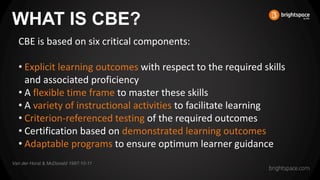
WHAT IS CBE?
CBE is based on six critical components:
• Explicit learning outcomes with respect to the required skills
and associated proficiency
• A flexible time frame to master these skills
• A variety of instructional activities to facilitate learning
• Criterion-referenced testing of the required outcomes
• Certification based on demonstrated learning outcomes
• Adaptable programs to ensure optimum learner guidance
Van der Horst & McDonald 1997:10-11
FUNDAMENTAL
DIFFERENCE
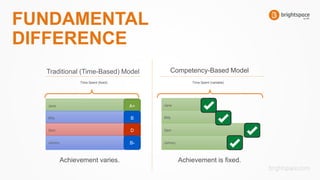
Traditional (Time-Based) Model Competency-Based Model
Jane
Billy
Sam
Johnny
A+
B
D
B-
Time Spent (fixed)
Jane
Billy
Sam
Johnny
Time Spent (variable)
Achievement varies. Achievement is fixed.
SO WHY ARE WE TALKING ABOUT IT NOW?
Over the next decade,
adult student enrollment is
expected to grow faster
than “traditional age”
students.
STUDENTS
HAVE
CHANGED.
Center for Postsecondary and Economic Success
More than 1/3 of
undergraduate students
work full time.
STUDENTS
HAVE
CHANGED.
Center for Postsecondary and Economic Success
Nearly a quarter of
students are parents.
STUDENTS
HAVE
CHANGED.
Center for Postsecondary and Economic Success
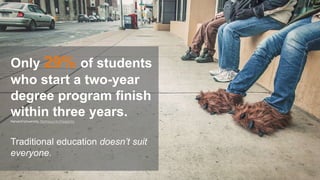
Traditional education doesn’t suit
everyone.
Only 29% of students
who start a two-year
degree program finish
within three years.Harvard University, Pathways to Prosperity
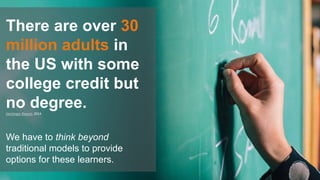
We have to think beyond
traditional models to provide
options for these learners.
There are over 30
million adults in
the US with some
college credit but
no degree.Hechinger Report, 2014
Education unlocks
opportunities for a better
life.
A postsecondary
degree is the key
to a middle class
salary.Georgetown University, Center on Education and the Workforce
Many schools are pursuing
competency-based
educational models to meet
the needs of a changing
student population.
What’s the
answer?
HOWEVER ….
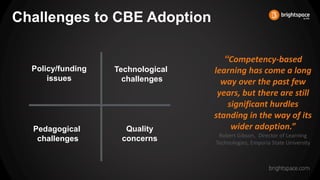
Challenges to CBE Adoption
“Competency-based
learning has come a long
way over the past few
years, but there are still
significant hurdles
standing in the way of its
wider adoption.”
Robert Gibson, Director of Learning
Technologies, Emporia State University
Pedagogical
challenges
Technological
challenges
Policy/funding
issues
Quality
concerns
Download our new
CBE eBook to learn the
five most important things
you need to know right now.
Want to learn more?

Introduction to Competency-based Education

  • 1.
    CBE 101 An Introductionto Competency-based education and the new student demographic
  • 2.
    WHAT IS CBE? CBEis based on six critical components: • Explicit learning outcomes with respect to the required skills and associated proficiency • A flexible time frame to master these skills • A variety of instructional activities to facilitate learning • Criterion-referenced testing of the required outcomes • Certification based on demonstrated learning outcomes • Adaptable programs to ensure optimum learner guidance Van der Horst & McDonald 1997:10-11
  • 3.
    FUNDAMENTAL DIFFERENCE Traditional (Time-Based) ModelCompetency-Based Model Jane Billy Sam Johnny A+ B D B- Time Spent (fixed) Jane Billy Sam Johnny Time Spent (variable) Achievement varies. Achievement is fixed.
  • 4.
    SO WHY AREWE TALKING ABOUT IT NOW?
  • 5.
    Over the nextdecade, adult student enrollment is expected to grow faster than “traditional age” students. STUDENTS HAVE CHANGED. Center for Postsecondary and Economic Success
  • 6.
    More than 1/3of undergraduate students work full time. STUDENTS HAVE CHANGED. Center for Postsecondary and Economic Success
  • 7.
    Nearly a quarterof students are parents. STUDENTS HAVE CHANGED. Center for Postsecondary and Economic Success
  • 8.
    Traditional education doesn’tsuit everyone. Only 29% of students who start a two-year degree program finish within three years.Harvard University, Pathways to Prosperity
  • 9.
    We have tothink beyond traditional models to provide options for these learners. There are over 30 million adults in the US with some college credit but no degree.Hechinger Report, 2014
  • 10.
    Education unlocks opportunities fora better life. A postsecondary degree is the key to a middle class salary.Georgetown University, Center on Education and the Workforce
  • 11.
    Many schools arepursuing competency-based educational models to meet the needs of a changing student population. What’s the answer? HOWEVER ….
  • 12.
    Challenges to CBEAdoption “Competency-based learning has come a long way over the past few years, but there are still significant hurdles standing in the way of its wider adoption.” Robert Gibson, Director of Learning Technologies, Emporia State University Pedagogical challenges Technological challenges Policy/funding issues Quality concerns
  • 13.
    Download our new CBEeBook to learn the five most important things you need to know right now. Want to learn more?

Editor's Notes

  • #3 Van der Horst & McDonald 1997:10-11 as seen in http://www.ajol.info/index.php/jfecs/article/viewFile/52788/41390
  • #6 http://www.clasp.org/resources-and-publications/publication-1/Nontraditional-Students-Facts-2011.pdf
  • #7 http://www.clasp.org/resources-and-publications/publication-1/Nontraditional-Students-Facts-2011.pdf
  • #8 http://www.clasp.org/resources-and-publications/publication-1/Nontraditional-Students-Facts-2011.pdf
  • #9 Unfortunately, the higher education system hasn’t changed fast enough to keep up with the needs of these non-traditional students.
  • #12 Schools are looking to CBE for answers…
  • #13 Source: http://evolllution.com/opinions/competency-based-learning-challenges-impediments/ Policy, funding, and technology is preparing for a shift towards more competency-based education and direct assessment. But it can be a very disruptive change at a campus level. There are lots of other hurdles to overcome. Entrenched behaviours The changing role of the instructor How to handle credit transfers, and ensuring quality assessment Cultural resistance to change
  • #14 Flickr Ethan Lofton