Competency-based Education
Presenters
Cheryl Aschenbach, 5C Co-chair
Karen Daar, 5C Co-chair
Aisha Lowe, Vice Chancellor, Educational Services & Support
Division
Overview
Background/Context
Implementing CBE in the CCCs
Preview Next Session
Q&A
Background and Context
Vision for Success
1. Increase credential obtainment
by 20%
2. Increase transfer by 35% to UC
and CSU
3. Decrease unit obtainment for a
degree
4. Increase employment for CTE
students
5. Reduce and erase equity gaps
6. Reduce regional gaps
1. Focus on students’ goals
2. Design and decide with the
student in mind
3. Pair high expectations and
high support
4. Evidence-based decisions
5. Own student performance
6. Enable innovation and action
7. Cross-system partnership
Core
Commitments
CBE Will Help Us Meet Our Goals
Why CBE and Why Now
• For-credit CBE programs are a needed addition to our
instructional portfolio
• CBE will help us meet our goals (Vision for Success)
• CBE is an economic mobility lever
• Career preparation is essential to the future of our state and our
system
• CBE can flex with changing technologies, employer demands,
and unexpected societal shifts
The Equity Imperative
• We have made substantial progress toward our goals, but gaps
remain
• Noncredit serves a high number of students that are
disproportionately impacted (DI)
• CBE for-credit opportunities will enhance student outcomes
• Giving students access to significant wage gains with a degree
C-BEN | Definition of Competency-Based
Education
Competency-based education combines an intentional and transparent
approach to curricular design with an academic model in which the time it
takes to demonstrate competencies varies and the expectations about
learning are held constant.
Students acquire and demonstrate their knowledge and skills by engaging in
learning exercises, activities and experiences that align with clearly defined
programmatic outcomes. Students receive proactive guidance and support
from faculty and staff.
Learners earn credentials by demonstrating mastery through multiple forms
of assessment, often at a personalized pace.
ACCJC | Definition of Competency-Based
Education
Competency-based education is an outcomes-based approach
to earning a college degree or other credential. Competencies are
statements of what students can do as a result of their learning
at an institution of higher education. The curriculum is structured
around the specified competencies, and satisfactory academic
progress is expressed as the attainment or mastery of the
identified competencies. Because competencies are often
anchored to external expectations, such as those of employers, to
pass a competency, students must generally perform at a level
considered to be very good or excellent.
CCC CBE Definition
Direct assessment competency-based education is an
intentional outcomes-based equity-minded approach to
earning a college degree with the expectations of learning
held constant, but time is variable through a flexible, self-
paced, high-touch and innovative learning practice. The goal
of competency-based education is to empower students in
their learning journey by providing a personalized,
flexible, adaptive, and culturally responsive curriculum with
which students can engage; it allows students to
demonstrate mastery of learning and the achievement of
competencies at their own pace aided by
customized instructional and student service support.
CBE Focuses on Mastery of Competencies
Credit Hour Model…
based on seat time
originally designed to
determine faculty pensions
and not as a measure of
learning.
Credit Hour is current basis
for awarding financial aid,
faculty workload & degree
completion.
Competency Based
Education… moves beyond
seat-time focusing on mastery of
competencies, through learning
activities and experiences that
align with clearly defined
programmatic outcomes.
Hours will vary, but the learning
is fixed.
Often fully online modules.
Flexible academic calendar term
options.
“Cracking the Credit Hour” by Amy
Laitinen
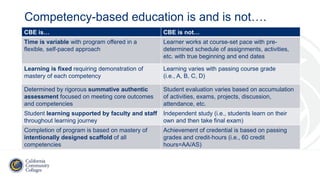
Competency-based education is and is not….
CBE is… CBE is not…
Time is variable with program offered in a
flexible, self-paced approach
Learner works at course-set pace with pre-
determined schedule of assignments, activities,
etc. with true beginning and end dates
Learning is fixed requiring demonstration of
mastery of each competency
Learning varies with passing course grade
(i.e., A, B, C, D)
Determined by rigorous summative authentic
assessment focused on meeting core outcomes
and competencies
Student evaluation varies based on accumulation
of activities, exams, projects, discussion,
attendance, etc.
Student learning supported by faculty and staff
throughout learning journey
Independent study (i.e., students learn on their
own and then take final exam)
Completion of program is based on mastery of
intentionally designed scaffold of all
competencies
Achievement of credential is based on passing
grades and credit-hours (i.e., 60 credit
hours=AA/AS)
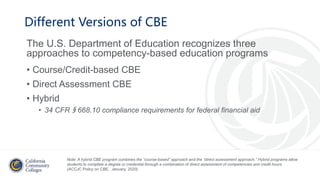
Different Versions of CBE
The U.S. Department of Education recognizes three
approaches to competency-based education programs
• Course/Credit-based CBE
• Direct Assessment CBE
• Hybrid
• 34 CFR § 668.10 compliance requirements for federal financial aid
Note: A hybrid CBE program combines the “course-based” approach and the “direct assessment approach.” Hybrid programs allow
students to complete a degree or credential through a combination of direct assessment of competencies and credit hours
(ACCJC Policy on CBE, January, 2020)
Direct Assessment CBE
• not based on academic terms or credit hours
• bases both the evaluation of student achievement and the
award of a degree or credential solely on the
demonstration of competencies
• students proceed at their own pace rather than
progressing through courses offered in a traditional
academic term
• conventional grades are not necessarily assigned
• students are expected to demonstrate the competency at a
high level of achievement
• establishes “credit-hour equivalencies” for the student
learning outcomes
Course/Credit-Based vs. Direct Assessment
Course/Credit-Based CBE Direct Assessment CBE
Is the traditional academic
term followed?
Yes
Traditional academic terms are
followed
No
Credit-hour equivalences are
established
Do students have autonomy
over their progress?
Yes, but bound within the
term
Students can accelerate through
summative assessment
Yes, within and across the
program
Students can proceed at their own
pace toward mastery
How is learning evaluated?
Competency-based mastery
Tied to courses
Competency-based mastery
Tied to the program
Is transfer credit or CPL
allowed?
Yes No
Is an ACCJC substantive
change approval required?
No
Yes
U.S. Secretary of Ed approval of 1st
program also required
Student Experience
• Freedom and flexibility
• Personalization
• Program is designed to minimize challenges
• Affordability
• Quality instructors and program
• Support from faculty and staff
• Trusted local institution
• Content applicable to current work
Implementing CBE in the
CCCs
The Team
• California Community Colleges Chancellor’s Office Staff
• California Community Colleges Curriculum Committee (5C) Co-
chairs and Representatives (work group)
• Foundation for California Community Colleges Policy Center
Staff
• Jobs for the Future Consultants
• Content Experts
• Lori Dodge, Vice Chancellor of Institutional Assessment and Planning,
Brandman University (CBE expert)
• Eddie Comeaux, Associate Professor of Higher Education, UCR
(Culturally Sensitive Pedagogy and Equity Expert)
Goals
Implement direct assessment CBE across our
system
• Title 5 regulations
• Funding models
• Financial aid models
• Intersegmental coordination for transfer
• CBE collaborative
5C CBE Work Group
• Objective: Engage the 5C in deep learning around competency-based
education for the purpose of identifying regulatory barriers to direct
assessment competency-based education.
• Outcome: To create a package of regulatory language for statewide
implementation of direct assessment CBE and identify the next steps
necessary to successfully pilot direct assessment CBE programs in the CCC
system.
• Process: 5C engages in monthly conversations around CBE having the
necessary discussions to develop policy.
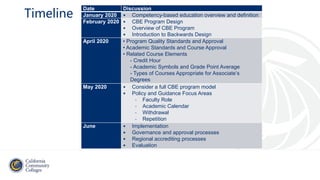
Timeline
Date Discussion
January 2020 • Competency-based education overview and definition
February 2020 • CBE Program Design
• Overview of CBE Program
• Introduction to Backwards Design
April 2020 • Program Quality Standards and Approval
• Academic Standards and Course Approval
• Related Course Elements
- Credit Hour
- Academic Symbols and Grade Point Average
- Types of Courses Appropriate for Associate’s
Degrees
May 2020 • Consider a full CBE program model
• Policy and Guidance Focus Areas
- Faculty Role
- Academic Calendar
- Withdrawal
- Repetition
June • Implementation
• Governance and approval processes
• Regional accrediting processes
• Evaluation
Draft Regulations
THE PROPOSED NEW REGULATIONS FOR
DIRECT ASSESSMENT CBE CONSISTS OF:
• Direct Assessment CBE Definition
and Application
• Scope and Intent
• Definitions
• CBE Program Approval
• Modality
• General Academic Standards and
Module approval
• Module Quality Standards
• Faculty Selection and Workload
• Instructor Contact
• Instruction
• Availability of Instructor
• Program and Curriculum
Development
• Academic Record Symbols and
Grade Point Average
• Repetition
• Evaluation
• Academic Calendar
• Competency-Based Credit
• Eligibility for State Funds
The Pilot
A collaborative of campuses implementing direct
assessment CBE programs
• Close coordination with the CCCCO
• Seed money to launch programs
• Program development support
• Research implementation process and program outcomes
• Recommendations for improvement
• Inform broader system implementation
Join us for the next session
Today at 2:45pm
Session 2 CBE Follow-up and Facilitated Dialog
Overview Draft Regulations
• Assumptions and Key Components
Introduce the CBE Collaborative
• Goals
• Objectives
• Criteria
• Timeline
Thank you!

Competency Based Education - Part FFFFFFFFFFFFFFFFFFFFFFFFI.pptx

  • 1.
  • 2.
    Presenters Cheryl Aschenbach, 5CCo-chair Karen Daar, 5C Co-chair Aisha Lowe, Vice Chancellor, Educational Services & Support Division
  • 3.
    Overview Background/Context Implementing CBE inthe CCCs Preview Next Session Q&A
  • 4.
  • 5.
    Vision for Success 1.Increase credential obtainment by 20% 2. Increase transfer by 35% to UC and CSU 3. Decrease unit obtainment for a degree 4. Increase employment for CTE students 5. Reduce and erase equity gaps 6. Reduce regional gaps 1. Focus on students’ goals 2. Design and decide with the student in mind 3. Pair high expectations and high support 4. Evidence-based decisions 5. Own student performance 6. Enable innovation and action 7. Cross-system partnership Core Commitments CBE Will Help Us Meet Our Goals
  • 6.
    Why CBE andWhy Now • For-credit CBE programs are a needed addition to our instructional portfolio • CBE will help us meet our goals (Vision for Success) • CBE is an economic mobility lever • Career preparation is essential to the future of our state and our system • CBE can flex with changing technologies, employer demands, and unexpected societal shifts
  • 7.
    The Equity Imperative •We have made substantial progress toward our goals, but gaps remain • Noncredit serves a high number of students that are disproportionately impacted (DI) • CBE for-credit opportunities will enhance student outcomes • Giving students access to significant wage gains with a degree
  • 8.
    C-BEN | Definitionof Competency-Based Education Competency-based education combines an intentional and transparent approach to curricular design with an academic model in which the time it takes to demonstrate competencies varies and the expectations about learning are held constant. Students acquire and demonstrate their knowledge and skills by engaging in learning exercises, activities and experiences that align with clearly defined programmatic outcomes. Students receive proactive guidance and support from faculty and staff. Learners earn credentials by demonstrating mastery through multiple forms of assessment, often at a personalized pace.
  • 9.
    ACCJC | Definitionof Competency-Based Education Competency-based education is an outcomes-based approach to earning a college degree or other credential. Competencies are statements of what students can do as a result of their learning at an institution of higher education. The curriculum is structured around the specified competencies, and satisfactory academic progress is expressed as the attainment or mastery of the identified competencies. Because competencies are often anchored to external expectations, such as those of employers, to pass a competency, students must generally perform at a level considered to be very good or excellent.
  • 10.
    CCC CBE Definition Directassessment competency-based education is an intentional outcomes-based equity-minded approach to earning a college degree with the expectations of learning held constant, but time is variable through a flexible, self- paced, high-touch and innovative learning practice. The goal of competency-based education is to empower students in their learning journey by providing a personalized, flexible, adaptive, and culturally responsive curriculum with which students can engage; it allows students to demonstrate mastery of learning and the achievement of competencies at their own pace aided by customized instructional and student service support.
  • 11.
    CBE Focuses onMastery of Competencies Credit Hour Model… based on seat time originally designed to determine faculty pensions and not as a measure of learning. Credit Hour is current basis for awarding financial aid, faculty workload & degree completion. Competency Based Education… moves beyond seat-time focusing on mastery of competencies, through learning activities and experiences that align with clearly defined programmatic outcomes. Hours will vary, but the learning is fixed. Often fully online modules. Flexible academic calendar term options. “Cracking the Credit Hour” by Amy Laitinen
  • 12.
    Competency-based education isand is not…. CBE is… CBE is not… Time is variable with program offered in a flexible, self-paced approach Learner works at course-set pace with pre- determined schedule of assignments, activities, etc. with true beginning and end dates Learning is fixed requiring demonstration of mastery of each competency Learning varies with passing course grade (i.e., A, B, C, D) Determined by rigorous summative authentic assessment focused on meeting core outcomes and competencies Student evaluation varies based on accumulation of activities, exams, projects, discussion, attendance, etc. Student learning supported by faculty and staff throughout learning journey Independent study (i.e., students learn on their own and then take final exam) Completion of program is based on mastery of intentionally designed scaffold of all competencies Achievement of credential is based on passing grades and credit-hours (i.e., 60 credit hours=AA/AS)
  • 13.
    Different Versions ofCBE The U.S. Department of Education recognizes three approaches to competency-based education programs • Course/Credit-based CBE • Direct Assessment CBE • Hybrid • 34 CFR § 668.10 compliance requirements for federal financial aid Note: A hybrid CBE program combines the “course-based” approach and the “direct assessment approach.” Hybrid programs allow students to complete a degree or credential through a combination of direct assessment of competencies and credit hours (ACCJC Policy on CBE, January, 2020)
  • 14.
    Direct Assessment CBE •not based on academic terms or credit hours • bases both the evaluation of student achievement and the award of a degree or credential solely on the demonstration of competencies • students proceed at their own pace rather than progressing through courses offered in a traditional academic term • conventional grades are not necessarily assigned • students are expected to demonstrate the competency at a high level of achievement • establishes “credit-hour equivalencies” for the student learning outcomes
  • 15.
    Course/Credit-Based vs. DirectAssessment Course/Credit-Based CBE Direct Assessment CBE Is the traditional academic term followed? Yes Traditional academic terms are followed No Credit-hour equivalences are established Do students have autonomy over their progress? Yes, but bound within the term Students can accelerate through summative assessment Yes, within and across the program Students can proceed at their own pace toward mastery How is learning evaluated? Competency-based mastery Tied to courses Competency-based mastery Tied to the program Is transfer credit or CPL allowed? Yes No Is an ACCJC substantive change approval required? No Yes U.S. Secretary of Ed approval of 1st program also required
  • 16.
    Student Experience • Freedomand flexibility • Personalization • Program is designed to minimize challenges • Affordability • Quality instructors and program • Support from faculty and staff • Trusted local institution • Content applicable to current work
  • 17.
  • 18.
    The Team • CaliforniaCommunity Colleges Chancellor’s Office Staff • California Community Colleges Curriculum Committee (5C) Co- chairs and Representatives (work group) • Foundation for California Community Colleges Policy Center Staff • Jobs for the Future Consultants • Content Experts • Lori Dodge, Vice Chancellor of Institutional Assessment and Planning, Brandman University (CBE expert) • Eddie Comeaux, Associate Professor of Higher Education, UCR (Culturally Sensitive Pedagogy and Equity Expert)
  • 19.
    Goals Implement direct assessmentCBE across our system • Title 5 regulations • Funding models • Financial aid models • Intersegmental coordination for transfer • CBE collaborative
  • 20.
    5C CBE WorkGroup • Objective: Engage the 5C in deep learning around competency-based education for the purpose of identifying regulatory barriers to direct assessment competency-based education. • Outcome: To create a package of regulatory language for statewide implementation of direct assessment CBE and identify the next steps necessary to successfully pilot direct assessment CBE programs in the CCC system. • Process: 5C engages in monthly conversations around CBE having the necessary discussions to develop policy.
  • 21.
    Timeline Date Discussion January 2020• Competency-based education overview and definition February 2020 • CBE Program Design • Overview of CBE Program • Introduction to Backwards Design April 2020 • Program Quality Standards and Approval • Academic Standards and Course Approval • Related Course Elements - Credit Hour - Academic Symbols and Grade Point Average - Types of Courses Appropriate for Associate’s Degrees May 2020 • Consider a full CBE program model • Policy and Guidance Focus Areas - Faculty Role - Academic Calendar - Withdrawal - Repetition June • Implementation • Governance and approval processes • Regional accrediting processes • Evaluation
  • 22.
    Draft Regulations THE PROPOSEDNEW REGULATIONS FOR DIRECT ASSESSMENT CBE CONSISTS OF: • Direct Assessment CBE Definition and Application • Scope and Intent • Definitions • CBE Program Approval • Modality • General Academic Standards and Module approval • Module Quality Standards • Faculty Selection and Workload • Instructor Contact • Instruction • Availability of Instructor • Program and Curriculum Development • Academic Record Symbols and Grade Point Average • Repetition • Evaluation • Academic Calendar • Competency-Based Credit • Eligibility for State Funds
  • 23.
    The Pilot A collaborativeof campuses implementing direct assessment CBE programs • Close coordination with the CCCCO • Seed money to launch programs • Program development support • Research implementation process and program outcomes • Recommendations for improvement • Inform broader system implementation
  • 24.
    Join us forthe next session Today at 2:45pm
  • 25.
    Session 2 CBEFollow-up and Facilitated Dialog Overview Draft Regulations • Assumptions and Key Components Introduce the CBE Collaborative • Goals • Objectives • Criteria • Timeline
  • 26.

Editor's Notes

  • #6 Completion- Most students who enter a community college never complete a degree or certificate or transfer to a 4-year university Time to Degree-CCC students who do reach a defined educational goal such as a degree or transfer take a long time to do so, often accumulating many excess course credits along the way Achievement gaps persist across the CCCs and high-need regions of the state are not served equitably
  • #8 Equity imperative: Noncredit serves a lot of DI students; CBE transitions to for-credit opportunities will enhance student outcomes
  • #9 Slide content January 2020 5C CBE presentation
  • #10 Slide content January 2020 5C CBE presentation
  • #11 Slide content January 2020 5C CBE presentation
  • #12 Slide from January 2020 5C CBE presentation Fully online modules Different term options for the academic calendar
  • #13 Slide from January 2020 5C CBE presentation
  • #14 CCCCO CBE Report to BOG (2020) ACCJC Policy on CBE (January, 2020)
  • #16 CCCCO CBE Report to BOG (2020) ACCJC Policy on CBE (January, 2020) Course/Credit-based: The demonstration of competencies is embedded into a conventional curriculum comprising courses to be completed to earn credits toward a degree or credential. Course/credit-based programs generally enroll students in traditional academic terms (typically, semesters or quarters) and award credits for courses successfully completed. Students may accelerate their learning and receive credit for the course when they have demonstrated mastery of the competencies by passing a summative assessment. Institutions may elect to create two academic transcripts, one that displays the credits earned (and grade point average or GPA) and one that specifies the competencies attained. (C-RAC, Common Framework for Defining & Approving CBE Programs, 2015). Within the course/credit-based model, institutions primarily adhere to traditional credit-hour based policies and structures including course and program approval, schedule configurations, and funding apportionment structures.” Direct Assessment: CBE approach that is not based on academic terms, such as semesters and quarters, or credit hours. Disregards conventional courses and bases both the evaluation of student achievement and the award of a degree or credential solely on the demonstration of competencies. Allows students to proceed at their own pace rather than to progress through courses offered in a traditional academic term. Because conventional grades are not necessarily assigned and no term length is imposed, the transcript reflects competencies attained rather than grades or credit hours earned. As with all CBE, students are expected to demonstrate the competency at a high level of achievement. Students demonstrate the competencies while they are enrolled in the program; Transfer credit or prior learning assessment is not permitted in direct assessment programs or in the direct assessment portion of a “partial direct assessment” program. Direct assessment programs establish “credit-hour equivalencies” for the student learning outcomes they evaluate and may choose to provide a transcript indicating course/credit equivalencies in addition to the competency transcript. Direct assessment programs must be in compliance with
  • #17 From summary memo: The theme around freedom and flexibility was addressed the most by all three students. Specific examples pointed to how valuable this type of program was in accommodating the many demands of life, including full-time work, having a baby, and buying a house. As one student mentioned, this program “lets me handle the things that come up in my life, and then finish my work on weekends, early in the morning, or at night.” Another student shared similar sentiments: “I didn’t have to put my program on hold when things came up, which I might have had to do otherwise.” Students indicated that this was one of the biggest and most beneficial differences between competency-based education compared and previous experience with post-secondary education. Students also indicated that flexibility to pursue coursework online was very valuable as it allowed students to avoid commute time, parking fees, gas money, etc.
  • #22 CCCCO CBE Report to BOG (2020) ACCJC Policy on CBE (January, 2020)