Deductive reasoning and logic

       Making connections
How crime scene analysis works
• The first step to crime scene analysis is making
  observations.

• Observations lead to questions…or…problem
  statements.

• Example: What crime was committed?
           Who committed this crime?
           How was this crime committed?
Using logic
Logic: a system of reasoning and
  inferences (conclusions that
  are based on observations)

• In context of forensics: does
  the evidence and the
  description make sense?
• Example: A body was found in an alley.
  The body had multiple stab wounds but
  there is very little blood at the crime
  scene.

• What is one logical explanation/inference
  of the crime that you can make with this
  information?
Deductive reasoning
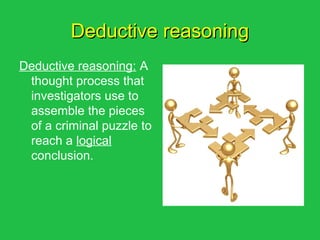
Deductive reasoning: A
 thought process that
 investigators use to
 assemble the pieces
 of a criminal puzzle to
 reach a logical
 conclusion.
Looking at facts
 (AN example of deductive reasoning)
• Facts:
  – Ice cream sales go down in the winter
  – Statistics show that there are fewer instances
    of domestic violence in the winter
• Facts:
  – Ice cream sales go up in the summer
  – Statistics show that there are more instances
    of domestic violence in the summer
What is the logical link?
• When ice cream sales go
  up domestic violence
  goes up.
• When ice cream sales go
  down domestic violence
  goes down.
• Conclusion: The more ice
  cream that is sold, the
  more domestic violence
  there will be…the less ice
  cream sold the less
  domestic violence
Cause and effect
• Describe the cause and effect of ice
  cream and domestic violence…

• If ice cream sales stop then domestic
  violence will also stop.

• Do the two really go together?
• While it may seem
  like the two go
  together, it does not
  mean that ice cream
  sales really effect
  domestic violence
• What we see when we look at the facts is
  a relationship that really doesn’t exist
  because we are only seeing a part of the
  whole picture…leading to misinterpretation
• What are some other pieces of the puzzle
  that we haven’t seen yet?
Reasoning
     • False reasoning, as
       we just saw, can lead
       to errors and
       misunderstandings or
       misinterpretation
       when evaluating
       evidence and results.
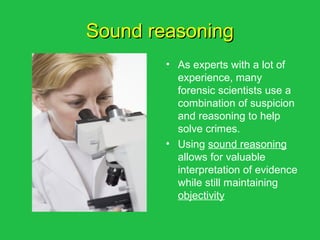
Sound reasoning
        • As experts with a lot of
          experience, many
          forensic scientists use a
          combination of suspicion
          and reasoning to help
          solve crimes.
        • Using sound reasoning
          allows for valuable
          interpretation of evidence
          while still maintaining
          objectivity

Deductive reasoning and logic

  • 1.
    Deductive reasoning andlogic Making connections
  • 2.
    How crime sceneanalysis works • The first step to crime scene analysis is making observations. • Observations lead to questions…or…problem statements. • Example: What crime was committed? Who committed this crime? How was this crime committed?
  • 3.
    Using logic Logic: asystem of reasoning and inferences (conclusions that are based on observations) • In context of forensics: does the evidence and the description make sense?
  • 4.
    • Example: Abody was found in an alley. The body had multiple stab wounds but there is very little blood at the crime scene. • What is one logical explanation/inference of the crime that you can make with this information?
  • 5.
    Deductive reasoning Deductive reasoning:A thought process that investigators use to assemble the pieces of a criminal puzzle to reach a logical conclusion.
  • 6.
    Looking at facts (AN example of deductive reasoning) • Facts: – Ice cream sales go down in the winter – Statistics show that there are fewer instances of domestic violence in the winter • Facts: – Ice cream sales go up in the summer – Statistics show that there are more instances of domestic violence in the summer
  • 7.
    What is thelogical link? • When ice cream sales go up domestic violence goes up. • When ice cream sales go down domestic violence goes down. • Conclusion: The more ice cream that is sold, the more domestic violence there will be…the less ice cream sold the less domestic violence
  • 8.
    Cause and effect •Describe the cause and effect of ice cream and domestic violence… • If ice cream sales stop then domestic violence will also stop. • Do the two really go together?
  • 9.
    • While itmay seem like the two go together, it does not mean that ice cream sales really effect domestic violence
  • 10.
    • What wesee when we look at the facts is a relationship that really doesn’t exist because we are only seeing a part of the whole picture…leading to misinterpretation • What are some other pieces of the puzzle that we haven’t seen yet?
  • 11.
    Reasoning • False reasoning, as we just saw, can lead to errors and misunderstandings or misinterpretation when evaluating evidence and results.
  • 12.
    Sound reasoning • As experts with a lot of experience, many forensic scientists use a combination of suspicion and reasoning to help solve crimes. • Using sound reasoning allows for valuable interpretation of evidence while still maintaining objectivity