Makinika Afrika International pg. 1
CRIME SCENE MANAGEMENT
BY: Amb Steve Mbugua
INTRODUCTION TO CRIME SCENE MANAGEMENT
Definition of a Crime Scene
The scene of a crime is the area in the immediate vicinity of the occurrence, within which evidence
might be found. In some cases, there may be a primary crime scene and one or more secondary
scene.
A primary crime scene is the area in the immediate vicinity of the occurrence within which
evidence might be found. Thus a bank where the armed robbery occurred is a primary crime scene.
A secondary crime scene is an area, although not in the immediate vicinity of the primary crime
scene, still may afford evidence thereby linking the offenders with the offence. Therefore, in the
case of an armed robbery, the place where the getaway car is parked is a secondary crime scene.
Similarly, the route between the bank and the place where the getaway car is abandoned, both are
secondary crime scenes. People such as suspects and victims could also be considered secondary
scenes.
The limits of this area will vary according to the nature of the event. At times it can be localized
but on other occasions it might cover a considerable area. (Such as a hit run accident, the
investigator would extend his search a considerable distance from the point of impact to locate
evidence).
Responsibilities of the First Responder
The duties of a first responder areto:
1. Assist the victim.
2. Search for and arrest the suspect if still on the scene.
3. Detain all witnesses because they possess valuable information about the crime scene.
Keep witnesses separated to preserve their objectivity.
4. Protect the crime scene. Begin by using barrier tape, official vehicles, or other means to
secure the scene. Establish a crime scene security log to record the names of all
persons who enter or exit the crime scene. Do not smoke, drink, or eat within the
secured crime scene and do not allow unnecessary persons or officials to enter or
contaminate the scene.
5. Note and communicate to crime scene investigators all movementsand alterations made
to the crime scene.
Makinika Afrika International pg. 2
Where a crime scene is complex or of a serious nature and you have access to experienced
investigators and forensic officers, you should not attempt to examine the scene alone if at all
possible.
Ascertain if Crime Committed
The first Officer(s) attending the scene must, where appropriate:
 Conduct First Aid to any Victim
 Establish the extent (size) of the scene
 Establish if a crime has been committed.
Establish whether the incident is minor or major to enable you to determine the level of support
that will be required to manage the crime scene.
Cordon the Scene
The following list demonstrates why it is important to ensure that the scene is not interfered with:
 To protect vital evidence especially if this evidence may be endangered prior to the arrival
of a Forensic Officer.
 Mark the scene boundary with tape or any material that will clearly show the area not to be
entered by unauthorised persons.
 To establish an entry/exit point at the scene.
 To prevent entry to the scene of any persons, including other police if they do not need to
be there.
Suspect Management
Along with witnesses when first arriving at a crime scene there may often is a suspect still present.
You should
Separate the suspect from other witnesses
Search and secure the suspect
Note any relevant comments he may make about the crime and Do NOT interview or question the
suspect as that is the role of the nominated investigator. However if you make the decision that
you are to be the Investigator then you make take any action with the offender that you deem
necessary in an inquiry. However you should make notes of anything the suspect says and if the
suspect starts to make admissions then you must appropriately caution him according to law.
Notify Authorities
Persons in authority should be notified, especially if the crime is of a serious nature. They may be;
 The Command Centre
Makinika Afrika International pg. 3
 Investigation Officer (IO), and
 Forensic Officers
This will ensure that specialized officers trained to deal with serious offences will attend the scene
expeditiously.
Record Crime Scene Movements
Duties of the Officer Preserving the Crime Scene include: -
 Commencing a Crime Scene Log/Administrative Log in which all actions occurring within
the scene are recorded. An Officer may be nominated as a log keeper after consultation
with the Officer in Charge of the investigation.
 Removing people through a common exit point.
 Recording who enters the scene and why, time of entry and exit to/from the crime scene.
 Maintaining control of the scene until it is taken over by an Investigator or Forensic
Officer.
 Authority to restrict access to the scene to prevent contamination.
Inquiries
Isolate witnesses, record their details and, where possible, request them to stay.
 Take notes about issues relevant to the scene.
 Draw a basic sketch to record the scene if there appears any danger of the scene or
exhibits being interfered with.
Record all facts relating the incident and hand over it to the investigator after his arrival.
Examples: Name of eye witnesses, particulars of injured shifted to hospital, time and
related person of all facts, related and parked vehicle numbers etc.
If there is doubt about the value of an object as an exhibit; treat it as evidence until a
person examines it that is qualified to make a judgment. Assistance of other services is to
be called for in the most expedient manner without you leaving the crime scene.
Handover
When you hand the scene over to Investigators and Forensic Officers you need to be in a
position to carry out the following;
Hand over the Crime Scene Log which should include
 Initial observations
 Witness List
 Victim Details
 Suspect details
 Other information of interest such as comments the suspect has made whilst in your
presence.
Makinika Afrika International pg. 4
ELEMENTS OF CRIME SCENE MANAGEMENT
The only thing consistent about crime scenes is their inconsistency. Because of their diversity,
crime scenes can be classified in many ways. First, crime scenes can be classified according to the
location of the original criminal activity. This classification of the crime scene labels the site of the
original or first criminal activity as the primary crime scene and any subsequent crime scenes as
secondary.
This classification does not infer any priority or importance to the scene, but is simply a
designation of sequence of locations.
Most crimes are often solved by a system that focuses on teamwork, advanced investigation skills,
ability to process crime scene properly.
By recognizing, collecting and preserving all relevant physical evidence and information, the
effectiveness of crime scene functions are only as good as the whole management system.
Crimes today are solved by the teamwork of investigators and crime scene personnel and by
the combined use of techniques and procedures recognizing the power of crime scenes, physical
evidence, records, and witnesses. Unfortunately, numerous cases, routine and complex,
have shown that despite available crime scene technologies and specially trained personnel, the
Makinika Afrika International pg. 5
productiveness of a crime scene investigation is only as good as the supportive management
team.
The four distinctive but interrelated components of crime scene management are;
• Information management
• Manpower management
• Technology management, and
• Management of logistics.
These components are all based on the fundamental need for good and ongoing communication.
1. Information management
With new developments in crime scene technology, investigation has proved that crime scene
contains a tremendous amount of information. This information can often link a suspect to a crime
scene, prove or disapprove an alibi, or develop investigative leads.
Information can be in oral form, written statements or documents, or in the form of pattern
evidence located or remarked absent from scene, or pattern evidence located within the scene.
The sooner information can be recognized, collected, analyzed, and preserved, the better the
chance that the case will be solved.
Various types of information can be used to solve crimes; comprehensive victim background
check, inquiry into the actions and whereabouts of the suspect and his or her belongings during
the last 24 hour period preceding the crime.
2. Manpower management
Manpower are the agencies responsible for the crime scene processing and construction.
Several factors involving manpower adversely affect crime scene management; insufficient
personnel, poor training and lack of experience or overworked crime scene team to deliver
dedicated qualified man-hours.
3. Technology management
Change in technology mandates the continual acquisition of new and often expensive equipment
and supplies for effective crime scene processing. The amount of resources allocated for
purchasing and upgrading equipment should be appropriate to the variety and volumes of crime
Makinika Afrika International pg. 6
scene s encountered by the team/unit. As well as adequate training to the personnel to properly
utilize any new technology or new equipment.
Different categories of equipment
• Support vehicles; specifically constructed for crime scene purposes
• Communication; two way radio, cell phones fax machines, and computer with internet
connection. Tele-forensics and telecommunication technologies are being developed
• Tools and search equipment; hand tools, forensic light sources, metal detectors etc
• Specialized crime scene kits; latent print kits, trajectory reconstruction dowel and
accessories, casting kits for tool marks and foot ware impressions
• Chemicals and reagents; blood print enhancement reagent, latent print developers, etc
• Portable instrumentation; night vision equipment, portable laser, radar etc
• Evidence packaging materials and related forms
4. Management of logistics
Logistical concerns should be properly addressed and managed through god planning, organization
and efficient allocation of resources to be established earlier in the investigation. The following
elements are to be established;
Command posts
First officer responders must do everything possible to secure the integrity of the crime scene. In
order to maintain the integrity of a crime scene, outer perimeters and a command post need to be
established. A command post should be situated outside the
perimeter of the working crime scene away from evidence location to allow investigators
document the scene logically and accurately disseminate relevant information to and from the
crime scene.
During the initial part of the investigation, a mobile or a temporary command post is ideal
and can be locate near the outer perimeter of the scene. As investigation evolves and rime scene
functions diminish a longer term command post may be established.
Makinika Afrika International pg. 7
The command post should focus on supporting the investigation team and provide facility to
establish a task force office or long term investigation centre.
Media relations
Care should be taken to restrict access to the crime scene and a separate area should be identified
for members of public and media. It is the right of the media to gather information and publicize it.
When the public information office is constantly updated and portrays an honest and timely
dissemination of information to the media, vast majority of media representatives will gladly
comply to protect the scene of crime and sensitive information.
The media area should be close to the actual crime scene for them to be able to obtain some file
footage for their newscasts. This is to be established with care to protect the entire scene or
sensitive information. Periodic news conferences should be scheduled and conducted by
authorized crime scene officers during major case investigations.
Conclusion
A deficiency in one of these areas or an over emphasis on component and neglect of another will
result in a system that is out of balance an that will jeopardize the overall management of crime
scene investigation process.
CRIME SCENE SECURITY
Introduction
Crime scene being anywhere an offence has been committed or anywhere with a potential to yield
evidence and is created after the commission of a crime, Majority of evidence required for proper
and successful prosecutions of perpetrators of crime is found at the scene of crime .Therefore, the
success of investigators depends on the actions of the first responder to a crime scene. The
integrity of a crime scene should be maintained at all times. Prompt visit is intended to safeguard
any physical evidence that could be available.
Makinika Afrika International pg. 8
Physical evidence is anything that a suspect has taken from, left at or that may be otherwise
connected with the crime scene or the crime itself.
Many people, both police and members of the community believe that the investigation of crime
is the sole responsibility of Investigation officer and no other police officers are capable of, or
are permitted to do so? This is a MYTH! All police officers have an investigative role.
Why Preserve a Crime Scene?
The scene of a crime is a very important area. The reason we preserve the scene is so that all
of the available evidence can be found in its original position and condition to help us solve
the crime and find out who committed the crime.
Constables are usually the first members to get to the scene of a serious crime. Most
members know that a crime scene should be protected but often do not know why or how to
go about it.
NB: EVERY CONTACT LEAVES ITS TRACES
Evidence found at the scene of a crime can be used later as exhibits in court to prove that an offender
is guilty of the offence. It is very important that evidence found at the scene is kept in its original
state.
The scene should be kept in its original state to stop contamination (interference) of the crime scene
by people or other factors such as the weather.
Remember: every time something comes in contact with something else it leaves a trace. It may be a
fingerprint, footprint or something that we can link the crime to the offender.
What are we protecting the crime scene from?
i. People
Crime scenes will often attract crowds of onlookers and friends and family of the victim.
This may well lead to these people either deliberately or unintentionally moving or
destroying valuable evidence. Some people may even steal exhibits such as guns, knives
etc. of particular concern are police members who may also contaminate the crime scene by
Makinika Afrika International pg. 9
handling or touching exhibits, walking over footprints or blood stains etc.
ii. Weather
Wind and rain, particularly, can destroy evidence quickly.
iii. Animals
Dogs, pigs and other animals generally may tend to scavenge or disturb a crime scene and
will thus destroy or relocate valuable evidence.
iv. Traffic
Motor vehicles, particularly police cars will often drive over and destroy evidence such as
tire marks, footprints and blood stains.
Locard’s principle
Locard’s exchange principle states, in essence, that when two objects touch, there is a transfer of
evidence.
Edmond Locard was educated in both medicine and law. He was fascinated with police work, and
persuaded a French police department to give him some space to start a laboratory in order to
study the concept of trace evidence. Locard believed that when two objects, or people, came into
contact with each other, each left a mark on the other.
Locard meant for his exchange principle to be an example of forces; for instance, billiard balls. A
cue ball is hit and it collides with another ball. The cue ball transfers the force to the second ball,
which begins moving. This explanation can also be applied to forensics. For example, when a red
car collides with a white car, we can expect to find white paint on the red car, and red paint on the
white car.
It is important to understand, however, that, while an investigator may find traces of a suspect at
the crime scene, this may not be sufficient to prove a case against the suspect. For example, if a
bank robbery suspect leaves a fingerprint on the door of a bank when he exits, this is not in and of
itself evidence of the robbery; it is only evidence that he has been on the scene. An investigator
needs additional evidence, such as witnesses, video, or proof that the suspect escaped with the
money, before making an arrest.
There cannot be discussion on crime scene security without mentioning locard’s principle.
Locard a French forensic scientist noted that whenever a crime occurs, no matter what the nature
Makinika Afrika International pg. 10
is, the crime scene is the most important thing that the criminal leaves behind. As far as forensic
science goes, the crime scene is the only biggest source of obtaining physical evidence related to
the crime. It is from the crime scene that a Crime Scene Investigation begins. For an investigator,
it is something that gives insight into the way the crime was committed and it is much like visiting
the footsteps of the criminal through the clues that have been left behind.
The Locard Exchange Principle is the basis for linking physical evidence from or to the
victim, suspect, and crime scene. Anyone entering a crime scene can alter or change the scene
and its evidence, so access to the crime scene must be restricted and, if possible, pre- vented
except for essential crime scene personnel. Any physical barriers like vehicles or tapes that help
protect the crime scene must be established as soon as possible by the first responders.
After scene barriers have been established, one officer shall be designated as the scene
security officer. He or she will be responsible for preventing entrance into the crime scene by
curious onlookers. A contamination log or security log should be kept to record all entries to and
exits from secure areas of the crime scene. Use of a multilevel security approach can
successfully prevent this important stage in the investigation.
Only in rare situations will the crime scene investigator be the first responder. After he or she
arrives, the first step is to evaluate the established secure areas and change them if necessary.
Unlike the way they are depicted on TV, crime scenes are often chaotic and difficult to secure.
There is so much going on and too many people coming and going. But if an accurate
investigation is to take place, you must properly secure a crime scene by following certain
guidelines.
1. Establish the boundaries of the crime scene. Determine an inner perimeter, the spot where
the crime occurred, and an outer perimeter, for example, the exit or entrance doors or
windows. There may also be an extended perimeter, an area where, for example, a
perpetrator may have tossed a murder weapon when fleeing the scene.
2. Mark perimeters with crime scene tape or police barriers.
3. Remove unnecessary individuals from the scene. Gather witnesses, if any.
4. Determine if there is any evidence present. If so, log it carefully.
Makinika Afrika International pg. 11
5. Record conditions of the area and anything that affects it. Write down time, weather
conditions, description of area and number of people, if any, present upon your arrival.
6. Release the crime scene after you complete all documentation, secure all evidence and
remove all photographs and sketches taken. Release should happen only when everyone
agrees that the scene has been adequately searched.
Crime scene security/approach
It is the responsibility of the first officer arriving on the scene of a crime to take first steps to
preserve and protect the area to the greatest extent possible. However the protection and securing
of the crime scene should involve all officers and persons involved at the crime scene. The
acronym S.C.E.N.E can be used as a guide in following the steps.
S- SAFETY; Safety Procedures and Emergency Care
C-CORDON; Secure and Control Persons at the Scene
E-EVIDENCE COLLECTION; Document Actions and Observations
N-NAME LOG LIST; Documentation
E- EVALUATE; Perform Final Survey of the Crime Scene
Safety
The safety and physical well-being of officers and other individuals, in and around the crime
scene, are the initial responding officer(s’) first priority of the first respondent is to Identifying and
controlling any dangerous situations or persons by ensuring that there is no immediate threat to
him and other responders through scanning the area for sights, sounds, and smells that may present
danger to personnel (e.g., hazardous materials such as gasoline, natural gas). He should Approach
the scene in a manner designed to reduce risk of harm to officer(s) while maximizing the safety of
victims, witnesses, and others in the area.
. Document the original location of the victim or objects that you observe being moved
Makinika Afrika International pg. 12
Cordon/sealing of crime scene
Defining and controlling boundaries provide a means for protecting and securing the crime
scene(s). The number of crime scenes and their boundaries are determined by their location(s) and
the type of crime.
Establish boundaries of the scene(s), starting at the focal point and extending outward to include:
• Where the crime occurred.
• Potential points and paths of exit and entry of suspects and witnesses.
• Places where the victim/evidence may have been moved
Sealing of crime scene may be through physical barriers (e.g., ropes, cones, crime scene barrier
tape, available vehicles, personnel, and other equipment) or use existing boundaries (e.g., doors,
walls, gates).
Document the entry/exit of all people entering and leaving the scene, once boundaries have been
established.
Establishing boundaries is a critical aspect in controlling the integrity of crime scene in that it
provide the area to be covered by the investigators and a warning to civilians to keep off
A crime scene security also encompasses identification of any threats to scene integrity, and
ensures protection of physical evidence. The investigator(s) in charge should conduct a
walkthrough of the scene to avoid contaminating the scene by using the established path of entry
and Prepare preliminary documentation methods of the scene as observed. This is done to ensure
that all evidence that may be compromised is immediately documented, photographed, and
collected.
Prioritize the collection of evidence to prevent loss, destruction, or contamination. This can be
achieved by the investigator(s) in charge and team members who shall determine the order in
which evidence is collected. The team member(s) should:
a. Conduct a careful and methodical evaluation considering all physical evidence possibilities
(e.g., biological fluids, latent prints, trace evidence ).
b. Focus first on the easily accessible areas in open view and proceed to out-of-view locations.
Makinika Afrika International pg. 13
c. Select a systematic search pattern for evidence collection based on the size and location of the
scene(s).
d. Select a progression of processing/collection methods so that initial techniques do not
compromise subsequent processing/collections methods.
Concentrate on the most transient evidence and work to the least transient forms of physical
evidence.
Importance of crime scene security
 Securing of physical evidence
 Effecting arrest and making recovery
 Confirming existence of a crime
 Protection from further interference
 Collection of information and intelligence
 Corroborate witness statement
 Crime scene reconstruction
CONCLUSION
So often members of the public brand investigation officers who come to scene of crime
with long coats and dark shades as ‘real cops’ or heroes who Have come to save the day.
While , cloud of malice and suspicion always hang over the first respondents often uniformed
officers who are often seen as either failing to prevent the occurrence of the crime, are
involved in the commission of the crime or are clueless . however the contrary is the truth , as
a successful prosecution depend on how the first respondent secure the scene. It is therefore
prudent that more emphasis and training on crime scene security should be given to officers in
patrol as the outcome of most crime depends on them.
References
Makinika Afrika International pg. 14
Crime Scene and Evidence Collection Handbook. Washington, D.C.:Bureau of Alcohol,
Tobacco and Firearms, 1999.
Crime Scene Investigation: A Guide for Law Enforcement. U.S. Department of Justice Office of
Justice Programs.
Evans, Colin, (2008).Criminal Investigations: Crime Scene Investigation Infobase
Publishing:NY
Handbook of Physical Evidence. Miami, Florida: Metro-Dade Police Department, 1996
CRIME SCENE EXAMINATION METHODS/ CRIME SCENE SEARCH
TECHNIQUES
Each crime scene is different according to the physical nature of the scene and the crime
committed. Consequently, the scene is thoroughly searched to develop essential evidentiary
facts pertinent to the offense. The actual crime scene search should not be confined to a
specific area, but extend along the path of approach and follow the line of flight of the
perpetrator. A search conducted in this manner will often uncover an item dropped or
discarded by the offender, which may later be instrumental in obtaining identification or a
conviction in court.
The Purpose of the Search
The crime scene search is conducted to uncover the physical evidence that will potentially do
the following:
 Determine the facts of the crime
 Identify the criminal
 Aid in the arrest and conviction of the criminal
Crime scene searching
Prior to the search, the crime scene specialist should survey the crime scene and set limits on
the area of the search for the purpose of determining how to organize the search procedure
and to ascertain what assistance is needed. Before starting the search, the investigator and
crime scene specialist should note the locations of obvious traces of evidence, probable entry
Makinika Afrika International pg. 15
and exit points used by the perpetrator, as well as the size, shape, and condition of the area to
be searched.
Once the crime scene examiner has gathered as much information as possible through the
initial assessment and completed initial photography the crime scene examination or search
can begin.
As a general rule evidence of a fragile or vulnerable nature should be collected before material
that is less likely to be lost or destroyed. Thus, crime scene photography and sketches
should be done because the crime scene will change with passing time and the examiner‘s aim is to
make a record of the scene as close to its original condition as possible.
NB: When examining the scene, remember to apply Locard‘s Principle of Exchange.
Search techniques
Traditionally, there are three types of searches conducted at a crime scene: spiral search, grid
search, and sector search. The specific technique used is not as important as having the
process conducted in an organized and systematic manner. There are five (5) systematic
search methods normally utilized to search crime scenes. They include the spiral search, strip
search, grid search, zone or sector search, and the pie or wheel search. Let‘s look at each of these and
discuss how they are conducted
Spiral Search Method
This ever-widening circle technique is conducted with the searching officer starting at the
focal point of the crime scene or the center of the area, working outward by circling in a
clockwise or counterclockwise direction to the outside edges of the crime scene. A spiral
technique is a good pattern for a rather confined area. This works well in a small room. In
addition to using the spiral pattern in a room, it is also helpful to apply this pattern in layers.
This can be done as follows:
 Visually search the top third of the rooms, as well as the ceiling. Police officers
typically do not look up very often, but should in the case of a crime scene. There may
be bullet holes in the ceiling, blood splatter or hidden items.
Makinika Afrika International pg. 16
 Search the middle third of the room including drawers and cabinets.
 Search the lower third, using the spiral technique. The floor and lower cabinets are
typically where most evidence is located.
Grid search
The grid search is a variation of the strip search and is useful for large crime scenes,
particularly outdoor scenes. After completing the strip search, the searchers are doubled
back perpendicularly across the area they just searched. It is very time consuming, but
causes a very methodical and thorough examination of the area. It also has the advantage of
allowing searchers to view and search the crime scene from two different viewpoints, thereby
increasing the possibility of uncovering evidence not previously noticed.
Makinika Afrika International pg. 17
Strip Search
A strip search is typically used in outdoor scenes to cover large areas in which detailed
examination is necessary. It is a technique frequently used by archeologists when they search
a particular area. The strip search uses a series of lanes across the crime scene. This method
can be used by one person or a group of searchers. It is done as follows:
 Each lane contains a searcher that walks down the lane parallel to the other searchers.
 Once the searchers get to the end of the lane they reverse their direction and walk
back adjacent to the lane they just searched.
 This process is continued until the entire crime scene area has been searched.
 If one of the searchers finds evidence, all searchers should stop until the evidence is
properly processed and they receive additional information.
Makinika Afrika International pg. 18
Zone or sector search
A zone or sector search is used when the search area is particularly large and cumbersome.
The zone or sector search requires the crime scene to be divided into four large quadrants (the
four large quadrants can also be sub-divided into four smaller quadrants). Each quadrant or
sector is then searched separately as an individual unit, using the spiral, strip and/or grid
search pattern.
Pie or Wheel Search
Makinika Afrika International pg. 19
The pie or wheel search is based on the establishment of a circle surrounding the crime scene.
The circle is then divided into six quadrants in a pie-like fashion.
It should be noted that a combination of search patterns can be applied if the
circumstances of the scene demand it. The search should also be multi-dimensional
meaning that the examiners need to look in all directions including up and down. The type of
search applied can depend on:
 The type of scene (whether internal or external)
 The presence of a body (victim)
 The size of the area to be searched
 The type of terrain
 The size of the evidence
 The need to move objects
 The number of skilled officers available
During the search of the crime scene the forensic officer must closely examine relevant
objects and identify their potential as evidence. Whilst doing so the examiner should consider:
 Physical evidence that may assist with the elimination of persons or establish the
identity of suspects
 Physical evidence that may assist with the corroboration of witnesses
 Interpretation of any impression evidence
 Relationships of evidence within the scene
 Any sequences of events suggested by the physical evidence
 Scenario development including alternative scenarios
During the crime scene search for physical evidence, special attention must be
directed to the discovery and documentation of impression evidence. Impression evidence is
often not readily apparent, therefore, each of the areas of possible contact between the
perpetrator and the scene must be carefully examined with the full expectation that it will
contain impression evidence.
Makinika Afrika International pg. 20
Point of Observation
Perpetrators sometimes observe a scene from a distance prior to committing a crime, or they
may stalk a victim in preparation for an assault. Such vantage points , which offer the
perpetrator a hidden viewpoint, should be searched for shoe or tire impressions.
Route to Scene
Take note of any contaminants (soil, dew, etc.). That may have collected on shoe soles along
the route used to approach a crime scene. These contaminants may be deposited at the point of
entry and within the scene.
Soft outdoor surfaces along the approach route may contain impression evidence that can be
collected and may allow for an interpretation of the number of perpetrators by noting the
number of different shoe sole patterns that are present.
Point of Entry
The point of entry is often a likely location to recover impression evidence. Contaminants that
have collected on the shoe soles are often deposited on interior surfaces upon entry. Pay
special attention to window sills, chair seats, desk and table tops at or near the point of entry.
Additionally, forced entry may have been accomplished by kicking in a door or climbing to
access a window. These surfaces should be thoroughly searched for impression evidence.
Route through the Crime Scene
A methodical visible search with existing light should be conducted anywhere that the route of
the perpetrator is apparent or suggested. Search for impressions in blood, grease, dust, etc. Take
note and collect any objects that bear indentations that may have been caused by being stepped
on by the perpetrator. Strewn or dropped paper items (envelopes, magazines, boxes, etc.) should
be recovered from floor surfaces to be examined for the presence of dust or residue
impressions.
Following the search with existing light, a thorough search should be made using a bright
floodlight held just off of the surface to direct a beam of oblique (low angle) lighting across
Makinika Afrika International pg. 21
the surface. This should be done in darkened room conditions and may reveal dust or residue
impressions that were not otherwise apparent.
Point of Occurrence
This is the area in a crime scene that the focal point of the criminal activity is obvious. This may
be an area where ransacking has taken place, where a struggle with the victim has taken place, or
where the victim‘s body is located. Impressions may be deposited in blood or other body fluids or on objects
that have been displaced or knocked over. In murder cases, the victim‘s body and clothing are
a potential source of impressions.
Point of Exit
Recover impressions from the area immediately adjacent to the point of exit. This includes
impressions in soft exterior ground surfaces. Any surface that may have been contacted
during exit should be searched.
Escape Route from the Scene
Attempt to reconstruct the direction and means of escape from the scene. Be alert for other
evidence associated with pathways from the scene such as discarded weapons and other
property.
Search for areas where a vehicle may have been parked, and recover associated tire
impression evidence.
Searching the scene for evidence
The search for evidence at a bombing crime scene is critical. The crime scene will contain
important evidence for identifying the suspect and assist in the successful prosecution of the
crime. The exact method of searching will depend on various uncontrollable factors.
Investigation of the scene of a bombing is a time-consuming task that requires a considerable
amount of physical work and attention to minute pieces of physical evidence. The search is
also dirty work and will require the crime scene specialist to sift through large quantities of
debris to locate items of evidence.
Makinika Afrika International pg. 22
One person should be placed in charge of the collection of evidence from the various
collectors. Valuable evidence may not be admissible in court if a proper ―chain of custody cannot be
established. The location where any evidence is recovered must be documented.
The search for evidence should not be concentrated on only obvious explosive-related
physical evidence such as safety fuse, blasting caps, timing mechanisms, pieces of
wire, batteries, and explosive residues. This may cause other valuable evidence to be
overlooked. Other evidence to look for includes:
 Fingerprints
 Hairs and fibers
 Soil, blood, paint, plastic, and tape
 Tools and/or tool marks
 Metals
 Writing paper, printing, cardboard, leather, and wood
 Tire tread and shoe print impressions
The search of the crime scene should not be stopped after a few items have located. The
search must be well-organized and thorough to prevent the necessity of a second search.
The probable flight path of the bomb components should be determined to prevent needless
searches. Trees, shrubbery, telephone poles, and the roofs, ledges and gutters of nearby
buildings need to be searched. A search pattern should be established for large areas. A
satisfactory method is a line of searchers who move forward. The areas to be searched should
be charted to ensure a thorough search pattern.
Any items that are foreign to the scene and items that the searchers cannot identify
need to be retained. Small debris should be sifted through a 1/4" wire screen onto an insect-
type screen. These screens are usually placed onto 2 foot square wooden frames constructed
from 2 x 4 inches lumber.
Makinika Afrika International pg. 23
Evidence Log
Due to the large number of persons involved with the bomb scene search and the amount of
evidence collected, an evidence log should be kept to detail each item collected, including
the date, time, and name of the person who collected the material. Using this log facilitates
establishing a chain of evidence and makes the inventory of all the evidence easier.
PHYSICAL EVIDENCE
General Introduction
Crime scene is a location where a crime took place (or another location where evidence of the
crime may be found), and comprises the area from which most of the physical evidence is
retrieved by law enforcement personnel, crime scene investigators (CSIs) or in rare
circumstances, forensic scientists. Crime scenes may or may not be where the crime was
committed. There are different levels and types of crime scenes.
Physical evidence is any material objects, which play some actual role in the matter that, gave rise
to the litigation, introduced in a trial, intended to prove a fact in issue based on its demonstrable
physical characteristics.
It would be impossible to list all the objects that could conceivably be of importance to a crime.
Almost anything can be Physical Evidence. According to Lawrence Chow; Physical evidence is
Makinika Afrika International pg. 24
any object that can establish that a crime has been committed or can provide a link between a
crime and its victim or between a crime and its perpetrator.
History and Development of Rules of Evidence
Evidence is the means by which the prosecution tries to prove its case and the defendant tries to
cast doubt upon the prosecution evidence. Similarly in civil case this is through addressing
evidence that the claimant attempts to prove his case and the defendant attempts counter the
claimant case.
The rules of evidence were designed to control both the judge and the jury. They were also
intended to make the trial more businesslike and efficient. The evolutionary process that
resulted in our present rules of evidence is a reflection of both English and U.S. history.
In the middle Ages, glaring abuses of the trial process, such as the Star Chamber and the
Inquisition, developed. Strangely enough, the Star Chamber was originally developed to cure
abuses by the royalty. At their height, both the Star Chamber and the Inquisition became
obsessed with obtaining confessions. The noble ideal that a person could not be con- victed
solely on the allegations of others dissolved into a nightmare of torture chambers designed to
force the suspect to confess.
The earliest forms of juries differed greatly from their modern counterpart. At one time jurors
were selected based on their knowledge of the case. Unlike our present system in which jurors are
not supposed to have an opinion about the case prior to the trial, early jurors were only selected
if they had personal knowledge of the facts. Busybodies made
Examination of evidence
The examination of physical evidence by a forensic investigator is usually undertaken for
identification and comparison. The purpose of identification is to determine the physical or
chemical identity of a substance with as near absolute certainty as existing analytical techniques
will permit. The objective of a comparison is to determine whether or not the suspect specimen
and a control specimen have a common origin, by subjecting them to the same examinations and
tests. In a comparison analysis, the forensic investigator must not forget the role that probability
plays a determining factor in the discovering the origins of two or more specimens. Evidence is
said to possess individual characteristics when it can be associated with a common source with an
Makinika Afrika International pg. 25
extremely high degree of probability. However, evidence that can be associated only with a group
and never with a single source is said to possess class characteristics. Evidence, broadly construed,
is anything presented in support of an assertion. This support may be strong or weak. The strongest
type of evidence is that which provides direct proof of the truth of an assertion. At the other
extreme is evidence that is merely consistent with an assertion but does not rule out other,
contradictory assertions, as in circumstantial evidence.
TYPES OF PHYSICAL EVIDENCE
 Blood Stains
 Seminal Stains
 Hair
 Fibers and Threads
 Glass
 Paint
 Flammable Liquids
 Firearms Evidence
 Tool Marks
 Controlled Substances and Medicinal Preparations
 Questioned Documents
 Latent Fingerprints
 Biological material - blood, semen or saliva
 Paint chips
 Soil and vegetation
 Accelerants
 Fingerprints
 Impression evidence – shoe prints, tire tracks or tool marks
 Narcotics
Based on the concept on the "Locard's Exchange Principle" every time someone enters an
environment, something is added to and removed from it. The principle is sometimes stated as
“every contact leaves a trace”, and applies to contact between individuals as well as between
individuals and a physical environment. Law enforcement investigators are therefore taught to
always assume that physical evidence is left behind at every scene. This will be generally true, and
Makinika Afrika International pg. 26
the amount and nature of the evidence created will be largely dependent on the circumstances of
the crime.
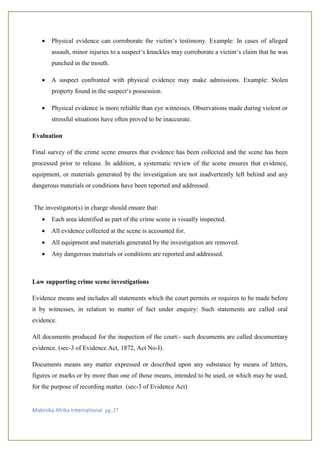
Examples ; finger print trace
The Role of Physical Evidence
• The physical evidence left behind at a crime scene plays a crucial role in reconstructing the
events that took place surrounding the crime.
• Although the evidence alone does not describe everything that happened, it can support or
contradict accounts given by witnesses and/or suspects.
• Information obtained from physical evidence can also generate leads and confirm the
reconstruction of a crime to a jury.
• The collection and documentation of physical evidence is the foundation of a
reconstruction.
• Reconstruction is a team effort that involves putting together many different pieces of a
puzzle.
• The right connections have to be made among all the parts involved so as to portray the
relationship among the victim, the suspect, and the crime scene.
• If successful, reconstruction can play a vital role in aiding a jury to arrive at an appropriate
verdict.
• Physical evidence can prove a crime has been committed or establish key elements of an
offence. Example: In cases of alleged rape, the victim‘s torn clothing and injuries may be
sufficient to prove non-consent.
• Physical evidence can place the suspect in contact with the victim or with the crime scene.
Example: Victims hair caught in the suspect‘s watch band.
• Physical evidence can establish the identity of persons connected to the crime. Example:
Fingerprints developed within the crime scene and subsequently identified to a person.
 Physical evidence can exonerate the innocent. Example: In cases of alleged rape DNA
analysis of samples taken from a victim may clear a suspect.
Makinika Afrika International pg. 27
 Physical evidence can corroborate the victim‘s testimony. Example: In cases of alleged
assault, minor injuries to a suspect‘s knuckles may corroborate a victim‘s claim that he was
punched in the mouth.
 A suspect confronted with physical evidence may make admissions. Example: Stolen
property found in the suspect‘s possession.
 Physical evidence is more reliable than eye witnesses. Observations made during violent or
stressful situations have often proved to be inaccurate.
Evaluation
Final survey of the crime scene ensures that evidence has been collected and the scene has been
processed prior to release. In addition, a systematic review of the scene ensures that evidence,
equipment, or materials generated by the investigation are not inadvertently left behind and any
dangerous materials or conditions have been reported and addressed.
The investigator(s) in charge should ensure that:
 Each area identified as part of the crime scene is visually inspected.
 All evidence collected at the scene is accounted for.
 All equipment and materials generated by the investigation are removed.
 Any dangerous materials or conditions are reported and addressed.
Law supporting crime scene investigations
Evidence means and includes all statements which the court permits or requires to be made before
it by witnesses, in relation to matter of fact under enquiry: Such statements are called oral
evidence.
All documents produced for the inspection of the court:- such documents are called documentary
evidence. (sec-3 of Evidence Act, 1872, Act No-I).
Documents means any matter expressed or described upon any substance by means of letters,
figures or marks or by more than one of those means, intended to be used, or which may be used,
for the purpose of recording matter. (sec-3 of Evidence Act)
Makinika Afrika International pg. 28
Connectivity of Physical evidence in existing law- Provided also that, if oral evidence refers to the
existence or condition of any material thing other than a document, the Court may, if thinks fit,
require the production of such material thing for its inspection. Sec-60 of Evidence Act, 1872.
Investigation means- Sec-4(k)(1) of Cr.P.C. ―Investigation‖ includes all the proceedings under
this code for the collection of evidence conducted by a police officer or by any person.
CONCLUSION
In criminal law, physical evidence is king, it does not have bias and exists independent of the
hopes and wishes of anyone. This is why it is so very important for physical evidence to be
discovered, not contaminated and properly analyzed.
Physical evidence usually involves objects found at the scene of a crime. Physical evidence may
consist of all sorts of prints such as fingerprints, footprints, handprints, tidemarks, cut marks, tool
marks, etc. Examination of some physical evidence is conducted by making impressions in plaster,
taking images of marks, or lifting the fingerprints from objects encountered. These serve later as a
comparison to identify, for example, a vehicle that was parked at the scene, a person who was
present, a type of manufacturing method used to create a tool, or a method or technique used to
break into a building or harm a victim. An examination of documents found at the scene or related
to the crime is often an integral part of forensic analysis. Such examination often helps to establish
not only the author, but more importantly identify any alterations that took place. Specialists are
also able to recover text from documents damaged by accident or on purpose. American Academy
of Forensic Sciences (AAFS) describes physical evidence as anything from small evidences that
require a microscope to view to anything as large as a truck.
Makinika Afrika International pg. 29
COLLECTION AND PRESERVATION OF EVIDENCE
Introduction
'Its a document or object produced in Court and referred to or identified by a witness in giving
evidence".
Therefore the exhibit can be any object or document from a microscopic speck to a large truck,
which in view of the Crime Scene Examiner may bear some information that may assist the Police
or the courts at a later date in determining the sequence of events that may have occurred, or may
prove guilt or innocence of the alleged offender. This evidence is referred to as PHYSICAL
EVIDENCE, and this evidence should stand alone, to enable the courts to interpret that value of
the evidence on its own merit.
After completion of the crime scene documentation and intensive search of the scene for
physical evidence, the collection and preservation of the evidence can begin. One individual
should be designated as the evidence collector to ensure that the evidence is collected,
packaged, marked, sealed, and preserved in a consistent manner. No item of evidence will
be missed, lost, or contaminated if only one person has the obligation for this important
stage in the investigation
There is no rigid order for collection of the evidence, but some types of evidence, by their nature,
should be given some priority of order. Transient, fragile, or easily lost evidence should
be collected first. Some items of evidence because of location within the crime scene may have
to be moved or repositioned. If items are moved and new evidence is discovered,
documentation must proceed immediately. It is difficult to generalize about the collection of
physical evidence.
What are Exhibits? Why Collect Exhibits?
Makinika Afrika International pg. 30
There are very few serious criminal cases that could be successfully prosecuted without the
presentation of exhibits to the court and members of a jury. Inevitably all criminals acquire
whether willingly or unwillingly, evidence in the form of exhibits that can be collected by
thorough investigators.
Evaluate each Potential Exhibit
Consider each potential exhibit and assess its value.
 Is it likely to be useful as evidence?
 Is it unlikely to be useful as evidence?
 Is it of no evidentiary value?
No instructor can tell you what to collect and why it should be collected, as each case is different
and the significance of particular items will vary from scene to scene. However, when collecting
exhibits you should do so with an ―open mind‖. It is important to establish the relevance of
individual pieces of evidence, (eg. their position and how that position relates to the incident), as
this information must be passed onto the Investigating Officer, and ultimately to the Prosecutor
and the court. The evidence could be rejected by the court on the application of the defence
counsel if it is not shown to be relevant.
Beware of Hazards!
Before collecting re handling an exhibit the crime scene examiner should assess potential hazards
and take the necessary precautions before proceeding. Hazards could be physical, biological or
chemical. Avoid Contamination! Your exhibit may need to be examined or analyzed by someone
else. Therefore you should avoid contaminating your exhibit by wearing gloves.
Avoiding Cross Contamination!
Each item collected should be placed in a separate bag to avoid the possible cross transfer of
material from one item to the other. One exhibit in each container.
Exhibit handling and management is an area where all police organizations tend to have
weaknesses in their systems and processes. Nine times out of ten, these weaknesses will go
unnoticed, or cause no consequences for Police investigators and police management. However, it
is the tenth occasion that the content of this session seeks to overcome. Poor exhibit handling and
Makinika Afrika International pg. 31
management can result in serious criminal prosecutions being challenged and defeated on the basis
of handling, security and continuity of exhibits when presented to the court. There will be an
increase in challenges in relation to the validity and admissibility of exhibits throughout the Pacific
Region as communities and individuals become more aware of their rights under legal systems and
judicial and investigative procedure. As an outcome many police organisations and individual
officers are likely to suffer criticism and experience a loss of credibility and public confidence.
Whilst the handling and management of exhibits is not the most glamorous and interesting aspect
of criminal investigation and prosecution, it is a critical aspect and one that police officers,
supervisors and managers need to complete more thoroughly and professionally.
Traditionally police have always attempted to present the actual exhibit. Traditionally police have
always attempted to present the actual exhibit‘ relating to a crime to the court. The motivation for
this belongs to a belief that the actual item, viewed and considered by a magistrate, judge and / or
members of a jury, is far more persuasive and informative than a description offered in a statement
by the police, victim or owner. This is true to a certain extent, however, it is quite obvious that
large exhibits, or live exhibits have never been able to be presented to a court, and so the belief is
really only partially true! Where exhibits are personal property and are of some value, quite
obviously the owner/s requires them to be returned at the earliest opportunity, for this reason and
for the equally important reason that police do not need to keep and be responsible for valuable or
bulky exhibits for long periods, Do not keep exhibits longer than necessary.
There are sufficient means by which exhibits can be recorded and presented to the court, without
retention of the actual item. Photographing, fingerprinting or analysis as needed can be
undertaken, allowing return to the owner or disposal at the earliest opportunity as sufficient
accountability and continuity, two important ‗ideas‘ in terms of police investigations and exhibits,
can be generated to satisfy the onus (obligation, duty, responsibility) of presenting evidence to the
court. Photographers, Property Officers and Analysts, through tendering photos, sworn testimony
and Certificates are able to corroborates and confirm the existence of an exhibit and its relevance
to a case.
Only items of a unique or controversial nature need necessarily be actually tendered such as
murder weapons, implements used in armed hold ups or serious assaults, documents, defective
vehicle parts, money or other articles with unique or distinctive characteristics.
Makinika Afrika International pg. 32
At times, something seized as an exhibit might prove not to have any evidentiary value. In such
circumstances, there is no need to tender it in court. Return it to the lawful owner.
Obtaining evidence from clothing
The purpose of this is to look at the importance of preserving items of clothing from suspects and
victims of violent crime so that valuable physical evidence, which may be present on the clothing,
can be obtained. The evidence may be so small or disguised by the colour of the garment, that it is
virtually invisible to the naked eye. It is easily and often overlooked by initial response police,
investigators and medical personnel.
An offender and victim may transfer some trace of themselves, some trace of their previous or
immediate environment or some trace of an associated article such as a motor vehicle or weapon,
onto each other during the course of a violent crime. The types of evidence are many and varied
however, physical evidence from clothing can generally be divided into the following categories.
Victims Transported to Hospital
In cases of sexual assault or hit and run motor vehicle collisions, where it is believed the offender
may have suffered a bleeding injury and most other violent crimes where the offender and victim
have come into close contact, it is critically important to obtain the clothing from the victim.
It would be advisable to contact medical staff at the hospital as soon as possible and ask them to
preserve the clothing from the victim for forensic examination. Never assume the hospital will
routinely retain or preserve the clothing items from the victim. It is an unfortunate fact that most
medical personnel are not trained to recognize the value of forensic evidence on clothing. If
possible have the hospital staff place each item of clothing into separate paper bags and secure
them in a safe location. The clothing should be collected as soon as possible from the hospital.
PROCEDURES FOR COLLECTING PHYSICAL EVIDENCE
The very first thing that must be done at all crime scenes is securing the scene. Law enforcement
officials must limit access to the area/scene; this is done to maintain the integrity of the evidence
that may be at the scene. You don't want scores of people trampling on the evidence.
Makinika Afrika International pg. 33
Physical Evidence Collection Guidelines
Blood Stains
Blood that is in liquid pools should be picked up on a gauze pad or other clean sterile cotton cloth
and allowed to air dry thoroughly, at room temperature. It should be refrigerated or frozen as soon
as possible and brought to the Laboratory as quickly as possible. Delays beyond 48 hours may
make the samples useless.
 If close to the Laboratory, deliver stained object immediately.
 If unable to deliver to the Laboratory, or if the object must be mailed, allow the stain to air
dry completely before packaging.
 Do not heat stained material or place it in bright sunlight to dry. Hang clothing and similar
articles in a room where there is adequate ventilation.
 If not completely dry, label and roll in paper or place in a brown paper bag or box and seal
and label container. Place only one item in each container. Do not use plastic containers.
Dried Blood Stains
 On clothing, if possible, wrap the item in clean paper, place the article in a brown paper
bag or box and seal and label container. Do not attempt to remove stains from the cloth.
 On small solid objects, send the whole stained object to the Laboratory, after labeling and
packaging.
Makinika Afrika International pg. 34
 On large solid objects, cover the stained area with clean paper and seal the edges down
with tape to prevent loss or contamination.
 If impractical to deliver the whole object to the Laboratory, scrape the stain onto a clean
piece of paper, which can be folded and placed in an envelope.
 Do not scrape directly into evidence envelope.
 Scrape blood from objects using a freshly washed and dried knife or similar tool.
 Wash and dry the tool before each stain is scraped off. Seal and mark the envelope.
 Do not mix dried stains. Place each stain in a separate envelope.
 Never attempt to wipe dried stains from an object using a moistened cloth or paper.
Standard Blood Specimens
Autopsy Blood Samples
Request that pathologist obtain the sample directly from the heart into a yellow (ACD) or purple
stopper vacutainer (some labs request both). In rare cases when no liquid blood is available, ask
pathologist to collect a section of liver, bone, and/or deep muscle tissue and freeze for typing. In
such cases, proceed also with collection of a secondary standard as described below.
Blood samples from Live Individuals
For typing purposes, have sample drawn into yellow and purple stoppered vacutainers. Note these
are distinguished from the BA tubes which have grey stoppers.
If the victim is injured to the extent that a transfusion is necessary, make an effort to obtain or
begin necessary procedures to obtain the pre-transfusion sample collected by the hospital. These
samples are not retained for long periods by the hospital, so it is important to act promptly. Also,
make sure that some bloodstained garment worn by the individual has been air dried and frozen to
serve as a secondary standard.
Makinika Afrika International pg. 35
Handling and Storage of Physiological Fluid Evidence
(Obligation under People vs Nation and Hitch that a reasonable and good faith effort be made to
preserve perishable evidence)
Stains and Controls
1. Air dry
2. Package in paper
3. Freeze
Consider special handling of non-absorbent items on (metal or plastic). Any condensation from
thawing could disturb or destroy such evidence. Such items should be kept at room temperature
and submitted to the lab as soon as possible.
Liquids (generally standards)
Blood
 Refrigerate, do not freeze standards collected in yellow stoppered vacutainers.
 Submit to the lab as soon as possible.
Saliva
Collect on a sterile gauze pad or swabs, allow to air dry and package in paper. Do not use plastic
containers.
Seminal Stains
 Seminal stains are often, but not always, found on clothing, blankets, sheets. Allow any
stains to air dry, wrap in paper, and package evidence in paper bags. Do not use plastic
bags.
Makinika Afrika International pg. 36
 For sex offense cases, the victim should always be examined by a physician. A Sexual
Assault Evidence Collection Kit is used to collect evidence from the victim. It is very
important that the instructions on the kit be followed with care in order to gain the greatest
benefit from the collected evidence.
 Label all garments such as undershorts, panties, or other exhibits and package each
garment separately.
 If damp, allow fabric to dry completely before packaging.
 Handle fabrics as little as possible.
Hair
 An examination of human hair can occasionally reveal the possible race of the individual
from whom it came and the part of the body from which it originated.
 Human hair can be compared to determine whether or not two samples could have had a
common origin. The value of the Laboratory examinations of such specimens will depend
upon the amount of hair recovered and the characteristics found in the examinations.
 Recover all hair present. If possible, use the fingers or tweezers to pick up hair, place in
paper bindles or coin envelopes which should then be folded and sealed in larger
envelopes. Label the outer sealed envelope.
 If hair is attached, such as in dry blood, or caught in metal or a crack of glass, do not
attempt to remove it but rather leave hair intact on the object. If the object is small, mark it,
wrap it, and seal it in an envelope. If the object is large, wrap the area containing the hair in
paper to prevent loss of hairs during shipment.
 In rape cases, the victim's pubic region should be combed prior to collecting standards.
Obtain known hair samples from the victim, suspect, or any other possible sources for
comparison with unknown specimens. The recommended method for collecting head hairs
is to start by having the person from whom they are being collected bend over a large sheet
of clean paper, rubbing or massaging their hands through the hair so that loose hair will fall
out on the paper. More should then be gathered by plucking them from representative areas
all over the head. A total or 50-100 hairs is desired. Do not cut the hair. This same method
Makinika Afrika International pg. 37
may be used to collect hairs from other parts of the body. 30-60 pubic hairs are required.
When the person is a suspect, hair should be gathered from all parts of the body even
though there may only be an interest in hair from the head at that particular time.
Fibers and Threads
 Such evidence is often found in fabric abrasions or caught in torn materials or other areas
on hit-and-run vehicles.
 In some burglary cases, it may be found caught in torn screens, broken glass, or other
locations.
 Examination of fibers can normally be conducted to determine the type or color of fiber.
Such examinations will sometimes indicate the type of garment or fabric from which they
originated.
 Fibers and threads can also be compared with suspects clothing to determine whether or
not they could have come from this clothing.
 If threads or large fibers are found, they can often be picked up with the fingers and placed
in a paper bindle, then in a coin envelope, which can be sealed and marked. Never place
loose fibers directly into a mailing envelope since they can be lost from this type of
envelope.
 If the fibers are short or few in number, and if it is possible to do so, wrap the area or the
entire item containing the fibers in paper and send the whole exhibit to the Laboratory.
 Pick up fibers on tape only if the laboratory in your jurisdiction allows it and gives you its
requirements. When fibers or threads are recovered, always send all clothing of persons
from which they might have originated to the Laboratory for comparison purposes.
In sex offenses, assaults, and some other cases, it may be possible to indicate or demonstrate
contact between two individuals or between one other individual and some other object, such as a
car seat, by comparing fibers. Such examinations are only of value when it is known no contact
occurred between the two individuals or an individual and some other object prior to, or
subsequent to, the offense. Extra care must be taken to keep each article of clothing of each
individual or other object separated. Each garment should be-laid on a clean sheet of paper, and
Makinika Afrika International pg. 38
separately rolled up in the paper after marking the exhibit. If the clothing of one subject touches
the clothing of another, or if it is laid down on the table of placed on the car seat contacted by the
clothing of the other suspect, the comparisons may be of no value.
Glass
Windows are frequently broken in burglaries, headlights in hit-and-run cases, and bottles or other
objects may break or leave fragments on personal belongings of suspects involved in various types
of crimes.
Recovery of Evidence Samples
 Shoes and clothing of suspects or other objects contaminated with glass should be wrapped
in paper and submitted to the Laboratory for examination.
 All glass found at hit-and-run scenes should be recovered. The search should not be limited
to the point of impact, since headlight glass may be dropped off at some distance away as
the car leaves the crime scene. Glass from different locations should be kept in different
containers. All glass should be collected because more than one type may be present. In
addition, if just a few representative samples are saved, individual pieces that could be
physically matched with glass remaining in the headlight shell of the suspected vehicle
may be overlooked.
 Place small glass fragments in paper bindles, then in coin envelopes, pill boxes, or film
cans which can be marked and completely sealed.
 Place large glass fragments in boxes. Separate individual pieces with cotton or tissue to
prevent breakage and damaged edges during shipment. Seal and mark the box containing
them.
Standards for Comparison
Windows: If the broken window is small, send the whole window or all glass remaining to the
Laboratory. If the window is large, recover several samples from different areas of the
window. If the evidence glass is large enough for physically matching the broken edges or
Makinika Afrika International pg. 39
comparing the fracture lines, hackle marks, surface abrasions or contamination, the whole
broken window is necessary.
Auto Glass - Auto Headlights: All glass remaining in the shell should be recovered. If it is
suspected that a new glass has been installed, this should be removed and a careful
examination made for small chips remaining in the shell from the previous lens which is
broken. In such cases, also submit the new lens to the Laboratory.
 Other Glass: When bottles or other glass objects are broken, recover all remaining glass.
Headlights and Taillights of Motor Vehicles
 As part of the investigation of vehicle accidents, it may be of importance to determine
whether or not a headlight or taillight was illuminated at the time the light was broken.
 Recovery of the filaments is of primary importance. These are quite small and their
location may require a careful search. If recovered, they should be placed in a paper bindle
or a small pill box sealed with tape. Whether or not the large filaments are located, all
remaining parts of the lamp socket, glass envelope, or sealed beam headlight unit should be
wrapped in paper and saved for Laboratory study.
Paint
Paint evidence is frequently encountered in hit-and run cases, on tools used by burglars, and
occasionally in other types of cases.
Hit-and-Run Cases
 Paint may be transferred to clothing of pedestrian victims. Examine all areas, with
particular attention being paid to areas showing pressure glaze, tears, or other contact.
 If found, do not remove the paint, but mark the garment, carefully wrap it by rolling it in
paper and send it to the Laboratory.
 Such paint will at least show the color of part of the responsible car. It must be
remembered, however, that many modern cars have more than one color and the paint
Makinika Afrika International pg. 40
transferred only represents the color of the particular area on the car that made contact with
the victims.
 Rarely will an examination of paint transfer on clothing indicate the make and model of the
vehicle involved, since only portions of the top oxidized layer on the cars are usually
transferred. In addition, many vehicles are repainted using colors and types of paint which
may be different from those specified by the automobile manufacturer. The color and type
of paint selected by the car owner for repainting his vehicle may also be the same as that
used by a different automobile manufacturer, which could cause confusion in the search for
the responsible car.
 Sometimes whole chips of paint will be transferred to the clothing. If these flakes contain
several layers, and in particular if they come from a repainted car, such evidence may have
great value when the responsible vehicle is located. Chips of paint may also be found on
the ground near the point of impact in some cases.
 Obtain samples for comparison from all areas showing fresh damage on suspected
vehicles. This is very important since the paint may be different in type or composition in
different areas, even if the color is the same. If the paint can be flaked off by bending the
metal slightly, remove it in this manner. If not, scrape or chip the paint off, using a clean
knife blade. Carefully wipe the blade before collecting each sample. Collect all layers
down to the metal. Place each sample in a separate container.
 Cross transfers of paint commonly occur in hit and-run cases of two or more vehicles. If
loose paint chips are found, attempt to remove and place them in a paper bindle. If,
however, the transfers are smeared on the surfaces, flake off chips or scrape paint from the
vehicle, including the transferred paint, as well as the top layer of paint originally on the
car. Keep all transfers recovered from different areas in separate containers. Do NOT place
samples directly into envelopes -- place into paper bindles first.
 When cross transfers occur, always collect contaminated samples from each vehicle from
areas immediately adjacent to each transfer collected. This is of great importance, since
such specimens permit the laboratory to distinguish between the transferred paint and the
paint originally present on the vehicle.
Makinika Afrika International pg. 41
Burglary Cases
 Tools used to gain entry into building, safes, or other places often contain traces of paint,
as well as other substances, such as plastic, safe insulation, etc. Care must be taken that
such traces are not lost. If such transfers may be present, wrap the end of the tool
containing the material in clean paper and seal with tape to prevent loss. In no case should
attempts be made to set the tool into marks or impressions found. If this is done, transfers
of paint or material can occur and any traces found later will have no significance as
evidence.
 Collect specimens of paint from all areas which the tools may have contacted at the crime
scene. These samples should include all layers present. Do not destroy the tool mark in
collecting the paint. If possible, cut out around the mark, and send it to the Laboratory.
 The tool itself may contain paint or other coatings, tracings of which may be left at the
crime scene. A careful search should be made for such matters, particularly in each tool
mark.
Collection and Preservation of Paint Specimens
 Keep all samples collected in separate containers.
 Small paper bindles can be used to collect and hold many paint samples. A satisfactory
method is to tape one side of the bindle to the side of the vehicle, building, or safe just
under the area where the sample is to be collected. By holding the bindle open with one
hand, and using a clean knife blade, paint can be scraped loose and into the bindle. With-
the sample in the bindle, scotch tape can be removed and the open end of the bindle folded
several times. It can be placed in a coin or mailing envelope, which can be marked and
sealed. Scotch tape may be used to seal the bindle, but such containers should never be
stapled.
Glass vials or other suitable containers are used only as a last resort.
 Never place paint directly into envelopes unless large pieces are enclosed. Most envelopes
have unsealed cracks in the corners and loss or contamination can occur.
Makinika Afrika International pg. 42
Flammable Fluids
The search for flammable fluids in arson cases should include a thorough examination of the entire
fire scene. This should extend to areas where no burning occurs, since flammable fluids may have
been placed in other locations where ignition failed.
Traces of flammable fluid may be found in cans at the fire scene in arson cases. Mattresses, rugs,
upholstery, wallboard, and other objects at the scene may also contain fluids which can be
separated and identified in the Laboratory, even though these objects are partially burned. Wood
upon which such fluids have been poured and ignited may still contain detectable traces of the
liquid, if the wood has not been completely charred by the fire. Even where a large and hot fire has
occurred, traces of such liquid are sometimes found where they have seeped into the ground
through cracks in the floor or flowed under baseboards and sills.
While most flammable fluids commonly used have characteristic odors, some substances
commonly available are almost odorless and quite easily escape detection. These include some
alcohols, deodorized kerosene, charcoal lighter fluids, and others.
 If volatile liquids are found in open containers, pour a small amount of the material into a
clean glass vial with an airtight seal so no loss will occur. Do not use any rubber-lined lids
or plastic containers.
 Small samples of soil, wood, cloth, paper, etc., should be placed in small, clean metal cans
and sealed immediately to prevent loss of additional volatile components by evaporation.
 Large pieces of wood, upholstery, wallboard, and similar exhibits which will not fit in cans
should be placed in heat-sealed KAPAK plastic. Be sure the Laboratory has examined a
sample of the plastic from each order before you use it.
 When the exhibits themselves can be marked, this should be done. In all cases, the package
or container should be marked.
 Samples of flammable fluids normally present at fire scenes should also be submitted for
comparison with any material recovered from partially burned substances.
 Samples of flammable fluids in the possession of any suspects should be submitted for
comparison purposes. This includes any clothing, rags, or other materials which have
Makinika Afrika International pg. 43
suspicious stains or odors. These should be packaged in the same manner as materials
recovered at the fire scene.
It is possible, in many cases, to isolate flammable fluids from various, partially burned articles
through means of gas chromatographic analysis and other studies to determine the type of
flammable fluid present. Normally, however, the manufacturer or brand name of the material
cannot be determined.
Firearms Evidence
Firearms
 Never submit a loaded gun to the Laboratory, unless it is delivered in person. Unfired
cartridges may be left in the magazine of a weapon, provided the magazine is removed
from the gun. A firearm with the cartridge in the chamber should never be shipped by any
method, even if the weapon is not cocked or on safety.
 Never clean the bore, chamber, or cylinder before submitting a firearm, and never attempt
to fire the gun before it is examined in the Laboratory.
 Never pick up a weapon by placing a pencil or other object in the end of the barrel.
Record serial number, make, model, and caliber of the weapon, and mark it in some
inconspicuous manner that does not detract from its value before sending it to the Laboratory.
Marking firearms is important since duplicate serial numbers are sometimes found on different
guns of the same make and general type. Do not confuse model numbers or patent numbers
with serial numbers.
Place weapons in strong cardboard or wooden boxes, well packed, to prevent shifting of guns
in transit.
 Rifles or shotguns should not be taken apart.
 If blood or any other material, which may pertain to an investigation is present on the gun,
place a clean paper around the gun and seal it with tape to prevent movement of the gun
and loss of the sample during shipment.
Makinika Afrika International pg. 44
 If the gun is to be examined for latent fingerprints, use procedures under that title in this
Manual.
Bullets
 Never mark bullets.
 Wrap recovered bullets in paper and seal in separate labeled pill boxes or envelopes.
 Submit all evidence bullets recovered to the Laboratory. A conclusive identification may
be possible on only one of several bullets recovered even when they all appear to be in
good condition.
 Do not attempt to clean recovered bullets before sending them to the Laboratory. Bullets
recovered from a body should be air dried and wrapped in paper. Washing may destroy
trace evidence.
Cartridge Cases
 Wrap recovered cartridge cases in and seal in separate labeled pill boxes or envelopes.
 Fired shotgun shells may be marked either on the inside or outside of the paper or plastic
portion of the shell.
 If an examination is required to determine if a shot shell or cartridge case was fired by a
specific weapon, submit the weapon and all recovered unfired ammunition.
 Submit all evidence cartridge cases or shotgun shells recovered to the Laboratory. Some
cases contain more identifying detail than do others.
 Wrap each cartridge in paper to prevent damaging the breech clock, firing pin, or other
markings by contact with other cartridge cases. Place wrapped cartridge cases in envelopes
or pill boxes. Label and seal container.
Ammunition
 Always attempt to recover unused ammunition for comparison purposes when firearms are
obtained as evidence. If not in the weapon itself, subjects often have additional ammunition
Makinika Afrika International pg. 45
in their cars, clothing, houses, or other locations. It may be important for test purposes to
duplicate exactly the make, type, and age of the ammunition used in the crime. Other
ammunition in the suspect's possession is identical to that fired during the crime.
 Unfired ammunition should not be marked. The box with the ammunition may be marked
without marking every round in the box.
Powder and Shot Pattern
 Submit clothing or other material showing evidence of gun powder residue or shot holes to
the Laboratory. The clothing should be carefully wrapped in clean paper and folded as little
as possible to prevent dislodging powder particles. Photographs of the pattern will not
suffice, as in most instances microscopic examination and chemical tests must be
conducted on the exhibits themselves. Package each item separately.
 For gunpowder or shot pattern tests to have significance, it is essential to obtain
ammunition identical in make, type, and age to that used at the crime scene. This duplicate
ammunition is necessary for firing in the weapon in question to determine the distance of
the muzzle of the weapon from the victim or other object at the time the questioned bullet
was fired.
Gunshot Residue
 Gunshot residue is extremely fragile evidence and should be collected as soon as possible
(preferably within three hours of the discharge of firearm). Use the laboratory-supplied
GSR kits and carefully follow the directions. In the case of live subjects, if more than six
hours have passed or if the subject has washed his hands, it is unlikely that meaningful
results will be obtained. If a body is to be sampled, whenever possible, gunshot residue
collection should be performed prior to moving the body. If this is not possible, protect the
hands with paper bags.
Serial Number Restoration
 In many cases, obliterated serial numbers can be restored if too much metal has not been
removed in erasing the number.
Makinika Afrika International pg. 46
 Always advise the Department of Justice in Sacramento if, after restoring the serial
number, the gun is to be numbered. If the original number can be restored, this is normally
restamped on the gun. If it cannot be restored, a new number is assigned to the gun and
stamped thereon by the Department of Justice or Numbering Station.
Tool Marks
Nature of Evidence
Tool marks are encountered most frequently in burglary cases but may also be found in other types
of crimes. The evidence consists of striations or impressions left by tools on objects at the crime
scene and various types of tools found in the possession of suspects. In other cases, it is possible
by means of physical and other comparisons to prove that parts of tools left at crime scenes were
broken from damaged tools found in the possession of suspects. In many cases, it is possible to
identify the specific tool which made the questioned marks by means of a Laboratory comparison
of tools and marked objects. In some instances, it is also possible to prove that marks of various
types on tools were produced by objects which they contacted at crime scene.
Preservation and Packaging of Tools
 All areas on recovered tools which contain transferred paint, building material, or other
contamination should be wrapped in paper and packaged to prevent the prying blades or
cutting edges .'rom contacting any other surface or object.
Make No Tests With Tools
 Attempts should never be made to fit tools into questioned marks or to make test marks
prior to Laboratory examination. If done, the questioned mark or tool may be altered and
this may make any Laboratory examination valueless. In addition, traces of transferred
paint or other stains on the tool may be lost or additional material may be transferred to the
tool.
Preservation of Tool Marks
 Whenever possible, submit the whole object containing tool marks to the Laboratory
instead of just removing the area containing the mark. If this is not possible, carefully
Makinika Afrika International pg. 47
photograph and sketch the area containing the mark. Although this photograph will not be
sufficient to allow the Laboratory to perform a toolmark comparison with the tool, it will
assist the Laboratory to determine how the mark was made so that test marks can be-more
easily made.
 Casts of tool marks can be made by a person who has had considerable experience in this
work. Poor casts are useless for comparison purposes and some marks will be damaged if
improper methods are used.
 Pack the object containing tool marks so that no alteration or damage will occur during
shipment. Small objects should be wrapped with clean paper and placed in envelopes or
boxes, while important areas on larger objects can be protected with paper. Whole, large
objects can be packed in cartons or crates, if not delivered in person.
Controlled Substances and Medical Preparations
The Laboratory handles the analysis of marijuana and other drugs and medicinal preparations
which may be involved in criminal cases or found in the possession of subjects involved in various
crimes.
Each sample of material recovered should be placed in a paper container, which can be sealed and
marked. Be sure to properly seal as loose material, particularly in the case of marijuana, can leak
and spill. Some drugs, like PCP, should be packaged in heat-sealed KAPAK bags.
Medicinal preparations found in prescription boxes or bottles should be left in these containers
which can be sealed and marked. The information on the prescription label may be of assistance to
the Laboratory.
By means of chemical tests, most controlled substances and common drugs can be identified.
Many pills, tablets, and other medical preparations are very difficult to analyze and identify unless
either large quantities are available for testing, or some clues are present as to the general type of
material they contain. In all cases where prescriptions are involved and the drug store and
prescription numbers are known, a check of possible container content should be made at the drug
store named on the label. With this information, the Laboratory will often be able to determine
whether or not the contents of the containers are the same as the material described.
Makinika Afrika International pg. 48
While controlled substances can be identified in routine cases, the Laboratory does not normally
attempt to identify all medicinal preparations which may be encountered in criminal
investigations. Unless specific instructions to the contrary are received, such materials are usually
tested only for common preparations and their possession may violate of the law.
All evidence of this nature should be brought to the Laboratory in a sealed package.
Questioned Documents
Questioned Material to be Submitted
All questioned documents involved in a particular investigation should be submitted to the
Laboratory for examination. This is important since questioned documents are identified by a
comparison of similarities, plus an absence of divergences or dissimilarities. In order to make an
identification, sufficient handwriting, typewriting, or other evidence must be available on which to
base an opinion. This means that all questioned material is needed, as well as sufficient exemplars
or known specimens.
Exemplars
It is very important to have sufficient handwriting exemplars for comparison with the questioned
document. One or two signatures on a suspect's driver's license or a draft card, in many cases, does
not contain sufficient individual characteristics on which to base a conclusion. In some instances,
such an examination may substantiate a suspicion and this should be considered as an
investigational lead. To support this, it is necessary to obtain and examine additional standards.
Collected specimens that were made in business transactions such as receipts, promissory notes,
credit and employment applications, letters, booking card, and fingerprint card signatures are
writings that, in most cases represent the individual's most normal writing. It is significant in many
cases that these writings be of the same date as the questioned document. It is important to obtain
request specimens from a suspect at the first interview; the suspect may be uncooperative at a later
date.
 The conditions surrounding the preparation of the questioned document should be duplicated as
nearly as possible when the request exemplars are obtained. If yellow-lined paper and blue ink
were used to produce the questioned document, the same or similar color and type of paper and
Makinika Afrika International pg. 49
instrument should be used. If the suspect document is a threatening letter and the note is either
handwritten or block lettered, the same style should be requested from the writer. Have subjects
write their names and addresses several times and brief personal histories. This should be removed
and another sheet of paper furnished.
Dictate the exact words and numbers which appear on the questioned document. This should be
done at least 12 times, removing the specimens from the writer's view as they are produced. If it is
a check case, the specimens should be taken on blank checks or slips of paper of the
same/appropriate size. The number of specimens necessary for an identification in any specific
case cannot be determined; therefore, at least twelve specimens should be obtained for each
questioned document.
When securing typewritten exemplars, several copies of the questioned documents should be made
on the suspected machine using light, medium, and heavy touches. At least one copy should be
made with the ribbon removed from the machine, or the ribbons set on stencil, and the keys
allowed to strike directly on a sheet of new carbon paper, which should be inserted on top of the
paper used for the specimen. This provides clear-cut exemplars of any machine's type face,
showing disfigurations in type characters. Always type the exemplars on the same type and color
of paper as that used on the questioned document.
Preservation of Questioned Documents
 Under no circumstances should either the questioned document or the exemplars be
marked, defaced, or altered. No new folds should be made, nor should marks or notes be
placed on such material. Personal marks for identification purposes should be made as
small as possible on the back or other area of the document where no handwriting or
typewriting is present.
 Whenever possible, all documents should be protected by placing them in cellophane or
plastic envelopes.
Shipment of Evidence
 Questioned documents may be submitted personally or left in previously described lockers
at the Laboratory entrance.
Makinika Afrika International pg. 50
Such evidence sent to the Laboratory by mail must be sent by certified or registered mail. If
there is a massive amount of material, it may be sent some other way, but the package must
always be sealed.
Charred Documents
Where examination and decipherment of charred paper is involved, great care must be taken to
prevent any additional crumbling or breaking apart of the burned material. Normally it should be
placed on top of loose cotton in a box and delivered in person to the Laboratory. Bullets
 Never mark bullets.
 Wrap recovered bullets in paper and seal in separate labeled pill boxes or envelopes.
 Submit all evidence bullets recovered to the Laboratory. A conclusive identification may
be possible on only one of several bullets recovered even when they all appear to be in
good condition.
 Do not attempt to clean recovered bullets before sending them to the Laboratory. Bullets
recovered from a body should be air dried and wrapped in paper. Washing may destroy
trace evidence and general type. Do not confuse model numbers or patent numbers with
serial numbers.
Place weapons in strong cardboard or wooden boxes, well packed, to prevent shifting of guns in
transit.
Rifles or shotguns should not be taken apart.
If blood or any other material, which may pertain to an investigation is present on the gun, place a
clean paper around the gun and seal it with tape to prevent movement of the gun and loss of the
sample during shipment.
If the gun is to be examined for latent fingerprints, use procedures under that title in this Manual is
packaged, such material will be damaged if attempts are made to ship it by mail.
Makinika Afrika International pg. 51
Other Questioned Document Evidence
In addition to handwriting and typewriting comparisons and the decipherment of charred
documents, many other related examinations can be conducted by the Laboratory. These include,
but are not limited, to:
 Restoration or decipherment of altered, obliterated, or erased writing.
 Comparison of check protectors and rubber stamps with questioned printing.
 Identification of embossed or indented writing or typing.
 Comparison of paper and commercially-printed material, such as checks, coupons, receipts,
and others.
 Physical matching of cut or torn paper of various types.
 Problems relating to inks.
Latent Fingerprints
Marking of Latent Fingerprint Evidence
 All such evidence should be marked in some distinctive manner, such as is the case with
any other type of physical evidence. Precautions should be taken, when marking evidence,
not to damage or destroy potential latent fingerprints.
 Lifted, developed latents should also be marked or sealed in marked envelopes.
 Photograph-developed latents with and without identifying markings and scale.
Preservation of Fingerprint Evidence
 The primary precaution in all cases is the prevention of adding fingerprints to evidence, or
of destroying those already present.
 Most fingerprints submitted will be on paper, glass, metal, or other smooth surfaced
objects. When articles containing latents must be picked up, touch as little as possible, and
then only in areas least likely to contain identifiable latents, such as rough surfaces.
Makinika Afrika International pg. 52
 While gloves or handkerchiefs may be used to pick up such exhibits, any unnecessary
contact should be avoided. Although using a cloth to pick up exhibits prevents leaving
additional prints on the articles, the cloth will frequently wipe off or smear any prints
originally present, unless great care is taken.
 Large articles containing latents such as glass, metal articles, and firearms should be placed
on wood or heavy cardboard and fastened down with string to prevent shifting and contact
with other objects in transit. Where such evidence is to be examined frequently, a pegboard
should be obtained on which wooden pegs can be moved as desired to support exhibits and
keep them from moving. Bottles and glasses may be placed vertically on a board and
placed in the bottom of a box. The base of the bottle or glass can be surrounded with nails
to hold it in place, and the top can be either inserted through a hole in a piece of cardboard
or held in position with a wooden board nailed to the container's lid.
 Papers and documents containing latent prints should be placed individually in a
cellophane or manila envelope. Such a container can be sandwiched between two sheets of
stiff cardboard, wrapped, and placed in a box for mailing.
EVIDENCE PRESENTATION
Preparation for court should begin long before the court date. Crime scene examiners who fail
to prepare properly should not be surprised when a skillful lawyer cuts them to shreds in the
witness stand. The culmination of any crime scene examination is to describe in court
observations made, actions carried out and evidence recovered. The crime scene examiner
should never take the trial and their appearance to present evidence lightly.
Following is a list of tips which may assist an officer to deal with the daunting prospect of
presenting crime scene related evidence in court.
Prepared – Be well-prepared for court by knowing your evidence well. Review your
notes, photographs, case file and exhibits and try and anticipate any questions which might be
asked.
Dress – Project a professional image by dressing professionally for court. Whether in uniform
or plain clothes ensure your clothes are neat and clean.
Makinika Afrika International pg. 53
Etiquette – Abide by the expected etiquette and rules of the courtroom.
Confidence – Be confident! If you know you did your best at the crime scene and whilst
preparing for court you have the right to feel confident.
Knowledgeable – Know your subject! A little research or revision leading up to the court
date will assist.
Demeanor – Be respectful to the court and the people asking you the questions.
Objective – Be objective and impartial when giving evidence by sticking to the facts.
Do not speculate.
Responsiveness – It pays to pause occasionally before answering questions but not too
often or for too long. The court expects a timely response to questions.
Clear and concise – Explain your answers clearly without needlessly over elaborating.
Explain in lay terms – Do not use technical terms which the court may have trouble
understanding. If technical terms must be used you will need to qualify them with an
explanation of their meaning.
Voice control – Your tone must be non-confrontation and the volume audible.
Body language – Be careful of your posture and body language. Do not shrug your shoulders
or rock or slump in the chair.
Eye contact – Your responses should be directed to the judge or magistrate not the
lawyer cross- examining.
Visual aids – Use charts or photographs to illustrate responses if you need to.
Limitations – Understand your limitations relating to what you can comment on and do not
extend beyond that boundary.
Makinika Afrika International pg. 54
CRIME SCENE NOTES AND SKETCHING
Crime
In ordinary language, the term crime denotes an unlawful act punishable by a state. The term
crime does not, in modern criminal law, have any simple and universally accepted definition,
though statutory definitions have been provided for certain purposes. The most popular view is
that crime is a category created by law (i.e. something is a crime if applicable law says that it
is).One proposed definition is that a crime, also called an offence or a criminal offence, is an act
harmful not only to some individual, but also to the community or the state (a public wrong). Such
acts are forbidden and punishable by law
What is a crime scene?
A crime scene is any physical scene, anywhere that may provide potential evidence to an
investigator. It may include a person’s body, any type of building, vehicles, and places in the open
air or objects found at those locations. “Crime scene examination” therefore refers to an
examination where forensic or scientific techniques are used to preserve and gather physical
evidence of a crime.
What can constitute evidence?
A fundamental principle of forensics is that every contact leaves a trace. This may be contact of a
person with a person, contact of a person with a vehicle or location, or of a vehicle with a location
etc. Forensic investigators identify those traces and analyze them to explain what has happened.
Evidence at crime scenes may include:
_ Biological samples such as DNA from blood, semen, saliva and breath, hair, fingerprints
and body part prints, urine, teeth
Makinika Afrika International pg. 55
_ Fibres such as pieces of material torn from clothing, or pieces of weapons broken during
an attack
_ Photographs, videos, drawings and plans
_ Documentary evidence such as receipts, travel tickets or bank statements
.
Securing the crime scene
A very simple action that investigators in any country can take is to make sure their staff
are aware of the need to secure a crime scene. Investigators should do all they can to ensure
that scenes (including the victims as well as the locations and the evidence at that location)
are not interfered with, and to allow adequate time to strategize the “forensic examination”.
Interference—leading to “forensic contamination”—can be avoided by simple measures
_ Controlling access to scenes
_ Covering scenes
_ Keeping records of everyone who has had access to a scene
_ Taking fingerprints and DNA samples from staff before they are allowed to get to a scene
_ Providing guidance in the packaging of recovered material, to prevent deterioration or
Contamination
Organization of crime scene investigation
The recovery, transport, storage and analysis of samples from crime scenes must be organized
to include the following elements:
_ Samples should be obtained by appropriately trained staff. Staff conducting medical
examinations will need to be highly trained; other examinations will require only basic
training.
_ Staff should be provided with appropriate equipment, including health and safety
clothing, bags, boxes and bottles to store samples and material, and labels and record
sheets to identify them clearly.
_ Appropriate and secure storage facilities should be provided where material is held
before it is taken for further analysis, and places of analysis should be clean and have
procedures in place to protect samples and materials.
_ Material should be transported in a way that does not allow contamination; there
should be a system of tracking samples by recording who placed them in storage, who
removed them and who received them for analysis.
Makinika Afrika International pg. 56
Handwritten Notes
The crime scene examiner should take accurate and extensive notes. These can include
entries in police notebooks and within forms specifically designed for crime scene recording.
These notes need to be accurate and should include the following:
The time and date the call was received to attend the scene.
The time, date and with whom you attended at the scene.
The names of those you spoke to at the scene.
Actions carried out at the scene including exhibits collected, examinations carried
out and conclusions reached.
Handwritten notes are important because
they:
Provide details permanent record of the investigation
Enable the distribution of information to all investigators
Enable the presentation of accurate information in court
Assist to refresh your memory at a later time.
Evidence which may be important may include:
 Items which are foreign to the scene. That is, items which may have been introduced
by an offender.
 Items used in the commission of the offence. For example, weapons.
 Any damage or signs of interference to the scene.
 Evidence relationships. For example, the proximity of shoe impressions to the point of
entry.
WHY IS IT IMPORTANT TO DOCUMENT THE SCENE AND ITS EVIDENCE
Makinika Afrika International pg. 57
• Personnel working at the scene may be called upon to recount certain details and
demonstrate actions taken during the scene investigation. Memory cannot be relied on for this.
• Documentation is crucial to recall and demonstrate, at a later stage, the
initial status of the scene and what was done, when, how and by whom.
• Chronologicalandcarefuldocumentationisimportanttoensurethe“traceability”and
“continuity” of the evidence throughout the process. The chain-of-custody establishes that what is
produced in court relates to the specified item recovered from the scene.
• All subsequent examinations and analyses can be compromised if the chain of-custody is
not properly initiated and maintained at the scene.
CRIME SCENE SKETCHING
Photographs alone are not sufficient for the adequate recording a crime scene. A crime scene
sketch will complement the photographs and notes made during the crime scene search. The
purpose of a sketch is to portray the information accurately, not necessarily artistically. It is
not required that the crime scene specialists have any artistic ability in order to construct an
adequate sketch of a crime scene. Crime scene sketches clarify the appearance of the scene
and make it easier to comprehend.
Information to be Included in the Sketch:
The sketch should include at least the following information:
The crime scene specialist‘s full name and assignment.
The date, time, crime classification, and report number.
The full name of any person who assists in taking measurements.
Address of the crime scene, its position in building, landmarks, and compass direction.
The scale of the drawing, if a scale drawing has been made.
The major discernible items of physical evidence and the critical features of the crime
scene. The location of such items is indicated by accurate measurements from at least two
fixed points, or by other methods discussed below.
A legend or key to the symbols used to identify objects or points of interest on the
Makinika Afrika International pg. 58
sketch.
Considerations Involved in Crime Scene Sketching
The measurements shown on the sketch should be as accurate as possible and they need to
be made and recorded uniformly. Steel tapes are the best means of taking measurements.
It is difficult to explain an erroneous measurement on a drawing, and can introduce doubt in
the minds of others as to the competence of the entire search of the crime scene.
Rough Sketch
A rough sketch is drawn free hand by the crime scene specialist at the scene of the
crime.
Changes should not be made to it after the specialist has left the scene. This sketch
will not normally be drawn to scale, but will indicate accurate distances, dimensions,
and relative proportions.
Detailed Sketch
A smooth sketch is one that is finished and is frequently drawn to scale from the
information provided in the rough sketch. If a sketch is drawn to scale, the numbers
concerning the distances can be eliminated. However, if the sketch is not drawn to
scale, the distances need to be shown.
Methods of sketching
Coordinate Method
The coordinate method measures the distance of an object from two fixed points. One
form of this method uses a baseline, which is drawn between two known points. The
baseline could be a wall, or drawn as a mathematical center of a room, the exact
dimensions of which are known. The measurements of a given object are then
taken from left to right along the baseline, to a point at right angles to the object,
which is to be plotted. The distance will be indicated in the legend with a number in
parentheses following the name of the object.
Makinika Afrika International pg. 59
Triangulation Method
The triangulation method is useful in an outdoor situation where there are no
easily identifiable edges of roads or fields to use as reference points. Two or more
reference points are located and should be widely separated if possible. The item
of interest is located by measuring along a straight line from the reference points.
Cross-Projection Method
The cross-projection method is useful when the items or locations of interest are on
or in the wall surfaces as well as elsewhere in an enclosed space. The walls, windows,
and doors in a cross-projection sketch are drawn as though the walls had been folded
flat on the floor. Then a sketch is drawn of the measurements from a given point on
the floor to the wall.
The sketch should include the location of victim, location of weapons and other exhibits
and if possible a north point. After the sketch or plan is finished it should be endorsed with
your name, signature, time and date.
Again, the sketch will be valuable to refresh your memory in the future and may be invaluable
if photographic equipment fails.
Steps in Sketching the Crime Scene
Examination of the Crime Scene
Before the investigators begin examining the scene of the crime, they should gather as much
information as possible about the scene. Once again, a slow and methodical approach is
recommended. Information is gathered to prevent destruction of valuable and/or fragile evidence
such as shoeprints, trace evidence, etc. Once all of the information is gathered, a mental plan is
Makinika Afrika International pg. 60
formulated as to how the crime scene will be analyzed. Copious notes and relevant times should be
kept on every aspect of the crime scene investigation. The examination of the scene will usually
begin with a walk through of the area along the "trail" of the crime. The trail is that area which all
apparent actions associated with the crime took place. The trail is usually marked by the presence
of physical evidence. This may include the point of entry, the location of the crime, areas where a
suspect may have cleaned up, and the point of exit. In some cases, a walk through may become
secondary if potential evidence is in danger of being destroyed. In that case, this evidence should
be preserved, or documented and collected as quickly as possible.
Documenting the Crime Scene
Videotaping the Crime Scene
If available, a video camera is the first step to documenting a crime scene. Videotape can provide a
perspective on the crime scene layout which cannot be as easily perceived in photographs and
sketches. It is a more natural viewing medium to which people can readily relate, especially in
demonstrating the structure of the crime scene and how the evidence relates to the crime. The
video camera should have a fully charged battery as well as date and time videotape display
functions. A title generator and "shake free" operations are also nice options. If a title generator is
not available, then about 15 seconds at the beginning of the tape should be left blank. This will
allow the addition of a title card with any pertinent information to the beginning of the crime scene
tape. The condition of the scene should remain unaltered with the exception of markers placed by
the investigators and any lights turned on during the walk through. These alterations can be noted
on the audio portion of the tape. Before taping, the camera range should be cleared of all
personnel. Any people in the area should be forewarned that taping is about to commence and they
should remain silent for the duration of the tape. This prevents recording any potentially
embarrassing statements.
Still Photography
Makinika Afrika International pg. 61
Whether a video camera is available or not, it is absolutely essential that still photographs be taken
to document the crime scene. If a video camera is available, then photographs will be the second
step in recording the crime scene. If video is not available, then still photography will be the first
step. Photographs can demonstrate the same type of things that the videotape does, but
photographs from the crime scene can also be used in direct comparison situations. For example,
actual size photographs (also known as one-to-one photos) can be used to compare fingerprint and
shoeprints photographed at the crime scene to known fingerprints or shoes from a suspect. This is
the advantage of photographs over videotape.
The photography of the crime scene should begin with wide angle photos of the crime scene and
surrounding areas. When shooting the general overall scene, the photos should show the layout of
the crime scene and the overall spatial relationships of the various pieces of evidence to each
other. A good technique to use indoors is to shoot from all four corners of a room to show its
overall arrangement. The next set of photos should be medium range to show the relationships of
individual pieces of evidence to other pieces of evidence or structures in the crime scene. Finally,
close up photos should be taken of key pieces of evidence. A ruler should be photographed with
items where relative size is important or on items which need to have one-to-one comparison
photographs. The object should first be photographed as is, then photographed with the ruler. It is
important that when doing one-to-one photography that the ruler is on the same plane as the object
being photographed and the film plane is parallel to the ruler. This is why a level and a tripod are
necessary. Notes should also be taken as to what the investigator is photographing or wishes to
demonstrate in each photograph. This is to prevent the investigator from getting the picture back at
a later date and trying to figure out what he or she was trying to accomplish with the photo. The
same areas should be photographed in the same sequence as mentioned above in the paragraphs on
videotaping.
Makinika Afrika International pg. 62
Sketching and Mapping the Scene
Makinika Afrika International pg. 63
Sketching—A crime scene sketch is a permanent record of the size and distance relationship of the
crime scene and the physical evidence within it. The sketch serves to clarify the special
information present within the photo-graphs and video documentation, because the other methods
do not allow the viewer to easily gauge distances and dimensions. A sketch is the most simplistic
manner in which to present crime scene layout and measurements. Often photographer/camera
positions may be noted within a sketch also.
Why is a sketch important to crime scene documentation?
 It accurately portrays the physical facts.
 It relates to the sequence of events at the scene.
 It establishes the precise location and relationship of objects and evidence at the scene.
 It helps to create a mental picture of the scene for those not present.
 It is a permanent record of the scene.
 It usually is admissible in court.
 It assists in interviewing and interrogating.
 It assists in preparing the written investigative report.
 It assists in presenting the case in court. Well-prepared sketches and drawings help judges,
juries, witnesses, and others to visualize the crime scene.
When should sketches be made?
 Sketch all serious crimes and accident scenes after photographs have been taken and before
anything is moved.
 Sketch the entire scene, the objects, and the evidence.
Two types of sketches are produced with regards to crime scene documentation: rough sketches,
and final/finished sketches. Rough
Makinika Afrika International pg. 64
sketches (Figure A) are developed while on-scene, typically
during the crime scene assessment/preliminary scene evaluation
phase to assist with development of a strategic plan for
processing. The sketch is not done to scale, can be drawn with
any implement (crayon, chalk, pencil, pen, etc.), and is very
rough artistically. As work progresses at the crime scene, the
sketch will include not only the crude crime scene layout, but
also will be used to record measurements of items and structures,
and distances between items.
A final sketch (Figure B) is a finished rendition of the rough
sketch. They are usually prepared for courtroom presentation and
often will not show all measurements and distances originally
recorded on the rough sketch. Only significant items and
structures are typically present within a final sketch. A final
sketch is produced in either ink or on a computer, in a manner
that is not able to be modified (i.e., not in pencil!). The sketch
should be clutter-free and should accurately depict all pertinent
items of evidence, typically through the use of an accompanying
legend. A legend is a note of explanation, outside of the sketch
area, which relates to a specific item, symbol, or information
contained within the graphical representation of a sketch. A final
sketch should include:
 Title (What does the sketch represent? For example,
Sketch of Bank ABC Robbery).
 Legend (What do symbols within the sketch mean?).
 Case Information. (i.e., date, time, place, case number).
 Initials/Name (person who drew the sketch).
 Indication of a direction (e.g., North).
 Scale (e.g.: 1” = 1’).
 Measurement table (If measurements are not represented within the confines of the sketch,
an accompanying measurement table should be included to explain the distances and
measurements associated with it.).
Figure A—An example of a
rough sketch. Courtesy of
Sarah Bedish
Figure B—An example of a
final sketch. Courtesy of Sarah
Bedish
Makinika Afrika International pg. 65
 There should be a notation following the scale or measurement table stating: “All
Measurements are Approximate.” This will ensure that the sketch’s author does not get into
a credibility argument in court that a measurement is documented as the listed
measurement, but could in fact be greater or lesser due to rounding errors or other factors.
Four different crime scene perspectives can be represented within a sketch: (a) the bird’s eye or
overhead view, (b) the elevation or side view, and (c) the three-dimensional (3D) view. Sometimes
personnel choose to incorporate several perspectives within a sketch (e.g., using both elevation and
overhead sketches to draw an exploded or cross-sectional view of a scene).
An overhead or bird’s eye view is the most common form of crime scene sketching. It is prepared
with the perspective being as though the author was looking down upon the scene from above.
This type shows the floor layout but cannot represent heights of items or show associated evidence
on walls. In order to show such information, a person must sketch an elevation or side view sketch
to show evidence located on a building façade, interior wall, or any item of which height is an
important aspect (e.g., death involving a hanging). A 3D crime scene perspective is created with
the aid of computers, and has its primary function as being crime scene activity reconstruction, to
help explain what happened and in what order.
Crime Scene Mapping—Mapping is the term associated with crime scene measurements.
Sometimes a person may sketch but not map, meaning that he or she draws a sketch of an area but
does not apply measurements to the sketch produced and items represented. Rarely, however, will
one map without sketching (i.e., record measurements with no graphical representation for what
the measurements represent). Sometimes this step is referred to as measuring. There are a variety
of methods for mapping a crime scene, depending upon whether the crime scene is an interior or
exterior scene. As this is an introductory text, only the most basic and most often used methods are
covered here. The basic types of mapping methods utilized for crime scene sketching and mapping
are: (a) baseline, (b) rectangular coordinates, (c) triangulation, and (d) polar/grid coordinates.
 Baseline Mapping—This is the most basic—and least accurate—form of crime scene
mapping. For this method, a baseline is developed or identified from which to conduct
measurements. This can be an existing area, such as the edge of a roadway, a wall, fence,
etc., or it can be developed by personnel, such as by placing a string or tape measure
through the scene and conducting measurements from there. In the case of the latter, the
Makinika Afrika International pg. 66
line should be run between two known fixed points, such as trees or other identifiable
points, so that the points could be found in the future and the scene reconstructed if
necessary. Once the baseline is established, measurements are taken from the baseline at an
approximate 90 degree angle from the baseline to a point on the identified item or area of
the crime scene. Typically, most measurements are made either to center mass of the item
or to the nearest point of the item to the baseline. Because it is impossible to ensure that the
measurement was taken at 90 degrees, the possibility exists that the measurement will be
longer if the measurement was over 90 degrees from the baseline, or if it was less than 90
degrees from the baseline. For this reason, this method is not as accurate as some of the
other methods; however, it is quick and extremely easy to use.
 Rectangular Coordinate Mapping—The rectangular coordinate mapping method is a
slightly more accurate variation of the baseline method because it utilizes two such
baselines instead of one. Two measurements are taken to a point on an item or location at
the scene. One from each identified baseline. Some personnel choose to measure to two or
more points on an item, using multiple rectangular measurements as a way of increasing
accuracy, while others simply choose to measure to an arbitrarily-identified center mass of
the object in question or point to which the measurements are being taken. As with the
baseline method, it cannot be determined that such measurements are taken precisely at 90
degree angles from the baseline, so there exists a greater possibility of errors than with
some of the other methods. However, due to this method having two measurements, it has
much greater accuracy than with the single line baseline method. This method is especially
useful in confined spaces and smaller interior scenes.
 Triangulation Mapping—This is the most accurate method that does not make use of
advanced technology. While it is quite a bit more laborious and time-consuming, it is
sufficiently more accurate than the aforementioned methods of mapping to be worth the
effort. The accuracy for this method comes in its foundation: two fixed points. From these
two fixed points, measurements are taken to specified points on an item or within the crime
scene. There is no need to worry about whether or not measurements have been made at a
right angle because the points derive from a known fixed point, such as the corner of a
room, or edge of a door frame. From these fixed points, a minimum of two measurements
are made to each identified point. If the object is of a fixed or constant shape (e.g., a
firearm or item of furniture), then the object is measured to two points, from the two fixed
points, for a total of four measurements. If the object is of a variable shape or size (e.g., a
Makinika Afrika International pg. 67
puddle of water, pool of blood, or pile of clothes), then the object is measured to an
approximate center of mass.
 Polar/Grid Coordinate Mapping—Utilizing polar coordinates is the fourth method of
crime scene mapping used to document evidence location at a crime scene. Like those
previously mentioned, this is a two-dimensional system that indicates the location of an
object by providing the angle and distance from the fixed or known point. Obviously, in
order to conduct measurements by this method a transit or compass is necessary to measure
the angles and polar directions. This method is best utilized in large outdoor scenes with
very few landmarks (e.g., a plane crash in forest or large field).
 Advanced Mapping Techniques—Some departments may have the ability to make better
utilization of modern technology, such as global positioning systems (GPS) and Total
Stations, which are mapping systems that can take measurements in polar coordinates and
then convert the measurements into grid coordinates. The benefit of this technology is that
they both are able to provide precise electronic distance measurements and are extremely
useful in mapping large-scale scenes and events.
A Total Station is an electronic surveying instrument that has an integrated computer and can
measure angles in the horizontal and vertical planes, utilizing a laser rangefinder instead of the
more archaic method of a manual tape measure. This is especially useful because changes in
elevation are very difficult to both measure and depict on a crime scene sketch. The Total Station
is capable of recording evidence positions in three dimensions, thus simplifying this otherwise
complicated situation.
GPS is a satellite-based navigation system comprising a network of 24 satellites that have been
placed in the Earth’s orbit by the U.S. Department of Defense. GPS was originally used by and
intended for the military; however, in the 1980s the government made the technology available for
civilian use. The benefit of GPS is that it works in any weather condition, anywhere in the world,
24 hours a day. There are no subscription fees or setup charges to utilize GPS. These satellites
complete two very precise orbits of the Earth a day, during which they transmit signal information.
It is these signals that GPS receivers gather and then use triangulation to calculate the user’s
location. A GPS receiver must be locked on to the position signal of at least three satellites in
order to calculate a two-dimensional position (latitude and longitude) as well as track movements
of an object. If the GPS receiver is able to lock onto four or more satellites, the receiver can
determine the user’s three-dimensional location (latitude, longitude, and altitude), along with
Makinika Afrika International pg. 68
object movement. The more satellites that the GPS is locked onto, the greater the accuracy of the
position. Once the user’s position has been determined, an additional service is that calculation of
movement can provide GPS users the ability to record information such as speed, bearing, track,
trip distance, distance to destination, sunrise, sunset, time, and many more possibilities.
How accurate is GPS? In most cases, commercially available GPS receivers are accurate to
approximately 12 meters, with higher end units capable of accuracy in the 3- to 5-meter range.
This is sufficiently accurate for large scenes that have no known/fixed landmarks. A GPS reading
is typically used to “mark” a known point and then measurements are made from that location,
thereby ensuring that any measurements taken will all be “off” by the same amount because they
all originate from the same location.
As with all other crime scene measurements, all measurements are approximate, and are never
documented as or testified to as being 100% accurate. Crime scene mapping is about doing the
best possible documentation with the resources available, realizing that rounding and other factors
inhibit the ability to be completely accurate.
NOTE TAKING
Crime scene notes should contain descriptions of the crime scene (signs of struggle, bullet holes,
and areas having a large amount of evidence), descriptions and locations of physical evidence, the
disposition of physical evidence, and any personnel in or out of the crime scene area. Notes must
be comprehensible and chronological as they might be called upon to be revealed as part of a pre-
trial discovery process. Notes serve the function of compensating for loss of memory, and a
familiar tactic in court that lends credibility to a detective is where they are allowed to consult
their notes. Notes also qualify as res gestae evidence, or spontaneous utterances, which carry
more weight in court as an exception to the hearsay rule. This can be very useful when the notes
have recorded the first moments of what was said or done by a witness or suspect.
Note taking at the scene must be a constant activity and should include:
a) Scene – a detailed written description of the scene with the location of the items of physical
evidence recovered. They should include:
1) time of discovery
Makinika Afrika International pg. 69
2) who discovered it
3) how it was discovered
4) who handled the item before packaging
5) Who packaged and marked the item
6) Disposition of the item
b) Details – this may be the only record of the scene that exists after a period of time. The note
taker should put down as many details as possible at the time the notes are taken. Only
contemporaneous notes are allowed as evidence in court.
Conclusion
Scientific crime scene investigation is the best methodology to ensure that an investigation is
properly conducted and justice is served. Use of this methodology will prevent the abrupt end of
an incomplete investigation and allow for the best use of the physical evidence found at crime
scenes.
LATENT PRINT PROCESSING
a) DEFINITION OF TERMS:
Physical evidence may be defined as articles or materials which are found in connection with an
investigation and which aid in establishing the identity of the perpetrator or the circumstances
under which the crime was committed or which, in general, assist in the discovery of the facts.
Crime Scene is any physical scene, anywhere that may provide potential physical evidence to the
investigator. It can be a person’s body, vehicles or any objects found at those locations.
Makinika Afrika International pg. 70
Scene of Crime is the general area where a crime was committed e.g Cannon Towers can be a
scene of crime and 10th
floor Lecture hall two where a body was found with a knife in the chest is
a crime scene
Value of Physical Evidence
– Helping to establish the scope of the crime scene
– Linking the perpetrator with the scene
– Connecting a suspect with a weapon
– Supporting witness statements
– Connecting crime scene areas (abduction, vehicle used, dump site)
b) LATENT EVIDENCE
“Evidence” includes any matter that illuminates the truth. It refers to any means that can establish
or prove the veracity of a fact in question. “Latent”, in a forensic sense, is evidence not visible or
obvious, but capable of emerging. Latent evidence is therefore, any evidence unseen or
undetected. Logically, if an item of evidence weren’t there, it couldn’t be latent. A fingerprint is an
example of latent evidence. Another, more common form of latent evidence is negative evidence.
Negative evidence can take any form, and can be anything tangible or intangible. To identify
evidence beneath the surface, one must employ critical thinking, reasoning, and logical analysis.
The main purpose of crime scene officers is to develop and identify latent fingerprints, palm
prints, and sometimes even foot prints. The word latent implies that the prints are hidden or not
easily seen without help (either chemical, physical, photographic, or electronic development).
Behind every investigation are additional facts waiting to be discovered. The slightest omission
may lead to an unidentified set of facts. As an experienced forensic expert, it is important that very
often, ask the right questions and know what to ask for it will yield an abundance of material from
which deductions can be made, a clearer picture of the accusation will develop, and more facets of
Makinika Afrika International pg. 71
the investigation will be revealed. In the process of getting beneath the surface to identify latent
evidence, one can reconstitute the evidentiary perspective of a case.
c) FINGERPRINTS
Fingerprint evidence is the most positive investigative means of identifying people. Every
fingerprint is unique. They form on a person before birth and remain unchanged until the body
decomposes after death. Fingerprints impressions often look alike but when closely examined;
their differences can prove the prints to have been made by different fingers. Prints from the same
finger may look different because the pressure used to make them differed or the curve of the
surface differed, yet examination by a qualified examiner can prove the prints to have been made
by the same finger.
Positive identification or elimination of the prints can only be made by a trained and qualified
fingerprint examiner. Prints are identified by making qualitative and quantitative comparisons of
one friction ridge print with another. The examiners compare separate ridge characteristics and
their relationship one to another.
FINDING AND PROCESSING LATENT PRINTS
Latent prints are a chance or unintentional prints found on items of a crime scene. Some prints can
be plainly visible especially those made by a finger coated with a foreign substance like blood,
grease or dirt. Some prints are imprinted in pliable substances like butter, semidry paint or candles.
The visibility depends on physical condition of the person who left the prints on the object or
surface and on the angle of reflection of the light by which they are viewed. The visibility also
depends on the time that has passed since they were placed, the amount of heat to which they have
been exposed among others.
Photographing prints can safe guard fingerprints evidence. This is because it can offset damage
which can occur in the preservation process. They are also useful in the preparation and
presentation of fingerprint evidence. After photographing, an enlargement can be made at the
crime lab which can be used in comparing with others with the print captured.
Makinika Afrika International pg. 72
PRESERVING PRINTS
Print lifting tape is used on prints made visible by a foreign substance or if they are on a small
object, the whole object may be held as evidence. Latent prints made by normal secretions of the
skin have to be processed in a special way before they can be seen or preserved. The two most
common means are powdering and chemical treatment. Prints which need dusting powder to
develop should be photographed before lifting. Prints found in dust should be photographed and
then lifted; they should not be powdered as this will destroy them completely.
[i] Powdering
 Choose a powder that best contrasts with the background. Powders are supplied in many
colours but black and white are commonly used.
 To preserve a print with powder, check for a test print in the area selected. Lightly brush
the place with powder to see if a latent print is actually present. Wipe the surface clean and
process the test print.
 The powder can be applied with feather brushes, fibreglass and camel hair. Magnetic wand
(rod) is used with magnetic powder. In case of a large area you can use a large piece of
cotton.
 Pour a small amount of powder on a clean sheet of paper.
 Gently touch the tips of the brush to the powder and shake off the excess powder back to
the paper. It is important for good prints processing to use small amount of powder and a
delicate touch.
 Using a smooth stroke, guide the brush over a suspected area or over a barely visible print.
Get enough ridge to see the direction of the flow of the ridge and follow the flow of the
ridge with the brush.
 Photograph the completed ridge detail and use more powder to make it more visible.
Photograph it again and protect the ridge with a tape. Make sure to use a ruler when
photographing the prints.
N/B
Makinika Afrika International pg. 73
If you are in the crime scene without proper powders, you can use soot (impure carbon particles
resulting from the incomplete combustion of hydrocarbons) as a field expedient. Pass some
nonflammable objects through the smoke of a burning piece of wood. A black, even deposit of
soot will form on the object. Carefully brushing will yield latent prints.
[ii] Lifting
 Transparent lifting tapes and rubber lifters are commonly used. Rubber lifters are better
than transparent lifting tapes in curved or uneven surfaces.
 Transparent lifting tape has an advantage of presenting the lifted fingerprints in the correct
position as the print is reversed in rubber tape.
 Transparent tapes used in homes and offices are not suitable for lifting prints but they can
be used as a field expedient.
 Rubber lifters store well and come in both black and white for use with different coloured
powders. They are well suited to use in places like doorknobs where the surface is uneven.
 User a lifter large enough to cover the print and leaves lots of room. Remove the plastic
cover of a rubber lifter with care in one steady movement. Any pause will result on a line
being left on the lifter. In most cases, powder on a print will not stick to the line, thus
ruining the print. Place the adhesive side of the lifter to the powdered print. Press it down
evenly, then peel the lifter from the surface on one smooth even motion. Press the plastic
cover of the lifter over the lifted print for protection.
 Transparent lifting tape which are available in dispensers speed up the lifting process.
 Prints on transparent lifting tape should be mounted on material which contrasts with that
of the lifting powder.
When lifting a print in either manner, use care to halt air bubbles forming under the lifter. Keep a
quarter twist on the tape with one hand while rolling it flat with the other to prevent air bubbles.
Powder might stick to object on which the print is found. If brushing will not remove the excess
powder, it is advisable to make two lifts; the first will remove the excess powder, the second will
preserve the fingerprint for identification. Also a latent print may be enhanced by adding brush
powder on the first lift.
[iii] Chemical processing
Makinika Afrika International pg. 74
Lab technicians are trained to use many chemical mixtures to process evidence using techniques
which are accepted in law. Latent on paper products should be developed with chemicals. Paper
acts as a blotter, absorbing skin secretions when touched therefore the latent prints will not rub off
paper as they rub off a nonporous surface. The amount of pressure and contact are the two
variables that affect these latents the most.
To develop the prints, the paper is exposed to chemicals which react to skin secretions of the print
residue. The chemical processes depend on the presence of mineral or organic or organic matter in
the perspiration.
Perspiration composition differs from person to person and from time to time in the same person.
The difference accounts for the uncertain and frequently spotty development of these processes.
CONCLUSION
Investigation is an objective process used to discover facts about a situation, person or behaviour.
It is of paramount importance for the investigator to be rich with evidence. Latent prints although
mostly found by a chance can be very useful in proving a case in court. The strength of an
investigator is to have the believe in Dr. Edmond Locard wherby Locard's principle holds that the
perpetrator of a crime will bring something into the crime scene and leave with something from it,
and that both can be used as forensic evidence. Every contact leaves a trace.
Makinika Afrika International pg. 75
CRIMINAL EVIDENCE
Makinika Afrika International pg. 76
CRIME SCENE PHOTOGRAPHY
Crime Scene Photography Equipment
Forensic photography, sometimes referred to as forensic imaging or crime scene photography,
is the art of producing an accurate reproduction of a crime scene or an accident scene using
photography for the benefit of a court or to aid in an investigation. It is part of the process of
evidence collecting. It provides investigators with photos of victims, places and items involved in
the crime. Pictures of accidents show broken machinery, or a car crash, and so on. Photography of
this kind involves choosing correct lighting, accurate angling of lenses, and a collection of
different viewpoints. Scales, like items of length measurement or objects of known size, are often
used in the picture so that dimensions of items are recorded on the image.
Good crime scene photo
A good photograph of a crime scene must meet certain technical specifications: correct exposure,
sharp focus and maximum depth of field, the portion of the photograph that appears sharp. The
image must also be free from distortion. Such technical standards produce photos that will actually
aid agents in their investigation of a crime.
But there are additional qualities that make a photo admissible in court. The image pictured cannot
alter the scene or evidence -- say through strategic blocking with a measuring device or an
intentionally shallow depth of field. The image must also be relevant to the case and should be
composed with technical precision in mind, not emotional appeal.
Makinika Afrika International pg. 77
Photographers might vary their kit based on personal preferences or the type of crime scene but
most carry certain basics: a camera, obviously, and maybe even multiple cameras; filters;
electronic flashes; various lenses for wide-angle, mid-range and close-up shots; a tripod; a
measuring device; a gray card, which when combined with a light meter helps produce correctly
exposed photographs; and a way to protect equipment from rain or extreme heat or cold.
Crime scene photographers usually use color images although black and white can be useful when
documenting evidence that relies more on texture than color like latent fingerprints.
CRIME SCENE PHOTOGRAPHY
Crime scene photography, like any other form of 'once-in-a-lifetime' photography has to be done right
the first time. There is no room for errors, for guessing or omissions. It is imperative that the crime
scene is recorded accurately on film in the first instance, because it will be too late to go back later.
As a crime scene examiner or as a designated crime scene photographer, it is your task to make that
accurate record for a number of reasons. Perhaps the most important reason is to eventually transport
judge and jury to the scene many years later, to show them what the scene looked like at the time of
or immediately after the crime was committed. It may be no more than a handful of photographs of a
simple break and enter offence. The attention to detail in that instance should be no different to that
paid to a major incident such as a murder. The only difference will be the volume of the work you
do. Other reasons for recording a scene are to provide Police with a photographic record to assist
them in their investigation - especially if it is unsolved, to reveal any latent details at the scene and to
enhance microscopic details which are not readily visible to the naked eye.
. THE CAMERA
There is an old saying which goes, “A tradesman is only as good as the tools he uses.” This is very
true when it comes to crime scene photography. Without good, well-maintained photographic
equipment you will not be able to do your job to perfection. You need modern, state-of-the-art
camera equipment which is capable of being used every day for hours on end and which can handle
the odd bump. Advances in digital photography are occurring at astounding rates and digital cameras
are slowly but surely making inroads to forensic photography. No matter what medium you use
however, the methods and procedures adopted to actually photograph a crime scene do not change.
Makinika Afrika International pg. 78
The minimum requirement for many years has been, and for a lot of years to come will be, a 35mm
SLR camera with a metal body. It is on that basis that the following is presented.
THE LENS
It is the quality of your lens which will govern the quality of your photography. For crime scene work
you will need more than a standard lens. The minimum requirement is a wide-angle lens of at least
28mm focal length; a macro lens of around 50mm focal length which will give you 1:1 magnification
and possibly a medium telephoto lens of 135mm focal length. If you are looking for greater
magnification than 1:1 with your macro lens, you will also need an extension tube. Your department
may also be able to supply you with a zoom lens in the range of 28-105mm which can take the place
of both the wide-angle and the medium telephoto lenses.
FLASH EQUIPMENT
Not every crime scene you attend will be as easy to photograph as an everyday, landscape shot. There
will be indoor scenes, underground scenes, night scenes, outdoor scenes with heavy contrasts between
light and shadow and any one of a myriad other situations which demand additional lighting. It is
therefore essential that your camera is coupled with an efficient flash unit with a high output, which
can be dedicated to the camera. Gone are the days of guessing lens apertures and flash guide numbers.
Today's modern cameras and dedicated flash units not only take the guess work out of camera and
flash settings, they also calculate the scene presented to them in less time than it takes to press the
shutter release button - and deliver an optimum image to the operator.
ESSENTIAL ACCESSORIES
No crime scene photographer would consider throwing such valuable camera equipment onto the
back seat or floor of a vehicle in between jobs. This valuable equipment must be looked after at all
times, and when it is not being used should be stored and transported in a sturdy, air-tight camera
case. Also, no crime scene photographer worth his salt would consider a camera outfit complete
without a sturdy tripod. The camera's power requirement must be kept in mind, with spare fresh
batteries always part of your equipment. This also applies to the power supply for your flash. Other
items essential to the crime scene photographer are scales and graphs, a grey card and a colour chart.
Makinika Afrika International pg. 79
FILM
The quality of film available today is constantly improving. Film technology is such that image
quality produced by fast films is superior to that of the slower films of 10 or 15 years ago. The grain
detail of today's ISO400 colour negative film is finer than that of yesteryear's ISO100 film. Many
Police departments today have moved right away from monochrome (black and white) film and now
photograph all their crime scenes in colour - including fingerprints. The Courts too, have come to
expect colour photographs. Jurors live in a colourful world. They have colour televisions, colour
photographs of the family on the wall at home and they are bombarded daily with colourful images
from bill boards and magazines. Why take them on a nostalgia trip, and put crime scene photography
back 50 years by producing monochrome photographs at Court when there is no need to? Of course
there will be times when monochrome film will be used, especially for technical applications, and
there it comes into its own. My personal preference for crime scene photography is ISO400 colour
film. When I have to use monochrome film I use ISO125 which I rate at ISO80 for greater image
contrast. Reversal (slide) film also has its place in crime scene photography, especially for
illustrative, demonstrative and lecture purposes. Whilst it is not always possible to photograph a
crime scene with both negative and reversal films, the copying of photographs onto slide film is a
simple procedure.
TECHNICALITIES
CORRECT EXPOSURE
It is important to keep in mind the need for pin sharp images coupled with maximum depth of field.
Both these aspects are achieved by careful selection of aperture settings, and the correct selection of
complementary shutter speeds to obtain the correct exposure. Bear in mind, that whilst negative film
(both colour and monochrome) has a fairly wide exposure latitude which will compensate for 2 or 3
stops over-exposure or under-exposure, there is nothing like a good set of correctly exposed negatives
to produce a perfect set of photographs.
FLASH MANIPULATION
Makinika Afrika International pg. 80
There will be times however, when you will have to take charge of the flash unit and dictate to the
camera and its film how much light you are going to apply to a particular scene, and how you want it
recorded on the film. If you are photographing the remains of the interior of a burned-out building for
instance, the need for flash lighting will be vastly different to that required to photograph a snow
scene in daylight. The black of the burned-out building will `soak up' the light from the flash and
there will be nothing left to record on the film. It will be necessary for you to switch your camera and
flash to manual, and allow 2 more stops over-exposure on your camera than the exposure indicated on
your flash. For instance, if you set your flash for an exposure at ƒ11 then you will have to set the
aperture of your lens to ƒ5.6 to compensate for the light which is `soaked up.' Conversely, if you are
photographing a scene in snow and it is necessary to use flash to highlight some details, you may
have to stop down your lens aperture by 2 stops to overcome the brilliant combination of flash and
snow glare which could wash out your image. In other words, in extremes of conditions don't allow
your camera and flash to do the work. Both are calibrated to work in a `normal' world where
everything is average. That is why the photographic industry works on the standard 18% reflectance
grey card which is technically in the middle between pitch black and brilliant white. If you do not
have a grey card amongst your equipment, then get one. It is one of the cheapest aids for determining
exposures that a photographer can own and use.
PAINTING WITH FLASH
All flash units, regardless of how much light they put out when fired, suffer from the same problem -
light fall off. If you are aware of the inverse square law relating to flash output, then you will know
that the furthest objects from the camera and flash receive less light than the ones closest to the
camera. They therefore show up darker in your photograph than those closer objects. When
photographing a large scene at night, especially outdoors, you can supply flash light to all of the scene
and make it appear like daylight by using a simple technique called `painting with flash'. All this
means is you have your camera mounted on a sturdy tripod, and with a suitable aperture selected (say
ƒ4 or ƒ5.6) you focus your lens, set your shutter speed to `B' and lock the shutter open. You then set
about walking around the scene with your flash unit set for the same aperture (ƒ4 or ƒ5.6) and fire the
flash off manually at objects in the scene which you want to appear correctly exposed in your
photograph. It is important not to stand between the flash and the camera and so create multiple
silhouettes of yourself throughout the scene, and not to fire the flash straight at the camera. It may be
Makinika Afrika International pg. 81
necessary between flash firings to have an assistant cover the front of the lens with a dark object such
as the inside of a Police hat to avoid `hot spots' such as street lights burning bright areas into your
photographs.
PHOTOGRAPHING THE CRIME SCENE
BASIC REASONS
There are a number of reasons for photographing a crime scene. The most basic of those reasons is:
• To record the scene and associated areas,
• To record the appearance of physical evidence as first encountered,
• To provide investigators with a photographic record of the scene to assist them with their
investigations, and
• To present the crime scene at court for the edification of judges, juries and counsel alike.
THE CRIME SCENE PROPER
It is important before entering and photographing a crime scene that you talk to investigators at the
scene and formulate a plan of attack. In the majority of cases, especially with indoor scenes, there is
no need to rush in, to take a dozen quick photographs and then leave. Outdoor scenes will be
governed by terrain and weather conditions. You must liaise with investigators, find out exactly what
they want photographed, know what they are investigating, and be prepared to use your expertise to
record the scene accurately. It is always possible that your trained eye will see something the
investigators cannot see. Bring it to their attention and record it.
THE TECHNIQUE FOR GOOD COVERAGE
THE BIG PICTURE
Photographing of a crime scene should start with location shots, which are wide-angle photographs of
the general crime scene and surrounding areas. They will present a big picture of the overall scene to
Makinika Afrika International pg. 82
show its layout, and to show the relationships between various pieces of evidence at the scene. This
may involve aerial photographs from an aircraft, from some other elevated advantage point nearby, or
simply general shots from a distance. If the scene itself is an indoor one, I work on a minimum of 10
photographs of a room using a wide-angle lens - one from each corner looking diagonally to the
opposite corner (4); one from the centre of each wall looking directly to the centre of the opposite
wall (4); one from near floor level at one end of the room looking up to the ceiling (1); and one from
the same end of the room near to ceiling height looking down to the floor of the room (1) giving the
total of 10 photographs.
THE MID-RANGE PHOTOGRAPHS
The next set of photographs should be your mid-range shots. These show the relationships of specific
items of evidence to each other and to the scene proper. They should be photographed from normal
viewing height, the same perspective any person in the room or at the scene would have when
walking through them. Remember, your photographs will eventually be viewed by a judge or a panel
of jurors, and they must be able to relate to the scene easily, with no distortions or confusion.
THE CLOSE-UP PHOTOGRAPHS
Generally, the final series of photographs will be close-ups to show details of important pieces of
evidence which you have already identified in your mid-range photographs. Items with which relative
sizes are important should be photographed with and without a scale. The item should be firstly
photographed as located, then photographed again including the scale. It is important that the scale is
placed on the same plane as the item, and that the film plane is parallel to the scale.
IMPORTANT POINTS TO REMEMBER
• If you have a crime scene which is not confined to one area, photograph it progressively by doing a
`walk-through'. Always link your photographs by having some identifiable object in one photograph
visible in the next photograph, and so on.
• Be careful where you step and what you touch. Do not destroy any evidence such as shoe
impressions, blood stains or fired cartridge cases as you are photographing.
• If an object was moved prior to your arrival, don't try to replace it or have someone else replace it in
an effort to reconstruct the scene. Photograph the scene as it presents itself to you.
Makinika Afrika International pg. 83
• Don't be rushed by an investigator. He or she has a job to do - and you have yours. Conduct your
photographic examination systematically and objectively. In serious and major crime scenes record
everything, regardless of its apparent irrelevance.
SPECIFIC CRIMES
Each crime scene has its own particular features, and the type of photography required at each scene
will be determined by those features.
HOMICIDE
Murder has been called the most heinous of crimes - the taking of another human life. It abhors all
humanity and demands swift and satisfactory resolution. For that alone, the photographing of a
murder scene will be a detailed one. The same procedures as outlined in 4.1 above are important.
Perhaps the most important `items' at the scene will be the victim, injuries and any weapons located.
It will be important to photograph any signs of activity prior to the murder; any evidence of a
struggle, or of forced entry if an indoor scene; and the views from the positions any witnesses had of
the crime. You will usually have to attend and photograph the ensuing autopsy, where as well as
taking photographs for your own information, you may be asked by the attending pathologist to take
photographs of anatomical significance for his information.
SUICIDE
When attending a suicide or any other deceased for that matter, and there is some doubt as to the
circumstances of the death - treat it as a homicide. Film is cheap, and if the suicide should turn out to
be a murder you have covered it fully. Don't think it cannot and will not happen. History is full of
murders made to look like suicides.
ASSAULT
Assaults and other injury crimes firstly require a general, overall photograph of the victim prior to
detailed photographs of injuries. An assault victim can be photographed like a mini crime scene, with
general (big picture) photographs, mid-range and close-up. When photographing bruises, bites marks
and other injuries close-up, use a scale to show the sizes of the injuries; photograph at 90 degrees to
the injury to avoid distortion; and use a small aperture especially on curved surfaces such as an arm or
finger to increase depth of field and so ensure the entire injury image is sharp.
Makinika Afrika International pg. 84
STRUCTURAL SCENES
Scenes of building fires, building collapses or other structural events, both externally and internally,
should also be photographed using the `big picture, mid-range and close-up' principles Always
ensure your own safety and the safety of your valuable equipment.
MOTOR VEHICLE CRASHES
Scenes of motor vehicle crashes, and for that matter scenes involving crashes of any kind - be they
motor vehicles, aircraft or even trains - should also be photographed using the `big picture, mid-range
and close-up' principle. These photographs must show the relationships of each vehicle to the other;
the view each driver had on approach to the point of impact; the direction from which each driver
came; debris and marks on the roadway; views from the points witnesses observed the crash at their
eye levels; technical photographs showing damage to the vehicles; and where necessary detailed
photographs of physical evidence to identify hit and run vehicles. The damage to a vehicle must be
photographed from at least two opposing diagonals and through the two axes of the vehicle, as a
minimum. Flash should be used to fill in shadows within damaged areas.
BREAK AND ENTER OFFENCES.
Again the `big picture, mid-range and close-up' principle applies. Close-up photographs will include
tool marks, shoe impressions, fabric impressions, fingerprints and other trace and physical evidence.
These will all include a scale, and fingerprint examinations and photography will be carried out
according to laid down procedures.
TRACE EVIDENCE
SHOE AND TYRE IMPRESSIONS
The same principle applies as in general crime scene photography, with the `big picture' photograph
showing where in the scene the impression is located. This can be indicated with a marker alongside
the impression, which is left in position when the mid range and close up photographs are taken.
With these larger items of trace evidence, maintain a standard lens setting when photographing them,
which makes it easier to relate sizes when viewing or enlarging photographs for comparison purposes.
Of course a scale is always included in the photograph as well as an identifier with the date, location
and my initials thereon. It is important to keep the film plane of the camera parallel to the surface
Makinika Afrika International pg. 85
bearing the impression. It is equally important to use an oblique light source to reveal the detail of the
impression. When using flash in this way on an impression which is outdoors and in sunlight, cast a
shadow across the impression to enable the flash to create a greater contrast and so reveal the detail in
the impression. A shoe impression can be photographed on one film frame. A tyre impression
however needs numerous frames which must overlap, and here it is important to have a measuring
tape alongside the impression to show the scale and to enable the photographs to be joined if
necessary. A standard 50mm to 55mm lens should be used for impression photography as a wide-
angle lens will give unacceptable distortion to the impression.
BLOOD SPLASH PATTERNS
Photographs of blood splash patterns, whether they be on a floor, on a vertical surface such as a wall
or even overhead on a ceiling, must be photographed with the film plane parallel to the surface
bearing the stain. A scale must be included on the same plane as the surface. Of course, like any
serious crime scene, general location photographs must be taken to show the positions of the blood
staining at the scene.
MACRO/MICRO PHOTOGRAPHY
Apart from 1:1 and 5:1 fingerprint photography other detailed photographs are often required of tool
marks, serial numbers, pieces of jewellery and the like. The focusing of a lens so close to small
objects, especially when an extension tube is used, requires the use of the smallest possible aperture in
the camera lens to ensure maximum depth of field and clarity of detail of the item being
photographed.
PURPOSE OF CRIME SCENE PHOTOGRAPHY
The purpose of crime scene photography is to provide a true and accurate record of the crime
scene and physical evidence present by recording the original scene and related areas. It provides
investigators and others with a permanent visual record of the scene that can be analyzed or
examined for later use. It’s also very beneficial in court hearings and trials as it provides the judge
as well as the jurors with a permanent visual record of the scene and evidence that was collected
from it. Regardless if a scene has been videotaped, still photographs are a must at every crime
scene. Although videotaping does record everything, photographs can demonstrate certain things
such as direct comparison. Actual size photographs can be used to compare fingerprint and shoe
Makinika Afrika International pg. 86
prints photographed at the scene against the suspect.
Makinika Afrika International pg. 87
Makinika Afrika International pg. 88
Makinika Afrika International pg. 89
Makinika Afrika International pg. 90
Makinika Afrika International pg. 91
INTRODUCTION TO FINGERPRINING
Introduction
The science of fingerprints is based on three fundamental principles:
 Fingerprints are unique to the individual.
 Fingerprints are persistent meaning they remain with us until after death.
 The fingerprint patterns are variable to the point where they can be systematically
classified for filing.
It is these three principles which enable fingerprints to be such a useful tool in criminal
investigation.
Learning Objective
At the end of this topic you should be able to:-
 Understand the fundamental principles of the fingerprint science.
 Describe how fingerprints can be used to assist in criminal investigation.
 Demonstrate how to take a set of inked fingerprints from another person.
 Detect, develop and preserve latent fingerprints.
Makinika Afrika International pg. 92
Inked Fingerprints
Inked fingerprints are used for two main purposes; compilation of the criminal history of an
individual and comparison against fingerprints found at crime scenes. Another non-criminal use of
inked fingerprints is for the elimination of fingerprints that may have been deposited by persons
who may have had legitimate access to a crime scene. As someone will be attempting to use the
inked impressions for comparison you must ensure that they are of the highest possible quality. Do
not allow your work to be the cause of an unsuccessful fingerprint search!
In the early 1900‘s many countries established inked fingerprint collections and commenced the
detection and development of fingerprints at crime scenes. Thus, began a new era in criminal
investigation and the identification of suspects through fingerprint comparisons.
A Word of Caution
Before discussing the procedure for taking inked fingerprints some remarks are appropriate about
the potential hazards of handling prisoners with open wounds or blood on their hands. Hepatitis
and AIDS are major concerns among persons who handle blood-stained objects (including
prisoner‘s hands). Nylon gloves should be worn to avoid coming into direct contact with blood.
Work station and equipment
Your police station may have permanent or temporary workspace for inked fingerprinting. In
either case there are certain pieces of equipment that you will require to carry out the task. As
with the tools of any trade, the equipment for taking inked fingerprints should be kept in top
condition in order to achieve optimum results.
Read through the following descriptive list for an introduction to the required
equipment
Working surface
Makinika Afrika International pg. 93
The working surface should ideally be at the height of the forearm of a standing person of
average height when the forearm is held parallel to the floor
It may be a permanent stand or a portable unit which, when placed on top of a desk or counter
comes to the appropriate height. It is convenient to incorporate storage inside the unit for the
equipment, forms and cleaning materials.
Inking Plate
The inking plate may be made of any smooth material such as glass, steel or a hard plastic that
is not easily scratched. A standard glass louver is a convenient size,
Ink
The ink must give dark grey, almost black, impressions and must dry almost immediately.
Specially formulated fingerprint inks give the best results. Other substitutes may appear light
grey or be a particularly slippery consistency, both of which lead to poor results.
Fingerprint Forms
Most fingerprint forms are laid out so that the right thumb is at the left end of the top row
of spaces and the other digits are in sequence until the left little linger is reached at the right
end of the second row. Below these two rows are spaces for the fingers of each hand to be
recorded simultaneously without rolling (plain impressions). Also included on the front of the
form are spaces for both the left and right thumb impressions, which are placed
simultaneously between both sets of the plain impressions of the fingers
Cleaning Materials
The working surface must always be kept clean. Non-flammable solvents and paper
towels will remove the ink.
Washing Facilities
Washing facilities for the subject must be provided before and after fingerprinting. Regular
soap and water is usually adequate for preparation of the hands of the subject before
printing. Waterless hand cleaner or a lotion is usually required to cleanly remove the ink
after printing.
Control of the Subject
The biggest single cause of poor quality fingerprints is lack of control of the subject. The
position in front of the work surface, your control of the arms and hands and your grip
Makinika Afrika International pg. 94
on the fingers while rolling, all combine to determine the ease with which the task will be
completed. This will, in turn, dictate the quality of the impressions. You will find it
awkward at first and this will cause errors of smeared and poorly defined impressions.
Careful practice will overcome the difficulty and eventually it will become second nature.
Relax the Subject
Encourage your subject to relax. The less tension in the arm and hand there is to overcome
the better your results will be. Have your subject look away from the fingerprint form so
there are fewer tendencies to anticipate the rolling action and to try to 'help' you. You must
be in control of these motions, not the subject.
Stance of the Subject
Position the subject in front of the work surface so that there is no difficulty in reaching any part of
the fingerprint form without having to stretch or change position.
Usually, if the forearm is at right angles to the workstation at a point midway between the
fingerprint form and the inking plate, the subject will not need to move to reach either the form or
the inking plate.
Stance of the Officer
There are two basic stances for the officer:
Makinika Afrika International pg. 95
One stance positions the officer to the left of the subject when rolling the left hand and to the right
when rolling the right hand. This method keeps the subject from standing directly behind the
technician.
The disadvantage of this method is that you must learn to work both left and right-handed. It is,
however, the preferred stance if you will be alone in the room with the subject.
Grasping the Hands of the Subject
A brief description of the technique is given here. Since the right hand impressions are at
the top of the fingerprint form the right hand will be rolled first and you will, therefore, have
the subject on your left
Grip the right hand of the subject with your left while supporting the tip of the digit with your
right thumb and index.
Your left hand will perform all of the rotating movement as you ink and roll the impressions
(assuming a right handed officer).
Your right hand will merely support the tips of the digits, helping to position them in the
boxes on the fingerprint form. This hand should place very little downward pressure on the
tips of the digits otherwise the result is likely to be smeared impressions.
When you move to the left side of the subject to roll the left hand you may wish also to
reverse your hand positions. Your right hand will now perform the rotation while your left
becomes the support.
Makinika Afrika International pg. 96
It takes a little practice to get the thumbs and fingers of the subject organised so that the
uninvolved digits are not in the way. This is especially true of the thumbs. By the time the
subject has curled the other fingers under and extended the thumb, and you have grasped
the hand, you may find that there is very little thumb left to stretch onto the fingerprint
form. The knuckles of the subject or your own fingers tend to catch on the edge of the form
holder in this situation. This, of course, leads to uneven rolling which is another cause of
smeared impressions. Practice will help teach you to overcome these difficulties.
In order to achieve full rotation it is important that the hand, wrist and forearm be in a
straight line. (A work surface at the proper height makes this very much easier.)
Because of the skeletal structure in the forearms it is usually easier to roll the fingers
outwards, away from the body of the subject and the thumbs inwards towards the body.
Test each subject, before inking, by rotating the fingers to check for tension in the muscles.
Always roll from a position of tension to one of less tension to avoid smearing the
impression at the end of the roll.
You will find that you must adapt your technique to accommodate the differing sizes and
shapes of hands. Experience will indicate how this is best accomplished.
The digits are inked and rolled starting with the right thumb and progressing to the left
little finger. Ink and roll one digit before inking the next one. Grasp the right hand of your
subject as described previously.
Rotate the hand outwards, away from the body of the subject, until the thumbnail is
vertical. Lay it on the inking surface and roll inwards until it is again vertical on the other
side of the nail. Check that the bulbous portion of the thumb is now evenly inked from the
flexion crease to the tip and from nail to nail.
Rotate it outwards again and position it
above the right side of the appropriate
space on the fingerprint form so that the
flexion crease is just above the bottom line.
When located satisfactorily above the form,
in one smooth, continuous motion, place the
thumb down onto the form, roll inwards and
lift off the form.
Makinika Afrika International pg. 97
The secret to success is to make these three actions form a single fluid motion. Keeping this
motion fluid and continuous while, simultaneously using suitable pressure, rolling fully and
positioning correctly will take much practice!
Many subjects will attempt to help and may put their fingers on the form before you are
ready. This will almost invariably result in a smeared impression. To avoid this situation
hold the digit in position above the form by resting your little finger, of the hand with
which you are supporting the fingertips, on the work surface. A slight pause at this point
often helps to relax your subject or at least take them by surprise when you begin the roll.
Having the subject look away from the fingerprint stand may also help to prevent them from
anticipating your actions.
Follow the same procedure with the other digits except that the fingers are rotated in the
opposite direction to the thumbs. i.e. in towards the body first, then outwards while rolling
on the form.
An important part of the inking procedure is to ensure that you roll each digit on an unused
area of the inking surface. If you roll a finger over an area which has already been used
you will often find that the ridge detail from the previous finger is also recorded on the new
impression.
Plain Impressions
Below the two rows of spaces for individual fingerprints on the form are spaces for
simultaneously recording the four fingers of each hand.
They are inked together and placed flat on the form without rolling. These serve as a check
that the rolled impressions are in the correct order. They are also often valuable for
comparison work since they more closely resemble the fingerprints found at scenes of crime
than do the rolled impressions.
Injuries
When a digit has an open wound it may be inadvisable to contaminate the injury with
fingerprint ink. If a digit has a bandage that cannot be temporarily removed it will be
impossible to record the impression. In these cases simply write "injured", and the reason, in
the space. If possible note the general pattern type. (Don't forget to wear disposable gloves.)
Makinika Afrika International pg. 98
Amputations
When the entire digit is amputated write "Amp." and the date of the amputation in the
space. Also make a note in the descriptor area of the form. Writing the information in the
digit box before you roll the other impressions helps to ensure that the remaining digits will
be in the correct boxes. Otherwise it is easy to forget to skip the space for the missing digit.
When there is only a partial amputation, ink and roll the digit to record the remaining area of
pattern and note the date of the amputation in the descriptor area of the form.
The final step in taking inked impressions is always a very careful check of your work.
If poor
-quality impressions are submitted they may be filed inaccurately or perhaps not filed at all.
Subsequent fingerprint searches of that individual may then fail to reveal a criminal
history and a crime scene impression search may indicate that there are no matches.
Keep in mind that all of your crime scene fingerprint work eventually relies on the
original fingerprints being complete and accurate.
Checking the Impressions
A good set of inked fingerprints will meet all of the following
criteria:
Rolled from nail to nail
All deltas recorded
Makinika Afrika International pg. 99
Flexion crease 2-3 mm. above bottom line of digit box on the fingerprint form
Impression centred in box, not overlapping next box or impression
Impression square in box, not more than 15 degrees either side of vertical
Inking even and of correct density across the whole impression
Clear, sharp ridge detail, no smearing, missed or filled-in areas
Rolled impressions in correct order
A good way to quickly check for sharpness and clarity of the rolled impressions is to compare
them against the plain impressions. Keep practicing until you can produce rolled impressions
just as clearly as good quality plain impressions.
Fingerprint Fundamentals
The underside of the fingers, thumbs, palms, toes and soles of the feet consists of skin that is
corrugated and referred to as ridged skin. This ridge skin assists with grip and provides the
body with a non-slip finish. These ridges are not all continuous with many having natural
variations called characteristics. It is these characteristics that are used for the process of
identification.
Examples of Fingerprint
Characteristics
A Ridge ending downwards
B Lake or enclosure
C Bifurcation upwards
D Dot
E Ridge ending upwards
F Short ridge
G Bifurcation downwards
These corrugations when coated with perspiration or other contaminate can leave a
reproduction of the ridges upon a surface, much like an office stamp. Reproductions of this
type are referred to as latent fingerprints and represent those normally located on exhibits
and/or at crime scenes. As a matter of course, they generally require some form of
development to make them visible.
For fingerprint recording purposes ink is used. As there is no physiological, biological or
Makinika Afrika International pg. 100
physical difference between the areas of the body bearing ridge skin the underside of the
palms of the hands and soles of the feet are of equal value for identification purposes.
The ridges and characteristics are formed after the 3rd to 4th month of foetal development and
remain unchanged throughout a person‘s life other than increasing in size with growth. Only deep injury or
disease may cause some difference in the appearance of the ridges. The pattern types vary
within limits that allow for classification.
The ―flow‖ of the ridges on the underside of the fingertips demonstrates a variety of distinct patterns with every
person having either all the same pattern or a combination of them. These patterns are not
unique from person to person with many having the same types. However depending on the
type of pattern or patterns a person has allows an examiner to group these patterns into
file groups. This enables fingerprints to be classified, filed, searched or retrieved from a
filing system.
From an identification perspective it is the first two criteria of the fundamental principles that
the fingerprint science depends upon with criteria three being convenient for fingerprint
processing.
Makinika Afrika International pg. 101
Fingerprint Crime Scene Examination
Upon arrival at the crime scene you should establish all information from the complainant,
whilst conducting a general overview of all areas brought to your attention. Ensure that you
question the complainant about other possibilities.
When commencing your examination stand 5-10 meters back from the Point of Entry (POE)
and get an overview of what you are going to examine. This can reveal evidence that you
may miss by being too close. Be methodical and work your way through the scene starting
from the outside location of the POE. A large percentage of your results particularly those
that pertain to the offender/s are going to be obtained from the POE, especially if it has been
forced.
Always examine the exterior of the premises for other signs of forced entry. A general tour
of the exterior of the premises examining all windows, doors etc. is recommended
(undisturbed dust, cobwebs etc. can assist to establish if any attempt has been made on these
areas). Additionally, it can assist your court testimony to state that you examined areas apart
from those of the actual scene area. An area of attempted forced entry can sometimes reveal
more forensic evidence than the actual POE.
Note the method of entry whilst examining from outside as this will assist what areas should
be examined inside. i.e.: the height, design and how the window opens, what the offender
may have used to assist entry i.e.: a chair to climb in will indicate to you what areas of the
window frame and surrounds need to be examined.
If practicable take portable exhibits outside for examination and when re-powdering the brush
take outside or place over a bin etc. to remove excess. Again, ensure any necessary
photographs are taken before fingerprinting.
Approach each examination with an open mind and try to view the scene as the offender
would. If possible follow the route used by the offender and use your knowledge of police
work to establish what he may and may not have handled. It is advisable not to waste time on
items that will not render evidence.
Upon completion of the main areas of examination, make a quick inspection of other rooms to
satisfy yourself that all possible areas of interest have been exploited.
Makinika Afrika International pg. 102
Fingerprint Equipment
Brush applied powders
There are three powders that are generally used for scene
examinations:
Black powder: designed to contrast with light coloured surfaces and comprises
principally of graphite.
Silver powder: designed to contrast with dark coloured surfaces and comprises
principally of aluminium.
Bi-chromatic powder: composition of both silver and black powders that can be used
on both light and dark surfaces.
Bi-chromatic powder is dark grey in colour and has a gritty textured appearance and can be
readily distinguished from black powder, which is distinctly black in colour and has a very
fine texture.
Magnetic Powders
Magnetic powders are available in both silver and black and comprises of the same
composition as the above powders but with the addition of very fine iron filings. This increases the powders‘
density and adhesive potential on some surfaces.
Containers of magnetic powder are notably heavy and can be easily distinguished from
containers of brush-applied powders. All powders can be used on any smooth non-
porous surface however magnetic powder has superior results on surfaces such as
ceramic, PVC, aluminium, glossy magazines and plastics.
Brushes
Powdering brushes are made from white fibreglass bristles mounted on either a plastic or
wooden handle and are designed for longevity, ability to suspend the fingerprint powders and
minimise risk of physical damage to developing fingerprints.
A brush should be dedicated to each type of powder especially silver and black as mixing of
powders on a brush will reduce its contrasting efficiency. Once a brush discolours to the
powder used it will work very effectively without constantly re-dipping the brush into the
powders.
Makinika Afrika International pg. 103
Fingerprint brushes must never be allowed to come in contact with anything that is wet, i.e.
water, oil, blood, as this will destroy the brush and render it permanently unusable.
The end of the brush handle should be carefully trimmed or sharpened to a point to assist with
endorsements. Always ensure the appropriate brush is used with the correct powder.
Magnetic wand
These comprise of a magnet mounted on a spindle inside a sleeve. When the spindle is in the
down position the magnetic powder can be picked up. Sliding the spindle up removes the
magnet and releases the powder.
Brushing out brush
These are a course bristled brush used to remove excess fingerprint powder or residual dirt
and dust from around the developed latent impression. They must NOT be used for
applying fingerprint powders.
Adhesive fingerprint lifters
Adhesive fingerprint lifters comprise of a 12cm x 14cm clear adhesive film attached to either
a black or white backing sheet. The two colours of the backing sheet are to
compliment the contrast depending on what fingerprint powder is used.
Makinika Afrika International pg. 104
When the adhesive film is removed from the backing keep contact with either surface to a
minimum, as it is very easy to leave your own fingerprints on the surfaces. The exposed
backing sheets are slightly static therefore care must be taken to avoid dust, dirt etc being
attracted to the surface. Bi- chromatic powder can be placed on either backing but superior
contrast is always achieved by placing it onto the white backing. Lifters can also be cut no
smaller than across the width to produce two 7cm x 12cm pieces.
Hinge lifters
These are similar to adhesive fingerprint lifters except the adhesive surface is placed onto a
clear backing once the fingerprint has been lifted.
Roll of lifting tape
Book binding tape can be used but again is not recommended. Its main advantage is cost as it
is very cheap compared to adhesive fingerprint lifters. The tape often has scratches and
impurities in its finish that may affect the lift and/or appearance of the developed fingerprint.
The tape must be placed on some form of backing of which exposed/unexposed photographic
paper is normally used.
Fingerprint Development Techniques
How powders work
All fingerprint powders simply adhere to any residue moisture left on a surface from the
Makinika Afrika International pg. 105
fingers and produces a contrast with the surface. This will make the fingerprint visible.
Unfortunately, fingerprint powders do not discriminate and will adhere to any residual
moisture, matter or contaminates left upon a surface.
Application
The fingerprint brush can be gently stroked or twirled over the surface or a combination of
both methods for best results. Surfaces can be treated quickly and as fingerprint impressions
begin to develop further attention can be concentrated on those areas. Brush applied powders
can cover a large surface area in very quick time. Additional powder should only be placed on
the brush if powdering is proving difficult. However non-development of fingerprints could
simply be because there are no impressions on the surface. Excess fingerprint powder can
spoil or destroy fingerprint impressions.
Magna wands must be dipped into the powder so that the powder suspends from the wand.
The wand is carefully stroked over the surface ensuring only the powder makes contact.
Excess pressure or lack of powder can cause the wand to come in contact with the
surface and damage the fingerprint. Residue powder left on the surface can be collected
using the wand and returned to the container.
NOTE: If the surface is particularly dusty or dirty do not return the powder to its
container, as this will contaminate the powder spoiling its adhesive properties. Using a
magna-wand and magnetic powders is restricted to small surface areas, those that are non-
magnetic and are on a horizontal plane.
Excess fingerprint powder or residue dust should then be removed using the dust out brush.
This is done by carefully and very lightly cleaning the area of the developed fingerprint.
Ideally, stroking the brush in the direction flow of the ridges is recommended. Extreme care
must be practiced, as these brushes will damage the impression if excess pressure is applied.
Arrow indicates
direction of brushing
Ridge flow
Makinika Afrika International pg. 106
The developed impression/s must be then lifted using a contrasting adhesive
fingerprint lifter. The clear adhesive film can be removed entirely from the backing or
peeled back and held in one corner. The adhesive is carefully place onto the developed
fingerprint ensuring all of the impression and endorsement are preserved. Rub gently
over the lifter to ensure contact with the surface. Peel the adhesive from the surface
and place back onto the backing card. Rub the surface to remove excess air bubbles.
A second lift may be made if the first proves unsuccessful or unclear. Both lifters
must be retained and endorsed accordingly as lifter 1, lifter 2 etc.
More fingerprint tips
Fingerprint impressions that appear in natural dust on a surface cannot be further
developed using fingerprint powders. These must be photographed first and a lift of
the impression with an adhesive fingerprint lifter can be attempted. Select a backing
colour that best contrasts with the colour of the dust. Minimal success is achieved by
lifting these types of impressions.
Fingerprint impressions in substances such as grease, oil, blood, or in a soft medium
such as putty or an etched fingerprint will require to be photographed for recording.
Endorsements
Every latent fingerprint lifted from an exhibit or crime scene must have an
endorsement on the rear of the fingerprint lifter. The endorsement is your notes at
the time and must be done A.S.A.P. after lifting to ensure accuracy.
The rear endorsement should include specific
information such as:
Address
Date
Location of fingerprints
Fingerprint officers name and police number
Inside or outside of glass
If a 2nd or 3rd lift
Small diagram of item or area from where fingerprint was lifted.
If the lifter relates to another lifter (i.e. a large area of hand that does not
fit onto one lifter) The rear endorsement should not include:
POE or Point of entry
Offender/suspect names
Other hearsay, unrelated or unnecessary information.
Makinika Afrika International pg. 107
Routinely officers are requested to fingerprint items that have been moved from their
original location by the complainant or by other police officers. It is imperative that
your endorsement reflects where you actually examined the item. DO NOT endorse
the location from where you are told it originated. That is the evidence of the person
who moved it to provide.
Fingerprint Comparison and Identification
It is useful for the any crime scene fingerprint officer to understand the fingerprint
comparison and identification process as this will help them to appreciate the
required quality and clarity of fingerprint detail. Fully-trained and qualified
fingerprint specialists compare crime scene fingerprints with inked fingerprints and
inked fingerprints with other inked fingerprints. The steps that are taken during the
comparison process are as follows:
1. The fingerprint impressions in both fingerprints are compared to determine if
patterns correspond.
2. Using an eye-glass a common ridge characteristic (starting point) should be
located in both impressions. That is, a common characteristic of the same
type, facing the same direction and in the same relative position in both
prints.
3. From this starting point the number of intervening ridges to the next
matching characteristic should be counted. This process should be continued
until a sequence of matching ridge characteristics that have the same
number of intervening ridges have been located. A minimum of 12
matching characteristics is required to complete an identification allowing the
examiner to reach the conclusion that the fingerprint impressions are
identical, that is made by one and the same person.
Makinika Afrika International pg. 108
LATENT PRINT PROCESSING
DEFINITION OF TERMS:
Physical evidence may be defined as articles or materials which are found in connection
with an investigation and which aid in establishing the identity of the perpetrator or the
circumstances under which the crime was committed or which, in general, assist in the
discovery of the facts.
Crime Scene is any physical scene, anywhere that may provide potential physical
evidence to the investigator. It can be a person’s body, vehicles or any objects found at
those locations.
Scene of Crime is the general area where a crime was committed e.g Cannon Towers can
be a scene of crime and 10th
floor Lecture hall two where a body was found with a knife
in the chest is a crime scene
Value of Physical Evidence
– Helping to establish the scope of the crime scene
– Linking the perpetrator with the scene
– Connecting a suspect with a weapon
– Supporting witness statements
– Connecting crime scene areas (abduction, vehicle used, dump site)
d) LATENT EVIDENCE
“Evidence” includes any matter that illuminates the truth. It refers to any means that can
establish or prove the veracity of a fact in question. “Latent”, in a forensic sense, is
evidence not visible or obvious, but capable of emerging. Latent evidence is therefore,
Makinika Afrika International pg. 109
any evidence unseen or undetected. Logically, if an item of evidence weren’t there, it
couldn’t be latent. A fingerprint is an example of latent evidence. Another, more common
form of latent evidence is negative evidence. Negative evidence can take any form, and
can be anything tangible or intangible. To identify evidence beneath the surface, one
must employ critical thinking, reasoning, and logical analysis.
The main purpose of crime scene officers is to develop and identify latent fingerprints,
palm prints, and sometimes even foot prints. The word latent implies that the prints are
hidden or not easily seen without help (either chemical, physical, photographic, or
electronic development).
Behind every investigation are additional facts waiting to be discovered. The slightest
omission may lead to an unidentified set of facts. As an experienced forensic expert, it is
important that very often, ask the right questions and know what to ask for it will yield an
abundance of material from which deductions can be made, a clearer picture of the
accusation will develop, and more facets of the investigation will be revealed. In the
process of getting beneath the surface to identify latent evidence, one can reconstitute
the evidentiary perspective of a case.
e) FINGERPRINTS
Fingerprint evidence is the most positive investigative means of identifying people. Every
fingerprint is unique. They form on a person before birth and remain unchanged until the
body decomposes after death. Fingerprints impressions often look alike but when closely
examined; their differences can prove the prints to have been made by different fingers.
Prints from the same finger may look different because the pressure used to make them
differed or the curve of the surface differed, yet examination by a qualified examiner can
prove the prints to have been made by the same finger.
Positive identification or elimination of the prints can only be made by a trained and
qualified fingerprint examiner. Prints are identified by making qualitative and
Makinika Afrika International pg. 110
quantitative comparisons of one friction ridge print with another. The examiners compare
separate ridge characteristics and their relationship one to another.
FINDING AND PROCESSING LATENT PRINTS
Latent prints are a chance or unintentional prints found on items of a crime scene. Some
prints can be plainly visible especially those made by a finger coated with a foreign
substance like blood, grease or dirt. Some prints are imprinted in pliable substances like
butter, semidry paint or candles. The visibility depends on physical condition of the
person who left the prints on the object or surface and on the angle of reflection of the
light by which they are viewed. The visibility also depends on the time that has passed
since they were placed, the amount of heat to which they have been exposed among
others.
Photographing prints can safe guard fingerprints evidence. This is because it can offset
damage which can occur in the preservation process. They are also useful in the
preparation and presentation of fingerprint evidence. After photographing, an
enlargement can be made at the crime lab which can be used in comparing with others
with the print captured.
PRESERVING PRINTS
Print lifting tape is used on prints made visible by a foreign substance or if they are on a
small object, the whole object may be held as evidence. Latent prints made by normal
secretions of the skin have to be processed in a special way before they can be seen or
preserved. The two most common means are powdering and chemical treatment. Prints
which need dusting powder to develop should be photographed before lifting. Prints
found in dust should be photographed and then lifted; they should not be powdered as
this will destroy them completely.
Makinika Afrika International pg. 111
[i] Powdering
 Choose a powder that best contrasts with the background. Powders are supplied in
many colours but black and white are commonly used.
 To preserve a print with powder, check for a test print in the area selected. Lightly
brush the place with powder to see if a latent print is actually present. Wipe the
surface clean and process the test print.
 The powder can be applied with feather brushes, fibreglass and camel hair.
Magnetic wand (rod) is used with magnetic powder. In case of a large area you
can use a large piece of cotton.
 Pour a small amount of powder on a clean sheet of paper.
 Gently touch the tips of the brush to the powder and shake off the excess powder
back to the paper. It is important for good prints processing to use small amount
of powder and a delicate touch.
 Using a smooth stroke, guide the brush over a suspected area or over a barely
visible print. Get enough ridge to see the direction of the flow of the ridge and
follow the flow of the ridge with the brush.
 Photograph the completed ridge detail and use more powder to make it more
visible. Photograph it again and protect the ridge with a tape. Make sure to use a
ruler when photographing the prints.
N/B
If you are in the crime scene without proper powders, you can use soot (impure carbon
particles resulting from the incomplete combustion of hydrocarbons) as a field expedient.
Pass some nonflammable objects through the smoke of a burning piece of wood. A black,
even deposit of soot will form on the object. Carefully brushing will yield latent prints.
[ii] Lifting
 Transparent lifting tapes and rubber lifters are commonly used. Rubber lifters are
better than transparent lifting tapes in curved or uneven surfaces.
Makinika Afrika International pg. 112
 Transparent lifting tape has an advantage of presenting the lifted fingerprints in
the correct position as the print is reversed in rubber tape.
 Transparent tapes used in homes and offices are not suitable for lifting prints but
they can be used as a field expedient.
 Rubber lifters store well and come in both black and white for use with different
coloured powders. They are well suited to use in places like doorknobs where the
surface is uneven.
 User a lifter large enough to cover the print and leaves lots of room. Remove the
plastic cover of a rubber lifter with care in one steady movement. Any pause will
result on a line being left on the lifter. In most cases, powder on a print will not
stick to the line, thus ruining the print. Place the adhesive side of the lifter to the
powdered print. Press it down evenly, then peel the lifter from the surface on one
smooth even motion. Press the plastic cover of the lifter over the lifted print for
protection.
 Transparent lifting tape which are available in dispensers speed up the lifting
process.
 Prints on transparent lifting tape should be mounted on material which contrasts
with that of the lifting powder.
When lifting a print in either manner, use care to halt air bubbles forming under the lifter.
Keep a quarter twist on the tape with one hand while rolling it flat with the other to
prevent air bubbles.
Powder might stick to object on which the print is found. If brushing will not remove the
excess powder, it is advisable to make two lifts; the first will remove the excess powder,
the second will preserve the fingerprint for identification. Also a latent print may be
enhanced by adding brush powder on the first lift.
[iii] Chemical processing
Lab technicians are trained to use many chemical mixtures to process evidence using
techniques which are accepted in law. Latent on paper products should be developed with
chemicals. Paper acts as a blotter, absorbing skin secretions when touched therefore the
Makinika Afrika International pg. 113
latent prints will not rub off paper as they rub off a nonporous surface. The amount of
pressure and contact are the two variables that affect these latents the most.
To develop the prints, the paper is exposed to chemicals which react to skin secretions of
the print residue. The chemical processes depend on the presence of mineral or organic or
organic matter in the perspiration.
Perspiration composition differs from person to person and from time to time in the same
person. The difference accounts for the uncertain and frequently spotty development of
these processes.
CONCLUSION
Investigation is an objective process used to discover facts about a situation, person or
behaviour. It is of paramount importance for the investigator to be rich with evidence.
Latent prints although mostly found by a chance can be very useful in proving a case in
court. The strength of an investigator is to have the believe in Dr. Edmond Locard
wherby Locard's principle holds that the perpetrator of a crime will bring something into
the crime scene and leave with something from it, and that both can be used as forensic
evidence. Every contact leaves a trace.
Makinika Afrika International pg. 114
CRIME SCENE PROCEDURES
The discoveries, inventions, and theories of our forensic science fore bearers have all
culminated into what we know today as the criminal investigation. Often, that
investigation begins upon discovery of a crime scene. The information on criminal
investigations, and crime scene procedure, is covered in scores of books. A basic
overview of crime scene procedures is covered below.
First Responder Priorities:
1. 1. Determine need for medical assistance
2. 2. Confirm or pronounce death
3. Conduct a scene walk through
4. Take steps to preserve and protect area
5. Secure and isolate the crime scene using ropes or barricades
6. Exclude all unauthorized personnel from scene
7. Determine the lead investigator
Physical evidence can be rendered useless by people wandering through the area.
Every single person has the potential to destroy valuable evidence. It's the responsibility
of the officer to prohibit access to anyone not directly involved with processing the site
(including fellow officers).
Evaluation of the Area
 Determine the boundaries of the scene
 Establish the perpetrator’s entrance and exit
 Initial walk though of the scene to determine the strategy for documentation of the entire
crime scene.
Makinika Afrika International pg. 115
DOCUMENTING THE SCENE
Photography/Video
1. Overall Photos
 Photographs must be in unaltered condition.
 Overview photographs are taken of the entire scene and surrounding areas, including
walls and points of entry and exit.
 The purpose is to include as much as possible in one photograph.
 The goal is to ensure that each important item is in at least one photo.
 Should be taken before anything is disturbed
 Photographs of physical evidence: should show the position and location relevant to the
scene.
 Photographs of the body: should show the body's position relative to the scene.
2. Mid Range Photographs
 The purpose is to focus attention on a specific object.
 Scales should be used when indicated. Without a scale, many photos can't be admitted in
court.
 Photos of wounds and bruises should be photographed with and without scales.
3. Close up Photographs
 The purpose is show a specific aspect of an object up close.
 Photos can show pattern of injuries
 Photos showing injuries or weapons lying near the body are necessary.
 After the body is removed, close up photos should be taken of the area underneath.
Digital/Video Photography
 Same principles used in regular photography apply.
 Overview shots as well as close ups should be taken.
SKETCHING THE SCENE
Rough Sketches:
 Shows all recovered items of physical evidence
 Objects are located by distance measurements from two fixed points.
 Distances marked must be accurate. All distances are made with a tape measure.
 Each item is assigned a letter or number.
Makinika Afrika International pg. 116
 The sketch shows a compass heading designating north.
Finished Sketches
 Usually prepared with the aide of templates
 Usually drawn to scale
 Must contain information contained in the rough sketch
NOTES
 Required in court
 Includes a detailed written description of the scene
 Identifies the time an item was discovered, by whom, how and by whom it was packaged,
and the disposition of the item.
 Notes are used to refresh memories, sometimes years later.
SEARCHING THE SCENE
Conducting the search for evidence is the responsibility of the lead investigator. A
thorough search is imperative and no important evidence should be overlooked. Failure to
collect all pertinent evidence may lead to charges of negligence or tampering.
Types of Searches
 Zone Search: A small area or room is searched. It's used in homicides, rape, drug and
bomb searches.
 Ever Widening Circle: The searcher starts in the middle of the ring and continues in an
ever widening circle until the whole area is searched. This is used when only one person
is available to search.
 Straight Line Search: Used outdoors for body dump search and after mass disasters. A
large number of people will stand, shoulder to shoulder, and walk across the area in a
straight line.
 Strip Search: Used for when only a small number of people are available to cover a large
outdoor area. With this search, the searchers will walk straight and then turn at right
angles across the area to be covered. Down, across, up, across, down, across, up....
 Grid Search: This type covers a large area. The area is divided into a grid and a search is
made of each grid. A second search will then be made perpendicular to the first search.
INDOOR SEARCHES
The search will start at the immediate area at and around the body and move outward. All
areas, including ceilings, windows, doors, and floors must be examined for evidence.
Any item which may carry trace evidence must be collected. Some examples of areas and
things to be searched for are listed below:
Makinika Afrika International pg. 117
 The victim
 Book cases
 Furniture
 Stoves
 Doors
 Windows
 Papers, magazines, and mail
 Ashtrays
 Lighting
 Kitchen - Check for place settings at table, number of place settings, food present and
condition of food.
 Heating Conditions - check type; vented or unvented; thermostat setting.
 Wastebaskets and trash cans
 Bathrooms
 Clocks and watches
 Stairs, passages, entry and exit
 Check for tool marks
 Check for signs of ransacking and general disorder
 Check for signs of a fight
 Check odor of rooms
 Check for blood, hair, signs of body fluids, fingerprints, footprints, etc.
 Check for hiding places for weapons behind stoves and bookcases, under beds, up on
high furniture, under the mattress, etc.
OUTDOOR SEARCHES
A large area will be searched, using personnel with metal detectors and sifters. The
search will usually be completed using the straight line, strip or grid method. Some of the
things the searchers will be looking for are: fingerprints, footprints, tire tracks or prints,
bloodstains, scratches, paint flakes, hair, fibers, etc. Soil samples are also taken in order
to compare traces of mud or soil on the suspect's clothing later. In some cases, collecting
samples of the surrounding vegetation and insects can also prove useful.
If a vehicle is suspected in the commission of a crime, a meticulous search is done all
over the vehicle, including the carriage underneath. Officers will be looking for dents,
scratches, scrapes, paint, hairs, fibers, bits of glass, pieces of clothing, etc. A special
Makinika Afrika International pg. 118
vacuum cleaner is used to catch minute traces of evidence. In vehicles, soil accumulates
under fenders and bodywork. When two vehicles collide, the soil or mud may be
dislodged. By doing a soil comparison, it can later be determined if a particular vehicle
was present at the crime scene.
COLLECTION OF EVIDENCE
The collection of physical evidence is vital to any crime scene search. The goal of
collection is to maintain the integrity of the evidence. Physical evidence can be anything
from huge items to minute traces of blood, dust, and fibers which can only be examined
in the crime laboratory. Physical evidence must be handled in an exact manner thus
preventing any contamination of the evidence. Blood evidence, for example, cannot be
packaged wet or it will grow mold. The handlers need to try to prevent any change from
taking place from the time the evidence is collected at the scene until it reaches the
laboratory.
EXAMPLES OF PHYSICAL EVIDENCE
 Blood, semen, saliva, sweat
 Hair
 Fibers
 Documents
 Fingerprints
 Glass
 Paint
 Powder residues
 Plastic and rubber items
 Tool marks
 Wood and metal objects
 Impressions
PACKAGING OF EVIDENCE
Correct packaging techniques are vital to maintaining the integrity of the evidence. If
the evidence is allowed to become contaminated, damaged or evaporated through
mishandling, it becomes worthless. A primary rule of packaging evidence is that,
whenever possible, the items should be sent to the crime lab intact. Rather than remove
evidence from the object, it's preferable that the entire object be sent to the laboratory. If
evidence must be removed, forceps or swabs can be utilized. If a swab is used, the swab
must be air dried before packaging.
Folded papers, labeled envelopes and paper bags are often supplied and are useful for
packaging evidence such as hair, blood and other body fluids, and debris. Ordinary
manila envelopes should not be used, since tiny particles can leak out. Each distinct item
must be packaged in separate paper bags to avoid cross contamination.
Makinika Afrika International pg. 119
Wet evidence, such as blood, semen, and saliva, must be air dried first. Any wet evidence
can grow mold which can cause the evidence to deteriorate. Once dried, the evidence can
be sealed in an envelope, then packaged in a paper bag, sealed and marked accordingly.
All items of clothing must be air dried then placed in separate paper bags. Other
containers which can be used include: screw top glass vials, plastic pill bottles, cardboard
boxes, and metal paint cans. Some examples are given below:
 Arson Material - metal paint can
 Blood, Semen, and Saliva (dried) - paper bags
 Blood (liquid) - glass vial
 Clothing - paper bag
 Fingernail Scrapings - envelope, then paper bag
 Bullets - cardboard box
 Fibers - envelope, then paper bag
 Drugs - plastic bag
 Paint - metal box
 Soil - paper bag
CHAIN OF CUSTODY
A continuous chain of custody must be maintained in order for evidenceto be accepted in
court. Standards require that every person who handles the evidence must be accounted
for. A log is created, for every piece of evidence, from the beginning of the crime scene
investigation until the evidence is released to the crime laboratory. This includes the
name, date, description, and location of the item, as well as the handler's name and title.
Once in the laboratory, the forensic examiner's signature, the incoming and
examination dates, the times, and the department are also logged in. In order to avoid
confusion or questionable handling, the evidence should be handled as minimally as
possible.
DISBURSEMENT OF THE BODY
The following Death Investigation Guidelines, from the Department of Justice, are used
for disbursement of the remains:
 Maintain integrity of evidence on the body
 Ensure the body is protected from further trauma or contamination.
Makinika Afrika International pg. 120
 Wrap hands and feet in paper bags
 Establish victim's identification
 Participate in scene debriefing
 Notification of appropriate agencies
 Notification of next of kin
 Inventory and secure property, clothing, and personal effects that are on the body.
Remove in a controlled environment with a witness present.
 Blood and/or vitreous samples are recovered prior to release of remains.
 Ensure the labeling, packaging, and removal of the remains.
 Secure transportation of the remains.
Questions
1. What are the basic steps of scientific crime scene investigation?
2. List and describe the definitions or classifications of crime scenes.
3. What are the eight types of information that can be obtained from the
examination of the physical evidence found at crime scenes?
4. What are the four components of crime scene management?
5. What are the five crime scene investigation models? Describe them and give the
advantages and disadvantages of each.
6. Discuss the duties of the first responder at a crime scene.
7. What is the multilevel approach to crime scene security?
8. What are the components or tasks of crime scene documentation? What is the
purpose of each?
9. What is the basic process used for photographing crime scenes? Discuss each step.
10. What are the two basic types of crime scene sketches? What are the two types of
perspectives used in sketches?

CRIME SCENE MANAGEMENT COMPILED

  • 1.
    Makinika Afrika Internationalpg. 1 CRIME SCENE MANAGEMENT BY: Amb Steve Mbugua INTRODUCTION TO CRIME SCENE MANAGEMENT Definition of a Crime Scene The scene of a crime is the area in the immediate vicinity of the occurrence, within which evidence might be found. In some cases, there may be a primary crime scene and one or more secondary scene. A primary crime scene is the area in the immediate vicinity of the occurrence within which evidence might be found. Thus a bank where the armed robbery occurred is a primary crime scene. A secondary crime scene is an area, although not in the immediate vicinity of the primary crime scene, still may afford evidence thereby linking the offenders with the offence. Therefore, in the case of an armed robbery, the place where the getaway car is parked is a secondary crime scene. Similarly, the route between the bank and the place where the getaway car is abandoned, both are secondary crime scenes. People such as suspects and victims could also be considered secondary scenes. The limits of this area will vary according to the nature of the event. At times it can be localized but on other occasions it might cover a considerable area. (Such as a hit run accident, the investigator would extend his search a considerable distance from the point of impact to locate evidence). Responsibilities of the First Responder The duties of a first responder areto: 1. Assist the victim. 2. Search for and arrest the suspect if still on the scene. 3. Detain all witnesses because they possess valuable information about the crime scene. Keep witnesses separated to preserve their objectivity. 4. Protect the crime scene. Begin by using barrier tape, official vehicles, or other means to secure the scene. Establish a crime scene security log to record the names of all persons who enter or exit the crime scene. Do not smoke, drink, or eat within the secured crime scene and do not allow unnecessary persons or officials to enter or contaminate the scene. 5. Note and communicate to crime scene investigators all movementsand alterations made to the crime scene.
  • 2.
    Makinika Afrika Internationalpg. 2 Where a crime scene is complex or of a serious nature and you have access to experienced investigators and forensic officers, you should not attempt to examine the scene alone if at all possible. Ascertain if Crime Committed The first Officer(s) attending the scene must, where appropriate:  Conduct First Aid to any Victim  Establish the extent (size) of the scene  Establish if a crime has been committed. Establish whether the incident is minor or major to enable you to determine the level of support that will be required to manage the crime scene. Cordon the Scene The following list demonstrates why it is important to ensure that the scene is not interfered with:  To protect vital evidence especially if this evidence may be endangered prior to the arrival of a Forensic Officer.  Mark the scene boundary with tape or any material that will clearly show the area not to be entered by unauthorised persons.  To establish an entry/exit point at the scene.  To prevent entry to the scene of any persons, including other police if they do not need to be there. Suspect Management Along with witnesses when first arriving at a crime scene there may often is a suspect still present. You should Separate the suspect from other witnesses Search and secure the suspect Note any relevant comments he may make about the crime and Do NOT interview or question the suspect as that is the role of the nominated investigator. However if you make the decision that you are to be the Investigator then you make take any action with the offender that you deem necessary in an inquiry. However you should make notes of anything the suspect says and if the suspect starts to make admissions then you must appropriately caution him according to law. Notify Authorities Persons in authority should be notified, especially if the crime is of a serious nature. They may be;  The Command Centre
  • 3.
    Makinika Afrika Internationalpg. 3  Investigation Officer (IO), and  Forensic Officers This will ensure that specialized officers trained to deal with serious offences will attend the scene expeditiously. Record Crime Scene Movements Duties of the Officer Preserving the Crime Scene include: -  Commencing a Crime Scene Log/Administrative Log in which all actions occurring within the scene are recorded. An Officer may be nominated as a log keeper after consultation with the Officer in Charge of the investigation.  Removing people through a common exit point.  Recording who enters the scene and why, time of entry and exit to/from the crime scene.  Maintaining control of the scene until it is taken over by an Investigator or Forensic Officer.  Authority to restrict access to the scene to prevent contamination. Inquiries Isolate witnesses, record their details and, where possible, request them to stay.  Take notes about issues relevant to the scene.  Draw a basic sketch to record the scene if there appears any danger of the scene or exhibits being interfered with. Record all facts relating the incident and hand over it to the investigator after his arrival. Examples: Name of eye witnesses, particulars of injured shifted to hospital, time and related person of all facts, related and parked vehicle numbers etc. If there is doubt about the value of an object as an exhibit; treat it as evidence until a person examines it that is qualified to make a judgment. Assistance of other services is to be called for in the most expedient manner without you leaving the crime scene. Handover When you hand the scene over to Investigators and Forensic Officers you need to be in a position to carry out the following; Hand over the Crime Scene Log which should include  Initial observations  Witness List  Victim Details  Suspect details  Other information of interest such as comments the suspect has made whilst in your presence.
  • 4.
    Makinika Afrika Internationalpg. 4 ELEMENTS OF CRIME SCENE MANAGEMENT The only thing consistent about crime scenes is their inconsistency. Because of their diversity, crime scenes can be classified in many ways. First, crime scenes can be classified according to the location of the original criminal activity. This classification of the crime scene labels the site of the original or first criminal activity as the primary crime scene and any subsequent crime scenes as secondary. This classification does not infer any priority or importance to the scene, but is simply a designation of sequence of locations. Most crimes are often solved by a system that focuses on teamwork, advanced investigation skills, ability to process crime scene properly. By recognizing, collecting and preserving all relevant physical evidence and information, the effectiveness of crime scene functions are only as good as the whole management system. Crimes today are solved by the teamwork of investigators and crime scene personnel and by the combined use of techniques and procedures recognizing the power of crime scenes, physical evidence, records, and witnesses. Unfortunately, numerous cases, routine and complex, have shown that despite available crime scene technologies and specially trained personnel, the
  • 5.
    Makinika Afrika Internationalpg. 5 productiveness of a crime scene investigation is only as good as the supportive management team. The four distinctive but interrelated components of crime scene management are; • Information management • Manpower management • Technology management, and • Management of logistics. These components are all based on the fundamental need for good and ongoing communication. 1. Information management With new developments in crime scene technology, investigation has proved that crime scene contains a tremendous amount of information. This information can often link a suspect to a crime scene, prove or disapprove an alibi, or develop investigative leads. Information can be in oral form, written statements or documents, or in the form of pattern evidence located or remarked absent from scene, or pattern evidence located within the scene. The sooner information can be recognized, collected, analyzed, and preserved, the better the chance that the case will be solved. Various types of information can be used to solve crimes; comprehensive victim background check, inquiry into the actions and whereabouts of the suspect and his or her belongings during the last 24 hour period preceding the crime. 2. Manpower management Manpower are the agencies responsible for the crime scene processing and construction. Several factors involving manpower adversely affect crime scene management; insufficient personnel, poor training and lack of experience or overworked crime scene team to deliver dedicated qualified man-hours. 3. Technology management Change in technology mandates the continual acquisition of new and often expensive equipment and supplies for effective crime scene processing. The amount of resources allocated for purchasing and upgrading equipment should be appropriate to the variety and volumes of crime
  • 6.
    Makinika Afrika Internationalpg. 6 scene s encountered by the team/unit. As well as adequate training to the personnel to properly utilize any new technology or new equipment. Different categories of equipment • Support vehicles; specifically constructed for crime scene purposes • Communication; two way radio, cell phones fax machines, and computer with internet connection. Tele-forensics and telecommunication technologies are being developed • Tools and search equipment; hand tools, forensic light sources, metal detectors etc • Specialized crime scene kits; latent print kits, trajectory reconstruction dowel and accessories, casting kits for tool marks and foot ware impressions • Chemicals and reagents; blood print enhancement reagent, latent print developers, etc • Portable instrumentation; night vision equipment, portable laser, radar etc • Evidence packaging materials and related forms 4. Management of logistics Logistical concerns should be properly addressed and managed through god planning, organization and efficient allocation of resources to be established earlier in the investigation. The following elements are to be established; Command posts First officer responders must do everything possible to secure the integrity of the crime scene. In order to maintain the integrity of a crime scene, outer perimeters and a command post need to be established. A command post should be situated outside the perimeter of the working crime scene away from evidence location to allow investigators document the scene logically and accurately disseminate relevant information to and from the crime scene. During the initial part of the investigation, a mobile or a temporary command post is ideal and can be locate near the outer perimeter of the scene. As investigation evolves and rime scene functions diminish a longer term command post may be established.
  • 7.
    Makinika Afrika Internationalpg. 7 The command post should focus on supporting the investigation team and provide facility to establish a task force office or long term investigation centre. Media relations Care should be taken to restrict access to the crime scene and a separate area should be identified for members of public and media. It is the right of the media to gather information and publicize it. When the public information office is constantly updated and portrays an honest and timely dissemination of information to the media, vast majority of media representatives will gladly comply to protect the scene of crime and sensitive information. The media area should be close to the actual crime scene for them to be able to obtain some file footage for their newscasts. This is to be established with care to protect the entire scene or sensitive information. Periodic news conferences should be scheduled and conducted by authorized crime scene officers during major case investigations. Conclusion A deficiency in one of these areas or an over emphasis on component and neglect of another will result in a system that is out of balance an that will jeopardize the overall management of crime scene investigation process. CRIME SCENE SECURITY Introduction Crime scene being anywhere an offence has been committed or anywhere with a potential to yield evidence and is created after the commission of a crime, Majority of evidence required for proper and successful prosecutions of perpetrators of crime is found at the scene of crime .Therefore, the success of investigators depends on the actions of the first responder to a crime scene. The integrity of a crime scene should be maintained at all times. Prompt visit is intended to safeguard any physical evidence that could be available.
  • 8.
    Makinika Afrika Internationalpg. 8 Physical evidence is anything that a suspect has taken from, left at or that may be otherwise connected with the crime scene or the crime itself. Many people, both police and members of the community believe that the investigation of crime is the sole responsibility of Investigation officer and no other police officers are capable of, or are permitted to do so? This is a MYTH! All police officers have an investigative role. Why Preserve a Crime Scene? The scene of a crime is a very important area. The reason we preserve the scene is so that all of the available evidence can be found in its original position and condition to help us solve the crime and find out who committed the crime. Constables are usually the first members to get to the scene of a serious crime. Most members know that a crime scene should be protected but often do not know why or how to go about it. NB: EVERY CONTACT LEAVES ITS TRACES Evidence found at the scene of a crime can be used later as exhibits in court to prove that an offender is guilty of the offence. It is very important that evidence found at the scene is kept in its original state. The scene should be kept in its original state to stop contamination (interference) of the crime scene by people or other factors such as the weather. Remember: every time something comes in contact with something else it leaves a trace. It may be a fingerprint, footprint or something that we can link the crime to the offender. What are we protecting the crime scene from? i. People Crime scenes will often attract crowds of onlookers and friends and family of the victim. This may well lead to these people either deliberately or unintentionally moving or destroying valuable evidence. Some people may even steal exhibits such as guns, knives etc. of particular concern are police members who may also contaminate the crime scene by
  • 9.
    Makinika Afrika Internationalpg. 9 handling or touching exhibits, walking over footprints or blood stains etc. ii. Weather Wind and rain, particularly, can destroy evidence quickly. iii. Animals Dogs, pigs and other animals generally may tend to scavenge or disturb a crime scene and will thus destroy or relocate valuable evidence. iv. Traffic Motor vehicles, particularly police cars will often drive over and destroy evidence such as tire marks, footprints and blood stains. Locard’s principle Locard’s exchange principle states, in essence, that when two objects touch, there is a transfer of evidence. Edmond Locard was educated in both medicine and law. He was fascinated with police work, and persuaded a French police department to give him some space to start a laboratory in order to study the concept of trace evidence. Locard believed that when two objects, or people, came into contact with each other, each left a mark on the other. Locard meant for his exchange principle to be an example of forces; for instance, billiard balls. A cue ball is hit and it collides with another ball. The cue ball transfers the force to the second ball, which begins moving. This explanation can also be applied to forensics. For example, when a red car collides with a white car, we can expect to find white paint on the red car, and red paint on the white car. It is important to understand, however, that, while an investigator may find traces of a suspect at the crime scene, this may not be sufficient to prove a case against the suspect. For example, if a bank robbery suspect leaves a fingerprint on the door of a bank when he exits, this is not in and of itself evidence of the robbery; it is only evidence that he has been on the scene. An investigator needs additional evidence, such as witnesses, video, or proof that the suspect escaped with the money, before making an arrest. There cannot be discussion on crime scene security without mentioning locard’s principle. Locard a French forensic scientist noted that whenever a crime occurs, no matter what the nature
  • 10.
    Makinika Afrika Internationalpg. 10 is, the crime scene is the most important thing that the criminal leaves behind. As far as forensic science goes, the crime scene is the only biggest source of obtaining physical evidence related to the crime. It is from the crime scene that a Crime Scene Investigation begins. For an investigator, it is something that gives insight into the way the crime was committed and it is much like visiting the footsteps of the criminal through the clues that have been left behind. The Locard Exchange Principle is the basis for linking physical evidence from or to the victim, suspect, and crime scene. Anyone entering a crime scene can alter or change the scene and its evidence, so access to the crime scene must be restricted and, if possible, pre- vented except for essential crime scene personnel. Any physical barriers like vehicles or tapes that help protect the crime scene must be established as soon as possible by the first responders. After scene barriers have been established, one officer shall be designated as the scene security officer. He or she will be responsible for preventing entrance into the crime scene by curious onlookers. A contamination log or security log should be kept to record all entries to and exits from secure areas of the crime scene. Use of a multilevel security approach can successfully prevent this important stage in the investigation. Only in rare situations will the crime scene investigator be the first responder. After he or she arrives, the first step is to evaluate the established secure areas and change them if necessary. Unlike the way they are depicted on TV, crime scenes are often chaotic and difficult to secure. There is so much going on and too many people coming and going. But if an accurate investigation is to take place, you must properly secure a crime scene by following certain guidelines. 1. Establish the boundaries of the crime scene. Determine an inner perimeter, the spot where the crime occurred, and an outer perimeter, for example, the exit or entrance doors or windows. There may also be an extended perimeter, an area where, for example, a perpetrator may have tossed a murder weapon when fleeing the scene. 2. Mark perimeters with crime scene tape or police barriers. 3. Remove unnecessary individuals from the scene. Gather witnesses, if any. 4. Determine if there is any evidence present. If so, log it carefully.
  • 11.
    Makinika Afrika Internationalpg. 11 5. Record conditions of the area and anything that affects it. Write down time, weather conditions, description of area and number of people, if any, present upon your arrival. 6. Release the crime scene after you complete all documentation, secure all evidence and remove all photographs and sketches taken. Release should happen only when everyone agrees that the scene has been adequately searched. Crime scene security/approach It is the responsibility of the first officer arriving on the scene of a crime to take first steps to preserve and protect the area to the greatest extent possible. However the protection and securing of the crime scene should involve all officers and persons involved at the crime scene. The acronym S.C.E.N.E can be used as a guide in following the steps. S- SAFETY; Safety Procedures and Emergency Care C-CORDON; Secure and Control Persons at the Scene E-EVIDENCE COLLECTION; Document Actions and Observations N-NAME LOG LIST; Documentation E- EVALUATE; Perform Final Survey of the Crime Scene Safety The safety and physical well-being of officers and other individuals, in and around the crime scene, are the initial responding officer(s’) first priority of the first respondent is to Identifying and controlling any dangerous situations or persons by ensuring that there is no immediate threat to him and other responders through scanning the area for sights, sounds, and smells that may present danger to personnel (e.g., hazardous materials such as gasoline, natural gas). He should Approach the scene in a manner designed to reduce risk of harm to officer(s) while maximizing the safety of victims, witnesses, and others in the area. . Document the original location of the victim or objects that you observe being moved
  • 12.
    Makinika Afrika Internationalpg. 12 Cordon/sealing of crime scene Defining and controlling boundaries provide a means for protecting and securing the crime scene(s). The number of crime scenes and their boundaries are determined by their location(s) and the type of crime. Establish boundaries of the scene(s), starting at the focal point and extending outward to include: • Where the crime occurred. • Potential points and paths of exit and entry of suspects and witnesses. • Places where the victim/evidence may have been moved Sealing of crime scene may be through physical barriers (e.g., ropes, cones, crime scene barrier tape, available vehicles, personnel, and other equipment) or use existing boundaries (e.g., doors, walls, gates). Document the entry/exit of all people entering and leaving the scene, once boundaries have been established. Establishing boundaries is a critical aspect in controlling the integrity of crime scene in that it provide the area to be covered by the investigators and a warning to civilians to keep off A crime scene security also encompasses identification of any threats to scene integrity, and ensures protection of physical evidence. The investigator(s) in charge should conduct a walkthrough of the scene to avoid contaminating the scene by using the established path of entry and Prepare preliminary documentation methods of the scene as observed. This is done to ensure that all evidence that may be compromised is immediately documented, photographed, and collected. Prioritize the collection of evidence to prevent loss, destruction, or contamination. This can be achieved by the investigator(s) in charge and team members who shall determine the order in which evidence is collected. The team member(s) should: a. Conduct a careful and methodical evaluation considering all physical evidence possibilities (e.g., biological fluids, latent prints, trace evidence ). b. Focus first on the easily accessible areas in open view and proceed to out-of-view locations.
  • 13.
    Makinika Afrika Internationalpg. 13 c. Select a systematic search pattern for evidence collection based on the size and location of the scene(s). d. Select a progression of processing/collection methods so that initial techniques do not compromise subsequent processing/collections methods. Concentrate on the most transient evidence and work to the least transient forms of physical evidence. Importance of crime scene security  Securing of physical evidence  Effecting arrest and making recovery  Confirming existence of a crime  Protection from further interference  Collection of information and intelligence  Corroborate witness statement  Crime scene reconstruction CONCLUSION So often members of the public brand investigation officers who come to scene of crime with long coats and dark shades as ‘real cops’ or heroes who Have come to save the day. While , cloud of malice and suspicion always hang over the first respondents often uniformed officers who are often seen as either failing to prevent the occurrence of the crime, are involved in the commission of the crime or are clueless . however the contrary is the truth , as a successful prosecution depend on how the first respondent secure the scene. It is therefore prudent that more emphasis and training on crime scene security should be given to officers in patrol as the outcome of most crime depends on them. References
  • 14.
    Makinika Afrika Internationalpg. 14 Crime Scene and Evidence Collection Handbook. Washington, D.C.:Bureau of Alcohol, Tobacco and Firearms, 1999. Crime Scene Investigation: A Guide for Law Enforcement. U.S. Department of Justice Office of Justice Programs. Evans, Colin, (2008).Criminal Investigations: Crime Scene Investigation Infobase Publishing:NY Handbook of Physical Evidence. Miami, Florida: Metro-Dade Police Department, 1996 CRIME SCENE EXAMINATION METHODS/ CRIME SCENE SEARCH TECHNIQUES Each crime scene is different according to the physical nature of the scene and the crime committed. Consequently, the scene is thoroughly searched to develop essential evidentiary facts pertinent to the offense. The actual crime scene search should not be confined to a specific area, but extend along the path of approach and follow the line of flight of the perpetrator. A search conducted in this manner will often uncover an item dropped or discarded by the offender, which may later be instrumental in obtaining identification or a conviction in court. The Purpose of the Search The crime scene search is conducted to uncover the physical evidence that will potentially do the following:  Determine the facts of the crime  Identify the criminal  Aid in the arrest and conviction of the criminal Crime scene searching Prior to the search, the crime scene specialist should survey the crime scene and set limits on the area of the search for the purpose of determining how to organize the search procedure and to ascertain what assistance is needed. Before starting the search, the investigator and crime scene specialist should note the locations of obvious traces of evidence, probable entry
  • 15.
    Makinika Afrika Internationalpg. 15 and exit points used by the perpetrator, as well as the size, shape, and condition of the area to be searched. Once the crime scene examiner has gathered as much information as possible through the initial assessment and completed initial photography the crime scene examination or search can begin. As a general rule evidence of a fragile or vulnerable nature should be collected before material that is less likely to be lost or destroyed. Thus, crime scene photography and sketches should be done because the crime scene will change with passing time and the examiner‘s aim is to make a record of the scene as close to its original condition as possible. NB: When examining the scene, remember to apply Locard‘s Principle of Exchange. Search techniques Traditionally, there are three types of searches conducted at a crime scene: spiral search, grid search, and sector search. The specific technique used is not as important as having the process conducted in an organized and systematic manner. There are five (5) systematic search methods normally utilized to search crime scenes. They include the spiral search, strip search, grid search, zone or sector search, and the pie or wheel search. Let‘s look at each of these and discuss how they are conducted Spiral Search Method This ever-widening circle technique is conducted with the searching officer starting at the focal point of the crime scene or the center of the area, working outward by circling in a clockwise or counterclockwise direction to the outside edges of the crime scene. A spiral technique is a good pattern for a rather confined area. This works well in a small room. In addition to using the spiral pattern in a room, it is also helpful to apply this pattern in layers. This can be done as follows:  Visually search the top third of the rooms, as well as the ceiling. Police officers typically do not look up very often, but should in the case of a crime scene. There may be bullet holes in the ceiling, blood splatter or hidden items.
  • 16.
    Makinika Afrika Internationalpg. 16  Search the middle third of the room including drawers and cabinets.  Search the lower third, using the spiral technique. The floor and lower cabinets are typically where most evidence is located. Grid search The grid search is a variation of the strip search and is useful for large crime scenes, particularly outdoor scenes. After completing the strip search, the searchers are doubled back perpendicularly across the area they just searched. It is very time consuming, but causes a very methodical and thorough examination of the area. It also has the advantage of allowing searchers to view and search the crime scene from two different viewpoints, thereby increasing the possibility of uncovering evidence not previously noticed.
  • 17.
    Makinika Afrika Internationalpg. 17 Strip Search A strip search is typically used in outdoor scenes to cover large areas in which detailed examination is necessary. It is a technique frequently used by archeologists when they search a particular area. The strip search uses a series of lanes across the crime scene. This method can be used by one person or a group of searchers. It is done as follows:  Each lane contains a searcher that walks down the lane parallel to the other searchers.  Once the searchers get to the end of the lane they reverse their direction and walk back adjacent to the lane they just searched.  This process is continued until the entire crime scene area has been searched.  If one of the searchers finds evidence, all searchers should stop until the evidence is properly processed and they receive additional information.
  • 18.
    Makinika Afrika Internationalpg. 18 Zone or sector search A zone or sector search is used when the search area is particularly large and cumbersome. The zone or sector search requires the crime scene to be divided into four large quadrants (the four large quadrants can also be sub-divided into four smaller quadrants). Each quadrant or sector is then searched separately as an individual unit, using the spiral, strip and/or grid search pattern. Pie or Wheel Search
  • 19.
    Makinika Afrika Internationalpg. 19 The pie or wheel search is based on the establishment of a circle surrounding the crime scene. The circle is then divided into six quadrants in a pie-like fashion. It should be noted that a combination of search patterns can be applied if the circumstances of the scene demand it. The search should also be multi-dimensional meaning that the examiners need to look in all directions including up and down. The type of search applied can depend on:  The type of scene (whether internal or external)  The presence of a body (victim)  The size of the area to be searched  The type of terrain  The size of the evidence  The need to move objects  The number of skilled officers available During the search of the crime scene the forensic officer must closely examine relevant objects and identify their potential as evidence. Whilst doing so the examiner should consider:  Physical evidence that may assist with the elimination of persons or establish the identity of suspects  Physical evidence that may assist with the corroboration of witnesses  Interpretation of any impression evidence  Relationships of evidence within the scene  Any sequences of events suggested by the physical evidence  Scenario development including alternative scenarios During the crime scene search for physical evidence, special attention must be directed to the discovery and documentation of impression evidence. Impression evidence is often not readily apparent, therefore, each of the areas of possible contact between the perpetrator and the scene must be carefully examined with the full expectation that it will contain impression evidence.
  • 20.
    Makinika Afrika Internationalpg. 20 Point of Observation Perpetrators sometimes observe a scene from a distance prior to committing a crime, or they may stalk a victim in preparation for an assault. Such vantage points , which offer the perpetrator a hidden viewpoint, should be searched for shoe or tire impressions. Route to Scene Take note of any contaminants (soil, dew, etc.). That may have collected on shoe soles along the route used to approach a crime scene. These contaminants may be deposited at the point of entry and within the scene. Soft outdoor surfaces along the approach route may contain impression evidence that can be collected and may allow for an interpretation of the number of perpetrators by noting the number of different shoe sole patterns that are present. Point of Entry The point of entry is often a likely location to recover impression evidence. Contaminants that have collected on the shoe soles are often deposited on interior surfaces upon entry. Pay special attention to window sills, chair seats, desk and table tops at or near the point of entry. Additionally, forced entry may have been accomplished by kicking in a door or climbing to access a window. These surfaces should be thoroughly searched for impression evidence. Route through the Crime Scene A methodical visible search with existing light should be conducted anywhere that the route of the perpetrator is apparent or suggested. Search for impressions in blood, grease, dust, etc. Take note and collect any objects that bear indentations that may have been caused by being stepped on by the perpetrator. Strewn or dropped paper items (envelopes, magazines, boxes, etc.) should be recovered from floor surfaces to be examined for the presence of dust or residue impressions. Following the search with existing light, a thorough search should be made using a bright floodlight held just off of the surface to direct a beam of oblique (low angle) lighting across
  • 21.
    Makinika Afrika Internationalpg. 21 the surface. This should be done in darkened room conditions and may reveal dust or residue impressions that were not otherwise apparent. Point of Occurrence This is the area in a crime scene that the focal point of the criminal activity is obvious. This may be an area where ransacking has taken place, where a struggle with the victim has taken place, or where the victim‘s body is located. Impressions may be deposited in blood or other body fluids or on objects that have been displaced or knocked over. In murder cases, the victim‘s body and clothing are a potential source of impressions. Point of Exit Recover impressions from the area immediately adjacent to the point of exit. This includes impressions in soft exterior ground surfaces. Any surface that may have been contacted during exit should be searched. Escape Route from the Scene Attempt to reconstruct the direction and means of escape from the scene. Be alert for other evidence associated with pathways from the scene such as discarded weapons and other property. Search for areas where a vehicle may have been parked, and recover associated tire impression evidence. Searching the scene for evidence The search for evidence at a bombing crime scene is critical. The crime scene will contain important evidence for identifying the suspect and assist in the successful prosecution of the crime. The exact method of searching will depend on various uncontrollable factors. Investigation of the scene of a bombing is a time-consuming task that requires a considerable amount of physical work and attention to minute pieces of physical evidence. The search is also dirty work and will require the crime scene specialist to sift through large quantities of debris to locate items of evidence.
  • 22.
    Makinika Afrika Internationalpg. 22 One person should be placed in charge of the collection of evidence from the various collectors. Valuable evidence may not be admissible in court if a proper ―chain of custody cannot be established. The location where any evidence is recovered must be documented. The search for evidence should not be concentrated on only obvious explosive-related physical evidence such as safety fuse, blasting caps, timing mechanisms, pieces of wire, batteries, and explosive residues. This may cause other valuable evidence to be overlooked. Other evidence to look for includes:  Fingerprints  Hairs and fibers  Soil, blood, paint, plastic, and tape  Tools and/or tool marks  Metals  Writing paper, printing, cardboard, leather, and wood  Tire tread and shoe print impressions The search of the crime scene should not be stopped after a few items have located. The search must be well-organized and thorough to prevent the necessity of a second search. The probable flight path of the bomb components should be determined to prevent needless searches. Trees, shrubbery, telephone poles, and the roofs, ledges and gutters of nearby buildings need to be searched. A search pattern should be established for large areas. A satisfactory method is a line of searchers who move forward. The areas to be searched should be charted to ensure a thorough search pattern. Any items that are foreign to the scene and items that the searchers cannot identify need to be retained. Small debris should be sifted through a 1/4" wire screen onto an insect- type screen. These screens are usually placed onto 2 foot square wooden frames constructed from 2 x 4 inches lumber.
  • 23.
    Makinika Afrika Internationalpg. 23 Evidence Log Due to the large number of persons involved with the bomb scene search and the amount of evidence collected, an evidence log should be kept to detail each item collected, including the date, time, and name of the person who collected the material. Using this log facilitates establishing a chain of evidence and makes the inventory of all the evidence easier. PHYSICAL EVIDENCE General Introduction Crime scene is a location where a crime took place (or another location where evidence of the crime may be found), and comprises the area from which most of the physical evidence is retrieved by law enforcement personnel, crime scene investigators (CSIs) or in rare circumstances, forensic scientists. Crime scenes may or may not be where the crime was committed. There are different levels and types of crime scenes. Physical evidence is any material objects, which play some actual role in the matter that, gave rise to the litigation, introduced in a trial, intended to prove a fact in issue based on its demonstrable physical characteristics. It would be impossible to list all the objects that could conceivably be of importance to a crime. Almost anything can be Physical Evidence. According to Lawrence Chow; Physical evidence is
  • 24.
    Makinika Afrika Internationalpg. 24 any object that can establish that a crime has been committed or can provide a link between a crime and its victim or between a crime and its perpetrator. History and Development of Rules of Evidence Evidence is the means by which the prosecution tries to prove its case and the defendant tries to cast doubt upon the prosecution evidence. Similarly in civil case this is through addressing evidence that the claimant attempts to prove his case and the defendant attempts counter the claimant case. The rules of evidence were designed to control both the judge and the jury. They were also intended to make the trial more businesslike and efficient. The evolutionary process that resulted in our present rules of evidence is a reflection of both English and U.S. history. In the middle Ages, glaring abuses of the trial process, such as the Star Chamber and the Inquisition, developed. Strangely enough, the Star Chamber was originally developed to cure abuses by the royalty. At their height, both the Star Chamber and the Inquisition became obsessed with obtaining confessions. The noble ideal that a person could not be con- victed solely on the allegations of others dissolved into a nightmare of torture chambers designed to force the suspect to confess. The earliest forms of juries differed greatly from their modern counterpart. At one time jurors were selected based on their knowledge of the case. Unlike our present system in which jurors are not supposed to have an opinion about the case prior to the trial, early jurors were only selected if they had personal knowledge of the facts. Busybodies made Examination of evidence The examination of physical evidence by a forensic investigator is usually undertaken for identification and comparison. The purpose of identification is to determine the physical or chemical identity of a substance with as near absolute certainty as existing analytical techniques will permit. The objective of a comparison is to determine whether or not the suspect specimen and a control specimen have a common origin, by subjecting them to the same examinations and tests. In a comparison analysis, the forensic investigator must not forget the role that probability plays a determining factor in the discovering the origins of two or more specimens. Evidence is said to possess individual characteristics when it can be associated with a common source with an
  • 25.
    Makinika Afrika Internationalpg. 25 extremely high degree of probability. However, evidence that can be associated only with a group and never with a single source is said to possess class characteristics. Evidence, broadly construed, is anything presented in support of an assertion. This support may be strong or weak. The strongest type of evidence is that which provides direct proof of the truth of an assertion. At the other extreme is evidence that is merely consistent with an assertion but does not rule out other, contradictory assertions, as in circumstantial evidence. TYPES OF PHYSICAL EVIDENCE  Blood Stains  Seminal Stains  Hair  Fibers and Threads  Glass  Paint  Flammable Liquids  Firearms Evidence  Tool Marks  Controlled Substances and Medicinal Preparations  Questioned Documents  Latent Fingerprints  Biological material - blood, semen or saliva  Paint chips  Soil and vegetation  Accelerants  Fingerprints  Impression evidence – shoe prints, tire tracks or tool marks  Narcotics Based on the concept on the "Locard's Exchange Principle" every time someone enters an environment, something is added to and removed from it. The principle is sometimes stated as “every contact leaves a trace”, and applies to contact between individuals as well as between individuals and a physical environment. Law enforcement investigators are therefore taught to always assume that physical evidence is left behind at every scene. This will be generally true, and
  • 26.
    Makinika Afrika Internationalpg. 26 the amount and nature of the evidence created will be largely dependent on the circumstances of the crime. Examples ; finger print trace The Role of Physical Evidence • The physical evidence left behind at a crime scene plays a crucial role in reconstructing the events that took place surrounding the crime. • Although the evidence alone does not describe everything that happened, it can support or contradict accounts given by witnesses and/or suspects. • Information obtained from physical evidence can also generate leads and confirm the reconstruction of a crime to a jury. • The collection and documentation of physical evidence is the foundation of a reconstruction. • Reconstruction is a team effort that involves putting together many different pieces of a puzzle. • The right connections have to be made among all the parts involved so as to portray the relationship among the victim, the suspect, and the crime scene. • If successful, reconstruction can play a vital role in aiding a jury to arrive at an appropriate verdict. • Physical evidence can prove a crime has been committed or establish key elements of an offence. Example: In cases of alleged rape, the victim‘s torn clothing and injuries may be sufficient to prove non-consent. • Physical evidence can place the suspect in contact with the victim or with the crime scene. Example: Victims hair caught in the suspect‘s watch band. • Physical evidence can establish the identity of persons connected to the crime. Example: Fingerprints developed within the crime scene and subsequently identified to a person.  Physical evidence can exonerate the innocent. Example: In cases of alleged rape DNA analysis of samples taken from a victim may clear a suspect.
  • 27.
    Makinika Afrika Internationalpg. 27  Physical evidence can corroborate the victim‘s testimony. Example: In cases of alleged assault, minor injuries to a suspect‘s knuckles may corroborate a victim‘s claim that he was punched in the mouth.  A suspect confronted with physical evidence may make admissions. Example: Stolen property found in the suspect‘s possession.  Physical evidence is more reliable than eye witnesses. Observations made during violent or stressful situations have often proved to be inaccurate. Evaluation Final survey of the crime scene ensures that evidence has been collected and the scene has been processed prior to release. In addition, a systematic review of the scene ensures that evidence, equipment, or materials generated by the investigation are not inadvertently left behind and any dangerous materials or conditions have been reported and addressed. The investigator(s) in charge should ensure that:  Each area identified as part of the crime scene is visually inspected.  All evidence collected at the scene is accounted for.  All equipment and materials generated by the investigation are removed.  Any dangerous materials or conditions are reported and addressed. Law supporting crime scene investigations Evidence means and includes all statements which the court permits or requires to be made before it by witnesses, in relation to matter of fact under enquiry: Such statements are called oral evidence. All documents produced for the inspection of the court:- such documents are called documentary evidence. (sec-3 of Evidence Act, 1872, Act No-I). Documents means any matter expressed or described upon any substance by means of letters, figures or marks or by more than one of those means, intended to be used, or which may be used, for the purpose of recording matter. (sec-3 of Evidence Act)
  • 28.
    Makinika Afrika Internationalpg. 28 Connectivity of Physical evidence in existing law- Provided also that, if oral evidence refers to the existence or condition of any material thing other than a document, the Court may, if thinks fit, require the production of such material thing for its inspection. Sec-60 of Evidence Act, 1872. Investigation means- Sec-4(k)(1) of Cr.P.C. ―Investigation‖ includes all the proceedings under this code for the collection of evidence conducted by a police officer or by any person. CONCLUSION In criminal law, physical evidence is king, it does not have bias and exists independent of the hopes and wishes of anyone. This is why it is so very important for physical evidence to be discovered, not contaminated and properly analyzed. Physical evidence usually involves objects found at the scene of a crime. Physical evidence may consist of all sorts of prints such as fingerprints, footprints, handprints, tidemarks, cut marks, tool marks, etc. Examination of some physical evidence is conducted by making impressions in plaster, taking images of marks, or lifting the fingerprints from objects encountered. These serve later as a comparison to identify, for example, a vehicle that was parked at the scene, a person who was present, a type of manufacturing method used to create a tool, or a method or technique used to break into a building or harm a victim. An examination of documents found at the scene or related to the crime is often an integral part of forensic analysis. Such examination often helps to establish not only the author, but more importantly identify any alterations that took place. Specialists are also able to recover text from documents damaged by accident or on purpose. American Academy of Forensic Sciences (AAFS) describes physical evidence as anything from small evidences that require a microscope to view to anything as large as a truck.
  • 29.
    Makinika Afrika Internationalpg. 29 COLLECTION AND PRESERVATION OF EVIDENCE Introduction 'Its a document or object produced in Court and referred to or identified by a witness in giving evidence". Therefore the exhibit can be any object or document from a microscopic speck to a large truck, which in view of the Crime Scene Examiner may bear some information that may assist the Police or the courts at a later date in determining the sequence of events that may have occurred, or may prove guilt or innocence of the alleged offender. This evidence is referred to as PHYSICAL EVIDENCE, and this evidence should stand alone, to enable the courts to interpret that value of the evidence on its own merit. After completion of the crime scene documentation and intensive search of the scene for physical evidence, the collection and preservation of the evidence can begin. One individual should be designated as the evidence collector to ensure that the evidence is collected, packaged, marked, sealed, and preserved in a consistent manner. No item of evidence will be missed, lost, or contaminated if only one person has the obligation for this important stage in the investigation There is no rigid order for collection of the evidence, but some types of evidence, by their nature, should be given some priority of order. Transient, fragile, or easily lost evidence should be collected first. Some items of evidence because of location within the crime scene may have to be moved or repositioned. If items are moved and new evidence is discovered, documentation must proceed immediately. It is difficult to generalize about the collection of physical evidence. What are Exhibits? Why Collect Exhibits?
  • 30.
    Makinika Afrika Internationalpg. 30 There are very few serious criminal cases that could be successfully prosecuted without the presentation of exhibits to the court and members of a jury. Inevitably all criminals acquire whether willingly or unwillingly, evidence in the form of exhibits that can be collected by thorough investigators. Evaluate each Potential Exhibit Consider each potential exhibit and assess its value.  Is it likely to be useful as evidence?  Is it unlikely to be useful as evidence?  Is it of no evidentiary value? No instructor can tell you what to collect and why it should be collected, as each case is different and the significance of particular items will vary from scene to scene. However, when collecting exhibits you should do so with an ―open mind‖. It is important to establish the relevance of individual pieces of evidence, (eg. their position and how that position relates to the incident), as this information must be passed onto the Investigating Officer, and ultimately to the Prosecutor and the court. The evidence could be rejected by the court on the application of the defence counsel if it is not shown to be relevant. Beware of Hazards! Before collecting re handling an exhibit the crime scene examiner should assess potential hazards and take the necessary precautions before proceeding. Hazards could be physical, biological or chemical. Avoid Contamination! Your exhibit may need to be examined or analyzed by someone else. Therefore you should avoid contaminating your exhibit by wearing gloves. Avoiding Cross Contamination! Each item collected should be placed in a separate bag to avoid the possible cross transfer of material from one item to the other. One exhibit in each container. Exhibit handling and management is an area where all police organizations tend to have weaknesses in their systems and processes. Nine times out of ten, these weaknesses will go unnoticed, or cause no consequences for Police investigators and police management. However, it is the tenth occasion that the content of this session seeks to overcome. Poor exhibit handling and
  • 31.
    Makinika Afrika Internationalpg. 31 management can result in serious criminal prosecutions being challenged and defeated on the basis of handling, security and continuity of exhibits when presented to the court. There will be an increase in challenges in relation to the validity and admissibility of exhibits throughout the Pacific Region as communities and individuals become more aware of their rights under legal systems and judicial and investigative procedure. As an outcome many police organisations and individual officers are likely to suffer criticism and experience a loss of credibility and public confidence. Whilst the handling and management of exhibits is not the most glamorous and interesting aspect of criminal investigation and prosecution, it is a critical aspect and one that police officers, supervisors and managers need to complete more thoroughly and professionally. Traditionally police have always attempted to present the actual exhibit. Traditionally police have always attempted to present the actual exhibit‘ relating to a crime to the court. The motivation for this belongs to a belief that the actual item, viewed and considered by a magistrate, judge and / or members of a jury, is far more persuasive and informative than a description offered in a statement by the police, victim or owner. This is true to a certain extent, however, it is quite obvious that large exhibits, or live exhibits have never been able to be presented to a court, and so the belief is really only partially true! Where exhibits are personal property and are of some value, quite obviously the owner/s requires them to be returned at the earliest opportunity, for this reason and for the equally important reason that police do not need to keep and be responsible for valuable or bulky exhibits for long periods, Do not keep exhibits longer than necessary. There are sufficient means by which exhibits can be recorded and presented to the court, without retention of the actual item. Photographing, fingerprinting or analysis as needed can be undertaken, allowing return to the owner or disposal at the earliest opportunity as sufficient accountability and continuity, two important ‗ideas‘ in terms of police investigations and exhibits, can be generated to satisfy the onus (obligation, duty, responsibility) of presenting evidence to the court. Photographers, Property Officers and Analysts, through tendering photos, sworn testimony and Certificates are able to corroborates and confirm the existence of an exhibit and its relevance to a case. Only items of a unique or controversial nature need necessarily be actually tendered such as murder weapons, implements used in armed hold ups or serious assaults, documents, defective vehicle parts, money or other articles with unique or distinctive characteristics.
  • 32.
    Makinika Afrika Internationalpg. 32 At times, something seized as an exhibit might prove not to have any evidentiary value. In such circumstances, there is no need to tender it in court. Return it to the lawful owner. Obtaining evidence from clothing The purpose of this is to look at the importance of preserving items of clothing from suspects and victims of violent crime so that valuable physical evidence, which may be present on the clothing, can be obtained. The evidence may be so small or disguised by the colour of the garment, that it is virtually invisible to the naked eye. It is easily and often overlooked by initial response police, investigators and medical personnel. An offender and victim may transfer some trace of themselves, some trace of their previous or immediate environment or some trace of an associated article such as a motor vehicle or weapon, onto each other during the course of a violent crime. The types of evidence are many and varied however, physical evidence from clothing can generally be divided into the following categories. Victims Transported to Hospital In cases of sexual assault or hit and run motor vehicle collisions, where it is believed the offender may have suffered a bleeding injury and most other violent crimes where the offender and victim have come into close contact, it is critically important to obtain the clothing from the victim. It would be advisable to contact medical staff at the hospital as soon as possible and ask them to preserve the clothing from the victim for forensic examination. Never assume the hospital will routinely retain or preserve the clothing items from the victim. It is an unfortunate fact that most medical personnel are not trained to recognize the value of forensic evidence on clothing. If possible have the hospital staff place each item of clothing into separate paper bags and secure them in a safe location. The clothing should be collected as soon as possible from the hospital. PROCEDURES FOR COLLECTING PHYSICAL EVIDENCE The very first thing that must be done at all crime scenes is securing the scene. Law enforcement officials must limit access to the area/scene; this is done to maintain the integrity of the evidence that may be at the scene. You don't want scores of people trampling on the evidence.
  • 33.
    Makinika Afrika Internationalpg. 33 Physical Evidence Collection Guidelines Blood Stains Blood that is in liquid pools should be picked up on a gauze pad or other clean sterile cotton cloth and allowed to air dry thoroughly, at room temperature. It should be refrigerated or frozen as soon as possible and brought to the Laboratory as quickly as possible. Delays beyond 48 hours may make the samples useless.  If close to the Laboratory, deliver stained object immediately.  If unable to deliver to the Laboratory, or if the object must be mailed, allow the stain to air dry completely before packaging.  Do not heat stained material or place it in bright sunlight to dry. Hang clothing and similar articles in a room where there is adequate ventilation.  If not completely dry, label and roll in paper or place in a brown paper bag or box and seal and label container. Place only one item in each container. Do not use plastic containers. Dried Blood Stains  On clothing, if possible, wrap the item in clean paper, place the article in a brown paper bag or box and seal and label container. Do not attempt to remove stains from the cloth.  On small solid objects, send the whole stained object to the Laboratory, after labeling and packaging.
  • 34.
    Makinika Afrika Internationalpg. 34  On large solid objects, cover the stained area with clean paper and seal the edges down with tape to prevent loss or contamination.  If impractical to deliver the whole object to the Laboratory, scrape the stain onto a clean piece of paper, which can be folded and placed in an envelope.  Do not scrape directly into evidence envelope.  Scrape blood from objects using a freshly washed and dried knife or similar tool.  Wash and dry the tool before each stain is scraped off. Seal and mark the envelope.  Do not mix dried stains. Place each stain in a separate envelope.  Never attempt to wipe dried stains from an object using a moistened cloth or paper. Standard Blood Specimens Autopsy Blood Samples Request that pathologist obtain the sample directly from the heart into a yellow (ACD) or purple stopper vacutainer (some labs request both). In rare cases when no liquid blood is available, ask pathologist to collect a section of liver, bone, and/or deep muscle tissue and freeze for typing. In such cases, proceed also with collection of a secondary standard as described below. Blood samples from Live Individuals For typing purposes, have sample drawn into yellow and purple stoppered vacutainers. Note these are distinguished from the BA tubes which have grey stoppers. If the victim is injured to the extent that a transfusion is necessary, make an effort to obtain or begin necessary procedures to obtain the pre-transfusion sample collected by the hospital. These samples are not retained for long periods by the hospital, so it is important to act promptly. Also, make sure that some bloodstained garment worn by the individual has been air dried and frozen to serve as a secondary standard.
  • 35.
    Makinika Afrika Internationalpg. 35 Handling and Storage of Physiological Fluid Evidence (Obligation under People vs Nation and Hitch that a reasonable and good faith effort be made to preserve perishable evidence) Stains and Controls 1. Air dry 2. Package in paper 3. Freeze Consider special handling of non-absorbent items on (metal or plastic). Any condensation from thawing could disturb or destroy such evidence. Such items should be kept at room temperature and submitted to the lab as soon as possible. Liquids (generally standards) Blood  Refrigerate, do not freeze standards collected in yellow stoppered vacutainers.  Submit to the lab as soon as possible. Saliva Collect on a sterile gauze pad or swabs, allow to air dry and package in paper. Do not use plastic containers. Seminal Stains  Seminal stains are often, but not always, found on clothing, blankets, sheets. Allow any stains to air dry, wrap in paper, and package evidence in paper bags. Do not use plastic bags.
  • 36.
    Makinika Afrika Internationalpg. 36  For sex offense cases, the victim should always be examined by a physician. A Sexual Assault Evidence Collection Kit is used to collect evidence from the victim. It is very important that the instructions on the kit be followed with care in order to gain the greatest benefit from the collected evidence.  Label all garments such as undershorts, panties, or other exhibits and package each garment separately.  If damp, allow fabric to dry completely before packaging.  Handle fabrics as little as possible. Hair  An examination of human hair can occasionally reveal the possible race of the individual from whom it came and the part of the body from which it originated.  Human hair can be compared to determine whether or not two samples could have had a common origin. The value of the Laboratory examinations of such specimens will depend upon the amount of hair recovered and the characteristics found in the examinations.  Recover all hair present. If possible, use the fingers or tweezers to pick up hair, place in paper bindles or coin envelopes which should then be folded and sealed in larger envelopes. Label the outer sealed envelope.  If hair is attached, such as in dry blood, or caught in metal or a crack of glass, do not attempt to remove it but rather leave hair intact on the object. If the object is small, mark it, wrap it, and seal it in an envelope. If the object is large, wrap the area containing the hair in paper to prevent loss of hairs during shipment.  In rape cases, the victim's pubic region should be combed prior to collecting standards. Obtain known hair samples from the victim, suspect, or any other possible sources for comparison with unknown specimens. The recommended method for collecting head hairs is to start by having the person from whom they are being collected bend over a large sheet of clean paper, rubbing or massaging their hands through the hair so that loose hair will fall out on the paper. More should then be gathered by plucking them from representative areas all over the head. A total or 50-100 hairs is desired. Do not cut the hair. This same method
  • 37.
    Makinika Afrika Internationalpg. 37 may be used to collect hairs from other parts of the body. 30-60 pubic hairs are required. When the person is a suspect, hair should be gathered from all parts of the body even though there may only be an interest in hair from the head at that particular time. Fibers and Threads  Such evidence is often found in fabric abrasions or caught in torn materials or other areas on hit-and-run vehicles.  In some burglary cases, it may be found caught in torn screens, broken glass, or other locations.  Examination of fibers can normally be conducted to determine the type or color of fiber. Such examinations will sometimes indicate the type of garment or fabric from which they originated.  Fibers and threads can also be compared with suspects clothing to determine whether or not they could have come from this clothing.  If threads or large fibers are found, they can often be picked up with the fingers and placed in a paper bindle, then in a coin envelope, which can be sealed and marked. Never place loose fibers directly into a mailing envelope since they can be lost from this type of envelope.  If the fibers are short or few in number, and if it is possible to do so, wrap the area or the entire item containing the fibers in paper and send the whole exhibit to the Laboratory.  Pick up fibers on tape only if the laboratory in your jurisdiction allows it and gives you its requirements. When fibers or threads are recovered, always send all clothing of persons from which they might have originated to the Laboratory for comparison purposes. In sex offenses, assaults, and some other cases, it may be possible to indicate or demonstrate contact between two individuals or between one other individual and some other object, such as a car seat, by comparing fibers. Such examinations are only of value when it is known no contact occurred between the two individuals or an individual and some other object prior to, or subsequent to, the offense. Extra care must be taken to keep each article of clothing of each individual or other object separated. Each garment should be-laid on a clean sheet of paper, and
  • 38.
    Makinika Afrika Internationalpg. 38 separately rolled up in the paper after marking the exhibit. If the clothing of one subject touches the clothing of another, or if it is laid down on the table of placed on the car seat contacted by the clothing of the other suspect, the comparisons may be of no value. Glass Windows are frequently broken in burglaries, headlights in hit-and-run cases, and bottles or other objects may break or leave fragments on personal belongings of suspects involved in various types of crimes. Recovery of Evidence Samples  Shoes and clothing of suspects or other objects contaminated with glass should be wrapped in paper and submitted to the Laboratory for examination.  All glass found at hit-and-run scenes should be recovered. The search should not be limited to the point of impact, since headlight glass may be dropped off at some distance away as the car leaves the crime scene. Glass from different locations should be kept in different containers. All glass should be collected because more than one type may be present. In addition, if just a few representative samples are saved, individual pieces that could be physically matched with glass remaining in the headlight shell of the suspected vehicle may be overlooked.  Place small glass fragments in paper bindles, then in coin envelopes, pill boxes, or film cans which can be marked and completely sealed.  Place large glass fragments in boxes. Separate individual pieces with cotton or tissue to prevent breakage and damaged edges during shipment. Seal and mark the box containing them. Standards for Comparison Windows: If the broken window is small, send the whole window or all glass remaining to the Laboratory. If the window is large, recover several samples from different areas of the window. If the evidence glass is large enough for physically matching the broken edges or
  • 39.
    Makinika Afrika Internationalpg. 39 comparing the fracture lines, hackle marks, surface abrasions or contamination, the whole broken window is necessary. Auto Glass - Auto Headlights: All glass remaining in the shell should be recovered. If it is suspected that a new glass has been installed, this should be removed and a careful examination made for small chips remaining in the shell from the previous lens which is broken. In such cases, also submit the new lens to the Laboratory.  Other Glass: When bottles or other glass objects are broken, recover all remaining glass. Headlights and Taillights of Motor Vehicles  As part of the investigation of vehicle accidents, it may be of importance to determine whether or not a headlight or taillight was illuminated at the time the light was broken.  Recovery of the filaments is of primary importance. These are quite small and their location may require a careful search. If recovered, they should be placed in a paper bindle or a small pill box sealed with tape. Whether or not the large filaments are located, all remaining parts of the lamp socket, glass envelope, or sealed beam headlight unit should be wrapped in paper and saved for Laboratory study. Paint Paint evidence is frequently encountered in hit-and run cases, on tools used by burglars, and occasionally in other types of cases. Hit-and-Run Cases  Paint may be transferred to clothing of pedestrian victims. Examine all areas, with particular attention being paid to areas showing pressure glaze, tears, or other contact.  If found, do not remove the paint, but mark the garment, carefully wrap it by rolling it in paper and send it to the Laboratory.  Such paint will at least show the color of part of the responsible car. It must be remembered, however, that many modern cars have more than one color and the paint
  • 40.
    Makinika Afrika Internationalpg. 40 transferred only represents the color of the particular area on the car that made contact with the victims.  Rarely will an examination of paint transfer on clothing indicate the make and model of the vehicle involved, since only portions of the top oxidized layer on the cars are usually transferred. In addition, many vehicles are repainted using colors and types of paint which may be different from those specified by the automobile manufacturer. The color and type of paint selected by the car owner for repainting his vehicle may also be the same as that used by a different automobile manufacturer, which could cause confusion in the search for the responsible car.  Sometimes whole chips of paint will be transferred to the clothing. If these flakes contain several layers, and in particular if they come from a repainted car, such evidence may have great value when the responsible vehicle is located. Chips of paint may also be found on the ground near the point of impact in some cases.  Obtain samples for comparison from all areas showing fresh damage on suspected vehicles. This is very important since the paint may be different in type or composition in different areas, even if the color is the same. If the paint can be flaked off by bending the metal slightly, remove it in this manner. If not, scrape or chip the paint off, using a clean knife blade. Carefully wipe the blade before collecting each sample. Collect all layers down to the metal. Place each sample in a separate container.  Cross transfers of paint commonly occur in hit and-run cases of two or more vehicles. If loose paint chips are found, attempt to remove and place them in a paper bindle. If, however, the transfers are smeared on the surfaces, flake off chips or scrape paint from the vehicle, including the transferred paint, as well as the top layer of paint originally on the car. Keep all transfers recovered from different areas in separate containers. Do NOT place samples directly into envelopes -- place into paper bindles first.  When cross transfers occur, always collect contaminated samples from each vehicle from areas immediately adjacent to each transfer collected. This is of great importance, since such specimens permit the laboratory to distinguish between the transferred paint and the paint originally present on the vehicle.
  • 41.
    Makinika Afrika Internationalpg. 41 Burglary Cases  Tools used to gain entry into building, safes, or other places often contain traces of paint, as well as other substances, such as plastic, safe insulation, etc. Care must be taken that such traces are not lost. If such transfers may be present, wrap the end of the tool containing the material in clean paper and seal with tape to prevent loss. In no case should attempts be made to set the tool into marks or impressions found. If this is done, transfers of paint or material can occur and any traces found later will have no significance as evidence.  Collect specimens of paint from all areas which the tools may have contacted at the crime scene. These samples should include all layers present. Do not destroy the tool mark in collecting the paint. If possible, cut out around the mark, and send it to the Laboratory.  The tool itself may contain paint or other coatings, tracings of which may be left at the crime scene. A careful search should be made for such matters, particularly in each tool mark. Collection and Preservation of Paint Specimens  Keep all samples collected in separate containers.  Small paper bindles can be used to collect and hold many paint samples. A satisfactory method is to tape one side of the bindle to the side of the vehicle, building, or safe just under the area where the sample is to be collected. By holding the bindle open with one hand, and using a clean knife blade, paint can be scraped loose and into the bindle. With- the sample in the bindle, scotch tape can be removed and the open end of the bindle folded several times. It can be placed in a coin or mailing envelope, which can be marked and sealed. Scotch tape may be used to seal the bindle, but such containers should never be stapled. Glass vials or other suitable containers are used only as a last resort.  Never place paint directly into envelopes unless large pieces are enclosed. Most envelopes have unsealed cracks in the corners and loss or contamination can occur.
  • 42.
    Makinika Afrika Internationalpg. 42 Flammable Fluids The search for flammable fluids in arson cases should include a thorough examination of the entire fire scene. This should extend to areas where no burning occurs, since flammable fluids may have been placed in other locations where ignition failed. Traces of flammable fluid may be found in cans at the fire scene in arson cases. Mattresses, rugs, upholstery, wallboard, and other objects at the scene may also contain fluids which can be separated and identified in the Laboratory, even though these objects are partially burned. Wood upon which such fluids have been poured and ignited may still contain detectable traces of the liquid, if the wood has not been completely charred by the fire. Even where a large and hot fire has occurred, traces of such liquid are sometimes found where they have seeped into the ground through cracks in the floor or flowed under baseboards and sills. While most flammable fluids commonly used have characteristic odors, some substances commonly available are almost odorless and quite easily escape detection. These include some alcohols, deodorized kerosene, charcoal lighter fluids, and others.  If volatile liquids are found in open containers, pour a small amount of the material into a clean glass vial with an airtight seal so no loss will occur. Do not use any rubber-lined lids or plastic containers.  Small samples of soil, wood, cloth, paper, etc., should be placed in small, clean metal cans and sealed immediately to prevent loss of additional volatile components by evaporation.  Large pieces of wood, upholstery, wallboard, and similar exhibits which will not fit in cans should be placed in heat-sealed KAPAK plastic. Be sure the Laboratory has examined a sample of the plastic from each order before you use it.  When the exhibits themselves can be marked, this should be done. In all cases, the package or container should be marked.  Samples of flammable fluids normally present at fire scenes should also be submitted for comparison with any material recovered from partially burned substances.  Samples of flammable fluids in the possession of any suspects should be submitted for comparison purposes. This includes any clothing, rags, or other materials which have
  • 43.
    Makinika Afrika Internationalpg. 43 suspicious stains or odors. These should be packaged in the same manner as materials recovered at the fire scene. It is possible, in many cases, to isolate flammable fluids from various, partially burned articles through means of gas chromatographic analysis and other studies to determine the type of flammable fluid present. Normally, however, the manufacturer or brand name of the material cannot be determined. Firearms Evidence Firearms  Never submit a loaded gun to the Laboratory, unless it is delivered in person. Unfired cartridges may be left in the magazine of a weapon, provided the magazine is removed from the gun. A firearm with the cartridge in the chamber should never be shipped by any method, even if the weapon is not cocked or on safety.  Never clean the bore, chamber, or cylinder before submitting a firearm, and never attempt to fire the gun before it is examined in the Laboratory.  Never pick up a weapon by placing a pencil or other object in the end of the barrel. Record serial number, make, model, and caliber of the weapon, and mark it in some inconspicuous manner that does not detract from its value before sending it to the Laboratory. Marking firearms is important since duplicate serial numbers are sometimes found on different guns of the same make and general type. Do not confuse model numbers or patent numbers with serial numbers. Place weapons in strong cardboard or wooden boxes, well packed, to prevent shifting of guns in transit.  Rifles or shotguns should not be taken apart.  If blood or any other material, which may pertain to an investigation is present on the gun, place a clean paper around the gun and seal it with tape to prevent movement of the gun and loss of the sample during shipment.
  • 44.
    Makinika Afrika Internationalpg. 44  If the gun is to be examined for latent fingerprints, use procedures under that title in this Manual. Bullets  Never mark bullets.  Wrap recovered bullets in paper and seal in separate labeled pill boxes or envelopes.  Submit all evidence bullets recovered to the Laboratory. A conclusive identification may be possible on only one of several bullets recovered even when they all appear to be in good condition.  Do not attempt to clean recovered bullets before sending them to the Laboratory. Bullets recovered from a body should be air dried and wrapped in paper. Washing may destroy trace evidence. Cartridge Cases  Wrap recovered cartridge cases in and seal in separate labeled pill boxes or envelopes.  Fired shotgun shells may be marked either on the inside or outside of the paper or plastic portion of the shell.  If an examination is required to determine if a shot shell or cartridge case was fired by a specific weapon, submit the weapon and all recovered unfired ammunition.  Submit all evidence cartridge cases or shotgun shells recovered to the Laboratory. Some cases contain more identifying detail than do others.  Wrap each cartridge in paper to prevent damaging the breech clock, firing pin, or other markings by contact with other cartridge cases. Place wrapped cartridge cases in envelopes or pill boxes. Label and seal container. Ammunition  Always attempt to recover unused ammunition for comparison purposes when firearms are obtained as evidence. If not in the weapon itself, subjects often have additional ammunition
  • 45.
    Makinika Afrika Internationalpg. 45 in their cars, clothing, houses, or other locations. It may be important for test purposes to duplicate exactly the make, type, and age of the ammunition used in the crime. Other ammunition in the suspect's possession is identical to that fired during the crime.  Unfired ammunition should not be marked. The box with the ammunition may be marked without marking every round in the box. Powder and Shot Pattern  Submit clothing or other material showing evidence of gun powder residue or shot holes to the Laboratory. The clothing should be carefully wrapped in clean paper and folded as little as possible to prevent dislodging powder particles. Photographs of the pattern will not suffice, as in most instances microscopic examination and chemical tests must be conducted on the exhibits themselves. Package each item separately.  For gunpowder or shot pattern tests to have significance, it is essential to obtain ammunition identical in make, type, and age to that used at the crime scene. This duplicate ammunition is necessary for firing in the weapon in question to determine the distance of the muzzle of the weapon from the victim or other object at the time the questioned bullet was fired. Gunshot Residue  Gunshot residue is extremely fragile evidence and should be collected as soon as possible (preferably within three hours of the discharge of firearm). Use the laboratory-supplied GSR kits and carefully follow the directions. In the case of live subjects, if more than six hours have passed or if the subject has washed his hands, it is unlikely that meaningful results will be obtained. If a body is to be sampled, whenever possible, gunshot residue collection should be performed prior to moving the body. If this is not possible, protect the hands with paper bags. Serial Number Restoration  In many cases, obliterated serial numbers can be restored if too much metal has not been removed in erasing the number.
  • 46.
    Makinika Afrika Internationalpg. 46  Always advise the Department of Justice in Sacramento if, after restoring the serial number, the gun is to be numbered. If the original number can be restored, this is normally restamped on the gun. If it cannot be restored, a new number is assigned to the gun and stamped thereon by the Department of Justice or Numbering Station. Tool Marks Nature of Evidence Tool marks are encountered most frequently in burglary cases but may also be found in other types of crimes. The evidence consists of striations or impressions left by tools on objects at the crime scene and various types of tools found in the possession of suspects. In other cases, it is possible by means of physical and other comparisons to prove that parts of tools left at crime scenes were broken from damaged tools found in the possession of suspects. In many cases, it is possible to identify the specific tool which made the questioned marks by means of a Laboratory comparison of tools and marked objects. In some instances, it is also possible to prove that marks of various types on tools were produced by objects which they contacted at crime scene. Preservation and Packaging of Tools  All areas on recovered tools which contain transferred paint, building material, or other contamination should be wrapped in paper and packaged to prevent the prying blades or cutting edges .'rom contacting any other surface or object. Make No Tests With Tools  Attempts should never be made to fit tools into questioned marks or to make test marks prior to Laboratory examination. If done, the questioned mark or tool may be altered and this may make any Laboratory examination valueless. In addition, traces of transferred paint or other stains on the tool may be lost or additional material may be transferred to the tool. Preservation of Tool Marks  Whenever possible, submit the whole object containing tool marks to the Laboratory instead of just removing the area containing the mark. If this is not possible, carefully
  • 47.
    Makinika Afrika Internationalpg. 47 photograph and sketch the area containing the mark. Although this photograph will not be sufficient to allow the Laboratory to perform a toolmark comparison with the tool, it will assist the Laboratory to determine how the mark was made so that test marks can be-more easily made.  Casts of tool marks can be made by a person who has had considerable experience in this work. Poor casts are useless for comparison purposes and some marks will be damaged if improper methods are used.  Pack the object containing tool marks so that no alteration or damage will occur during shipment. Small objects should be wrapped with clean paper and placed in envelopes or boxes, while important areas on larger objects can be protected with paper. Whole, large objects can be packed in cartons or crates, if not delivered in person. Controlled Substances and Medical Preparations The Laboratory handles the analysis of marijuana and other drugs and medicinal preparations which may be involved in criminal cases or found in the possession of subjects involved in various crimes. Each sample of material recovered should be placed in a paper container, which can be sealed and marked. Be sure to properly seal as loose material, particularly in the case of marijuana, can leak and spill. Some drugs, like PCP, should be packaged in heat-sealed KAPAK bags. Medicinal preparations found in prescription boxes or bottles should be left in these containers which can be sealed and marked. The information on the prescription label may be of assistance to the Laboratory. By means of chemical tests, most controlled substances and common drugs can be identified. Many pills, tablets, and other medical preparations are very difficult to analyze and identify unless either large quantities are available for testing, or some clues are present as to the general type of material they contain. In all cases where prescriptions are involved and the drug store and prescription numbers are known, a check of possible container content should be made at the drug store named on the label. With this information, the Laboratory will often be able to determine whether or not the contents of the containers are the same as the material described.
  • 48.
    Makinika Afrika Internationalpg. 48 While controlled substances can be identified in routine cases, the Laboratory does not normally attempt to identify all medicinal preparations which may be encountered in criminal investigations. Unless specific instructions to the contrary are received, such materials are usually tested only for common preparations and their possession may violate of the law. All evidence of this nature should be brought to the Laboratory in a sealed package. Questioned Documents Questioned Material to be Submitted All questioned documents involved in a particular investigation should be submitted to the Laboratory for examination. This is important since questioned documents are identified by a comparison of similarities, plus an absence of divergences or dissimilarities. In order to make an identification, sufficient handwriting, typewriting, or other evidence must be available on which to base an opinion. This means that all questioned material is needed, as well as sufficient exemplars or known specimens. Exemplars It is very important to have sufficient handwriting exemplars for comparison with the questioned document. One or two signatures on a suspect's driver's license or a draft card, in many cases, does not contain sufficient individual characteristics on which to base a conclusion. In some instances, such an examination may substantiate a suspicion and this should be considered as an investigational lead. To support this, it is necessary to obtain and examine additional standards. Collected specimens that were made in business transactions such as receipts, promissory notes, credit and employment applications, letters, booking card, and fingerprint card signatures are writings that, in most cases represent the individual's most normal writing. It is significant in many cases that these writings be of the same date as the questioned document. It is important to obtain request specimens from a suspect at the first interview; the suspect may be uncooperative at a later date.  The conditions surrounding the preparation of the questioned document should be duplicated as nearly as possible when the request exemplars are obtained. If yellow-lined paper and blue ink were used to produce the questioned document, the same or similar color and type of paper and
  • 49.
    Makinika Afrika Internationalpg. 49 instrument should be used. If the suspect document is a threatening letter and the note is either handwritten or block lettered, the same style should be requested from the writer. Have subjects write their names and addresses several times and brief personal histories. This should be removed and another sheet of paper furnished. Dictate the exact words and numbers which appear on the questioned document. This should be done at least 12 times, removing the specimens from the writer's view as they are produced. If it is a check case, the specimens should be taken on blank checks or slips of paper of the same/appropriate size. The number of specimens necessary for an identification in any specific case cannot be determined; therefore, at least twelve specimens should be obtained for each questioned document. When securing typewritten exemplars, several copies of the questioned documents should be made on the suspected machine using light, medium, and heavy touches. At least one copy should be made with the ribbon removed from the machine, or the ribbons set on stencil, and the keys allowed to strike directly on a sheet of new carbon paper, which should be inserted on top of the paper used for the specimen. This provides clear-cut exemplars of any machine's type face, showing disfigurations in type characters. Always type the exemplars on the same type and color of paper as that used on the questioned document. Preservation of Questioned Documents  Under no circumstances should either the questioned document or the exemplars be marked, defaced, or altered. No new folds should be made, nor should marks or notes be placed on such material. Personal marks for identification purposes should be made as small as possible on the back or other area of the document where no handwriting or typewriting is present.  Whenever possible, all documents should be protected by placing them in cellophane or plastic envelopes. Shipment of Evidence  Questioned documents may be submitted personally or left in previously described lockers at the Laboratory entrance.
  • 50.
    Makinika Afrika Internationalpg. 50 Such evidence sent to the Laboratory by mail must be sent by certified or registered mail. If there is a massive amount of material, it may be sent some other way, but the package must always be sealed. Charred Documents Where examination and decipherment of charred paper is involved, great care must be taken to prevent any additional crumbling or breaking apart of the burned material. Normally it should be placed on top of loose cotton in a box and delivered in person to the Laboratory. Bullets  Never mark bullets.  Wrap recovered bullets in paper and seal in separate labeled pill boxes or envelopes.  Submit all evidence bullets recovered to the Laboratory. A conclusive identification may be possible on only one of several bullets recovered even when they all appear to be in good condition.  Do not attempt to clean recovered bullets before sending them to the Laboratory. Bullets recovered from a body should be air dried and wrapped in paper. Washing may destroy trace evidence and general type. Do not confuse model numbers or patent numbers with serial numbers. Place weapons in strong cardboard or wooden boxes, well packed, to prevent shifting of guns in transit. Rifles or shotguns should not be taken apart. If blood or any other material, which may pertain to an investigation is present on the gun, place a clean paper around the gun and seal it with tape to prevent movement of the gun and loss of the sample during shipment. If the gun is to be examined for latent fingerprints, use procedures under that title in this Manual is packaged, such material will be damaged if attempts are made to ship it by mail.
  • 51.
    Makinika Afrika Internationalpg. 51 Other Questioned Document Evidence In addition to handwriting and typewriting comparisons and the decipherment of charred documents, many other related examinations can be conducted by the Laboratory. These include, but are not limited, to:  Restoration or decipherment of altered, obliterated, or erased writing.  Comparison of check protectors and rubber stamps with questioned printing.  Identification of embossed or indented writing or typing.  Comparison of paper and commercially-printed material, such as checks, coupons, receipts, and others.  Physical matching of cut or torn paper of various types.  Problems relating to inks. Latent Fingerprints Marking of Latent Fingerprint Evidence  All such evidence should be marked in some distinctive manner, such as is the case with any other type of physical evidence. Precautions should be taken, when marking evidence, not to damage or destroy potential latent fingerprints.  Lifted, developed latents should also be marked or sealed in marked envelopes.  Photograph-developed latents with and without identifying markings and scale. Preservation of Fingerprint Evidence  The primary precaution in all cases is the prevention of adding fingerprints to evidence, or of destroying those already present.  Most fingerprints submitted will be on paper, glass, metal, or other smooth surfaced objects. When articles containing latents must be picked up, touch as little as possible, and then only in areas least likely to contain identifiable latents, such as rough surfaces.
  • 52.
    Makinika Afrika Internationalpg. 52  While gloves or handkerchiefs may be used to pick up such exhibits, any unnecessary contact should be avoided. Although using a cloth to pick up exhibits prevents leaving additional prints on the articles, the cloth will frequently wipe off or smear any prints originally present, unless great care is taken.  Large articles containing latents such as glass, metal articles, and firearms should be placed on wood or heavy cardboard and fastened down with string to prevent shifting and contact with other objects in transit. Where such evidence is to be examined frequently, a pegboard should be obtained on which wooden pegs can be moved as desired to support exhibits and keep them from moving. Bottles and glasses may be placed vertically on a board and placed in the bottom of a box. The base of the bottle or glass can be surrounded with nails to hold it in place, and the top can be either inserted through a hole in a piece of cardboard or held in position with a wooden board nailed to the container's lid.  Papers and documents containing latent prints should be placed individually in a cellophane or manila envelope. Such a container can be sandwiched between two sheets of stiff cardboard, wrapped, and placed in a box for mailing. EVIDENCE PRESENTATION Preparation for court should begin long before the court date. Crime scene examiners who fail to prepare properly should not be surprised when a skillful lawyer cuts them to shreds in the witness stand. The culmination of any crime scene examination is to describe in court observations made, actions carried out and evidence recovered. The crime scene examiner should never take the trial and their appearance to present evidence lightly. Following is a list of tips which may assist an officer to deal with the daunting prospect of presenting crime scene related evidence in court. Prepared – Be well-prepared for court by knowing your evidence well. Review your notes, photographs, case file and exhibits and try and anticipate any questions which might be asked. Dress – Project a professional image by dressing professionally for court. Whether in uniform or plain clothes ensure your clothes are neat and clean.
  • 53.
    Makinika Afrika Internationalpg. 53 Etiquette – Abide by the expected etiquette and rules of the courtroom. Confidence – Be confident! If you know you did your best at the crime scene and whilst preparing for court you have the right to feel confident. Knowledgeable – Know your subject! A little research or revision leading up to the court date will assist. Demeanor – Be respectful to the court and the people asking you the questions. Objective – Be objective and impartial when giving evidence by sticking to the facts. Do not speculate. Responsiveness – It pays to pause occasionally before answering questions but not too often or for too long. The court expects a timely response to questions. Clear and concise – Explain your answers clearly without needlessly over elaborating. Explain in lay terms – Do not use technical terms which the court may have trouble understanding. If technical terms must be used you will need to qualify them with an explanation of their meaning. Voice control – Your tone must be non-confrontation and the volume audible. Body language – Be careful of your posture and body language. Do not shrug your shoulders or rock or slump in the chair. Eye contact – Your responses should be directed to the judge or magistrate not the lawyer cross- examining. Visual aids – Use charts or photographs to illustrate responses if you need to. Limitations – Understand your limitations relating to what you can comment on and do not extend beyond that boundary.
  • 54.
    Makinika Afrika Internationalpg. 54 CRIME SCENE NOTES AND SKETCHING Crime In ordinary language, the term crime denotes an unlawful act punishable by a state. The term crime does not, in modern criminal law, have any simple and universally accepted definition, though statutory definitions have been provided for certain purposes. The most popular view is that crime is a category created by law (i.e. something is a crime if applicable law says that it is).One proposed definition is that a crime, also called an offence or a criminal offence, is an act harmful not only to some individual, but also to the community or the state (a public wrong). Such acts are forbidden and punishable by law What is a crime scene? A crime scene is any physical scene, anywhere that may provide potential evidence to an investigator. It may include a person’s body, any type of building, vehicles, and places in the open air or objects found at those locations. “Crime scene examination” therefore refers to an examination where forensic or scientific techniques are used to preserve and gather physical evidence of a crime. What can constitute evidence? A fundamental principle of forensics is that every contact leaves a trace. This may be contact of a person with a person, contact of a person with a vehicle or location, or of a vehicle with a location etc. Forensic investigators identify those traces and analyze them to explain what has happened. Evidence at crime scenes may include: _ Biological samples such as DNA from blood, semen, saliva and breath, hair, fingerprints and body part prints, urine, teeth
  • 55.
    Makinika Afrika Internationalpg. 55 _ Fibres such as pieces of material torn from clothing, or pieces of weapons broken during an attack _ Photographs, videos, drawings and plans _ Documentary evidence such as receipts, travel tickets or bank statements . Securing the crime scene A very simple action that investigators in any country can take is to make sure their staff are aware of the need to secure a crime scene. Investigators should do all they can to ensure that scenes (including the victims as well as the locations and the evidence at that location) are not interfered with, and to allow adequate time to strategize the “forensic examination”. Interference—leading to “forensic contamination”—can be avoided by simple measures _ Controlling access to scenes _ Covering scenes _ Keeping records of everyone who has had access to a scene _ Taking fingerprints and DNA samples from staff before they are allowed to get to a scene _ Providing guidance in the packaging of recovered material, to prevent deterioration or Contamination Organization of crime scene investigation The recovery, transport, storage and analysis of samples from crime scenes must be organized to include the following elements: _ Samples should be obtained by appropriately trained staff. Staff conducting medical examinations will need to be highly trained; other examinations will require only basic training. _ Staff should be provided with appropriate equipment, including health and safety clothing, bags, boxes and bottles to store samples and material, and labels and record sheets to identify them clearly. _ Appropriate and secure storage facilities should be provided where material is held before it is taken for further analysis, and places of analysis should be clean and have procedures in place to protect samples and materials. _ Material should be transported in a way that does not allow contamination; there should be a system of tracking samples by recording who placed them in storage, who removed them and who received them for analysis.
  • 56.
    Makinika Afrika Internationalpg. 56 Handwritten Notes The crime scene examiner should take accurate and extensive notes. These can include entries in police notebooks and within forms specifically designed for crime scene recording. These notes need to be accurate and should include the following: The time and date the call was received to attend the scene. The time, date and with whom you attended at the scene. The names of those you spoke to at the scene. Actions carried out at the scene including exhibits collected, examinations carried out and conclusions reached. Handwritten notes are important because they: Provide details permanent record of the investigation Enable the distribution of information to all investigators Enable the presentation of accurate information in court Assist to refresh your memory at a later time. Evidence which may be important may include:  Items which are foreign to the scene. That is, items which may have been introduced by an offender.  Items used in the commission of the offence. For example, weapons.  Any damage or signs of interference to the scene.  Evidence relationships. For example, the proximity of shoe impressions to the point of entry. WHY IS IT IMPORTANT TO DOCUMENT THE SCENE AND ITS EVIDENCE
  • 57.
    Makinika Afrika Internationalpg. 57 • Personnel working at the scene may be called upon to recount certain details and demonstrate actions taken during the scene investigation. Memory cannot be relied on for this. • Documentation is crucial to recall and demonstrate, at a later stage, the initial status of the scene and what was done, when, how and by whom. • Chronologicalandcarefuldocumentationisimportanttoensurethe“traceability”and “continuity” of the evidence throughout the process. The chain-of-custody establishes that what is produced in court relates to the specified item recovered from the scene. • All subsequent examinations and analyses can be compromised if the chain of-custody is not properly initiated and maintained at the scene. CRIME SCENE SKETCHING Photographs alone are not sufficient for the adequate recording a crime scene. A crime scene sketch will complement the photographs and notes made during the crime scene search. The purpose of a sketch is to portray the information accurately, not necessarily artistically. It is not required that the crime scene specialists have any artistic ability in order to construct an adequate sketch of a crime scene. Crime scene sketches clarify the appearance of the scene and make it easier to comprehend. Information to be Included in the Sketch: The sketch should include at least the following information: The crime scene specialist‘s full name and assignment. The date, time, crime classification, and report number. The full name of any person who assists in taking measurements. Address of the crime scene, its position in building, landmarks, and compass direction. The scale of the drawing, if a scale drawing has been made. The major discernible items of physical evidence and the critical features of the crime scene. The location of such items is indicated by accurate measurements from at least two fixed points, or by other methods discussed below. A legend or key to the symbols used to identify objects or points of interest on the
  • 58.
    Makinika Afrika Internationalpg. 58 sketch. Considerations Involved in Crime Scene Sketching The measurements shown on the sketch should be as accurate as possible and they need to be made and recorded uniformly. Steel tapes are the best means of taking measurements. It is difficult to explain an erroneous measurement on a drawing, and can introduce doubt in the minds of others as to the competence of the entire search of the crime scene. Rough Sketch A rough sketch is drawn free hand by the crime scene specialist at the scene of the crime. Changes should not be made to it after the specialist has left the scene. This sketch will not normally be drawn to scale, but will indicate accurate distances, dimensions, and relative proportions. Detailed Sketch A smooth sketch is one that is finished and is frequently drawn to scale from the information provided in the rough sketch. If a sketch is drawn to scale, the numbers concerning the distances can be eliminated. However, if the sketch is not drawn to scale, the distances need to be shown. Methods of sketching Coordinate Method The coordinate method measures the distance of an object from two fixed points. One form of this method uses a baseline, which is drawn between two known points. The baseline could be a wall, or drawn as a mathematical center of a room, the exact dimensions of which are known. The measurements of a given object are then taken from left to right along the baseline, to a point at right angles to the object, which is to be plotted. The distance will be indicated in the legend with a number in parentheses following the name of the object.
  • 59.
    Makinika Afrika Internationalpg. 59 Triangulation Method The triangulation method is useful in an outdoor situation where there are no easily identifiable edges of roads or fields to use as reference points. Two or more reference points are located and should be widely separated if possible. The item of interest is located by measuring along a straight line from the reference points. Cross-Projection Method The cross-projection method is useful when the items or locations of interest are on or in the wall surfaces as well as elsewhere in an enclosed space. The walls, windows, and doors in a cross-projection sketch are drawn as though the walls had been folded flat on the floor. Then a sketch is drawn of the measurements from a given point on the floor to the wall. The sketch should include the location of victim, location of weapons and other exhibits and if possible a north point. After the sketch or plan is finished it should be endorsed with your name, signature, time and date. Again, the sketch will be valuable to refresh your memory in the future and may be invaluable if photographic equipment fails. Steps in Sketching the Crime Scene Examination of the Crime Scene Before the investigators begin examining the scene of the crime, they should gather as much information as possible about the scene. Once again, a slow and methodical approach is recommended. Information is gathered to prevent destruction of valuable and/or fragile evidence such as shoeprints, trace evidence, etc. Once all of the information is gathered, a mental plan is
  • 60.
    Makinika Afrika Internationalpg. 60 formulated as to how the crime scene will be analyzed. Copious notes and relevant times should be kept on every aspect of the crime scene investigation. The examination of the scene will usually begin with a walk through of the area along the "trail" of the crime. The trail is that area which all apparent actions associated with the crime took place. The trail is usually marked by the presence of physical evidence. This may include the point of entry, the location of the crime, areas where a suspect may have cleaned up, and the point of exit. In some cases, a walk through may become secondary if potential evidence is in danger of being destroyed. In that case, this evidence should be preserved, or documented and collected as quickly as possible. Documenting the Crime Scene Videotaping the Crime Scene If available, a video camera is the first step to documenting a crime scene. Videotape can provide a perspective on the crime scene layout which cannot be as easily perceived in photographs and sketches. It is a more natural viewing medium to which people can readily relate, especially in demonstrating the structure of the crime scene and how the evidence relates to the crime. The video camera should have a fully charged battery as well as date and time videotape display functions. A title generator and "shake free" operations are also nice options. If a title generator is not available, then about 15 seconds at the beginning of the tape should be left blank. This will allow the addition of a title card with any pertinent information to the beginning of the crime scene tape. The condition of the scene should remain unaltered with the exception of markers placed by the investigators and any lights turned on during the walk through. These alterations can be noted on the audio portion of the tape. Before taping, the camera range should be cleared of all personnel. Any people in the area should be forewarned that taping is about to commence and they should remain silent for the duration of the tape. This prevents recording any potentially embarrassing statements. Still Photography
  • 61.
    Makinika Afrika Internationalpg. 61 Whether a video camera is available or not, it is absolutely essential that still photographs be taken to document the crime scene. If a video camera is available, then photographs will be the second step in recording the crime scene. If video is not available, then still photography will be the first step. Photographs can demonstrate the same type of things that the videotape does, but photographs from the crime scene can also be used in direct comparison situations. For example, actual size photographs (also known as one-to-one photos) can be used to compare fingerprint and shoeprints photographed at the crime scene to known fingerprints or shoes from a suspect. This is the advantage of photographs over videotape. The photography of the crime scene should begin with wide angle photos of the crime scene and surrounding areas. When shooting the general overall scene, the photos should show the layout of the crime scene and the overall spatial relationships of the various pieces of evidence to each other. A good technique to use indoors is to shoot from all four corners of a room to show its overall arrangement. The next set of photos should be medium range to show the relationships of individual pieces of evidence to other pieces of evidence or structures in the crime scene. Finally, close up photos should be taken of key pieces of evidence. A ruler should be photographed with items where relative size is important or on items which need to have one-to-one comparison photographs. The object should first be photographed as is, then photographed with the ruler. It is important that when doing one-to-one photography that the ruler is on the same plane as the object being photographed and the film plane is parallel to the ruler. This is why a level and a tripod are necessary. Notes should also be taken as to what the investigator is photographing or wishes to demonstrate in each photograph. This is to prevent the investigator from getting the picture back at a later date and trying to figure out what he or she was trying to accomplish with the photo. The same areas should be photographed in the same sequence as mentioned above in the paragraphs on videotaping.
  • 62.
    Makinika Afrika Internationalpg. 62 Sketching and Mapping the Scene
  • 63.
    Makinika Afrika Internationalpg. 63 Sketching—A crime scene sketch is a permanent record of the size and distance relationship of the crime scene and the physical evidence within it. The sketch serves to clarify the special information present within the photo-graphs and video documentation, because the other methods do not allow the viewer to easily gauge distances and dimensions. A sketch is the most simplistic manner in which to present crime scene layout and measurements. Often photographer/camera positions may be noted within a sketch also. Why is a sketch important to crime scene documentation?  It accurately portrays the physical facts.  It relates to the sequence of events at the scene.  It establishes the precise location and relationship of objects and evidence at the scene.  It helps to create a mental picture of the scene for those not present.  It is a permanent record of the scene.  It usually is admissible in court.  It assists in interviewing and interrogating.  It assists in preparing the written investigative report.  It assists in presenting the case in court. Well-prepared sketches and drawings help judges, juries, witnesses, and others to visualize the crime scene. When should sketches be made?  Sketch all serious crimes and accident scenes after photographs have been taken and before anything is moved.  Sketch the entire scene, the objects, and the evidence. Two types of sketches are produced with regards to crime scene documentation: rough sketches, and final/finished sketches. Rough
  • 64.
    Makinika Afrika Internationalpg. 64 sketches (Figure A) are developed while on-scene, typically during the crime scene assessment/preliminary scene evaluation phase to assist with development of a strategic plan for processing. The sketch is not done to scale, can be drawn with any implement (crayon, chalk, pencil, pen, etc.), and is very rough artistically. As work progresses at the crime scene, the sketch will include not only the crude crime scene layout, but also will be used to record measurements of items and structures, and distances between items. A final sketch (Figure B) is a finished rendition of the rough sketch. They are usually prepared for courtroom presentation and often will not show all measurements and distances originally recorded on the rough sketch. Only significant items and structures are typically present within a final sketch. A final sketch is produced in either ink or on a computer, in a manner that is not able to be modified (i.e., not in pencil!). The sketch should be clutter-free and should accurately depict all pertinent items of evidence, typically through the use of an accompanying legend. A legend is a note of explanation, outside of the sketch area, which relates to a specific item, symbol, or information contained within the graphical representation of a sketch. A final sketch should include:  Title (What does the sketch represent? For example, Sketch of Bank ABC Robbery).  Legend (What do symbols within the sketch mean?).  Case Information. (i.e., date, time, place, case number).  Initials/Name (person who drew the sketch).  Indication of a direction (e.g., North).  Scale (e.g.: 1” = 1’).  Measurement table (If measurements are not represented within the confines of the sketch, an accompanying measurement table should be included to explain the distances and measurements associated with it.). Figure A—An example of a rough sketch. Courtesy of Sarah Bedish Figure B—An example of a final sketch. Courtesy of Sarah Bedish
  • 65.
    Makinika Afrika Internationalpg. 65  There should be a notation following the scale or measurement table stating: “All Measurements are Approximate.” This will ensure that the sketch’s author does not get into a credibility argument in court that a measurement is documented as the listed measurement, but could in fact be greater or lesser due to rounding errors or other factors. Four different crime scene perspectives can be represented within a sketch: (a) the bird’s eye or overhead view, (b) the elevation or side view, and (c) the three-dimensional (3D) view. Sometimes personnel choose to incorporate several perspectives within a sketch (e.g., using both elevation and overhead sketches to draw an exploded or cross-sectional view of a scene). An overhead or bird’s eye view is the most common form of crime scene sketching. It is prepared with the perspective being as though the author was looking down upon the scene from above. This type shows the floor layout but cannot represent heights of items or show associated evidence on walls. In order to show such information, a person must sketch an elevation or side view sketch to show evidence located on a building façade, interior wall, or any item of which height is an important aspect (e.g., death involving a hanging). A 3D crime scene perspective is created with the aid of computers, and has its primary function as being crime scene activity reconstruction, to help explain what happened and in what order. Crime Scene Mapping—Mapping is the term associated with crime scene measurements. Sometimes a person may sketch but not map, meaning that he or she draws a sketch of an area but does not apply measurements to the sketch produced and items represented. Rarely, however, will one map without sketching (i.e., record measurements with no graphical representation for what the measurements represent). Sometimes this step is referred to as measuring. There are a variety of methods for mapping a crime scene, depending upon whether the crime scene is an interior or exterior scene. As this is an introductory text, only the most basic and most often used methods are covered here. The basic types of mapping methods utilized for crime scene sketching and mapping are: (a) baseline, (b) rectangular coordinates, (c) triangulation, and (d) polar/grid coordinates.  Baseline Mapping—This is the most basic—and least accurate—form of crime scene mapping. For this method, a baseline is developed or identified from which to conduct measurements. This can be an existing area, such as the edge of a roadway, a wall, fence, etc., or it can be developed by personnel, such as by placing a string or tape measure through the scene and conducting measurements from there. In the case of the latter, the
  • 66.
    Makinika Afrika Internationalpg. 66 line should be run between two known fixed points, such as trees or other identifiable points, so that the points could be found in the future and the scene reconstructed if necessary. Once the baseline is established, measurements are taken from the baseline at an approximate 90 degree angle from the baseline to a point on the identified item or area of the crime scene. Typically, most measurements are made either to center mass of the item or to the nearest point of the item to the baseline. Because it is impossible to ensure that the measurement was taken at 90 degrees, the possibility exists that the measurement will be longer if the measurement was over 90 degrees from the baseline, or if it was less than 90 degrees from the baseline. For this reason, this method is not as accurate as some of the other methods; however, it is quick and extremely easy to use.  Rectangular Coordinate Mapping—The rectangular coordinate mapping method is a slightly more accurate variation of the baseline method because it utilizes two such baselines instead of one. Two measurements are taken to a point on an item or location at the scene. One from each identified baseline. Some personnel choose to measure to two or more points on an item, using multiple rectangular measurements as a way of increasing accuracy, while others simply choose to measure to an arbitrarily-identified center mass of the object in question or point to which the measurements are being taken. As with the baseline method, it cannot be determined that such measurements are taken precisely at 90 degree angles from the baseline, so there exists a greater possibility of errors than with some of the other methods. However, due to this method having two measurements, it has much greater accuracy than with the single line baseline method. This method is especially useful in confined spaces and smaller interior scenes.  Triangulation Mapping—This is the most accurate method that does not make use of advanced technology. While it is quite a bit more laborious and time-consuming, it is sufficiently more accurate than the aforementioned methods of mapping to be worth the effort. The accuracy for this method comes in its foundation: two fixed points. From these two fixed points, measurements are taken to specified points on an item or within the crime scene. There is no need to worry about whether or not measurements have been made at a right angle because the points derive from a known fixed point, such as the corner of a room, or edge of a door frame. From these fixed points, a minimum of two measurements are made to each identified point. If the object is of a fixed or constant shape (e.g., a firearm or item of furniture), then the object is measured to two points, from the two fixed points, for a total of four measurements. If the object is of a variable shape or size (e.g., a
  • 67.
    Makinika Afrika Internationalpg. 67 puddle of water, pool of blood, or pile of clothes), then the object is measured to an approximate center of mass.  Polar/Grid Coordinate Mapping—Utilizing polar coordinates is the fourth method of crime scene mapping used to document evidence location at a crime scene. Like those previously mentioned, this is a two-dimensional system that indicates the location of an object by providing the angle and distance from the fixed or known point. Obviously, in order to conduct measurements by this method a transit or compass is necessary to measure the angles and polar directions. This method is best utilized in large outdoor scenes with very few landmarks (e.g., a plane crash in forest or large field).  Advanced Mapping Techniques—Some departments may have the ability to make better utilization of modern technology, such as global positioning systems (GPS) and Total Stations, which are mapping systems that can take measurements in polar coordinates and then convert the measurements into grid coordinates. The benefit of this technology is that they both are able to provide precise electronic distance measurements and are extremely useful in mapping large-scale scenes and events. A Total Station is an electronic surveying instrument that has an integrated computer and can measure angles in the horizontal and vertical planes, utilizing a laser rangefinder instead of the more archaic method of a manual tape measure. This is especially useful because changes in elevation are very difficult to both measure and depict on a crime scene sketch. The Total Station is capable of recording evidence positions in three dimensions, thus simplifying this otherwise complicated situation. GPS is a satellite-based navigation system comprising a network of 24 satellites that have been placed in the Earth’s orbit by the U.S. Department of Defense. GPS was originally used by and intended for the military; however, in the 1980s the government made the technology available for civilian use. The benefit of GPS is that it works in any weather condition, anywhere in the world, 24 hours a day. There are no subscription fees or setup charges to utilize GPS. These satellites complete two very precise orbits of the Earth a day, during which they transmit signal information. It is these signals that GPS receivers gather and then use triangulation to calculate the user’s location. A GPS receiver must be locked on to the position signal of at least three satellites in order to calculate a two-dimensional position (latitude and longitude) as well as track movements of an object. If the GPS receiver is able to lock onto four or more satellites, the receiver can determine the user’s three-dimensional location (latitude, longitude, and altitude), along with
  • 68.
    Makinika Afrika Internationalpg. 68 object movement. The more satellites that the GPS is locked onto, the greater the accuracy of the position. Once the user’s position has been determined, an additional service is that calculation of movement can provide GPS users the ability to record information such as speed, bearing, track, trip distance, distance to destination, sunrise, sunset, time, and many more possibilities. How accurate is GPS? In most cases, commercially available GPS receivers are accurate to approximately 12 meters, with higher end units capable of accuracy in the 3- to 5-meter range. This is sufficiently accurate for large scenes that have no known/fixed landmarks. A GPS reading is typically used to “mark” a known point and then measurements are made from that location, thereby ensuring that any measurements taken will all be “off” by the same amount because they all originate from the same location. As with all other crime scene measurements, all measurements are approximate, and are never documented as or testified to as being 100% accurate. Crime scene mapping is about doing the best possible documentation with the resources available, realizing that rounding and other factors inhibit the ability to be completely accurate. NOTE TAKING Crime scene notes should contain descriptions of the crime scene (signs of struggle, bullet holes, and areas having a large amount of evidence), descriptions and locations of physical evidence, the disposition of physical evidence, and any personnel in or out of the crime scene area. Notes must be comprehensible and chronological as they might be called upon to be revealed as part of a pre- trial discovery process. Notes serve the function of compensating for loss of memory, and a familiar tactic in court that lends credibility to a detective is where they are allowed to consult their notes. Notes also qualify as res gestae evidence, or spontaneous utterances, which carry more weight in court as an exception to the hearsay rule. This can be very useful when the notes have recorded the first moments of what was said or done by a witness or suspect. Note taking at the scene must be a constant activity and should include: a) Scene – a detailed written description of the scene with the location of the items of physical evidence recovered. They should include: 1) time of discovery
  • 69.
    Makinika Afrika Internationalpg. 69 2) who discovered it 3) how it was discovered 4) who handled the item before packaging 5) Who packaged and marked the item 6) Disposition of the item b) Details – this may be the only record of the scene that exists after a period of time. The note taker should put down as many details as possible at the time the notes are taken. Only contemporaneous notes are allowed as evidence in court. Conclusion Scientific crime scene investigation is the best methodology to ensure that an investigation is properly conducted and justice is served. Use of this methodology will prevent the abrupt end of an incomplete investigation and allow for the best use of the physical evidence found at crime scenes. LATENT PRINT PROCESSING a) DEFINITION OF TERMS: Physical evidence may be defined as articles or materials which are found in connection with an investigation and which aid in establishing the identity of the perpetrator or the circumstances under which the crime was committed or which, in general, assist in the discovery of the facts. Crime Scene is any physical scene, anywhere that may provide potential physical evidence to the investigator. It can be a person’s body, vehicles or any objects found at those locations.
  • 70.
    Makinika Afrika Internationalpg. 70 Scene of Crime is the general area where a crime was committed e.g Cannon Towers can be a scene of crime and 10th floor Lecture hall two where a body was found with a knife in the chest is a crime scene Value of Physical Evidence – Helping to establish the scope of the crime scene – Linking the perpetrator with the scene – Connecting a suspect with a weapon – Supporting witness statements – Connecting crime scene areas (abduction, vehicle used, dump site) b) LATENT EVIDENCE “Evidence” includes any matter that illuminates the truth. It refers to any means that can establish or prove the veracity of a fact in question. “Latent”, in a forensic sense, is evidence not visible or obvious, but capable of emerging. Latent evidence is therefore, any evidence unseen or undetected. Logically, if an item of evidence weren’t there, it couldn’t be latent. A fingerprint is an example of latent evidence. Another, more common form of latent evidence is negative evidence. Negative evidence can take any form, and can be anything tangible or intangible. To identify evidence beneath the surface, one must employ critical thinking, reasoning, and logical analysis. The main purpose of crime scene officers is to develop and identify latent fingerprints, palm prints, and sometimes even foot prints. The word latent implies that the prints are hidden or not easily seen without help (either chemical, physical, photographic, or electronic development). Behind every investigation are additional facts waiting to be discovered. The slightest omission may lead to an unidentified set of facts. As an experienced forensic expert, it is important that very often, ask the right questions and know what to ask for it will yield an abundance of material from which deductions can be made, a clearer picture of the accusation will develop, and more facets of
  • 71.
    Makinika Afrika Internationalpg. 71 the investigation will be revealed. In the process of getting beneath the surface to identify latent evidence, one can reconstitute the evidentiary perspective of a case. c) FINGERPRINTS Fingerprint evidence is the most positive investigative means of identifying people. Every fingerprint is unique. They form on a person before birth and remain unchanged until the body decomposes after death. Fingerprints impressions often look alike but when closely examined; their differences can prove the prints to have been made by different fingers. Prints from the same finger may look different because the pressure used to make them differed or the curve of the surface differed, yet examination by a qualified examiner can prove the prints to have been made by the same finger. Positive identification or elimination of the prints can only be made by a trained and qualified fingerprint examiner. Prints are identified by making qualitative and quantitative comparisons of one friction ridge print with another. The examiners compare separate ridge characteristics and their relationship one to another. FINDING AND PROCESSING LATENT PRINTS Latent prints are a chance or unintentional prints found on items of a crime scene. Some prints can be plainly visible especially those made by a finger coated with a foreign substance like blood, grease or dirt. Some prints are imprinted in pliable substances like butter, semidry paint or candles. The visibility depends on physical condition of the person who left the prints on the object or surface and on the angle of reflection of the light by which they are viewed. The visibility also depends on the time that has passed since they were placed, the amount of heat to which they have been exposed among others. Photographing prints can safe guard fingerprints evidence. This is because it can offset damage which can occur in the preservation process. They are also useful in the preparation and presentation of fingerprint evidence. After photographing, an enlargement can be made at the crime lab which can be used in comparing with others with the print captured.
  • 72.
    Makinika Afrika Internationalpg. 72 PRESERVING PRINTS Print lifting tape is used on prints made visible by a foreign substance or if they are on a small object, the whole object may be held as evidence. Latent prints made by normal secretions of the skin have to be processed in a special way before they can be seen or preserved. The two most common means are powdering and chemical treatment. Prints which need dusting powder to develop should be photographed before lifting. Prints found in dust should be photographed and then lifted; they should not be powdered as this will destroy them completely. [i] Powdering  Choose a powder that best contrasts with the background. Powders are supplied in many colours but black and white are commonly used.  To preserve a print with powder, check for a test print in the area selected. Lightly brush the place with powder to see if a latent print is actually present. Wipe the surface clean and process the test print.  The powder can be applied with feather brushes, fibreglass and camel hair. Magnetic wand (rod) is used with magnetic powder. In case of a large area you can use a large piece of cotton.  Pour a small amount of powder on a clean sheet of paper.  Gently touch the tips of the brush to the powder and shake off the excess powder back to the paper. It is important for good prints processing to use small amount of powder and a delicate touch.  Using a smooth stroke, guide the brush over a suspected area or over a barely visible print. Get enough ridge to see the direction of the flow of the ridge and follow the flow of the ridge with the brush.  Photograph the completed ridge detail and use more powder to make it more visible. Photograph it again and protect the ridge with a tape. Make sure to use a ruler when photographing the prints. N/B
  • 73.
    Makinika Afrika Internationalpg. 73 If you are in the crime scene without proper powders, you can use soot (impure carbon particles resulting from the incomplete combustion of hydrocarbons) as a field expedient. Pass some nonflammable objects through the smoke of a burning piece of wood. A black, even deposit of soot will form on the object. Carefully brushing will yield latent prints. [ii] Lifting  Transparent lifting tapes and rubber lifters are commonly used. Rubber lifters are better than transparent lifting tapes in curved or uneven surfaces.  Transparent lifting tape has an advantage of presenting the lifted fingerprints in the correct position as the print is reversed in rubber tape.  Transparent tapes used in homes and offices are not suitable for lifting prints but they can be used as a field expedient.  Rubber lifters store well and come in both black and white for use with different coloured powders. They are well suited to use in places like doorknobs where the surface is uneven.  User a lifter large enough to cover the print and leaves lots of room. Remove the plastic cover of a rubber lifter with care in one steady movement. Any pause will result on a line being left on the lifter. In most cases, powder on a print will not stick to the line, thus ruining the print. Place the adhesive side of the lifter to the powdered print. Press it down evenly, then peel the lifter from the surface on one smooth even motion. Press the plastic cover of the lifter over the lifted print for protection.  Transparent lifting tape which are available in dispensers speed up the lifting process.  Prints on transparent lifting tape should be mounted on material which contrasts with that of the lifting powder. When lifting a print in either manner, use care to halt air bubbles forming under the lifter. Keep a quarter twist on the tape with one hand while rolling it flat with the other to prevent air bubbles. Powder might stick to object on which the print is found. If brushing will not remove the excess powder, it is advisable to make two lifts; the first will remove the excess powder, the second will preserve the fingerprint for identification. Also a latent print may be enhanced by adding brush powder on the first lift. [iii] Chemical processing
  • 74.
    Makinika Afrika Internationalpg. 74 Lab technicians are trained to use many chemical mixtures to process evidence using techniques which are accepted in law. Latent on paper products should be developed with chemicals. Paper acts as a blotter, absorbing skin secretions when touched therefore the latent prints will not rub off paper as they rub off a nonporous surface. The amount of pressure and contact are the two variables that affect these latents the most. To develop the prints, the paper is exposed to chemicals which react to skin secretions of the print residue. The chemical processes depend on the presence of mineral or organic or organic matter in the perspiration. Perspiration composition differs from person to person and from time to time in the same person. The difference accounts for the uncertain and frequently spotty development of these processes. CONCLUSION Investigation is an objective process used to discover facts about a situation, person or behaviour. It is of paramount importance for the investigator to be rich with evidence. Latent prints although mostly found by a chance can be very useful in proving a case in court. The strength of an investigator is to have the believe in Dr. Edmond Locard wherby Locard's principle holds that the perpetrator of a crime will bring something into the crime scene and leave with something from it, and that both can be used as forensic evidence. Every contact leaves a trace.
  • 75.
    Makinika Afrika Internationalpg. 75 CRIMINAL EVIDENCE
  • 76.
    Makinika Afrika Internationalpg. 76 CRIME SCENE PHOTOGRAPHY Crime Scene Photography Equipment Forensic photography, sometimes referred to as forensic imaging or crime scene photography, is the art of producing an accurate reproduction of a crime scene or an accident scene using photography for the benefit of a court or to aid in an investigation. It is part of the process of evidence collecting. It provides investigators with photos of victims, places and items involved in the crime. Pictures of accidents show broken machinery, or a car crash, and so on. Photography of this kind involves choosing correct lighting, accurate angling of lenses, and a collection of different viewpoints. Scales, like items of length measurement or objects of known size, are often used in the picture so that dimensions of items are recorded on the image. Good crime scene photo A good photograph of a crime scene must meet certain technical specifications: correct exposure, sharp focus and maximum depth of field, the portion of the photograph that appears sharp. The image must also be free from distortion. Such technical standards produce photos that will actually aid agents in their investigation of a crime. But there are additional qualities that make a photo admissible in court. The image pictured cannot alter the scene or evidence -- say through strategic blocking with a measuring device or an intentionally shallow depth of field. The image must also be relevant to the case and should be composed with technical precision in mind, not emotional appeal.
  • 77.
    Makinika Afrika Internationalpg. 77 Photographers might vary their kit based on personal preferences or the type of crime scene but most carry certain basics: a camera, obviously, and maybe even multiple cameras; filters; electronic flashes; various lenses for wide-angle, mid-range and close-up shots; a tripod; a measuring device; a gray card, which when combined with a light meter helps produce correctly exposed photographs; and a way to protect equipment from rain or extreme heat or cold. Crime scene photographers usually use color images although black and white can be useful when documenting evidence that relies more on texture than color like latent fingerprints. CRIME SCENE PHOTOGRAPHY Crime scene photography, like any other form of 'once-in-a-lifetime' photography has to be done right the first time. There is no room for errors, for guessing or omissions. It is imperative that the crime scene is recorded accurately on film in the first instance, because it will be too late to go back later. As a crime scene examiner or as a designated crime scene photographer, it is your task to make that accurate record for a number of reasons. Perhaps the most important reason is to eventually transport judge and jury to the scene many years later, to show them what the scene looked like at the time of or immediately after the crime was committed. It may be no more than a handful of photographs of a simple break and enter offence. The attention to detail in that instance should be no different to that paid to a major incident such as a murder. The only difference will be the volume of the work you do. Other reasons for recording a scene are to provide Police with a photographic record to assist them in their investigation - especially if it is unsolved, to reveal any latent details at the scene and to enhance microscopic details which are not readily visible to the naked eye. . THE CAMERA There is an old saying which goes, “A tradesman is only as good as the tools he uses.” This is very true when it comes to crime scene photography. Without good, well-maintained photographic equipment you will not be able to do your job to perfection. You need modern, state-of-the-art camera equipment which is capable of being used every day for hours on end and which can handle the odd bump. Advances in digital photography are occurring at astounding rates and digital cameras are slowly but surely making inroads to forensic photography. No matter what medium you use however, the methods and procedures adopted to actually photograph a crime scene do not change.
  • 78.
    Makinika Afrika Internationalpg. 78 The minimum requirement for many years has been, and for a lot of years to come will be, a 35mm SLR camera with a metal body. It is on that basis that the following is presented. THE LENS It is the quality of your lens which will govern the quality of your photography. For crime scene work you will need more than a standard lens. The minimum requirement is a wide-angle lens of at least 28mm focal length; a macro lens of around 50mm focal length which will give you 1:1 magnification and possibly a medium telephoto lens of 135mm focal length. If you are looking for greater magnification than 1:1 with your macro lens, you will also need an extension tube. Your department may also be able to supply you with a zoom lens in the range of 28-105mm which can take the place of both the wide-angle and the medium telephoto lenses. FLASH EQUIPMENT Not every crime scene you attend will be as easy to photograph as an everyday, landscape shot. There will be indoor scenes, underground scenes, night scenes, outdoor scenes with heavy contrasts between light and shadow and any one of a myriad other situations which demand additional lighting. It is therefore essential that your camera is coupled with an efficient flash unit with a high output, which can be dedicated to the camera. Gone are the days of guessing lens apertures and flash guide numbers. Today's modern cameras and dedicated flash units not only take the guess work out of camera and flash settings, they also calculate the scene presented to them in less time than it takes to press the shutter release button - and deliver an optimum image to the operator. ESSENTIAL ACCESSORIES No crime scene photographer would consider throwing such valuable camera equipment onto the back seat or floor of a vehicle in between jobs. This valuable equipment must be looked after at all times, and when it is not being used should be stored and transported in a sturdy, air-tight camera case. Also, no crime scene photographer worth his salt would consider a camera outfit complete without a sturdy tripod. The camera's power requirement must be kept in mind, with spare fresh batteries always part of your equipment. This also applies to the power supply for your flash. Other items essential to the crime scene photographer are scales and graphs, a grey card and a colour chart.
  • 79.
    Makinika Afrika Internationalpg. 79 FILM The quality of film available today is constantly improving. Film technology is such that image quality produced by fast films is superior to that of the slower films of 10 or 15 years ago. The grain detail of today's ISO400 colour negative film is finer than that of yesteryear's ISO100 film. Many Police departments today have moved right away from monochrome (black and white) film and now photograph all their crime scenes in colour - including fingerprints. The Courts too, have come to expect colour photographs. Jurors live in a colourful world. They have colour televisions, colour photographs of the family on the wall at home and they are bombarded daily with colourful images from bill boards and magazines. Why take them on a nostalgia trip, and put crime scene photography back 50 years by producing monochrome photographs at Court when there is no need to? Of course there will be times when monochrome film will be used, especially for technical applications, and there it comes into its own. My personal preference for crime scene photography is ISO400 colour film. When I have to use monochrome film I use ISO125 which I rate at ISO80 for greater image contrast. Reversal (slide) film also has its place in crime scene photography, especially for illustrative, demonstrative and lecture purposes. Whilst it is not always possible to photograph a crime scene with both negative and reversal films, the copying of photographs onto slide film is a simple procedure. TECHNICALITIES CORRECT EXPOSURE It is important to keep in mind the need for pin sharp images coupled with maximum depth of field. Both these aspects are achieved by careful selection of aperture settings, and the correct selection of complementary shutter speeds to obtain the correct exposure. Bear in mind, that whilst negative film (both colour and monochrome) has a fairly wide exposure latitude which will compensate for 2 or 3 stops over-exposure or under-exposure, there is nothing like a good set of correctly exposed negatives to produce a perfect set of photographs. FLASH MANIPULATION
  • 80.
    Makinika Afrika Internationalpg. 80 There will be times however, when you will have to take charge of the flash unit and dictate to the camera and its film how much light you are going to apply to a particular scene, and how you want it recorded on the film. If you are photographing the remains of the interior of a burned-out building for instance, the need for flash lighting will be vastly different to that required to photograph a snow scene in daylight. The black of the burned-out building will `soak up' the light from the flash and there will be nothing left to record on the film. It will be necessary for you to switch your camera and flash to manual, and allow 2 more stops over-exposure on your camera than the exposure indicated on your flash. For instance, if you set your flash for an exposure at ƒ11 then you will have to set the aperture of your lens to ƒ5.6 to compensate for the light which is `soaked up.' Conversely, if you are photographing a scene in snow and it is necessary to use flash to highlight some details, you may have to stop down your lens aperture by 2 stops to overcome the brilliant combination of flash and snow glare which could wash out your image. In other words, in extremes of conditions don't allow your camera and flash to do the work. Both are calibrated to work in a `normal' world where everything is average. That is why the photographic industry works on the standard 18% reflectance grey card which is technically in the middle between pitch black and brilliant white. If you do not have a grey card amongst your equipment, then get one. It is one of the cheapest aids for determining exposures that a photographer can own and use. PAINTING WITH FLASH All flash units, regardless of how much light they put out when fired, suffer from the same problem - light fall off. If you are aware of the inverse square law relating to flash output, then you will know that the furthest objects from the camera and flash receive less light than the ones closest to the camera. They therefore show up darker in your photograph than those closer objects. When photographing a large scene at night, especially outdoors, you can supply flash light to all of the scene and make it appear like daylight by using a simple technique called `painting with flash'. All this means is you have your camera mounted on a sturdy tripod, and with a suitable aperture selected (say ƒ4 or ƒ5.6) you focus your lens, set your shutter speed to `B' and lock the shutter open. You then set about walking around the scene with your flash unit set for the same aperture (ƒ4 or ƒ5.6) and fire the flash off manually at objects in the scene which you want to appear correctly exposed in your photograph. It is important not to stand between the flash and the camera and so create multiple silhouettes of yourself throughout the scene, and not to fire the flash straight at the camera. It may be
  • 81.
    Makinika Afrika Internationalpg. 81 necessary between flash firings to have an assistant cover the front of the lens with a dark object such as the inside of a Police hat to avoid `hot spots' such as street lights burning bright areas into your photographs. PHOTOGRAPHING THE CRIME SCENE BASIC REASONS There are a number of reasons for photographing a crime scene. The most basic of those reasons is: • To record the scene and associated areas, • To record the appearance of physical evidence as first encountered, • To provide investigators with a photographic record of the scene to assist them with their investigations, and • To present the crime scene at court for the edification of judges, juries and counsel alike. THE CRIME SCENE PROPER It is important before entering and photographing a crime scene that you talk to investigators at the scene and formulate a plan of attack. In the majority of cases, especially with indoor scenes, there is no need to rush in, to take a dozen quick photographs and then leave. Outdoor scenes will be governed by terrain and weather conditions. You must liaise with investigators, find out exactly what they want photographed, know what they are investigating, and be prepared to use your expertise to record the scene accurately. It is always possible that your trained eye will see something the investigators cannot see. Bring it to their attention and record it. THE TECHNIQUE FOR GOOD COVERAGE THE BIG PICTURE Photographing of a crime scene should start with location shots, which are wide-angle photographs of the general crime scene and surrounding areas. They will present a big picture of the overall scene to
  • 82.
    Makinika Afrika Internationalpg. 82 show its layout, and to show the relationships between various pieces of evidence at the scene. This may involve aerial photographs from an aircraft, from some other elevated advantage point nearby, or simply general shots from a distance. If the scene itself is an indoor one, I work on a minimum of 10 photographs of a room using a wide-angle lens - one from each corner looking diagonally to the opposite corner (4); one from the centre of each wall looking directly to the centre of the opposite wall (4); one from near floor level at one end of the room looking up to the ceiling (1); and one from the same end of the room near to ceiling height looking down to the floor of the room (1) giving the total of 10 photographs. THE MID-RANGE PHOTOGRAPHS The next set of photographs should be your mid-range shots. These show the relationships of specific items of evidence to each other and to the scene proper. They should be photographed from normal viewing height, the same perspective any person in the room or at the scene would have when walking through them. Remember, your photographs will eventually be viewed by a judge or a panel of jurors, and they must be able to relate to the scene easily, with no distortions or confusion. THE CLOSE-UP PHOTOGRAPHS Generally, the final series of photographs will be close-ups to show details of important pieces of evidence which you have already identified in your mid-range photographs. Items with which relative sizes are important should be photographed with and without a scale. The item should be firstly photographed as located, then photographed again including the scale. It is important that the scale is placed on the same plane as the item, and that the film plane is parallel to the scale. IMPORTANT POINTS TO REMEMBER • If you have a crime scene which is not confined to one area, photograph it progressively by doing a `walk-through'. Always link your photographs by having some identifiable object in one photograph visible in the next photograph, and so on. • Be careful where you step and what you touch. Do not destroy any evidence such as shoe impressions, blood stains or fired cartridge cases as you are photographing. • If an object was moved prior to your arrival, don't try to replace it or have someone else replace it in an effort to reconstruct the scene. Photograph the scene as it presents itself to you.
  • 83.
    Makinika Afrika Internationalpg. 83 • Don't be rushed by an investigator. He or she has a job to do - and you have yours. Conduct your photographic examination systematically and objectively. In serious and major crime scenes record everything, regardless of its apparent irrelevance. SPECIFIC CRIMES Each crime scene has its own particular features, and the type of photography required at each scene will be determined by those features. HOMICIDE Murder has been called the most heinous of crimes - the taking of another human life. It abhors all humanity and demands swift and satisfactory resolution. For that alone, the photographing of a murder scene will be a detailed one. The same procedures as outlined in 4.1 above are important. Perhaps the most important `items' at the scene will be the victim, injuries and any weapons located. It will be important to photograph any signs of activity prior to the murder; any evidence of a struggle, or of forced entry if an indoor scene; and the views from the positions any witnesses had of the crime. You will usually have to attend and photograph the ensuing autopsy, where as well as taking photographs for your own information, you may be asked by the attending pathologist to take photographs of anatomical significance for his information. SUICIDE When attending a suicide or any other deceased for that matter, and there is some doubt as to the circumstances of the death - treat it as a homicide. Film is cheap, and if the suicide should turn out to be a murder you have covered it fully. Don't think it cannot and will not happen. History is full of murders made to look like suicides. ASSAULT Assaults and other injury crimes firstly require a general, overall photograph of the victim prior to detailed photographs of injuries. An assault victim can be photographed like a mini crime scene, with general (big picture) photographs, mid-range and close-up. When photographing bruises, bites marks and other injuries close-up, use a scale to show the sizes of the injuries; photograph at 90 degrees to the injury to avoid distortion; and use a small aperture especially on curved surfaces such as an arm or finger to increase depth of field and so ensure the entire injury image is sharp.
  • 84.
    Makinika Afrika Internationalpg. 84 STRUCTURAL SCENES Scenes of building fires, building collapses or other structural events, both externally and internally, should also be photographed using the `big picture, mid-range and close-up' principles Always ensure your own safety and the safety of your valuable equipment. MOTOR VEHICLE CRASHES Scenes of motor vehicle crashes, and for that matter scenes involving crashes of any kind - be they motor vehicles, aircraft or even trains - should also be photographed using the `big picture, mid-range and close-up' principle. These photographs must show the relationships of each vehicle to the other; the view each driver had on approach to the point of impact; the direction from which each driver came; debris and marks on the roadway; views from the points witnesses observed the crash at their eye levels; technical photographs showing damage to the vehicles; and where necessary detailed photographs of physical evidence to identify hit and run vehicles. The damage to a vehicle must be photographed from at least two opposing diagonals and through the two axes of the vehicle, as a minimum. Flash should be used to fill in shadows within damaged areas. BREAK AND ENTER OFFENCES. Again the `big picture, mid-range and close-up' principle applies. Close-up photographs will include tool marks, shoe impressions, fabric impressions, fingerprints and other trace and physical evidence. These will all include a scale, and fingerprint examinations and photography will be carried out according to laid down procedures. TRACE EVIDENCE SHOE AND TYRE IMPRESSIONS The same principle applies as in general crime scene photography, with the `big picture' photograph showing where in the scene the impression is located. This can be indicated with a marker alongside the impression, which is left in position when the mid range and close up photographs are taken. With these larger items of trace evidence, maintain a standard lens setting when photographing them, which makes it easier to relate sizes when viewing or enlarging photographs for comparison purposes. Of course a scale is always included in the photograph as well as an identifier with the date, location and my initials thereon. It is important to keep the film plane of the camera parallel to the surface
  • 85.
    Makinika Afrika Internationalpg. 85 bearing the impression. It is equally important to use an oblique light source to reveal the detail of the impression. When using flash in this way on an impression which is outdoors and in sunlight, cast a shadow across the impression to enable the flash to create a greater contrast and so reveal the detail in the impression. A shoe impression can be photographed on one film frame. A tyre impression however needs numerous frames which must overlap, and here it is important to have a measuring tape alongside the impression to show the scale and to enable the photographs to be joined if necessary. A standard 50mm to 55mm lens should be used for impression photography as a wide- angle lens will give unacceptable distortion to the impression. BLOOD SPLASH PATTERNS Photographs of blood splash patterns, whether they be on a floor, on a vertical surface such as a wall or even overhead on a ceiling, must be photographed with the film plane parallel to the surface bearing the stain. A scale must be included on the same plane as the surface. Of course, like any serious crime scene, general location photographs must be taken to show the positions of the blood staining at the scene. MACRO/MICRO PHOTOGRAPHY Apart from 1:1 and 5:1 fingerprint photography other detailed photographs are often required of tool marks, serial numbers, pieces of jewellery and the like. The focusing of a lens so close to small objects, especially when an extension tube is used, requires the use of the smallest possible aperture in the camera lens to ensure maximum depth of field and clarity of detail of the item being photographed. PURPOSE OF CRIME SCENE PHOTOGRAPHY The purpose of crime scene photography is to provide a true and accurate record of the crime scene and physical evidence present by recording the original scene and related areas. It provides investigators and others with a permanent visual record of the scene that can be analyzed or examined for later use. It’s also very beneficial in court hearings and trials as it provides the judge as well as the jurors with a permanent visual record of the scene and evidence that was collected from it. Regardless if a scene has been videotaped, still photographs are a must at every crime scene. Although videotaping does record everything, photographs can demonstrate certain things such as direct comparison. Actual size photographs can be used to compare fingerprint and shoe
  • 86.
    Makinika Afrika Internationalpg. 86 prints photographed at the scene against the suspect.
  • 87.
  • 88.
  • 89.
  • 90.
  • 91.
    Makinika Afrika Internationalpg. 91 INTRODUCTION TO FINGERPRINING Introduction The science of fingerprints is based on three fundamental principles:  Fingerprints are unique to the individual.  Fingerprints are persistent meaning they remain with us until after death.  The fingerprint patterns are variable to the point where they can be systematically classified for filing. It is these three principles which enable fingerprints to be such a useful tool in criminal investigation. Learning Objective At the end of this topic you should be able to:-  Understand the fundamental principles of the fingerprint science.  Describe how fingerprints can be used to assist in criminal investigation.  Demonstrate how to take a set of inked fingerprints from another person.  Detect, develop and preserve latent fingerprints.
  • 92.
    Makinika Afrika Internationalpg. 92 Inked Fingerprints Inked fingerprints are used for two main purposes; compilation of the criminal history of an individual and comparison against fingerprints found at crime scenes. Another non-criminal use of inked fingerprints is for the elimination of fingerprints that may have been deposited by persons who may have had legitimate access to a crime scene. As someone will be attempting to use the inked impressions for comparison you must ensure that they are of the highest possible quality. Do not allow your work to be the cause of an unsuccessful fingerprint search! In the early 1900‘s many countries established inked fingerprint collections and commenced the detection and development of fingerprints at crime scenes. Thus, began a new era in criminal investigation and the identification of suspects through fingerprint comparisons. A Word of Caution Before discussing the procedure for taking inked fingerprints some remarks are appropriate about the potential hazards of handling prisoners with open wounds or blood on their hands. Hepatitis and AIDS are major concerns among persons who handle blood-stained objects (including prisoner‘s hands). Nylon gloves should be worn to avoid coming into direct contact with blood. Work station and equipment Your police station may have permanent or temporary workspace for inked fingerprinting. In either case there are certain pieces of equipment that you will require to carry out the task. As with the tools of any trade, the equipment for taking inked fingerprints should be kept in top condition in order to achieve optimum results. Read through the following descriptive list for an introduction to the required equipment Working surface
  • 93.
    Makinika Afrika Internationalpg. 93 The working surface should ideally be at the height of the forearm of a standing person of average height when the forearm is held parallel to the floor It may be a permanent stand or a portable unit which, when placed on top of a desk or counter comes to the appropriate height. It is convenient to incorporate storage inside the unit for the equipment, forms and cleaning materials. Inking Plate The inking plate may be made of any smooth material such as glass, steel or a hard plastic that is not easily scratched. A standard glass louver is a convenient size, Ink The ink must give dark grey, almost black, impressions and must dry almost immediately. Specially formulated fingerprint inks give the best results. Other substitutes may appear light grey or be a particularly slippery consistency, both of which lead to poor results. Fingerprint Forms Most fingerprint forms are laid out so that the right thumb is at the left end of the top row of spaces and the other digits are in sequence until the left little linger is reached at the right end of the second row. Below these two rows are spaces for the fingers of each hand to be recorded simultaneously without rolling (plain impressions). Also included on the front of the form are spaces for both the left and right thumb impressions, which are placed simultaneously between both sets of the plain impressions of the fingers Cleaning Materials The working surface must always be kept clean. Non-flammable solvents and paper towels will remove the ink. Washing Facilities Washing facilities for the subject must be provided before and after fingerprinting. Regular soap and water is usually adequate for preparation of the hands of the subject before printing. Waterless hand cleaner or a lotion is usually required to cleanly remove the ink after printing. Control of the Subject The biggest single cause of poor quality fingerprints is lack of control of the subject. The position in front of the work surface, your control of the arms and hands and your grip
  • 94.
    Makinika Afrika Internationalpg. 94 on the fingers while rolling, all combine to determine the ease with which the task will be completed. This will, in turn, dictate the quality of the impressions. You will find it awkward at first and this will cause errors of smeared and poorly defined impressions. Careful practice will overcome the difficulty and eventually it will become second nature. Relax the Subject Encourage your subject to relax. The less tension in the arm and hand there is to overcome the better your results will be. Have your subject look away from the fingerprint form so there are fewer tendencies to anticipate the rolling action and to try to 'help' you. You must be in control of these motions, not the subject. Stance of the Subject Position the subject in front of the work surface so that there is no difficulty in reaching any part of the fingerprint form without having to stretch or change position. Usually, if the forearm is at right angles to the workstation at a point midway between the fingerprint form and the inking plate, the subject will not need to move to reach either the form or the inking plate. Stance of the Officer There are two basic stances for the officer:
  • 95.
    Makinika Afrika Internationalpg. 95 One stance positions the officer to the left of the subject when rolling the left hand and to the right when rolling the right hand. This method keeps the subject from standing directly behind the technician. The disadvantage of this method is that you must learn to work both left and right-handed. It is, however, the preferred stance if you will be alone in the room with the subject. Grasping the Hands of the Subject A brief description of the technique is given here. Since the right hand impressions are at the top of the fingerprint form the right hand will be rolled first and you will, therefore, have the subject on your left Grip the right hand of the subject with your left while supporting the tip of the digit with your right thumb and index. Your left hand will perform all of the rotating movement as you ink and roll the impressions (assuming a right handed officer). Your right hand will merely support the tips of the digits, helping to position them in the boxes on the fingerprint form. This hand should place very little downward pressure on the tips of the digits otherwise the result is likely to be smeared impressions. When you move to the left side of the subject to roll the left hand you may wish also to reverse your hand positions. Your right hand will now perform the rotation while your left becomes the support.
  • 96.
    Makinika Afrika Internationalpg. 96 It takes a little practice to get the thumbs and fingers of the subject organised so that the uninvolved digits are not in the way. This is especially true of the thumbs. By the time the subject has curled the other fingers under and extended the thumb, and you have grasped the hand, you may find that there is very little thumb left to stretch onto the fingerprint form. The knuckles of the subject or your own fingers tend to catch on the edge of the form holder in this situation. This, of course, leads to uneven rolling which is another cause of smeared impressions. Practice will help teach you to overcome these difficulties. In order to achieve full rotation it is important that the hand, wrist and forearm be in a straight line. (A work surface at the proper height makes this very much easier.) Because of the skeletal structure in the forearms it is usually easier to roll the fingers outwards, away from the body of the subject and the thumbs inwards towards the body. Test each subject, before inking, by rotating the fingers to check for tension in the muscles. Always roll from a position of tension to one of less tension to avoid smearing the impression at the end of the roll. You will find that you must adapt your technique to accommodate the differing sizes and shapes of hands. Experience will indicate how this is best accomplished. The digits are inked and rolled starting with the right thumb and progressing to the left little finger. Ink and roll one digit before inking the next one. Grasp the right hand of your subject as described previously. Rotate the hand outwards, away from the body of the subject, until the thumbnail is vertical. Lay it on the inking surface and roll inwards until it is again vertical on the other side of the nail. Check that the bulbous portion of the thumb is now evenly inked from the flexion crease to the tip and from nail to nail. Rotate it outwards again and position it above the right side of the appropriate space on the fingerprint form so that the flexion crease is just above the bottom line. When located satisfactorily above the form, in one smooth, continuous motion, place the thumb down onto the form, roll inwards and lift off the form.
  • 97.
    Makinika Afrika Internationalpg. 97 The secret to success is to make these three actions form a single fluid motion. Keeping this motion fluid and continuous while, simultaneously using suitable pressure, rolling fully and positioning correctly will take much practice! Many subjects will attempt to help and may put their fingers on the form before you are ready. This will almost invariably result in a smeared impression. To avoid this situation hold the digit in position above the form by resting your little finger, of the hand with which you are supporting the fingertips, on the work surface. A slight pause at this point often helps to relax your subject or at least take them by surprise when you begin the roll. Having the subject look away from the fingerprint stand may also help to prevent them from anticipating your actions. Follow the same procedure with the other digits except that the fingers are rotated in the opposite direction to the thumbs. i.e. in towards the body first, then outwards while rolling on the form. An important part of the inking procedure is to ensure that you roll each digit on an unused area of the inking surface. If you roll a finger over an area which has already been used you will often find that the ridge detail from the previous finger is also recorded on the new impression. Plain Impressions Below the two rows of spaces for individual fingerprints on the form are spaces for simultaneously recording the four fingers of each hand. They are inked together and placed flat on the form without rolling. These serve as a check that the rolled impressions are in the correct order. They are also often valuable for comparison work since they more closely resemble the fingerprints found at scenes of crime than do the rolled impressions. Injuries When a digit has an open wound it may be inadvisable to contaminate the injury with fingerprint ink. If a digit has a bandage that cannot be temporarily removed it will be impossible to record the impression. In these cases simply write "injured", and the reason, in the space. If possible note the general pattern type. (Don't forget to wear disposable gloves.)
  • 98.
    Makinika Afrika Internationalpg. 98 Amputations When the entire digit is amputated write "Amp." and the date of the amputation in the space. Also make a note in the descriptor area of the form. Writing the information in the digit box before you roll the other impressions helps to ensure that the remaining digits will be in the correct boxes. Otherwise it is easy to forget to skip the space for the missing digit. When there is only a partial amputation, ink and roll the digit to record the remaining area of pattern and note the date of the amputation in the descriptor area of the form. The final step in taking inked impressions is always a very careful check of your work. If poor -quality impressions are submitted they may be filed inaccurately or perhaps not filed at all. Subsequent fingerprint searches of that individual may then fail to reveal a criminal history and a crime scene impression search may indicate that there are no matches. Keep in mind that all of your crime scene fingerprint work eventually relies on the original fingerprints being complete and accurate. Checking the Impressions A good set of inked fingerprints will meet all of the following criteria: Rolled from nail to nail All deltas recorded
  • 99.
    Makinika Afrika Internationalpg. 99 Flexion crease 2-3 mm. above bottom line of digit box on the fingerprint form Impression centred in box, not overlapping next box or impression Impression square in box, not more than 15 degrees either side of vertical Inking even and of correct density across the whole impression Clear, sharp ridge detail, no smearing, missed or filled-in areas Rolled impressions in correct order A good way to quickly check for sharpness and clarity of the rolled impressions is to compare them against the plain impressions. Keep practicing until you can produce rolled impressions just as clearly as good quality plain impressions. Fingerprint Fundamentals The underside of the fingers, thumbs, palms, toes and soles of the feet consists of skin that is corrugated and referred to as ridged skin. This ridge skin assists with grip and provides the body with a non-slip finish. These ridges are not all continuous with many having natural variations called characteristics. It is these characteristics that are used for the process of identification. Examples of Fingerprint Characteristics A Ridge ending downwards B Lake or enclosure C Bifurcation upwards D Dot E Ridge ending upwards F Short ridge G Bifurcation downwards These corrugations when coated with perspiration or other contaminate can leave a reproduction of the ridges upon a surface, much like an office stamp. Reproductions of this type are referred to as latent fingerprints and represent those normally located on exhibits and/or at crime scenes. As a matter of course, they generally require some form of development to make them visible. For fingerprint recording purposes ink is used. As there is no physiological, biological or
  • 100.
    Makinika Afrika Internationalpg. 100 physical difference between the areas of the body bearing ridge skin the underside of the palms of the hands and soles of the feet are of equal value for identification purposes. The ridges and characteristics are formed after the 3rd to 4th month of foetal development and remain unchanged throughout a person‘s life other than increasing in size with growth. Only deep injury or disease may cause some difference in the appearance of the ridges. The pattern types vary within limits that allow for classification. The ―flow‖ of the ridges on the underside of the fingertips demonstrates a variety of distinct patterns with every person having either all the same pattern or a combination of them. These patterns are not unique from person to person with many having the same types. However depending on the type of pattern or patterns a person has allows an examiner to group these patterns into file groups. This enables fingerprints to be classified, filed, searched or retrieved from a filing system. From an identification perspective it is the first two criteria of the fundamental principles that the fingerprint science depends upon with criteria three being convenient for fingerprint processing.
  • 101.
    Makinika Afrika Internationalpg. 101 Fingerprint Crime Scene Examination Upon arrival at the crime scene you should establish all information from the complainant, whilst conducting a general overview of all areas brought to your attention. Ensure that you question the complainant about other possibilities. When commencing your examination stand 5-10 meters back from the Point of Entry (POE) and get an overview of what you are going to examine. This can reveal evidence that you may miss by being too close. Be methodical and work your way through the scene starting from the outside location of the POE. A large percentage of your results particularly those that pertain to the offender/s are going to be obtained from the POE, especially if it has been forced. Always examine the exterior of the premises for other signs of forced entry. A general tour of the exterior of the premises examining all windows, doors etc. is recommended (undisturbed dust, cobwebs etc. can assist to establish if any attempt has been made on these areas). Additionally, it can assist your court testimony to state that you examined areas apart from those of the actual scene area. An area of attempted forced entry can sometimes reveal more forensic evidence than the actual POE. Note the method of entry whilst examining from outside as this will assist what areas should be examined inside. i.e.: the height, design and how the window opens, what the offender may have used to assist entry i.e.: a chair to climb in will indicate to you what areas of the window frame and surrounds need to be examined. If practicable take portable exhibits outside for examination and when re-powdering the brush take outside or place over a bin etc. to remove excess. Again, ensure any necessary photographs are taken before fingerprinting. Approach each examination with an open mind and try to view the scene as the offender would. If possible follow the route used by the offender and use your knowledge of police work to establish what he may and may not have handled. It is advisable not to waste time on items that will not render evidence. Upon completion of the main areas of examination, make a quick inspection of other rooms to satisfy yourself that all possible areas of interest have been exploited.
  • 102.
    Makinika Afrika Internationalpg. 102 Fingerprint Equipment Brush applied powders There are three powders that are generally used for scene examinations: Black powder: designed to contrast with light coloured surfaces and comprises principally of graphite. Silver powder: designed to contrast with dark coloured surfaces and comprises principally of aluminium. Bi-chromatic powder: composition of both silver and black powders that can be used on both light and dark surfaces. Bi-chromatic powder is dark grey in colour and has a gritty textured appearance and can be readily distinguished from black powder, which is distinctly black in colour and has a very fine texture. Magnetic Powders Magnetic powders are available in both silver and black and comprises of the same composition as the above powders but with the addition of very fine iron filings. This increases the powders‘ density and adhesive potential on some surfaces. Containers of magnetic powder are notably heavy and can be easily distinguished from containers of brush-applied powders. All powders can be used on any smooth non- porous surface however magnetic powder has superior results on surfaces such as ceramic, PVC, aluminium, glossy magazines and plastics. Brushes Powdering brushes are made from white fibreglass bristles mounted on either a plastic or wooden handle and are designed for longevity, ability to suspend the fingerprint powders and minimise risk of physical damage to developing fingerprints. A brush should be dedicated to each type of powder especially silver and black as mixing of powders on a brush will reduce its contrasting efficiency. Once a brush discolours to the powder used it will work very effectively without constantly re-dipping the brush into the powders.
  • 103.
    Makinika Afrika Internationalpg. 103 Fingerprint brushes must never be allowed to come in contact with anything that is wet, i.e. water, oil, blood, as this will destroy the brush and render it permanently unusable. The end of the brush handle should be carefully trimmed or sharpened to a point to assist with endorsements. Always ensure the appropriate brush is used with the correct powder. Magnetic wand These comprise of a magnet mounted on a spindle inside a sleeve. When the spindle is in the down position the magnetic powder can be picked up. Sliding the spindle up removes the magnet and releases the powder. Brushing out brush These are a course bristled brush used to remove excess fingerprint powder or residual dirt and dust from around the developed latent impression. They must NOT be used for applying fingerprint powders. Adhesive fingerprint lifters Adhesive fingerprint lifters comprise of a 12cm x 14cm clear adhesive film attached to either a black or white backing sheet. The two colours of the backing sheet are to compliment the contrast depending on what fingerprint powder is used.
  • 104.
    Makinika Afrika Internationalpg. 104 When the adhesive film is removed from the backing keep contact with either surface to a minimum, as it is very easy to leave your own fingerprints on the surfaces. The exposed backing sheets are slightly static therefore care must be taken to avoid dust, dirt etc being attracted to the surface. Bi- chromatic powder can be placed on either backing but superior contrast is always achieved by placing it onto the white backing. Lifters can also be cut no smaller than across the width to produce two 7cm x 12cm pieces. Hinge lifters These are similar to adhesive fingerprint lifters except the adhesive surface is placed onto a clear backing once the fingerprint has been lifted. Roll of lifting tape Book binding tape can be used but again is not recommended. Its main advantage is cost as it is very cheap compared to adhesive fingerprint lifters. The tape often has scratches and impurities in its finish that may affect the lift and/or appearance of the developed fingerprint. The tape must be placed on some form of backing of which exposed/unexposed photographic paper is normally used. Fingerprint Development Techniques How powders work All fingerprint powders simply adhere to any residue moisture left on a surface from the
  • 105.
    Makinika Afrika Internationalpg. 105 fingers and produces a contrast with the surface. This will make the fingerprint visible. Unfortunately, fingerprint powders do not discriminate and will adhere to any residual moisture, matter or contaminates left upon a surface. Application The fingerprint brush can be gently stroked or twirled over the surface or a combination of both methods for best results. Surfaces can be treated quickly and as fingerprint impressions begin to develop further attention can be concentrated on those areas. Brush applied powders can cover a large surface area in very quick time. Additional powder should only be placed on the brush if powdering is proving difficult. However non-development of fingerprints could simply be because there are no impressions on the surface. Excess fingerprint powder can spoil or destroy fingerprint impressions. Magna wands must be dipped into the powder so that the powder suspends from the wand. The wand is carefully stroked over the surface ensuring only the powder makes contact. Excess pressure or lack of powder can cause the wand to come in contact with the surface and damage the fingerprint. Residue powder left on the surface can be collected using the wand and returned to the container. NOTE: If the surface is particularly dusty or dirty do not return the powder to its container, as this will contaminate the powder spoiling its adhesive properties. Using a magna-wand and magnetic powders is restricted to small surface areas, those that are non- magnetic and are on a horizontal plane. Excess fingerprint powder or residue dust should then be removed using the dust out brush. This is done by carefully and very lightly cleaning the area of the developed fingerprint. Ideally, stroking the brush in the direction flow of the ridges is recommended. Extreme care must be practiced, as these brushes will damage the impression if excess pressure is applied. Arrow indicates direction of brushing Ridge flow
  • 106.
    Makinika Afrika Internationalpg. 106 The developed impression/s must be then lifted using a contrasting adhesive fingerprint lifter. The clear adhesive film can be removed entirely from the backing or peeled back and held in one corner. The adhesive is carefully place onto the developed fingerprint ensuring all of the impression and endorsement are preserved. Rub gently over the lifter to ensure contact with the surface. Peel the adhesive from the surface and place back onto the backing card. Rub the surface to remove excess air bubbles. A second lift may be made if the first proves unsuccessful or unclear. Both lifters must be retained and endorsed accordingly as lifter 1, lifter 2 etc. More fingerprint tips Fingerprint impressions that appear in natural dust on a surface cannot be further developed using fingerprint powders. These must be photographed first and a lift of the impression with an adhesive fingerprint lifter can be attempted. Select a backing colour that best contrasts with the colour of the dust. Minimal success is achieved by lifting these types of impressions. Fingerprint impressions in substances such as grease, oil, blood, or in a soft medium such as putty or an etched fingerprint will require to be photographed for recording. Endorsements Every latent fingerprint lifted from an exhibit or crime scene must have an endorsement on the rear of the fingerprint lifter. The endorsement is your notes at the time and must be done A.S.A.P. after lifting to ensure accuracy. The rear endorsement should include specific information such as: Address Date Location of fingerprints Fingerprint officers name and police number Inside or outside of glass If a 2nd or 3rd lift Small diagram of item or area from where fingerprint was lifted. If the lifter relates to another lifter (i.e. a large area of hand that does not fit onto one lifter) The rear endorsement should not include: POE or Point of entry Offender/suspect names Other hearsay, unrelated or unnecessary information.
  • 107.
    Makinika Afrika Internationalpg. 107 Routinely officers are requested to fingerprint items that have been moved from their original location by the complainant or by other police officers. It is imperative that your endorsement reflects where you actually examined the item. DO NOT endorse the location from where you are told it originated. That is the evidence of the person who moved it to provide. Fingerprint Comparison and Identification It is useful for the any crime scene fingerprint officer to understand the fingerprint comparison and identification process as this will help them to appreciate the required quality and clarity of fingerprint detail. Fully-trained and qualified fingerprint specialists compare crime scene fingerprints with inked fingerprints and inked fingerprints with other inked fingerprints. The steps that are taken during the comparison process are as follows: 1. The fingerprint impressions in both fingerprints are compared to determine if patterns correspond. 2. Using an eye-glass a common ridge characteristic (starting point) should be located in both impressions. That is, a common characteristic of the same type, facing the same direction and in the same relative position in both prints. 3. From this starting point the number of intervening ridges to the next matching characteristic should be counted. This process should be continued until a sequence of matching ridge characteristics that have the same number of intervening ridges have been located. A minimum of 12 matching characteristics is required to complete an identification allowing the examiner to reach the conclusion that the fingerprint impressions are identical, that is made by one and the same person.
  • 108.
    Makinika Afrika Internationalpg. 108 LATENT PRINT PROCESSING DEFINITION OF TERMS: Physical evidence may be defined as articles or materials which are found in connection with an investigation and which aid in establishing the identity of the perpetrator or the circumstances under which the crime was committed or which, in general, assist in the discovery of the facts. Crime Scene is any physical scene, anywhere that may provide potential physical evidence to the investigator. It can be a person’s body, vehicles or any objects found at those locations. Scene of Crime is the general area where a crime was committed e.g Cannon Towers can be a scene of crime and 10th floor Lecture hall two where a body was found with a knife in the chest is a crime scene Value of Physical Evidence – Helping to establish the scope of the crime scene – Linking the perpetrator with the scene – Connecting a suspect with a weapon – Supporting witness statements – Connecting crime scene areas (abduction, vehicle used, dump site) d) LATENT EVIDENCE “Evidence” includes any matter that illuminates the truth. It refers to any means that can establish or prove the veracity of a fact in question. “Latent”, in a forensic sense, is evidence not visible or obvious, but capable of emerging. Latent evidence is therefore,
  • 109.
    Makinika Afrika Internationalpg. 109 any evidence unseen or undetected. Logically, if an item of evidence weren’t there, it couldn’t be latent. A fingerprint is an example of latent evidence. Another, more common form of latent evidence is negative evidence. Negative evidence can take any form, and can be anything tangible or intangible. To identify evidence beneath the surface, one must employ critical thinking, reasoning, and logical analysis. The main purpose of crime scene officers is to develop and identify latent fingerprints, palm prints, and sometimes even foot prints. The word latent implies that the prints are hidden or not easily seen without help (either chemical, physical, photographic, or electronic development). Behind every investigation are additional facts waiting to be discovered. The slightest omission may lead to an unidentified set of facts. As an experienced forensic expert, it is important that very often, ask the right questions and know what to ask for it will yield an abundance of material from which deductions can be made, a clearer picture of the accusation will develop, and more facets of the investigation will be revealed. In the process of getting beneath the surface to identify latent evidence, one can reconstitute the evidentiary perspective of a case. e) FINGERPRINTS Fingerprint evidence is the most positive investigative means of identifying people. Every fingerprint is unique. They form on a person before birth and remain unchanged until the body decomposes after death. Fingerprints impressions often look alike but when closely examined; their differences can prove the prints to have been made by different fingers. Prints from the same finger may look different because the pressure used to make them differed or the curve of the surface differed, yet examination by a qualified examiner can prove the prints to have been made by the same finger. Positive identification or elimination of the prints can only be made by a trained and qualified fingerprint examiner. Prints are identified by making qualitative and
  • 110.
    Makinika Afrika Internationalpg. 110 quantitative comparisons of one friction ridge print with another. The examiners compare separate ridge characteristics and their relationship one to another. FINDING AND PROCESSING LATENT PRINTS Latent prints are a chance or unintentional prints found on items of a crime scene. Some prints can be plainly visible especially those made by a finger coated with a foreign substance like blood, grease or dirt. Some prints are imprinted in pliable substances like butter, semidry paint or candles. The visibility depends on physical condition of the person who left the prints on the object or surface and on the angle of reflection of the light by which they are viewed. The visibility also depends on the time that has passed since they were placed, the amount of heat to which they have been exposed among others. Photographing prints can safe guard fingerprints evidence. This is because it can offset damage which can occur in the preservation process. They are also useful in the preparation and presentation of fingerprint evidence. After photographing, an enlargement can be made at the crime lab which can be used in comparing with others with the print captured. PRESERVING PRINTS Print lifting tape is used on prints made visible by a foreign substance or if they are on a small object, the whole object may be held as evidence. Latent prints made by normal secretions of the skin have to be processed in a special way before they can be seen or preserved. The two most common means are powdering and chemical treatment. Prints which need dusting powder to develop should be photographed before lifting. Prints found in dust should be photographed and then lifted; they should not be powdered as this will destroy them completely.
  • 111.
    Makinika Afrika Internationalpg. 111 [i] Powdering  Choose a powder that best contrasts with the background. Powders are supplied in many colours but black and white are commonly used.  To preserve a print with powder, check for a test print in the area selected. Lightly brush the place with powder to see if a latent print is actually present. Wipe the surface clean and process the test print.  The powder can be applied with feather brushes, fibreglass and camel hair. Magnetic wand (rod) is used with magnetic powder. In case of a large area you can use a large piece of cotton.  Pour a small amount of powder on a clean sheet of paper.  Gently touch the tips of the brush to the powder and shake off the excess powder back to the paper. It is important for good prints processing to use small amount of powder and a delicate touch.  Using a smooth stroke, guide the brush over a suspected area or over a barely visible print. Get enough ridge to see the direction of the flow of the ridge and follow the flow of the ridge with the brush.  Photograph the completed ridge detail and use more powder to make it more visible. Photograph it again and protect the ridge with a tape. Make sure to use a ruler when photographing the prints. N/B If you are in the crime scene without proper powders, you can use soot (impure carbon particles resulting from the incomplete combustion of hydrocarbons) as a field expedient. Pass some nonflammable objects through the smoke of a burning piece of wood. A black, even deposit of soot will form on the object. Carefully brushing will yield latent prints. [ii] Lifting  Transparent lifting tapes and rubber lifters are commonly used. Rubber lifters are better than transparent lifting tapes in curved or uneven surfaces.
  • 112.
    Makinika Afrika Internationalpg. 112  Transparent lifting tape has an advantage of presenting the lifted fingerprints in the correct position as the print is reversed in rubber tape.  Transparent tapes used in homes and offices are not suitable for lifting prints but they can be used as a field expedient.  Rubber lifters store well and come in both black and white for use with different coloured powders. They are well suited to use in places like doorknobs where the surface is uneven.  User a lifter large enough to cover the print and leaves lots of room. Remove the plastic cover of a rubber lifter with care in one steady movement. Any pause will result on a line being left on the lifter. In most cases, powder on a print will not stick to the line, thus ruining the print. Place the adhesive side of the lifter to the powdered print. Press it down evenly, then peel the lifter from the surface on one smooth even motion. Press the plastic cover of the lifter over the lifted print for protection.  Transparent lifting tape which are available in dispensers speed up the lifting process.  Prints on transparent lifting tape should be mounted on material which contrasts with that of the lifting powder. When lifting a print in either manner, use care to halt air bubbles forming under the lifter. Keep a quarter twist on the tape with one hand while rolling it flat with the other to prevent air bubbles. Powder might stick to object on which the print is found. If brushing will not remove the excess powder, it is advisable to make two lifts; the first will remove the excess powder, the second will preserve the fingerprint for identification. Also a latent print may be enhanced by adding brush powder on the first lift. [iii] Chemical processing Lab technicians are trained to use many chemical mixtures to process evidence using techniques which are accepted in law. Latent on paper products should be developed with chemicals. Paper acts as a blotter, absorbing skin secretions when touched therefore the
  • 113.
    Makinika Afrika Internationalpg. 113 latent prints will not rub off paper as they rub off a nonporous surface. The amount of pressure and contact are the two variables that affect these latents the most. To develop the prints, the paper is exposed to chemicals which react to skin secretions of the print residue. The chemical processes depend on the presence of mineral or organic or organic matter in the perspiration. Perspiration composition differs from person to person and from time to time in the same person. The difference accounts for the uncertain and frequently spotty development of these processes. CONCLUSION Investigation is an objective process used to discover facts about a situation, person or behaviour. It is of paramount importance for the investigator to be rich with evidence. Latent prints although mostly found by a chance can be very useful in proving a case in court. The strength of an investigator is to have the believe in Dr. Edmond Locard wherby Locard's principle holds that the perpetrator of a crime will bring something into the crime scene and leave with something from it, and that both can be used as forensic evidence. Every contact leaves a trace.
  • 114.
    Makinika Afrika Internationalpg. 114 CRIME SCENE PROCEDURES The discoveries, inventions, and theories of our forensic science fore bearers have all culminated into what we know today as the criminal investigation. Often, that investigation begins upon discovery of a crime scene. The information on criminal investigations, and crime scene procedure, is covered in scores of books. A basic overview of crime scene procedures is covered below. First Responder Priorities: 1. 1. Determine need for medical assistance 2. 2. Confirm or pronounce death 3. Conduct a scene walk through 4. Take steps to preserve and protect area 5. Secure and isolate the crime scene using ropes or barricades 6. Exclude all unauthorized personnel from scene 7. Determine the lead investigator Physical evidence can be rendered useless by people wandering through the area. Every single person has the potential to destroy valuable evidence. It's the responsibility of the officer to prohibit access to anyone not directly involved with processing the site (including fellow officers). Evaluation of the Area  Determine the boundaries of the scene  Establish the perpetrator’s entrance and exit  Initial walk though of the scene to determine the strategy for documentation of the entire crime scene.
  • 115.
    Makinika Afrika Internationalpg. 115 DOCUMENTING THE SCENE Photography/Video 1. Overall Photos  Photographs must be in unaltered condition.  Overview photographs are taken of the entire scene and surrounding areas, including walls and points of entry and exit.  The purpose is to include as much as possible in one photograph.  The goal is to ensure that each important item is in at least one photo.  Should be taken before anything is disturbed  Photographs of physical evidence: should show the position and location relevant to the scene.  Photographs of the body: should show the body's position relative to the scene. 2. Mid Range Photographs  The purpose is to focus attention on a specific object.  Scales should be used when indicated. Without a scale, many photos can't be admitted in court.  Photos of wounds and bruises should be photographed with and without scales. 3. Close up Photographs  The purpose is show a specific aspect of an object up close.  Photos can show pattern of injuries  Photos showing injuries or weapons lying near the body are necessary.  After the body is removed, close up photos should be taken of the area underneath. Digital/Video Photography  Same principles used in regular photography apply.  Overview shots as well as close ups should be taken. SKETCHING THE SCENE Rough Sketches:  Shows all recovered items of physical evidence  Objects are located by distance measurements from two fixed points.  Distances marked must be accurate. All distances are made with a tape measure.  Each item is assigned a letter or number.
  • 116.
    Makinika Afrika Internationalpg. 116  The sketch shows a compass heading designating north. Finished Sketches  Usually prepared with the aide of templates  Usually drawn to scale  Must contain information contained in the rough sketch NOTES  Required in court  Includes a detailed written description of the scene  Identifies the time an item was discovered, by whom, how and by whom it was packaged, and the disposition of the item.  Notes are used to refresh memories, sometimes years later. SEARCHING THE SCENE Conducting the search for evidence is the responsibility of the lead investigator. A thorough search is imperative and no important evidence should be overlooked. Failure to collect all pertinent evidence may lead to charges of negligence or tampering. Types of Searches  Zone Search: A small area or room is searched. It's used in homicides, rape, drug and bomb searches.  Ever Widening Circle: The searcher starts in the middle of the ring and continues in an ever widening circle until the whole area is searched. This is used when only one person is available to search.  Straight Line Search: Used outdoors for body dump search and after mass disasters. A large number of people will stand, shoulder to shoulder, and walk across the area in a straight line.  Strip Search: Used for when only a small number of people are available to cover a large outdoor area. With this search, the searchers will walk straight and then turn at right angles across the area to be covered. Down, across, up, across, down, across, up....  Grid Search: This type covers a large area. The area is divided into a grid and a search is made of each grid. A second search will then be made perpendicular to the first search. INDOOR SEARCHES The search will start at the immediate area at and around the body and move outward. All areas, including ceilings, windows, doors, and floors must be examined for evidence. Any item which may carry trace evidence must be collected. Some examples of areas and things to be searched for are listed below:
  • 117.
    Makinika Afrika Internationalpg. 117  The victim  Book cases  Furniture  Stoves  Doors  Windows  Papers, magazines, and mail  Ashtrays  Lighting  Kitchen - Check for place settings at table, number of place settings, food present and condition of food.  Heating Conditions - check type; vented or unvented; thermostat setting.  Wastebaskets and trash cans  Bathrooms  Clocks and watches  Stairs, passages, entry and exit  Check for tool marks  Check for signs of ransacking and general disorder  Check for signs of a fight  Check odor of rooms  Check for blood, hair, signs of body fluids, fingerprints, footprints, etc.  Check for hiding places for weapons behind stoves and bookcases, under beds, up on high furniture, under the mattress, etc. OUTDOOR SEARCHES A large area will be searched, using personnel with metal detectors and sifters. The search will usually be completed using the straight line, strip or grid method. Some of the things the searchers will be looking for are: fingerprints, footprints, tire tracks or prints, bloodstains, scratches, paint flakes, hair, fibers, etc. Soil samples are also taken in order to compare traces of mud or soil on the suspect's clothing later. In some cases, collecting samples of the surrounding vegetation and insects can also prove useful. If a vehicle is suspected in the commission of a crime, a meticulous search is done all over the vehicle, including the carriage underneath. Officers will be looking for dents, scratches, scrapes, paint, hairs, fibers, bits of glass, pieces of clothing, etc. A special
  • 118.
    Makinika Afrika Internationalpg. 118 vacuum cleaner is used to catch minute traces of evidence. In vehicles, soil accumulates under fenders and bodywork. When two vehicles collide, the soil or mud may be dislodged. By doing a soil comparison, it can later be determined if a particular vehicle was present at the crime scene. COLLECTION OF EVIDENCE The collection of physical evidence is vital to any crime scene search. The goal of collection is to maintain the integrity of the evidence. Physical evidence can be anything from huge items to minute traces of blood, dust, and fibers which can only be examined in the crime laboratory. Physical evidence must be handled in an exact manner thus preventing any contamination of the evidence. Blood evidence, for example, cannot be packaged wet or it will grow mold. The handlers need to try to prevent any change from taking place from the time the evidence is collected at the scene until it reaches the laboratory. EXAMPLES OF PHYSICAL EVIDENCE  Blood, semen, saliva, sweat  Hair  Fibers  Documents  Fingerprints  Glass  Paint  Powder residues  Plastic and rubber items  Tool marks  Wood and metal objects  Impressions PACKAGING OF EVIDENCE Correct packaging techniques are vital to maintaining the integrity of the evidence. If the evidence is allowed to become contaminated, damaged or evaporated through mishandling, it becomes worthless. A primary rule of packaging evidence is that, whenever possible, the items should be sent to the crime lab intact. Rather than remove evidence from the object, it's preferable that the entire object be sent to the laboratory. If evidence must be removed, forceps or swabs can be utilized. If a swab is used, the swab must be air dried before packaging. Folded papers, labeled envelopes and paper bags are often supplied and are useful for packaging evidence such as hair, blood and other body fluids, and debris. Ordinary manila envelopes should not be used, since tiny particles can leak out. Each distinct item must be packaged in separate paper bags to avoid cross contamination.
  • 119.
    Makinika Afrika Internationalpg. 119 Wet evidence, such as blood, semen, and saliva, must be air dried first. Any wet evidence can grow mold which can cause the evidence to deteriorate. Once dried, the evidence can be sealed in an envelope, then packaged in a paper bag, sealed and marked accordingly. All items of clothing must be air dried then placed in separate paper bags. Other containers which can be used include: screw top glass vials, plastic pill bottles, cardboard boxes, and metal paint cans. Some examples are given below:  Arson Material - metal paint can  Blood, Semen, and Saliva (dried) - paper bags  Blood (liquid) - glass vial  Clothing - paper bag  Fingernail Scrapings - envelope, then paper bag  Bullets - cardboard box  Fibers - envelope, then paper bag  Drugs - plastic bag  Paint - metal box  Soil - paper bag CHAIN OF CUSTODY A continuous chain of custody must be maintained in order for evidenceto be accepted in court. Standards require that every person who handles the evidence must be accounted for. A log is created, for every piece of evidence, from the beginning of the crime scene investigation until the evidence is released to the crime laboratory. This includes the name, date, description, and location of the item, as well as the handler's name and title. Once in the laboratory, the forensic examiner's signature, the incoming and examination dates, the times, and the department are also logged in. In order to avoid confusion or questionable handling, the evidence should be handled as minimally as possible. DISBURSEMENT OF THE BODY The following Death Investigation Guidelines, from the Department of Justice, are used for disbursement of the remains:  Maintain integrity of evidence on the body  Ensure the body is protected from further trauma or contamination.
  • 120.
    Makinika Afrika Internationalpg. 120  Wrap hands and feet in paper bags  Establish victim's identification  Participate in scene debriefing  Notification of appropriate agencies  Notification of next of kin  Inventory and secure property, clothing, and personal effects that are on the body. Remove in a controlled environment with a witness present.  Blood and/or vitreous samples are recovered prior to release of remains.  Ensure the labeling, packaging, and removal of the remains.  Secure transportation of the remains. Questions 1. What are the basic steps of scientific crime scene investigation? 2. List and describe the definitions or classifications of crime scenes. 3. What are the eight types of information that can be obtained from the examination of the physical evidence found at crime scenes? 4. What are the four components of crime scene management? 5. What are the five crime scene investigation models? Describe them and give the advantages and disadvantages of each. 6. Discuss the duties of the first responder at a crime scene. 7. What is the multilevel approach to crime scene security? 8. What are the components or tasks of crime scene documentation? What is the purpose of each? 9. What is the basic process used for photographing crime scenes? Discuss each step. 10. What are the two basic types of crime scene sketches? What are the two types of perspectives used in sketches?