z
QUALITATIVE AND
QUANTATITIVE RESEARCH
METHODS
Research in Daily Life
zQUALITATIVE AND QUANTATITIVE RESEARCH
 The Research method determines the approach the
researcher takes in identifying relevant data for the research,
and collecting and analyzing the information gathered in the
research.
 Choosing either a quantitative or qualitative approach will
affect the components of research.
z
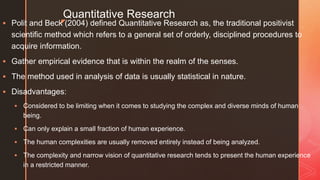
Quantitative Research
 Polit and Beck (2004) defined Quantitative Research as, the traditional positivist
scientific method which refers to a general set of orderly, disciplined procedures to
acquire information.
 Gather empirical evidence that is within the realm of the senses.
 The method used in analysis of data is usually statistical in nature.
 Disadvantages:
 Considered to be limiting when it comes to studying the complex and diverse minds of human
being.
 Can only explain a small fraction of human experience.
 The human complexities are usually removed entirely instead of being analyzed.
 The complexity and narrow vision of quantitative research tends to present the human experience
in a restricted manner.
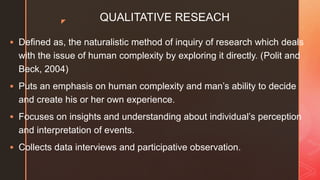
z QUALITATIVE RESEACH
 Defined as, the naturalistic method of inquiry of research which deals
with the issue of human complexity by exploring it directly. (Polit and
Beck, 2004)
 Puts an emphasis on human complexity and man’s ability to decide
and create his or her own experience.
 Focuses on insights and understanding about individual’s perception
and interpretation of events.
 Collects data interviews and participative observation.
z
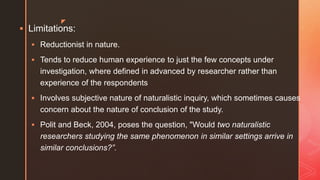
 Limitations:
 Reductionist in nature.
 Tends to reduce human experience to just the few concepts under
investigation, where defined in advanced by researcher rather than
experience of the respondents
 Involves subjective nature of naturalistic inquiry, which sometimes causes
concern about the nature of conclusion of the study.
 Polit and Beck, 2004, poses the question, "Would two naturalistic
researchers studying the same phenomenon in similar settings arrive in
similar conclusions?”.
z
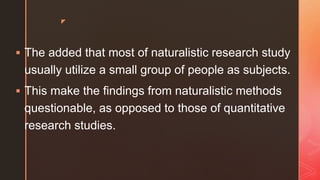
 The added that most of naturalistic research study
usually utilize a small group of people as subjects.
 This make the findings from naturalistic methods
questionable, as opposed to those of quantitative
research studies.
z
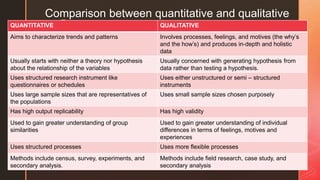
Comparison between quantitative and qualitative
QUANTITATIVE QUALITATIVE
Aims to characterize trends and patterns Involves processes, feelings, and motives (the why’s
and the how’s) and produces in-depth and holistic
data
Usually starts with neither a theory nor hypothesis
about the relationship of the variables
Usually concerned with generating hypothesis from
data rather than testing a hypothesis.
Uses structured research instrument like
questionnaires or schedules
Uses either unstructured or semi – structured
instruments
Uses large sample sizes that are representatives of
the populations
Uses small sample sizes chosen purposely
Has high output replicability Has high validity
Used to gain greater understanding of group
similarities
Used to gain greater understanding of individual
differences in terms of feelings, motives and
experiences
Uses structured processes Uses more flexible processes
Methods include census, survey, experiments, and
secondary analysis.
Methods include field research, case study, and
secondary analysis
z

Qualitative and quantatitive research methods

  • 1.
  • 2.
    zQUALITATIVE AND QUANTATITIVERESEARCH  The Research method determines the approach the researcher takes in identifying relevant data for the research, and collecting and analyzing the information gathered in the research.  Choosing either a quantitative or qualitative approach will affect the components of research.
  • 3.
    z Quantitative Research  Politand Beck (2004) defined Quantitative Research as, the traditional positivist scientific method which refers to a general set of orderly, disciplined procedures to acquire information.  Gather empirical evidence that is within the realm of the senses.  The method used in analysis of data is usually statistical in nature.  Disadvantages:  Considered to be limiting when it comes to studying the complex and diverse minds of human being.  Can only explain a small fraction of human experience.  The human complexities are usually removed entirely instead of being analyzed.  The complexity and narrow vision of quantitative research tends to present the human experience in a restricted manner.
  • 4.
    z QUALITATIVE RESEACH Defined as, the naturalistic method of inquiry of research which deals with the issue of human complexity by exploring it directly. (Polit and Beck, 2004)  Puts an emphasis on human complexity and man’s ability to decide and create his or her own experience.  Focuses on insights and understanding about individual’s perception and interpretation of events.  Collects data interviews and participative observation.
  • 5.
    z  Limitations:  Reductionistin nature.  Tends to reduce human experience to just the few concepts under investigation, where defined in advanced by researcher rather than experience of the respondents  Involves subjective nature of naturalistic inquiry, which sometimes causes concern about the nature of conclusion of the study.  Polit and Beck, 2004, poses the question, "Would two naturalistic researchers studying the same phenomenon in similar settings arrive in similar conclusions?”.
  • 6.
    z  The addedthat most of naturalistic research study usually utilize a small group of people as subjects.  This make the findings from naturalistic methods questionable, as opposed to those of quantitative research studies.
  • 7.
    z Comparison between quantitativeand qualitative QUANTITATIVE QUALITATIVE Aims to characterize trends and patterns Involves processes, feelings, and motives (the why’s and the how’s) and produces in-depth and holistic data Usually starts with neither a theory nor hypothesis about the relationship of the variables Usually concerned with generating hypothesis from data rather than testing a hypothesis. Uses structured research instrument like questionnaires or schedules Uses either unstructured or semi – structured instruments Uses large sample sizes that are representatives of the populations Uses small sample sizes chosen purposely Has high output replicability Has high validity Used to gain greater understanding of group similarities Used to gain greater understanding of individual differences in terms of feelings, motives and experiences Uses structured processes Uses more flexible processes Methods include census, survey, experiments, and secondary analysis. Methods include field research, case study, and secondary analysis
  • 8.