PRESENTED BY
BHIMSEN
 The name ‘conifer’ comes from Latin and means ‘cone bearing’.
All conifers bear their male and female reproductive organs in
separate cones (strobili) rather than in flowers.
 Trees usually bear both male and female cones. Male cones produce
pollen grains which are transported to the female cones by wind.
The seeds subsequently develop within the female cones.
 In some genera, such as Juniperus and Podocarpus, these may be
fleshy. The foliage of conifers is either needle-like (eg Pinus, Abies)
or scalelike (egCupressus, Chamaecyparis), and most conifers, with
the exception of four genera, are evergreen trees and shrubs.
 The conifers belong to the
group of seed plants known as
the gymnosperms.
Gymnosperm literally means
‘naked seed’.
 This is the main characteristic
which differentiates them from
the more advanced flowering
plants (angiosperms) which
bear their seeds encased in an
ovary that becomes the fruit.
Other gymnosperms include
ginkgo (Ginkgo biloba) and
cycads.
Conifer
Great importance is attached with the Conifers mainly because of
their utility to human being.
 Timber:
 Resin and turpentine:
 Railway sleepers:
 Newsprint paper:
 Dry fruits:
 Medicinal uses
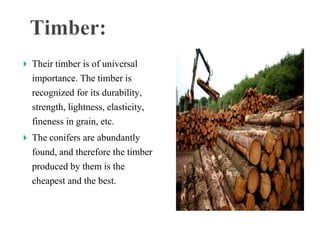
 Their timber is of universal
importance. The timber is
recognized for its durability,
strength, lightness, elasticity,
fineness in grain, etc.
 The conifers are abundantly
found, and therefore the timber
produced by them is the
cheapest and the best.
 Resin and turpentine are
obtained from the coniferous
trees on commercial scale. A
well known resin Canada
balsam is obtained from
Abies balsamia.
 It is used as mounting
medium for preparing
permanent biological slides.
They are a source of
immense revenue to the
Government of India.
Abies balsamia
 Deodar wood is the
strongest of the Indian
conifers. Its primary use is
for railway sleepers. The
average life of the sleepers
being 15 years.
Deodar wood
 A large quantity of
newsprint and other
rough paper is
obtained from the
wood of various
conifers, e.g., Abies,
Picea, Cryptomeria,
etc.
Abies Picea
Cryptomeria
 The seeds of Pinus
gerardiana are called
chilgoza which are
roasted and eaten.
Pinus gerardiana
 The turpentine obtained from the resin of all pine trees is antiseptic, diuretic, ru
befacient and vermifuge.
 It is a valuable remedy used internally in the treatment of kidney and bladde
r complaints and is used both internally and as a rub and steam bath in the tre
atment of rheumatic affections.

It is also very beneficial to the respiratory system and so is useful in treatin
g diseases of the mucous membranes and respiratory complaints such as coughs
, colds, influenza and TB.

Externally it is a very beneficial treatment for a variety of skin complaints,
wounds, sores, burns, boils etc and is used in the form of liniment plasters,
poultices, herbal steam baths and inhalers. The wood is diaphoretic and stimulan
t. It is useful in treating burning of the body, cough, fainting and ulcers
Presentation1

Presentation1

  • 1.
  • 2.
     The name‘conifer’ comes from Latin and means ‘cone bearing’. All conifers bear their male and female reproductive organs in separate cones (strobili) rather than in flowers.  Trees usually bear both male and female cones. Male cones produce pollen grains which are transported to the female cones by wind. The seeds subsequently develop within the female cones.  In some genera, such as Juniperus and Podocarpus, these may be fleshy. The foliage of conifers is either needle-like (eg Pinus, Abies) or scalelike (egCupressus, Chamaecyparis), and most conifers, with the exception of four genera, are evergreen trees and shrubs.
  • 3.
     The conifersbelong to the group of seed plants known as the gymnosperms. Gymnosperm literally means ‘naked seed’.  This is the main characteristic which differentiates them from the more advanced flowering plants (angiosperms) which bear their seeds encased in an ovary that becomes the fruit. Other gymnosperms include ginkgo (Ginkgo biloba) and cycads. Conifer
  • 4.
    Great importance isattached with the Conifers mainly because of their utility to human being.  Timber:  Resin and turpentine:  Railway sleepers:  Newsprint paper:  Dry fruits:  Medicinal uses
  • 5.
     Their timberis of universal importance. The timber is recognized for its durability, strength, lightness, elasticity, fineness in grain, etc.  The conifers are abundantly found, and therefore the timber produced by them is the cheapest and the best.
  • 6.
     Resin andturpentine are obtained from the coniferous trees on commercial scale. A well known resin Canada balsam is obtained from Abies balsamia.  It is used as mounting medium for preparing permanent biological slides. They are a source of immense revenue to the Government of India. Abies balsamia
  • 7.
     Deodar woodis the strongest of the Indian conifers. Its primary use is for railway sleepers. The average life of the sleepers being 15 years. Deodar wood
  • 8.
     A largequantity of newsprint and other rough paper is obtained from the wood of various conifers, e.g., Abies, Picea, Cryptomeria, etc. Abies Picea Cryptomeria
  • 9.
     The seedsof Pinus gerardiana are called chilgoza which are roasted and eaten. Pinus gerardiana
  • 10.
     The turpentineobtained from the resin of all pine trees is antiseptic, diuretic, ru befacient and vermifuge.  It is a valuable remedy used internally in the treatment of kidney and bladde r complaints and is used both internally and as a rub and steam bath in the tre atment of rheumatic affections.  It is also very beneficial to the respiratory system and so is useful in treatin g diseases of the mucous membranes and respiratory complaints such as coughs , colds, influenza and TB.  Externally it is a very beneficial treatment for a variety of skin complaints, wounds, sores, burns, boils etc and is used in the form of liniment plasters, poultices, herbal steam baths and inhalers. The wood is diaphoretic and stimulan t. It is useful in treating burning of the body, cough, fainting and ulcers