1
Berg • Tymoczko • Stryer
Biochemistry
Sixth Edition
Chapter 17:
Th Cit i A id C lThe Citric Acid Cycle
Copyright © 2007 by W. H. Freeman and Company
The Citric Acid Cycle
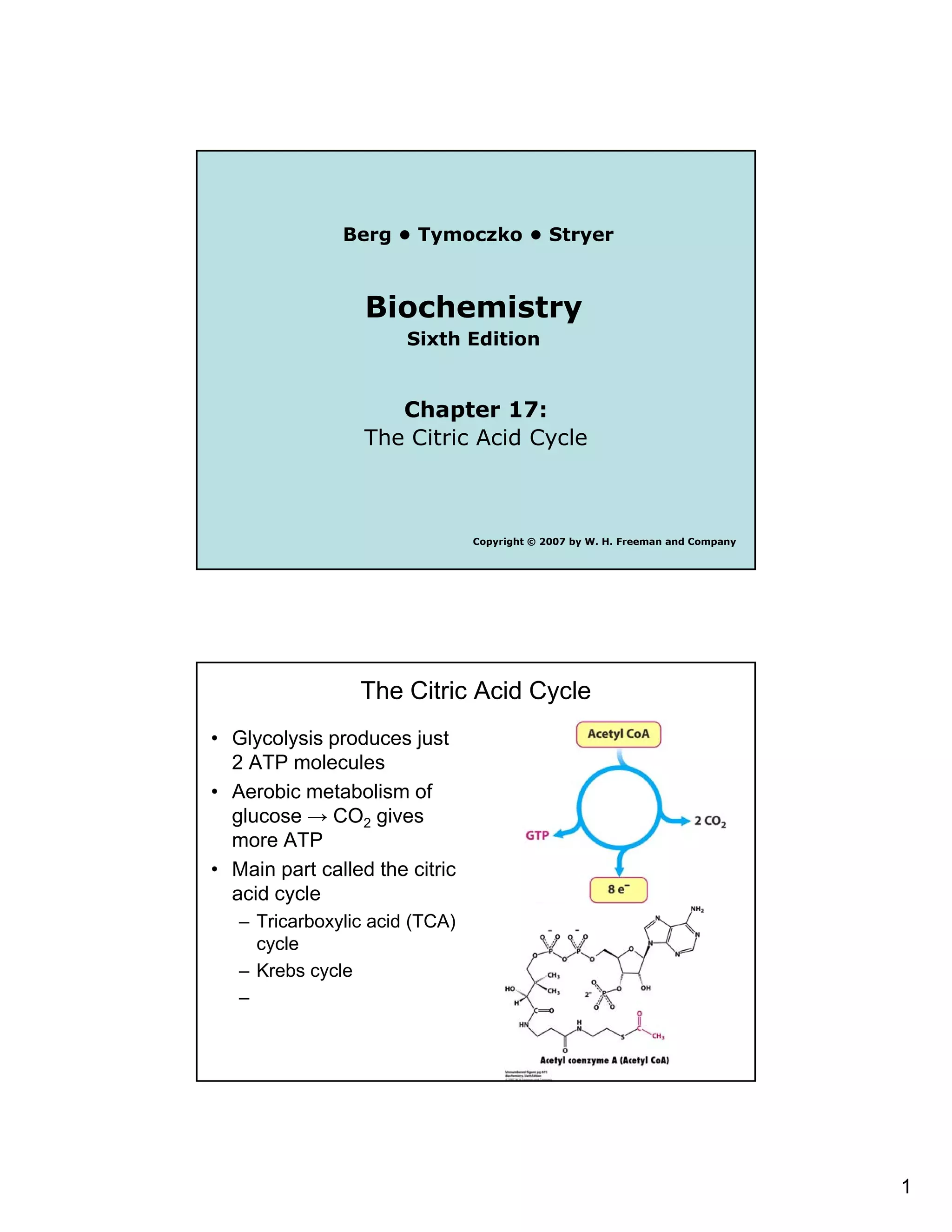
• Glycolysis produces just
2 ATP molecules
• Aerobic metabolism of
glucose → CO2 gives
more ATP
• Main part called the citric
acid cycle
– Tricarboxylic acid (TCA)
cyclecycle
– Krebs cycle
–
2
The Citric Acid Cycle
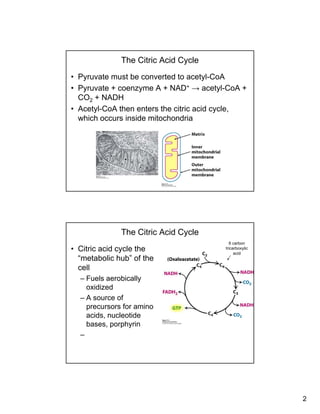
• Pyruvate must be converted to acetyl-CoA
• Pyruvate + coenzyme A + NAD+ → acetyl-CoA +
CO + NADHCO2 + NADH
• Acetyl-CoA then enters the citric acid cycle,
which occurs inside mitochondria
The Citric Acid Cycle
• Citric acid cycle the
“metabolic hub” of the
cell
6 carbon
tricarboxylic
acid
cell
– Fuels aerobically
oxidized
– A source of
precursors for amino
acids nucleotideacids, nucleotide
bases, porphyrin
–
3
The Citric Acid Cycle
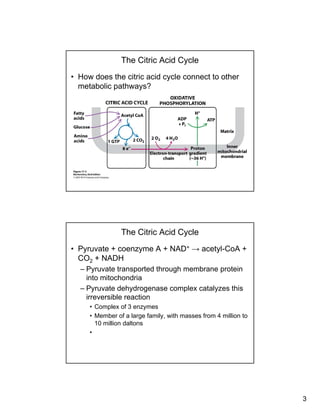
• How does the citric acid cycle connect to other
metabolic pathways?
The Citric Acid Cycle
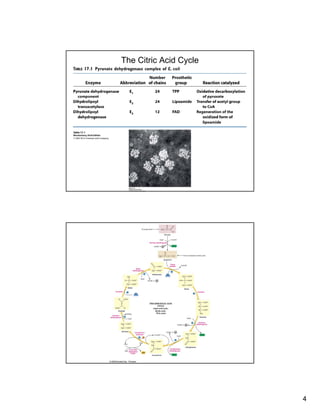
• Pyruvate + coenzyme A + NAD+ → acetyl-CoA +
CO2 + NADH
– Pyruvate transported through membrane protein– Pyruvate transported through membrane protein
into mitochondria
– Pyruvate dehydrogenase complex catalyzes this
irreversible reaction
• Complex of 3 enzymes
• Member of a large family with masses from 4 million toMember of a large family, with masses from 4 million to
10 million daltons
•
4
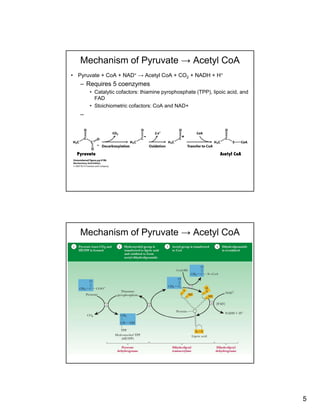
The Citric Acid Cycle
5
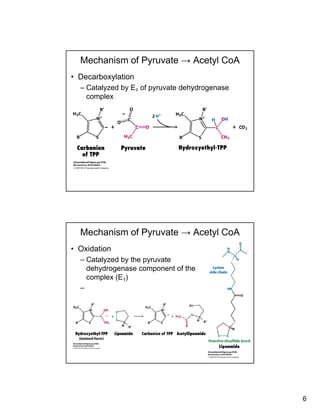
Mechanism of Pyruvate → Acetyl CoA
• Pyruvate + CoA + NAD+ → Acetyl CoA + CO2 + NADH + H+
– Requires 5 coenzymes
• Catalytic cofactors: thiamine pyrophosphate (TPP), lipoic acid, and
FADFAD
• Stoichiometric cofactors: CoA and NAD+
–
Mechanism of Pyruvate → Acetyl CoA
6
Mechanism of Pyruvate → Acetyl CoA
• Decarboxylation
– Catalyzed by E1 of pyruvate dehydrogenase
complexcomplex
Mechanism of Pyruvate → Acetyl CoA
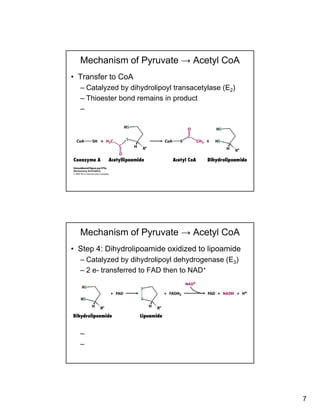
• Oxidation
– Catalyzed by the pyruvate
dehydrogenase component of thedehydrogenase component of the
complex (E1)
–
7
Mechanism of Pyruvate → Acetyl CoA
• Transfer to CoA
– Catalyzed by dihydrolipoyl transacetylase (E2)
Thioester bond remains in product– Thioester bond remains in product
–
Mechanism of Pyruvate → Acetyl CoA
• Step 4: Dihydrolipoamide oxidized to lipoamide
– Catalyzed by dihydrolipoyl dehydrogenase (E3)
2 e transferred to FAD then to NAD+– 2 e- transferred to FAD then to NAD+
–
–
8
Mechanism of Pyruvate → Acetyl CoA
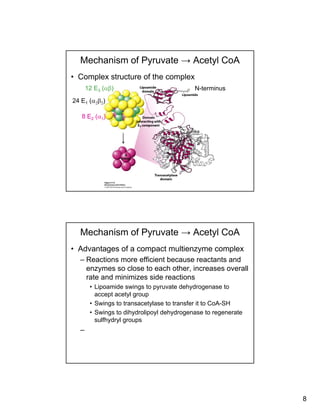
• Complex structure of the complex
12 E3 (αβ) N-terminus
24 E1 (α2β2)
8 E2 (α3)
Mechanism of Pyruvate → Acetyl CoA
• Advantages of a compact multienzyme complex
– Reactions more efficient because reactants and
enzymes so close to each other increases overallenzymes so close to each other, increases overall
rate and minimizes side reactions
• Lipoamide swings to pyruvate dehydrogenase to
accept acetyl group
• Swings to transacetylase to transfer it to CoA-SH
• Swings to dihydrolipoyl dehydrogenase to regenerate
sulfhydryl groups
–
9
Reactions of the Citric Acid Cycle
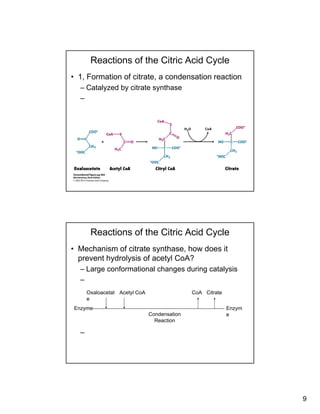
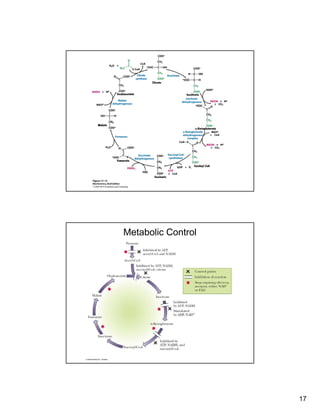
• 1, Formation of citrate, a condensation reaction
– Catalyzed by citrate synthase
–
Reactions of the Citric Acid Cycle
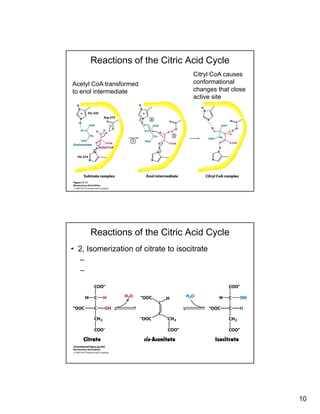
• Mechanism of citrate synthase, how does it
prevent hydrolysis of acetyl CoA?
– Large conformational changes during catalysis– Large conformational changes during catalysis
–
Oxaloacetat
e
Acetyl CoA CoA Citrate
Enzym
e
Enzyme
Condensation
–
Reaction
10
Reactions of the Citric Acid Cycle
Acetyl CoA transformed
to enol intermediate
Citryl CoA causes
conformational
changes that close
active siteactive site
Reactions of the Citric Acid Cycle
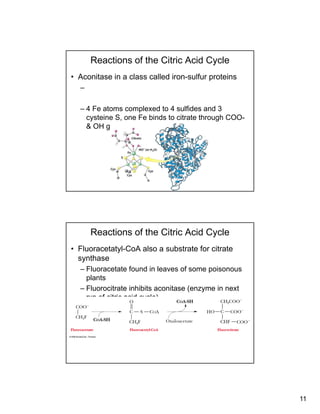
• 2, Isomerization of citrate to isocitrate
–
–
11
Reactions of the Citric Acid Cycle
• Aconitase in a class called iron-sulfur proteins
–
– 4 Fe atoms complexed to 4 sulfides and 3
cysteine S, one Fe binds to citrate through COO-
& OH groups
Reactions of the Citric Acid Cycle
• Fluoracetatyl-CoA also a substrate for citrate
synthase
– Fluoracetate found in leaves of some poisonous– Fluoracetate found in leaves of some poisonous
plants
– Fluorocitrate inhibits aconitase (enzyme in next
rxn of citric acid cycle)
12
Reactions of the Citric Acid Cycle
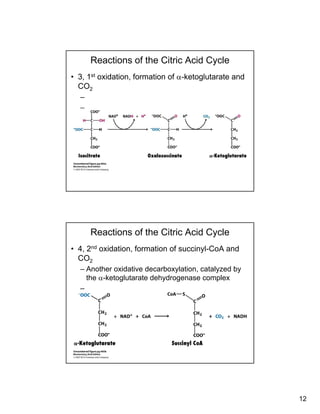
• 3, 1st oxidation, formation of α-ketoglutarate and
CO2
––
–
Reactions of the Citric Acid Cycle
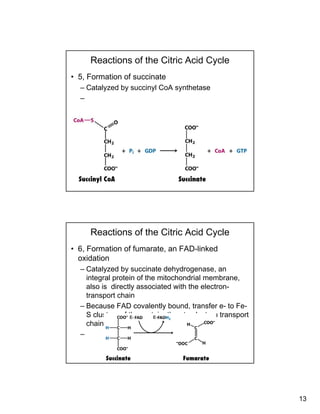
• 4, 2nd oxidation, formation of succinyl-CoA and
CO2
– Another oxidative decarboxylation catalyzed by– Another oxidative decarboxylation, catalyzed by
the α-ketoglutarate dehydrogenase complex
–
13
Reactions of the Citric Acid Cycle
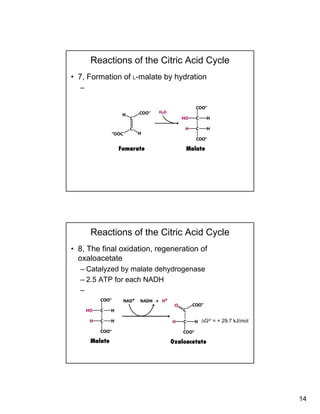
• 5, Formation of succinate
– Catalyzed by succinyl CoA synthetase
–
Reactions of the Citric Acid Cycle
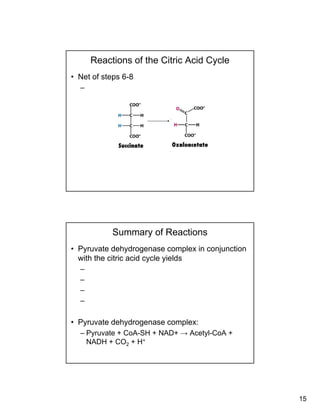
• 6, Formation of fumarate, an FAD-linked
oxidation
– Catalyzed by succinate dehydrogenase an– Catalyzed by succinate dehydrogenase, an
integral protein of the mitochondrial membrane,
also is directly associated with the electron-
transport chain
– Because FAD covalently bound, transfer e- to Fe-
S clusters of the protein, then to electron transportE ES clusters of the protein, then to electron transport
chain
–
E- E-
14
Reactions of the Citric Acid Cycle
• 7, Formation of L-malate by hydration
–
Reactions of the Citric Acid Cycle
• 8, The final oxidation, regeneration of
oxaloacetate
– Catalyzed by malate dehydrogenase– Catalyzed by malate dehydrogenase
– 2.5 ATP for each NADH
–
ΔGo’ = + 29.7 kJ/mol
15
Reactions of the Citric Acid Cycle
• Net of steps 6-8
–
Summary of Reactions
• Pyruvate dehydrogenase complex in conjunction
with the citric acid cycle yields
––
–
–
–
• Pyruvate dehydrogenase complex:
– Pyruvate + CoA-SH + NAD+ → Acetyl-CoA +
NADH + CO2 + H+
16
Summary of Reactions
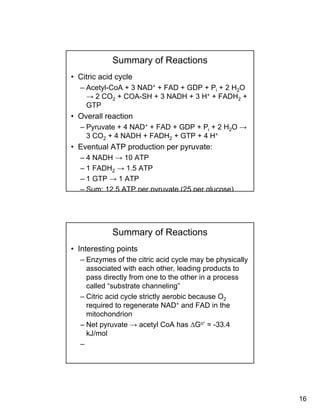
• Citric acid cycle
– Acetyl-CoA + 3 NAD+ + FAD + GDP + Pi + 2 H2O
→ 2 CO2 + COA-SH + 3 NADH + 3 H+ + FADH2 +→ 2 CO2 + COA SH + 3 NADH + 3 H + FADH2 +
GTP
• Overall reaction
– Pyruvate + 4 NAD+ + FAD + GDP + Pi + 2 H2O →
3 CO2 + 4 NADH + FADH2 + GTP + 4 H+
E t l ATP d ti t• Eventual ATP production per pyruvate:
– 4 NADH → 10 ATP
– 1 FADH2 → 1.5 ATP
– 1 GTP → 1 ATP
– Sum: 12.5 ATP per pyruvate (25 per glucose)
Summary of Reactions
• Interesting points
– Enzymes of the citric acid cycle may be physically
associated with each other leading products toassociated with each other, leading products to
pass directly from one to the other in a process
called “substrate channeling”
– Citric acid cycle strictly aerobic because O2
required to regenerate NAD+ and FAD in the
mitochondriontoc o d o
– Net pyruvate → acetyl CoA has ΔGo’ = -33.4
kJ/mol
–
17
Metabolic Control
18
Metabolic Control
• Entry into cycle & rate of cycle
tightly controlled
• Pyruvate → acetyl CoA• Pyruvate → acetyl CoA
irreversible in animals
– C oxidized to CO2 by TCA cycle
– Incorporated into lipids
• Pyruvate dehydrogenase (PDH)
complex inhibited by products
–
–
Metabolic Control
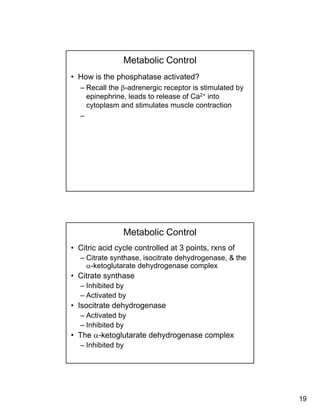
• PDH complex activated by ADP and pyruvate
–
ADP & pyruvate inhibit the kinase that turns off– ADP & pyruvate inhibit the kinase that turns off
PDH
– Both the kinase and phosphatase are associated
with the PDH complex
19
Metabolic Control
• How is the phosphatase activated?
– Recall the β-adrenergic receptor is stimulated by
epinephrine leads to release of Ca2+ intoepinephrine, leads to release of Ca into
cytoplasm and stimulates muscle contraction
–
Metabolic Control
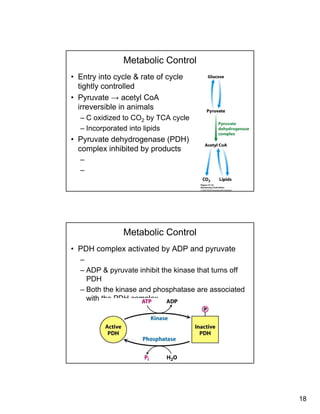
• Citric acid cycle controlled at 3 points, rxns of
– Citrate synthase, isocitrate dehydrogenase, & the
α-ketoglutarate dehydrogenase complexg y g p
• Citrate synthase
– Inhibited by
– Activated by
• Isocitrate dehydrogenase
– Activated byActivated by
– Inhibited by
• The α-ketoglutarate dehydrogenase complex
– Inhibited by
20
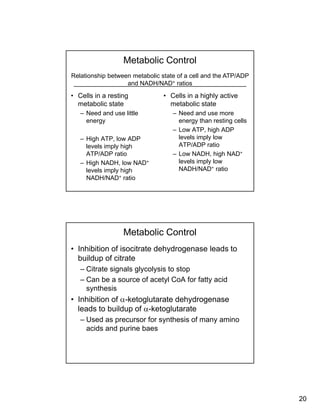
Metabolic Control
• Cells in a resting • Cells in a highly active
Relationship between metabolic state of a cell and the ATP/ADP
and NADH/NAD+ ratios
Cells in a resting
metabolic state
– Need and use little
energy
– High ATP, low ADP
l l i l hi h
Cells in a highly active
metabolic state
– Need and use more
energy than resting cells
– Low ATP, high ADP
levels imply low
ATP/ADP ratiolevels imply high
ATP/ADP ratio
– High NADH, low NAD+
levels imply high
NADH/NAD+ ratio
ATP/ADP ratio
– Low NADH, high NAD+
levels imply low
NADH/NAD+ ratio
Metabolic Control
• Inhibition of isocitrate dehydrogenase leads to
buildup of citrate
– Citrate signals glycolysis to stop– Citrate signals glycolysis to stop
– Can be a source of acetyl CoA for fatty acid
synthesis
• Inhibition of α-ketoglutarate dehydrogenase
leads to buildup of α-ketoglutarate
– Used as precursor for synthesis of many amino
acids and purine baes
21
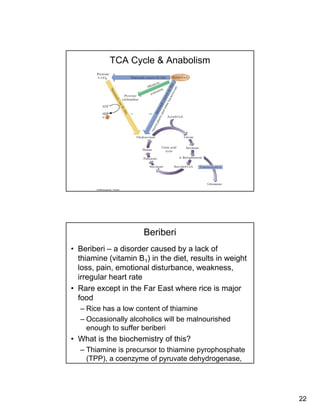
Metabolic Control
TCA Cycle & Anabolism
• Supply of cycle components need to be
replenished to keep cycle operating as they are
used for synthesisused for synthesis
– Anaplerotic reaction – reaction that replenishes a
citric acid cycle intermediate
– [Oxaloacetate] must allow acetyl-CoA to enter
cycle
In mammals Pyruvate + CO + ATP + H O →– In mammals, Pyruvate + CO2 + ATP + H2O →
oxaloacetate + ADP + Pi + 2 H+
–
22
TCA Cycle & Anabolism
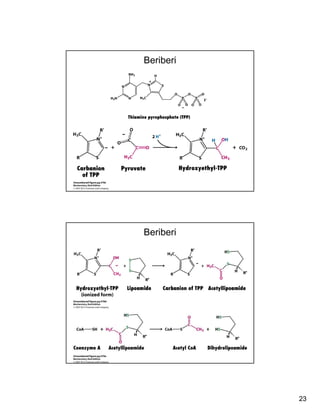
Beriberi
• Beriberi – a disorder caused by a lack of
thiamine (vitamin B1) in the diet, results in weight
loss, pain, emotional disturbance, weakness,loss, pain, emotional disturbance, weakness,
irregular heart rate
• Rare except in the Far East where rice is major
food
– Rice has a low content of thiamine
O i ll l h li ill b l i h d– Occasionally alcoholics will be malnourished
enough to suffer beriberi
• What is the biochemistry of this?
– Thiamine is precursor to thiamine pyrophosphate
(TPP), a coenzyme of pyruvate dehydrogenase,
23
Beriberi
Beriberi
24
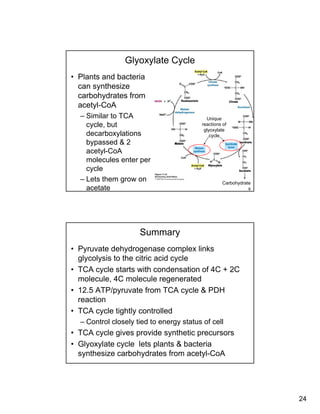
Glyoxylate Cycle
• Plants and bacteria
can synthesize
carbohydrates fromcarbohydrates from
acetyl-CoA
– Similar to TCA
cycle, but
decarboxylations
bypassed & 2
Unique
reactions of
glyoxylate
cycle
bypassed & 2
acetyl-CoA
molecules enter per
cycle
– Lets them grow on
acetate
Carbohydrate
s
Summary
• Pyruvate dehydrogenase complex links
glycolysis to the citric acid cycle
• TCA cycle starts with condensation of 4C + 2C• TCA cycle starts with condensation of 4C + 2C
molecule, 4C molecule regenerated
• 12.5 ATP/pyruvate from TCA cycle & PDH
reaction
• TCA cycle tightly controlled
– Control closely tied to energy status of cell
• TCA cycle gives provide synthetic precursors
• Glyoxylate cycle lets plants & bacteria
synthesize carbohydrates from acetyl-CoA

TCA Cycle

  • 1.
    1 Berg • Tymoczko• Stryer Biochemistry Sixth Edition Chapter 17: Th Cit i A id C lThe Citric Acid Cycle Copyright © 2007 by W. H. Freeman and Company The Citric Acid Cycle • Glycolysis produces just 2 ATP molecules • Aerobic metabolism of glucose → CO2 gives more ATP • Main part called the citric acid cycle – Tricarboxylic acid (TCA) cyclecycle – Krebs cycle –
  • 2.
    2 The Citric AcidCycle • Pyruvate must be converted to acetyl-CoA • Pyruvate + coenzyme A + NAD+ → acetyl-CoA + CO + NADHCO2 + NADH • Acetyl-CoA then enters the citric acid cycle, which occurs inside mitochondria The Citric Acid Cycle • Citric acid cycle the “metabolic hub” of the cell 6 carbon tricarboxylic acid cell – Fuels aerobically oxidized – A source of precursors for amino acids nucleotideacids, nucleotide bases, porphyrin –
  • 3.
    3 The Citric AcidCycle • How does the citric acid cycle connect to other metabolic pathways? The Citric Acid Cycle • Pyruvate + coenzyme A + NAD+ → acetyl-CoA + CO2 + NADH – Pyruvate transported through membrane protein– Pyruvate transported through membrane protein into mitochondria – Pyruvate dehydrogenase complex catalyzes this irreversible reaction • Complex of 3 enzymes • Member of a large family with masses from 4 million toMember of a large family, with masses from 4 million to 10 million daltons •
  • 4.
    4 The Citric AcidCycle The Citric Acid Cycle
  • 5.
    5 Mechanism of Pyruvate→ Acetyl CoA • Pyruvate + CoA + NAD+ → Acetyl CoA + CO2 + NADH + H+ – Requires 5 coenzymes • Catalytic cofactors: thiamine pyrophosphate (TPP), lipoic acid, and FADFAD • Stoichiometric cofactors: CoA and NAD+ – Mechanism of Pyruvate → Acetyl CoA
  • 6.
    6 Mechanism of Pyruvate→ Acetyl CoA • Decarboxylation – Catalyzed by E1 of pyruvate dehydrogenase complexcomplex Mechanism of Pyruvate → Acetyl CoA • Oxidation – Catalyzed by the pyruvate dehydrogenase component of thedehydrogenase component of the complex (E1) –
  • 7.
    7 Mechanism of Pyruvate→ Acetyl CoA • Transfer to CoA – Catalyzed by dihydrolipoyl transacetylase (E2) Thioester bond remains in product– Thioester bond remains in product – Mechanism of Pyruvate → Acetyl CoA • Step 4: Dihydrolipoamide oxidized to lipoamide – Catalyzed by dihydrolipoyl dehydrogenase (E3) 2 e transferred to FAD then to NAD+– 2 e- transferred to FAD then to NAD+ – –
  • 8.
    8 Mechanism of Pyruvate→ Acetyl CoA • Complex structure of the complex 12 E3 (αβ) N-terminus 24 E1 (α2β2) 8 E2 (α3) Mechanism of Pyruvate → Acetyl CoA • Advantages of a compact multienzyme complex – Reactions more efficient because reactants and enzymes so close to each other increases overallenzymes so close to each other, increases overall rate and minimizes side reactions • Lipoamide swings to pyruvate dehydrogenase to accept acetyl group • Swings to transacetylase to transfer it to CoA-SH • Swings to dihydrolipoyl dehydrogenase to regenerate sulfhydryl groups –
  • 9.
    9 Reactions of theCitric Acid Cycle • 1, Formation of citrate, a condensation reaction – Catalyzed by citrate synthase – Reactions of the Citric Acid Cycle • Mechanism of citrate synthase, how does it prevent hydrolysis of acetyl CoA? – Large conformational changes during catalysis– Large conformational changes during catalysis – Oxaloacetat e Acetyl CoA CoA Citrate Enzym e Enzyme Condensation – Reaction
  • 10.
    10 Reactions of theCitric Acid Cycle Acetyl CoA transformed to enol intermediate Citryl CoA causes conformational changes that close active siteactive site Reactions of the Citric Acid Cycle • 2, Isomerization of citrate to isocitrate – –
  • 11.
    11 Reactions of theCitric Acid Cycle • Aconitase in a class called iron-sulfur proteins – – 4 Fe atoms complexed to 4 sulfides and 3 cysteine S, one Fe binds to citrate through COO- & OH groups Reactions of the Citric Acid Cycle • Fluoracetatyl-CoA also a substrate for citrate synthase – Fluoracetate found in leaves of some poisonous– Fluoracetate found in leaves of some poisonous plants – Fluorocitrate inhibits aconitase (enzyme in next rxn of citric acid cycle)
  • 12.
    12 Reactions of theCitric Acid Cycle • 3, 1st oxidation, formation of α-ketoglutarate and CO2 –– – Reactions of the Citric Acid Cycle • 4, 2nd oxidation, formation of succinyl-CoA and CO2 – Another oxidative decarboxylation catalyzed by– Another oxidative decarboxylation, catalyzed by the α-ketoglutarate dehydrogenase complex –
  • 13.
    13 Reactions of theCitric Acid Cycle • 5, Formation of succinate – Catalyzed by succinyl CoA synthetase – Reactions of the Citric Acid Cycle • 6, Formation of fumarate, an FAD-linked oxidation – Catalyzed by succinate dehydrogenase an– Catalyzed by succinate dehydrogenase, an integral protein of the mitochondrial membrane, also is directly associated with the electron- transport chain – Because FAD covalently bound, transfer e- to Fe- S clusters of the protein, then to electron transportE ES clusters of the protein, then to electron transport chain – E- E-
  • 14.
    14 Reactions of theCitric Acid Cycle • 7, Formation of L-malate by hydration – Reactions of the Citric Acid Cycle • 8, The final oxidation, regeneration of oxaloacetate – Catalyzed by malate dehydrogenase– Catalyzed by malate dehydrogenase – 2.5 ATP for each NADH – ΔGo’ = + 29.7 kJ/mol
  • 15.
    15 Reactions of theCitric Acid Cycle • Net of steps 6-8 – Summary of Reactions • Pyruvate dehydrogenase complex in conjunction with the citric acid cycle yields –– – – – • Pyruvate dehydrogenase complex: – Pyruvate + CoA-SH + NAD+ → Acetyl-CoA + NADH + CO2 + H+
  • 16.
    16 Summary of Reactions •Citric acid cycle – Acetyl-CoA + 3 NAD+ + FAD + GDP + Pi + 2 H2O → 2 CO2 + COA-SH + 3 NADH + 3 H+ + FADH2 +→ 2 CO2 + COA SH + 3 NADH + 3 H + FADH2 + GTP • Overall reaction – Pyruvate + 4 NAD+ + FAD + GDP + Pi + 2 H2O → 3 CO2 + 4 NADH + FADH2 + GTP + 4 H+ E t l ATP d ti t• Eventual ATP production per pyruvate: – 4 NADH → 10 ATP – 1 FADH2 → 1.5 ATP – 1 GTP → 1 ATP – Sum: 12.5 ATP per pyruvate (25 per glucose) Summary of Reactions • Interesting points – Enzymes of the citric acid cycle may be physically associated with each other leading products toassociated with each other, leading products to pass directly from one to the other in a process called “substrate channeling” – Citric acid cycle strictly aerobic because O2 required to regenerate NAD+ and FAD in the mitochondriontoc o d o – Net pyruvate → acetyl CoA has ΔGo’ = -33.4 kJ/mol –
  • 17.
  • 18.
    18 Metabolic Control • Entryinto cycle & rate of cycle tightly controlled • Pyruvate → acetyl CoA• Pyruvate → acetyl CoA irreversible in animals – C oxidized to CO2 by TCA cycle – Incorporated into lipids • Pyruvate dehydrogenase (PDH) complex inhibited by products – – Metabolic Control • PDH complex activated by ADP and pyruvate – ADP & pyruvate inhibit the kinase that turns off– ADP & pyruvate inhibit the kinase that turns off PDH – Both the kinase and phosphatase are associated with the PDH complex
  • 19.
    19 Metabolic Control • Howis the phosphatase activated? – Recall the β-adrenergic receptor is stimulated by epinephrine leads to release of Ca2+ intoepinephrine, leads to release of Ca into cytoplasm and stimulates muscle contraction – Metabolic Control • Citric acid cycle controlled at 3 points, rxns of – Citrate synthase, isocitrate dehydrogenase, & the α-ketoglutarate dehydrogenase complexg y g p • Citrate synthase – Inhibited by – Activated by • Isocitrate dehydrogenase – Activated byActivated by – Inhibited by • The α-ketoglutarate dehydrogenase complex – Inhibited by
  • 20.
    20 Metabolic Control • Cellsin a resting • Cells in a highly active Relationship between metabolic state of a cell and the ATP/ADP and NADH/NAD+ ratios Cells in a resting metabolic state – Need and use little energy – High ATP, low ADP l l i l hi h Cells in a highly active metabolic state – Need and use more energy than resting cells – Low ATP, high ADP levels imply low ATP/ADP ratiolevels imply high ATP/ADP ratio – High NADH, low NAD+ levels imply high NADH/NAD+ ratio ATP/ADP ratio – Low NADH, high NAD+ levels imply low NADH/NAD+ ratio Metabolic Control • Inhibition of isocitrate dehydrogenase leads to buildup of citrate – Citrate signals glycolysis to stop– Citrate signals glycolysis to stop – Can be a source of acetyl CoA for fatty acid synthesis • Inhibition of α-ketoglutarate dehydrogenase leads to buildup of α-ketoglutarate – Used as precursor for synthesis of many amino acids and purine baes
  • 21.
    21 Metabolic Control TCA Cycle& Anabolism • Supply of cycle components need to be replenished to keep cycle operating as they are used for synthesisused for synthesis – Anaplerotic reaction – reaction that replenishes a citric acid cycle intermediate – [Oxaloacetate] must allow acetyl-CoA to enter cycle In mammals Pyruvate + CO + ATP + H O →– In mammals, Pyruvate + CO2 + ATP + H2O → oxaloacetate + ADP + Pi + 2 H+ –
  • 22.
    22 TCA Cycle &Anabolism Beriberi • Beriberi – a disorder caused by a lack of thiamine (vitamin B1) in the diet, results in weight loss, pain, emotional disturbance, weakness,loss, pain, emotional disturbance, weakness, irregular heart rate • Rare except in the Far East where rice is major food – Rice has a low content of thiamine O i ll l h li ill b l i h d– Occasionally alcoholics will be malnourished enough to suffer beriberi • What is the biochemistry of this? – Thiamine is precursor to thiamine pyrophosphate (TPP), a coenzyme of pyruvate dehydrogenase,
  • 23.
  • 24.
    24 Glyoxylate Cycle • Plantsand bacteria can synthesize carbohydrates fromcarbohydrates from acetyl-CoA – Similar to TCA cycle, but decarboxylations bypassed & 2 Unique reactions of glyoxylate cycle bypassed & 2 acetyl-CoA molecules enter per cycle – Lets them grow on acetate Carbohydrate s Summary • Pyruvate dehydrogenase complex links glycolysis to the citric acid cycle • TCA cycle starts with condensation of 4C + 2C• TCA cycle starts with condensation of 4C + 2C molecule, 4C molecule regenerated • 12.5 ATP/pyruvate from TCA cycle & PDH reaction • TCA cycle tightly controlled – Control closely tied to energy status of cell • TCA cycle gives provide synthetic precursors • Glyoxylate cycle lets plants & bacteria synthesize carbohydrates from acetyl-CoA