Practicing what we preach
usage-centered approaches to
designing effective deliverables
Aviva Rosenstein, PhD
Salesforce.com
arosenstein@salesforce.com


Twitter: @uxresearch
Design Deliverables
• documentation or artifacts from
  the UX design process
• NOT the final product of the
  design process
• created in order to help make
  something happen
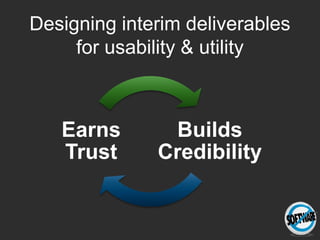
Designing interim deliverables
     for usability & utility


   Earns       Builds
   Trust      Credibility
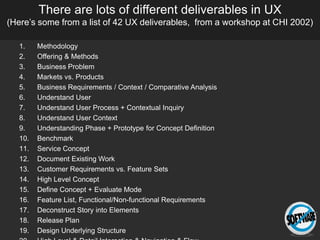
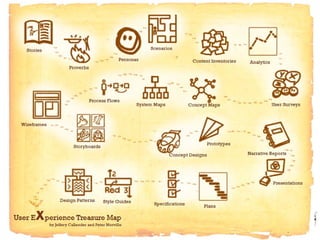
There are lots of different deliverables in UX
(Here’s some from a list of 42 UX deliverables, from a workshop at CHI 2002)

   1.    Methodology
   2.    Offering & Methods
   3.    Business Problem
   4.    Markets vs. Products
   5.    Business Requirements / Context / Comparative Analysis
   6.    Understand User
   7.    Understand User Process + Contextual Inquiry
   8.    Understand User Context
   9.    Understanding Phase + Prototype for Concept Definition
   10.   Benchmark
   11.   Service Concept
   12.   Document Existing Work
   13.   Customer Requirements vs. Feature Sets
   14.   High Level Concept
   15.   Define Concept + Evaluate Mode
   16.   Feature List, Functional/Non-functional Requirements
   17.   Deconstruct Story into Elements
   18.   Release Plan
   19.   Design Underlying Structure
No cookie
  cutter
solutions,
  today.
Agenda:
1) Define framework
   for identifying
   deliverable design
   criteria
2) Try it out
3) Share findings
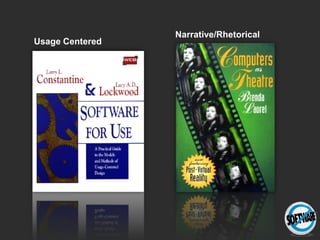
Narrative/Rhetorical
Usage Centered
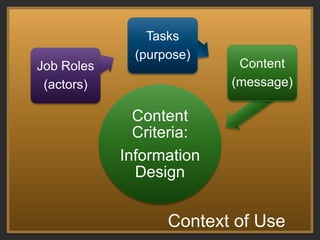
Tasks
              (purpose)
Job Roles                  Content
 (actors)                 (message)

              Content
              Criteria:
            Information
              Design


                   Context of Use
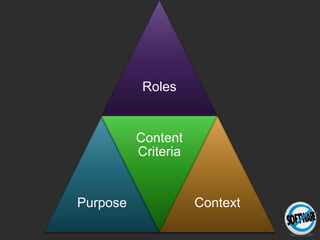
Roles


          Content
          Criteria


Purpose              Context
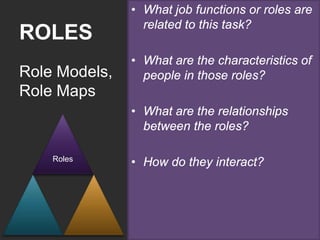
• What job functions or roles are
                 related to this task?
ROLES
               • What are the characteristics of
Role Models,     people in those roles?
Role Maps
               • What are the relationships
                 between the roles?

    Roles
               • How do they interact?
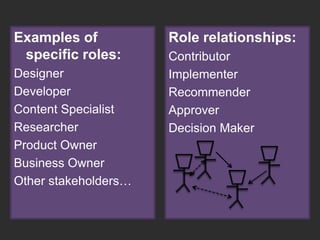
Examples of           Role relationships:
 specific roles:      Contributor
Designer              Implementer
Developer             Recommender
Content Specialist    Approver
Researcher            Decision Maker
Product Owner
Business Owner
Other stakeholders…
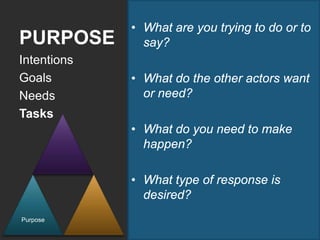
• What are you trying to do or to
PURPOSE        say?
Intentions
Goals        • What do the other actors want
Needs          or need?
Tasks
             • What do you need to make
               happen?

             • What type of response is
               desired?
Purpose
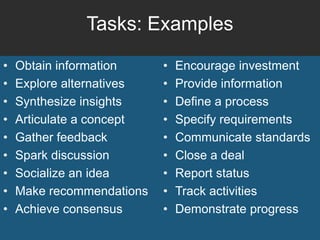
Tasks: Examples

•   Obtain information     •   Encourage investment
•   Explore alternatives   •   Provide information
•   Synthesize insights    •   Define a process
•   Articulate a concept   •   Specify requirements
•   Gather feedback        •   Communicate standards
•   Spark discussion       •   Close a deal
•   Socialize an idea      •   Report status
•   Make recommendations   •   Track activities
•   Achieve consensus      •   Demonstrate progress
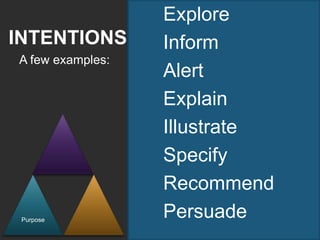
Explore
INTENTIONS        Inform
A few examples:
                  Alert
                  Explain
                  Illustrate
                  Specify
                  Recommend
 Purpose
                  Persuade
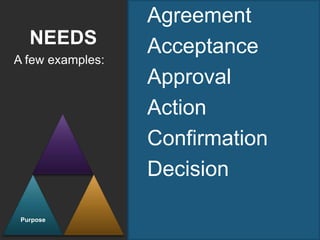
Agreement
   NEEDS          Acceptance
A few examples:
                  Approval
                  Action
                  Confirmation
                  Decision

 Purpose
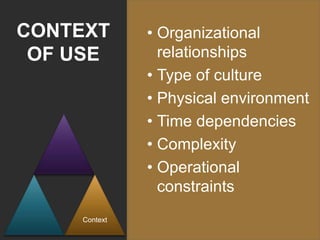
CONTEXT       • Organizational
 OF USE         relationships
              • Type of culture
              • Physical environment
              • Time dependencies
              • Complexity
              • Operational
                constraints
    Context
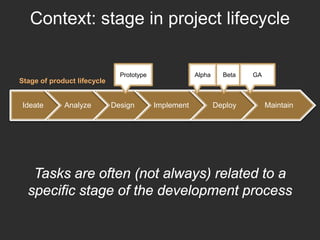
Context: stage in project lifecycle

                               Prototype               Alpha     Beta   GA
Stage of product lifecycle


Ideate       Analyze         Design        Implement           Deploy        Maintain


   Tasks are often (not always) related to a
  specific stage of the development process
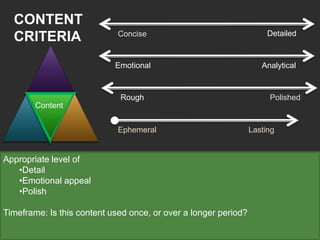
CONTENT
                             Concise                                  Detailed
  CRITERIA
                            Emotional                               Analytical


                             Rough                                    Polished
        Content


                             Ephemeral                           Lasting


Appropriate level of
   •Detail
   •Emotional appeal
   •Polish

Timeframe: Is this content used once, or over a longer period?
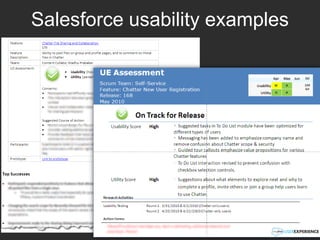
Salesforce usability examples
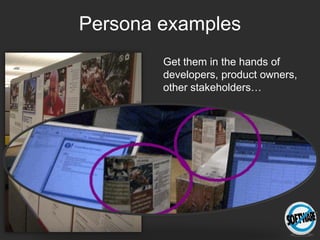
Persona examples
        Get them in the hands of
        developers, product owners,
        other stakeholders…
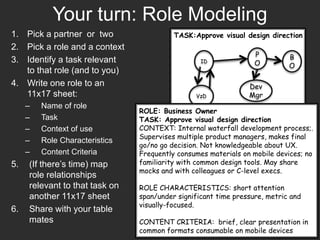
Your turn: Role Modeling
1. Pick a partner or two                  TASK:Approve visual design direction
2. Pick a role and a context
                                                                  P         B
3. Identify a task relevant                       ID              O         O
   to that role (and to you)
4. Write one role to an                                         Dev
   11x17 sheet:                                 VzD             Mgr
     –   Name of role
                                ROLE: Business Owner
     –   Task                   TASK: Approve visual design direction
     –   Context of use         CONTEXT: Internal waterfall development process;.
                                Supervises multiple product managers, makes final
     –   Role Characteristics
                                go/no go decision. Not knowledgeable about UX.
     –   Content Criteria       Frequently consumes materials on mobile devices; no
5.   (If there’s time) map      familiarity with common design tools. May share
                                mocks and with colleagues or C-level execs.
     role relationships
     relevant to that task on   ROLE CHARACTERISTICS: short attention
     another 11x17 sheet        span/under significant time pressure, metric and
                                visually-focused.
6.   Share with your table
     mates                      CONTENT CRITERIA: brief, clear presentation in
                                common formats consumable on mobile devices
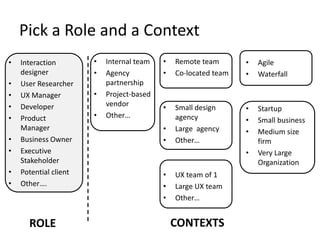
Pick a Role and a Context
•   Interaction        •   Internal team   •   Remote team       •   Agile
    designer           •   Agency          •   Co-located team   •   Waterfall
•   User Researcher        partnership
•   UX Manager         •   Project-based
•   Developer              vendor              Small design
                                           •                     •   Startup
•   Product            •   Other…              agency            •   Small business
    Manager                                •   Large agency      •   Medium size
•   Business Owner                         •   Other…                firm
•   Executive                                                    •   Very Large
    Stakeholder                                                      Organization
•   Potential client                       •   UX team of 1
•   Other….                                •   Large UX team
                                           •   Other…


      ROLE                                     CONTEXTS
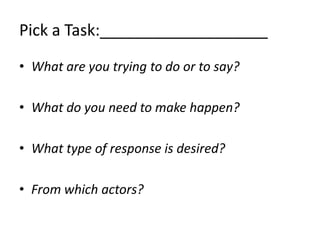
Pick a Task:___________________
• What are you trying to do or to say?

• What do you need to make happen?

• What type of response is desired?

• From which actors?
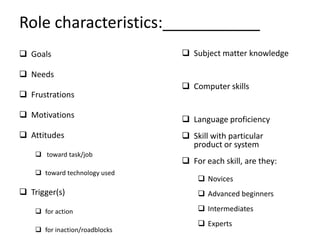
Role characteristics:___________
 Goals                          Subject matter knowledge

 Needs
                                 Computer skills
 Frustrations

 Motivations
                                 Language proficiency
 Attitudes                      Skill with particular
                                  product or system
     toward task/job
                                 For each skill, are they:
     toward technology used
                                     Novices
 Trigger(s)                         Advanced beginners

     for action                     Intermediates
                                     Experts
     for inaction/roadblocks
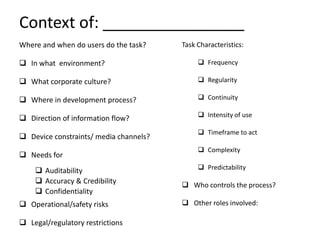
Context of: ________________
Where and when do users do the task?    Task Characteristics:

 In what environment?                        Frequency

 What corporate culture?                     Regularity

 Where in development process?               Continuity

                                              Intensity of use
 Direction of information flow?
                                              Timeframe to act
 Device constraints/ media channels?
                                              Complexity
 Needs for
     Auditability                            Predictability
     Accuracy & Credibility             Who controls the process?
     Confidentiality
 Operational/safety risks               Other roles involved:

 Legal/regulatory restrictions
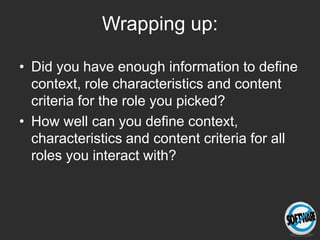
Wrapping up:

• Did you have enough information to define
  context, role characteristics and content
  criteria for the role you picked?
• How well can you define context,
  characteristics and content criteria for all
  roles you interact with?
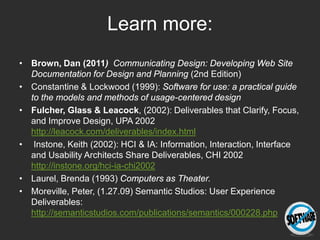
Learn more:
• Brown, Dan (2011) Communicating Design: Developing Web Site
  Documentation for Design and Planning (2nd Edition)
• Constantine & Lockwood (1999): Software for use: a practical guide
  to the models and methods of usage-centered design
• Fulcher, Glass & Leacock, (2002): Deliverables that Clarify, Focus,
  and Improve Design, UPA 2002
  http://leacock.com/deliverables/index.html
• Instone, Keith (2002): HCI & IA: Information, Interaction, Interface
  and Usability Architects Share Deliverables, CHI 2002
  http://instone.org/hci-ia-chi2002
• Laurel, Brenda (1993) Computers as Theater.
• Moreville, Peter, (1.27.09) Semantic Studios: User Experience
  Deliverables:
  http://semanticstudios.com/publications/semantics/000228.php
Talk the talk                       Walk the walk

                     UX


       Aviva Rosenstein, PhD
       Salesforce.com               Twitter: @uxresearch
       arosenstein@salesforce.com

Practicing What We Preach: designing usage centered deliverables

  • 1.
    Practicing what wepreach usage-centered approaches to designing effective deliverables Aviva Rosenstein, PhD Salesforce.com arosenstein@salesforce.com Twitter: @uxresearch
  • 2.
    Design Deliverables • documentationor artifacts from the UX design process • NOT the final product of the design process • created in order to help make something happen
  • 3.
    Designing interim deliverables for usability & utility Earns Builds Trust Credibility
  • 4.
    There are lotsof different deliverables in UX (Here’s some from a list of 42 UX deliverables, from a workshop at CHI 2002) 1. Methodology 2. Offering & Methods 3. Business Problem 4. Markets vs. Products 5. Business Requirements / Context / Comparative Analysis 6. Understand User 7. Understand User Process + Contextual Inquiry 8. Understand User Context 9. Understanding Phase + Prototype for Concept Definition 10. Benchmark 11. Service Concept 12. Document Existing Work 13. Customer Requirements vs. Feature Sets 14. High Level Concept 15. Define Concept + Evaluate Mode 16. Feature List, Functional/Non-functional Requirements 17. Deconstruct Story into Elements 18. Release Plan 19. Design Underlying Structure
  • 6.
    No cookie cutter solutions, today. Agenda: 1) Define framework for identifying deliverable design criteria 2) Try it out 3) Share findings
  • 7.
  • 8.
    Tasks (purpose) Job Roles Content (actors) (message) Content Criteria: Information Design Context of Use
  • 9.
    Roles Content Criteria Purpose Context
  • 10.
    • What jobfunctions or roles are related to this task? ROLES • What are the characteristics of Role Models, people in those roles? Role Maps • What are the relationships between the roles? Roles • How do they interact?
  • 11.
    Examples of Role relationships: specific roles: Contributor Designer Implementer Developer Recommender Content Specialist Approver Researcher Decision Maker Product Owner Business Owner Other stakeholders…
  • 12.
    • What areyou trying to do or to PURPOSE say? Intentions Goals • What do the other actors want Needs or need? Tasks • What do you need to make happen? • What type of response is desired? Purpose
  • 13.
    Tasks: Examples • Obtain information • Encourage investment • Explore alternatives • Provide information • Synthesize insights • Define a process • Articulate a concept • Specify requirements • Gather feedback • Communicate standards • Spark discussion • Close a deal • Socialize an idea • Report status • Make recommendations • Track activities • Achieve consensus • Demonstrate progress
  • 14.
    Explore INTENTIONS Inform A few examples: Alert Explain Illustrate Specify Recommend Purpose Persuade
  • 15.
    Agreement NEEDS Acceptance A few examples: Approval Action Confirmation Decision Purpose
  • 16.
    CONTEXT • Organizational OF USE relationships • Type of culture • Physical environment • Time dependencies • Complexity • Operational constraints Context
  • 17.
    Context: stage inproject lifecycle Prototype Alpha Beta GA Stage of product lifecycle Ideate Analyze Design Implement Deploy Maintain Tasks are often (not always) related to a specific stage of the development process
  • 18.
    CONTENT Concise Detailed CRITERIA Emotional Analytical Rough Polished Content Ephemeral Lasting Appropriate level of •Detail •Emotional appeal •Polish Timeframe: Is this content used once, or over a longer period?
  • 19.
  • 20.
    Persona examples Get them in the hands of developers, product owners, other stakeholders…
  • 21.
    Your turn: RoleModeling 1. Pick a partner or two TASK:Approve visual design direction 2. Pick a role and a context P B 3. Identify a task relevant ID O O to that role (and to you) 4. Write one role to an Dev 11x17 sheet: VzD Mgr – Name of role ROLE: Business Owner – Task TASK: Approve visual design direction – Context of use CONTEXT: Internal waterfall development process;. Supervises multiple product managers, makes final – Role Characteristics go/no go decision. Not knowledgeable about UX. – Content Criteria Frequently consumes materials on mobile devices; no 5. (If there’s time) map familiarity with common design tools. May share mocks and with colleagues or C-level execs. role relationships relevant to that task on ROLE CHARACTERISTICS: short attention another 11x17 sheet span/under significant time pressure, metric and visually-focused. 6. Share with your table mates CONTENT CRITERIA: brief, clear presentation in common formats consumable on mobile devices
  • 22.
    Pick a Roleand a Context • Interaction • Internal team • Remote team • Agile designer • Agency • Co-located team • Waterfall • User Researcher partnership • UX Manager • Project-based • Developer vendor Small design • • Startup • Product • Other… agency • Small business Manager • Large agency • Medium size • Business Owner • Other… firm • Executive • Very Large Stakeholder Organization • Potential client • UX team of 1 • Other…. • Large UX team • Other… ROLE CONTEXTS
  • 23.
    Pick a Task:___________________ •What are you trying to do or to say? • What do you need to make happen? • What type of response is desired? • From which actors?
  • 24.
    Role characteristics:___________  Goals  Subject matter knowledge  Needs  Computer skills  Frustrations  Motivations  Language proficiency  Attitudes  Skill with particular product or system  toward task/job  For each skill, are they:  toward technology used  Novices  Trigger(s)  Advanced beginners  for action  Intermediates  Experts  for inaction/roadblocks
  • 25.
    Context of: ________________ Whereand when do users do the task? Task Characteristics:  In what environment?  Frequency  What corporate culture?  Regularity  Where in development process?  Continuity  Intensity of use  Direction of information flow?  Timeframe to act  Device constraints/ media channels?  Complexity  Needs for  Auditability  Predictability  Accuracy & Credibility  Who controls the process?  Confidentiality  Operational/safety risks  Other roles involved:  Legal/regulatory restrictions
  • 26.
    Wrapping up: • Didyou have enough information to define context, role characteristics and content criteria for the role you picked? • How well can you define context, characteristics and content criteria for all roles you interact with?
  • 27.
    Learn more: • Brown,Dan (2011) Communicating Design: Developing Web Site Documentation for Design and Planning (2nd Edition) • Constantine & Lockwood (1999): Software for use: a practical guide to the models and methods of usage-centered design • Fulcher, Glass & Leacock, (2002): Deliverables that Clarify, Focus, and Improve Design, UPA 2002 http://leacock.com/deliverables/index.html • Instone, Keith (2002): HCI & IA: Information, Interaction, Interface and Usability Architects Share Deliverables, CHI 2002 http://instone.org/hci-ia-chi2002 • Laurel, Brenda (1993) Computers as Theater. • Moreville, Peter, (1.27.09) Semantic Studios: User Experience Deliverables: http://semanticstudios.com/publications/semantics/000228.php
  • 28.
    Talk the talk Walk the walk UX Aviva Rosenstein, PhD Salesforce.com Twitter: @uxresearch arosenstein@salesforce.com