Intravenous therapy
By-
Dr. ASHOK DHAKA BISHNOI
Director, JINC
 It is the administration of fluid in to blood stream
by I/V catheter or butterfly needle inserted in to a
peripheral vein replace water, Electrolyte &
Nutrients
Introduction:-
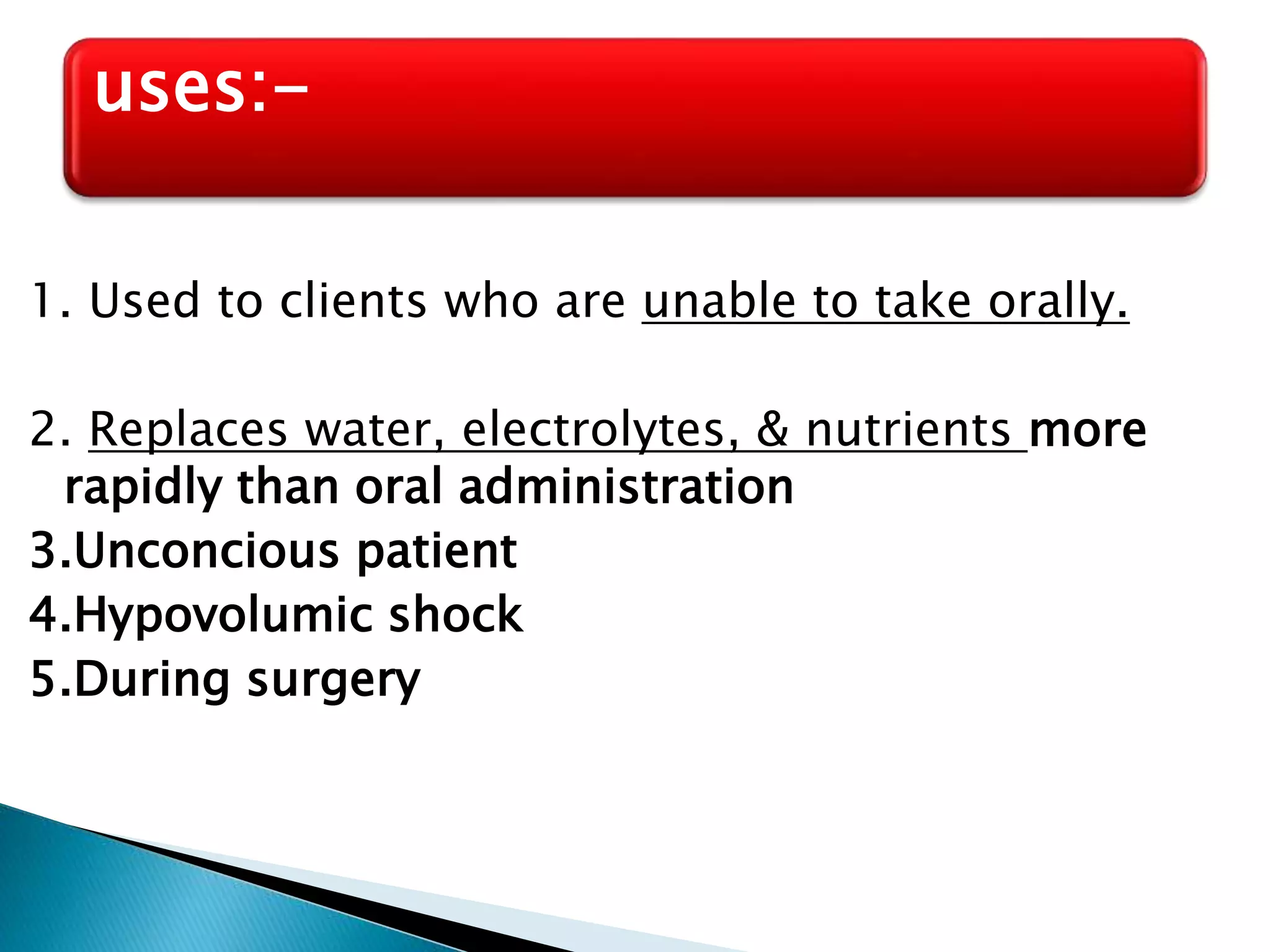
1. Used to clients who are unable to take orally.
2. Replaces water, electrolytes, & nutrients more
rapidly than oral administration
3.Unconcious patient
4.Hypovolumic shock
5.During surgery
uses:-
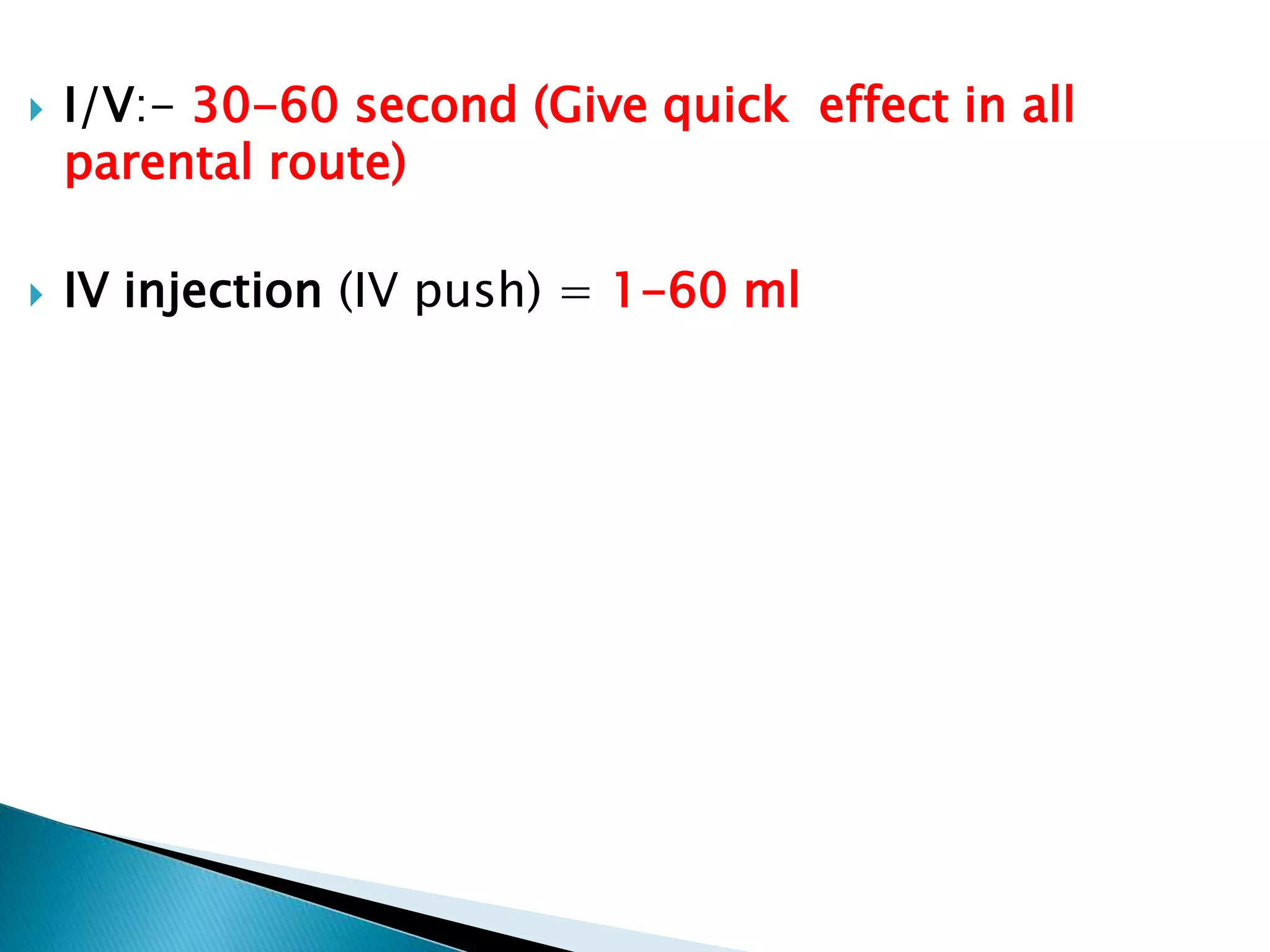
 I/V:- 30-60 second (Give quick effect in all
parental route)
 IV injection (IV push) = 1-60 ml
Types of solutions:
1. Hypertonic solutions
2. Hpotonic solution
3. Isotonic solution
Osmolality:- Concentration of a solution expressed as the total
number of solute particles per kilogram.
270-300 Mosm/kg water
Osmolarity :-the concentration of a solution expressed as the
total number of solute particles per litre.
 Measured by Osmometer.
Osmoler Gap :-Deference B/W Osmolality & Osmolarity
normal osmol gap is < 10 mOsm/kg .
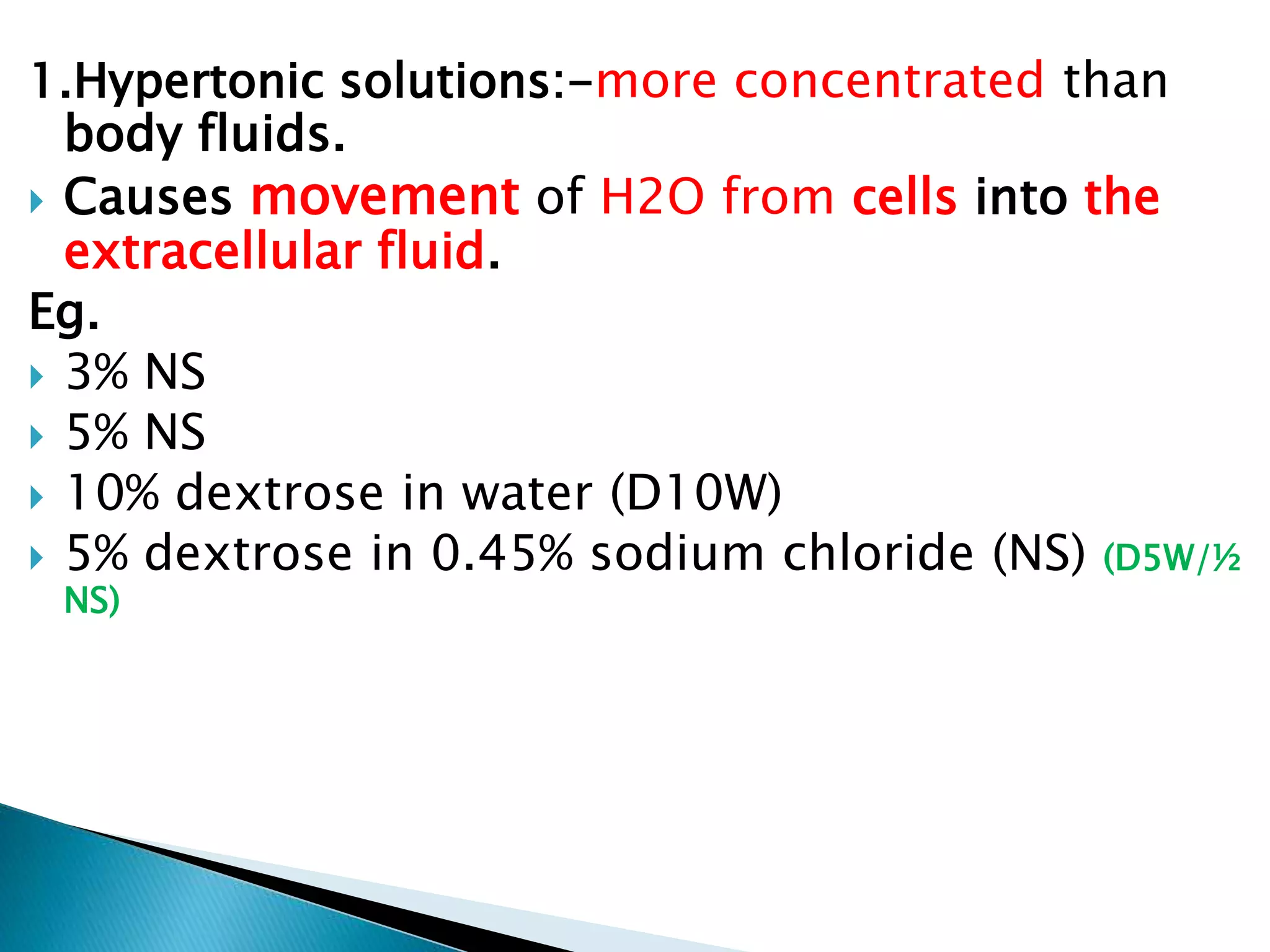
1.Hypertonic solutions:-more concentrated than
body fluids.
 Causes movement of H2O from cells into the
extracellular fluid.
Eg.
 3% NS
 5% NS
 10% dextrose in water (D10W)
 5% dextrose in 0.45% sodium chloride (NS) (D5W/½
NS)
2.Hypotonic solution:-Solutions that are more dilute or have a lower
osmolality than body fluids.
 Causes movement of water into cells by osmosis.
 Administer slowly to prevent edema.
Eg.
 0.45% sodium chloride (NS ); (½ NS) Osmolarity of 154 mOsmol/L
 0.225% sodium chloride (NS); (¼ NS)
 0.33% sodium chloride (NS); (⅓ NS)

3.Isotonic solution:-Solution that have the same
osmolality as body fluids.
 It increases extracellular fluid volume.
 These solutions do not enter the cells because no
osmotic force exists to shift the fluids.
 Eg.
 0.9% sodium chloride (NS); (0.9% NS)
 5% dextrose in water (D5W)
 5% dextrose in 0.225% saline (D5W/¼ NS)
 Lactated Ringer’s (LR)/Sodium lactate solution / Hartmann's
solution
.
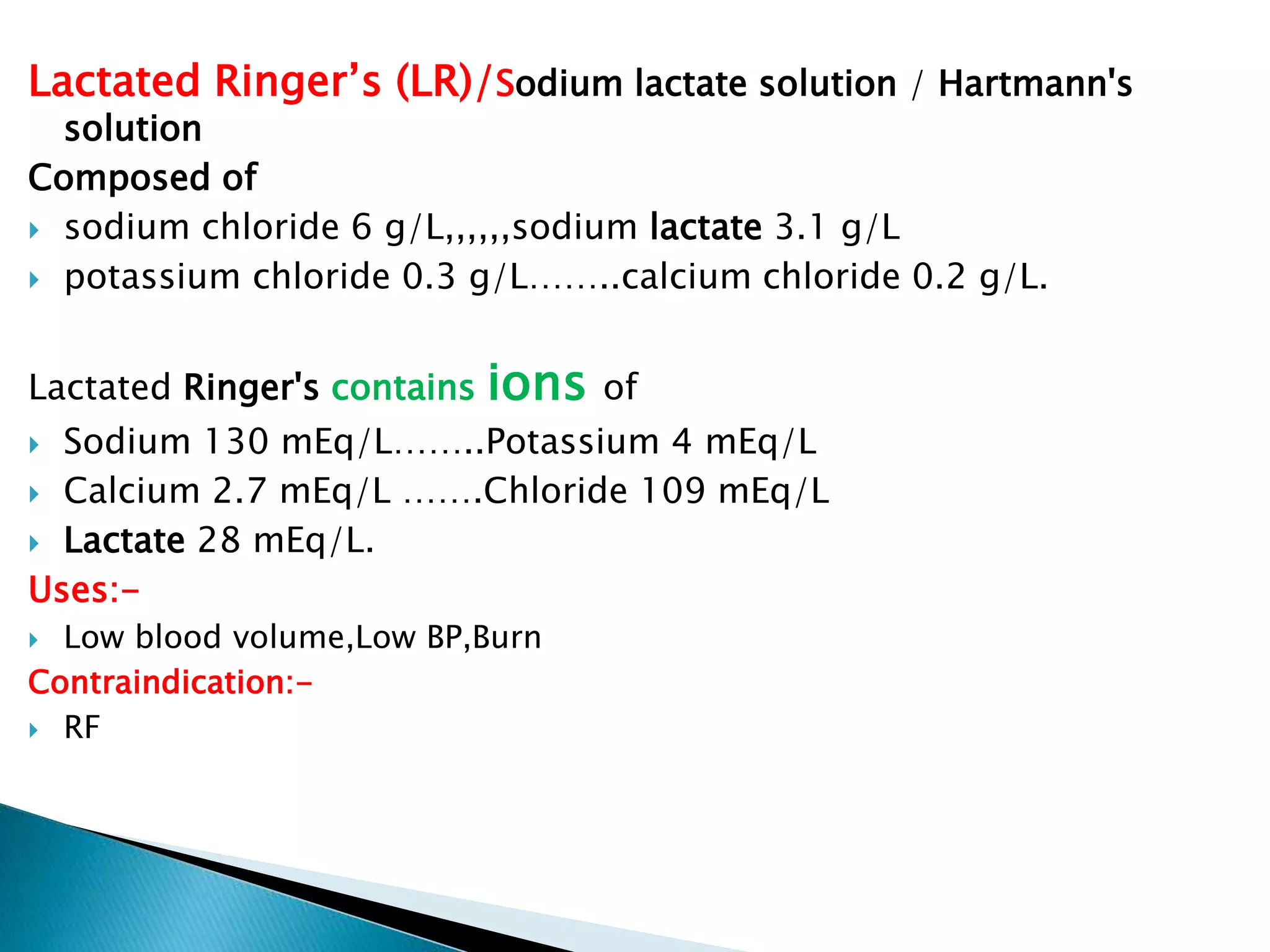
Lactated Ringer’s (LR)/Sodium lactate solution / Hartmann's
solution
Composed of
 sodium chloride 6 g/L,,,,,,sodium lactate 3.1 g/L
 potassium chloride 0.3 g/L……..calcium chloride 0.2 g/L.
Lactated Ringer's contains ions of
 Sodium 130 mEq/L……..Potassium 4 mEq/L
 Calcium 2.7 mEq/L …….Chloride 109 mEq/L
 Lactate 28 mEq/L.
Uses:-
 Low blood volume,Low BP,Burn
Contraindication:-
 RF
0.9% sodium chloride (NS); (0.9% NS)
 Half-NS (0.45% NaCl)
 Quarter-NS (0.22% NaCl) used alone in Neonatal Intensive Care Units.
 pH of NS is 5.5 (4.5 to 7.0)
Composition:-
 9 g/L Sodium Chloride
 Osmolarity of 308 mOsmol/L. It contains 154 mEq/L Sodium &Chloride (GMCH).
Uses:-
 Clean wounds, help remove contact lenses
 Dehydration
 Dilute BCG (AIIMS Bhubaneswar 2018)
 Nebulization .Hemodialysis, Hyponatremia
Contraindication:-
 HT, PE, CHF,Pre-eclampsia
Types of volume expanders
1.Crystalloids:-contain electrolyte.
 Used for fluid volume replacement.
 Eg. Ringer's solution & 5% dextrose in water.
2.Colloids/Plasma expanders.
 It pull fluid from the Interstitial compartment into the
vascular compartment
 Used to increase the vascular volume rapidly.
Eg.Hemorrhage or severe hypovolemic.
 Eg. Albumin, Hetastarches (starches), Dextran
Size of cannula according to color:-

16 G needle used if Major Surgery/RTA accident
require massive fluid

18 G needle Used in Blood and lots of fluid

20 G needle is a Universal

22 G needle used in Small and elderly (Appropriate
for fluid maintenance)
Containers:-
 1. Container may be glass or plastic.
 2. Squeeze the plastic bag to ensure intactness &
assess the glass bottle for any cracks before
hanging.
 Range in size from 50 mL to 1000 mL
 Note:-Do not write on a plastic IV bag with a marking pen
because the ink may be absorbed through the plastic into the
solution.
 Use a label & a ballpoint pen for marking the bag, placing the label
onto the bag.
 Note:- During I/V therapy , hang the bottle on the
I/V pole about 18-24 inch height.
 The needle is 0.5 to 1.5 inches in length with 16 to 26 G.
 The smaller the gauge number, the larger the outside
diameter of the cannula.
 For peripheral fat infusion (lipids), a 20 or 21 gauge is
used.
Instruction which follow during administration of I/V
fluid:-
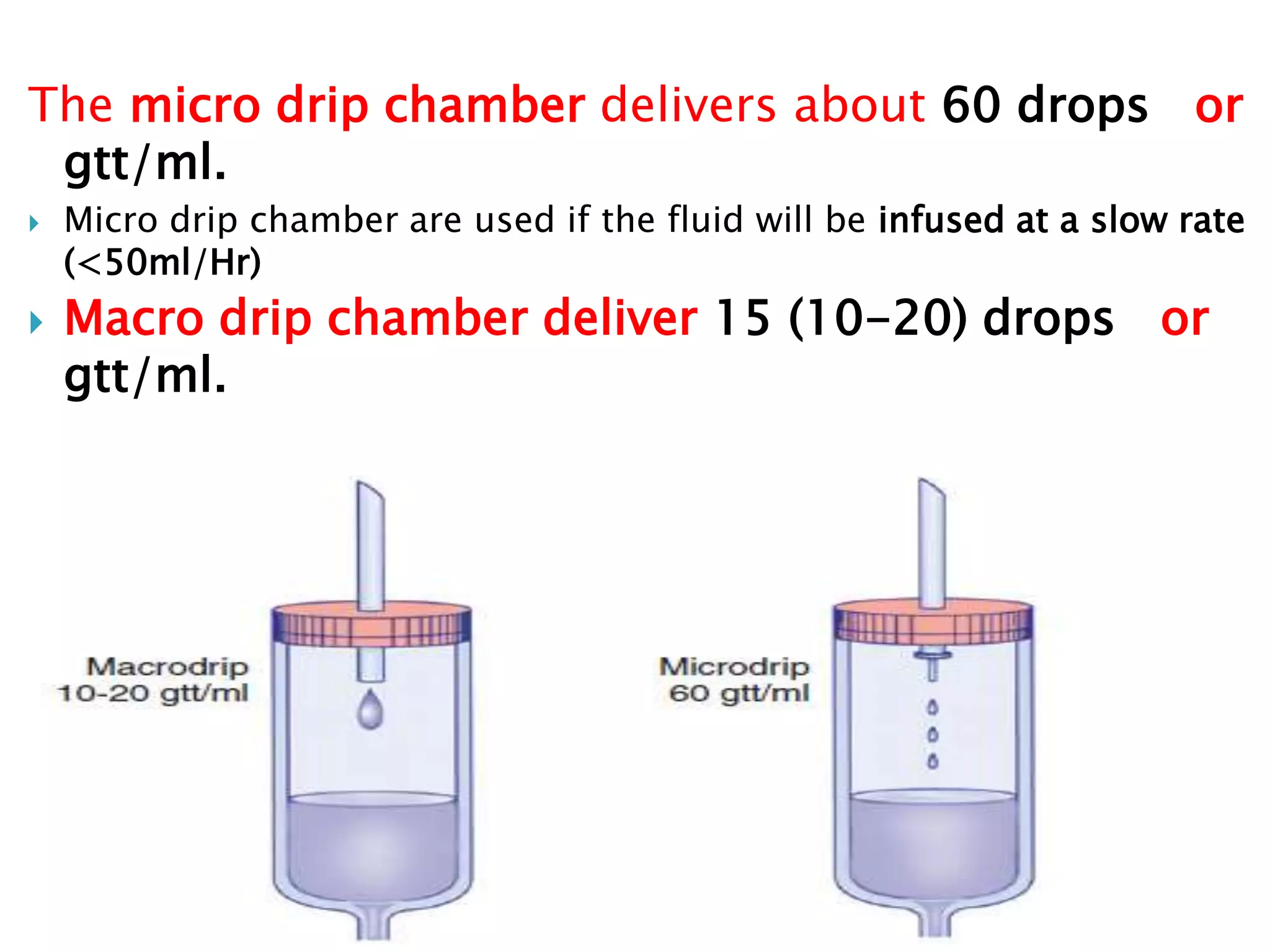
The micro drip chamber delivers about 60 drops or
gtt/ml.
 Micro drip chamber are used if the fluid will be infused at a slow rate
(<50ml/Hr)
 Macro drip chamber deliver 15 (10-20) drops or
gtt/ml.
Formula:-
1.The physician orders dextrose 5 % in water, 1,000
ml to be infused over 8 hours. The I.V. tubing
delivers 15 drops/ml. Nurse John should run the
I.V. infusion at a rate of:
 a. 30 drops/minute
b. 32 drops/minute
c. 20 drops/minute
d. 18 drops/minute
 b. 32 drops/minute
 Change the filter/Drip set every 24 to 72 hours to
prevent bacterial growth.
 Veins in the hand, forearm & antecubital fossa are
suitable sites.
 The most frequently used sites are the veins of
the forearm because the bones of the forearm act as a natural support &
splint.
 Veins in the hand (Cephalic vein) , forearm (Basilic vein) &
antecubital fossa are suitable sites in adult.
 Veins in the scalp & feet (Sephanous vein)may be suitable
sites for Infants
Site Selection:-
 Short term:- (Peripheral vein (7days)
 Mid term:- (anterior Jugular vein, Subclavian vein (4Week)
 Long term:-( PICC Line)-Peripheral insert Central catheter)
(6Month)
 Incase of 3-5 year (Port Implant –Cancer patient-Superior vena-
cava & Rt Atrium
 Before inserting the IV line. Clean the IV site, skin &
an antimicrobial solution, using an Inner to
outer circular motion.
 If client with CHF usually not giving a solution
containing saline because it increase water
retention of water.
 If client with DM usually does not receive dexrose
(Glucose) solution.
 RL Solution contain Potasium & should not be
administered to client with renal failure
IV Complications:-
 Phalibitis:-An inflammation of the vein.
 Thrombophalibitis:- Development of a clot & infection of vein
 (Thrombophob Ointment used to minimize clot)
 Infiltration:-Seepage of Intravenous fluid out of the vain& in to the
surrounding in to the interstitial space.
 Air embolism
◦ Air enters blood stream
 Infection
◦ Localized or systemic
 Tissue damage
 Hematoma
 A client is nauseated, has been vomiting for several
hours, and needs to receive an antiemetic (anti-
nausea) medication. Which of the following is
accurate?
A. An enteric-coated medication should be given.
B. Any medication will not be absorbed as easily
because of the nausea problem.
C. A parenteral route is the route of choice.
D. A rectal suppository must be administered.
 C. A parenteral route is the route of choice.
MCQ

Intravenous therapy

  • 1.
    Intravenous therapy By- Dr. ASHOKDHAKA BISHNOI Director, JINC
  • 2.
     It isthe administration of fluid in to blood stream by I/V catheter or butterfly needle inserted in to a peripheral vein replace water, Electrolyte & Nutrients Introduction:-
  • 3.
    1. Used toclients who are unable to take orally. 2. Replaces water, electrolytes, & nutrients more rapidly than oral administration 3.Unconcious patient 4.Hypovolumic shock 5.During surgery uses:-
  • 4.
     I/V:- 30-60second (Give quick effect in all parental route)  IV injection (IV push) = 1-60 ml
  • 5.
    Types of solutions: 1.Hypertonic solutions 2. Hpotonic solution 3. Isotonic solution Osmolality:- Concentration of a solution expressed as the total number of solute particles per kilogram. 270-300 Mosm/kg water Osmolarity :-the concentration of a solution expressed as the total number of solute particles per litre.  Measured by Osmometer. Osmoler Gap :-Deference B/W Osmolality & Osmolarity normal osmol gap is < 10 mOsm/kg .
  • 6.
    1.Hypertonic solutions:-more concentratedthan body fluids.  Causes movement of H2O from cells into the extracellular fluid. Eg.  3% NS  5% NS  10% dextrose in water (D10W)  5% dextrose in 0.45% sodium chloride (NS) (D5W/½ NS)
  • 7.
    2.Hypotonic solution:-Solutions thatare more dilute or have a lower osmolality than body fluids.  Causes movement of water into cells by osmosis.  Administer slowly to prevent edema. Eg.  0.45% sodium chloride (NS ); (½ NS) Osmolarity of 154 mOsmol/L  0.225% sodium chloride (NS); (¼ NS)  0.33% sodium chloride (NS); (⅓ NS) 
  • 8.
    3.Isotonic solution:-Solution thathave the same osmolality as body fluids.  It increases extracellular fluid volume.  These solutions do not enter the cells because no osmotic force exists to shift the fluids.  Eg.  0.9% sodium chloride (NS); (0.9% NS)  5% dextrose in water (D5W)  5% dextrose in 0.225% saline (D5W/¼ NS)  Lactated Ringer’s (LR)/Sodium lactate solution / Hartmann's solution .
  • 9.
    Lactated Ringer’s (LR)/Sodiumlactate solution / Hartmann's solution Composed of  sodium chloride 6 g/L,,,,,,sodium lactate 3.1 g/L  potassium chloride 0.3 g/L……..calcium chloride 0.2 g/L. Lactated Ringer's contains ions of  Sodium 130 mEq/L……..Potassium 4 mEq/L  Calcium 2.7 mEq/L …….Chloride 109 mEq/L  Lactate 28 mEq/L. Uses:-  Low blood volume,Low BP,Burn Contraindication:-  RF
  • 10.
    0.9% sodium chloride(NS); (0.9% NS)  Half-NS (0.45% NaCl)  Quarter-NS (0.22% NaCl) used alone in Neonatal Intensive Care Units.  pH of NS is 5.5 (4.5 to 7.0) Composition:-  9 g/L Sodium Chloride  Osmolarity of 308 mOsmol/L. It contains 154 mEq/L Sodium &Chloride (GMCH). Uses:-  Clean wounds, help remove contact lenses  Dehydration  Dilute BCG (AIIMS Bhubaneswar 2018)  Nebulization .Hemodialysis, Hyponatremia Contraindication:-  HT, PE, CHF,Pre-eclampsia
  • 11.
    Types of volumeexpanders 1.Crystalloids:-contain electrolyte.  Used for fluid volume replacement.  Eg. Ringer's solution & 5% dextrose in water. 2.Colloids/Plasma expanders.  It pull fluid from the Interstitial compartment into the vascular compartment  Used to increase the vascular volume rapidly. Eg.Hemorrhage or severe hypovolemic.  Eg. Albumin, Hetastarches (starches), Dextran
  • 12.
    Size of cannulaaccording to color:-
  • 13.
     16 G needleused if Major Surgery/RTA accident require massive fluid  18 G needle Used in Blood and lots of fluid  20 G needle is a Universal  22 G needle used in Small and elderly (Appropriate for fluid maintenance)
  • 15.
    Containers:-  1. Containermay be glass or plastic.  2. Squeeze the plastic bag to ensure intactness & assess the glass bottle for any cracks before hanging.  Range in size from 50 mL to 1000 mL  Note:-Do not write on a plastic IV bag with a marking pen because the ink may be absorbed through the plastic into the solution.  Use a label & a ballpoint pen for marking the bag, placing the label onto the bag.
  • 16.
     Note:- DuringI/V therapy , hang the bottle on the I/V pole about 18-24 inch height.
  • 17.
     The needleis 0.5 to 1.5 inches in length with 16 to 26 G.  The smaller the gauge number, the larger the outside diameter of the cannula.  For peripheral fat infusion (lipids), a 20 or 21 gauge is used. Instruction which follow during administration of I/V fluid:-
  • 18.
    The micro dripchamber delivers about 60 drops or gtt/ml.  Micro drip chamber are used if the fluid will be infused at a slow rate (<50ml/Hr)  Macro drip chamber deliver 15 (10-20) drops or gtt/ml.
  • 19.
  • 20.
    1.The physician ordersdextrose 5 % in water, 1,000 ml to be infused over 8 hours. The I.V. tubing delivers 15 drops/ml. Nurse John should run the I.V. infusion at a rate of:  a. 30 drops/minute b. 32 drops/minute c. 20 drops/minute d. 18 drops/minute  b. 32 drops/minute
  • 21.
     Change thefilter/Drip set every 24 to 72 hours to prevent bacterial growth.  Veins in the hand, forearm & antecubital fossa are suitable sites.
  • 22.
     The mostfrequently used sites are the veins of the forearm because the bones of the forearm act as a natural support & splint.  Veins in the hand (Cephalic vein) , forearm (Basilic vein) & antecubital fossa are suitable sites in adult.  Veins in the scalp & feet (Sephanous vein)may be suitable sites for Infants
  • 23.
    Site Selection:-  Shortterm:- (Peripheral vein (7days)  Mid term:- (anterior Jugular vein, Subclavian vein (4Week)  Long term:-( PICC Line)-Peripheral insert Central catheter) (6Month)  Incase of 3-5 year (Port Implant –Cancer patient-Superior vena- cava & Rt Atrium
  • 24.
     Before insertingthe IV line. Clean the IV site, skin & an antimicrobial solution, using an Inner to outer circular motion.
  • 25.
     If clientwith CHF usually not giving a solution containing saline because it increase water retention of water.  If client with DM usually does not receive dexrose (Glucose) solution.  RL Solution contain Potasium & should not be administered to client with renal failure
  • 26.
    IV Complications:-  Phalibitis:-Aninflammation of the vein.  Thrombophalibitis:- Development of a clot & infection of vein  (Thrombophob Ointment used to minimize clot)  Infiltration:-Seepage of Intravenous fluid out of the vain& in to the surrounding in to the interstitial space.  Air embolism ◦ Air enters blood stream  Infection ◦ Localized or systemic  Tissue damage  Hematoma
  • 27.
     A clientis nauseated, has been vomiting for several hours, and needs to receive an antiemetic (anti- nausea) medication. Which of the following is accurate? A. An enteric-coated medication should be given. B. Any medication will not be absorbed as easily because of the nausea problem. C. A parenteral route is the route of choice. D. A rectal suppository must be administered.  C. A parenteral route is the route of choice. MCQ