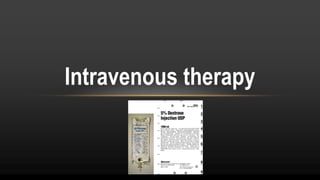
Intravenous therapy
I. Introduction to IV Therapy
• Indications for IV therapy
• To provide water, electrolytes, and nutrients to meet
daily requirements
• To replace water and correct electrolyte deficits
• To administer medications and blood products
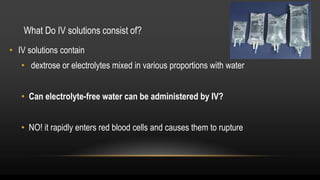
What Do IV solutions consist of?
• IV solutions contain
• dextrose or electrolytes mixed in various proportions with water
• Can electrolyte-free water can be administered by IV?
• NO! it rapidly enters red blood cells and causes them to rupture
IV Solutions
• There are several types of IV fluids
• type of fluid used selected according to the client and the reason for its use
• IV solutions are clearly labeled with the exact components and amount of
solution
• IV solutions orders – often written with abbreviations
Remember the Abbreviations!
• “D” is for dextrose
• “W” is for water
• “S” is for saline
• “NS” is for normal saline
• Ringer lactate (lactated Ringer)- commonly used electrolyte solution
• abbreviated “RL” or “LR”
Solution Strength
• IV’s often identified with abbreviation letters
• These indicate the components in the IV solution
• the numbers indicate the solution strength or concentration of components in the IV fluid
• numbers written as subscripts
• for example, D5W (dextrose 5% in water).
Let’s Practice:
• What is the full name of the IV’S from these abbreviations?
• NS =
• D5W =
• RL =
• D5 and ½ NS (0.45%) =
• What is the full name of the IV’S from these abbreviations?
• NS = Sodium Chloride 0.9%
• D5W = Dextrose 5% in water
• RL = Lactated Ringer solution (electrolytes)
• D5 and ½ NS (0.45%) = Dextrose 5% in 0.45% sodium chloride
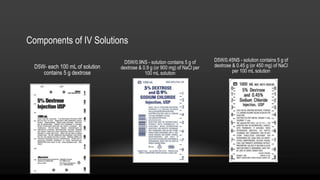
Components of IV Solutions
D5W- each 100 mL of solution
contains 5 g dextrose
D5W/0.9NS - solution contains 5 g of
dextrose & 0.9 g (or 900 mg) of NaCl per
100 mL solution
D5W/0.45NS - solution contains 5 g of
dextrose & 0.45 g (or 450 mg) of NaCl
per 100 mL solution
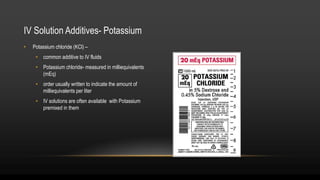
• Potassium chloride (KCl) –
• common additive to IV fluids
• Potassium chloride- measured in milliequivalents
(mEq)
• order usually written to indicate the amount of
milliequivalents per liter
• IV solutions are often available with Potassium
premixed in them
IV Solution Additives- Potassium
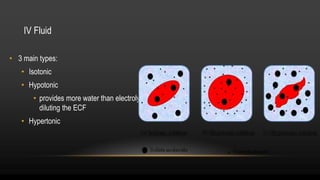
IV Fluid
• 3 main types:
• Isotonic
• Hypotonic
• provides more water than electrolytes-
diluting the ECF
• Hypertonic
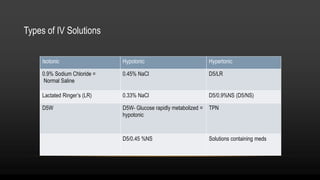
Types of IV Solutions
Isotonic Hypotonic Hypertonic
0.9% Sodium Chloride =
Normal Saline
0.45% NaCl D5/LR
Lactated Ringer’s (LR) 0.33% NaCl D5/0.9%NS (D5/NS)
D5W D5W- Glucose rapidly metabolized =
hypotonic
TPN
D5/0.45 %NS Solutions containing meds
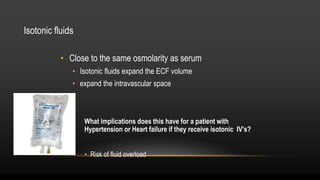
Isotonic fluids
• Close to the same osmolarity as serum
• Isotonic fluids expand the ECF volume
• expand the intravascular space
What implications does this have for a patient with
Hypertension or Heart failure if they receive isotonic IV’s?
• Risk of fluid overload
Isotonic Solutions
• Provides Benefits OF:
• Hydration
• maintain electrolytes
• Used during and after surgery
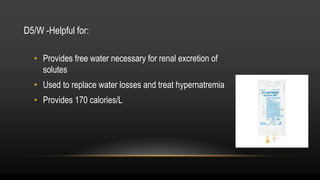
D5/W -Helpful for:
• Provides free water necessary for renal excretion of
solutes
• Used to replace water losses and treat hypernatremia
• Provides 170 calories/L
Hypotonic Fluids – Purpose
• Replace cellular fluid
• Provides free water for excretion of wastes
• Often use 0.45% NS – Rx hypernatremia or other
hyperosmolar conditions
• Less osmolarity than serum
• Dilutes the serum
Excessive Use of hypotonic Solutions
• Leads to intravascular fluid depletion
• Decreased blood pressure
• Cellular edema
0.45% NS - Hypotonic
• Provides free water in addition to Na+ and Cl–
• Used to replace hypotonic fluid losses
• Used as maintenance solution
• does not replace daily losses of other electrolytes
• Provides no calories
• A hypotonic solution that provides Na+, Cl−, & free water
• Used as a basic fluid for maintenance needs
Helpful for:
• Cellular dehydration:
• Fluid shifts out of blood vessel (less concentrated) to the
tissue cells (more concentrated)
• Ex: dry mucous membranes
• Hyperglycemic conditions:
• Diabetic ketoacidosis
Can be harmful:
• Sudden shift of fluid from blood vessel to the cells – cardiovascular collapse
• Hypotonic solutions - potential to cause cellular swelling
• Monitor for changes in mentation →indicate cerebral edema
• Examples- Hypotonic IV solutions
• D5NS.45 (5% dextrose in ½ normal saline)
• 5% Dextrose and water (D5W)- Provides calories and water
Hypertonic (hyper-osmolar)
• Higher osmolarity than serum
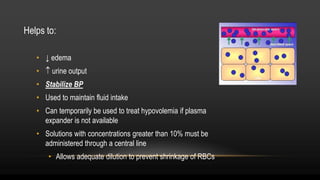
• Pulls fluids and electrolytes from the intracellular &
interstitial compartments into the intravascular
compartment
• Examples
• D5/0.9NS and D5/0.45NS
• Use Postop when some sodium is needed
• D5LR
Helps to:
• ↓ edema
•  urine output
• Stabilize BP
• Used to maintain fluid intake
• Can temporarily be used to treat hypovolemia if plasma
expander is not available
• Solutions with concentrations greater than 10% must be
administered through a central line
• Allows adequate dilution to prevent shrinkage of RBCs
IV sites • Peripheral
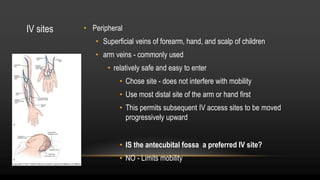
• Superficial veins of forearm, hand, and scalp of children
• arm veins - commonly used
• relatively safe and easy to enter
• Chose site - does not interfere with mobility
• Use most distal site of the arm or hand first
• This permits subsequent IV access sites to be moved
progressively upward
• IS the antecubital fossa a preferred IV site?
• NO - Limits mobility
Other IV sites to be Cautious OF:
• Leg veins should rarely be used
• high risk of thromboembolism
• avoid vein access distal to a previous IV infiltration
• Avoid sclerosed or thrombosed veins
• Avoid an arm with an arteriovenous shunt or fistula
• Avoid arm affected by edema, infection or blood clot
• Avoid arm on the side of a mastectomy - impaired lymphatic flow.
• Can be inserted by nurses
who have had special
training
• Long catheter inserted into
antecubital vein with tip
positioned in superior vena
cava
• Use for IV antibiotics for
several weeks or TPN
• Less risk of complications
PICC line (peripherally inserted catheter)
• Centrally inserted catheters -
special catheter inserted into
a large vein in the neck or
chest (subclavian or jugular)
• threaded through into the
right atrium
• tip rests in distal end of
superior vena cava
Central Line IV Therapy
Use of CVC’s (Central Venous Catheters)
Medication administration
•• Cancer
•• Chemotherapy- infuse irritating or vesicant
medications
•• Infection •• Long-term administration of antibiotics
Nutritional replacement
•• Infusion of parenteral nutrition (PN)
•• Able to infuse higher dextrose solutions through
central line than peripheral line
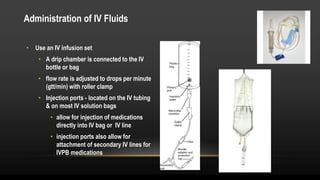
• Use an IV infusion set
• A drip chamber is connected to the IV
bottle or bag
• flow rate is adjusted to drops per minute
(gtt/min) with roller clamp
• Injection ports - located on the IV tubing
& on most IV solution bags
• allow for injection of medications
directly into IV bag or IV line
• injection ports also allow for
attachment of secondary IV lines for
IVPB medications
Administration of IV Fluids
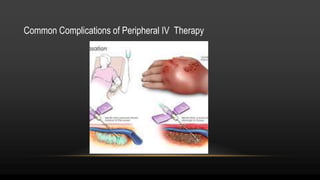
Common Complications of Peripheral IV Therapy
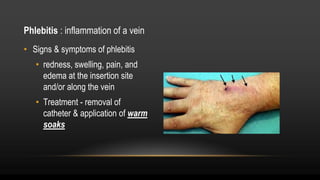
• Signs & symptoms of phlebitis
• redness, swelling, pain, and
edema at the insertion site
and/or along the vein
• Treatment - removal of
catheter & application of warm
soaks
Phlebitis : inflammation of a vein
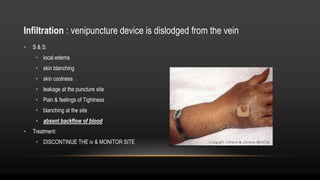
• S & S:
• local edema
• skin blanching
• skin coolness
• leakage at the puncture site
• Pain & feelings of Tightness
• blanching at the site
• absent backflow of blood
• Treatment:
• DISCONTINUE THE iv & MONITOR SITE
Infiltration : venipuncture device is dislodged from the vein
• redness
• Swelling
• pain and edema at the insertion site
and/or along the vein
• Phlebitis
edema
skin blanching
skin coolness
leakage at the puncture site
absent backflow of blood
Infiltration
Which is it?
Variety of ways for Implementing IV Therapy

IV .ppt

  • 1.
  • 2.
    I. Introduction toIV Therapy • Indications for IV therapy • To provide water, electrolytes, and nutrients to meet daily requirements • To replace water and correct electrolyte deficits • To administer medications and blood products
  • 3.
    What Do IVsolutions consist of? • IV solutions contain • dextrose or electrolytes mixed in various proportions with water • Can electrolyte-free water can be administered by IV? • NO! it rapidly enters red blood cells and causes them to rupture
  • 4.
    IV Solutions • Thereare several types of IV fluids • type of fluid used selected according to the client and the reason for its use • IV solutions are clearly labeled with the exact components and amount of solution • IV solutions orders – often written with abbreviations
  • 5.
    Remember the Abbreviations! •“D” is for dextrose • “W” is for water • “S” is for saline • “NS” is for normal saline • Ringer lactate (lactated Ringer)- commonly used electrolyte solution • abbreviated “RL” or “LR”
  • 6.
    Solution Strength • IV’soften identified with abbreviation letters • These indicate the components in the IV solution • the numbers indicate the solution strength or concentration of components in the IV fluid • numbers written as subscripts • for example, D5W (dextrose 5% in water).
  • 7.
    Let’s Practice: • Whatis the full name of the IV’S from these abbreviations? • NS = • D5W = • RL = • D5 and ½ NS (0.45%) =
  • 8.
    • What isthe full name of the IV’S from these abbreviations? • NS = Sodium Chloride 0.9% • D5W = Dextrose 5% in water • RL = Lactated Ringer solution (electrolytes) • D5 and ½ NS (0.45%) = Dextrose 5% in 0.45% sodium chloride
  • 9.
    Components of IVSolutions D5W- each 100 mL of solution contains 5 g dextrose D5W/0.9NS - solution contains 5 g of dextrose & 0.9 g (or 900 mg) of NaCl per 100 mL solution D5W/0.45NS - solution contains 5 g of dextrose & 0.45 g (or 450 mg) of NaCl per 100 mL solution
  • 10.
    • Potassium chloride(KCl) – • common additive to IV fluids • Potassium chloride- measured in milliequivalents (mEq) • order usually written to indicate the amount of milliequivalents per liter • IV solutions are often available with Potassium premixed in them IV Solution Additives- Potassium
  • 11.
    IV Fluid • 3main types: • Isotonic • Hypotonic • provides more water than electrolytes- diluting the ECF • Hypertonic
  • 12.
    Types of IVSolutions Isotonic Hypotonic Hypertonic 0.9% Sodium Chloride = Normal Saline 0.45% NaCl D5/LR Lactated Ringer’s (LR) 0.33% NaCl D5/0.9%NS (D5/NS) D5W D5W- Glucose rapidly metabolized = hypotonic TPN D5/0.45 %NS Solutions containing meds
  • 13.
    Isotonic fluids • Closeto the same osmolarity as serum • Isotonic fluids expand the ECF volume • expand the intravascular space What implications does this have for a patient with Hypertension or Heart failure if they receive isotonic IV’s? • Risk of fluid overload
  • 14.
    Isotonic Solutions • ProvidesBenefits OF: • Hydration • maintain electrolytes • Used during and after surgery
  • 15.
    D5/W -Helpful for: •Provides free water necessary for renal excretion of solutes • Used to replace water losses and treat hypernatremia • Provides 170 calories/L
  • 16.
    Hypotonic Fluids –Purpose • Replace cellular fluid • Provides free water for excretion of wastes • Often use 0.45% NS – Rx hypernatremia or other hyperosmolar conditions • Less osmolarity than serum • Dilutes the serum
  • 17.
    Excessive Use ofhypotonic Solutions • Leads to intravascular fluid depletion • Decreased blood pressure • Cellular edema
  • 18.
    0.45% NS -Hypotonic • Provides free water in addition to Na+ and Cl– • Used to replace hypotonic fluid losses • Used as maintenance solution • does not replace daily losses of other electrolytes • Provides no calories • A hypotonic solution that provides Na+, Cl−, & free water • Used as a basic fluid for maintenance needs
  • 19.
    Helpful for: • Cellulardehydration: • Fluid shifts out of blood vessel (less concentrated) to the tissue cells (more concentrated) • Ex: dry mucous membranes • Hyperglycemic conditions: • Diabetic ketoacidosis
  • 20.
    Can be harmful: •Sudden shift of fluid from blood vessel to the cells – cardiovascular collapse • Hypotonic solutions - potential to cause cellular swelling • Monitor for changes in mentation →indicate cerebral edema • Examples- Hypotonic IV solutions • D5NS.45 (5% dextrose in ½ normal saline) • 5% Dextrose and water (D5W)- Provides calories and water
  • 21.
    Hypertonic (hyper-osmolar) • Higherosmolarity than serum • Pulls fluids and electrolytes from the intracellular & interstitial compartments into the intravascular compartment • Examples • D5/0.9NS and D5/0.45NS • Use Postop when some sodium is needed • D5LR
  • 22.
    Helps to: • ↓edema •  urine output • Stabilize BP • Used to maintain fluid intake • Can temporarily be used to treat hypovolemia if plasma expander is not available • Solutions with concentrations greater than 10% must be administered through a central line • Allows adequate dilution to prevent shrinkage of RBCs
  • 23.
    IV sites •Peripheral • Superficial veins of forearm, hand, and scalp of children • arm veins - commonly used • relatively safe and easy to enter • Chose site - does not interfere with mobility • Use most distal site of the arm or hand first • This permits subsequent IV access sites to be moved progressively upward • IS the antecubital fossa a preferred IV site? • NO - Limits mobility
  • 24.
    Other IV sitesto be Cautious OF: • Leg veins should rarely be used • high risk of thromboembolism • avoid vein access distal to a previous IV infiltration • Avoid sclerosed or thrombosed veins • Avoid an arm with an arteriovenous shunt or fistula • Avoid arm affected by edema, infection or blood clot • Avoid arm on the side of a mastectomy - impaired lymphatic flow.
  • 25.
    • Can beinserted by nurses who have had special training • Long catheter inserted into antecubital vein with tip positioned in superior vena cava • Use for IV antibiotics for several weeks or TPN • Less risk of complications PICC line (peripherally inserted catheter)
  • 26.
    • Centrally insertedcatheters - special catheter inserted into a large vein in the neck or chest (subclavian or jugular) • threaded through into the right atrium • tip rests in distal end of superior vena cava Central Line IV Therapy
  • 27.
    Use of CVC’s(Central Venous Catheters) Medication administration •• Cancer •• Chemotherapy- infuse irritating or vesicant medications •• Infection •• Long-term administration of antibiotics Nutritional replacement •• Infusion of parenteral nutrition (PN) •• Able to infuse higher dextrose solutions through central line than peripheral line
  • 28.
    • Use anIV infusion set • A drip chamber is connected to the IV bottle or bag • flow rate is adjusted to drops per minute (gtt/min) with roller clamp • Injection ports - located on the IV tubing & on most IV solution bags • allow for injection of medications directly into IV bag or IV line • injection ports also allow for attachment of secondary IV lines for IVPB medications Administration of IV Fluids
  • 29.
    Common Complications ofPeripheral IV Therapy
  • 30.
    • Signs &symptoms of phlebitis • redness, swelling, pain, and edema at the insertion site and/or along the vein • Treatment - removal of catheter & application of warm soaks Phlebitis : inflammation of a vein
  • 31.
    • S &S: • local edema • skin blanching • skin coolness • leakage at the puncture site • Pain & feelings of Tightness • blanching at the site • absent backflow of blood • Treatment: • DISCONTINUE THE iv & MONITOR SITE Infiltration : venipuncture device is dislodged from the vein
  • 32.
    • redness • Swelling •pain and edema at the insertion site and/or along the vein • Phlebitis edema skin blanching skin coolness leakage at the puncture site absent backflow of blood Infiltration Which is it?
  • 33.
    Variety of waysfor Implementing IV Therapy