Glucocorticoids
Synthesis | Receptor | Effects
Glucocorticoids
Synthesis | Receptor | Effects
Arun Viswanathan
IInd Sem, M.Sc.BMB
Adrenal Glands
• The paired one of which lies superior to each kidney in the
retroperitoneal space
• flattened pyramidal shape.
• In an adult, each adrenal gland is 3–5 cm in height, 2–3 cm in
width, and a little less than 1 cm
• thick, with a mass of 3.5–5 g, only half its size at birth.
• differentiate into two structurally and functionally distinct
regions: a large, peripherally located adrenal cortex (80–90%
of the gland) & a small, centrally located adrenal medulla
• Complete loss of adrenocortical hormones leads to death
due to dehydration and electrolyte imbalances in a few days.
• The adrenal medulla produces three catecholamine
hormones—norepinephrine, epinephrine, and a small
amount of dopamine.
• The paired one of which lies superior to each kidney in the
retroperitoneal space
• flattened pyramidal shape.
• In an adult, each adrenal gland is 3–5 cm in height, 2–3 cm in
width, and a little less than 1 cm
• thick, with a mass of 3.5–5 g, only half its size at birth.
• differentiate into two structurally and functionally distinct
regions: a large, peripherally located adrenal cortex (80–90%
of the gland) & a small, centrally located adrenal medulla
• Complete loss of adrenocortical hormones leads to death
due to dehydration and electrolyte imbalances in a few days.
• The adrenal medulla produces three catecholamine
hormones—norepinephrine, epinephrine, and a small
amount of dopamine.
Adrenal Glands
Tortora.J.Gerard, Derrickson.B, ‘Principles of Anatomy and Physiology’(13th Edition), John Wiley & sons, Inc.,
Adrenal Cortex
• subdivided into 3 zones, each of which secretes different hormones
• The outer zone - zona glomerulosa
• Its cells, which are closely packed and arranged in spherical clusters
and arched columns, secrete hormones called mineralocorticoids
• The middle zone - zona fasciculata is the widest of the three zones
and consists of cells arranged in long, straight columns.
• secrete mainly glucocorticoids primarily cortisol
• The cells of the inner zone - zona reticularis are arranged in
branching cords.
• They synthesize small amounts of weak androgens steroid
hormones that have masculinizing effects.
• subdivided into 3 zones, each of which secretes different hormones
• The outer zone - zona glomerulosa
• Its cells, which are closely packed and arranged in spherical clusters
and arched columns, secrete hormones called mineralocorticoids
• The middle zone - zona fasciculata is the widest of the three zones
and consists of cells arranged in long, straight columns.
• secrete mainly glucocorticoids primarily cortisol
• The cells of the inner zone - zona reticularis are arranged in
branching cords.
• They synthesize small amounts of weak androgens steroid
hormones that have masculinizing effects.
Tortora.J.Gerard, Derrickson.B, ‘Principles of Anatomy and Physiology’(13th Edition), John Wiley & sons, Inc.,
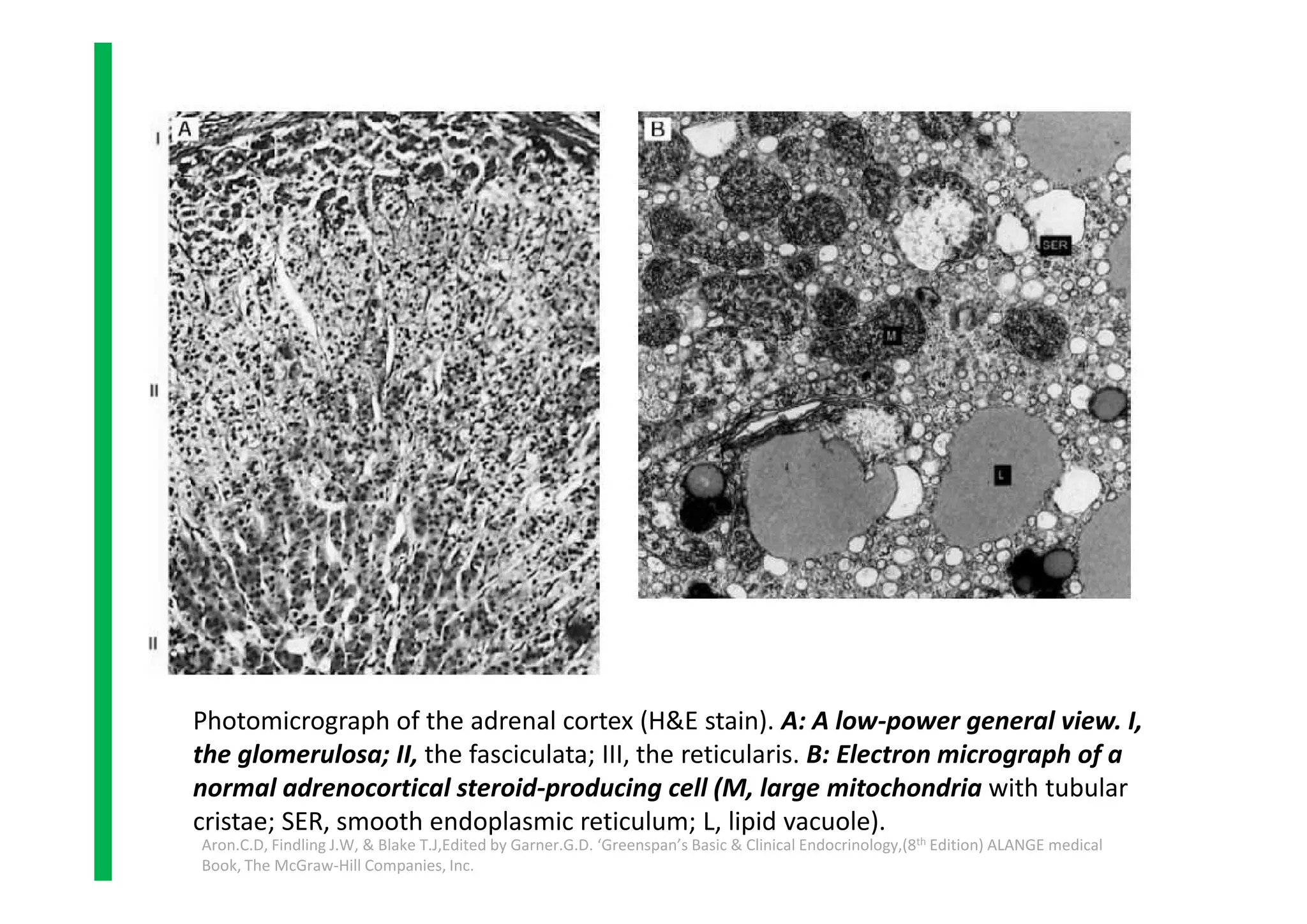
Photomicrograph of the adrenal cortex (H&E stain). A: A low-power general view. I,
the glomerulosa; II, the fasciculata; III, the reticularis. B: Electron micrograph of a
normal adrenocortical steroid-producing cell (M, large mitochondria with tubular
cristae; SER, smooth endoplasmic reticulum; L, lipid vacuole).
Aron.C.D, Findling J.W, & Blake T.J,Edited by Garner.G.D. ‘Greenspan’s Basic & Clinical Endocrinology,(8th Edition) ALANGE medical
Book, The McGraw-Hill Companies, Inc.
Adrenal Steroidogenesis
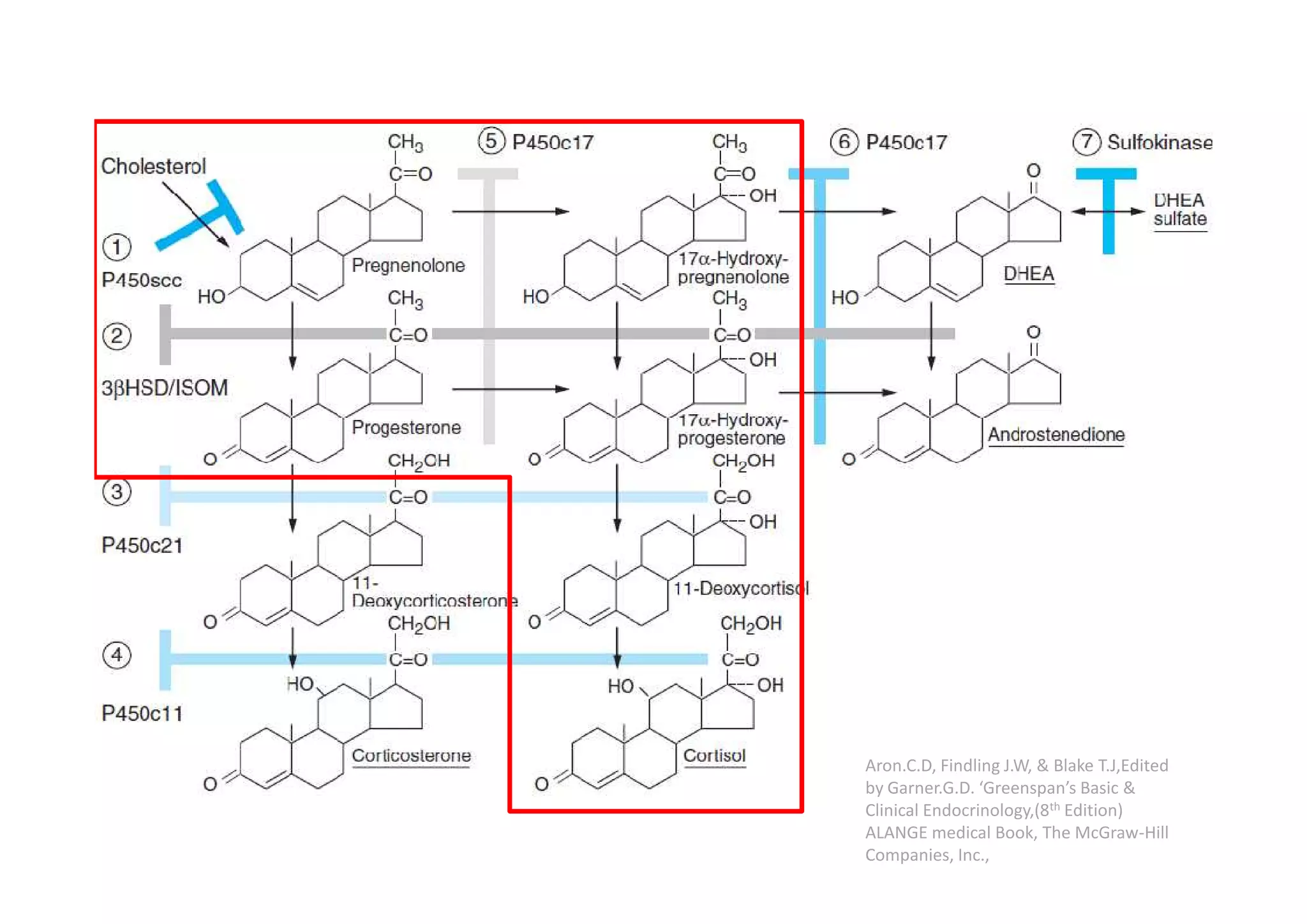
• Cholesterol is the precursor for adrenal
steroidogenesis.
• LDL Cholestrol is taken specific cell-surface LDL
receptors mediated Endocytosis
• the resulting vesicles fuse with lysozymes, & free
cholesterol is produced after hydrolysis.
• Cholesterol can be generated de novo within the
adrenal cortex from acetyl coenzyme A (CoA).
• adrenal can utilize HDL cholesterol after uptake
through the putative HDL receptor, SR-B1
• Cholesterol is the precursor for adrenal
steroidogenesis.
• LDL Cholestrol is taken specific cell-surface LDL
receptors mediated Endocytosis
• the resulting vesicles fuse with lysozymes, & free
cholesterol is produced after hydrolysis.
• Cholesterol can be generated de novo within the
adrenal cortex from acetyl coenzyme A (CoA).
• adrenal can utilize HDL cholesterol after uptake
through the putative HDL receptor, SR-B1
Adrenal Steroidogenesis
• the transport of intracellular cholesterol from
the outer to inner mt membrane for
conversion to pregnenolone by cyt P450 side-
chain cleavage enzyme (P450scc) is mediated
by steroidogenic acute regulatory protein
(StAR)
• the transport of intracellular cholesterol from
the outer to inner mt membrane for
conversion to pregnenolone by cyt P450 side-
chain cleavage enzyme (P450scc) is mediated
by steroidogenic acute regulatory protein
(StAR)
Melmed.S.,
Polonsky.S.K,
Larsen.P.R.,
Kronenberg.H.M.
‘Williams Textbook of
Endocrinology’(12th
Edition), Elsevir
Saunders 2011
Aron.C.D, Findling J.W, & Blake T.J,Edited
by Garner.G.D. ‘Greenspan’s Basic &
Clinical Endocrinology,(8th Edition)
ALANGE medical Book, The McGraw-Hill
Companies, Inc.,
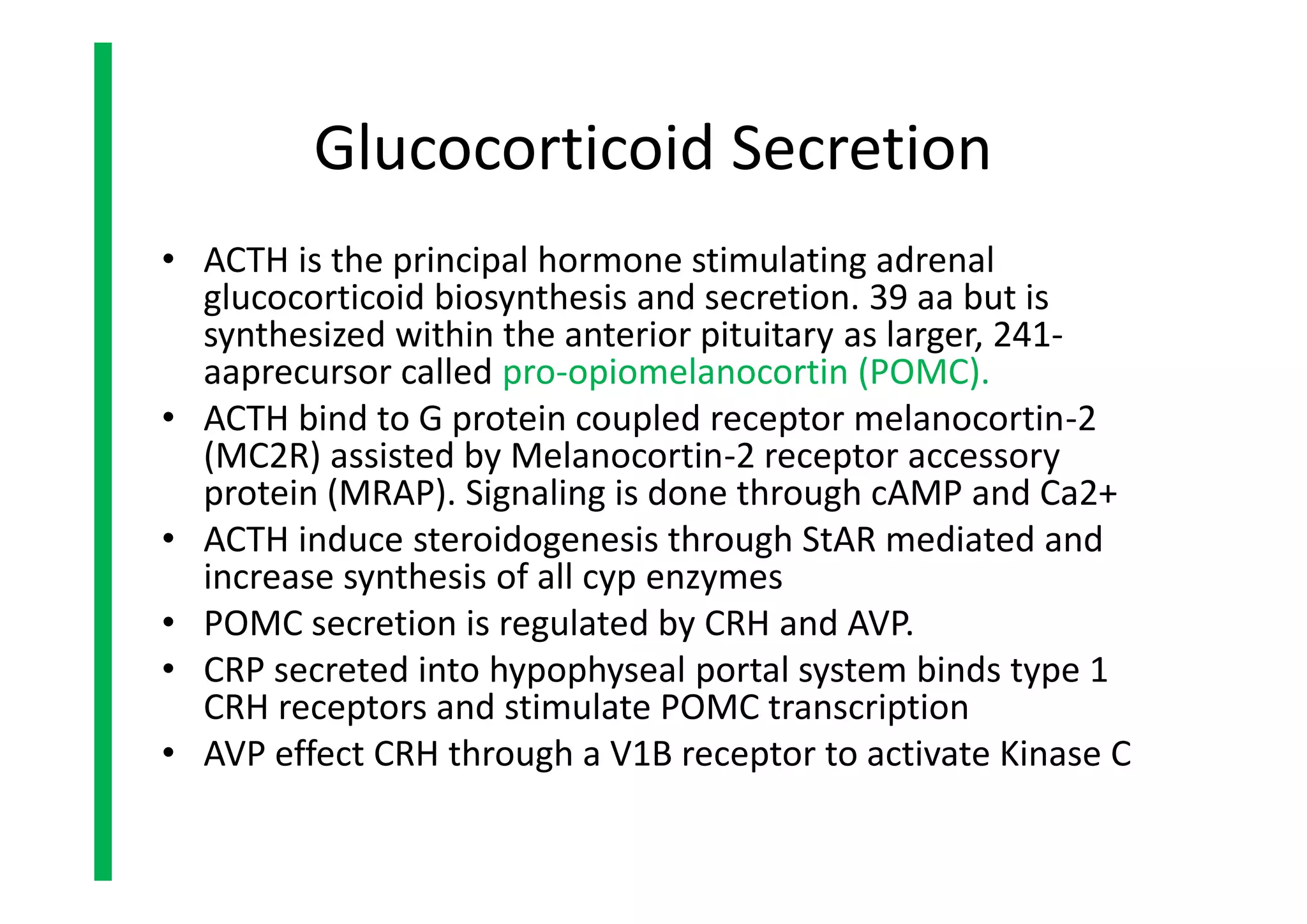
Glucocorticoid Secretion
• ACTH is the principal hormone stimulating adrenal
glucocorticoid biosynthesis and secretion. 39 aa but is
synthesized within the anterior pituitary as larger, 241-
aaprecursor called pro-opiomelanocortin (POMC).
• ACTH bind to G protein coupled receptor melanocortin-2
(MC2R) assisted by Melanocortin-2 receptor accessory
protein (MRAP). Signaling is done through cAMP and Ca2+
• ACTH induce steroidogenesis through StAR mediated and
increase synthesis of all cyp enzymes
• POMC secretion is regulated by CRH and AVP.
• CRP secreted into hypophyseal portal system binds type 1
CRH receptors and stimulate POMC transcription
• AVP effect CRH through a V1B receptor to activate Kinase C
• ACTH is the principal hormone stimulating adrenal
glucocorticoid biosynthesis and secretion. 39 aa but is
synthesized within the anterior pituitary as larger, 241-
aaprecursor called pro-opiomelanocortin (POMC).
• ACTH bind to G protein coupled receptor melanocortin-2
(MC2R) assisted by Melanocortin-2 receptor accessory
protein (MRAP). Signaling is done through cAMP and Ca2+
• ACTH induce steroidogenesis through StAR mediated and
increase synthesis of all cyp enzymes
• POMC secretion is regulated by CRH and AVP.
• CRP secreted into hypophyseal portal system binds type 1
CRH receptors and stimulate POMC transcription
• AVP effect CRH through a V1B receptor to activate Kinase C
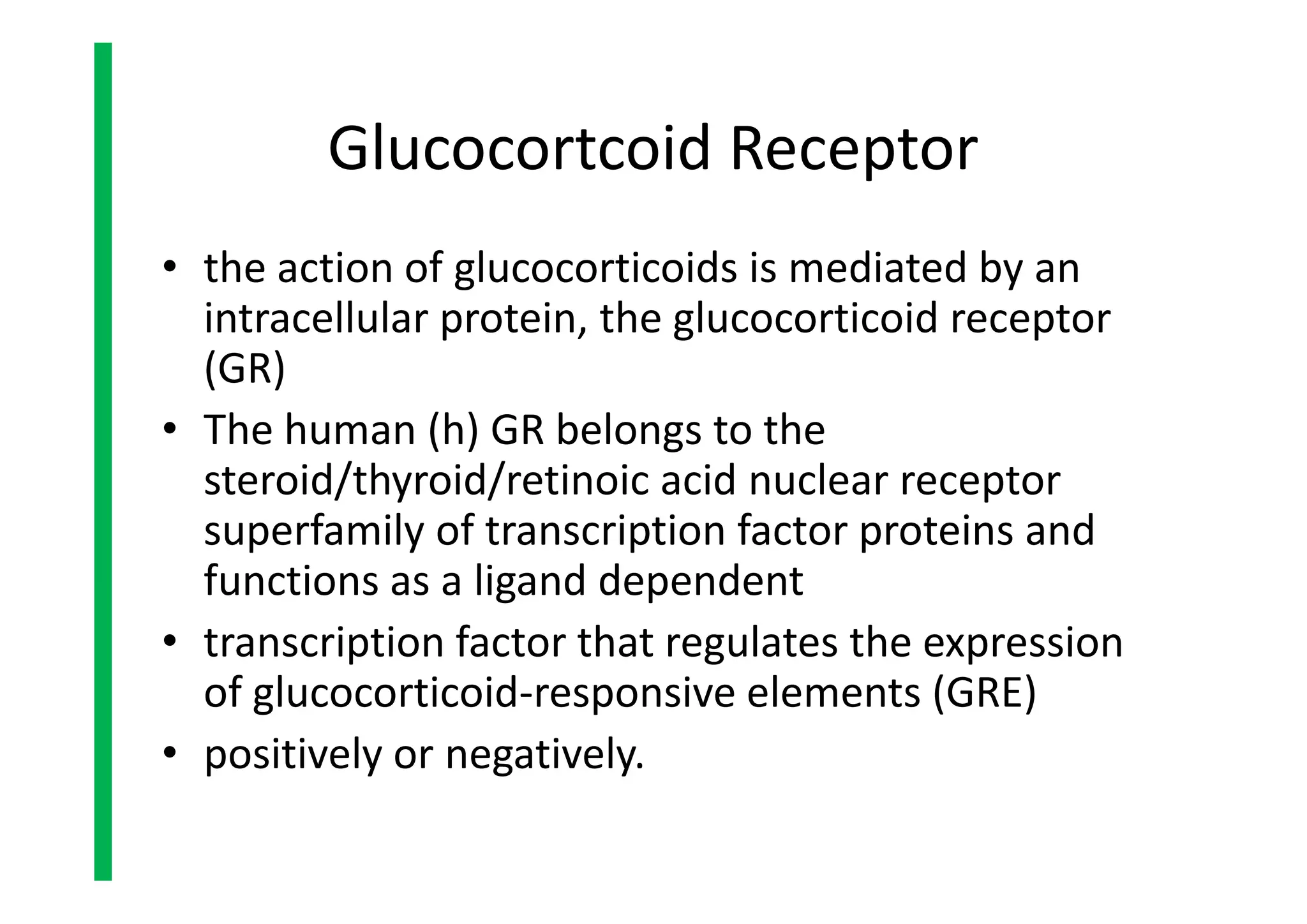
Glucocortcoid Receptor
• the action of glucocorticoids is mediated by an
intracellular protein, the glucocorticoid receptor
(GR)
• The human (h) GR belongs to the
steroid/thyroid/retinoic acid nuclear receptor
superfamily of transcription factor proteins and
functions as a ligand dependent
• transcription factor that regulates the expression
of glucocorticoid-responsive elements (GRE)
• positively or negatively.
• the action of glucocorticoids is mediated by an
intracellular protein, the glucocorticoid receptor
(GR)
• The human (h) GR belongs to the
steroid/thyroid/retinoic acid nuclear receptor
superfamily of transcription factor proteins and
functions as a ligand dependent
• transcription factor that regulates the expression
of glucocorticoid-responsive elements (GRE)
• positively or negatively.
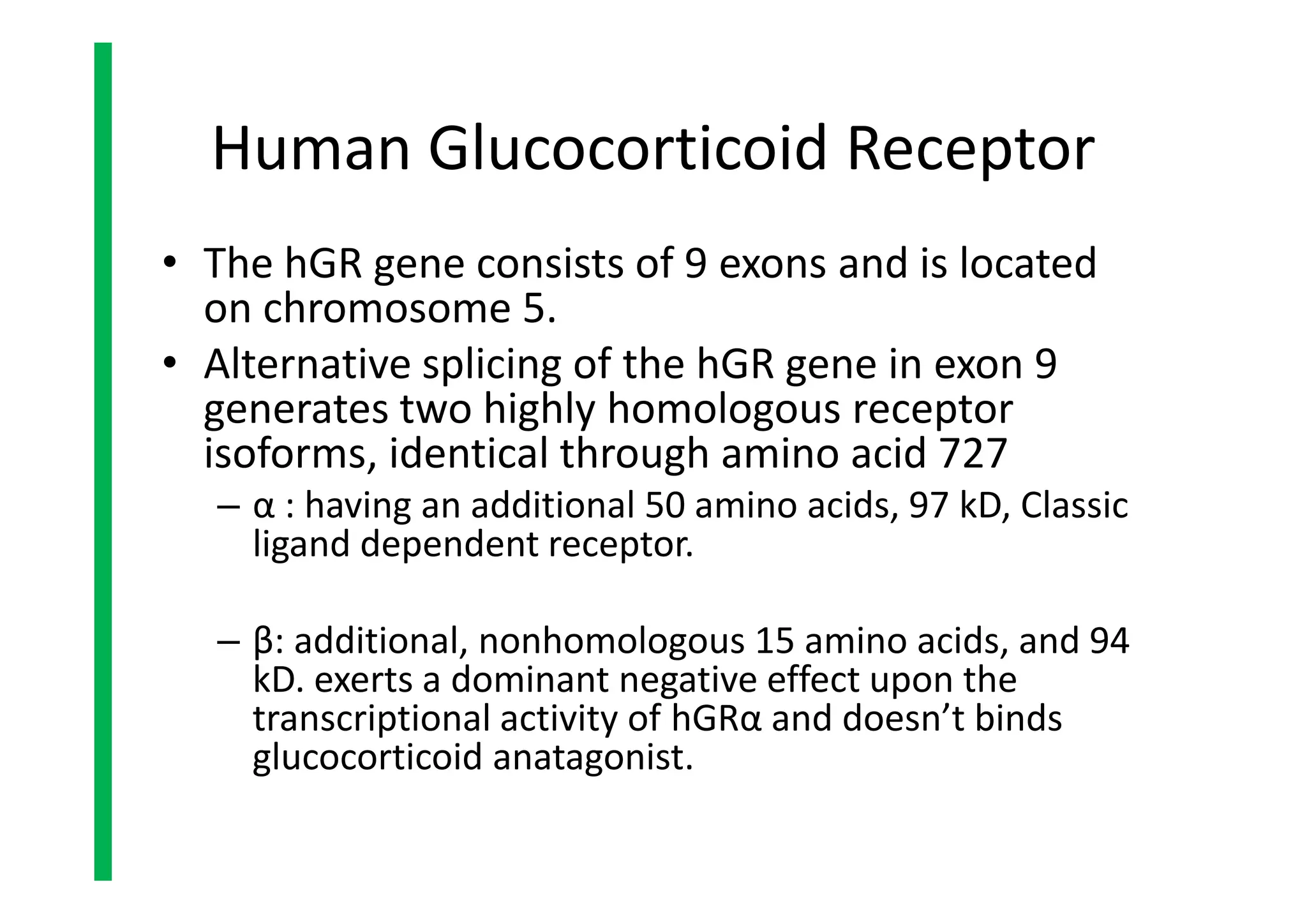
Human Glucocorticoid Receptor
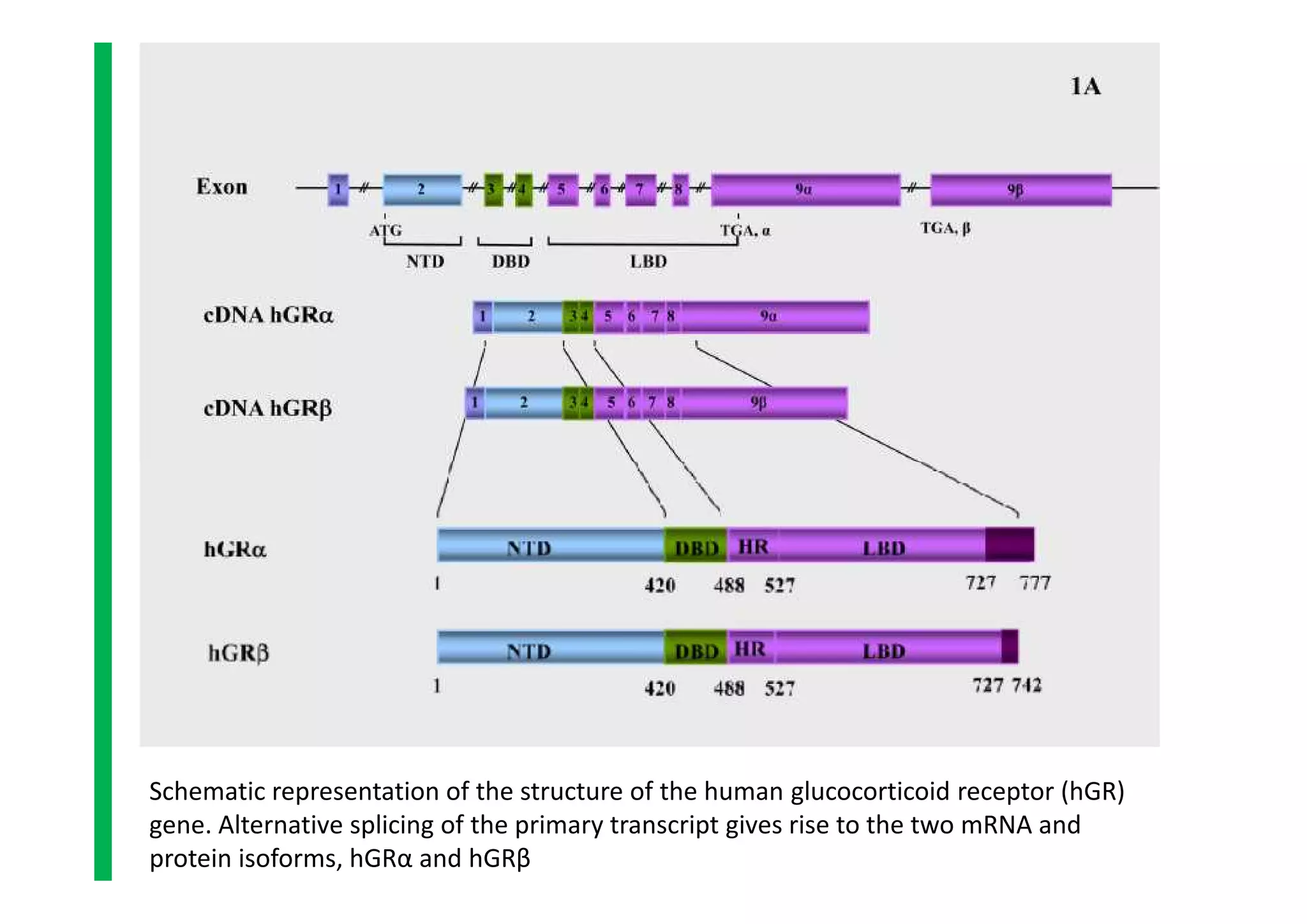
• The hGR gene consists of 9 exons and is located
on chromosome 5.
• Alternative splicing of the hGR gene in exon 9
generates two highly homologous receptor
isoforms, identical through amino acid 727
– α : having an additional 50 amino acids, 97 kD, Classic
ligand dependent receptor.
– β: additional, nonhomologous 15 amino acids, and 94
kD. exerts a dominant negative effect upon the
transcriptional activity of hGRα and doesn’t binds
glucocorticoid anatagonist.
• The hGR gene consists of 9 exons and is located
on chromosome 5.
• Alternative splicing of the hGR gene in exon 9
generates two highly homologous receptor
isoforms, identical through amino acid 727
– α : having an additional 50 amino acids, 97 kD, Classic
ligand dependent receptor.
– β: additional, nonhomologous 15 amino acids, and 94
kD. exerts a dominant negative effect upon the
transcriptional activity of hGRα and doesn’t binds
glucocorticoid anatagonist.
Schematic representation of the structure of the human glucocorticoid receptor (hGR)
gene. Alternative splicing of the primary transcript gives rise to the two mRNA and
protein isoforms, hGRα and hGRβ
NTD
• The N-terminal domain (NTD) of the hGRα contains a
major transactivation domain - activation function
(AF)-1, which is located between amino acids 77 and
262 of the hGRα and is ligand-independent.
• AF-1 plays an important role in the interaction of the
receptor with
– coactivators,
– Chromatin modulators
– basal transcription factors, including RNA polymerase II,
TATA-binding protein (TBP) and a host of TBP-associated
proteins (TAFIIs)
• The N-terminal domain (NTD) of the hGRα contains a
major transactivation domain - activation function
(AF)-1, which is located between amino acids 77 and
262 of the hGRα and is ligand-independent.
• AF-1 plays an important role in the interaction of the
receptor with
– coactivators,
– Chromatin modulators
– basal transcription factors, including RNA polymerase II,
TATA-binding protein (TBP) and a host of TBP-associated
proteins (TAFIIs)
DBD
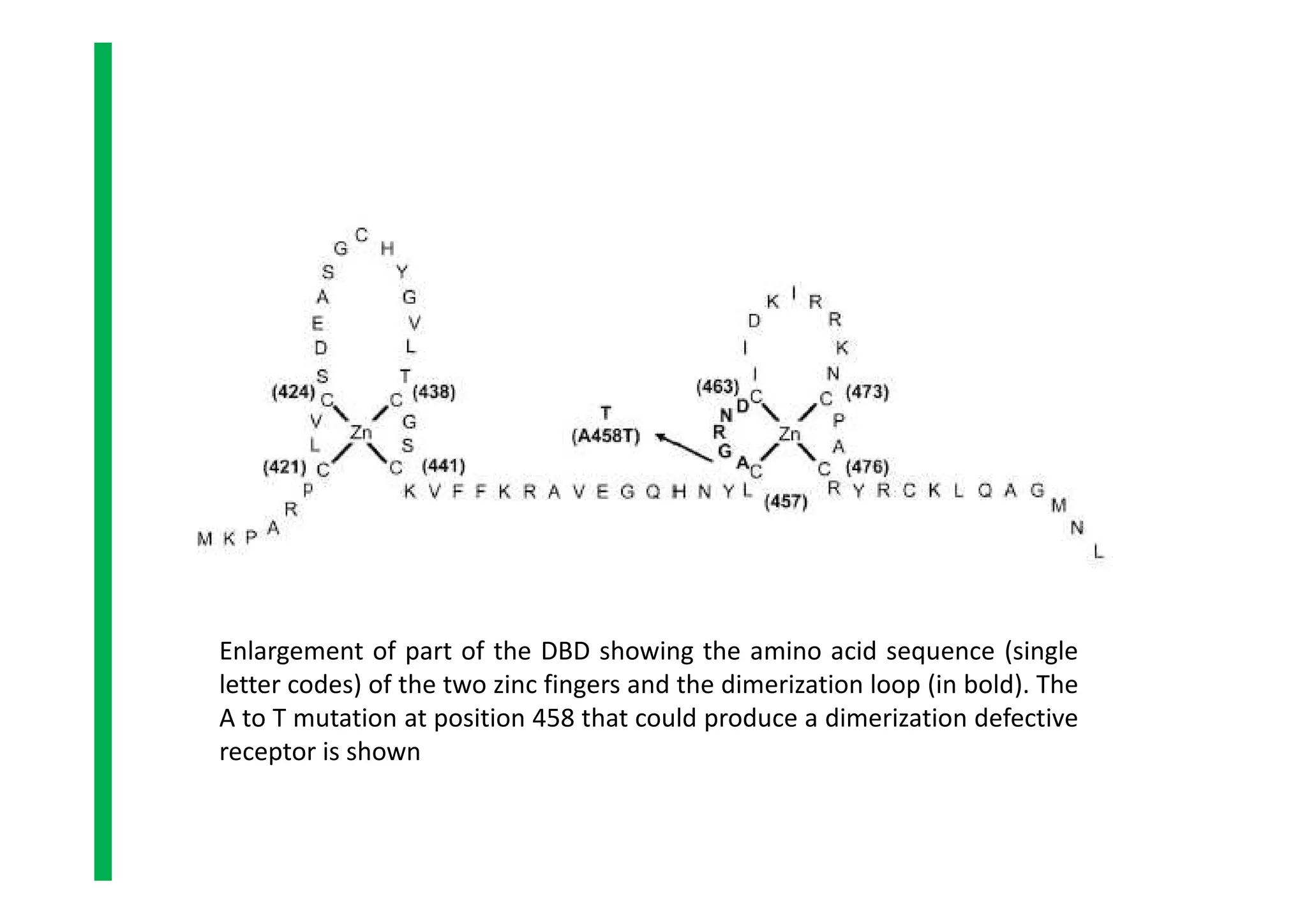
• The DNA-binding domain (DBD) of the hGRα - aa 420–
480
• two zinc finger motifs through which the hGRα binds
to GREs in the promoter region
• DBD is the most highly conserved
• The two zinc finger motifs are able to tetrahedrally
coordinate a Zn atom and are held by four Cys residues
• P Box : within the first zinc finger, responsible for
specific recognition of the cognate GREs
• D box : within 2nd zinc finger, forms the weak
dimerization interface of the DBD.
• contains sequences important for receptor
dimerization and nuclear translocation
• The DNA-binding domain (DBD) of the hGRα - aa 420–
480
• two zinc finger motifs through which the hGRα binds
to GREs in the promoter region
• DBD is the most highly conserved
• The two zinc finger motifs are able to tetrahedrally
coordinate a Zn atom and are held by four Cys residues
• P Box : within the first zinc finger, responsible for
specific recognition of the cognate GREs
• D box : within 2nd zinc finger, forms the weak
dimerization interface of the DBD.
• contains sequences important for receptor
dimerization and nuclear translocation
Enlargement of part of the DBD showing the amino acid sequence (single
letter codes) of the two zinc fingers and the dimerization loop (in bold). The
A to T mutation at position 458 that could produce a dimerization defective
receptor is shown
Hinge region D
• The hinge region or region D is a flexible
region between the DNA- and ligand-binding
domains.
• an integral part of the DBD and is involved in
its dimerization.
• The hinge region confers structural flexibility
in the receptor dimmers allowing a single
receptor dimmer to interact with multiple
GREs
• The hinge region or region D is a flexible
region between the DNA- and ligand-binding
domains.
• an integral part of the DBD and is involved in
its dimerization.
• The hinge region confers structural flexibility
in the receptor dimmers allowing a single
receptor dimmer to interact with multiple
GREs
Functional domains of the hGRα. The functional domains and subdomains are indicated
beneath the linearized protein structures. AF, activation function; DBD, DNAbinding
domain; LBD, ligand-binding domain; NLS, nuclear localization signal.
LBD
• The ligand-binding domain (LBD) of the hGRα
corresponds to aa 481–777
• binds to glucocorticoids & plays a critical role
in the ligand-induced activation of hGRα.
• a second transactivation domain, termed AF-
2, which is ligand-dependent, important for
receptor dimerization, nuclear translocation,
binding to HSP &interaction with coactivators
• The ligand-binding domain (LBD) of the hGRα
corresponds to aa 481–777
• binds to glucocorticoids & plays a critical role
in the ligand-induced activation of hGRα.
• a second transactivation domain, termed AF-
2, which is ligand-dependent, important for
receptor dimerization, nuclear translocation,
binding to HSP &interaction with coactivators
Crystal structure of the ligandbinding domain (LBD) of the human
glucocorticoid receptor-α (hGRα). Stereotactic conformation of the agonist
(left) and antagonist (right) form of the LBD of hGRα. The yellow arrows
indicate the position of Helix 12, which is critical for the formation of AF-2
surface that allows interaction with activators
Nucleocytoplasmic Shuttling of hGRα
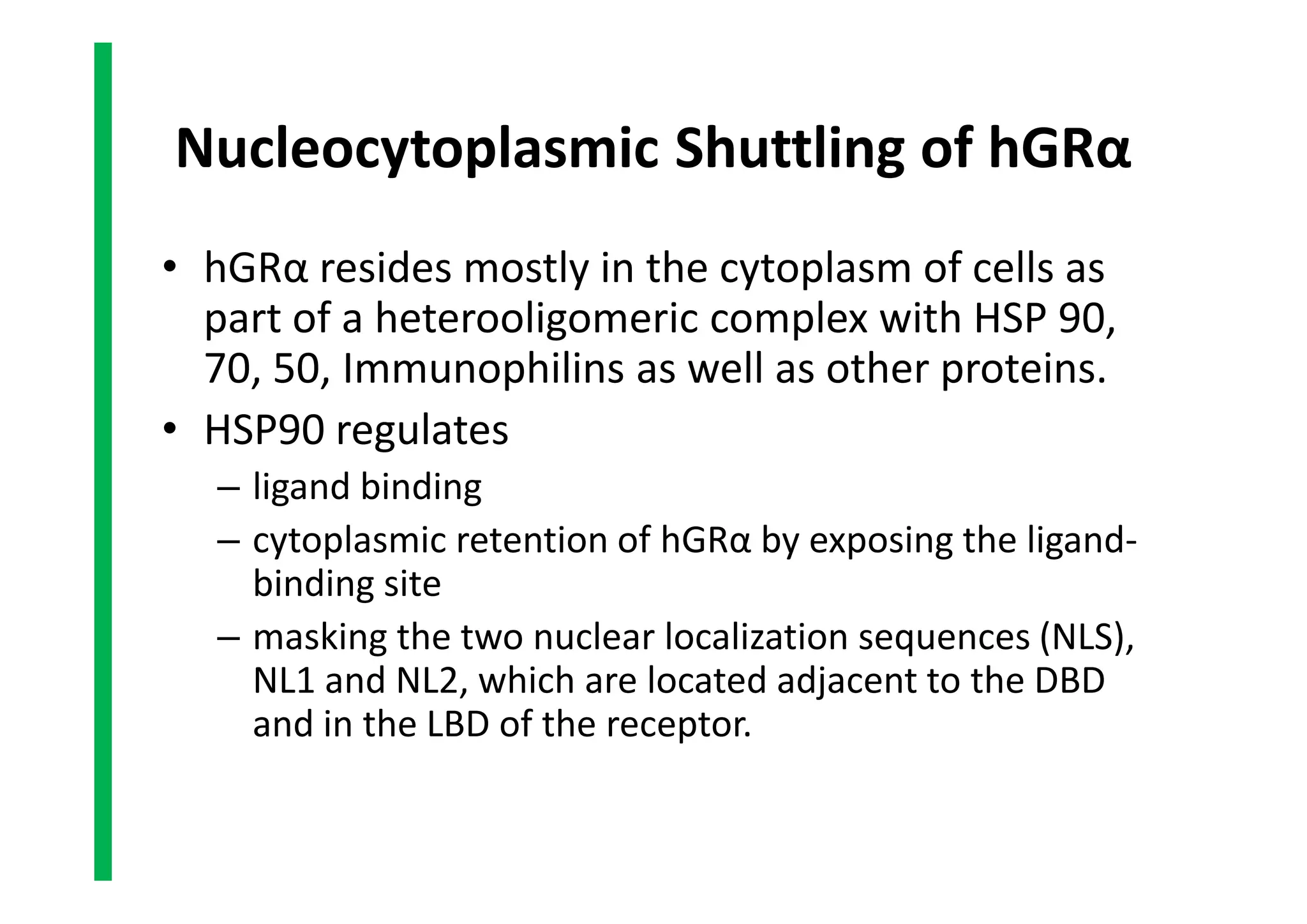
• hGRα resides mostly in the cytoplasm of cells as
part of a heterooligomeric complex with HSP 90,
70, 50, Immunophilins as well as other proteins.
• HSP90 regulates
– ligand binding
– cytoplasmic retention of hGRα by exposing the ligand-
binding site
– masking the two nuclear localization sequences (NLS),
NL1 and NL2, which are located adjacent to the DBD
and in the LBD of the receptor.
• hGRα resides mostly in the cytoplasm of cells as
part of a heterooligomeric complex with HSP 90,
70, 50, Immunophilins as well as other proteins.
• HSP90 regulates
– ligand binding
– cytoplasmic retention of hGRα by exposing the ligand-
binding site
– masking the two nuclear localization sequences (NLS),
NL1 and NL2, which are located adjacent to the DBD
and in the LBD of the receptor.
Nucleocytoplasmic Shuttling of hGRα
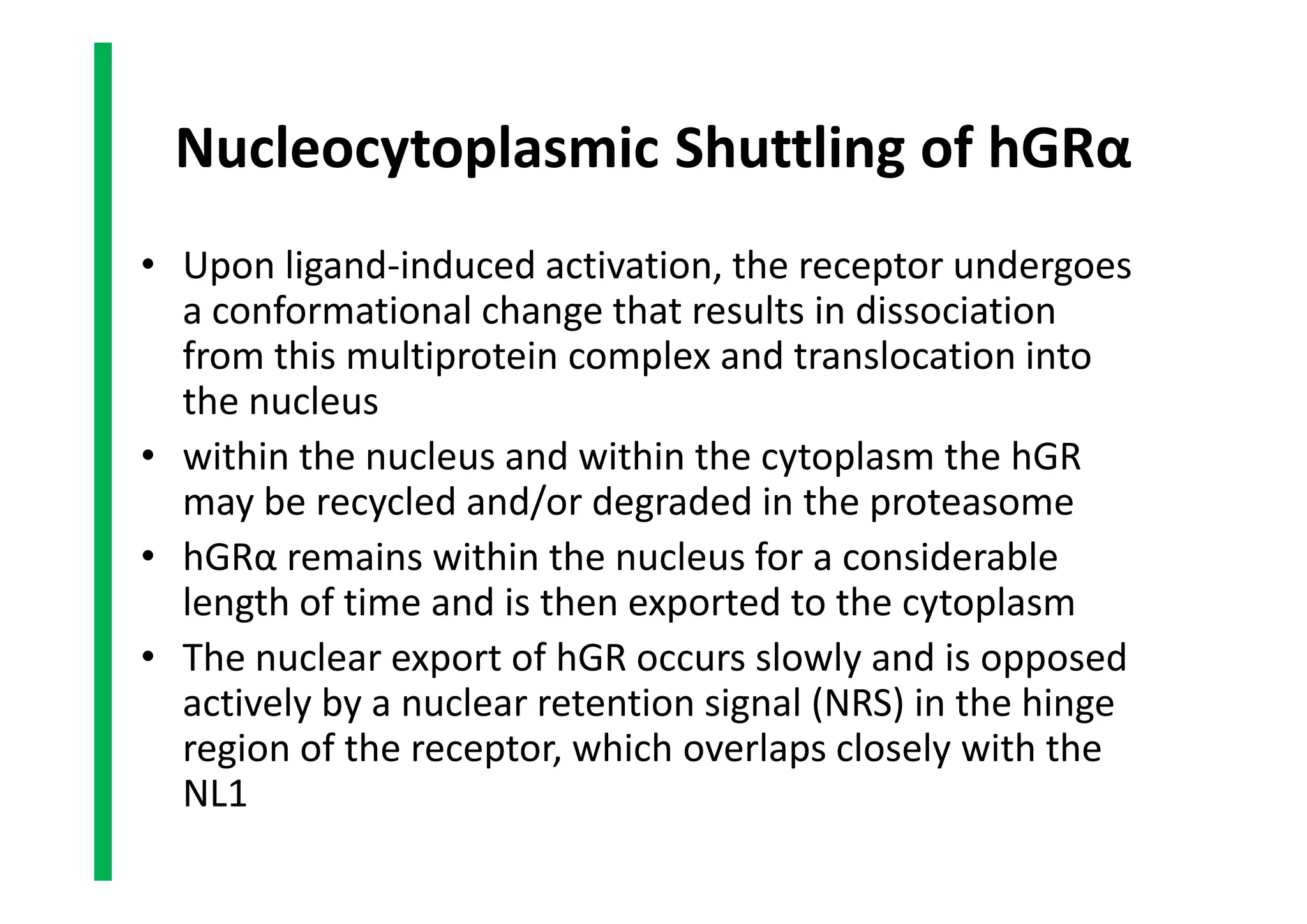
• Upon ligand-induced activation, the receptor undergoes
a conformational change that results in dissociation
from this multiprotein complex and translocation into
the nucleus
• within the nucleus and within the cytoplasm the hGR
may be recycled and/or degraded in the proteasome
• hGRα remains within the nucleus for a considerable
length of time and is then exported to the cytoplasm
• The nuclear export of hGR occurs slowly and is opposed
actively by a nuclear retention signal (NRS) in the hinge
region of the receptor, which overlaps closely with the
NL1
• Upon ligand-induced activation, the receptor undergoes
a conformational change that results in dissociation
from this multiprotein complex and translocation into
the nucleus
• within the nucleus and within the cytoplasm the hGR
may be recycled and/or degraded in the proteasome
• hGRα remains within the nucleus for a considerable
length of time and is then exported to the cytoplasm
• The nuclear export of hGR occurs slowly and is opposed
actively by a nuclear retention signal (NRS) in the hinge
region of the receptor, which overlaps closely with the
NL1
Nucleocytoplasmic shuttling of the glucocorticoid receptor. Upon binding to the
ligand, the activated hGRα dissociates from HSPs and translocates into the nucleus,
where it homodimerizes and binds to GREs in the promoter region of target genes
Mechanism of transcriptional
Activation
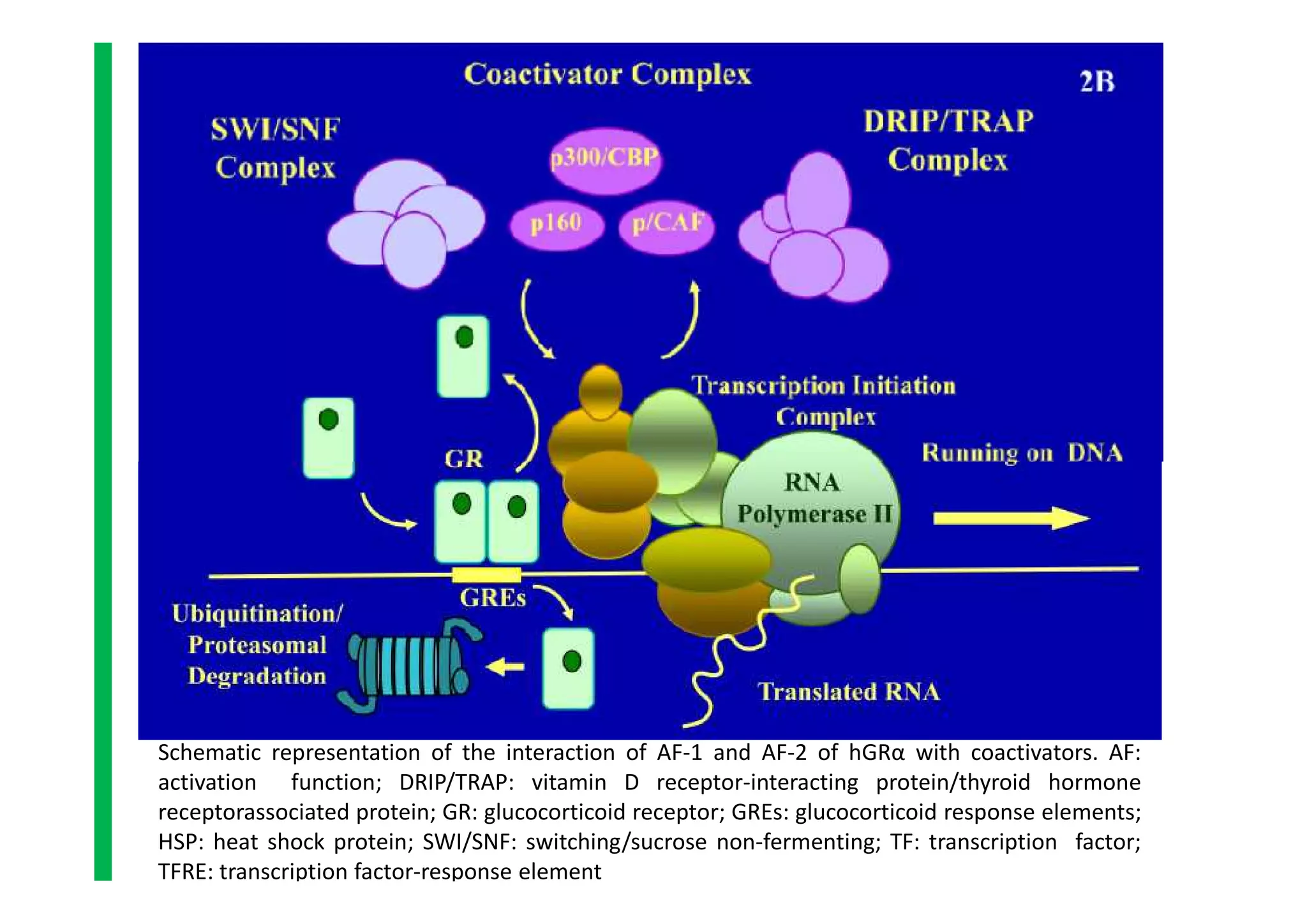
• hGRα uses its transcriptional activation domains,
AF-1 and AF-2
• Several coactivators form a bridge between the
DNA-bound hGRα and the transcription initiation
complex, and facilitate the transmission of the
glucocorticoid signal to the RNA pol II
• These include:
– CREB binding Proteins
– P300/CBP associated factors (p/CAF) which is
accumulated by p160 coactivators
• hGRα uses its transcriptional activation domains,
AF-1 and AF-2
• Several coactivators form a bridge between the
DNA-bound hGRα and the transcription initiation
complex, and facilitate the transmission of the
glucocorticoid signal to the RNA pol II
• These include:
– CREB binding Proteins
– P300/CBP associated factors (p/CAF) which is
accumulated by p160 coactivators
Mechanism of transcriptional
Activation
• p/CAF and p160 intrinsic histone
acetyltransferase (HAT) activity - promotes
chromatin decondensation, and allows the
transcription
• Other transactivation domains include
– switching/sucrose non-fermenting (SWI/ SNF)
complex
– components of the vitamin D receptor-interacting
protein/thyroid hormone receptor-associated protein
(DRIP/TRAP) complex
• p/CAF and p160 intrinsic histone
acetyltransferase (HAT) activity - promotes
chromatin decondensation, and allows the
transcription
• Other transactivation domains include
– switching/sucrose non-fermenting (SWI/ SNF)
complex
– components of the vitamin D receptor-interacting
protein/thyroid hormone receptor-associated protein
(DRIP/TRAP) complex
Schematic representation of the interaction of AF-1 and AF-2 of hGRα with coactivators. AF:
activation function; DRIP/TRAP: vitamin D receptor-interacting protein/thyroid hormone
receptorassociated protein; GR: glucocorticoid receptor; GREs: glucocorticoid response elements;
HSP: heat shock protein; SWI/SNF: switching/sucrose non-fermenting; TF: transcription factor;
TFRE: transcription factor-response element
Biological Effects
Embryonic Development
• Schutz and colleagues conducted genetic studies with GR
knockout mice.
• GR/ neonates die soon after birth due to respiratory failure
arising from impaired lung development, indicating the
important role of GR signaling in lung maturation
• profound alterations in the regulation of the liver, adrenal
gland, brain, and HPA axis were observed in GR/ mice.
• thymocytes become resistant to apoptosis in the absence
of GR
• the presence of a functional GR during gestation is essential
for postnatal survival as well as during development.
• Schutz and colleagues conducted genetic studies with GR
knockout mice.
• GR/ neonates die soon after birth due to respiratory failure
arising from impaired lung development, indicating the
important role of GR signaling in lung maturation
• profound alterations in the regulation of the liver, adrenal
gland, brain, and HPA axis were observed in GR/ mice.
• thymocytes become resistant to apoptosis in the absence
of GR
• the presence of a functional GR during gestation is essential
for postnatal survival as well as during development.
Biological Effects
Nervous System
• Elevation of glucocorticoids has been implicated in
psychiatric disorders such as schizophrenia, drug
addiction, post-traumatic stress disorder (PTSD), &
mood disorders
• GR in the forebrain has been shown to regulate the HPA
axis and behavior under stressed conditions, whereas in
the amygdala it has been shown to play an important
role in memory acquisition and fear conditioning.
• Several studies indicate that GR functions in the brain
correlate positively with anxiety behavior
– Tronche et al.- brain-specific deletion of the GR resulted in
mice with decreased anxiety and lower levels of despair like
behavior
• Elevation of glucocorticoids has been implicated in
psychiatric disorders such as schizophrenia, drug
addiction, post-traumatic stress disorder (PTSD), &
mood disorders
• GR in the forebrain has been shown to regulate the HPA
axis and behavior under stressed conditions, whereas in
the amygdala it has been shown to play an important
role in memory acquisition and fear conditioning.
• Several studies indicate that GR functions in the brain
correlate positively with anxiety behavior
– Tronche et al.- brain-specific deletion of the GR resulted in
mice with decreased anxiety and lower levels of despair like
behavior
Biological Effects
Visual System
• glucocorticoids in treating ocular
inflammation (e.g., conjunctivitis, keratitis,
uveitis), macular edema, and macular
degeneration
• used to inhibit neovascularization in the eye
that could lead to vision loss
• glucocorticoids confer protection on
photoreceptors in the retina by preventing
their apoptosis
• glucocorticoids in treating ocular
inflammation (e.g., conjunctivitis, keratitis,
uveitis), macular edema, and macular
degeneration
• used to inhibit neovascularization in the eye
that could lead to vision loss
• glucocorticoids confer protection on
photoreceptors in the retina by preventing
their apoptosis
• Increase blood glucose concentration
• Stimulate glycogen deposition by increasing glycogen
synthase and inhibiting glycogen phosphorylase
• Activates hepatic glucose 6- phosphate and PEPCK
• Peripheral tissue: inhibit glucose uptake and utilization
• Adipose tissue: Lipolysis is activated, HDL cholestrol
falls
• Imparts insulin resistance to cells and increase glucose
through its permissive actions on other hormones
Biological Effects
Carbohydrate, Protein and Lipid Metabolism
• Increase blood glucose concentration
• Stimulate glycogen deposition by increasing glycogen
synthase and inhibiting glycogen phosphorylase
• Activates hepatic glucose 6- phosphate and PEPCK
• Peripheral tissue: inhibit glucose uptake and utilization
• Adipose tissue: Lipolysis is activated, HDL cholestrol
falls
• Imparts insulin resistance to cells and increase glucose
through its permissive actions on other hormones
• used for treating cutaneous inflammatory
conditions : psoriasis and eczema
• adverse effects such as skin atrophy and
delayed wound healing
• Results from mice lacking GR in the skin
(GREKO) demonstrated that the physiological
role of the GR in the skin is to regulate
epithelial integrity and immune function
Biological Effects
Integumentary System
• used for treating cutaneous inflammatory
conditions : psoriasis and eczema
• adverse effects such as skin atrophy and
delayed wound healing
• Results from mice lacking GR in the skin
(GREKO) demonstrated that the physiological
role of the GR in the skin is to regulate
epithelial integrity and immune function
• ‘ gold standard ‘ for immune suppression in organ transplantation
patients
• exert their classic anti-inflammatory role by acting on nearly all cell
types of the immune system
• glucocorticoids suppress dendritic cell maturation and convert them
into tolerogenic dendritic cells that possess weak T cell-stimulating
activity
• Dendritic cell migration and apoptosis are also controlled by
glucocorticoids
• By contrast:
– GR has also been shown to enhance phagocytosis of neutrophils by
macrophages
– regulate positively NLRP3, a component of the inflammasome complex
in macrophages, to augment the proinflammatory response
– cooperate with the proinflammatory molecule TNFa to induce Toll-like
receptor 2 gene expression, thereby stimulating innate immunity
Biological Effects
Immune System
• ‘ gold standard ‘ for immune suppression in organ transplantation
patients
• exert their classic anti-inflammatory role by acting on nearly all cell
types of the immune system
• glucocorticoids suppress dendritic cell maturation and convert them
into tolerogenic dendritic cells that possess weak T cell-stimulating
activity
• Dendritic cell migration and apoptosis are also controlled by
glucocorticoids
• By contrast:
– GR has also been shown to enhance phagocytosis of neutrophils by
macrophages
– regulate positively NLRP3, a component of the inflammasome complex
in macrophages, to augment the proinflammatory response
– cooperate with the proinflammatory molecule TNFa to induce Toll-like
receptor 2 gene expression, thereby stimulating innate immunity
• Glucocorticoids suppress migration of these
neutrophils by repressing the expression of cell
adhesion molecules
• mice lacking GRs in T cells by gene-targeted
deletion displayed resistance to
glucocorticoid-induced apoptosis.
Biological Effects
Immune System
• Glucocorticoids suppress migration of these
neutrophils by repressing the expression of cell
adhesion molecules
• mice lacking GRs in T cells by gene-targeted
deletion displayed resistance to
glucocorticoid-induced apoptosis.
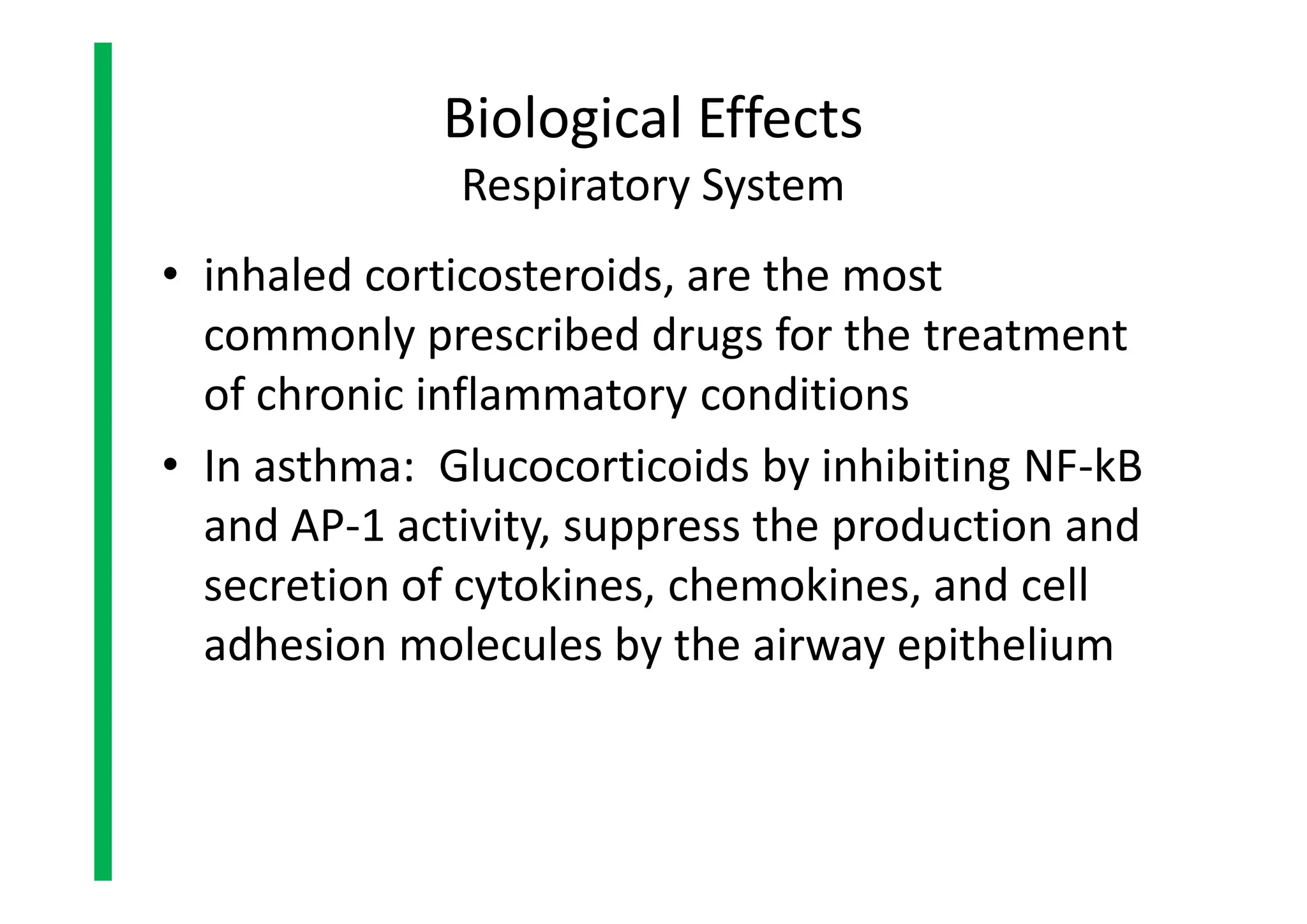
Classic anti-inflamatory response of Glucocorticoids
Melmed.S., Polonsky.S.K, Larsen.P.R., Kronenberg.H.M. ‘Williams Textbook of Endocrinology’(12th Edition), Elsevir Saunders 2011
• inhaled corticosteroids, are the most
commonly prescribed drugs for the treatment
of chronic inflammatory conditions
• In asthma: Glucocorticoids by inhibiting NF-kB
and AP-1 activity, suppress the production and
secretion of cytokines, chemokines, and cell
adhesion molecules by the airway epithelium
Biological Effects
Respiratory System
• inhaled corticosteroids, are the most
commonly prescribed drugs for the treatment
of chronic inflammatory conditions
• In asthma: Glucocorticoids by inhibiting NF-kB
and AP-1 activity, suppress the production and
secretion of cytokines, chemokines, and cell
adhesion molecules by the airway epithelium
• Glucocorticoids suppress thyroid axis on the
secretion of TSH
• Inhibit 5’ deiodinase activity that mediates the
conversiton of thyroxine to active
triidothyronine.
• Inhibit GnRH, LH and FSH
Biological Effects
Endocrine System
• Glucocorticoids suppress thyroid axis on the
secretion of TSH
• Inhibit 5’ deiodinase activity that mediates the
conversiton of thyroxine to active
triidothyronine.
• Inhibit GnRH, LH and FSH
• Inhibits osteoblast function which accounts for
osteopenia and osteoporosis in glucocorticoid excess.
• Inhibit Ca2+ absorption & increase renal Ca2+
excreation
• the gonads and adrenals share a common
adrenogonadal primordium
• Long explosure leads to infertility at the same time
controled explosure leads to fertility induction and
ovulation rate enhancement.
• There is an association between miscarriages and
polymorphism in NR3C1 suggesting the importance of
an intact functioning GR achieving a successful
pregnancy
Biological Effects
• Inhibits osteoblast function which accounts for
osteopenia and osteoporosis in glucocorticoid excess.
• Inhibit Ca2+ absorption & increase renal Ca2+
excreation
• the gonads and adrenals share a common
adrenogonadal primordium
• Long explosure leads to infertility at the same time
controled explosure leads to fertility induction and
ovulation rate enhancement.
• There is an association between miscarriages and
polymorphism in NR3C1 suggesting the importance of
an intact functioning GR achieving a successful
pregnancy
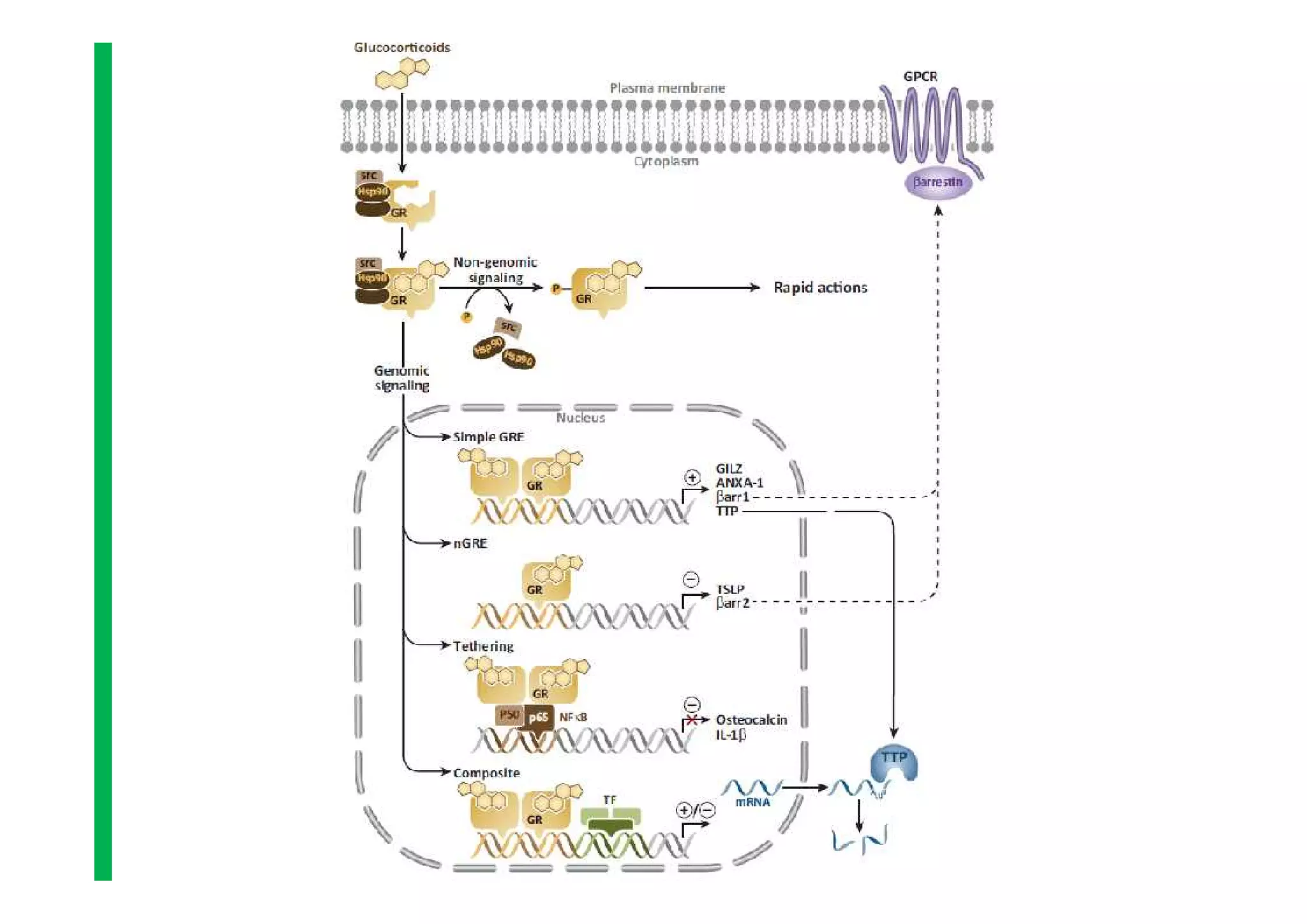
Biological Effects: Summary
Kadmiel.M, Cidlowski.A.J, ‘Glucocorticoid Receptor Signaling in Health and Disease’ (Review). Cell press, Trends in Pharmacological
Sciences September 2013, Vol. 34, No. 9
References
• Kadmiel.M, Cidlowski.A.J, ‘Glucocorticoid Receptor Signaling in Health and Disease’ (Review).
Cell press, Trends in Pharmacological Sciences September 2013, Vol. 34, No. 9
• Nicolaides.C.N, Galata.Z, Kino.T, X, Chrousos.P.G, & Charmandari.E, ‘The Human Glucocorticoid
Receptor: Molecular Basis of Biologic Function’, PMC 2010 January 30, Volume 75(1):1,
doi:10.1016/j.steroids.2009.09.002 ( National Institute of Health, Public Access, Author
Manuscript)
• Melmed.S., Polonsky.S.K, Larsen.P.R., Kronenberg.H.M. ‘Williams Textbook of
Endocrinology’(12th Edition), Elsevir Saunders 2011, p479-494
• Aron.C.D, Findling J.W, & Blake T.J,Edited by Garner.G.D. ‘Greenspan’s Basic & Clinical
Endocrinology,(8th Edition) ALANGE medical Book, The McGraw-Hill Companies, Inc., p346-378
• Gyton.C.A, Hall.E.J.‘Textbook of Medical Physiology’ (11th Edition), Elsevier Saunders 2006,
p944-955
• Tortora.J.Gerard, Derrickson.B, ‘Principles of Anatomy and Physiology’(13th Edition), John Wiley
& sons, Inc., p703-704
• Gottlicher M, Heck S, Herrlich P. ‘Transcriptional crosstalk, the second mode of steroid
hormone receptor action’. J Mol Med 1998;76:480–489. [PubMed: 9660166]
• Schule R, Rangarajan P, Kliewer S, Ransone LJ, Bolado J, Yang N, Verma IM, Evans RM.
‘Functional antagonism between oncoprotein c-Jun and the glucocorticoid receptor’. Cell
1990;62:1217–1226. [PubMed: 2169353]
• Jonat C, Rahmsdorf HJ, Park KK, Cato AC, Gebel S, Ponta H, Herrlich P. ‘Antitumor promotion
and anti inflammation: down-modulation of AP-1 (Fos/Jun) activity by glucocorticoid
hormone’. Cell 1990;62:1189–1204. [PubMed: 2169351]
• Kadmiel.M, Cidlowski.A.J, ‘Glucocorticoid Receptor Signaling in Health and Disease’ (Review).
Cell press, Trends in Pharmacological Sciences September 2013, Vol. 34, No. 9
• Nicolaides.C.N, Galata.Z, Kino.T, X, Chrousos.P.G, & Charmandari.E, ‘The Human Glucocorticoid
Receptor: Molecular Basis of Biologic Function’, PMC 2010 January 30, Volume 75(1):1,
doi:10.1016/j.steroids.2009.09.002 ( National Institute of Health, Public Access, Author
Manuscript)
• Melmed.S., Polonsky.S.K, Larsen.P.R., Kronenberg.H.M. ‘Williams Textbook of
Endocrinology’(12th Edition), Elsevir Saunders 2011, p479-494
• Aron.C.D, Findling J.W, & Blake T.J,Edited by Garner.G.D. ‘Greenspan’s Basic & Clinical
Endocrinology,(8th Edition) ALANGE medical Book, The McGraw-Hill Companies, Inc., p346-378
• Gyton.C.A, Hall.E.J.‘Textbook of Medical Physiology’ (11th Edition), Elsevier Saunders 2006,
p944-955
• Tortora.J.Gerard, Derrickson.B, ‘Principles of Anatomy and Physiology’(13th Edition), John Wiley
& sons, Inc., p703-704
• Gottlicher M, Heck S, Herrlich P. ‘Transcriptional crosstalk, the second mode of steroid
hormone receptor action’. J Mol Med 1998;76:480–489. [PubMed: 9660166]
• Schule R, Rangarajan P, Kliewer S, Ransone LJ, Bolado J, Yang N, Verma IM, Evans RM.
‘Functional antagonism between oncoprotein c-Jun and the glucocorticoid receptor’. Cell
1990;62:1217–1226. [PubMed: 2169353]
• Jonat C, Rahmsdorf HJ, Park KK, Cato AC, Gebel S, Ponta H, Herrlich P. ‘Antitumor promotion
and anti inflammation: down-modulation of AP-1 (Fos/Jun) activity by glucocorticoid
hormone’. Cell 1990;62:1189–1204. [PubMed: 2169351]
Thank youThank you

Glucocorticoids

  • 1.
    Glucocorticoids Synthesis | Receptor| Effects Glucocorticoids Synthesis | Receptor | Effects Arun Viswanathan IInd Sem, M.Sc.BMB
  • 2.
    Adrenal Glands • Thepaired one of which lies superior to each kidney in the retroperitoneal space • flattened pyramidal shape. • In an adult, each adrenal gland is 3–5 cm in height, 2–3 cm in width, and a little less than 1 cm • thick, with a mass of 3.5–5 g, only half its size at birth. • differentiate into two structurally and functionally distinct regions: a large, peripherally located adrenal cortex (80–90% of the gland) & a small, centrally located adrenal medulla • Complete loss of adrenocortical hormones leads to death due to dehydration and electrolyte imbalances in a few days. • The adrenal medulla produces three catecholamine hormones—norepinephrine, epinephrine, and a small amount of dopamine. • The paired one of which lies superior to each kidney in the retroperitoneal space • flattened pyramidal shape. • In an adult, each adrenal gland is 3–5 cm in height, 2–3 cm in width, and a little less than 1 cm • thick, with a mass of 3.5–5 g, only half its size at birth. • differentiate into two structurally and functionally distinct regions: a large, peripherally located adrenal cortex (80–90% of the gland) & a small, centrally located adrenal medulla • Complete loss of adrenocortical hormones leads to death due to dehydration and electrolyte imbalances in a few days. • The adrenal medulla produces three catecholamine hormones—norepinephrine, epinephrine, and a small amount of dopamine.
  • 3.
    Adrenal Glands Tortora.J.Gerard, Derrickson.B,‘Principles of Anatomy and Physiology’(13th Edition), John Wiley & sons, Inc.,
  • 4.
    Adrenal Cortex • subdividedinto 3 zones, each of which secretes different hormones • The outer zone - zona glomerulosa • Its cells, which are closely packed and arranged in spherical clusters and arched columns, secrete hormones called mineralocorticoids • The middle zone - zona fasciculata is the widest of the three zones and consists of cells arranged in long, straight columns. • secrete mainly glucocorticoids primarily cortisol • The cells of the inner zone - zona reticularis are arranged in branching cords. • They synthesize small amounts of weak androgens steroid hormones that have masculinizing effects. • subdivided into 3 zones, each of which secretes different hormones • The outer zone - zona glomerulosa • Its cells, which are closely packed and arranged in spherical clusters and arched columns, secrete hormones called mineralocorticoids • The middle zone - zona fasciculata is the widest of the three zones and consists of cells arranged in long, straight columns. • secrete mainly glucocorticoids primarily cortisol • The cells of the inner zone - zona reticularis are arranged in branching cords. • They synthesize small amounts of weak androgens steroid hormones that have masculinizing effects.
  • 5.
    Tortora.J.Gerard, Derrickson.B, ‘Principlesof Anatomy and Physiology’(13th Edition), John Wiley & sons, Inc.,
  • 6.
    Photomicrograph of theadrenal cortex (H&E stain). A: A low-power general view. I, the glomerulosa; II, the fasciculata; III, the reticularis. B: Electron micrograph of a normal adrenocortical steroid-producing cell (M, large mitochondria with tubular cristae; SER, smooth endoplasmic reticulum; L, lipid vacuole). Aron.C.D, Findling J.W, & Blake T.J,Edited by Garner.G.D. ‘Greenspan’s Basic & Clinical Endocrinology,(8th Edition) ALANGE medical Book, The McGraw-Hill Companies, Inc.
  • 7.
    Adrenal Steroidogenesis • Cholesterolis the precursor for adrenal steroidogenesis. • LDL Cholestrol is taken specific cell-surface LDL receptors mediated Endocytosis • the resulting vesicles fuse with lysozymes, & free cholesterol is produced after hydrolysis. • Cholesterol can be generated de novo within the adrenal cortex from acetyl coenzyme A (CoA). • adrenal can utilize HDL cholesterol after uptake through the putative HDL receptor, SR-B1 • Cholesterol is the precursor for adrenal steroidogenesis. • LDL Cholestrol is taken specific cell-surface LDL receptors mediated Endocytosis • the resulting vesicles fuse with lysozymes, & free cholesterol is produced after hydrolysis. • Cholesterol can be generated de novo within the adrenal cortex from acetyl coenzyme A (CoA). • adrenal can utilize HDL cholesterol after uptake through the putative HDL receptor, SR-B1
  • 8.
    Adrenal Steroidogenesis • thetransport of intracellular cholesterol from the outer to inner mt membrane for conversion to pregnenolone by cyt P450 side- chain cleavage enzyme (P450scc) is mediated by steroidogenic acute regulatory protein (StAR) • the transport of intracellular cholesterol from the outer to inner mt membrane for conversion to pregnenolone by cyt P450 side- chain cleavage enzyme (P450scc) is mediated by steroidogenic acute regulatory protein (StAR)
  • 9.
  • 10.
    Aron.C.D, Findling J.W,& Blake T.J,Edited by Garner.G.D. ‘Greenspan’s Basic & Clinical Endocrinology,(8th Edition) ALANGE medical Book, The McGraw-Hill Companies, Inc.,
  • 11.
    Glucocorticoid Secretion • ACTHis the principal hormone stimulating adrenal glucocorticoid biosynthesis and secretion. 39 aa but is synthesized within the anterior pituitary as larger, 241- aaprecursor called pro-opiomelanocortin (POMC). • ACTH bind to G protein coupled receptor melanocortin-2 (MC2R) assisted by Melanocortin-2 receptor accessory protein (MRAP). Signaling is done through cAMP and Ca2+ • ACTH induce steroidogenesis through StAR mediated and increase synthesis of all cyp enzymes • POMC secretion is regulated by CRH and AVP. • CRP secreted into hypophyseal portal system binds type 1 CRH receptors and stimulate POMC transcription • AVP effect CRH through a V1B receptor to activate Kinase C • ACTH is the principal hormone stimulating adrenal glucocorticoid biosynthesis and secretion. 39 aa but is synthesized within the anterior pituitary as larger, 241- aaprecursor called pro-opiomelanocortin (POMC). • ACTH bind to G protein coupled receptor melanocortin-2 (MC2R) assisted by Melanocortin-2 receptor accessory protein (MRAP). Signaling is done through cAMP and Ca2+ • ACTH induce steroidogenesis through StAR mediated and increase synthesis of all cyp enzymes • POMC secretion is regulated by CRH and AVP. • CRP secreted into hypophyseal portal system binds type 1 CRH receptors and stimulate POMC transcription • AVP effect CRH through a V1B receptor to activate Kinase C
  • 12.
    Glucocortcoid Receptor • theaction of glucocorticoids is mediated by an intracellular protein, the glucocorticoid receptor (GR) • The human (h) GR belongs to the steroid/thyroid/retinoic acid nuclear receptor superfamily of transcription factor proteins and functions as a ligand dependent • transcription factor that regulates the expression of glucocorticoid-responsive elements (GRE) • positively or negatively. • the action of glucocorticoids is mediated by an intracellular protein, the glucocorticoid receptor (GR) • The human (h) GR belongs to the steroid/thyroid/retinoic acid nuclear receptor superfamily of transcription factor proteins and functions as a ligand dependent • transcription factor that regulates the expression of glucocorticoid-responsive elements (GRE) • positively or negatively.
  • 13.
    Human Glucocorticoid Receptor •The hGR gene consists of 9 exons and is located on chromosome 5. • Alternative splicing of the hGR gene in exon 9 generates two highly homologous receptor isoforms, identical through amino acid 727 – α : having an additional 50 amino acids, 97 kD, Classic ligand dependent receptor. – β: additional, nonhomologous 15 amino acids, and 94 kD. exerts a dominant negative effect upon the transcriptional activity of hGRα and doesn’t binds glucocorticoid anatagonist. • The hGR gene consists of 9 exons and is located on chromosome 5. • Alternative splicing of the hGR gene in exon 9 generates two highly homologous receptor isoforms, identical through amino acid 727 – α : having an additional 50 amino acids, 97 kD, Classic ligand dependent receptor. – β: additional, nonhomologous 15 amino acids, and 94 kD. exerts a dominant negative effect upon the transcriptional activity of hGRα and doesn’t binds glucocorticoid anatagonist.
  • 14.
    Schematic representation ofthe structure of the human glucocorticoid receptor (hGR) gene. Alternative splicing of the primary transcript gives rise to the two mRNA and protein isoforms, hGRα and hGRβ
  • 16.
    NTD • The N-terminaldomain (NTD) of the hGRα contains a major transactivation domain - activation function (AF)-1, which is located between amino acids 77 and 262 of the hGRα and is ligand-independent. • AF-1 plays an important role in the interaction of the receptor with – coactivators, – Chromatin modulators – basal transcription factors, including RNA polymerase II, TATA-binding protein (TBP) and a host of TBP-associated proteins (TAFIIs) • The N-terminal domain (NTD) of the hGRα contains a major transactivation domain - activation function (AF)-1, which is located between amino acids 77 and 262 of the hGRα and is ligand-independent. • AF-1 plays an important role in the interaction of the receptor with – coactivators, – Chromatin modulators – basal transcription factors, including RNA polymerase II, TATA-binding protein (TBP) and a host of TBP-associated proteins (TAFIIs)
  • 17.
    DBD • The DNA-bindingdomain (DBD) of the hGRα - aa 420– 480 • two zinc finger motifs through which the hGRα binds to GREs in the promoter region • DBD is the most highly conserved • The two zinc finger motifs are able to tetrahedrally coordinate a Zn atom and are held by four Cys residues • P Box : within the first zinc finger, responsible for specific recognition of the cognate GREs • D box : within 2nd zinc finger, forms the weak dimerization interface of the DBD. • contains sequences important for receptor dimerization and nuclear translocation • The DNA-binding domain (DBD) of the hGRα - aa 420– 480 • two zinc finger motifs through which the hGRα binds to GREs in the promoter region • DBD is the most highly conserved • The two zinc finger motifs are able to tetrahedrally coordinate a Zn atom and are held by four Cys residues • P Box : within the first zinc finger, responsible for specific recognition of the cognate GREs • D box : within 2nd zinc finger, forms the weak dimerization interface of the DBD. • contains sequences important for receptor dimerization and nuclear translocation
  • 18.
    Enlargement of partof the DBD showing the amino acid sequence (single letter codes) of the two zinc fingers and the dimerization loop (in bold). The A to T mutation at position 458 that could produce a dimerization defective receptor is shown
  • 19.
    Hinge region D •The hinge region or region D is a flexible region between the DNA- and ligand-binding domains. • an integral part of the DBD and is involved in its dimerization. • The hinge region confers structural flexibility in the receptor dimmers allowing a single receptor dimmer to interact with multiple GREs • The hinge region or region D is a flexible region between the DNA- and ligand-binding domains. • an integral part of the DBD and is involved in its dimerization. • The hinge region confers structural flexibility in the receptor dimmers allowing a single receptor dimmer to interact with multiple GREs
  • 20.
    Functional domains ofthe hGRα. The functional domains and subdomains are indicated beneath the linearized protein structures. AF, activation function; DBD, DNAbinding domain; LBD, ligand-binding domain; NLS, nuclear localization signal.
  • 21.
    LBD • The ligand-bindingdomain (LBD) of the hGRα corresponds to aa 481–777 • binds to glucocorticoids & plays a critical role in the ligand-induced activation of hGRα. • a second transactivation domain, termed AF- 2, which is ligand-dependent, important for receptor dimerization, nuclear translocation, binding to HSP &interaction with coactivators • The ligand-binding domain (LBD) of the hGRα corresponds to aa 481–777 • binds to glucocorticoids & plays a critical role in the ligand-induced activation of hGRα. • a second transactivation domain, termed AF- 2, which is ligand-dependent, important for receptor dimerization, nuclear translocation, binding to HSP &interaction with coactivators
  • 22.
    Crystal structure ofthe ligandbinding domain (LBD) of the human glucocorticoid receptor-α (hGRα). Stereotactic conformation of the agonist (left) and antagonist (right) form of the LBD of hGRα. The yellow arrows indicate the position of Helix 12, which is critical for the formation of AF-2 surface that allows interaction with activators
  • 23.
    Nucleocytoplasmic Shuttling ofhGRα • hGRα resides mostly in the cytoplasm of cells as part of a heterooligomeric complex with HSP 90, 70, 50, Immunophilins as well as other proteins. • HSP90 regulates – ligand binding – cytoplasmic retention of hGRα by exposing the ligand- binding site – masking the two nuclear localization sequences (NLS), NL1 and NL2, which are located adjacent to the DBD and in the LBD of the receptor. • hGRα resides mostly in the cytoplasm of cells as part of a heterooligomeric complex with HSP 90, 70, 50, Immunophilins as well as other proteins. • HSP90 regulates – ligand binding – cytoplasmic retention of hGRα by exposing the ligand- binding site – masking the two nuclear localization sequences (NLS), NL1 and NL2, which are located adjacent to the DBD and in the LBD of the receptor.
  • 24.
    Nucleocytoplasmic Shuttling ofhGRα • Upon ligand-induced activation, the receptor undergoes a conformational change that results in dissociation from this multiprotein complex and translocation into the nucleus • within the nucleus and within the cytoplasm the hGR may be recycled and/or degraded in the proteasome • hGRα remains within the nucleus for a considerable length of time and is then exported to the cytoplasm • The nuclear export of hGR occurs slowly and is opposed actively by a nuclear retention signal (NRS) in the hinge region of the receptor, which overlaps closely with the NL1 • Upon ligand-induced activation, the receptor undergoes a conformational change that results in dissociation from this multiprotein complex and translocation into the nucleus • within the nucleus and within the cytoplasm the hGR may be recycled and/or degraded in the proteasome • hGRα remains within the nucleus for a considerable length of time and is then exported to the cytoplasm • The nuclear export of hGR occurs slowly and is opposed actively by a nuclear retention signal (NRS) in the hinge region of the receptor, which overlaps closely with the NL1
  • 25.
    Nucleocytoplasmic shuttling ofthe glucocorticoid receptor. Upon binding to the ligand, the activated hGRα dissociates from HSPs and translocates into the nucleus, where it homodimerizes and binds to GREs in the promoter region of target genes
  • 26.
    Mechanism of transcriptional Activation •hGRα uses its transcriptional activation domains, AF-1 and AF-2 • Several coactivators form a bridge between the DNA-bound hGRα and the transcription initiation complex, and facilitate the transmission of the glucocorticoid signal to the RNA pol II • These include: – CREB binding Proteins – P300/CBP associated factors (p/CAF) which is accumulated by p160 coactivators • hGRα uses its transcriptional activation domains, AF-1 and AF-2 • Several coactivators form a bridge between the DNA-bound hGRα and the transcription initiation complex, and facilitate the transmission of the glucocorticoid signal to the RNA pol II • These include: – CREB binding Proteins – P300/CBP associated factors (p/CAF) which is accumulated by p160 coactivators
  • 27.
    Mechanism of transcriptional Activation •p/CAF and p160 intrinsic histone acetyltransferase (HAT) activity - promotes chromatin decondensation, and allows the transcription • Other transactivation domains include – switching/sucrose non-fermenting (SWI/ SNF) complex – components of the vitamin D receptor-interacting protein/thyroid hormone receptor-associated protein (DRIP/TRAP) complex • p/CAF and p160 intrinsic histone acetyltransferase (HAT) activity - promotes chromatin decondensation, and allows the transcription • Other transactivation domains include – switching/sucrose non-fermenting (SWI/ SNF) complex – components of the vitamin D receptor-interacting protein/thyroid hormone receptor-associated protein (DRIP/TRAP) complex
  • 28.
    Schematic representation ofthe interaction of AF-1 and AF-2 of hGRα with coactivators. AF: activation function; DRIP/TRAP: vitamin D receptor-interacting protein/thyroid hormone receptorassociated protein; GR: glucocorticoid receptor; GREs: glucocorticoid response elements; HSP: heat shock protein; SWI/SNF: switching/sucrose non-fermenting; TF: transcription factor; TFRE: transcription factor-response element
  • 30.
    Biological Effects Embryonic Development •Schutz and colleagues conducted genetic studies with GR knockout mice. • GR/ neonates die soon after birth due to respiratory failure arising from impaired lung development, indicating the important role of GR signaling in lung maturation • profound alterations in the regulation of the liver, adrenal gland, brain, and HPA axis were observed in GR/ mice. • thymocytes become resistant to apoptosis in the absence of GR • the presence of a functional GR during gestation is essential for postnatal survival as well as during development. • Schutz and colleagues conducted genetic studies with GR knockout mice. • GR/ neonates die soon after birth due to respiratory failure arising from impaired lung development, indicating the important role of GR signaling in lung maturation • profound alterations in the regulation of the liver, adrenal gland, brain, and HPA axis were observed in GR/ mice. • thymocytes become resistant to apoptosis in the absence of GR • the presence of a functional GR during gestation is essential for postnatal survival as well as during development.
  • 31.
    Biological Effects Nervous System •Elevation of glucocorticoids has been implicated in psychiatric disorders such as schizophrenia, drug addiction, post-traumatic stress disorder (PTSD), & mood disorders • GR in the forebrain has been shown to regulate the HPA axis and behavior under stressed conditions, whereas in the amygdala it has been shown to play an important role in memory acquisition and fear conditioning. • Several studies indicate that GR functions in the brain correlate positively with anxiety behavior – Tronche et al.- brain-specific deletion of the GR resulted in mice with decreased anxiety and lower levels of despair like behavior • Elevation of glucocorticoids has been implicated in psychiatric disorders such as schizophrenia, drug addiction, post-traumatic stress disorder (PTSD), & mood disorders • GR in the forebrain has been shown to regulate the HPA axis and behavior under stressed conditions, whereas in the amygdala it has been shown to play an important role in memory acquisition and fear conditioning. • Several studies indicate that GR functions in the brain correlate positively with anxiety behavior – Tronche et al.- brain-specific deletion of the GR resulted in mice with decreased anxiety and lower levels of despair like behavior
  • 32.
    Biological Effects Visual System •glucocorticoids in treating ocular inflammation (e.g., conjunctivitis, keratitis, uveitis), macular edema, and macular degeneration • used to inhibit neovascularization in the eye that could lead to vision loss • glucocorticoids confer protection on photoreceptors in the retina by preventing their apoptosis • glucocorticoids in treating ocular inflammation (e.g., conjunctivitis, keratitis, uveitis), macular edema, and macular degeneration • used to inhibit neovascularization in the eye that could lead to vision loss • glucocorticoids confer protection on photoreceptors in the retina by preventing their apoptosis
  • 33.
    • Increase bloodglucose concentration • Stimulate glycogen deposition by increasing glycogen synthase and inhibiting glycogen phosphorylase • Activates hepatic glucose 6- phosphate and PEPCK • Peripheral tissue: inhibit glucose uptake and utilization • Adipose tissue: Lipolysis is activated, HDL cholestrol falls • Imparts insulin resistance to cells and increase glucose through its permissive actions on other hormones Biological Effects Carbohydrate, Protein and Lipid Metabolism • Increase blood glucose concentration • Stimulate glycogen deposition by increasing glycogen synthase and inhibiting glycogen phosphorylase • Activates hepatic glucose 6- phosphate and PEPCK • Peripheral tissue: inhibit glucose uptake and utilization • Adipose tissue: Lipolysis is activated, HDL cholestrol falls • Imparts insulin resistance to cells and increase glucose through its permissive actions on other hormones
  • 34.
    • used fortreating cutaneous inflammatory conditions : psoriasis and eczema • adverse effects such as skin atrophy and delayed wound healing • Results from mice lacking GR in the skin (GREKO) demonstrated that the physiological role of the GR in the skin is to regulate epithelial integrity and immune function Biological Effects Integumentary System • used for treating cutaneous inflammatory conditions : psoriasis and eczema • adverse effects such as skin atrophy and delayed wound healing • Results from mice lacking GR in the skin (GREKO) demonstrated that the physiological role of the GR in the skin is to regulate epithelial integrity and immune function
  • 35.
    • ‘ goldstandard ‘ for immune suppression in organ transplantation patients • exert their classic anti-inflammatory role by acting on nearly all cell types of the immune system • glucocorticoids suppress dendritic cell maturation and convert them into tolerogenic dendritic cells that possess weak T cell-stimulating activity • Dendritic cell migration and apoptosis are also controlled by glucocorticoids • By contrast: – GR has also been shown to enhance phagocytosis of neutrophils by macrophages – regulate positively NLRP3, a component of the inflammasome complex in macrophages, to augment the proinflammatory response – cooperate with the proinflammatory molecule TNFa to induce Toll-like receptor 2 gene expression, thereby stimulating innate immunity Biological Effects Immune System • ‘ gold standard ‘ for immune suppression in organ transplantation patients • exert their classic anti-inflammatory role by acting on nearly all cell types of the immune system • glucocorticoids suppress dendritic cell maturation and convert them into tolerogenic dendritic cells that possess weak T cell-stimulating activity • Dendritic cell migration and apoptosis are also controlled by glucocorticoids • By contrast: – GR has also been shown to enhance phagocytosis of neutrophils by macrophages – regulate positively NLRP3, a component of the inflammasome complex in macrophages, to augment the proinflammatory response – cooperate with the proinflammatory molecule TNFa to induce Toll-like receptor 2 gene expression, thereby stimulating innate immunity
  • 36.
    • Glucocorticoids suppressmigration of these neutrophils by repressing the expression of cell adhesion molecules • mice lacking GRs in T cells by gene-targeted deletion displayed resistance to glucocorticoid-induced apoptosis. Biological Effects Immune System • Glucocorticoids suppress migration of these neutrophils by repressing the expression of cell adhesion molecules • mice lacking GRs in T cells by gene-targeted deletion displayed resistance to glucocorticoid-induced apoptosis.
  • 37.
    Classic anti-inflamatory responseof Glucocorticoids Melmed.S., Polonsky.S.K, Larsen.P.R., Kronenberg.H.M. ‘Williams Textbook of Endocrinology’(12th Edition), Elsevir Saunders 2011
  • 38.
    • inhaled corticosteroids,are the most commonly prescribed drugs for the treatment of chronic inflammatory conditions • In asthma: Glucocorticoids by inhibiting NF-kB and AP-1 activity, suppress the production and secretion of cytokines, chemokines, and cell adhesion molecules by the airway epithelium Biological Effects Respiratory System • inhaled corticosteroids, are the most commonly prescribed drugs for the treatment of chronic inflammatory conditions • In asthma: Glucocorticoids by inhibiting NF-kB and AP-1 activity, suppress the production and secretion of cytokines, chemokines, and cell adhesion molecules by the airway epithelium
  • 39.
    • Glucocorticoids suppressthyroid axis on the secretion of TSH • Inhibit 5’ deiodinase activity that mediates the conversiton of thyroxine to active triidothyronine. • Inhibit GnRH, LH and FSH Biological Effects Endocrine System • Glucocorticoids suppress thyroid axis on the secretion of TSH • Inhibit 5’ deiodinase activity that mediates the conversiton of thyroxine to active triidothyronine. • Inhibit GnRH, LH and FSH
  • 40.
    • Inhibits osteoblastfunction which accounts for osteopenia and osteoporosis in glucocorticoid excess. • Inhibit Ca2+ absorption & increase renal Ca2+ excreation • the gonads and adrenals share a common adrenogonadal primordium • Long explosure leads to infertility at the same time controled explosure leads to fertility induction and ovulation rate enhancement. • There is an association between miscarriages and polymorphism in NR3C1 suggesting the importance of an intact functioning GR achieving a successful pregnancy Biological Effects • Inhibits osteoblast function which accounts for osteopenia and osteoporosis in glucocorticoid excess. • Inhibit Ca2+ absorption & increase renal Ca2+ excreation • the gonads and adrenals share a common adrenogonadal primordium • Long explosure leads to infertility at the same time controled explosure leads to fertility induction and ovulation rate enhancement. • There is an association between miscarriages and polymorphism in NR3C1 suggesting the importance of an intact functioning GR achieving a successful pregnancy
  • 41.
    Biological Effects: Summary Kadmiel.M,Cidlowski.A.J, ‘Glucocorticoid Receptor Signaling in Health and Disease’ (Review). Cell press, Trends in Pharmacological Sciences September 2013, Vol. 34, No. 9
  • 42.
    References • Kadmiel.M, Cidlowski.A.J,‘Glucocorticoid Receptor Signaling in Health and Disease’ (Review). Cell press, Trends in Pharmacological Sciences September 2013, Vol. 34, No. 9 • Nicolaides.C.N, Galata.Z, Kino.T, X, Chrousos.P.G, & Charmandari.E, ‘The Human Glucocorticoid Receptor: Molecular Basis of Biologic Function’, PMC 2010 January 30, Volume 75(1):1, doi:10.1016/j.steroids.2009.09.002 ( National Institute of Health, Public Access, Author Manuscript) • Melmed.S., Polonsky.S.K, Larsen.P.R., Kronenberg.H.M. ‘Williams Textbook of Endocrinology’(12th Edition), Elsevir Saunders 2011, p479-494 • Aron.C.D, Findling J.W, & Blake T.J,Edited by Garner.G.D. ‘Greenspan’s Basic & Clinical Endocrinology,(8th Edition) ALANGE medical Book, The McGraw-Hill Companies, Inc., p346-378 • Gyton.C.A, Hall.E.J.‘Textbook of Medical Physiology’ (11th Edition), Elsevier Saunders 2006, p944-955 • Tortora.J.Gerard, Derrickson.B, ‘Principles of Anatomy and Physiology’(13th Edition), John Wiley & sons, Inc., p703-704 • Gottlicher M, Heck S, Herrlich P. ‘Transcriptional crosstalk, the second mode of steroid hormone receptor action’. J Mol Med 1998;76:480–489. [PubMed: 9660166] • Schule R, Rangarajan P, Kliewer S, Ransone LJ, Bolado J, Yang N, Verma IM, Evans RM. ‘Functional antagonism between oncoprotein c-Jun and the glucocorticoid receptor’. Cell 1990;62:1217–1226. [PubMed: 2169353] • Jonat C, Rahmsdorf HJ, Park KK, Cato AC, Gebel S, Ponta H, Herrlich P. ‘Antitumor promotion and anti inflammation: down-modulation of AP-1 (Fos/Jun) activity by glucocorticoid hormone’. Cell 1990;62:1189–1204. [PubMed: 2169351] • Kadmiel.M, Cidlowski.A.J, ‘Glucocorticoid Receptor Signaling in Health and Disease’ (Review). Cell press, Trends in Pharmacological Sciences September 2013, Vol. 34, No. 9 • Nicolaides.C.N, Galata.Z, Kino.T, X, Chrousos.P.G, & Charmandari.E, ‘The Human Glucocorticoid Receptor: Molecular Basis of Biologic Function’, PMC 2010 January 30, Volume 75(1):1, doi:10.1016/j.steroids.2009.09.002 ( National Institute of Health, Public Access, Author Manuscript) • Melmed.S., Polonsky.S.K, Larsen.P.R., Kronenberg.H.M. ‘Williams Textbook of Endocrinology’(12th Edition), Elsevir Saunders 2011, p479-494 • Aron.C.D, Findling J.W, & Blake T.J,Edited by Garner.G.D. ‘Greenspan’s Basic & Clinical Endocrinology,(8th Edition) ALANGE medical Book, The McGraw-Hill Companies, Inc., p346-378 • Gyton.C.A, Hall.E.J.‘Textbook of Medical Physiology’ (11th Edition), Elsevier Saunders 2006, p944-955 • Tortora.J.Gerard, Derrickson.B, ‘Principles of Anatomy and Physiology’(13th Edition), John Wiley & sons, Inc., p703-704 • Gottlicher M, Heck S, Herrlich P. ‘Transcriptional crosstalk, the second mode of steroid hormone receptor action’. J Mol Med 1998;76:480–489. [PubMed: 9660166] • Schule R, Rangarajan P, Kliewer S, Ransone LJ, Bolado J, Yang N, Verma IM, Evans RM. ‘Functional antagonism between oncoprotein c-Jun and the glucocorticoid receptor’. Cell 1990;62:1217–1226. [PubMed: 2169353] • Jonat C, Rahmsdorf HJ, Park KK, Cato AC, Gebel S, Ponta H, Herrlich P. ‘Antitumor promotion and anti inflammation: down-modulation of AP-1 (Fos/Jun) activity by glucocorticoid hormone’. Cell 1990;62:1189–1204. [PubMed: 2169351]
  • 43.