SLBS ENGINEERING COLLEGE
WELL STIMULATION
Submitted by
BHAVESH KUMAR
14ESLPE007
Submitted to
Dr. R.K. BAWA
(ACADEMIC DIRECTOR)
DEPT. OF PETROLEUM ENGINEERING
CONTENTS
INTRODUCTION
TYPES
ACIDIZING
MATRIX ACIDIZING
FRACTURE ACIDIZING
HYDRAULIC FRACTURING
2
INTRODUCTION
• Well stimulation is a well intervention performed
on an oil or gas well to increase production by
improving the flow of hydrocarbons from
the drainage area into the well bore.
• Well stimulation technique used for extending
the perforation tunnels and fractures.
3
WELL STIMULATION
TYPES OF WELL STIMULATION TECHNIQUE
1) Acidizing
2) Hydraulic fracturing
4
ACIDIZING
• Acidizing also termed as Acid Stimulation.
• Acid stimulation refers to using reactive acids
to increase permeability in wells.
• It dissolves various acid-soluble solids
naturally present in the rock matrix or as
formation damage.
5
6
ACIDIZING
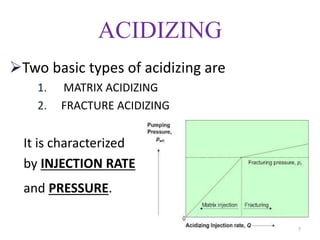
Two basic types of acidizing are
1. MATRIX ACIDIZING
2. FRACTURE ACIDIZING
It is characterized
by INJECTION RATE
and PRESSURE.
7
ACIDIZING
 MATRIX ACIDIZING
• In Matrix acidizing acid is pumped into the
formation below the fracture pressure.
• It removes acid-soluble damage.
• This method is used for both sandstone and
carbonate formation
8
MATRIX ACIDIZING
9
ACIDIZING
 FRACTURE ACIDIZING
• In Fracture acidizing acid is pumped into the
wellbore, above the fracturing pressure of
reservoir rock.
• It creates long and open channels.
• It is usually carried out on carbonate
reservoirs, which have lower permeability
than sandstone
10
ACIDIZING
 ACIDS USED IN ACIDIZING
• Hydrochloric acid (HCL)
• Acetic acid (CH3COOH)
• Formic acid (HCOOH)
• Hydrofluoric acid (HF)
• Mud acid (HCL-HF)
• Sulfamic acid (NH2SO3H)
11
ACIDIZING
 Acid additives
• Surfactant
• Corrosion inhibitor
• Anti-sludge agent
• Suspending agent
12
Hydraulic fracturing
• Hydraulic fracturing is usually termed as
fracking and hydrofracturing.
• This stimulation method have two major steps
1. Create crack in rock formation using acid
2. Proppant injection
13
Hydraulic fracturing
• The objective of hydraulic fracturing is to
increase well productivity by creating a highly
conductive path.
• In Hydraulic fracturing rock is fractured by a
pressurized liquid, the conductivity is
maintained by propping with sand to hold
the fracture faces apart.
14
15
Hydraulic fracturing
Composition of fracture fluid
• Water
• Proppant
• Gelling agent (guar gum)
• Foaming agent
• Compressed gases (N2 ,CO2, air)
• Corrosion inhibitors
16
HYDRAULIC FRACTURING
STAGES
1. SPEARHEAD STAGE
2. PAD STAGE
3. PROPPANT STAGE
4. FLUSH STAGE
17
• SPEARHEAD STAGE- Mixing water with
acid, used to clear debris and create path way.
• PAD STAGE- Inject fluid before proppant to
break the formation.
• PROPPANT STAGE- Injection of water and
sand and remains in formation.
• FLUSH STAGE- At last fresh water is
pumped into wellbore.
18
Hydraulic fracturing
Proppant
• The proppant is a granular material that
prevents the created fractures from closing
after the fracturing treatment.
• Types of proppant
1. Silica sand
2. Resin-coated sand
3. Bauxite
4. Ceramics
19
20
21
22

Well Stimulation

  • 1.
    SLBS ENGINEERING COLLEGE WELLSTIMULATION Submitted by BHAVESH KUMAR 14ESLPE007 Submitted to Dr. R.K. BAWA (ACADEMIC DIRECTOR) DEPT. OF PETROLEUM ENGINEERING
  • 2.
  • 3.
    INTRODUCTION • Well stimulationis a well intervention performed on an oil or gas well to increase production by improving the flow of hydrocarbons from the drainage area into the well bore. • Well stimulation technique used for extending the perforation tunnels and fractures. 3
  • 4.
    WELL STIMULATION TYPES OFWELL STIMULATION TECHNIQUE 1) Acidizing 2) Hydraulic fracturing 4
  • 5.
    ACIDIZING • Acidizing alsotermed as Acid Stimulation. • Acid stimulation refers to using reactive acids to increase permeability in wells. • It dissolves various acid-soluble solids naturally present in the rock matrix or as formation damage. 5
  • 6.
  • 7.
    ACIDIZING Two basic typesof acidizing are 1. MATRIX ACIDIZING 2. FRACTURE ACIDIZING It is characterized by INJECTION RATE and PRESSURE. 7
  • 8.
    ACIDIZING  MATRIX ACIDIZING •In Matrix acidizing acid is pumped into the formation below the fracture pressure. • It removes acid-soluble damage. • This method is used for both sandstone and carbonate formation 8
  • 9.
  • 10.
    ACIDIZING  FRACTURE ACIDIZING •In Fracture acidizing acid is pumped into the wellbore, above the fracturing pressure of reservoir rock. • It creates long and open channels. • It is usually carried out on carbonate reservoirs, which have lower permeability than sandstone 10
  • 11.
    ACIDIZING  ACIDS USEDIN ACIDIZING • Hydrochloric acid (HCL) • Acetic acid (CH3COOH) • Formic acid (HCOOH) • Hydrofluoric acid (HF) • Mud acid (HCL-HF) • Sulfamic acid (NH2SO3H) 11
  • 12.
    ACIDIZING  Acid additives •Surfactant • Corrosion inhibitor • Anti-sludge agent • Suspending agent 12
  • 13.
    Hydraulic fracturing • Hydraulicfracturing is usually termed as fracking and hydrofracturing. • This stimulation method have two major steps 1. Create crack in rock formation using acid 2. Proppant injection 13
  • 14.
    Hydraulic fracturing • Theobjective of hydraulic fracturing is to increase well productivity by creating a highly conductive path. • In Hydraulic fracturing rock is fractured by a pressurized liquid, the conductivity is maintained by propping with sand to hold the fracture faces apart. 14
  • 15.
  • 16.
    Hydraulic fracturing Composition offracture fluid • Water • Proppant • Gelling agent (guar gum) • Foaming agent • Compressed gases (N2 ,CO2, air) • Corrosion inhibitors 16
  • 17.
    HYDRAULIC FRACTURING STAGES 1. SPEARHEADSTAGE 2. PAD STAGE 3. PROPPANT STAGE 4. FLUSH STAGE 17
  • 18.
    • SPEARHEAD STAGE-Mixing water with acid, used to clear debris and create path way. • PAD STAGE- Inject fluid before proppant to break the formation. • PROPPANT STAGE- Injection of water and sand and remains in formation. • FLUSH STAGE- At last fresh water is pumped into wellbore. 18
  • 19.
    Hydraulic fracturing Proppant • Theproppant is a granular material that prevents the created fractures from closing after the fracturing treatment. • Types of proppant 1. Silica sand 2. Resin-coated sand 3. Bauxite 4. Ceramics 19
  • 20.
  • 21.
  • 22.

Editor's Notes

  • #9 Fracture pressure means specific pressure at which formation start to fracture (injection pressure >= formation pressure) Pore pressure